By Nick Carter
Coco Gauff has been talked about for nearly four years, ever since she burst onto the scene at the 2019 Wimbledon Championships at age 15 (!). She has been discussed as a big star of the future, however now there are increasing doubts over whether she will obtain that stardom.
To be clear, Gauff has had an incredible career so far and one most players would struggle to reach by age 29 – let alone 19. She is a major finalist in singles and doubles, has reached the second week at least once at every major, has won 3 WTA 250 titles in singles, 2 WTA 1000 titles in doubles, has reached the top ten in singles and is the youngest ever player to be ranked world number one in doubles. If that wasn’t enough, she’s won matches against major champions Naomi Osaka, Jelena Ostapenko, Elena Rybakina, Petra Kvitová and Aryna Sabalenka (twice) as well as against former world number one Karolina Pliskova and her childhood hero, the all-time great Venus Williams (twice again). And she is still a teenager! Against her peers in the top ten, she has a decent record apart from against Iga Świątek, against whom she just lost at Roland Garros for the second consecutive year.
And yet, despite all this, the response to Gauff’s tennis is usually along the lines of “that’s great, but will she win a grand slam?” Tennis is a sport obsessed with the four biggest prizes in singles, to the point where any other achievement can be seen as insignificant. Daniil Medvedev was lauded for his Rome title, then promptly lost at Roland-Garros and it ceased to mean much. Clay season over. Anything less than regularly contending for majors, and winning them, is viewed by many fans as not good enough (which if you take a step back is actually crazy given how good all these professionals are).
Coco Gauff, on paper, is following in the path of so many great players before her. Most players who make second weeks of majors as teenagers eventually win at least one. Some quickly become enveloped in greatness (like Serena and Venus Williams), some take a bit longer (like Caroline Wozniacki) but there is a minority that don’t quite get there (like Eugenie Bouchard or Anna Kournikova).
Something that a lot of commentators have picked up on is the tendency for Gauff’s forehand to break down when put under pressure. It is something players have noticed too, with Paula Badosa saying as much to Talking Tennis after she beat Gauff in Madrid. What the exact issue is with the forehand is up for some debate, with some critiquing Gauff’s extreme grip, some looking at the swing and others suggesting that her footwork isn’t sufficiently setting up the stroke. Regardless of why, the shot itself produces a lot of topspin but can lack pace and depth, sometimes to a startling degree given the polished nature of the rest of her game. The biggest problem with the forehand is that it can be rushed by an opponent and generate errors. Gauff said during Roland-Garros that she regards her forehand as a weapon. She is right in that she can use it to dictate points, move opponents around and even hit winners. Though the shot can lack pace, she has the ability to strike with it and hit winners. However, this is provided she is not rushed when attempting the stroke.
Gauff’s base level is clearly Top 20, but her ceiling is yet to be discovered. Not many can name a match where she has shown herself at full capability. Two examples where she performed well for very different reasons were her match against Yulia Putintseva in Rome this year and against Zhang Shuai in New York last year (2022). The Putintseva match is an interesting case, as Gauff dominated a match against someone she has historically had intense battles with. The American was incredibly aggressive from both sides, stepping into the court, attacking well and pushing her opponent back. Yet there was a lot of tactical savvy in there too: Gauff tossed in delicate drop shots after forcing Putintseva beyond the baseline instead of just bashing away. Gauff wasn’t rushed much and she could deploy her weapons, which the slow clay of Rome and Roland-Garros enables.
The Zhang match was an example of Gauff really grinding out a win. Zhang was playing well, being a break up in both sets but eventually the crowd favourite Gauff came through 7-5, 7-5. Gauff wasn’t fully aggressive all the way through, but when she turned it on she was brutal from both wings. The points she turned up the intensity on were usually big ones, when there was a real opportunity to impact the match. She was able to rally with Zhang until she elicited an error. However, the aspect of Gauff’s game the match highlights most is her fighting spirit. She never backed down – if anything, she maintained or increased her focus and fed off the crowd’s cheers. This mentality and general solidity to her game enabled her to turn defense into attack. Her speed around the court is also unbelievable, which boosts her confidence; she’s never out of a point.
The strength and solidity of Gauff’s game is what has got her so far up the rankings so soon in her career, and gives her an advantage over the rest of the field. She is still in the top 10 in the 2023 race at the halfway point of the season. Her breakout run at Wimbledon in 2019 is noteworthy for two reasons in addition to her age at the time: her win over Venus Williams and her win over Polona Hercog. The former was a comprehensive win over her hero, a great champion of the sport. The latter was a win that was ground out, snatched from the jaws of defeat. Gauff rarely gives up on matches, unless she’s a set and two breaks down. It is this fighting spirit that will endure within her for her whole career, and will elevate any evolutions her game goes through.
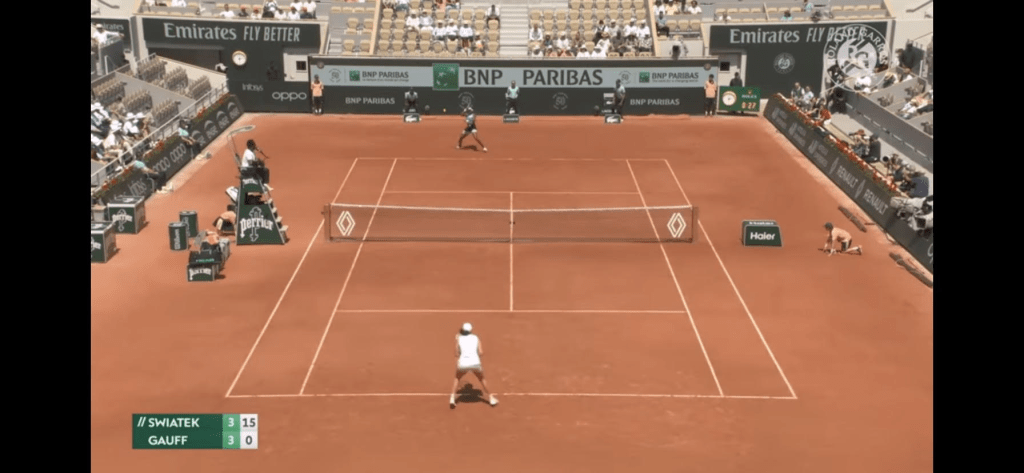
We saw some progress against Świątek in the Roland Garros quarter-finals. Gauff pushed her Polish rival for a set and a half, trying to change up tactics. However, it might just be that she is playing a similar player with a much better forehand. Both are great movers and returners, so it all comes down to weaponry. Very few players have a defense against the Świątek forehand offence. If Gauff can improve her own weaponry, her best chance to eventually get a win against the (for now) world number one is to make an aggressive pattern of play work.
Every player’s game has evolved. Świątek is clearly making marginal but meaningful gains with her serve. Aryna Sabalenka (who was a whisker away from making the Roland-Garros final before Karolina Muchova made a savage comeback) has reinvented her service motion at age 24. It will take time, but Gauff can make her forehand less of a liability under pressure. Świątek has the best forehand in the sport right now, and even then it is liable to break down when rushed (though in a way that overhits rather than complete lack of control as with Gauff). She has just found a way to better protect it from breaking down, or working points to her advantage sooner. Yet, while Świątek and Gauff’s forehands might seem worlds apart, they are both based around an extreme grip and generating heavy topspin (though Iga is able to flatten it if she needs to). Rather than a reinvention, Gauff perhaps needs to evolve and develop her stroke.
A conversation around Gauff’s weaknesses is valid, but we have not seen her ceiling yet. There has not been a match where she has comprehensively outplayed an opponent having a good day, nor has there been a match where she’s played her best and still lost. She’s established an ability to grind out wins however she’s playing, and that’s what champions do. Champions also evolve their games, doing what is necessary to get them to the top and then keep them there. There is no reason to doubt that this (still) very young player is capable of doing the same.
 Popcorn Tennis
Action Packed summary of action packed games- Ace reporting
LikeLike