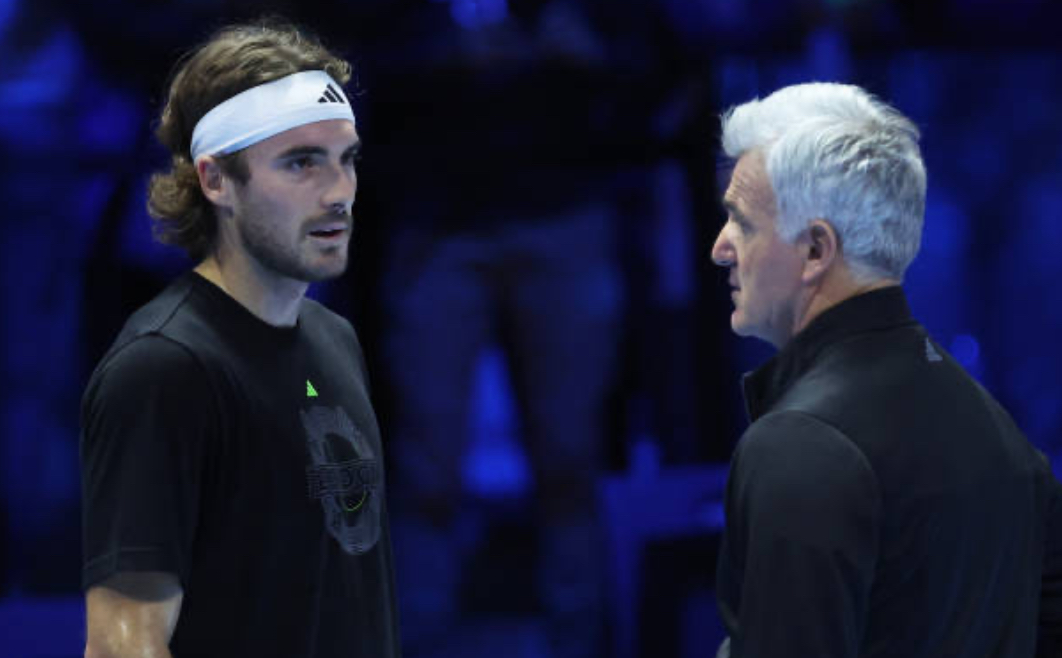
56 days.
That is how long it took for the player-coach collaboration of Stefanos Tsitsipas and Goran Ivanisevic to live and die. Within that time, 3 matches were played. One was won, two were lost. One of those losses was a third-set walkover due to injury. Wimbledon saw Tsitsipas hampered by his back, withdrawing from his first-round match having dropped the opening two sets. The scale of the task in front of Ivanisevic seemed to reveal itself in the form of rehab, reflection and planning. It was an unfortunate blip on a road that had barely been trodden but with time, it felt like the potential was still there. It just needed a little breathing room. Instead, it suffocated on the spot.
In the months prior, Tsitsipas had been struggling, his form wayward. A title in Dubai had served as a stopgap between consistent alarm bells. It was at that tournament that he changed his racket, going from his usual Wilson to a blacked-out Babolat that seemed to immediately positively impact his game. This was exciting! Changing rackets is one of those big-small things, a very personal decision not to be taken lightly. For a player of familial habit like Tsitsipas, stepping out of his comfort zone to try something new and seeing results was huge. Watching him lift the trophy come finals day felt like the planting of seeds of promise, an investment for an immediate future that desperately required something leafy and fresh.
A month or so on, Tsitsipas would change back to his Wilson racket citing issues adapting to the clay surface he was now playing on. He wanted something he felt he could trust and the Wilson was there to embrace him with fond memories of Monte-Carlo wins and French Open finals. A risk had been taken for a little while but now normality could resume.
Normality bled through his results, a loss in the second round of the French Open ending an underwhelming clay season highlighted only by a handful of quarterfinal appearances at lesser tournaments. This run would push Tsitsipas out of the top 20 in the ATP rankings. He found himself looking up at a top 10 he’d once felt at home in. Now, it appeared outgrown and scary-looking, tangled with younger generational talents and those willing to keep trying to usurp them with different strategies. It would be harsh to say that at this point, it felt like Tsitsipas had given up, but at 26, his game was outdated. His backhand, a glaring weakness, left him at the mercy of his peers that had him all worked out. In short, he went where they pushed him. This surely must have had Tsitsipas nostalgic for those meaningful days that weren’t even that far gone; the quarterfinals of the French Open 2024 close enough to touch, the finals of the Australian Open the year prior still visible in the rearview mirror. Nothing about him had changed and that was a problem that was now directly impacting his career.
Hiring Ivanisevic felt like a moment that Tsitsipas fans had been begging for, a simple sign that he was willing to switch things up in the face of downturn in fortunes that could surely still be reversed with the right actions. Whether Ivanisevic held all the answers wouldn’t necessarily matter if Tsitsipas could, in some small conceivable way, draw on the experience of working with him to develop a willingness to experiment. Ivanisevic was in the box when Marin Cilic won his sole major title at the US Open 2014 and was similarly influential in helping Novak Djokovic surpass Rafael Nadal for the major title record. Should he find a way to make Tsitsipas’s tennis feel relevant again, it would be some of his very finest work.
In the span of a few short weeks, Tsitsipas dropped further in the rankings, outside the top 25. His professional life took hold of its personal counterpart and dragged it down with it, his relationship with Spanish player Paula Badosa coming to an end. It didn’t help that both suffered first round Wimbledon losses, leading to tabloid headlines that took great pleasure in broadcasting the unwelcome coincidence. A small but vocal band of Tsitsipas’s critics had needlessly circled Badosa as being a core distraction behind his struggles on the court. At Wimbledon, the truth revealed itself to them; he was losing regardless of her presence in his life.
Difficulties are so frequently emboldened by the birth of more of them. Many found it hard to sympathise with Tsitsipas before this run of form due to his philosophical outlooks that often advertised perceived pretentiousness. But you didn’t need to be a fan to be able to relate to that feeling of freefall, of everything just not quite working out. Many called him a clown but as he faltered, for me at least, the red nose had slipped and fallen by the wayside. Never has a handsome multi-millionaire seemed more human. His opponents could reach out and mould him easily, their fingers dragging through his weak points, leaving him in the shape of defeat time and again. It’s why Ivanisevic represented a bit of hope, a stoic but flammable figure that would expect positive results for the investment he was putting in.
The issue with flammable people is you don’t get to choose when they go up in flames. In the day or so following Tsitsipas’s Wimbledon stint, Ivanisevic gave an interview in which he directly criticised his new charge’s work ethic. It painted Tsitsipas as a child, demanding answers for questions that he wasn’t willing to put in the work to be able to properly ask. The whole situation was, admittedly, amusing from the perspective of an outsider, but one can imagine how emasculating it must have felt to have his shiny new supercoach verbally undress him so publicly. It immediately positioned them at odds with one another. Was this simply tough love? Could Tsitsipas see the value in such open bluntness that he would be willing to use it as motivation?

The answer is a resounding no, the announcement that the two would part ways coming late last Wednesday night in a short statement published on Tsitsipas’s Instagram story. He called it a “brief but intense experience”, code that can only really be interpreted to mean a whole lot of noise for a whole lot of nothing.
Some have found it easy to mock Tsitsipas for the way this has turned out for him. Their argument is that Ivanisevic was simply trying to hold him accountable with a reality check designed to get him going. If that was indeed his aim, I think he chose the wrong moment to fire the shot. Tsitsipas, already bent out of shape with his back, needed something other than extra lashings in the media spotlight. He’s quite obviously an emotional man that values loyalty and security from those he has around him. Ivanisevic has played a part in some of the most notable major wins in recent tennis history and for this whole show to have burnt itself out within the span of a couple of months is inarguably embarrassing for all involved – including Ivanisevic himself.
Tsitsipas’s father, like his trusty Wilson racket, stands ready to welcome him back with open arms. This is a well-publicised pairing, and those warning alarms are sounding louder than ever. Parental control over a player’s career is a dangerous mix that has often threatens results while pointlessly messaging egos. Of course, whether we think Tsitsipas going back to his father is a good move or not is largely irrelevant. He’s seeking someone he knows will always be there for him regardless of if it’s actually beneficial. Given his current frailty, I think going home is at the very least just as understandable as it is frustrating. It’s a safe, predictable option that promises some semblance of familiarity, even if it does nothing to suggest that a miracle exists just beyond the next horizon for him.
I’m really struggling to see where else Tsitsipas can go from here. Wrapped in a toxic safety net of his father’s cast, the best that can really be hoped for is that he finds some level of comfort in no longer being seriously considered as a major contender. Perhaps he’ll simply take pleasure in knowing that he did ultimately take risks in his career, even if he didn’t let them live long enough to have any tangible impact.
 Popcorn Tennis