Note: This article discusses the Calendar Grand Slam strictly in singles tennis.
–
The problem with living through an era of greatness as a tennis fan is that it generally diminishes how rare achieving it really is. Brought up on a diet of Roger Federer and Rafael Nadal, and seeing the two of them learn to deal with the arrival of Novak Djokovic while records tumbled at the feet of all three was a pleasure that came with its own level of acceptance that this was just how professional tennis was. The major title record was passed between all of them and landed finally atop Djokovic’s head and there it’s remained. We all nodded our heads in acknowledgment of the fact that all records were broken in front of us and this was the result. Everything could indeed be achieved and ultimately would be.
Well, almost everything. A by-product of having three of the greatest of all time playing the sport simultaneously is that they were always getting in each other’s ways. The result of that is that the Calendar Year Grand Slam (historically known as the Grand Slam) wears decades of dust still today. It feels strange that this absolute representation of domination remained elusive in the face of a trio who seemed so completely unburdened by history as they themselves were writing it. 1969 is now a lifetime ago and Rod Laver, the last man to achieve it back then, attends the majors regularly nowadays as a living legend, a frequent reminder that those of us that weren’t alive to see him win it haven’t quite seen everything yet. The iconic Steffi Graf remains the last woman to accomplish the feat, doing so as a teenager back in 1988 in a run that feels comically unfathomable nowadays.
There’s many that debate the relevance of winning all four major titles in one year. Why does it matter if the act of winning them falls neatly within a singular season or not? Djokovic and Serena Williams have each won variations split between two different seasons. Should that not be enough? My answer to that would be to point to the very occasions that undid both Djokovic and Williams, those last few steps at the US Open that proved to be impossible even for players as heavily armed with evidence of their own brilliance as these two were. Even they could not get it done and that, in my opinion, matters.
***
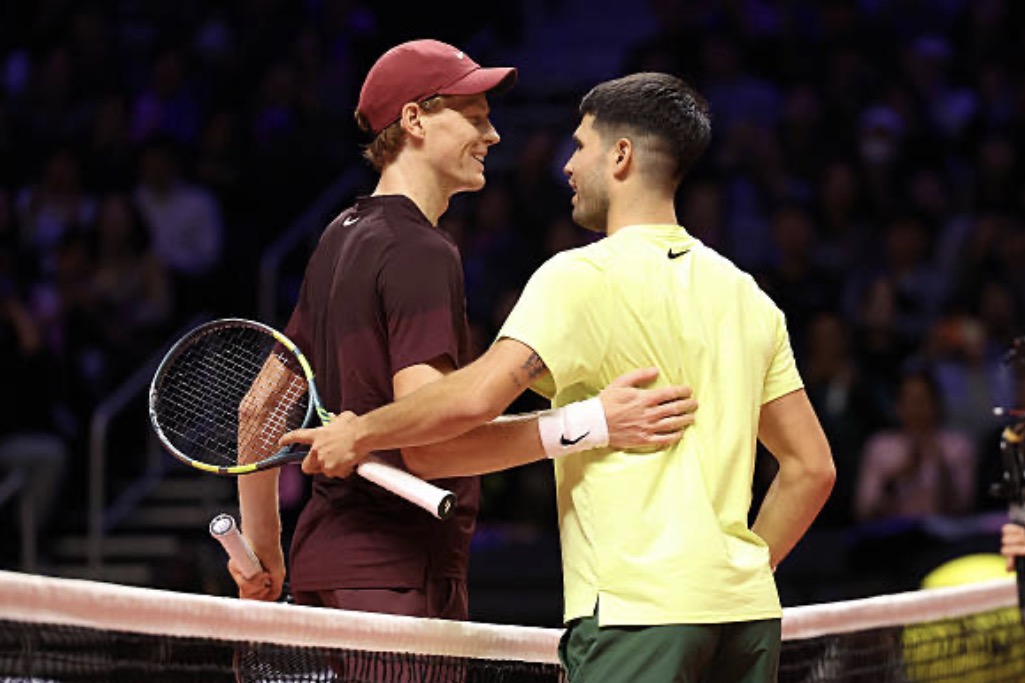
Fast-forwarding to the here and now, discussion as to who can stop both Carlos Alcaraz and Jannik Sinner from dominating men’s tennis is a temptingly inevitable one and I don’t begrudge anyone for partaking in it. Indeed, it moves the sport of tennis along in the only way that it should; by embracing the ever-changing landscape of the unpredictable future and trying – quite impossibly – to prepare for it. But I do think these wonderings often overlook what could be achieved here and now, while there isn’t anyone else. The gap between these two and the rest of the tour is often criticised for representing a lack of depth but I think seeing it only as that diminishes the possibilities buried within it. Why must we rush past the here and now?
Alcaraz and Sinner have separated themselves from the rest of the tour and this is embedded within the spaces between their actual matches. Their preparation for the Australian Open looked comically relaxed, a laugh-a-minute exhibition played against each other in South Korea standing in stark contrast to the sweltering battlegrounds of the main tour that had already been underway for weeks by that point. With players exhausting themselves in order to try and be ready, Alcaraz and Sinner arrived fresh and with the only knowledge that matters: they can win these things. If you ask me who between them I could see as a more likely candidate to win the Calendar Slam, I’d say that both are capable of it, which is – naturally – the big problem. If I were pushed further to make a call, I’d pick Sinner. Alcaraz feels the more combustible, reliant as he is on in-the-moment magic that rewards consistent risk-taking at its best but bleeds openly on the rare occasions that it’s pulled apart.
In any case, when you have two players so far removed, it’s important to dare at least one of them to do the impossible. Who knows how long a Joao Fonseca needs to develop into an opponent capable of beating these two at a major? The very fact that this debate is currently hinged purely on whether one player can beat the other at four majors in a row shows just how close it is to happening. I like to think I’m a fan of a sport that rewards the efforts that its fans take to fall in love with it but the reality is, we’re all just along for the ride, hoping to see the things we want to see with the time that we’ve got.
***
Many people argue that the Calendar Grand Slam can only possibly represent some great embarrassment, a red-faced, heads down sort of achievement that warrants a proper reassessment of how the hell every other player let it happen and a concerted effort from everyone involved to make sure it’s never repeated. I find this conclusion wildly surface level and rather barebones in that it only looks at the entirety of the Slam, rather than the specifics within it that would, I hope, ultimately work against this very conclusion. Majors are so often won just about, with a stumble and an “oops-a-daisy, that was fucking close, thank god I came through that!” and I very much doubt the four needed for the Slam to be completed would be any different. Why must we fear seeing it happen due to some preconceived and quite ludicrous notion that the entire thing would render the sport submerged and in some way in need of rescuing?
I’m asking us to sacrifice none of the drama or frustrations of the matches we favour. I want this won by a player willing to fade to the edges of accepting their failure to accomplish it, before reversing their fortunes in some dramatically cinematic fashion. I want them falling over the finish lines. A rag-doll champion, hunched and exhausted on the horizon, and broken in victory. Four trophies scattered at their feet, tokens of war, looking down upon them, wondering if it was worth it. And even if it doesn’t quite turn out like all that, I’ll know what it feels like to be disappointed by it. To read what it must ultimately mean in the many sports pages that would cover it, to process my own thoughts, to come to my own conclusions. To ultimately argue about its relevance and wonder what’s next for the sport I love. It’ll be framed afterwards, a proper renaissance painting of moody history that I – and you, reading this right now – can say we were there for.
Embed from Getty Images Popcorn Tennis