Featured

Why Tennis Needs Silence

By André Rolemberg

Whether you watch it on tv, on live, or at your local club, tennis has a unique quality among sports: it needs silence.

If you play the sport, you also notice it for yourself that any noise can break your flow, disrupt your momentum, make you downright pissed off.

Why?

Every athlete needs focus to perform. Most athletes have the super-human ability to shut off any influence from the outside world, as if nothing else existed but themselves and the game being played. 

Even tennis players have that ability. Novak Djokovic spoke about the ability to cut out the crowd chanting his opponent’s name, and even magically making it sound like they were saying his instead. Djokovic is one of the most focused players ever to walk on a tennis court.

But noise still sucks. Somehow, it still messes everything up. So, if every sport needs a state of absolute focus to be performed at the highest of levels, why do tennis players need complete silence, to the point where it is a requirement if you want to watch a match live?

Here’s a few things I think could explain this rather uncommon need.

Rally structure

First of all, there is the way the rallies happen. In tennis, you are only allowed a single touch at the ball. The touch happens in a split second, meaning you cannot just land the ball on your racket and think about it: it must leave your racket nearly as soon as it touches it. 

This is true for doubles as well. There is no saving grace. You mess up, and that’s it for the point. No one will be there to save it. Unlike in volleyball, a sport with some similarities, where players can produce miraculous defense and turn into attack before it even crosses the net. Or a routine play turned into nightmare if a player fails to do the job right in the first two touches: a third can still keep the point alive.

In tennis, that single touch is what you have. What’s worse: it only guarantees your survival for a little longer.

You can successfully hit the ball back 40 times in a rally. If you miss on the 41st time, you lose the point. Hitting the ball back in is the bare minimum, the prerequisite to playing tennis. Hit the ball out, your efforts are often nil.

Scoring system

The scoring system in tennis is a work of art. It is divided in a few pieces that, grossly putting, are independent of each other.

You need to score sets to win a match. You need to score games to win a set. You need to score points to win a game. You need to keep the ball in play longer than your opponent to win a point.

Conversely, you can hit 50% more balls in than your opponent, and they still finish with more points. You may win more games in a match and your opponent still wins the match. You may win more points then your opponent, and still lose the match. You may do literally everything better than your opponent, albeit just marginally, and still lose the match.
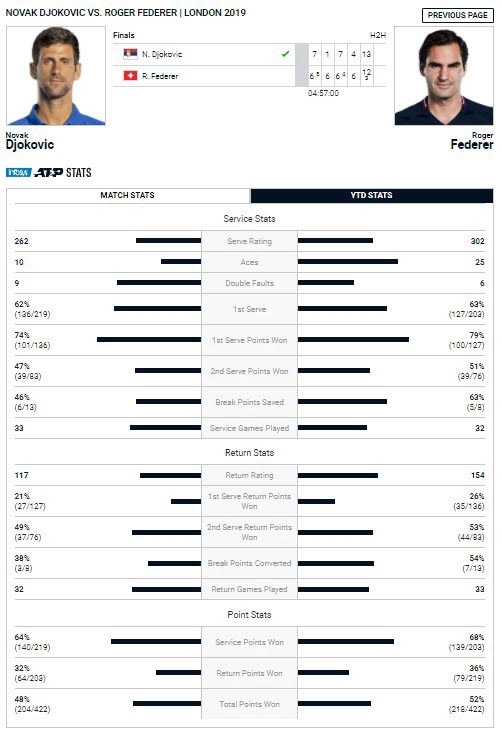
Look at these numbers — brutal. And what is worse, you must win to advance. Tennis really can be an unforgiving sport.

This brings us to pressure points: the ones that close out the clusters of a game, a set, and a match.

When a point is worth more than others, to a point where all your work can turn out completely fruitless, nerves kick in. The absolute need for precision and focus become the ultimate truth. There are no second chances. Or, at least, not after you hit your first serve. 

Players need silence, because one single point gone the wrong way and it cascades down into catastrophe. A lapse in concentration, a shanked forehand, a shaky second serve, and the momentum gets pulled hard towards the other side, as if all your teammates decided to drop the rope at the same time in a game of tug-of-war.

Speed of play

Several sports are quick paced, but there’s something to be said about the incredible speeds at which balls are thrown around on a tennis court. 

Not only does the ball go fast, but also racket heads move at super-human speed to generate the amounts of pace and spin we see coming from players.

With a tiny ball, rackets that have become bigger, but are still somewhat small especially if you consider that only the “sweet spot” is where you want to make contact with the ball, it makes sense to say that any distractions and it’s all over.

As previously stated, you misfire, you lose the point. Even on serve, if you lose your first serve, there goes what is possibly the biggest weapon in the game, and you have to make a choice between going for the second serve and risk losing the point with a double-fault, or playing more conservative and counting on winning the point in a rally which likely will start neutral.

When things happen fast, you have to move fast and think fast. When that happens, you cannot afford to get caught in any sort of distractions. Head in the game, or you’re off-tempo. 

Technique and physics

And just as things happen fast, you must be able to do things fast, but also well. Tennis technique is very precise and also does not allow much room for sloppiness and error.

Moving well means reading the trajectory of the ball, judging the distance from your body to the contact point, placing your legs in the optimal position for optimal balance, swinging with the right distance from the racket head to your body, applying the right amount of spin or “feeling” the right trajectory of a flatter shot or a slice.

All of this happens in a fraction of a second, but obviously no one is truly thinking about these things as a step-by-step guideline when playing. It happens with muscle memory and proprioception, which is basically thinking with your body.

But, just as you can lose your train of thought if someone interrupts you mid-sentence, you can lose your balance and spatial perception if something significantly disturbs the environment you’re in.

Some sports have a higher tolerance to this. Think of soccer, basketball, hockey. They will stop at almost nothing short of a streaker or something that physically interrupts play, like an object thrown on the field/court/ice (and even still, hockey players can even play for a few seconds without a stick that has been broken, and still lies around during play.)

Tennis does not tolerate much at all. Camera flashes, people moving, a whisper too loud between people or from commentators sitting courtside. 

Any small disturbance jeopardizes the outcome of a point. It could be a nuisance at 0–0 in the second game of the first set, on serve. It could be 30-all at 11–11 in the fifth set of a Wimbledon final.

The importance of a crowd

Should crowds just shut up, then?

Absolutely not. Players have *some* tolerance to a little bit of noise, and can play through “ooohh’s” and “ahhh!” sometimes. Murray did that on match point against Djokovic at his second Wimbledon final, and won. Who could blame the British crowd? It was a historical moment. Even I, who’s never been to Great Britain, felt the magic energy.

So crowds have space, and can turn things around. Think of Leylah Annie Fernandez in her US Open matches. Think of the electric atmosphere during Tiafoe-Sinner in Vienna last year (2021). Players can work the crowds. They can draw energy and adrenaline from them.

Crowds matter. 

The point is, you want to be involved in the game, you want to be a part of it. What you don’t want to be is the one who breaks the flow, that swims against the current and consequently ruins everyone’s experience. Making noise at a bad time is like talking on the phone during a movie in the theatre. It doesn’t enhance the experience, it just makes you stick out like a sore thumb, and like such, anyone would want to get rid of the pain as soon as possible.

Make noise between points, scream your favourite player’s name, jump up and down.

But when the umpire says, “quiet, please”, then… Quiet. Please.
Why Ben Shelton won’t win the Australian Open 2026

I think what his fans like about Ben Shelton the most is the energy that he brings to the individual moments he creates. He becomes untethered in these flashes, demanding of vocal appreciation in response to the furore he’s stirred up, and the whole experience is admittedly an enjoyable one. It’s quite addicting to watch. You want to be a part of the party he’s started. His game feels anchored to these specific points and he has the talent to ensure that he’s able to produce them at least a handful of times in matches, and so if you’re watching for these slices of life alone, you rarely come away disappointed.

There’s problems though, enough for me at least to hold back on my assessment of where he’ll ultimately end up. His tennis, reliant so heavily on a temporary explosiveness, advertises its weaknesses to an almost comical degree that it becomes difficult to ignore. His opponents know it too and so rather than panic when Shelton hits those frequencies he’s always searching for, they merely sit back and take it, aware as they are that the show is unlikely to last longer than a game or two. It feels easy to survive once you recognise the flow of it.

In Shelton’s final tournament of 2025 played against his fellow top 8 players, he failed to win a match. Out of the three he contested, he managed a set. In the first of these contests, with his opponent, Alexander Zverev, up a set but down three set points in the second, Shelton rushed to the net for an attempted serve-and-volley putaway, only to be caught by an excellent Zverev backhand pass down the line. Two nonsense forehand unforced errors from Shelton followed, drawing the tiebreak level, and you just knew what was happening. This was the great unravelling. The match was not yet over but the opportunity to extend it was. Zverev shook hands as a straight sets winner moments later.

Embed from Getty Images

You feel it with Shelton, a subtle change in temperature. He begins snatching at shots that were there, right there, just moments before, finding more of them missing and sliding away through the cracks in points he’s desperately still trying to cobble together. What was contained mere second ago, now leak through the downturn of the momentum swing he’d been excitedly riding over the past few games. His backhand crumbles beneath the weight of the pressure he’s now putting on it to keep working. The cockiness is gone and he visibly fears what’s coming. It’s a desperate process that stares him in the face, threatening him to find an answer for it as his errors become ever more familiar to those watching. How difficult must it be to wrestle with what surely feels like the inevitable? 

When scrolling through my timeline a few weeks back, I came across an article posted by the official Australian Open twitter account. It boldly proclaimed Shelton to be in prime position to win his first major at the tournament come January. I smiled at the audacity of the headline as I clicked the link, finding myself reading a nice enough piece unpacking a couple of statements made by Shelton and his father in a recent interview. However, there was little detail here to convince me of his success in Melbourne. The core argument made by the reporter seemed to be reliant almost entirely on the need to find a third man to fill a perceived gap at the top of the rankings. “If not Shelton, then who?” does nothing to sway my feeling that either Jannik Sinner or Carlos Alcaraz will be taking the title. Call me unimaginative in that prediction but my crystal ball laughs in the face of suggestions of any other possible outcome at this stage. Sinner and Alcaraz don’t stop being Sinner and Alcaraz because some of us would prefer someone else. Professional tennis doesn’t deal in fan-fiction. Shelton’s poor return and backhand are very real and very difficult to simply ignore in favour of daydreams.

The certainty with which some like to name Shelton as their pick for the next person to win one of these trophies feels premature and this is coming from someone that’s very willing to buy into the hype. I love players like him, the ones that live for the moment and refuse to overthink. They earn the uncertainty their opponents must feel heading into battle against them. But players like this so rarely find themselves winning the biggest of titles because to do so requires at least a semblance of mature consistency that you don’t often see in them. Indeed, as brilliant a player as Shelton is, I like him predominantly because he reminds me of my own childhood, playing tactic-free tennis that rewarded only those amongst my group of friends that could hit the ball as hard as we could at just the right moment and laugh about it all afterwards, the arrogance of an entire life of possibilities ahead of us.

Do not get me wrong here. Shelton’s base level is enough to see him through the vast majority of matches he plays on tour. He would not be sitting where he is in the rankings if he could not live without the flashes of brilliance that define his tennis. But even at this tippy-top level, if you’re not moving up, you find yourself sitting right alongside the issues that continue to plague you. Shelton’s frustrations dwell within the valleys of the matches he’s still yet to find a way through. At 23, he’s hardly pushed for time but I find myself wondering if he’s perhaps the type to let the delusions of youth guide him past opportunities to make the most of it. 

I hope he’s not. I really hope he’s not.

Family First

56 days.

That is how long it took for the player-coach collaboration of Stefanos Tsitsipas and Goran Ivanisevic to live and die. Within that time, 3 matches were played. One was won, two were lost. One of those losses was a third-set walkover due to injury. Wimbledon saw Tsitsipas hampered by his back, withdrawing from his first-round match having dropped the opening two sets. The scale of the task in front of Ivanisevic seemed to reveal itself in the form of rehab, reflection and planning. It was an unfortunate blip on a road that had barely been trodden but with time, it felt like the potential was still there. It just needed a little breathing room. Instead, it suffocated on the spot.

In the months prior, Tsitsipas had been struggling, his form wayward. A title in Dubai had served as a stopgap between consistent alarm bells. It was at that tournament that he changed his racket, going from his usual Wilson to a blacked-out Babolat that seemed to immediately positively impact his game. This was exciting! Changing rackets is one of those big-small things, a very personal decision not to be taken lightly. For a player of familial habit like Tsitsipas, stepping out of his comfort zone to try something new and seeing results was huge. Watching him lift the trophy come finals day felt like the planting of seeds of promise, an investment for an immediate future that desperately required something leafy and fresh.

A month or so on, Tsitsipas would change back to his Wilson racket citing issues adapting to the clay surface he was now playing on. He wanted something he felt he could trust and the Wilson was there to embrace him with fond memories of Monte-Carlo wins and French Open finals. A risk had been taken for a little while but now normality could resume.

Normality bled through his results, a loss in the second round of the French Open ending an underwhelming clay season highlighted only by a handful of quarterfinal appearances at lesser tournaments. This run would push Tsitsipas out of the top 20 in the ATP rankings. He found himself looking up at a top 10 he’d once felt at home in. Now, it appeared outgrown and scary-looking, tangled with younger generational talents and those willing to keep trying to usurp them with different strategies. It would be harsh to say that at this point, it felt like Tsitsipas had given up, but at 26, his game was outdated. His backhand, a glaring weakness, left him at the mercy of his peers that had him all worked out. In short, he went where they pushed him. This surely must have had Tsitsipas nostalgic for those meaningful days that weren’t even that far gone; the quarterfinals of the French Open 2024 close enough to touch, the finals of the Australian Open the year prior still visible in the rearview mirror. Nothing about him had changed and that was a problem that was now directly impacting his career.

Hiring Ivanisevic felt like a moment that Tsitsipas fans had been begging for, a simple sign that he was willing to switch things up in the face of downturn in fortunes that could surely still be reversed with the right actions. Whether Ivanisevic held all the answers wouldn’t necessarily matter if Tsitsipas could, in some small conceivable way, draw on the experience of working with him to develop a willingness to experiment. Ivanisevic was in the box when Marin Cilic won his sole major title at the US Open 2014 and was similarly influential in helping Novak Djokovic surpass Rafael Nadal for the major title record.  Should he find a way to make Tsitsipas’s tennis feel relevant again, it would be some of his very finest work.

In the span of a few short weeks, Tsitsipas dropped further in the rankings, outside the top 25. His professional life took hold of its personal counterpart and dragged it down with it, his relationship with Spanish player Paula Badosa coming to an end. It didn’t help that both suffered first round Wimbledon losses, leading to tabloid headlines that took great pleasure in broadcasting the unwelcome coincidence. A small but vocal band of Tsitsipas’s critics had needlessly circled Badosa as being a core distraction behind his struggles on the court. At Wimbledon, the truth revealed itself to them; he was losing regardless of her presence in his life.

Difficulties are so frequently emboldened by the birth of more of them. Many found it hard to sympathise with Tsitsipas before this run of form due to his philosophical outlooks that often advertised perceived pretentiousness. But you didn’t need to be a fan to be able to relate to that feeling of freefall, of everything just not quite working out. Many called him a clown but as he faltered, for me at least, the red nose had slipped and fallen by the wayside. Never has a handsome multi-millionaire seemed more human. His opponents could reach out and mould him easily, their fingers dragging through his weak points, leaving him in the shape of defeat time and again. It’s why Ivanisevic represented a bit of hope, a stoic but flammable figure that would expect positive results for the investment he was putting in.

The issue with flammable people is you don’t get to choose when they go up in flames. In the day or so following Tsitsipas’s Wimbledon stint, Ivanisevic gave an interview in which he directly criticised his new charge’s work ethic. It painted Tsitsipas as a child, demanding answers for questions that he wasn’t willing to put in the work to be able to properly ask. The whole situation was, admittedly, amusing from the perspective of an outsider, but one can imagine how emasculating it must have felt to have his shiny new supercoach verbally undress him so publicly. It immediately positioned them at odds with one another. Was this simply tough love? Could Tsitsipas see the value in such open bluntness that he would be willing to use it as motivation?

A statement on the end of Stefanos Tsitsipas and Goran Ivanisevic’s coaching agreement after just 56 days published on Tsitsipas’s Instagram.

The answer is a resounding no, the announcement that the two would part ways coming late last Wednesday night in a short statement published on Tsitsipas’s Instagram story. He called it a “brief but intense experience”, code that can only really be interpreted to mean a whole lot of noise for a whole lot of nothing.

Some have found it easy to mock Tsitsipas for the way this has turned out for him. Their argument is that Ivanisevic was simply trying to hold him accountable with a reality check designed to get him going. If that was indeed his aim, I think he chose the wrong moment to fire the shot. Tsitsipas, already bent out of shape with his back, needed something other than extra lashings in the media spotlight. He’s quite obviously an emotional man that values loyalty and security from those he has around him. Ivanisevic has played a part in some of the most notable major wins in recent tennis history and for this whole show to have burnt itself out within the span of a couple of months is inarguably embarrassing for all involved – including Ivanisevic himself.

Tsitsipas’s father, like his trusty Wilson racket, stands ready to welcome him back with open arms. This is a well-publicised pairing, and those warning alarms are sounding louder than ever. Parental control over a player’s career is a dangerous mix that has often threatens results while pointlessly messaging egos. Of course, whether we think Tsitsipas going back to his father is a good move or not is largely irrelevant. He’s seeking someone he knows will always be there for him regardless of if it’s actually beneficial. Given his current frailty, I think going home is at the very least just as understandable as it is frustrating. It’s a safe, predictable option that promises some semblance of familiarity, even if it does nothing to suggest that a miracle exists just beyond the next horizon for him.

I’m really struggling to see where else Tsitsipas can go from here. Wrapped in a toxic safety net of his father’s cast, the best that can really be hoped for is that he finds some level of comfort in no longer being seriously considered as a major contender. Perhaps he’ll simply take pleasure in knowing that he did ultimately take risks in his career, even if he didn’t let them live long enough to have any tangible impact. 

Embed from Getty Images Embed from Getty Images Embed from Getty Images

The State of the ATP top 10

Today, while procrastinating, I decided to have a look at the current ATP top 10 rankings. Browsing through them, I came to the realisation that I’m now writing about: I do not think that anyone in the top 10 as of today (30th of May 2025) that doesn’t yet have a major title will ever win one in their careers. That’s 7 out of those 10. Now before you yell at me, at least walk with me first. Bring your pitchforks for a wander and then, when all is said and done and you’ve heard my explanation, if you still think me a fool, burn me at the stake of stupidity and let me rot.

Deal?

Deal.

Let’s get to it then!

Embed from Getty Images

Alexander Zverev, world number 3 – I think it’s very likely that Zverev ends his career and takes up the title as the greatest player of all time to never win a major. That, in and of itself, is some achievement and requires a demonstration of talent so ridiculous, that it’s quite unbelievable that said player never won one. Zverev has it all, aside from a major. Multiple Masters 1000s, ATP Finals, Olympic Gold, an arrogance and list of excuses for why he loses. The lot. And yet, he’s been surpassed by younger, fresher names. I don’t see him overcoming the mental hurdle, that brain blockade that must scream at him every day that he should already have a major, so why doesn’t he?!

Embed from Getty Images

Taylor Fritz, world number 4 – Listen, I like Fritz! He’s like an American frat boy but he seems harmless, just a dude you’d see walking the streets. I feel like he’d tip well at a restaurant and tell you to have a nice day at the checkout if you sold him something. Unfortunately, none of this translates to major glory. He doesn’t have the depth to his game. It’s all a bit too janky and awkward. Better players are better players and none of them are willing to let Fritz through. His movement lacks and makes him sluggish. It’s his big undoing.

Embed from Getty Images

Jack Draper, world number 5 – Now this… this is where things get hard to justify. A couple of years ago, as Draper worked his way through the rankings, I thought there was no chance. Didn’t achieve the early career goals of someone I’d expect of a major winner. And yet now, today, he’s the enormous question mark in this article because the improvement has been astronomical! Huge, massive, big time. He could well prove to be my biggest embarrassment when writing this rundown in the future when he wins a Wimbledon. And yet, his fitness is to be questioned, his injury history there to be judged. And while making this claim, I’m judging it and judging it HARD. As a result of it, he never finds a way to work through two weeks and best of 5 set tennis to lift a trophy – in my opinion.

Embed from Getty Images

Lorenzo Musetti, world number 7 – It’s nice to see a one-handed backhand here in the top 10 and his runs this year at tournaments have been impressive. He’s young still too so time is on his side. But man, his forehand is awkward, that backswing a bit too unconventional, and when properly pushed by a great player, it faulters, especially with lower bounces. While his backhand is nice, it’s still a one-hander and that comes with all the issues a typical one-hander does regarding high-bounces and perfect set-ups required constantly. Unless you’re a Stan Wawrinka or Dominic Thiem, it’ll always be a liability and that’s enough for me to confidently say that I don’t think Musetti ever wins a major title.

Embed from Getty Images

Casper Ruud, world number 8 – He seems like a sweetheart, I really mean it. A man you’d love to be friends with and introduce to your parents. I heard him speaking Spanish a few weeks ago and my god, I had to take a minute! But sexy pronunciations don’t automatically make major winners. Ruud’s tennis – as world class as it is! – is simply too unimaginative. It doesn’t have the creative edges that it needs and he lacks pace on his shots to really damage opponents that will lift these trophies ahead of him every time. He’s had chances as well, against the then-current, now-past Rafael Nadal and the then-future, now-current Carlos Alcaraz, and come up wanting. He simply does not have it in him and he actually seems somewhat content with it!

Embed from Getty Images

Alex de Minaur, world number 9 – He’s a Duracell bunny of a player and it’s impressive every time you watch him systematically dismantling players he should be systematically dismantling. That, though, is his biggest problem: he wins against those ranked below and completely faulters against those ranked higher, meaning he’ll never crawl over those above him to one of these titles. His game has no real kill-shot, no weapon that you put house-money on. Nothing screams champion about his tennis and that’s OK because he’ll keep running and running and running. Just not in the direction of a major trophy.

Embed from Getty Images

Holger Rune, world number 10 – This is my second big banana peel of the list. Part of me thinks he could really be the third name in a Alcaraz/Jannik Sinner trio to dominate men’s tennis for the next decade. For the sake of this article, I really hope not, but it could happen! I’d lean towards no if pushed though. He’s got a lot going for him. Wins over Novak Djokovic are not to be sniffed at. And yet, best of 5 over two weeks is a scary beast that roars in his direction whenever it can and I don’t think Rune can roar back when all is said and done. He’s a bit too angsty, a bit too desperate to prove himself. He’s young and could figure things out with time… but I’m yet to be sold on him.

***

And that… is sort of that! People that follow me on twitter (I appreciate you if you do btw, thanks very much!) will point to tweets of mine recently – especially regarding Draper! – that imply I think he will win a major and while that’s entirely fair, you need to understand that a huge amount of what I tweet is total rubbish! Or rather, things I feel entirely different about 5 minutes after sending out. I’m nothing if not consistently talking complete crap. This article could very well serve as an example. Just watch Draper win the US Open later this year or something! But for now, I’m standing by it and if you so wish to burn me alive, so be it. I can take it!

*proceeds to howl in unimaginable pain and suffering as my body turns to ash*

Naomi Osaka and the Agony of Doubt

Watching Naomi Osaka take to a tennis court these days still feels like a spectacle, even if her game isn’t what it once was. Her looks are iconic, however fleeting they are. You’re fairly certain you’re about to witness an early round loss from a player that used to be a contender but it’s not outside the realms of possibility that she might just surprise you and so you stick around. The game’s moved on a bit from her but not so far that it feels out of reach. Her defeats to players ranked within the top 10 still feel newsworthy. Her game, as powerful as it ever was, lacks the consistency that’s necessary at this level and so, as her opponents creep away from her over the course of a match, you find yourself wishing for an uncertain point in the weeks, months, years to come in which she manages to find it again.

Osaka’s defeat to the world number 10 Paula Badosa in a three setter in this year’s French Open opening round felt like the sort of result that tennis fanatics would argue should be expected by now and yet, casuals will stop and stare at. The reality is that Osaka’s prime years were over so quickly, with so much achieved in so little time, that people that watch only the later stages of these biggest of tournaments still recall her fondly. It seems unfathomable that these sorts of matches should be normalised now so soon after those highlights. Her press conference following this particular loss was emotional and required a brief intermission while she composed herself:

Still in her 20s, Osaka is already eyeing the clock. For so lonely a sport, tennis frequently asks its players to question the impact it’s having on the ones they surround themselves with. It’s an unfair pressure that demands self-awareness and rewards it only with further worries. Winning her first clay court title recently at Challenger level will have left her feeling quietly confident about her form coming into this tournament. As good a player as Badosa is, her career tells a familiar story of someone not quite capable of winning these tournaments, a typical mould Osaka has repeatedly proven that she doesn’t fit. Indeed, this was a winnable match, evidenced by how close it ended up being, Badosa lifting her game above Osaka’s in the closing stages of a third set that shifted and shifted again before finally settling.

There’s something quite endearing about Osaka’s apparent problem with chasing a past version of herself. Those of us trying to recreate magic from better days can relate, even if we can’t even begin to understand the layers of complexity that come with giving birth and then trying to return to professional sport. She’s not necessarily unhappier now then she was then but she was winning more, playing more engaging tennis that felt more meaningful – to us as fans, for sure, but also, clearly, to her.

She’s also entered dangerous territory of being visibly shaken by how she might possibly be perceived by those she relies on to help her. Self-doubt is such a uniquely human trait that professional athletes like to hide away beneath layers of performative lines drilled into them from the early stages of careers that promise little and reward less. It’s how they cope. Osaka – softly spoken and careful with her words – has refreshingly allowed fans frequent glimpses of who she is and what she stands for. All of this enables us to gain a far better sense of what she wants us to understand as her motivations. As well as this works to humanise her, to grow her fanbase far beyond the numbers of some of her fellow players, it can also leave her feeling open and perhaps a little bit too vulnerable in moments of weakness. Her expectations for her tennis have clearly outgrown what she’s currently able to provide. She falls in matches like this and on the way down, meets only her own internalised guilt for not performing. Those in her box watch on, wanting what’s best for her, not knowing that it’s that very desire that’s causing her such angst. Scared of what everyone else is thinking, she disappoints only herself.

Embed from Getty Images

Late last year, Osaka hinted that she may not want to hang around the tour as an active player if her results don’t improve and in her press conference yesterday afternoon, she mentioned how unexpectedly slow this process was proving to be. This sense of needing to rush back, to hurry her game into an acceptable formation to enable her to reach the level she wants to be at, is hugely detrimental while her ranking restricts her tournaments to first, second and third round matchups she isn’t the favorite to win anymore. Further doubt as time goes on beckons, a vicious cycle that even the very best tennis coaches can’t come up with a game-plan for. 

She has more time than she realises. In comparing herself against marks she simply can’t hit at the moment, she risks limiting her game further. Her lofty expectations are immediate and now but her fear of failing threaten to crush her out of the sport she’s still capable of achieving things in longer term. Everyone knows tennis stops for no-one but Osaka has the sort of game to make it question what it stands to lose out on if she leaves early.

The Athletic’s Tennis Liveblogs Aren’t Worth Following

The liveblog is a classic writing format with an obvious purpose: recap an event for somebody unable to tune in. The reader gets to approximate the watching experience, or at least stay informed of the major plot points. Ideally, the writer mixes in some analysis along the way. A bunch of sites do liveblogs, so a good one will differentiate itself through jokes, an unusual perspective, or a real-time mental breakdown if the event goes off the rails.

At rare times the liveblog is more compelling than the event itself. Reading this blurb from Stuart Heritage’s Game of Thrones finale liveblog on The Guardian was likely a richer experience for many than watching the last season:

“Ohh, Tyrion’s telling Jon that he also loves Daenerys. ‘Love is the death of duty’ says Jon. ‘Duty is the death of love’ replies Tyrion. ‘Death is the love of duty’, I add, trying to join in. I’M JUST TRYING TO JOIN IN.”

With tennis, a sport whose matches last anywhere between one and six hours with plenty of variation, the most important thing is simply summarizing the crucial moments with a bit of color. If you’re on-site, add some extra sensory details. You don’t need to cover every point. The Guardian is consistently excellent at capturing the flow of a match (Katy Murrells on Jack Draper-Aleksandar Vukic is a good example), and even their tennis livebloggers who usually cover other sports tend to put enough juice into their updates to make them worth reading. 

Unfortunately, The Athletic is not up to snuff. The New York Times-owned sports site can be exasperating to read at the best of times—identifying areas prominently neglected by an editor’s helping hands is always way too easy, especially for the prestigious, moneyed publication in question. But most of the writers are very good, even if The Athletic’s subscriptions-above-all business strategy and questionable editing doesn’t exactly set them up to do their best work. The site does have access to the biggest events and athletes in spades, so you would think their tennis liveblogs would feature plenty of scene details as well as shrewd analysis. 

What we too often get instead is The Athletic/Times doing an approximation of a Twitter aggregator’s favorite format: one-sentence paragraphs devoid of analysis. The greatest sin a liveblog can commit is failing to add insight beyond a score update, because this gives the reader no reason to follow said liveblog instead of the Google scorebug, yet many of The Athletic’s updates do just that. Lukas Weese, who covered last year’s U.S. Open from on-site, paid excruciating homage to The Tennis Letter with his updates of the Jannik Sinner-Tommy Paul fourth-rounder.

Some notes and questions: The bolded heading and first “paragraph” here say the same thing. The other three “paragraphs” are not complete sentences. In the lone line that could generously be classified as an observation, “tension rising in Arthur Ashe Stadium,” Weese writes with the color of a century-old movie. Did tension rise because the set was neck-and-neck? Did tension rise because Paul was down a set at the time of the update and needed to win the second to retain any chances of beating Sinner, the world No. 1? Did tension rise because the American crowd sensed this and rallied themselves behind Paul, also an American? What did the crowd even look and sound like? Did the fans get louder, more nervous, more restless? Was Darren Cahill doing star jumps in the player’s box? Weese didn’t have to answer all these questions, but I’d have preferred him to answer any of them than to write what he wrote. Maybe worst (or best) of all: Weese didn’t provide another update on the match until the end of the set, 38 minutes later.

Weese’s role at The Athletic might indicate the reason for these watery updates: you’ll note that at the time of this liveblog, he was a news editor, not a writer (he’s since shifted into a role as a live reporter). Still, as far as I’m aware, good newsers still use descriptive, complete sentences to inform the reader. And by covering a major in person, for at least that fortnight, you are definitionally a professional tennis writer. Pick your favorite former tennis writer who has been bounced into a different career, and compare one of their pieces to Weese’s liveblog under the nytimes.com banner. Any illusions that tennis writing is a meritocracy should end there.

Weese’s weak offerings getting past an editor suggests that The Athletic lacks sufficient respect for their reader to not overfeed them with baby-food paragraphs. Alas, this is a pattern extending through the recently concluded Australian Open.

In the middle of this excerpt, Michael Bailey rejects Weese’s comparatively lengthy “paragraphs” in favor of a single word. Again the specificity is lacking—is Bailey breathless? Is Keys feeling the nerves ahead of her service game? Is the crowd?—but I can’t deny the art form of the one-word paragraph, even if Bailey bungles the timing. We’re also blessed with the phrase “creates her way to a love hold,” which makes tennis sound like Minecraft. Like Weese, Bailey does not describe a single point or hot shot. He does provide an update on new balls, though given the lack of tennis in his tennis analysis, I’m not sure who for. If the person reading this liveblog isn’t worthy of any details about the service game or digesting any paragraph longer than 23 words, surely they can’t be trusted to understand that new balls have a springier bounce off the racket than old ones and usually lend themselves to a comfortable service game. 

You might be thinking that The Athletic is avoiding specifics in their live tennis coverage to be mindful of a general audience. It seems that livebloggers like Weese and Bailey are simply there to fill space, given that full-time tennis writers Charlie Eccleshare and Matt Futterman, and tennis editor James Hansen, also pop into the live recaps to offer more detailed analysis (even if it does often still come in those maddeningly diced portions). But The Athletic is also not afraid to leave their reader in the dark for a bit, like with the lede of a story co-written by Hansen and Eccleshare (whose work I like a lot) after Carlos Alcaraz beat Jannik Sinner in a sensational Beijing final late last year: 

Gotta love the note that Alcaraz deserved the win, as if a tennis win were subject to some kind of value judgment like the controversial decisions in boxing. Anybody who converts a match point deserves to win a tennis match.

At the time the story came out, I stared at this opening line for a good while trying to figure out what Hansen and Eccleshare were referring to with “6-4.” I had Alcaraz’s second-set comeback on the brain, and wondered if they were thinking back to the rapid turnaround in the middle of that stanza, which ended 6-4. But kicking off a story with a reference to a second set sandwiched by dramatic tiebreak sets made no sense. Finally I realized “6-4” was the updated head-to-head between Alcaraz and Sinner. You’d think the head-to-head simply lying on the page for the reader to identify without any accompanying context, until the story circles back in the third paragraph, is something an editor would catch. On top of that, “6-4” is such a common tennis score that anybody could easily mistake the head-to-head for a set score in the meantime.

Even if The Athletic’s catering to casuals were consistent, the “tennis writing as second grader’s class assignment” liveblog style still would not be fun to read. The editorial staff’s willingness and desire to pump out flavorless liveblog updates on such a large platform does not service the curious tennis fan, but it’s a slap in the face to writers capable of doing better.

Remember the Titan

By Vikram Nijhawan

In his final French Open match in May, Rafael Nadal took to Court Phillipe-Chatrier like one of the three hundred Spartan warriors at Thermopylae. He’d established his prowess and notched countless victories on these courts his entire career. Now that his reign faced legitimate jeopardy for the first time, he was determined to stand his ground. But if a blaze of glory was the best he could hope for, that mission was slipping further and further away. 

Nadal served at 15-40, 0-1 at the start of the second set in his first-round match, against an imperious Alexander Zverev. He opened the match by surrendering his serve, then lost the first set 3-6. Another immediate break to start this set would surely be perilous. The red sediments staining his white socks and shorts, the residue from his long-time battlefield, could on this day easily be confused for an old player’s rust, or first blood drawn.

One of his better first serves of the match went deep down the tee, setting up a crosscourt rally. A sharply angled Nadal backhand forced a Zverev forehand to fly long. At 30-40, he fired off his first ace of the match to bring the score to deuce. His next serve went unreturned. At Ad, he yanked Zverev out wide, then ran around to thump one of his signature forehand winners into the open deuce court. He held, and by doing so, gave the invested audience something to hold onto as well.

The inevitable kept at bay, if only for a little while longer. For most of his career, Nadal was content to evade time’s grasp, and to pummel mortality into submission. If his winning on his Parisian terre battue wasn’t a foregone conclusion for the better part of the early 21st century, then he did a good job of making it seem so. His supremacy at Roland Garros felt like one of the few sure things in the increasingly uncertain world in which I came of age. In 2020, the least shocking global event was Nadal winning a 20th major title there, in a near-empty stadium, within a once-buzzing metropolis rendered a ghost town under a nationwide pandemic curfew. 

That match happened on my twentieth birthday: Sunday, October 11. But I didn’t watch it then. As with many of my pastimes, I inherited my love for the sport from my dad, and along with that, a fervid loyalty for one swashbuckling Spanish teenager from Mallorca. Throughout his long life as a sports fan, my dad switched team allegiances too many times to count. At the dawn of the first tennis golden age, when he grew up as a club player and fan, he initially took a liking to the antics of Ilie Nastase, then later the irreverent shotmaking of John McEnroe. Perhaps that prefigured his support for another famous lefty arriviste, decades later, who’d challenge the sport’s reigning golden boy, and its status quo. 

When I was first introduced to the sport at five years old, Nadal was everything that a traditional genteel tennis player wasn’t: long hair, short sleeves, bulging biceps, and a racquet that in his southpaw grip more resembled a cudgel. It’s not that the sport had never seen a baseline grinder, or a successful Iberian “dirt rat,” — the old pejorative for clay court champions — but Nadal was the apex of this archetype’s evolution. My dad’s uncle, another lifelong player (tennis ran in the family), always derided him as a “bull,” the animal that soon became the young Spaniard’s brand image. If all you admired was gliding cross-court movements and slick groundstrokes, you didn’t need to look any further than Roger Federer. Nadal was the ruffian who sought to disrupt that tennis empire. I perceived him as the Luke Skywalker to Federer’s Darth Vader (not an unfounded analogy, as it turned out).

But from outsider to the establishment, Nadal soon became the steadiest constant himself. At Roland-Garros, he was Darth Vader, the Leviathan, and every other imperious force of myth and pop culture rolled up into one. His lifetime record at the tournament is 112 wins to four losses. In his runner-up speech at Wimbledon in 2022, Nick Kyrgios said that trying to beat any one of the Big Three in a major final was like climbing Mount Everest — a heroic feat, to be sure, but one occasionally proven possible. Trying to beat Nadal in a French Open final was the journey to the center of the Earth that no one ever lived to recount. In 14 different years, his opponents on the other side of the net in championship matches on the Parisian clay were more often than not rendered passengers; no one, including Federer in four attempts and Djokovic in three, even pushed him to five sets. His invincibility at the tournament was accepted as an immutable truth for the nearly two decades I’d been alive.

I never knew the sport without Nadal’s dominance. His violent on-court grunts were part of the soundtrack of my upbringing, coming from our home’s living room TV,  which always seemed to be playing tennis by default. His rituals and tics befuddled grandmothers; his raw machismo caused older sisters to swoon. Eventually, my dad and I stopped following tennis regularly, when the other parts of life got in the way. For a patch of my late adolescence, tennis had existed on my periphery, supplanted by other new interests and academic priorities. I ended up on nodding terms with something I once loved, and took for granted the state of the landscape when I had left it.

*****

By May 2021, a year into a new post-pandemic decade, tennis had become an afterthought. So on one fateful Friday, when my dad nonchalantly informed me that Nadal had lost to Novak Djokovic in a titanic, curfew-defying French Open semifinal, something awoke in me. I watched highlights of the match online soon after, and absorbed the shock of tennis netizens. After three sets of brutally attritional tennis, Nadal’s lifelong foot injury flared up and rendered him unable to play competitively in the fourth. I felt a twinge of disappointment that my longtime favorite player had lost, that I had missed out on a collective cultural moment, but also something deeper. A certain status quo that I took comfort in was upended. It was a taste of something I had yet to truly come to terms with in my life: aging, and impermanence.  

It was the shock to my system that caused me to backslide into my old tennis fandom. I followed the rest of Nadal’s lackluster season before his chronic foot injury ended it prematurely, anticipating his return to court at the start of 2022. Djokovic’s GOAT case was beginning to look unimpeachable, but the race for most major titles was still ongoing. The Australian Open would be a decisive chapter in this story. Nadal returned from his sixth-month hiatus in top form, clinching a tune-up event in preparation, decked out in an all-black kit (“Like Darth Vader without the PTSD,” as some unhinged YouTube commenter described his appearance). My mother wondered where all his hair had gone. 

I awoke on that ungodly, pre-dawn Sunday morning at the end of January to watch the Australian Open final. I went in half-expecting to watch as if attending a vigil for a once-great champion. When he went down two sets to love against Danil Medvedev, I braced for disappointment. But hope spread its feathered wings. As he saved the third set, after serving from 2-3 and 0-40 down, it wobbled shakily off the ground. By the end of the fourth, it flew steadily. By the fifth, it soared to new heights, as he went to serve out the five-hour, twenty-four-minute marathon match, completing the most impressive comeback win of his career.

It was more than any Nadal fan could ever hope for, beginning what looked like a proper renaissance. Here he was at 36 years old, like Tennyson’s Ulysses, proving that “some work of noble note may yet be done” in his lifelong field. Even as new contenders arrived on the scene, he showed that he could still hold his own against them, including his compatriot and heir-apparent, Carlos Alcaraz. But nothing felt guaranteed, which made every one of his victories all the more special.

One set point he saved against Zverev in a torturously close French Open semifinal that year captured it all. Down 6-2 in the first set tiebreak, an ace from Nadal and a flubbed volley from Zverev brought the set back within striking distance. With Zverev now serving at 6-4, Nadal had to slide into his backhand corner to slice a return, then pirouetted off his back foot to return to the center – one of his trademark defensive movements. Zverev swung a cross-court backhand that could have ended the set there. Nadal, on the run, slung a sangfroid forehand passing shot; Zverev could only watch the ball go past him. The crowd went delirious. From there, Nadal clawed back to parity. After a few more points, he took the tiebreak, the match, and two days later, his 14th Roland Garros title. For the first stretch of that year, during Nadal’s latest renaissance, it felt like time had frozen.

*****

With Nadal announcing that 2024 would likely be his last year on the tour, there was reason to believe he could end with some further glory. After all, we had the receipts from two years ago, to show that he could still achieve the unthinkable in his mid-thirties. I recall watching his first-round match against Australia’s Jordan Thompson during that resurgent 2022 season, on Phillipe-Chatrier. Thompson complained to the umpire about the noise, or some disputed line call. “Come on, I need all the help I can get here,” he said, in a mock-pleading way. But when the two players faced each other in Brisbane back in January, the reverse could have been true. Nadal let slip a match point and lost in three sets. 

With each passing month, Nadal withdrew from event after event with whatever new injuries his 37-year-old body had picked up. Waiting for the wounded titan to return to the court soon felt like that initial 2020 quarantine period — the goalposts for returning to the earlier status quo slid further back, until these projected deadlines ceased to be reassuring. That he gave up winning chances or suffered new injuries wasn’t entirely shocking or unprecedented. But there was a foreboding, for the first time in a long time. There would be no divine intervention or miracles conspiring for the perfect comeback narrative. Nadal had already spent all of his indulgences. A faint alarm bell rang in the distance, if you cared to hear it; the twelve rounds were up. 

When the French Open rolled around, after a clay court swing that delivered more on nostalgia than promising results or form, it was clear this would be Nadal’s final hurrah, despite his frequent hedging when questioned about his retirement. Perhaps impermanence was difficult for him to grasp too. In a cruel symmetry, his first-round opponent for his Roland Garros sendoff was one Alexander Zverev, who nearly ended his title run two years prior, and was currently in the form of his career. The enemy army, a million men strong, encroached on Thermopylae.

I knew that this time, I could sooner expect a vigil than a resurrection. It seemed the rest of the world awaited the same. Sportswriters had their Nadal career eulogies drafted and ready to file. Luminaries like Iga Świątek, Alcaraz, and yes, even Djokovic watched in the audience. They wanted to witness the end of something significant too. 

The discrepancy in this match-up was clear to the eye. It was tempting to look away to spare the pain, but even the sound of the struck balls revealed it all — Zverev drilled them with a mallet-like intensity, while Nadal struggled just to make clean contact. He was a half-step slower, but time had kept its pace. Mortality wouldn’t submit so easily now. I watched this match on a rainy Monday morning in my grad school residence, alongside a friend and fellow Rafa fan from Mexico, who’d shout his fair share of Vamoses and other Spanish exclamations when our man got on the scoreboard. Resignation seeped in as the match went on, and the inevitable was in front of our eyes. Nadal lost in straight sets, and the world continued spinning.

*****

In October, just one day before my birthday, the long-awaited announcement came. Nadal’s final match would be in Spain for the Davis Cup. If the previous career bookending didn’t offer a sufficient chance to exit with glory, surely this historically successful event for Spain (and Nadal) would, where his winning record (29-1) was nearly as outstanding as at Roland-Garros.

His entire family was there watching him, alongside fans from across the country. Nadal lost his singles match, and then Spain lost a decisive doubles match. All the tributes from peers and contemporaries seemed to center on the concept of eternity. Spain’s team captain, David Ferrer, in his post-match ceremony speech to the reeling crowds in Malaga, told his teary-eyed former rival, “There are people who are remembered for their achievements in life, regardless of what they are. Some people are remembered until the end of their days. And some people are remembered eternally. You will be remembered eternally.” He was talking to a man who already had a statue in his likeness, at the site of his greatest career triumphs. A man who already had a stadium court in Barcelona named after him.

Immortality is a lofty goal in tennis, a competitive plane that has already seen the records of old smashed to pieces in recent years, many of them at Nadal’s hands. My most enduring memory from watching Federer’s televised farewell at the Laver Cup two years earlier, aside from his and Nadal’s shared waterworks, was Coldplay’s “Viva La Vida” ringing through London’s O2 arena. But the symbolism in those lyrics felt more fitting when reminiscing on Nadal’s career: “And I discovered that my castles stand/Upon pillars of salt and pillars of sand.” What jumps to mind is a 19-year-old lying on his back atop the red dirt of Court Phillipe-Chatrier, after winning his maiden title there, too ecstatic about the start of an era to even think about how it could end.

Vikram Nijhawan has written longform stories about tennis for Hammock Magazine and the popular YouTube channel Cult Tennis. He has a knack for running into famous players coming out of changerooms at tournaments.

Carlos Alcaraz Is Making His Own Luck

I still struggle to make sense of Carlos Alcaraz’s five-set win over Jannik Sinner in the Roland-Garros semifinals earlier this year. For 60% of the match, Alcaraz looked completely intent on handing the victory over without much of a fight. In the opener, he fell behind 4-0 and promptly broke himself again once he appeared to have righted the ship; in the third set, going up a break at 2-1 was all he needed to self-destruct once more. He may have won the second, but that owed more to a significant physical lapse from Sinner than any brilliance on Alcaraz’s part. So, down two sets to one to a player who had proven far more consistent in 2024 and hitting his supposedly godlike forehand as if it was Benoit Paire’s, Alcaraz was screwed. 

Only he wasn’t, suddenly turning into a rock on serve in the fourth set, and exploding to break with two winners and an error-forcing, low-percentage backhand down the line at 5-4. In the fifth, Alcaraz broke serve instantly – with consecutive winners – and survived a series of deuces without ever facing a break point. The clutch veteran was inside the blindingly erratic Alcaraz all along.

What still mystifies me: why didn’t that player show up earlier? By the fourth set, the pressure should have been greater than it was early in the match, not lesser. Sinner even played better in the fourth, I think, than he did in the third, when all that was required of him was to put the ball between the lines and watch Alcaraz self-destruct. How was it that Alcaraz had command over his most absurd, dangerous hot shots on the precipice of elimination, but not at the relatively relaxed beginning of the match? That skyscraping level lurking in him somewhere could render all opponents not just defeated but irrelevant, but it was as if Alcaraz needed to self-sabotage on loop for three hours before he could allow himself to play at that level. 

In the Beijing final yesterday, Alcaraz repeated the trick, against the same opponent. Sinner will not feature much in my retelling of this match, which I feel badly about, but rarely does a close, top-level final have such an obvious main character. Alcaraz left the comeback even later this time, in fact until most people thought it was too late: after spurning a diverse buffet of leads to lose the first set and rescuing the second, Alcaraz primed himself to take a double-break lead in the third against a fatiguing Sinner. He eventually had to battle just to force a tiebreak against an opponent who had won 18 of his last 19 breakers, including one from set points down over Alcaraz earlier in the same match. Carlos promptly fell behind 3-0 – two mini-breaks – as Sinner nailed a first serve and fired a couple deep returns. 

That’s supposed to be an insurmountable deficit against a tiebreak god like Sinner. And maybe it would’ve been if Sinner had kept landing his first serve. Instead, Alcaraz won the next seven points in a row, six winners or unreturnable shots included. 

Again, the timing is not just perfect but baffling. Why the hell was that immaculate, irresistible tennis player not accessible in the first-set tiebreak, which not only mattered less but which Alcaraz actually led at the beginning? Why could Alcaraz accomplish the most difficult of tasks at a dire moment, but not the seemingly simple task of keeping the ball in play against a tiring opponent, or maintain a break lead on a hard court? Alcaraz likes to talk about how he can take a loss in good conscience as long as he goes for his shots, and in doing so evades the very defeat he’s accepted the concept of. That still doesn’t explain how every forehand missile goes in, and every dinked half-volley that Taylor Fritz would miss entirely not only clears the net but dies in the first quarter of the court. Alcaraz suddenly becomes a good spot server. Opponents, whether the best player of the moment or the most decorated in tennis history, shake their heads, smile, and accept their fates. 

And the consistency with which Alcaraz pulls off these miracles. During the match, I was marveling at how many chances he had blown – the break in the first set (plus whispers of opportunities to grab another), the set points in the tiebreak, the double break points in the third, the 4-2 lead in the third, the break point at 5-all. No matter the emotional baggage he’s accumulated, in a match that is there for the taking, Alcaraz eventually and almost unfailingly takes it. Since he fired a 5-0 second-set lead to Hugo Gaston into the sun as a tennis embryo in 2021, I can’t really think of a notable match in which Alcaraz truly beat himself and had multiple chances to win. (His biggest problem now seems to be losing the first two sets at hard court majors before he hums into gear.) He may waste break points in bunches, but he has a rare immunity to the accompanying emotional hangover. All previous mistakes are minimized into the background. 

This isn’t supposed to happen, not for any tennis player but especially not one who takes as many risks as Alcaraz does. Roger Federer, for years, tried to harness his shotmaking to beat Rafael Nadal and Novak Djokovic at the majors. He ended his career 10-21 against them in the four biggest tournaments, with a 2-6 record in five-setters. Time after time, Fed made the matches extremely competitive, only to wilt in crunch time. He’d miss the delicate half-volley in a tiebreak, but he’d also miss a rally forehand for no apparent reason. We would blame both on the low margin in his game, which became untenable when the pressure rose. It was as if all the forces which made his improbable winners earlier in the match possible suddenly turned around and bit him in the ass when he needed those winners most. 

Alcaraz has successfully forged a peaceful co-existence with those same forces. It’s very possible that he is gliding on insane fortune, which will eventually run out and steer these stunning, clutch shots wide of the lines. But I don’t think so.

***

That the Beijing final has started a debate over who the best player in the world is amuses me. Our very established ranking system tells us that Sinner is better by exactly 4,000 points as of today, a value equal to winning two major titles. The U.S. Open, which Sinner won a week and a half after Alcaraz played arguably the worst match of his career, is not that far in the rearview mirror. Unless you think that beating your biggest rival should be worth 1,334 bonus points just for kicks, you don’t really think Alcaraz is the best player in the world, you just watched him establish himself as the best out there for a week and have a bad case of Social Media Syndrome. By the same token, despite his better year, Sinner is not a better player than Alcaraz overall, who still leads him 4-2 in major titles. We are allowed to let more than one tournament pass by before materializing our hot takes. 

The debate we’re looking for, I think, is which player we would rather be. As Serena Williams knows well, this doesn’t always have to be the same player who sits atop the rankings. Alcaraz and Sinner split the majors 2-2 this year; this is a close race, if one with a clear leader, and the gap is not particularly meaningful outside the weeks at #1 Sinner is netting. Are those weeks more valuable than a 3-0 head-to-head record against a primary rival in both players’ most accomplished seasons to date? This is a question that you could truly and justifiably go either way on.

I think I’d take the 3-0. Head-to-heads have many chapters to them – Djokovic and Federer didn’t play their most consequential match until more than 13 years after their first meeting. But they’re also made up of patterns. A decisive win early, say, saving two match points to win a U.S. Open semifinal, can set up an identical win the following year, and even a similar win at Wimbledon almost eight years after that. Carlos Alcaraz has now saved a match point to beat Sinner at a major, won both of their meetings that went five sets, and beat him in the only deciding-set tiebreak they’ve played against each other. Losing the first set, as Alcaraz did in all three matches with Sinner this year, does not faze him. We have a pattern: Alcaraz has won more of the closer and high-profile matches in this rivalry. (Sinner did beat Alcaraz at Wimbledon in 2022, but since he didn’t go on to win the title and Alcaraz has since won the last two editions of the tournament, Carlos has already wiped out the consequences of that loss.) Sinner, for all his consistency, is vulnerable to Alcaraz’s lightning aggression when the chips are down. This is something that he will have to contend with, and that might even force him to tweak his style. Perhaps the pattern will break in their next meeting. It could also last a while, bleeding into the pair’s legacy-altering matches of the future, and I don’t think valuing that possibility more than a few dozen weeks at number one is absurd. 

The tantalizing notion here is that Alcaraz-Sinner (leader in the head-to-head gets their name written first) will follow a pattern unlike Djokovic-Federer or either of the other Big Three rivalries. With his electric shots under pressure, Alcaraz is arguing that it is possible to play tennis like you’re playing Russian Roulette and still be reliable. Dominic Thiem and Stan Wawrinka have made the opening statements in this argument, but neither could match Alcaraz’s consistency or, let’s be honest, overall skill. 

If Alcaraz is the truth, if he can really keep doing insane things like this and maintain a level of control in the rivalry with Sinner, the potential timelines that could spiral out of the present moment are dazzling. Maybe Alcaraz will do his high-wire act in a major final. Maybe Sinner will improve further, either by improving his endurance (the clear next step for him, I think) or by trying to match Alcaraz in the forecourt, and can learn to neuter Carlos’s creativity for an entire match. Other players will have to be braver because the standard has been raised. Alcaraz might need to add the vintage Djokodal “on this point I will rally for 50 shots and never miss” string to his bow. I’m probably being hyperbolic about all of this, but watching a player win seven straight points to swipe a tiebreak from a world #1 on a winning streak in breakers will do that to a person. What Alcaraz is doing may conflict with every law of tennis we know to exist, but it works. If it were too good to be true, the luck would have run out by now. 

Carlos Alcaraz Is Feeling The Pain

I do not think Carlos Alcaraz is over his loss to Novak Djokovic in the Olympic final last month. There are other possible explanations for the four-time major champion’s 1-2 record since that 7-6, 7-6 defeat, of course: Alcaraz is probably better on the natural surfaces than hard courts outside Indian Wells, Alcaraz’s body is wrecked after a torrid schedule the past few months, Alcaraz’s game is volatile and is now self-destructing after operating at a high level during Roland-Garros and Wimbledon. But none of that explains Alcaraz breaking a racket in an uncharacteristic fit of rage during his first-round match in Cincinnati, or the fact that he has been running down balls like a madman as per usual, he just can’t find the court. What we seem to have here is a 21-year-old fresh off some good old heartbreak.

Alcaraz has circumvented many of tennis’s typical obstacles to this point in his young and glorious career. He won a major, the 2022 U.S. Open, all of one year after announcing himself to the world with a win over Stefanos Tsitsipas at the 2021 event in Flushing. He did not experience any particularly difficult losses in the interim, save a five-set loss to Matteo Berrettini that he avenged a month later. Alcaraz does not share Jannik Sinner’s impotence in five-setters, Holger Rune’s battles with cramps, or even a hostile relationship with trying to improve a troublesome shot. Unlike Novak Djokovic, Alcaraz did not have to break through a pair of all-time-greats in their physical prime to win a major himself. None of his struggles — with injury, with surface, with opponent — have been prolonged. Alcaraz meets challenges and overcomes them with alarming speed.

The Olympic final, then, must have thrown him for a loop. He had just beaten Djokovic in the Wimbledon final to the ruthless tune of 6-2, 6-2, 7-6, not simply outclassing the greatest player to ever do it but humiliating him. Surely, winning that battle was the end of his competitive rivalry with Djokovic, or at least a meaningful blow that would affect their next bout. Instead, Djokovic returned in supersonic form for the gold medal match, thwarted Alcaraz on eight of eight break points, and handed the kid a loss that he won’t be able to correct until the next Olympics in 2028. Alcaraz, whether because of his aggressive brand of tennis or presence in a generation hopelessly addicted to screens, does not like to wait. Here, for the first time, is an obstacle he can’t just jump over.

Beating Djokovic in this U.S. Open final might have been consolation enough; now that chance is gone. Alcaraz just lost to Botic van de Zandschulp in the second round, the 6-1, 7-5, 6-4 scoreline not surprising numerically but in who scored the win. Alcaraz was erratic in the first set, trying to slam home a winner at every opportunity. He couldn’t even land one, foiled by his own glitches and his opponent’s bafflingly good defense. Alcaraz essentially stuck to the same strategy in set two — greater accuracy earned him a trace of momentum, but the misfires returned and the stanza fell away like the first. In the third, Alcaraz found his first and only break of serve, a love hold and another tense van de Zandschulp service game seemed to promise a fourth set at the least, then once more Alcaraz forgot how to put the ball between the lines. All the while, van de Zandschulp played steady tennis to a nearly comical degree: he sacrificed aces for smart first serves that would set him up to dictate the point, never took risks on a defensive shot since he knew he could count on Alcaraz to miss first, and produced a handful of magic moments at net usually reserved for his opponent.

Botic’s performance was one for the ages, and will stay with me primarily because he never even seemed to leave first gear. His expression changed less during a high-stakes multi-hour battle against a player who is exhausting to compete against then mine does during a peaceful nap. But it shouldn’t have been enough to beat a player of Alcaraz’s ilk, and it especially shouldn’t have been enough to beat him so smoothly. We have seen erratic Alcaraz (any of his five-setters this year) and we have seen tired Alcaraz (the 2022 U.S. Open final). Alcaraz’s off days do not get him bounced from a major in the second round, they drag him into a tough four or five-setter that he usually wins emphatically in the end. This was something new, and worse.

Alcaraz is among the most joyful tennis players you’ll ever see, delighting in not just his own brilliant shots but his opponent’s, and the happiness is infectious. If we’re being honest, though, his phenomenal success rate and nitro-powered path to greatness is probably a primary reason why he seems to enjoy the same kinds of matches that drive many of his peers to existential crises on court. Going out on a limb here, but I imagine it’s easier to smile mid-match when you’re the reigning Roland-Garros and Wimbledon champion than when you’re still trying to string together consecutive wins at a major for the first time in 2024, which van de Zandschulp was. Alcaraz has little to no baggage relative to his peers. Probably the thing he is under most pressure to do is to become one of the best players of all time; if he doesn’t, he’ll have to settle for eight or nine major titles and maybe $100 million in career prize money. Tragic stuff.

So, why the disastrous level in New York? He’s finally had his heart broken. He cannot get back that break point at 4-4 in the first set of the Olympic final on which he managed to get into a rally — having lost all the previous break points almost immediately after the serve — and burned his chance by hitting an uber-low-percentage backhand down the line when the shot wasn’t there. He can’t get back the four consecutive points he lost at the end of the first tiebreak to Djokovic, he can’t get back the five consecutive points he lost at the end of the second, he can’t get back that match and can’t get that gold medal and he just has to keep on playing and these early-round matches in stinking-hot America probably feel worthless by comparison. Alcaraz’s past 18 months on tour are the equivalent of an entire Hall of Fame career hypercondensed into a season and a half. He could probably use a break.

What I don’t think that break will get him, though, is the innocence he played with before losing that Olympic final. Tasting new highs and lows in life irrevocably alters your outlook on the world for better and worse. All your previous standards for emotion are recontextualized; you now know feel like you intimately understand the meaning of the words happy and sad. Alcaraz did flash his trademark grin at moments in this loss to van de Zandschulp, but the fleeting joy would last two minutes and then he’d slap another neutral backhand into the net.

Despite Alcaraz’s accelerated career path, he ran into heartbreak like anybody else. The question now is how he deals with it. Judging from how he’s rebounded from difficult defeats in the past, I imagine he will be fine. But the immediate emotional hangover is undeniable. Alcaraz has a scar now, inflicted upon him at the Olympic Games by a 37-year-old opponent who he was favored to beat and who he may not have many more chances to compete against. I hope Alcaraz keeps smiling on court, and I think he will, because his style of tennis is exhilarating enough to simply demand it at times. Still, I think he’s entered a new phase of his career now. As far as tennis is concerned, Alcaraz isn’t the golden child anymore, he’s just another player on tour, ripe for heartbreak in every big match and in every big moment. Boyhood’s over.

Novak Djokovic Completed Tennis But Do Not Take It For Granted

By Srihari Ravi

Disclaimer: If your first reaction to this is “don’t you think it is a little late?”, know that the man himself is still partying drunk in Serbia.

It has been over a week since Novak Djokovic triumphed in historic fashion at the Olympics, winning the gold medal for the first time in 5 attempts and putting together what was the final piece of the proverbial puzzle that is his career. Doing so at the age of 37, on the most physically demanding surface, two months post meniscus surgery, against all odds and against the reigning Roland Garros and Wimbledon champion Carlos Alcaraz is beyond legendary. This was the tournament Djokovic had badly wanted to win all his career following successive heartbreaks, and he could not have possibly asked for a better narrative. 

There are people who will try to brush this off as “of course he won. Djokovic wins all the time. What’s new?”, and that is very reductionist. There are plenty of reasons why, not the least of which is the fact that very few people gave him any serious chance of winning the gold medal for aforementioned reasons. As someone who has been following and supporting Djokovic for 17 years, let me zoom things out for you.

While this is not a chronicle on my entire journey of being a Djokovic fan and I will try to condense the timeline the best way possible, consider this to be my personal tribute to the legend. It was his Montreal 2007 title run defeating the Top 3 ranked players at the time – Andy Roddick, Rafael Nadal and Roger Federer – in succession that first made me a tennis fan. During the peak of the Fedal duopoly, I wanted to find that rookie to root for. I just love an underdog story in sport (expect another piece on this). 

While Djokovic would soon enough win his maiden slam in what was a remarkably successful 2008 season, he stagnated for a couple of years. Just one big title won during 2009-10 and a period featuring plenty of head scratching defeats including the loss at Roland Garros 2010 from 2-0 up to Jurgen Melzer which Djokovic stated was an inflection point in his career as it left him distraught and resulted in a long discussion with his team on how to proceed from there. There was exponentially more disappointment than success during this period. I sat through all of it while also watching his fellow Big 4 contemporaries lifting big titles every other Sunday. At this point, it was almost laughable to the average Jane and Joe that I was a Djokovic fan and not one of Federer or Nadal. While most people just did not take him seriously as a player, I questioned his potential of becoming an all-time great while simultaneously tuning into every match of his with excitement. Through the pain of watching him being content losing to Federer and Nadal while defeating them on the odd occasion, it became clear that, deep down, he was resigned to the fact that he was simply not as good as them. So many questions were whispered regarding his fitness, being a lanky and skinny man who – a bit more frequently than normal – retired mid-match. Now, I must say that when you foolishly hold out hope for a player to achieve great heights when they have shown little-to-no signs of it, the eventual success feels so much more rewarding. Yes, this was the prelude to the legendary 2011 season. Before we proceed, try to digest this graphic.

A group of men's faces

Description automatically generated

What about 2011 Djokovic? If you watched him, you would need no introduction. 3 Grand Slam titles. 41-0 start to the season, 5 consecutive Masters 1000 titles and Year-End No.1. He surpassed all of his amassed career achievements within just one year. We are now talking about a week-in and week-out world dominator who delivered on the biggest stages against the mightiest of opposition. We saw a player who, just a year prior, was happy to lose to his rivals, turn everything around and absolutely dominate them (10-1, to be precise). The entire sporting world was looking at men’s tennis in a very different way. Any narrative before this was just quashed. The crowning moment when he really became a household name and the talk of the town all over the planet was when he won the 2012 Australian Open, defeating Andy Murray in 5 sets over 5 hours, and just over 24 hrs later outlasting his arch rival Rafael Nadal in 5 sets over 6 hours. Yes, the same man who was tapping out of matches several times when be broke out on tour. I never imagined a timeline in which I would witness Novak Djokovic being a physical beast.

A tennis player kneeling on the floor with a trophy

Description automatically generatedA person screaming at a tennis match

Description automatically generated

Is that all? Far from it.

Another narrative that floats around is that Djokovic is somehow immune to heartbreak and that he has not tasted close defeats in big matches. Time to debunk that too. Wimbledon 2014, arguably the most important triumph in Djokovic’s career. He is tasked to face the greatest ever on grass – Federer – in the final. This, too, on the back of a 1.5 year Grand Slam drought and several heartbreaking defeats at this level, especially the 2013 Roland Garros SF one to Nadal which set him back quite a bit. He was 6-7 in slam finals at this stage and his opponent had 6 more Wimbledon titles at the time. If that does not describe an underdog, I don’t know what will. When most people were quite certain that Federer would be victorious, it was Djokovic who took the spoils. Since then, he holds a 18-6 record in slam finals. Once again, this fact itself, and not the prelude, is what people remember.

Rolling it forward to another inflection point in his career: 2018, just two years after the historic “Nole Slam” during which he won 4 consecutive majors on 3 different surfaces (only man in the Open Era to achieve this feat). Falling outside the Top 20 and not having reached a slam SF in nearly two years while his rivals were rolling back the years and dominating the sport once again, this was another very tough period. It somehow hurt more to watch Federer and Nadal sweeping the slams than it did in 2009-10 because this time, the caliber and greatness of Djokovic was on full display for years and I just felt that this did not mean that he was inferior to them. It was completely different to that time almost forgotten, way back when he held just one slam title whereas his rivals held them in the count of double digits.

Wimbledon 2018 SF, World No. 21(!) Djokovic vs World No. 1 Nadal, 7-7 AD Nadal in the 5th set with a chance to serve for the match. There comes an angled cross court forehand winner, which ultimately sealed the fate of the match, the tournament and even the “GOAT debate”. Sure, if Djokovic lost that match, history suggested that he most likely comes back to dominate again in ruthless fashion. However, he was carrying quite a bit of baggage of having lost nail biters during that season. Anyhow, Djokovic only went on to double his slam tally, complete two more career slams, claim the elusive Masters 1000 title missing from his cabinet and got his hands on that Olympic gold medal. The most sought-after title considering how he wears his patriotism on his sleeve. He had one chance, and he did it. He has “completed tennis”.

Notice a recurring theme in every significant moment in his career? Every breakthrough achievement of Djokovic has come when people least expected it to. So yes, I will make the bold statement and say that Djokovic claiming what he himself calls the biggest triumph of his career, was done so in the most Novak Djokovic way possible – against all odds.

He has, at least to reasonable people, been the undisputed GOAT of men’s tennis for more than a year now. He holds every substantial record, has won every big tournament on tour (something nobody else has managed to accomplish) and has done all of it coming through the best of opposition overall. I ask you, however, to not let the accomplishments themselves trivialize the journey which is what makes this athlete so special. To those that need a reality check that Djokovic was not born in the penthouse and also to those who have been following Djokovic’s career for a long time and needed a reminder of the same, I rest my case.

Leaving Like Andy Murray

I’m not a religious man but if I were, I’d be thinking Andy Murray was sent from above to torture those of us that love him. Coming from the dead a total of 7 times across 2 days has us studying miracles and comparing them closely to this, for what much more would it need to constitute as one? I suppose we can now allow ourselves to whisper the possibility of a medal away on the wind as a wish, for nobody but our own selves and those many thousands like us will know that we’re all thinking it. We only have Murray himself to blame for such irrationality.

If their first round Olympic match felt like one that Murray and his doubles partner Dan Evans were losing until they won, then this match felt like one that got away from them right up until it didn’t. They won the first set easily and found pushback from their opponents in the second manageable. Standing two more career-ending points for Murray down in the deciding championship breaker, it felt like it was time to try and cope with the enormity of it all.

***

Following their first round win, Murray was asked how he faced down match points knowing that a loss would mean the end of his career:

“I wasn’t like “oh my God, my career is about to be over. What should I do?” I was like “where am I going to serve and how am I going to execute it?””

The finish lies only beyond a final loss or a final win and that’s a good thing because playing to win is far more familiar than playing for a tiny bit more of all that he’s ever really known. Pressure is properly managed by being at ease with your expectations of an event regardless of external factors. Those of us watching were screaming at a hypothetical situation that existed on the other side of a point yet to be played; for Murray, there simply existed no other side.

Evans is all of us at this tournament and it’s excellent to witness. His nervous excitement is palpable, kid-on-Christmas sort of stuff. He dropped points to be at the Olympics, his title in Washington last year sacrificed. He’ll pick up the pieces later on, alongside the rest of us. His career goes on after this week, as do our lives. For now, his bulldog ruggedness works well in conjunction with Murray’s survival instincts and there are very obvious moments where Evans is taking the lead in points, actively moving the elements of their team with a calmness not usually associated with him. Whatever happens now, he’ll remember this week and be remembered by others that’ll remember it for life.

Embed from Getty Images

***

A few weeks ago, prior to his final Wimbledon, Murray was posed a question about how he felt about his career coming to an injury-inflicted end:

“Maybe this is just how it was supposed to happen for me.”

That line has leaked through his goodbye at Wimbledon and absolutely drenched the Olympics. Everything about his first two matches here have been so incredibly him. He’s started badly. He’s fought well. He’s cried, not at all an uncommon sight for someone that many once claimed lacked emotion. He’s thanked Evans for sharing this moment with him and sat in the middle of it all, head down. There’s at the very least one more chance for more of this to come but you could see that this is already the run he’d been waiting on, matches that he can proudly sign off on being his last.

It’ll all be so different after this week, won’t it? The actual positive essence of certain days will no longer be dictated by one man’s tennis match scores. I’ll no longer ruin my regular daily structure to watch him. I’ll sleep more. In a way, I’ll be a relieved. In a way, I’ll be devastated. All things change but I don’t want them too and I’m blessed to be able to say I’m a fan of the man that currently has me believing that if I hope hard enough, maybe we’ll all just stay frozen out here on the precipice. Is there really such a difference between a week and a forever?

He will always be undermined by a section of tennis fans that struggled to accept his place alongside his most notable career rivals but it was because of his willingness to fall on the line as many times as he did that he always felt more tangible. Like a guy you could just chat with endlessly about stuff and he’d never mention that time he won Wimbledon twice. You could reach out and prod him in the face with your finger and he’d tell you to fuck off with a laugh. That’s the kind of real he felt like.

He lost more big matches than he won throughout his career and that makes this very final hurrah this week all the more intriguing. It’s damn rare that an ending fits the person but if the last image of Murray as a professional player is one with an Olympic medal around his neck, it would be as close as we’re ever likely to get. I don’t think I’m whispering it anymore when I say that I do need to see it happen.

Few athletes have tasted retirement and spat it out as much as Murray. Maybe it’s the acidic finality of it or the stomach drop of difference it promises. I suppose you either love it or learn to do so with time but Murray clearly wants to ease himself into the process and won’t go until he really must. Never again will we get to watch him play a professional match after this week. More importantly for him, never again will he get the opportunity to inflict them on us. This was always far harder for him than it ever was for us and what’s just a few more heart-attacks anyway? Keep saving us a little longer though. Just a little longer. One more one more time.

I’ve lost my mind over this man on multiple occasions over the years and if at all possible, I’d like to lose it a few more times before the end. Leave us angry that you’re going, Andy. Leave us bereft. Leave us golden.

Embed from Getty Images Embed from Getty Images