Night Matches Aren’t a Tennis Issue, They’re a Class Issue

By James Steel

I, like many of you reading this, have read and listened to TV pundits, journalists and podcasters bemoan the fact that tennis matches dare attempt to be played past 7 p.m. during the work week. They insist that these matches should be played during the daytime, no discussion. In my opinion, this is a very short-sighted and narrow viewpoint for the functioning of the sport and one that looks to denigrate the working class and working people from the sport.

A fundamental goal of all who play, operate, and follow the sport of tennis is the increased accessibility of the sport and increased viewership. This aim should be a constant part of the way tennis structures itself. It’s also why I’m hugely supportive of night matches to further this goal. 

Watching tennis matches is a leisure. It’s a pastime people do outside of their working lives to destress (well, to try to. We all know how dramatic tennis can be) and enjoy themselves before getting back to work. Many people around the world work during the daytime and any leisure time they have comes in the evening and during the weekends. This, ideally, is when sports and other popular activities or programs would schedule themselves, so as to secure the widest audience possible.

Sports such as football and rugby understand this. They make sure that all matches being played are during the evening in the week and on at the weekend. Because of this, they have very large fanbases with millions tuning in even to watch the most normal of league matches. By making their sport accessible to the biggest group possible, they provide enjoyment and access for many.

Tennis has started to move in a similar vein. Three out of the four Grand Slam events have introduced night sessions (Wimbledon doesn’t have official night sessions but has a later show court start time), the majority of ATP Masters 1000s and WTA 1000s have night sessions, and a range of 250 and 500 tournaments have night sessions. These timings allow those in their time zones the ability to watch live tennis after work and experience some of the biggest names in our sport. From a working class perspective, this sounds like a win-win to me. 

I understand the argument about night sessions’ impact on players; there are sometimes bizarre situations when a match goes late one night and the victor has to return to play a match the following day, forced to take the court again with less than 24 hours of rest. It’s also possible to go too late. Roland-Garros’s notorious night sessions this year didn’t kick off until 9 p.m., with many going to sleep before matches had ended. (Even Roger Federer didn’t watch the entire Djokovic-Nadal quarterfinal, which didn’t end until past one in the morning Paris time.) But these examples should be used to help discuss how to tinker with night sessions to improve the overall experience, not to advocate for their removal.  

Marin Čilić and Daniil Medvedev duke it out during a night-session at Roland-Garros. Čilić’s masterclass would have made this a fun two-hour watch for many tuning in after work.

This then brings me back to my original statement, those who present, pundit, write articles and talk about tennis through podcasts tend to be in a privileged position, they can spend a tournament watching the tennis all day, every day, then talking about it afterwards.. But their experience isn’t the same to working-class people who are looking forward to watching Rafael Nadal, Andy Murray, Iga Świątek and Emma Raducanu when they get home. Before complaining about night sessions, journalists, pundits, and podcasters should think about the working-class people who want to watch live tennis and become invested in the sport, but are denied the opportunity.

A Scatterbrained Day at Wimbledon

By Jack Edward

Hi Popcorn Tennis readers!

Hope you are all well!

It’s been a while, eh?

Sorry about that. I’ve been juggling various things in my life (don’t worry, all good things!) and haven’t had much time to contribute.

But here I am post-Wimbledon trip, coughing a little from a bout of COVID (again thanks for your concern but I’m feeling alright considering!) but raring to give you the scoop on part of my wonderful adventure.

Here’s how my first day at Wimbledon went.

Organised As Fuck

I wake up in my friend’s flat in London on Wednesday morning groggy as fuck. I’ve had the best part of 60 minutes to get some sleep, tossing and turning at the thought of the next day.

See, I don’t have a ticket but figured I wouldn’t need one. My idea was to sell myself a little on the cut-throat streets of Wimbledon. I’ve got a blog and a podcast that I wanna’ kindly tell people about – I have wee postcards of the Big Four to give to people, little quizzes they can do if they’re bored at the very least.

After saying the idea out loud to Molly however, her eyes widen momentarily. She about-faces to say it’s a brilliant idea but it occurs to me in that split-second of her horror I’d have to have my biggest set of balls on to actually walk up to people and tell them about it.

Plus I don’t have a ticket.

So I was kept up thinking about that and then waking up having had one hour of sleep, I was even more daunted at the idea…

Fuck it. I’d figure it out.

My five-line itinerary starts with “25-minute cycle to Wimbledon”. I grab a Santander bike and feel rejuvenated by the London smog rushing through my hair. As I approach Wimbledon, it occurs to me I’d have to find somewhere to park it. I look up the map of docking stations for the closest one and…

There isn’t one for a mile.

Class. Organised as fuck. Well done, Jack.

(Not) Selling Myself

I cycle back into the city centre to park the bike before all hell breaks loose from the sky above. I continue onwards through the pissing rain and park the bike.

There is a 40-something man standing under some shelter with his mum.

Fuck it, let’s give it a shot.

They’re both going to watch the tennis so I proceed to give them a wee quiz on Wimbledon. They’re both loving it and they love the postcards but they haven’t got a scooby on some of the questions.

Iga Świątek? “Never heard of him”.

Easy enough approaching a captive audience of two in isolation but no way I’d be doing that to folk walking in the street, stopping them in their tracks to tell them this and that about players they’ve never heard of…

Would I?

I walk into Wimbledon soaked as fuck and – sure enough – bail out of talking to anyone.

Meeting The Man Himself

I change my immediate plans. Let’s touch base with another Popcorn Tennis member for the first time!

I give Scott Barclay a message on Twitter wishing him a happy birthday and invite him to meet up briefly before the action begins.

He’s up for it!

Okay, okay…

Meet me here Scott? Does that help?

Scott replies 10 minutes later: “Feel like I may have wandered right by you mate! Are you back up the street slightly?”

My reply: “I’m afraid I don’t know where you are Scott!”

Scott: “A classic… Hold on.”

10 minutes pass….

Scott:

I know where you are Scott!

…and we finally bump into each other! Scott’s taller than I expected – he’s a tennis player though of course – but nothing else comes as a surprise. He’s bubbly and kind – I’m still struggling to keep my eyes open at this point but I hope I do a pretty good job of keeping up with the conversation.

He shows me a text he’s received from Judy Murray saying she’s got a birthday surprise for him. I get him suitably hyped. We part ways for two minutes before…

“We should get a photo!”

Breaking Into Wimbledon

So the idea post-meeting with Scott was to make my way down to the queue to hand out some post-cards and entertain folk with some quiz questions.

Unfortunately the queue is non-existent at this point.

Hmm.

I walk straight up to the ticket sellers and buy myself a grounds pass.

Righto…

Tennis Ecstasy

What proceeded to transpire was a bit of an ecstatic blur.

I walked onto the grounds for the fifth time in my life but I’d only really previously been in as a complete and utter Andy fan. For the first time in my life, I was at Wimbledon as a complete and utter tennis fan and I was spellbound.

If the moment presented itself for me to give a wee postcard to someone, I’d take it. But inside the grounds, I didn’t want to spoil anything for anyone.

My plan on the back-burner for now, I met up with Scott and his partner Molly to wish them good luck for meeting Judy before traipsing round the outside courts.

I settled into front row seats for Metkić/Pavić and introduced myself to my two bench mates – two Aussies, John and Paul, who had plenty of questions about Benoit Paire.

“He jist doesn’t look lyke ‘ee geeves a fuck y’know what I mean mate?”

He’s clearly here for the paycheque, John.

After a stunning return to close the set from Mektić, I give my new mates a couple of postcards and wish them a happy holiday.

My phone starts ringing as I look for a Nakd bar in my bag.

It’s Ruairidh from my tennis club!

“We’re just grabbing some fish and chips before Emma comes on. Do you want our centre court tickets for the last set of Novak’s match? They’re fucking good seats by the way!”

Ahem. I sprint over to the restaurant, thank Ruairidh a million times, give his daughter a fist-bump and settle in for Djokovic v Kokkinakis.

Being that close, absorbing tennis on centre court like that…

It’s unreal. It’s amazing. It’s fucking FAN-tastic actually!

I return the tickets to Ruairidh, thanking him and my lucky stars I didn’t lose the tickets on the way back.

Tennis Heroin

I settle into Henman Hill to decompress and watch the tail end of Jule Niemeier and Anett Kontaveit.

If the previous occurrence had been a blur, what happened next was a freaking whirlwind.

A message from Scott: “There might be a chance of getting you on Centre for Andy’s match… Message you after the Emma match.”

I’m screaming internally on the hill.

I’ve been in touch with Isabel from Tennis Twitter and this site itself, who had been keen to go to Wimbledon. We were planning to meet up one of the days so I share the news… I might have a spare ticket to Centre Court! Stay tuned!

Isabel: “THIS IS NOT REAL”

Em, yeah shit maybe not. I may have got carried away –

Scott: “Well, I may have offered the other ticket to Joe.”

Here I am jumping the fucking gun. That was dumb, sorry Isabel, I’ve given you hope and shattered it instantaneously.

Isabel: “😶”

We meet up anyways in the hopes that this Joe guy falls through. Isabel looks as dazed and confused as someone that’s made their way through London at the drop of a hat. I’m still fresh off the buzz of Centre Court so I try to play it cool.

It was pretty cool on Centre Court, Isabel, but the real action is in the grounds. There’s so much going on and if you’re a real fan, you’ll know what to look out for… She looks convinced – she’s never seen live tennis before and the mere thought of setting foot in Wimbledon is clearly exciting her.

We wait in the queue for a grounds pass when suddenly…

Scott: “She’s all good to come in!”

Not sure what happened to Joe but Isabel couldn’t care less. She breaks into visible convulsions. We mooch about the grounds before sheepishly walking onto Centre Court where the convulsions turn into tears.

I don’t blame her. Having never watched live tennis before, this is as intense an experience as it gets.

It takes all of about two points for me to realise I’m in the same boat.

Tennis heroin. Andy Murray. Centre Court. Right here, right now. Every fucking point.

The disparity of the silence during every point interspersed with me screaming “C’MON ANDY!” at every available opportunity. I can’t handle the drama of that second-set tiebreak. My head hurts from screaming – but I keep screaming.

The third set is as good as it gets, Andy getting as pumped up as ever. Isabel can barely contain herself punching the air aimlessly in an attempt to release the energy she’s absorbed from the whole experience.

The fourth set ends in fantastic devastation as John Isner aces his way to match point and floats a volley out of Andy’s reach.

Mush

We sleepwalk off of Centre Court. Mine and Isabel’s brains are now collective mush. We meet up with Scott briefly to thank him for the experience of a lifetime barely stringing together coherent sentences.

I walk Isabel to the bus stop. She can’t really fathom what just happened. I didn’t really know what to say – I am now among the walking dead, my brain beaten to a pulp. Who knows what I had originally come here to do. The day had danced this way and that, dealing the haymaker in the final round.

The next two days are another essay’s worth so I’ll leave it at this.

I slept like a baby. Once more I’d been caught up in this sport’s amazingness. With the mush worn off, I woke up feeling thankful as ever.

Thank you Scott for your generosity.

Thank you Isabel for your company.

Thank you Andy for being you.

And one more time for good luck – thank you, tennis.

The Kyrgios Conundrum

By Owais Majid

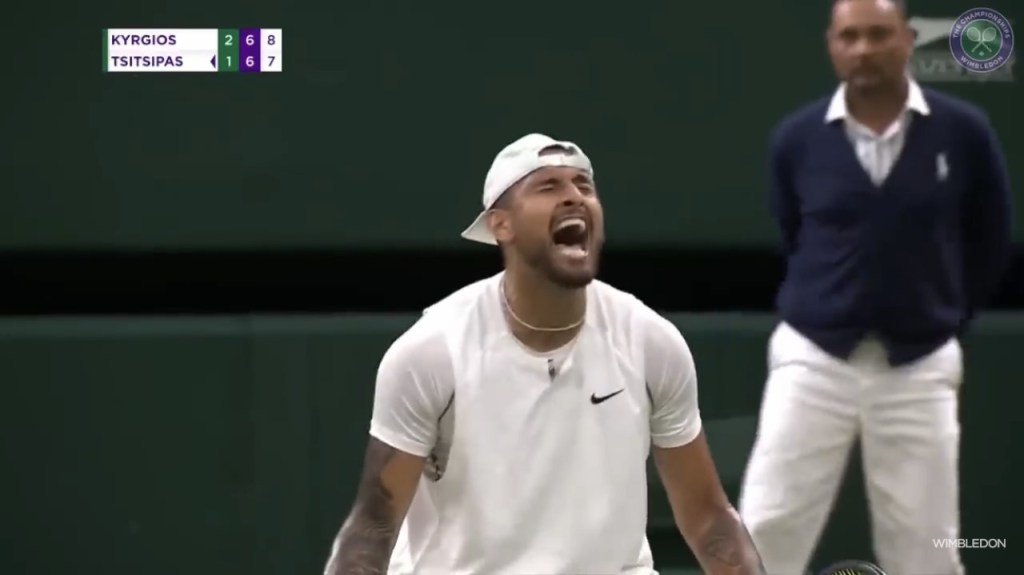
Nick Kyrgios produced a masterclass to defeat Stefanos Tsitsipas in four enthralling sets. To say that was a side note would be an enormous understatement. Tennis matches involving Kyrgios rarely pass without at times giving way to a bit of controversy. On Saturday evening, it felt like controversy sometimes gave way to a bit of a tennis match.  

It all started at 5-5 duece in the first set. When the line judge stopped a point that it turned out Kyrgios had won, the 27-year old expressed his frustration to the umpire. His incessant and by now predictable complaining continued for the duration of that first set which he eventually lost in a tiebreak where his level dipped significantly.

At every change of ends in the second set, Kyrgios continued to make his point. At 4-4, 30-40, when Tsitsipas finally had an opening on the Australian’s serve which had been so solid up until that point, Kyrgios came up with a second serve ace before closing the game out with more ruthless serving. He then played a brilliant return game to take the set 6-4. At this point, Tsitsipas swatted the ball away in frustration, apparently hitting a spectator in the process. 

This prompted another outburst from Kyrgios, as he demanded that Tsitsipas be defaulted for his actions. Whether or not that should have been the case is a debate in and of itself. With the rules being as vague as they are, it’s difficult to establish what constitutes being defaulted and what doesn’t.

Even at this point, it was all fairly par for the course for a Kyrgios match. It was what followed that was so jarring.

Tsitsipas, clearly rattled by his opponent’s antics, proceeded to try and hit Kyrgios on numerous occasions with the ball. There were moments in that third set where it appeared that things would boil over, with the Greek seemingly on the verge of a Kyrgios-esq implosion.

It continued in a similar fashion. Kyrgios closed out the third set with more excellent serving, at one point sarcastically remarking “nice shot” at a Tsitsipas stroke which landed way long.

Relatively speaking, set four was a more tepid affair with Kyrgios maintaining his near faultless level on serve. He eventually took it 7-6 on a tiebreak to record one of the biggest victories of his career. 

The match had a multitude of interesting aspects to it but what struck me the most was the broad range of reaction that this was eliciting. As is probably the case with the majority of you reading this, I often find myself scrolling through Twitter whilst watching a match. I’m not sure I’ve ever seen such a range of opinions about something as I did about this match. 

On the one hand, there was what we’d consider as Tennis Twitter. The vast majority in this fairly small bubble were far from impressed by what they were witnessing. This felt like a completely unnecessary act in what should be a high quality, high stakes tennis match. What started as a bit of an inconvenience quickly became the primary focus of this contest and it’s fair to say that people were pretty vexed at that.  

There was a far bigger group however, that were lapping up everything that was going on and positively overjoyed by what they were witnessing. For the casual sports fan, probably only watching Wimbledon because it was on the BBC and there’s no club football on at the moment, this was the epitome of Saturday night entertainment. When you don’t watch tennis on a regular basis, when you’re not as familiar with all of the storylines within storylines, it’s far less likely that a tennis match involving two players ranked 5th and 41st in the world is going to catch your attention the way it would with a seasoned follower of the sport.

Add a considerable amount of needle to said tennis match and it’s a completely different ball game, excuse the pun. Whether we like it or not, pure tennis doesn’t attract your man or woman in the street to anywhere near the extent that a match like this one did.

The avid tennis fan will understandably turn their nose up at them, but the sort of thing Kyrgios does whenever he steps out on to a tennis court sells. He was widely ridiculed when he claimed that he was “one of the most important people for the sport”. Although this was an absurd comment and one that sounded at best ill advised and at worst narcissistic, it’s not entirely untrue. Commentating for BBC 5Live, Kim Clijsters remarked that many of the young children in Belgium consider Kyrgios as one of their favourite players. In fact, plenty of grown adults cheer for Kyrgios more so than they do for other players simply because he brings an element of drama rarely seen in a sport otherwise so polite. WE can debate whether the sport is better off for having such fans and such players, but the fact of the matter is that the growth of the sport is ultimately  a positive as far as ticket sails and viewership are concerned. There’s no doubting that Kyrgios enhances that aspect.

Whilst in our bubble, the importance that Kyrgios gives himself seems ludicrous. On the surface of it, here’s a player, ranked in the top 50, who is at a push a part-time tennis player. But the truth is there’s so much more to the Kyrgios experience than that.  

On a personal note, I’m not sure on which side of the divide I stand. I was an enormous Kyrgios fan for a number of years. Slowly over time, his continuous harassment of line judges, umpires and just about anyone else has significantly reduced my good will towards him. I’d consider myself a tennis purest, someone who follows the tour on a regular basis, and as such I should have been appalled by his actions. But I think the most accurate way of putting it is that I wanted him to win in spite of what he now is as opposed to because of what he is. It’s not something I’m particularly proud of and I’m pretty tentative to admit it and I also realise how naive that statement probably comes across, not least after Tsitsipas’s claims of Kyrgios being a bully in his post match press conference and Kyrgios’s reaction to that. It’s evident to anyone that he has a big problem when it comes to admitting his own faults, a trait which is hardly endearing, and yet, inexplicably, I find myself rapt by his matches.  

Whether or not he is good for the sport will be debated until the cows come home. The point is, that debate will continue, and people will continue talking about him and that, beyond anything else, is why Kyrgios matches are watched by so many.

The Winning Moment: Nick Kyrgios beats out Stefanos Tsitsipas to reach the 4th round of Wimbledon 2022. Screenshot: Wimbledon

End of a Chapter

By Nick Carter

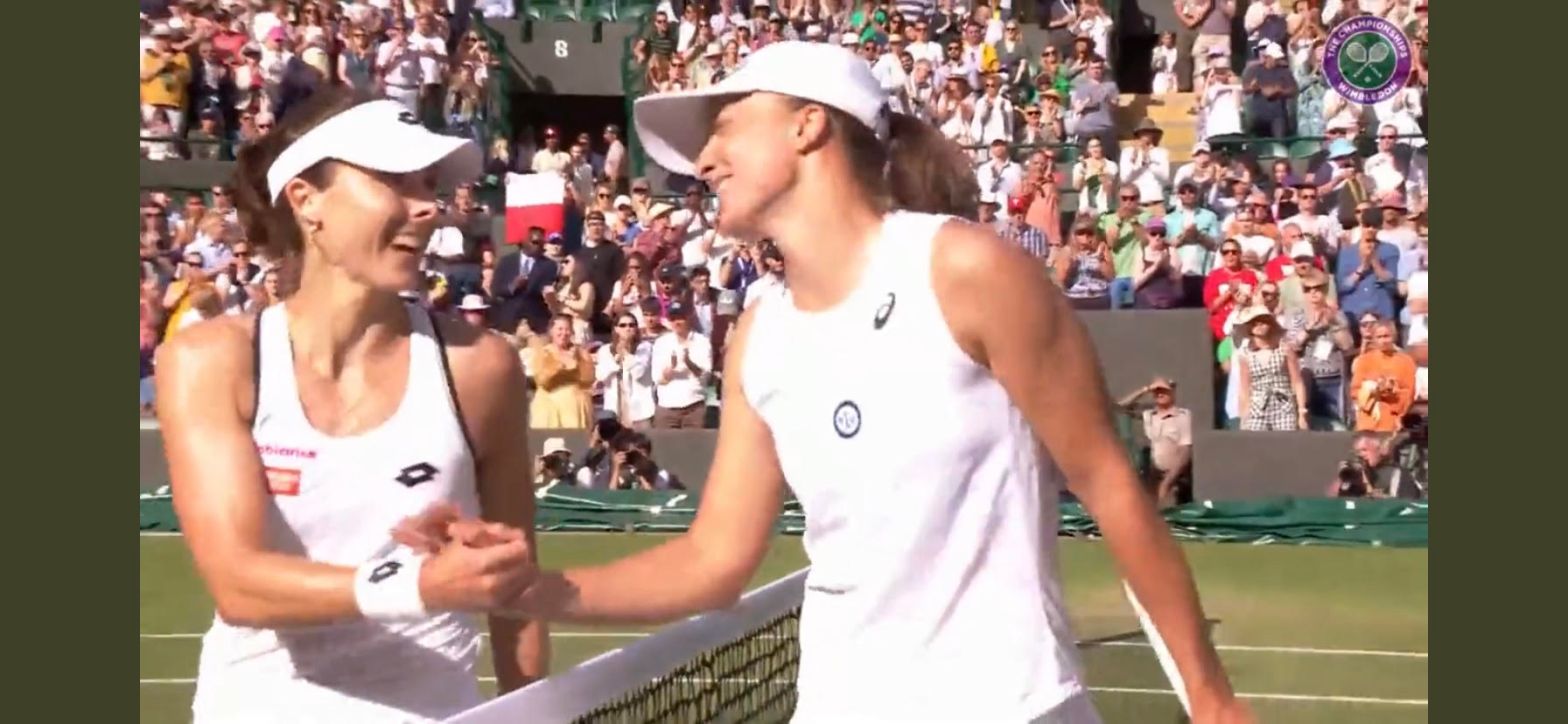
We all knew it was going to come to an end. No one is truly unstoppable. Even Roger Federer, Novak Djokovic and Serena Williams had losses during their most dominant periods. However, for me, today’s loss by Iga Świątek was very odd. I’ll let others reflect on the streak as a whole, but I want to look at the end.

Let’s get one thing out of the way now: Alizé Cornet played a really good match. She was solid, consistent, and pulled off some incredible gets. She really stepped up to her role as one of the disruptors of women’s tennis. Cornet famously did it before against Serena Williams the last time she reached the fourth round of Wimbledon in 2014, and she just did it again. Her peak level is up with the best, we just don’t see it that often. It was enough to end two streaks Iga Świątek had: 37 consecutive match wins since February 2022, and 7 consecutive fourth round appearances at majors (starting at Roland-Garros 2020). 

Consistency is the key word of this match. Iga Świątek has achieved most of her wins this year by being aggressive whilst somehow not missing most of her strikes, the heavy topspin keeping the ball in. Today, it was Cornet keeping the unforced errors to a minimum and finding her shots somehow landing in the court. By contrast, Świątek was the one misfiring, particularly at the start and end of the match. The middle part (from 3-0 down in set one through to 2-0 up in set two), was closer to the kind of performance we’ve come to expect from the Pole, blasting shots her opponent couldn’t handle. However, the ruthlessness on return was still missing to an extent. 

Weirdly, Świątek was very calm during the match. She got very animated during her tough moments at Roland Garros last month against Zheng (and against Kovinić to an extent). Here, she didn’t show much emotion, but you could tell from her shot selection near the end that she hadn’t quite worked Cornet out. She continued to up the aggression, which led to some unforced errors and even questionable shot choices. It was by no means a mental collapse, she seemed to very much believe she could get back in the match, but there was an element to her game that wasn’t quite there today.

In discussing what it would take for Świątek to lose, most have said that one of two things would need to happen: that she would need to have a bad day or she would have to face a particular type of opponent, either one with a lot of power that could outhit her (if they redlined) or one with enough variety to disrupt her. Cornet does not fit the power player mold, but she can mix up the pace. That said, the streak ended because Świątek was having a bad day. It was possible to tell this from the start of the match. She usually starts matches well and uses the momentum to keep herself in front, here she blasted unforced errors to go a double-break down immediately and gave herself a big mountain to climb.

Still, Świątek has had bad days during the streak, she was just usually able to stabilise things enough to win the first set and then take control early in the second. Thinking about her recent wobbles in Roland Garros, against Kovinić and Zheng, and her second round match at Wimbledon against Pattinama Kerkhove, her solid groundstrokes did desert her for a while. Zheng was a slightly different situation as her aggression was disrupting the world number one until her body intervened. In the case of the other two however, they lacked the consistency to take advantage of the situation they faced. Even when not at her best, Świątek is still able to execute some brilliant shots and even off her best, her defence is hard to breach. 

In today’s match, Cornet only hit seven unforced errors, easily taking the mantle as the more consistent player. In addition, she got many of her opponent’s heavy shots back in play. This helped her take control of the first set, and frustrated Świątek in the second as she tried to up the aggression and hit through the veteran. This is a scenario I hadn’t considered, that somehow that Świątek could lose to someone playing more consistently but it’s what ended up happening. 

This might be contributing to a sense of anti-climax. I think most of us hoped that the streak would come to a spectacular end in the second week of a major as Świątek took on a fellow top player, like Bianca Andreescu, Coco Gauff, Simona Halep, Paula Badosa, Jelena Ostapenko or Ons Jabeur. Fading out in round three to Alize Cornet seems inauspicious, especially to those who may not have seen the match. Rest assured, though, Cornet earned that win with her level and has some decent pedigree, having some big wins against top players (including the aforementioned Serena Williams), reached a career high of 11 and has reached a 1000 final in her career (Rome 2008, where she beat two French Open champions). She’s on a high this year, having finally reached a major quarter-final in Australia and a semi-final on grass in Bad Homburg last week (beating Angelique Kerber and narrowly losing to eventual champion Caroline Garcia, who is also into the fourth round at Wimbledon). 

If Świątek was going to have an early exit, it was probably going to be on grass. She’s yet to beat a top 60 opponent on the surface (check Juan Ignacio’s tweet below), as she seems to struggle to adjust to the different movement required and the bounce the surface produces. This lessens the sense that she’s underperformed, she’s far from being alone in being yet to figure out grass. In theory, her game should still translate to the surface, she just needs some more time.

I don’t like endings. It’s no secret that I am a massive Iga Świątek fan so it’s even more weird for me to see her match-win streak end compared to most tennis watchers. Now, there’s going to be a new story on the WTA at Wimbledon and I hope it’s a good one. I’m kind of hoping that Ons Jabeur wins the tournament, but there’s a long way to go before that begins to manifest. However, I’m not sad because Cornet played really well, and Świątek’s achievements this year are by no means diminished. This was one of the greatest four months a player has ever produced in the professional era, only matched by other greats such as Serena Williams, Steffi Graf, Chris Evert and Martina Navratilova. Let’s reflect on that, and remember that Świątek didn’t play that bad a match and that Cornet stepped up to the required level to win. The streak may be over, but the story is not.

Smile Through the Pain

Sometimes you’ll hear a top tennis player say something like “if you watch someone in the top five and someone in the top 500 practice, you won’t be able to tell the difference. The difference is more mental than technical.” This might have a grain of truth to it, but I call BS. Novak Djokovic can play someone ranked in the top 10 and make them look like a junior. In Madrid, he played Carlos Alcaraz in the semifinals, and in the first set, Djokovic consistently hit the ball harder than Alcaraz despite having less firepower. Alcaraz’s blazing groundstrokes were tormenting everyone on tour, but Djokovic barely let him get a clean hit on anything by constantly moving him around and putting the ball in uncomfortable positions. At one point, Djokovic won 21 straight points on serve.

This was in a match Djokovic wound up losing, yet he had still managed to make Alcaraz look much worse than he really was for a good portion of the contest. The dynamic can be even more extreme — at Roland-Garros, Djokovic played Diego Schwartzman in the fourth round, who had made the semifinals in Paris before, had been in the top 10 before, and is known as one of the cleanest hitters on tour. Djokovic beat him in a little over two hours. Schwartzman had gone up 3-0 in the second set, which is usually a safe lead, and Djokovic responded by winning six games in a row. Despite both men being in the top 20, it felt like Schwartzman was a pupil who had managed to really piss off his teacher.

I’ve belabored the point by now, but ranking is not necessarily a great indicator for how close to the top you are, and gaps in level can be enormous even at the top end of the rankings. Miomir Kecmanović may know that as well as anyone. He is having a great year. Ranked 78th as 2022 rang in, he is now ranked 30th. In spells, he has played at a world-class level — in Miami, he dragged the red-hot Alcaraz to the brink in a pulsating three-setter, two tiebreaks included. Though Kecmanović lost narrowly, the revelation of the day was how consistently well he played, pulling Alcaraz wide with vicious angles from first ball to last. When the match was over, Alcaraz celebrated like he had won a major rather than advancing to the semifinals of a Masters 1000.

Kecmanović went to Belgrade next, where he played Djokovic in the quarterfinals. Djokovic was still fairly early in his comeback from not playing due to (heavy sigh) being unvaccinated and therefore not permitted to enter certain countries, so going into the match, there was a persuasive argument that Kecmanović was the favorite. And for a set and a half, he played like one. He was calm and confident, opening up the court with those sharp-angled groundstrokes and hitting difficult shots under pressure. He broke Djokovic early, almost broke him again, then held on to win the first set. He went up a break at the start of the second. Djokovic came back at him, tying the match and then pulling away late in the third with some electric backhand winners, but he had been forced to play his best to win. It felt like Kecmanović had made more progress.

Fast forward to today at Wimbledon. Kecmanović, having won a pair of four-setters, set a rematch with Djokovic in the third round. It didn’t go well. He lost the first set 6-0. The second set was more even, Kecmanović toughing out a couple big holds of serve, but he couldn’t get close to breaking Djokovic. At 3-4, 30-all, Kecmanović attacked the net, but twice hit putaways to the side of the court Djokovic was standing on and ended up getting lobbed. You could feel the air go out of the match at that point. He quickly lost the second set.

Being down two sets against a much better player is a pretty terrible position to be in, and not just from an odds-of-winning perspective. Since your chances are basically nil, the easiest thing to do is lose as fast as you can, then book it off the court and drown your sorrows in a food or drink item of your choice. You can fight, sure, but 99% of the time, it won’t work, it will keep you out on court only marginally longer (it will still tire you out, somehow), and you will be left hating everything.

A lot of the time, I think players in this phase — way behind against a significantly better player — fight because they feel they’re supposed to, not because they expect it to work. Tanking is dishonorable in tennis, and matches against top players are regarded as invaluable learning experiences. You get to see what the gold standard is, up close and personal! Who can say no to that? So the expectation is that even when a player is down two sets and two breaks, and for all intents and purposes has a 0% chance of winning the match, they fight tooth and nail to stay out on court for an extra few minutes, an extra few seconds. There will be nothing a player can do, but we still expect them to try. It’s an unfair expectation, really. Fighting against impossible odds is honorable, I guess, but the fact remains that the odds are impossible. There comes a moment when trying is pointless.

I would have captioned this “playing cat and mouse at his compatriot.”

That was where Kecmanović found himself late in the third set, down two sets and 5-2. The match was over. The commentators had given up on analyzing the match. Andrew Castle spent a while asking Lleyton Hewitt what he thought of Jack Draper’s upside, then started marveling at how “Alex de Minaur has a great demeanor.” (I think thousands of people muted their streams after this.) No one would have admitted it, but everyone was waiting for the match to end. There was no tension whatsoever. Kecmanović knew it as well as we did. He had tried his best and it had gotten him nowhere, yet he was now supposed to put on a brave face in the face of the inevitable end.

Every tennis player has to deal with this at some point. No one is ever ready to dominate the tour when they emerge on the world scene (and most are never ready). There will always be a match, probably several, when the opponent is so much better that resistance is futile. We love to watch comebacks from two sets down, but they hardly ever happen, and are all the rarer against the top players. Djokovic has lost from two sets up exactly once in his career at a major. It was in 2010, one of his worst years, so was probably more of an anomaly than anything else. Coaches do not yell “remember 2010!” when their player falls two sets down against Djokovic. (The rightful response would probably be a rueful “screw you.”)

The thing is, the resilience you need to stage an improbable comeback usually has to be built up over time. The belief that you can in fact beat the odds isn’t that apparent until the comeback actually does happen, at which point everyone fawns over your perseverance, and your mental strength, and your admirable never-say-die attitude. Though tanking is easier, always, if it becomes automatic, you will start to miss those windows for a comeback, tiny though they may be. Tennis is hard and never stops being hard, but it’s also a long game. Staying out there for those excruciating extra few minutes today could be the start of an epic comeback tomorrow. Or in five years. Or maybe never, but you’ll have given yourself a better chance.

Kecmanović actually did haul a couple games back at the end of the match, though he didn’t really raise his level much. Djokovic lost his mind for a couple minutes up 5-2, 30-love, then failed to break in the following game despite being up love-30. To call it memorable would be a stretch.

What I will remember, though, is the reaction to Kecmanović breaking serve at 2-5 in the third, his first break in the entire match. Everyone knew that it wasn’t going to change anything. “Well, there you go!” Andrew Castle said. “Two sets and two breaks down, and finally he gets his breakthrough.” The camera bounced around, from Djokovic to Kecmanović to the players’ boxes. Everyone was kind of trying not to smirk, but some small smiles broke through anyway.

On to the next one. Screenshot: ATP Tour

Making Us Care

One of my major takeaways from my first live-and-in-person experience of watching Andy Murray play on the Centre Court of Wimbledon is that he truly does ask a lot of us as his fans. He screams at us. Yells at us. Roars at us. We lose our voices to him as all sense of the usual socially acceptable decorum that SW19 is known for is overtaken by this rampant need to see a man overcome whatever obstacle he may face.

But the thing is, watching Andy Murray traverse his way across odds that are stacked against him is one thing but watching him fail to do so is quite another. Yes, it’s heartbreaking, devastating, crushing, all of that for sure, but it’s also a reminder that sometimes we can work hard, practice harder, prepare the hardest and be as ready for something as it’s possible for us to be, and still be told “sorry, not today.”

***

As the roof came over and the lights came on across the 100-year-old stadium court last night with Murray trailing the American John Isner 2-4 in a do-or-die fourth set for the Scot, there was a sense that if he was going to win this match, it would require something that seemed impossibly out of reach. Murray seemed to know this as well, his head bowed as he sat court-side briefly before the roof announcement, his fingers stretching wide across the top of his head and imprisoning his thoughts in there for us all to only guess at.

The first two sets of the match had been a one-note story, Isner’s serve writing yet another chapter for itself to be considered as the greatest in the game. In fairness, this was backed up by baseline consistency and a wicked touch at net that we haven’t come to expect from him and this combination was enough for him to remain on the front-foot throughout in a display that had Centre Court murmuring with frustrated acknowledgment of superior play. Some will call the Isner style boring but that line of thought matters little in terms of tennis results. Boringly effective is still very much effective.

The potential storyline from here was barely tangible for Murray fans. It existed on the edges of our thoughts, daring us to look at it and acknowledge it, none of us daring yet to do so in case it should disappear in a flash beneath our wanting-gaze. 

A five-set fightback? Let none of us think it. Not yet. Not. Yet.

The third set progressed as serenely as the first two and a second tiebreak was upon us, this one coming with the added pressure of a match lost for Murray should he fail to win it. But win it he did, Isner’s first serve faltering beneath the weight of Murray’s desire that made itself apparent through the usual hallmarks of growls and fist-pumps and asking grated growls that had the Centre Court faithful on their feet by the end of it. 

The one thing that needs to be said here is that regardless of your thoughts on the 2022 version of Andy Murray’s tennis, he still has the innate ability to make us think the unthinkable. Two sets to one down, a metal hip in place, and in battle with a cannonball barrage, he STILL had us all believing he could click his fingers and fix it. Because this was Andy fucking Murray in his prime, Andy Murray in his element, Andy Murray in action, artfully Picasso-ing his way out of yet another messy situation, paint splattering emotion dripping down the edges of the stands, from the seats, from the rafters high on the roof above, from the Royal fucking Box, and zigzagging its way amongst the precisely cut blades of Centre Court. 

Andy Murray can still make us forget reality and likelihood and reason and the realistic and in a world dominated by cold dark facts, those moments of madness should be treasured and bottled and held onto for as long as humanly possible.

So were we thinking a five-set fightback? Were we thinking it at that stage? I think yes. I think yes we were.

But when we want something, how frequently is it quickly taken away? Indeed, on the come-up and playing better, energised and gassed from a crowd that were giving him everything, Murray netted a backhand that knocked the wind from his sails and drew haunted gasps from the crowd. You felt it at that moment. Isner, belief instilled with the knowledge of his serve remaining unbroken throughout, took the break point that followed and after the roof closure, the match.

Vocal cords hanging limply in our throats, we stood and applauded him — the two-time Wimbledon champion, the three-time major winner, the two-time Olympic gold medalist, a former world number one — off the court in defeat. 

***

Watching Andy Murray makes you feel like you’re a part of something. It makes you feel like you belong, that your tiny small bit in it all really truly does matter. When you watch him on the TV, he makes you want to reach through the screen and push him just that little bit beyond the limit just one more time. When you watch him in person, well… he makes you care. He makes you care because he asks you to and because he does, he cares, so damn much that it looks like it’s hurting him sometimes, tearing itself through his skin in anguish. And so we do whatever we can do to help him cope with it. Maybe if you shout just that wee bitty louder, it’ll be enough. And sometimes it is! Sometimes it is enough and sometimes… sometimes it isn’t. What that ultimately means is that when Andy Murray loses, you hurt along with him. It’s what you sign up for. It’s what’s necessary. It’s what’s required. And my god, being an Andy Murray fan has hurt sometimes. Hurt hard. Hurt big. But at no point, at no singular point throughout his decade-and-a-half long career, has he ever made me regret caring.

As he took his leave from Centre Court last night, exiting in the second round of Wimbledon 2022, Andy Murray left his fans hurting and caring and still very much hoping that this wouldn’t be the last.

Until the Very End

By Archit Suresh

The second day of the 2022 Wimbledon Championships is over. The tournament so far has produced spectacular matches and moments that, to our current minds, probably seem unforgettable. I’m here to tell you that they will be forgotten. One day, ten years from now, people are not going to bring up an inconsequential first round match of a tournament that doesn’t even have ranking points attached to it. Forget ten years from now, many of us aren’t even going to mention Day 2 ten days from now. Serena Williams’ long-awaited comeback was memorable and headline-worthy, but by the end of the first week, it’ll have fallen out of the current of storylines. We’ll be swept up in whatever crazy match we see in the latter stages of this tournament and tweet all about those storylines until something better pops up in a few days’ time. It’s the life cycle of the sport. 

Tennis fans, much like the players they support, seem never to have a second to breathe. The match you were watching on Centre Court is over and there’s a 20 minute break before the next one comes on? OK, turn it over to the stream on Court 12 where your ninth-favorite player is battling it out against a wildcard you’ve never heard of. Your favorite player just won a title? Congrats, but be ready for them to lose the first round of a 250 in three days’ time. Appreciating and enjoying the moment is hard to do in a sport like tennis where the season slows down for no one. So why would anyone choose to remember Day 2 of Wimbledon?

The date June 30, 2015 will always hold a special place in my heart. To some, it represents an insignificant Day 2 at SW19. To me, it’s the day I became a tennis fan and my life changed forever. While visiting family in London, we somehow happened to land tickets to Centre Court, a once-in-a-lifetime opportunity that I completely took for granted. Of course, we showed up late, catching the second half of a complete demolition job by Petra Kvitová over Kiki Bertens. Next, I saw Roger Federer glide his way to a nice and easy straight sets win over Damir Džumhur. I should probably repeat that. I saw Roger Federer play tennis on Centre Court. This was the moment I got hooked and became a fan of the sport, never looking back. I then got to watch Andy Murray win three relatively tight sets against Mikhail Kukushkin, a tricky Round 1 draw on grass. Finally, I watched the first half of Caroline Wozniacki’s win over Zheng Saisai before deciding to explore the grounds a bit more. The first time I had ever seen professional tennis live and in person was on Centre Court — I couldn’t have been any luckier. And I do look back on that inconsequential Day 2 at Wimbledon quite fondly, but not for the reasons you’d think.

For most fans, it would be the perfect day and the absolute best way to be introduced to the tennis world. However, the main feeling I carry from that day is regret. I regret not understanding the significance of what I was doing. I regret not cheering loud enough for the two athletes who have had the biggest impact on my life, Roger Federer and Andy Murray. I regret flying back home and watching that 2015 semifinal between the two, not realizing how good of a performance Federer had put on that day, without knowing that I couldn’t take performances like that for granted from the Swiss. I regret not knowing that I was so close to seeing Andy Murray almost lose everything to the sport he loved so dearly. 

While I do carry plenty of regrets from my first tournament as a tennis fan, I’m fortunate to have learned plenty of lessons from it. Over the course of those two weeks, I cheered when Dustin Brown beat Rafael Nadal in the second round, and was left in despair when Novak Djokovic defeated Federer in the final on the morning of my birthday. Soon, it became a pretty easy pattern. I cheered equally for every Federer win and every Djokovic or Nadal loss. If Federer had lost, I’d cheer for Murray. I didn’t realize how good I had it at that point. With the Big Four truly alive and Serena Williams as dominant as ever, I was spoiled by their greatness, and almost didn’t appreciate each of them for what they were. That’s the thing about human beings — we get used to good things being around almost immediately, and we quite often never realize what we have until we’ve lost it. 

My tennis story has come full circle at this year’s Wimbledon. I watched Serena Williams destroying second serve returns in ways only she could, as she battled tenaciously against an inspired opponent in Harmony Tan, with Caroline Wozniacki commentating. I saw Andy Murray back on grass, doggedly scrapping for a four set win under the Centre Court lights. I saw Rafael Nadal and Novak Djokovic battle their opponents and themselves as they found their footing on the grass, bidding to hold onto their positions at the top of the game. Somewhere, Roger Federer was watching on TV, just yearning for another chance to compete at the highest level, and you can bet he’ll be doing everything he can to make it happen. 

Serena celebrates exuberantly after breaking Tan at 4-all in the third. She wouldn’t be able to close the match out, but she made an incredible memory for anyone who watched the three-hour battle. Screenshot: ESPN

Perhaps to most people, these are matches that will never matter in the grand scheme of things — first-round matches are rarely relevant to tennis history — but I think they do matter. In 20 years when people show highlights of Novak Djokovic winning in Australia, I’ll also remember him losing to Denis Istomin in 2017, along with him grinding through five setters against Taylor Fritz and Gilles Simon to go on title runs. When I see images of Andy Murray holding the Wimbledon trophy, I’ll remember the pain he felt in his years out of the game, and the win against Oscar Otte, where he rode the waves of the crowd willing him to victory. When Federer’s graceful and poetic wins on grass are brought up, I’ll remember him gutting out a one-legged four set victory against Dominik Koepfer in an empty Phillipe-Chatrier. When Rafael Nadal’s 14 French Opens are replayed, I’ll remember him battling his foot just to get on the grass, to face the likes of Francisco Cerundolo in the first round. During a montage of Serena’s 23 Grand Slams, I’ll remember every iconic pose, gutsy hold, and thunderous “come on!” from her match against Harmony Tan, all for her to come up just short.

Every match may mean something else, but all of them matter. They matter to the eight-year-old who just picked up a racket last week. They matter to the 90-year-old who still feels 20 when they hear the soft thud of strings meeting ball. People may one day only remember the result of the slam, and not care at all about the Day 2’s of the world, but it’s our job to remember these days. Andy Murray may never have his fairytale run he so desires. Novak Djokovic may one day slip and fall, unable to find his way back to the top of the mountain. Rafael Nadal may succumb to the onslaught his own body continues to send at him. Roger Federer and Serena Williams may finally lose their long lasting battles with age, which they’ve evaded for longer than we thought anyone could. 

What I mean to say is that we can no longer take these players’ positions in Day 13 and 14 for granted. Those days could very well soon be behind us, but we’ll always have Day 2. We’ll keep believing in them because we don’t want them to stop. They’ll keep fighting because that’s just who they are. We’ll be right there with them, until the very end.

Day 1 Wimbledon Diary: The Queue

By Hanya El Ghetany

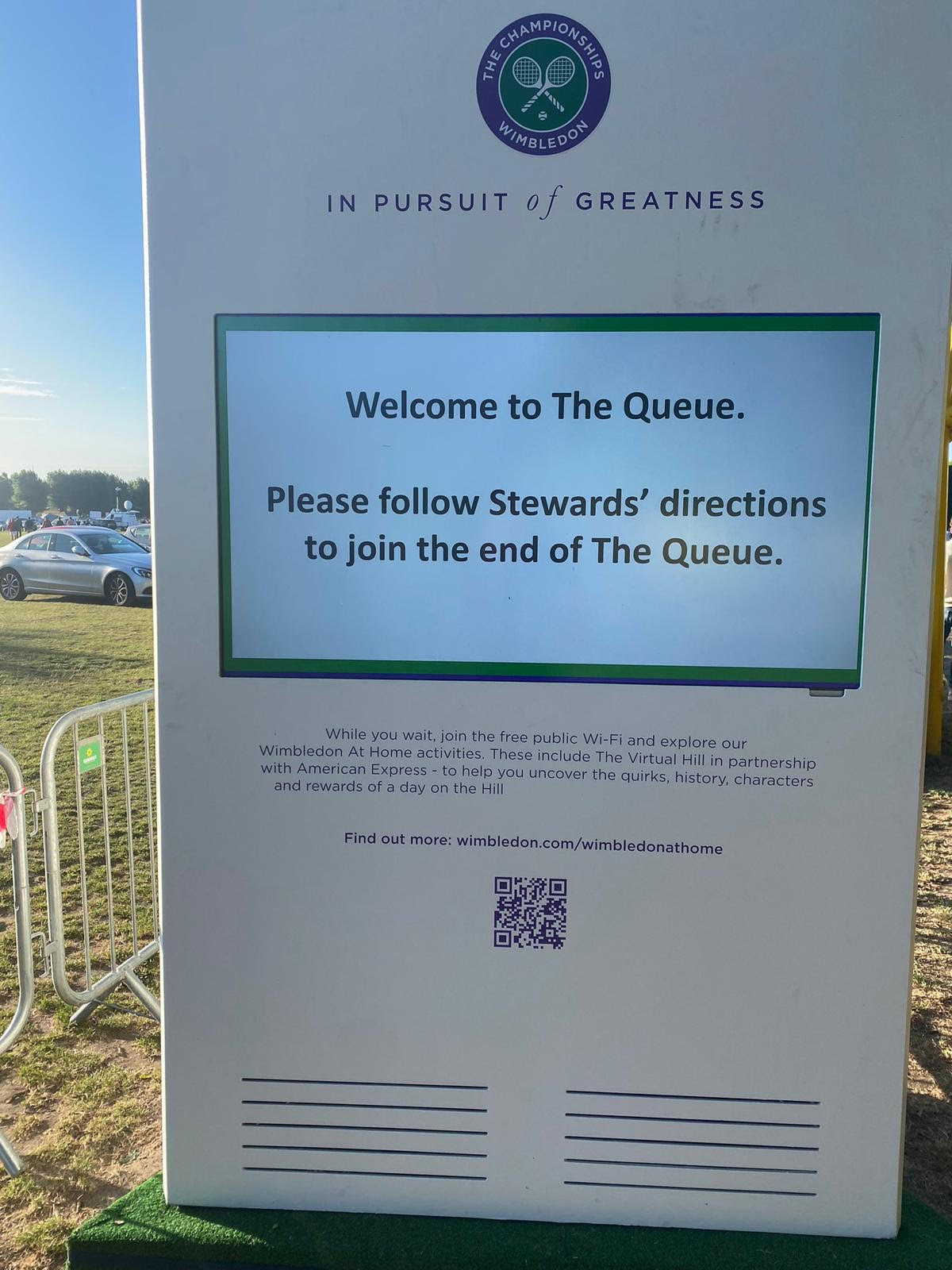
Players are testing positive for COVID-19 and withdrawing, yet the event is at full capacity and the greatest and most bizarre tradition of Wimbledon is back: The Queue. 

I decided that I wanted to get ground passes for the early rounds to meet as many players as possible and watch matches beyond Court 3 in proximity. I woke up at 4 A.M., ordered an Uber (Tubes don’t operate that early), and headed to the Wimbledon queue. I reached the queue area around 6ish and was number 2561. The stewards were telling me that if you got a card, you’re getting in, no matter if it stated otherwise on the card. They were also confirming that it is 100% a ground pass. 

The queue is an experience. I recommend trying it at least once in your life. It is very hectic because you often stay in your place for at least six hours before you get in. The younger version of me could have done this a couple of days in a row, but I just can’t now. To everyone’s pleasure, the sun was shining for most of the time we spent in the queue, and it only started to rain heavily the last 30 minutes. Everyone enjoyed this very much because it meant that play was delayed, and we could make it to the first couple of matches. To my delight, it meant I could still make it to Tommy Paul’s match. 

The highlight of the queue are the people first and the stewards second. From 6:00 A.M. to 10:00 A.M., people were playing sports, drinking coffee, having breakfast, and enjoying chats about their favorite tennis players with random people in the crowd. The stewards were telling us about their experiences at Wimbledon and why they joined the team. The best way to enjoy the queue is to go with a friend. Otherwise, you need to be an extrovert enough to talk to people. Usually, people are nice and willing to start conversations. Otherwise, bring a book or a movie on your phone to kill the time. 

At about 10 A.M., the stewards told us to get ready for the queue to start moving. Everyone went back to their designated place — you will never be able to cut the queue, as there are people checking your number with every checkpoint. People were still getting in the queue at around 10:30. I realized that you could join the queue at any given point, but getting there later resulted in a longer waiting time.

I posted videos on Twitter of the queue and everyone from the Daily Mail to London Live — no kidding — were asking my permission to reshare the video with courtesy to me. Suddenly the videos had 5000+ views, which was cool. 

The queue started to move very slowly at around 10. People continued to chat with each other. Free coffee was offered to everyone in the line, which was awesome (though I was already coffeed out, personally). The couple in front of me were Australians, the ones behind me were a group of Brazilians and Italians. We played a game where everyone was guessing where the other groups were from — the Italians were pretty evident, I thought the Australians were Canadians, and everyone thought I was Spanish, which is becoming a trend. We then started talking about our favorite players, who we are excited to see in action. The Australians told us that Nick Kyrgios isn’t that liked in Australia in comparison to Kokkinakis. We reached the end of the queue at about 12:15, got the grounds passes for 27 pounds and got in. Then we all wished each other a great day and went along. 

For 27 pounds, you have access to all courts beyond Court 3, on a first come first serve basis. I got to watch Bublik-Fucsovics, Taberner-Opelka, Griekspoor-Fognini, Kokkinakis-Majchrzak, the last set of Ruud-Ramos-Viñolas and started the day with Paul-Verdasco. It was a pretty good deal. 

The Tommy Paul match was the first I attended. The first set ended when I was in the queue but because of the rain delay, I was able to watch the last two sets. After the match, I ran into him again. To be honest, I was too embarrassed to go for another picture but as he saw me, he immediately said “hey, it’s you again, good to see you” and I decided fuck it, I’m going for that picture

As I was walking back, I ran into Kalinina who kindly told me to walk with her for the picture because she was running late. As Ruud’s match was about to end, we left to meet him at the exit for a picture. It’s Ruud, so the crowd around him was crazy and he had security guards. He was nice and waited to take pictures with everyone. He asked us to have our cameras ready so he could go through the pictures quickly. 

There were A LOT of Australians at Wimbledon on day 1. You’d think you were in Australia from the amount of support Kokkinakis was getting. The smaller courts are much easier to catch players at, and after the match, I also asked him for a picture. He was smiling, high-fiving everyone and thanking people who came to support him. 

As I was walking randomly through the grounds, Isner was speed walking towards me. I ran to him, but the security guard tried to push me out of the way. I asked him for a quick selfie, he said yes but the security guard kept pushing me. Isner had to tell him it was okay three times before I was allowed to take the selfie. 

Juan Carlos Ferrero was walking around unrecognized, which was a bit crazy. He was on the phone when he noticed that we recognized him. He stopped talking and posed for selfies. Anett Kontaveit was literally just randomly hanging out talking to someone when we recognized her and asked her for photos. Finally, my dream to meet every Italian in the top 100 was achieved when I met Fognini. I managed to catch him before the match, and he wanted to stop for a quick chat and photo, but the security guard stopped us both and told me maybe after the match. Seriously, Wimbledon — if the players are okay with it, just let them take the damn photo. Fognini turned back to me as he walked and told me sorry, which was nice of him. I watched his match, which he unfortunately lost, but as he left, I was the first person he took a photo with. 

Around 9 P.M. (I had been in out since four A.M.), the tiredness of the day started to kick in. There were still a couple of matches still going on, but everything beyond the courts that had sealing were stopped because of lack of light. Basically, everyone who wasn’t already at one of those courts just left because it made no sense to hangout with no matches going on. 

It was the longest and most tiring day of tennis I had — I went to Eastbourne from London and back in the same day. Hope you enjoyed reading about it!

Nowhere To Hide

Novak Djokovic has been the perennial favorite at most big events for the majority of the past eleven years. With the (skyscraper-sized) exception of Nadal on clay, Djokovic’s best level is better than the field’s. His game makes it so difficult to bet against him — he has safety net after safety net; if you can hang with him in a rally he’ll beat you with his serve, if you have a better forehand he’ll constantly force you to hit it on the run, if you’re playing as well as him but aren’t physically fit, he’ll expose your lack of stamina. The Australian Open is Djokovic’s best event historically, but at the moment, it’s hard to find a tournament he has a better chance of winning than Wimbledon. He was the champion in 2018, 2019, and 2021, with COVID forcing the tournament out of 2020. His last loss at Wimbledon was an injury-influenced one in 2017, his last loss on Center Court was in 2013. With Roger Federer way past his best years and sidelined with injury (he had Djokovic pinned at double championship point in the 2019 final) and the young guns’ lack of experience on grass, Djokovic may be as big a favorite as he’s ever been.

And yet. Djokovic enters this year’s Wimbledon with more pressure on him than I can remember, for the simple reason that if he does not win the tournament, his entire year goes in the bin. (Due to his ongoing unvaccinated status, Djokovic won’t be able to play the U.S. Open unless the U.S. start to allow unvaccinated visitors to enter the country.) He couldn’t play the Australian Open this year for the same reason, and at Roland-Garros he lost to a resurgent Nadal. The result was that his momentum from a brilliant 2021 season was utterly snuffed out. After winning three majors last year, Djokovic had evened the major count with Nadal and Federer at 20, and looked certain to cruise past them this year, but 2022 has brought an unwelcome twist of fate for the Serb. Nadal picked up the first two majors, opening up a gap again. If Djokovic doesn’t win Wimbledon, he could begin 2023 trailing Rafa by two or more. He’s as resistant to Father Time as anyone, but he isn’t getting any younger, and Nadal is surging. Djokovic needs to close the gap now.

Djokovic has had stretches of pure dominance in the past, but he rarely avoids close matches. He’s never won a major title without dropping a set. He was five points away from losing to Nadal in the 2018 Wimbledon semifinals and was down double match point to Federer in the 2019 final. Last year’s title in London was more comfortable, but things looked dicey for a bit when Djokovic lost the first set to Matteo Berrettini in the final.

Djokovic eventually gained control of this match, comfortably outplaying Berrettini in the final three sets.

And there is reason to think this year’s tournament will be difficult. Djokovic lacks the base — he’s only played 21 matches this year — and the form he had in 2021. He may be the top seed, but he has no wind in his sails. The one tournament he has won this year, the Italian Open, feels next to meaningless since Djokovic failed to follow it up with a title at Roland-Garros. His loss to Nadal in Paris has cast doubt over his typically impeccable physicality; he lost steam at the end of the vital fourth set. A few days after the match, his coach Goran Ivanišević declared that Djokovic would be ready for Wimbledon, but that the loss had affected him badly. Djokovic’s self-confidence is usually unshakeable, but if there were a time for there to be doubts, it would be now.

That said, Djokovic has a rich history of performing well under pressure. In 2018, with his form flagging, he suffered a brutal four-set loss to Marco Cecchinato in the quarterfinals of Roland-Garros, despite having multiple set points to take the match to a fifth (sound familiar?). Despondent in press, Djokovic confessed that he wasn’t even sure he would play the grass season. But he did, and he won Wimbledon, beating the red-hot and then-world-number-one Nadal in an epic five-set semifinal. Last year at Wimbledon, he faced the pressure of never having won the Channel Double, but he came away with a relatively comfortable win. Many of the best feats of his career have been performed while walking a tightrope — those match point saves against Federer, the grueling matches he pulls out with the extra ounce of energy in his legs, the matches that could have gotten complicated if he had just missed a first serve here, a running forehand there. Djokovic is a master at navigating pressure.

The difference this year, I think, is that it feels like Djokovic has to navigate pressure. Usually, obstacles appear on his path to a title as he’s walking it — he’s off in an early-round match, or a seemingly innocuous opponent has a great day, or he has a late-round clash with a big rival. But this year the pressure is already etched into the tournament itself, which means every round is a potential pitfall. In the case of a loss, Djokovic can’t comfort himself with the knowledge that he’s done a lot this year already, because he hasn’t. He can’t look ahead to the U.S. Open as a site of redemption, because he won’t be able to play it. He might not be able to keep his deficit in the major race static, because Rafa could win Wimbledon, and his chances improve if Djokovic isn’t there to meet him in the final.

Think about it: what if Djokovic doesn’t win Wimbledon? He’ll be stuck on 20 major titles until 2023. He won’t be at the U.S. Open, barring a travel policy shift between now and late August. He might not even be at the Australian Open next year — you still have to be vaccinated to be guaranteed entry Down Under — and after that comes Roland-Garros, which has never been Djokovic’s tournament to win. What is he supposed to do in the meantime? He’s not going to qualify for the World Tour Finals at the rate he’s going. His ranking will continue to tank. Since he can’t get into the U.S., he won’t be able to play the Masters 1000s in the States, and even if he could, he wouldn’t be adding noticeably to his career. His lack of match practice in the first third of 2022 might have doomed him in some important matches — his lack of fitness was painfully obvious in Monte-Carlo and Belgrade, and he may not even have recovered all of his old zeal by Roland-Garros. Can he keep taking long breaks like that? I don’t think he can; not playing for a while kills a player’s familiarity with the rigors of competitive matches, and it takes a huge effort to get reacclimated. By the second spell off tour, Djokovic might already be reaching the point of diminishing returns.

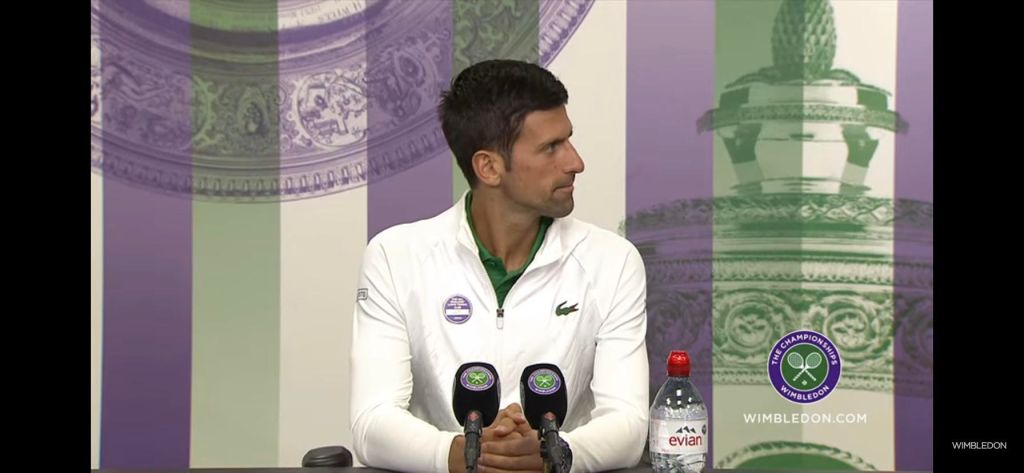
Djokovic in the press room pre-tournament. Screenshot: Wimbledon

The painful truth is that while Djokovic rarely has to win a title to cement his place at the top of men’s tennis, he needs to win this one. The potential consequences in the case of a loss are too great — it could be almost a year before he can play a major again, at which point his form could be damaged beyond repair, his motivation shot, or his deficit in the major race too large. I can’t read Djokovic’s thoughts, so maybe he isn’t worried about any of this. Hell, just recently he happily posted a video of trying to put together a trampoline with his coaches. Judging from his recent press conference, though, he knows how important this tournament is. If I had to guess, he must also know that his aura from last year has been diminished almost beyond recognition, which means he’s understandably desperate to get it back.

In Paris, despite Djokovic’s status as favorite at the time, his loss could be easily explained. We thought Nadal would be physically compromised, and he wasn’t, and he played a great match. Fine. Djokovic had lost to him in Paris seven times before. It is much more difficult to imagine a plausible scenario where Djokovic could fall (figuratively, not literally. Grass is slippery) at Wimbledon. This is his title to lose, and a loss could have catastrophic consequences. When he plays tennis, he usually denies his opponents of a comfort zone; if they have a weakness, he will target it until it not only cracks but shatters. He may now be the one realizing he has nowhere to hide.

A Broadcasting Legend Calls Time On Wimbledon

By Lee Stanley

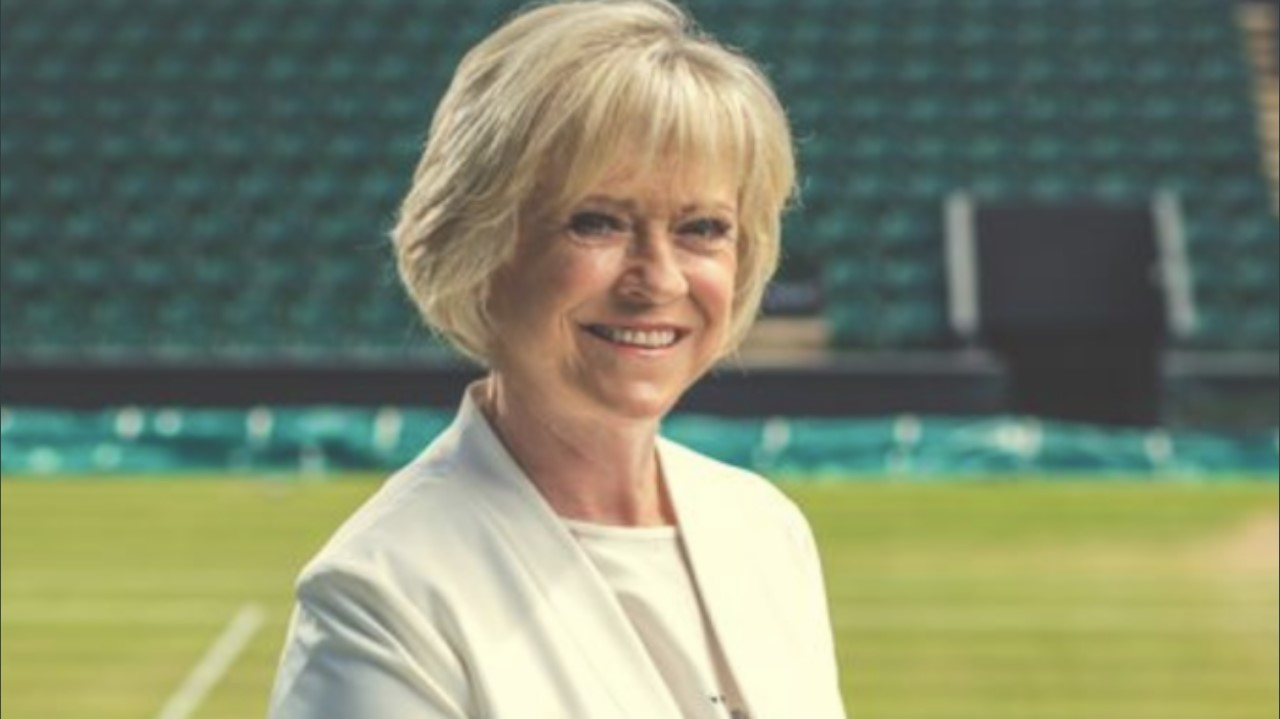
Winner of the French Open in 1976 and of fourteen tour titles during a 12-year career with a highest ranking of 3, Sue Barker is arguably one of Great Britain’s most successful tennis players. However, she is probably better known to younger fans as the face of tennis coverage on British television.

Sue Barker has transported millions from their living rooms, via BBC television, onto the hallowed courts of Wimbledon for 22 years. That’s over a quarter of the 85 years that the Championships have been broadcast by the network.

Sue joined the BBC in 1993 following stints on Australian television and Sky Sports. In addition to tennis, she has worked on racing, athletics, Olympic, Paralympic and Commonwealth Games, and Sports Personality of the Year. Sue recently presented her final Queen’s Club Championships, and also brought us the ATP Tour Finals from London as well as many of Great Britain’s Davis Cup ties.

Sue Barker will be remembered for emotional interviews with Andy Murray on winning the 2013 and 2016 Championships, for her expert filling during rain delays before the roof was installed, and moonlighting as a continuity announcer, expertly guiding viewers across two channels at once while dashing between Centre and No. 1 Courts.

Host of A Question of Sport for 24 years, until an arguably unsuccessful revamp saw her replaced in 2020, Sue is now 66 years old. While it would be natural for someone of such an age to consider retirement, one has to wonder if she has slowly and subtly felt pushed away in favour of younger, fresher talent.

Any sense of this sentiment is not being displayed publicly. Sue will get the send off she deserves with prime-time coverage bumped up to BBC One every day of her final Championships. She will be missed by tennis die-hards and drop-ins alike, and many will consider her irreplaceable. But tennis never ends. Someone new will take over the biggest job in tennis broadcasting from 2023’s Championships.

The favourite to succeed Sue is someone who will be more familiar to cricket fans. Isa Guha gets a head start over anyone else by co-anchoring this year’s Wimbledon coverage. She will open proceedings on the outer courts each morning on BBC Two before Sue introduces the showcase matches later on BBC One.

Other names are already flying around social media. Two stand-out fan favourites are Catherine Whitaker and Marcus Buckland, the friendly and knowledgeable all-year-round anchors of Prime Video’s excellent coverage. With the streaming service reportedly about to lose the US Open to Sky and the ATP and WTA Tour rights up for negotiation before the end of 2023, this might be the next logical step for both.

Many of the broadcasters currently involved in the BBC’s coverage of Wimbledon have been suggested for the top job, and while some of them have experience in front of the camera, most are well established in commentary or analysis roles than presenting. The BBC will probably want someone who is seen as a BBC person rather than a freelancer to be their new face of tennis, potentially for many years to come.

Versatile like Sue, Clare Balding is their next most experienced live tennis presenter — she also presents their coverage of Eastbourne — and it’s likely that she will retain her current role if she is not promoted.

Two not to be ignored are Kat Downes, who has presented sport on BBC News and highlights of the Australian Open, as well as commentated on Wimbledon, and Lee McKenzie, who is best known for her work in motorsport and rugby coverage, but has experience as Centre Court most-match interviewer and reporter.

Whoever comes in, they will have big shoes to fill. As for Sue Barker, it would not be a surprise to see her invited back to BBC Sport as an occasional pundit and guest on other shows, so hopefully this will not be the last we see of her on our screens.