Reasons That I’m Excited For Wimbledon In 2022

By Nick Carter

It is Wimbledon in only a matter of days and I’m so excited. In fact, I am so positive about the event, I want to share exactly why I am excited.

Let’s start with the emotions, and get my biases out of the way. I’m British, I grew up with Wimbledon. To me, it is the home of tennis, as for a long time it was the only event I could watch. The bright green courts on a sunny day, with two combatants clad in white playing a wonderful game that mixes power with precision and control. It is that controlled aggression that I admire the most in a tennis player, which is what appeals to me about my favourites Roger Federer and Iga Swiatek. 

To me, grass court tennis is fantastic. I see too many people doing it down, comparing it to clay court tennis. Now, I like watching players on clay, the rallies are longer, more physical and technical. However, I love the fact that on grass you get more winners, and aggressive play is rewarded more often. The way players have to get down that bit lower to scoop up shots is great to watch and this adds to the power plays we see. Actually, the idea that grass court tennis is more boring doesn’t sit well with me. Yes, you get a lot more serve dominated matches but at least those are over quickly. Dull matches occur just as often on slower surfaces, but they just look different (lots of neutral rallies ending in errors). I’m not going to say different people’s tastes are wrong, what you enjoy or not is up to you. All I’m asking is that you let me enjoy tennis on grass. 

In fact, I’d say Wimbledon has produced contenders for the best match of the year for the last decade and a half. Certainly, the finals are usually the best the majors have to offer. The Australian Open has usually provided the main competitions, and it takes place on a fast surface. That’s a tangent as part of my fast-court tennis agenda. If you look at men’s tennis then you can say that Wimbledon produced the definitive best match of the season in 2007, 2008, 2018 and 2019. Two of those matches were the best of the decade, if not of all time. If you look at 2009, 2014, 2015 and 2016 Wimbledon produced matches that were contenders for best of the season even if they weren’t clear winners like the previous list. Add in 2011, 2013 and 2017, which also produced some well-remembered matches, and suddenly that’s 11/14 Wimbledon events that have given us some awesome moments. That is just in the men’s game, given how the WTA has produced some consistently great battles over the last couple of years, Wimbledon should magnify this.

Furthermore, Wimbledon is where the greats truly rise to the occasion. Most winners at SW19 are multiple major champions or world number ones. In the Open Era, there have only been seven players who have won their only major at Wimbledon: Marion Bartoli, Goran Ivanisevic, Jana Novotna, Richard Krajicek, Conchita Martinez, Michael Stich and Pat Cash. Otherwise, Centre Court is the home of champions, with many of greats being dominant on finals day. Great players including Roger Federer, Serena Williams, Bjorn Borg, Pete Sampras, Steffi Graf, Martina Navratilova and Novak Djokovic have won five or more titles here. Only a few players in history who could be included in the goat debate have failed to win here (off the top of my head I’m thinking of Ken Rosewall, Ivan Lendl, Mats Wilander, Monica Seles and Justine Henin), but they usually find themselves in the final at some point. With tennis’ long history on grass, Wimbledon is the place where greatness can be best compared. Every other major has fluctuated in importance over the year, but The Championships has always been at the pinnacle.

So, that’s why I’m excited in general for Wimbledon and always will be. What about Wimbledon 2022 though? The event has come in for a lot of criticism because of recent events, which I have talked a lot about already. However, if you unconditionally love someone, how you feel about them doesn’t change even when they make mistakes. This sums up my feelings about Wimbledon right now. Regardless of how much I disagree with what they’ve done recently, I am looking forward to the action.

I’m not going to do a full preview here, I want to keep this general. However, the 2022 edition of Wimbledon, the 100th anniversary of Centre Court, already has a lot of elements that will make this specific event very interesting.

First of all, this is the first major since the 2021 Australian Open where Novak Djokovic and Rafael Nadal are the top two seeds. The last time these two played in a major final against each other was at Roland Garros in 2020. Nadal has a really tough draw, but I’m done underestimating him this year. If they were to meet in the final, Djokovic would be the favourite for what would be his 7th title (he has not lost at Wimbledon since 2017!). However, part of me would be thrilled if Nadal won his third, especially given how he’s underperformed on grass after a streak of five consecutive finals (when he played the event). Regardless, the result could really swing the grand slam race definitively one way or the other.

Other things to watch for in the men’s draw are the performances of other grass specialists. Matteo Berrettini is probably the best grass court player in the world right now outside of the “Big Four” (and yes I am including Andy Murray if he’s at his peak and fully fit). If he takes on Nadal in a semi-final, I could see him producing what would be the biggest win of his career. Berrettini is often underrated and overlooked as a player, and it’s worth reading this piece by Owen about his career. Then of course there’s Felix Auger-Aliassime (who also is potentially drawn to have a run-in with Nadal) and Hubert Hurkacz, who seem to have figured grass out better than most. It will be interesting to see how Carlos Alcaraz does. He’s had some time out so is likely to be rusty, but his game should work really well on grass thanks to his big strokes and matchplay skills. This Wimbledon will be the real test of his skill there. There are also two wide open quarter-final spots, as both Casper Ruud and Stefanos Tsitsipas do not have great reputations on grass. I think this is harsh on Tsitsipas, who has reached the fourth round at Wimbledon before and did reach the Mallorca final. Unfortunately he is in a tough section with those who have better surface records. 

Moving to the women’s singles, and it feels odd to say the event feels wide open when Iga Swiatek is still on this massive winning streak. This is due to the perception of her game not being quite as effective on grass. What I would say about that is that her run last year was pretty strong until Ons Jabeur got in her head in the fourth round, and she is still a former junior champion here. There are players who will be bigger threats to her on grass though compared to hard and clay. Jabeur is the obvious choice here, and now she is world number two she has an opportunity to solidify that status. The Tunisian woman’s game is so suited to grass and she now has the experience to manage the occasion to her advantage. Former champions Simona Halep and Angelique Kerber should not be counted out either, they have a special relationship with SW19 that gives them an advantage. Last year’s runner up Karolina Pliskova should be on the list as well, although she is hard to predict, whilst former US Open champion Bianca Andreescu has built some form since her comeback and has arguably underperformed at Wimbledon. Coco Gauff should not be counted out as she seems to have unlocked some potential within herself and then there’s the amazing run of Beatriz Haddad Maia at the British warm-up events in Nottingham, Birmingham and Eastbourne. I don’t see the Brazilian as a title contender but I think we’ll see her in the second week. One more name I want to throw into the mix: Jelena Ostapenko, the 2017 Roland Garros champion and 2018 Wimbledon semi-finalist. Her grass court game is really strong and I think she is a serious contender every year.In short, I don’t think there will be any random winners, but it will be a real battle for whoever does come through (my pick is still Swiatek though). 

Of course, the big story for a lot of people is the return of Serena Williams, and the big question is whether this will be her final time playing Wimbledon. I’ve given up trying to predict when the greats will wrap up their careers, and she can carry on as long as she wants. Still, if this is the end for Serena, I hope it is on her own terms and in the spectacular style we have come to expect.

Finally, I’ll be watching the home favourites with great interest. Interestingly, it hasn’t been the British players one would expect to be making headlines who have suddenly hit form in the warm-up events. Ryan Peniston won a lot of people over after his exploits at Surbiton and especially Queen’s Club. Katie Boulter got some big wins and Harriet Dart some deep runs, whilst Jodie Burrage somehow managed to dig deep to beat a top five player in Eastbourne. Jack Draper seems to be going from strength to strength, and has a growing fanbase. All these players should have some really good momentum and provide some good news stories for the British media to promote. Cameron Norrie and Dan Evans haven’t set the grass alight these last few weeks but they’ve got decent draws so should reach round three. Then of course there is Andy Murray, who is returning after his injury sustained whilst playing against Berrettini in the Stuttgart Open final. I think if he’s fully fit, he’ll be back in the second week and challenging for a quarter-final spot. Yet again, the Scot will be the best hope for British interest at Wimbledon. In fact, Emma Raducanu is somehow the player with the lowest expectations as she’s still recovering from her own injury woes and is drawn against a very in-form Alison Van Uytvanck in round one. There is a lot of potential here for the best result from British players as a whole at Wimbledon in a very long time. I could see four still standing by Middle Sunday. As a Brit myself, this excites me greatly.

In my view, Wimbledon is awesome in general and there are reasons to look forward to it whatever the context. The story of 2022 so far means that these next two weeks could end up being the most intriguing chapter so far. And, this will be another glorious summer in my love affair with the event. We’ve had some disagreements recently, but I still hold on to what’s important, and I want it as an unconditional part of my life. So, here’s to two weeks of sunshine, tennis, nostalgia and great moments.

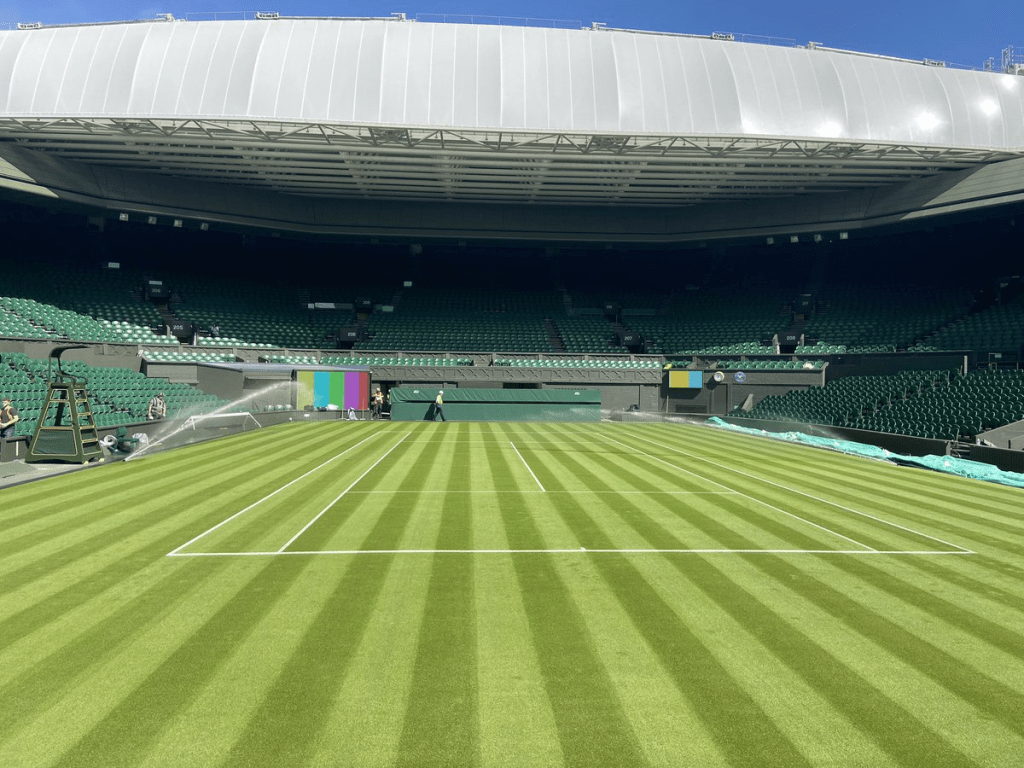
100 Years Old: Centre Court at Wimbledon. Screenshot: WImbledon

How To Expand the Grass Season

By Danny Richardson

It’s called Lawn Tennis for a reason.

Well, not really. The manicured croquet lawns where our sport originated have long disappeared from the name. The Lawn Tennis Association may disagree, but their name is probably less a statement and more a typically British desire to avoid change if it involves a bit of work. Still, nomenclature aside, grass is the original surface of tennis, perhaps the most famous, and in the eyes of many, the best.

Although some philistines may want to finally end the grass court, its presence as the surface of the most famous grand slam tournament kept it alive, even as the artificial menace took over the rest of the world. Indeed, such is the status of Wimbledon and their pride in the lawns, if the Chairman of the All England Club were to ever suggest paving over the courts – or heaven forbid replacing them with that most European surface of all, clay – one suspects they would be thrown out of the club faster than a player showing coloured underwear.

Photo credit: @AELTCGroundsman on Twitter/All England Lawn Tennis & Croquet Club

In recent years grass has undergone a minor revival. Reduced by 2014 to a two week stretch pre-Wimbledon, and for the men the Hall of Fame Open stubbornly clinging on at the original home of the U.S. Open the week after, in 2015 we finally gained an extra week. Even better, the prestigious Queen’s Club and Halle championships were upgraded from the rather sad status of 250s to 500s (the more enlightened WTA had always kept Eastbourne at their intermediate Premier level).

Now, ATP chair Andrea Gaudenzi has revealed there may be a new masters event on grass. The WTA must surely follow, particularly when the loss of China means they have two 1000 tournaments to replace.

You’d think then that grass court tennis is healthier than ever right? Well, not exactly. 

The trouble lies in the lower leagues of tennis. While this year’s ATP Tour features eight grass tournaments, on the challengers there are only three out of 123 scheduled events. For the lowest ranks, the ITF circuit has another three post Wimbledon. The women have it even worse. The WTA Tour has seven grass tournaments, but there is only one solitary event on the WTA 125 series, and out of over 500 ITF women’s tournaments, a grand total of two W100s are held on grass.

(Interestingly, bar the WTA 125 at “Gaibledon”, Italy, all these lower level events are held in the United Kingdom, a fact that cannot have escaped the minds of the governing bodies as they pondered their response to the LTA’s ban of Russian and Belarusian players.)

Is this just a result of a calendar truncated by the still ongoing Covid pandemic? Partially. The ITF schedules pre-2020 had grass court events in countries like Australia, Japan and India. While hopefully they can return next year, a “full” calendar still usually had only a single-figure amount of grass events.

These limited opportunities create a huge barrier. Unless you’re British, meaning you have a better chance of receiving wild cards into those few grass events, your ranking determines your entry like everywhere else. But the main draw cutoff at a W100 event is often in the 100s; for Wimbledon ladies’ qualifying this year it was #290. With hundreds of players ranked lower than that, how do they gain experience on grass?

The answer is that they don’t really. Beatriz Haddad Maia, the surprise winner of the midlands double of Nottingham and Birmingham, admitted in a post-match interview that her form was a surprise even to her, as she has no access to grass courts in Brazil. Only after grinding her ranking up to 166 in 2015, five years after her senior debut, would Haddad Maia play on grass, winning only two matches in four tournaments. She didn’t play on grass again until 2017, and an unfortunate injury in the summer of 2018 meant another year without playing on grass. This isn’t atypical. Pick a player at random, and odds are their CV will show a sparse grass history in their early years. Junior tennis may give a limited opportunity (Haddad Maia played junior Wimbledon three times), but with all the costs and no monetary reward, not every player commits to the full junior circuit.

Prize money at the bottom is sparse. A first round loser at a W15 receives $147, which might cover a pair of shoes. Is it any wonder that faced with little possibility of making the draw, and scant reward if they do, some players simply decide to grind away on clay and hard, avoiding grass altogether?

You don’t see this with other surfaces. British players have little access to red clay growing up, yet they all play multiple clay tournaments every year. (Emma Raducanu, who won the U.S. Open before playing a single clay match, remains a wonderful unicorn.) The difference? The hundreds of clay events held yearly. Without the pressure from hundreds of players trying to fit into a handful of 32 player draws, even an unranked player can easily find a tournament.

For grass tennis to really thrive, it needs to be accessible to more than just the elite. How do we fix it? If the tennis governing bodies are asking, I have a wonderfully obvious idea: put on more events. 

How do we do that, when a tournament is expensive to host and even a 250 level event can lose money? Well, that’s a little trickier, but tennis is privileged to be a wealthy sport. 

It is common in sport for the top of the pyramid to support the bottom. For a sport to continue it needs a future generation; for a sport to grow it needs new markets. This already happens in tennis to some extent. The ATP has subsidised challengers, Wimbledon plays a role supporting the new grass court tournaments, and the top players have pushed for prize money increases to be aimed at early rounds. It should not be a major ask for the largesse to be shared a little further.

Running a successful event at the lower level is tricky. You can’t ask for hundreds of dollars for a ticket, there’s no lucrative TV contract, and sponsorship is sparse. But successful challenger events exist. The combined grass events in Ilkley and Surbiton attracted full crowds and even a BBC stream. Many challengers throughout Europe and South America, held largely on clay, also attract passionate fans. With other surfaces already well represented, and the possibility of the unusualness of grass attracting a curious audience, it is surely possible for some events to switch surfaces.

Grass adds another expense; courts are expensive to keep and a week of professional tennis leaves them in a sorry state – not an inviting prospect for a club tasked with getting them back into play for their members. With support to get started, though, and a subsidy if necessary to keep events viable, new events could start up within a few years.

With new events established, and the return of pre-pandemic tournaments, grass court tennis at the lower levels will begin to re-establish itself. Unencumbered by the tours’ need to regularly gather together at the big events, a typical week on the ITF circuit features events on every (other) surface at every corner of the globe. Add grass to the mix, and players could gain experience any time of the year.

As great as all this could be, if the elite level of tennis still only features a few weeks of grass, it will remain a niche surface that many players will never feel comfortable on. However many challengers exist, if the tours only have a few weeks on grass, it will still be a surface some players feel they can skip, a surface players already at the top may never hone their games for. So expansion is just as needed on the tours.

Expanding into the moribund July clay swing is the obvious ploy, and perhaps that will be the case if the grass masters appears. But why limit ourselves to one stretch? Why not have a second grass court swing at a different time of year? The calendar is too full to carve out an exclusive period, but there is nothing stipulating all tournaments held the same week must be on the same surface. After all we have the golden swing in February, while the other half of the tennis world remains on hard in Europe and the Middle East.

Freed from the gap between Roland-Garros and Wimbledon necessitating tennis remaining in Europe, we could venture anywhere. Maybe Australia would like tennis outside of January, or South Africa (a traditional lawn tennis nation!) might make a return. Or what about India? They hosted the only other grass event this year – a home Davis Cup tie versus Denmark. Despite a long tennis history, India has only intermittently hosted top tier tennis in recent decades. Could being part of a new grass swing cement a home for professional tennis in a nation with over a billion people?

It’s easy to dream of these things. It’s almost as easy to imagine yourself as the President of Tennis and spend money that isn’t yours. But the fact remains, grass is going nowhere, even while its current state limits its potential. For tennis to grow and thrive, it must invest in grass.

Let Coaches Do Their Jobs

By Ashlee Woods

Some of the best moments in sports history happened because a coach stepped up and helped their players, and tennis looks like it’s willing to be more receptive of a coach’s job. On Wednesday morning, the ATP announced an off-court coaching trial. Coaches will be able to guide their players out of trouble starting on July 11 — not by having full conversations, but through gestures and abbreviated verbal phrases. The trial will end at the Nitto ATP Finals and the results will be evaluated. 

“Congratulations to the ATP for ‘legalizing’ a practice that has been going on at almost every match for decades,” Patrick Mourataglou wrote on Twitter. “No more hypocrisy.” 

For years, what made tennis unique is that a player has to ride the ebbs and flows of a match by themselves. It’s what makes Rafael Nadal so great. It helped Serena Williams win 23 career singles grand slams. But not everyone has the tennis IQ of a tennis great. Sometimes, a player may realize what they’re doing is wrong, but can’t find a solution.  

Tennis has seen some vast changes over the past couple years. Some — like a final set tiebreak and ballpeople not handling sweaty towels — have been good for the sport. Others have not, but this one may actually help the game more than hurt it. 

Yes, seeing a player like Nadal dig out of a two-set hole to win a major with problem solving is awe-inspiring. But there are countless other awe-inspiring moments that wouldn’t have happened if a coach didn’t step in to make the right call. 

Imagine if Kyra Elzy, head coach of Kentucky women’s basketball, had not drawn up a play for her best shooter, Dre’Una Edwards, on the fateful day of the SEC championship finals. Kentucky wouldn’t have won the SEC championship. Is that moment lessened because a coach set her team up for success? 

That’s what coaches are supposed to do. Set their players up for success. 

The prestige, glory and honor that comes with winning a title on tour isn’t lessened by someone telling another person what to do. It’s what allowed many people to win championships. If taking away points won’t dim the light of a major, I’m hesitant to say that off-court coaching will. 

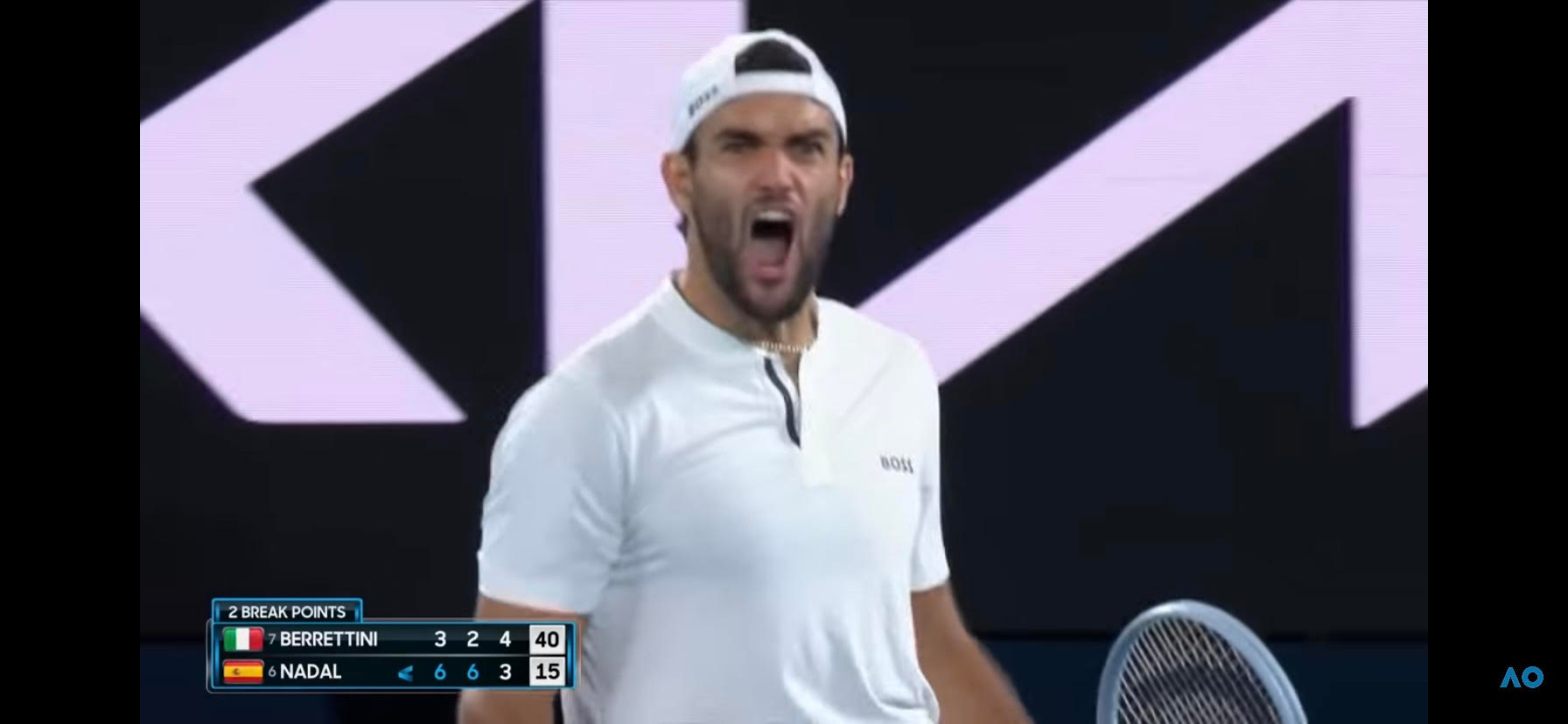
What makes a match exciting is not what a coach says to a player. It’s how that player executes that thought. If Edwards doesn’t make that shot, if Nadal doesn’t nail that drop shot at 0-40 down 2-3 in the third set, we don’t get to see those moments. 

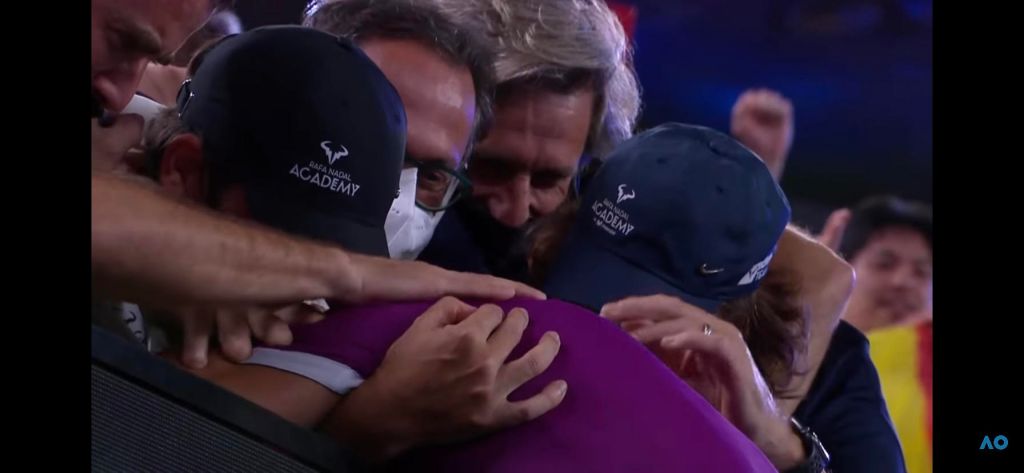
Nadal celebrates with his team after completing the comeback in the 2022 Australian Open final. Screenshot: Australian Open

Off-court coaching doesn’t take away the validity of winning. In fact, coaching is a big reason why the top players execute consistently. Every player isn’t suddenly going to win matches in bunches because of this. In five months, the rule change may no longer exist. But that doesn’t mean tennis shouldn’t try something new. 

Tennis, a sport in desperate need of a facelift, has shown that they’re okay with change. The burden now lies on the fans. Enjoy the sport and the content we’re getting from it. If you’re worried about the sport changing too much, ask yourself this question:

Is the future of tennis really contingent on whether or not two people can do watered down TikTok dances at each other? 

Calm Down. Novak Djokovic Isn’t Done Winning Just Yet…

By Srihari Ravi

Recency bias is a disease that infects the majority of us at some point. Analogous to how, say, COVID-19 has different variants and attacks various people over a duration of time.  

In 2022, the beneficiary of recency bias is Rafael Nadal whereas the one who is being dismissed, so to speak, is Novak Djokovic. Yes, the same Novak Djokovic who became the first man in the Open Era to win multiple titles at each Grand Slam event, the man who defeated Rafael Nadal at Roland-Garros (!!) on his way to doing so, the man who won his 20th Grand Slam title to tie his biggest rivals Roger Federer and Nadal, and the man who was a single match win away from completing the Calendar Grand Slam. 

What has happened since? How was such a juggernaut who was well on his way to sealing every significant record in the sport in his favor reduced to someone who is according to many “not on the same level as Rafael Nadal”? 

If you were anticipating the next few paragraphs to be on the Australian Saga involving Djokovic’s refusal to get vaccinated and his deportation from the country following the entry through a medical exemption, you have come to the wrong place. I have no time for that. This entire piece is purely tennis based.  

Remember how I said that recency bias affects different people at different times? It is not just the case with Novak. Last year, it was Nadal who was labelled “semi-retired” and was not even given a chance at the tournament he has unfathomably dominated for the better part of the last decade and a half: Roland-Garros. Rafa, however, has more than gained redemption for 2021. He would achieve the same feat at the Australian Open that Novak did last year at Roland-Garros, winning his second title there to complete the Double Career Slam. Not only that, but he would snatch back the Roland-Garros crown he has owned for the longest time from the same player who dethroned him in last year’s semifinal, defeating him in another four-plus-hour battle on Philippe Chatrier at night. 

https://www.youtube.com/watch?v=jzBneaWSswY
 
What is the discourse now? We read everywhere that Rafael Nadal is the undisputed GOAT from the same “experts” and even fans (full-time and casual) who only last year predicted that Djokovic would reach 25 Grand Slam titles. To me, this really does not make much sense and all I want to tell people is to hold their horses and back up their trucks. It is not over until it is over. 

Don’t get me wrong, this is not coming from annoyance of the ardent Djokovic fan in me. Well, it is partially. But in fairness, I would usually be the first to scoff at those who predict that Djokovic will finish with 25-30 slams whenever he as much as triumphs at one. Here is the catch. When the same people write off Nadal, as much as it annoys me to see their vehemence in doing so, I can sense that it doesn’t come from any sort of repulsion or disrespect for the man. With Djokovic, that is not the case. It is almost as if people want him out of the big picture once and for all. 

This is not even up for debate. You can’t possibly go from saying that “Djokovic will end up as the undisputed GOAT” to going as far as rating Rod Laver and Bjorn Borg ahead of him in the all-time greatest players list. Not just that, but also trying to rewrite history and bringing in asinine “what-if” scenarios to erode the man’s legacy and suggest that all of his accolades are somehow attributed to circumstantial luck. You have that, and then you have the constant background noise signal of people regurgitating the same, tired narrative of him not being “as loved as Federer and Nadal” or having the same flair as those two. Since when did tennis become an eye test and popularity contest? 

Think whatever you want to about Novak Djokovic. You don’t even have to like him to acknowledge the obvious that is his greatness. Trying to come up with alternate realities to show that he isn’t great is borderline ridiculous, and this level of writing-off is not something I ever saw being done with Federer and Nadal, or even any other great player who is leagues below Novak. 
 
That rant was for his detractors, but I also have one for his fans who think he is finished. Enemies within your own clan are actually worse than outside enemies, especially those who say “he doesn’t care about tennis anymore.” 
 
Tell me this. When Novak was ranked No. 22 and was 10-7 for the season at one point in 2018, did any of you expect him to win another eight slams, including at least one at all four major events? Even better, let’s talk about more recent events. After getting disqualified from the U.S. Open and being handed his worst loss in a slam final at Roland-Garros in 2020, did you anticipate that he would come within a match win from completing the CALENDAR SLAM the very next season? (Not to mention defeating the same Rafael Nadal who massacred him in the final of Roland-Garros exactly 8 months prior.) Here’s my advice: do not be foolish. Play out the long game. It is what we have been doing for the longest time in this sport. Our moment will arrive once more, and this time it will be sweeter than ever before. 

My final verdict is this: You want to write off Novak Djokovic? Go ahead and do so at your own peril (at the risk of sounding cliché). However, I am here to tell you that soon the massive joke will be on all of you. It will not be very long before he is back to his Grand Slam winning ways. And mind you, this man wins them in bunches at a time. (Recall 2011, 2015, 2018-2019, and 2021.) Then, when the same people show up again and start making claims about him finishing with 30 Grand Slams and <insert other nonsensical scenarios>, I will keep all of this in mind and give you a long, ironic stare.

He’ll Be Back: Novak Djokovic hasn’t had the best start to 2022. Screenshot: Australian Open

Mobile Death

Beginnings happen very quickly in tennis. During a spell of dominance, for instance, it can be hard to remember what the landscape of the sport looked like beforehand. The last time Iga Świątek lost a match, it was February. Ash Barty was the world #1 then, and had you told any tennis fan she’d be retiring in a month, you’d have been laughed at.

Doesn’t that seem like a completely different universe? Barty’s retirement aside, all that’s really happened since February is that Świątek clicked into warrior-robot mode and stopped losing tennis matches. That singular event, though, has totally altered what the sport looks like. We’re now living in the Świątek era, where her supremacy is so total that it’s difficult to remember how things felt before she became what she is now. Such beginnings separate tennis history into befores and afters. Roger Federer’s rise in 2003 ushered in the Big Three era; before he rose to prominence, men’s tennis was a mishmosh of one-time major winners, aging legends, and “which American man will be the successor of Pete Sampras and Andre Agassi?” (Answer 1A turned out to be Andy Roddick; answer 1B was “awkward silence”.) It’s night and day, but those two extremes aren’t separated by much.

Carlos Alcaraz is another bridge between eras — for years, no, over a decade, tennis fans and pundits lamented the weakness of the next generation in men’s tennis. “Who will dethrone the Big Three?” rang out as young guy after young guy tried and failed to ascend to that elusive top level. After Alcaraz played a couple good matches, it was obvious to everyone that he was the guy they were waiting for, whether he made the most of his many gifts or not. All that waiting, and then the payoff emerged quickly enough to not just extinguish the flame of anticipation but turn it on itself.

This wasn’t a great match from Alcaraz, but he plays a few points that immediately convey that he is just different from his peers.

Endings work differently than beginnings. When a great tennis player is faltering, the media can be ruthless, but there’s also an obligatory grace period before everyone declares that the next era has begun. The first uncharacteristic loss is just that, a reminder that the champion is human, that they can lose, after all. The second is weirder, and it gets people talking, but it’s hardly a death knell. Decline is usually a slow process — if you’re good enough to dominate tennis at your best, your 80% is easily enough to keep you relevant. Brian Phillips constantly marveled at how long Federer spent in the “still” phase, where he was visibly not as good as he once was, but still had plenty of skills to work with.

Federer’s “still” phase didn’t end until 2019, and Rafael Nadal and Novak Djokovic are currently riding their own seemingly endless afterburners, keeping up with their full-speed rivals with ease. We are still in the era of legends — Nadal and Djokovic have won 14 of the last 17 majors. Younger guys have moved in to win everything from Masters 1000s to the World Tour Finals to even a major title here and there (Thiem in 2020, Medvedev in 2021) but the shift feels partially due to a tactical retreat from Djokovic and Nadal. They can feel their bodies groaning at tasks they would have once sung at, so they’re cunningly ceding territory that doesn’t matter as much as the rich fields everyone covets the most. As impressive as some of the NextGen are, you get the sense that they’re winning Masters 1000 titles as much due to Djokovic and Nadal’s indifference as their own good play.

This era is ending, but it’s been ending for over a decade, and it hasn’t actually ended yet. We’re watching it happen in real time; that finish line is on the horizon, but we can’t quite estimate when the runners are going to cross it. We can evaluate a conclusion almost before it arrives. Federer has expressed a desire to make a comeback later this year, and indeed play on through next season, but someone could probably write a fantastic Federer eulogy right now.

And it’s not just Federer — other big players like Stan Wawrinka and Andy Murray are nowhere near the height of their powers and are unlikely to return, but they’re still kicking around on tour in hopes of getting something going, probably because they also understand that even their weakened kicks are as strong as others’ at full power. They, too, have completed the vast majority of their careers, but they insist on continuing, willing the finish line farther away in the distance.

Or take Serena Williams, who has had a long, glorious, career whose ending seems to be approaching. She recently announced that she’ll be playing with a wild card at Wimbledon, which the tennis world is over the moon about. The excitement isn’t due to the possibility that she could win the tournament — she hasn’t played a competitive match in almost a year now — it’s because she’s Serena Williams, a 23-time major champion who took tennis to levels no one knew it could have. (She was somehow simultaneously the best server and the best returner on tour, the insanity of which words cannot do justice.) She had her own still phase, making four major finals in the 2018-2019 period but coming away winless and setless. Currently unseeded, she will be a nightmare first-round draw for someone at Wimbledon, but she may not be more of a factor than that. She is still around because she wants to be, even though her invincibility has receded in the process.

Some vintage Serena: huge serving (especially under pressure), heavy returning, and groundstrokes that caused damage from any position on the court. Henin played a very good match and lost 6-2 in the third for her trouble.

My point is this: while breakout performances and the height of dominance can appear scripted in their splendor, endings rarely feel fitting from a viewer’s perspective. The 2002 U.S. Open is widely regarded as a sort of farewell victory for Pete Sampras, but he didn’t retire until late the following year. He lived in a victorious haze for months after his win, still feeling like he could contend for the biggest titles, only to discover that his will to compete had faded when he tried to train. He retired in late 2003 despite not having played a major after the 2002 victory in Flushing Meadows. “It may sound odd coming from a guy who was often said to lack emotion,” Sampras wrote in his lukewarm (it must be said) autobiography A Champion’s Mind, “but my decision to quit was an emotional one. The love of the battle had gone from my heart.”

There’s absolutely nothing wrong with this, but it’s not a cookie-cutter retirement. For all the uproar about legacy-tarnishing (which is not a thing) when a player refuses to “go out on top,” the reality is that it barely ever happens. Few tennis players care about preserving an invincible reputation after they retire — the goal is to squeeze every last drop out of their careers, and to do that, they have to play until invulnerability fades into fragility. The process is slow, like a renowned author writing book after book for hungry audiences until they gradually realize their series really isn’t as good as it used to be. By the end, players are always so different from how they were early in their careers — since 2003, Federer has seen his ponytail disappear, his forehand and movement get worse, his serve and backhand get better, and his rivals grow from upstarts into fellow titans of destruction. Does today’s Roger Federer — or even the 2019 version, when he was still active and capable of beating anyone — resemble his 2003 self much at all? He’s a ship that’s replaced its flag eight times, its mast six, its hull five, and its crew once. Is it the same ship? The fact that the question can even be asked is all the answer I need.

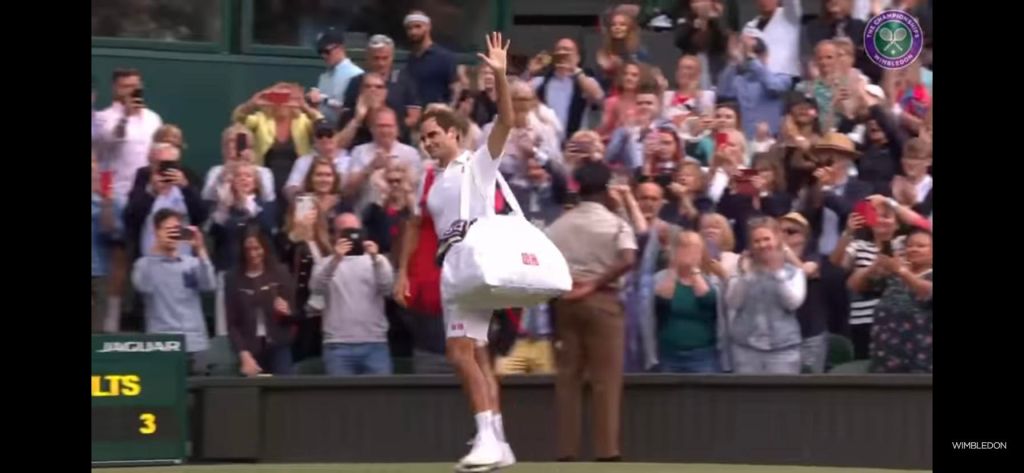
Federer waves to the Center Court crowd after losing to Hubert Hurkacz in the quarterfinals last year. Screenshot: Wimbledon

To me, none of this is a bad thing. Love for a player, I think, tends to be immune to renovations in game style or a trophy flow slowing. It can be scary to watch players we care about changing before they retire, but really, they’re the same as us — they miss the glory days and want to get them back. Even when they try for so long that it becomes obvious to everyone and their goats that the lost peaks are never going to make a reappearance, a side effect is that we get to watch these players for longer. The trade-off is more than worth it.

A Day in the Rain

By Nick Carter

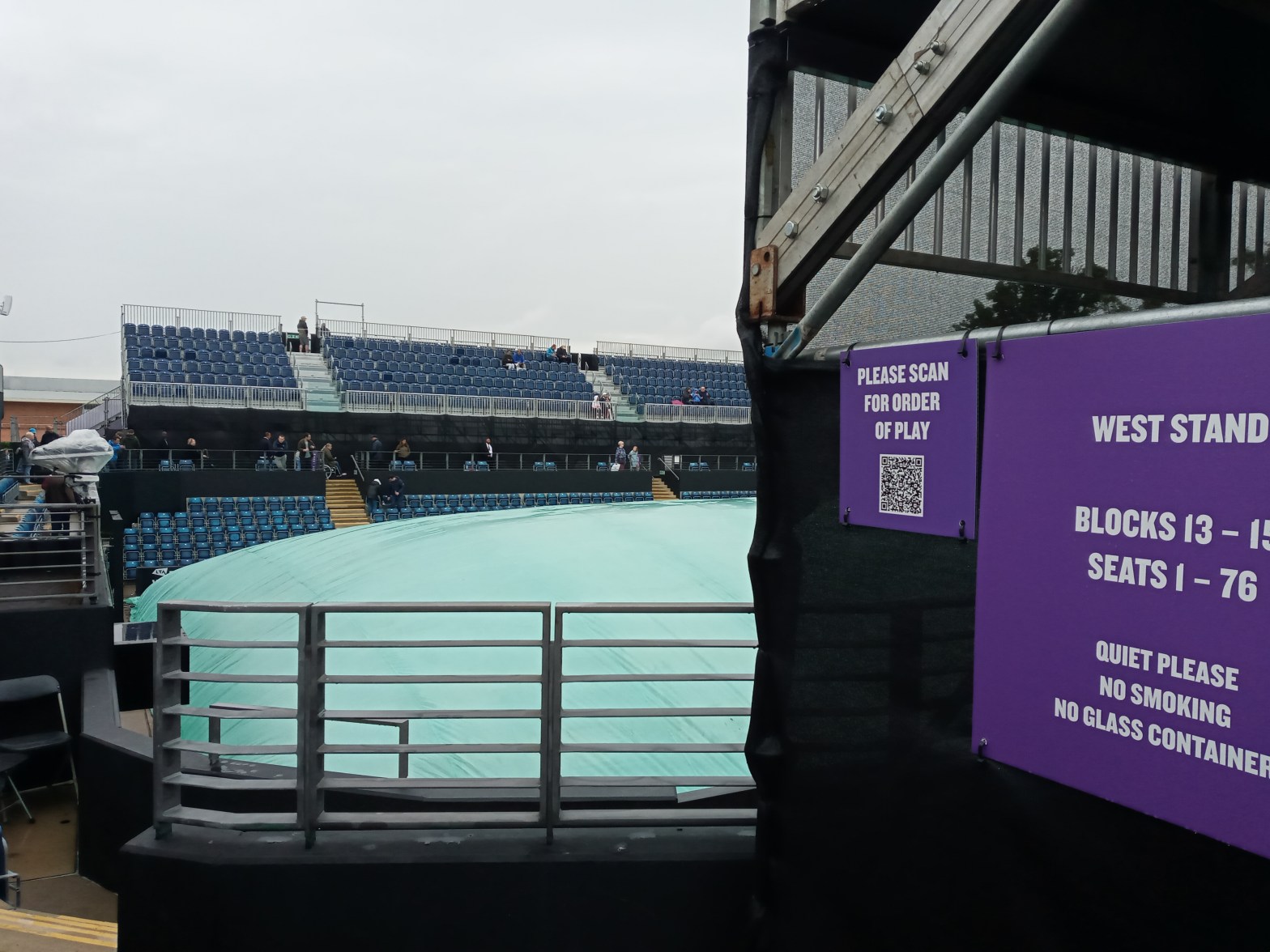
I was hoping to bring you a report of the semifinals day at the Birmingham Classic, but sadly the weather intervened and there was no play. There were points where the rain stopped, but at around 3 pm UK time it was announced that play had been cancelled as more bad weather was on the way. I stayed in Birmingham for a couple of hours after and saw they were right to do so.

Regardless of the lack of play, I thought I’d share some thoughts on my experience of visiting the event. This is the lowest category of event I have attended, having only previously been to Wimbledon and the ATP Finals when they were held in London. (I’ll try not to make too many comparisons but it might be useful for those who have up to this point only visited big events.)

As I parked in the school field that was being used for the event, I immediately saw how rough and ready aspects were. Now, to be fair, were I to park at Wimbledon it would be a similar experience (for the record I have never done this, nor do I recommend it to anyone as it is a ludicrous price and involves driving in London). The Edgbaston Priory Club is a private tennis establishment that is hosting the Birmingham Classic, and it is clearly well resourced. I counted multiple courts on the way in that were still open to members to use, including ones with hard and clay surfaces. One suspects the membership fee is at a premium. However, it is a tennis club first and a sporting venue second. This is where you will see the biggest difference with Wimbledon (other than scale), which is a sporting venue first and a tennis facility second, with far more permanent structures around it (at least once you get on the site and past the queue). Besides the scale, the whole event feels like having a grounds pass at a major championships. The small courts are the same, with the main stadium being much like a mid-level one at a slam. 

This is the second time I’ve been to a rain-affected tennis event. Both times, shelter was at a premium. Tennis is usually an open-air sport, and the only indoor places are usually restaurants, bars, shops or any overlapping stands. If there aren’t enough of these, then you’d better have a good waterproof on you. Waiting in the rain is a strange experience, as everyone there is hoping it will pass, hope rising with any mild brightening of the sky. If there has been no rain for ten minutes, everyone starts getting impatient and saying that they should start play straight away. We’re here for tennis, we want to see tennis, and we don’t want to go home disappointed. 

One of the things that’s great about tennis, rain or shine, is the interactions with other fans. Today I spoke to a someone who was bringing his young son to a tennis tournament for the first time (this seven-year-old told me he was a fan of Emma Raducanu, Andy Murray and Rafael Nadal), a fan who had flown over from Ireland to visit the tournament (a regular pilgrimage for their family and fortunately they had enjoyed the Quarter-Finals on Friday), and I got to meet Lee, who is the mastermind behind the website and Twitter account @tennisontelly, which has helped many a tennis fan know when and how to watch a tennis match on TV. It is wonderful that it is possible to talk for hours with a stranger about something we instantly share, and generally everyone I’ve met at an event has been so nice. Rain provides even more opportunities for such conversations, outside of a good old-fashioned British queue. 

I would have loved to talk more about the event, but due to circumstances beyond their control they couldn’t provide the full product. This does not put me off visiting another 250 or 500 event in the future, and I’m looking forward to going to somewhere like Nottingham, Queens or Eastbourne. I would like to encourage anyone reading this, it is worth visiting a pro-tennis event at any level because the experience is similar across the board and the quality of play will usually be very high.

What’s Next?

As Caleb Pereira wrote a few months ago, Matteo Berrettini is great. He’s great at serving and forehanding. He’s great at hiding or papering over his weaknesses. When he has a lead, he’s great at closing, and when he’s behind, he’s adept at mounting comebacks. His game is in the mold of a grass or fast hard court specialist — big serve, big forehand, subpar backhand and movement — but he’s done very well on clay, making the Madrid final and Roland-Garros quarterfinal in 2021 (he had to skip the entirety of this year’s clay swing due to a right hand injury that required surgery). In the past year, the only players he’s lost to at majors have been Novak Djokovic and Rafael Nadal. It is difficult to do much better than that on the ATP Tour unless you actually are one of the two aforementioned GOATs.

It must be said that Berrettini’s style of play is limited. He’s not cut out for all-court rallies or incredible defense or strong returning, all of which are invaluable assets in this era of tennis. (To give you an idea of how poor his returning is, he didn’t even produce a break point against Nadal until midway through the second match and sixth set they had played against each other.) When Berrettini comes up against an opponent who can neutralize his serve — take Nadal at the Australian Open this year, or Djokovic at the U.S. Open in 2021 — he’s in major trouble, because in an even rally against a world-class baseliner, he’s vulnerable to having his backhand pummeled. Errors ensue. Berrettini is able to avoid such dynamics against the vast majority of opponents, though. Besides Djokovic and Nadal, only Carlos Alcaraz has really made Berrettini look helpless recently. He’s had other losses, sure, but other than matches against that thin layer of the elite, the Italian has a good chance to win against anyone. His serve and forehand are so imposing that few players can even find his backhand, let alone expose it.

Berrettini is currently ranked 10th in the world, which is a little low due to him being unable to defend any of the points from last year’s clay season, but his ranking typically demonstrates exactly how good he is. He tends to beat anyone below him in the rankings, laying waste with his serve and forehand. Against those capable of surviving his initial two shots (these players also tend to be above Berrettini in the rankings, not by coincidence), he tends to lose. The last time he beat a player ranked higher than him was over a year ago.

One of Berrettini’s most impressive wins (considering Alcaraz’s violent rise to the top of the ATP, it looks more impressive every week) came at this year’s Australian Open, where he held off a fierce push to beat the young Spaniard in five sets.

You usually know what you’re going to get with Berrettini, which is valuable considering the current landscape of the ATP. Djokovic and Nadal’s results are predictable in the best way, but besides them, the men’s tour is layered with inconsistency. Daniil Medvedev, the current world #1, is significantly better on hard court than on grass or clay. Alexander Zverev, the world #2, is a hugely problematic figure for reasons outside of tennis — he’s been credibly accused of domestic abuse and came within inches of breaking an umpire’s ankle earlier this year. When he is playing, he can’t summon his A game for more than a couple tournaments a year. Stefanos Tsitsipas is electric at his best, but hasn’t been at his best for about a year now, and really struggles on faster courts. Felix Auger-Aliassime is still developing, as is Carlos Alcaraz (though his consistency already goes beyond anyone not named Djokovic or Nadal). Berrettini might not be winning big titles, but he’s as reliable a player as there is on tour right now. Excluding Roland-Garros this year and the Australian Open last year — tournaments Berrettini didn’t play and couldn’t finish, respectively — he has made the quarterfinals or better at the last four majors. He’ll consistently avoid upsets, make deep runs, then push a player better than him before eventually losing to them.

Berrettini has been doing his thing for a while now. It’s impressive, but it also means he’s in a bit of a holding pattern. His career-best result at a major was last year at Wimbledon, where he made the final and took a set off Djokovic. The natural next step would be to win the whole thing, but if he meets the Serb on the lawns again this year, he will lose again. He hasn’t improved sufficiently in the past year to make the jump; there is a gear he does not possess that remains well out of his reach. He’s primed to make another very good run at Wimbledon — fresh off his return from the hand injury, he promptly won Stuttgart and is currently advancing through the draw at Queen’s — but if Djokovic doesn’t lose to someone else, Berrettini won’t win the event.

This is a highlight video, so you’ll only see the best points — which are rarely representative of a match as a whole — but in this match, despite Berrettini’s knife-like backhand slice, the balance of a point tended to tip against him almost immediately when the ball went to his backhand side.

Even suggesting that Berrettini might win Wimbledon, I think, puts an excessive layer of pressure on him, and it’s not that I think he’s incapable of lifting the trophy. Progress is just much less linear than players (and writers) would like to pretend. As straight-faced as I was when I wrote The natural next step would be to win the whole thing in the previous paragraph, I know it’s not that simple. Daniil Medvedev was a set away from winning the U.S. Open in 2019; the next year, Dominic Thiem straight-setted him in the semifinals. In 2020, Zverev was two points away from winning the U.S. Open (Thiem standing in the way yet again); in 2021, he lost to Djokovic in the semifinals. Tsitsipas was a set away from winning Roland-Garros last year and this year he crashed out in the fourth round. Things don’t look much better for Casper Ruud, the newest NextGen major finalist. He’s a great player, yes, but do we really think he’ll be ready to beat Rafa at Roland-Garros in 12 months, presuming the living legend is still active on tour? Professional tennis isn’t a book. Sometimes the truth is ugly; sometimes you are simply not good enough at a given moment.

Berrettini, to take the ugly-truth stance, is currently not good enough to win a major title. His arc begs the question, then, of what comes next. Is he recreating David Ferrer’s career — a tough out, someone who makes you earn a win and is always in the later rounds but is rarely a threat to the best of the best — just with a much bigger serve-forehand combo and slimmer calves? With Djokovic and Nadal set to age out, will Berrettini win majors despite lacking the gear that the legends have? Will he improve in future years — he’s 26, so he could have as many as 10 good years on tour lying in front of him — to the extent that he does obtain that elusive, legendary level? Tennis is unpredictable, and Berrettini’s consistency makes projections only slightly easier. Maybe he will continue to suffer from injuries. Maybe Carlos Alcaraz will have swallowed the entire world by the time I revisit this piece in a year or so to measure Berrettini’s progress.

If I had to say, I’d guess that Berrettini will remain very consistent, especially at the majors, racking up more deep runs and even a title or two once Djokovic and Nadal mercifully descend into their cryogenic chambers (to emerge even stronger in a couple decades, probably). Winning a major is freaking hard, and most who try — even those who have a realistic chance — fail. Call me an optimist, though. I find myself encouraged by the consistency Berrettini has been able to refine over the past couple years, even if that final giant-killing edge to his game is missing. He’s fun to have around, and for now, that’s enough.

Cinch Championships: Pictures, Berrettini, and More Sun

By Hanya El Ghetany

Day 4 of the Cinch Championships and Day 2 of my experience there was as exciting as the first. We had a few nice surprise appearances on the practice courts, some reappearances, and a few cameos from the first day. Here’s what happened.

There were four matches on Centre Court today. I was excited to watch Berrettini play for the first time. There was also an early clash between Stan “The Man” Wawrinka and Tommy Paul. Court 1 had an interesting doubles match between Paul/Fritz and Norrie/De Minaur. 

I arrived a few minutes late today because, as usual, the Piccadilly line was delayed (ughh). I had to take off for the tournament one station early because of some sort of technical issue and walk for 15 minutes to the site, which caused the delay.  

I wanted to catch Stan Wawrinka’s practice before the match. I was talking to my friend about how awesome it would be to take a picture with him. As we walked into the practice ground, we saw a few ball girls chasing a player for autographs. Of course, it was Wawrinka. I literally was walking a few steps behind him and even when I speed-walked to catch him, I couldn’t make it. We went back to the practice court, and as I walked, I bumped into Tommy Paul for the THIRD TIME. This time around, I asked him for a picture, and it finally happened. I think I’ve seen Tommy Paul this week more than any other player. I honestly deserved that picture. It was nice of him to stop for a picture when he had a match to play in a few minutes. (Against Wawrinka, of course.)

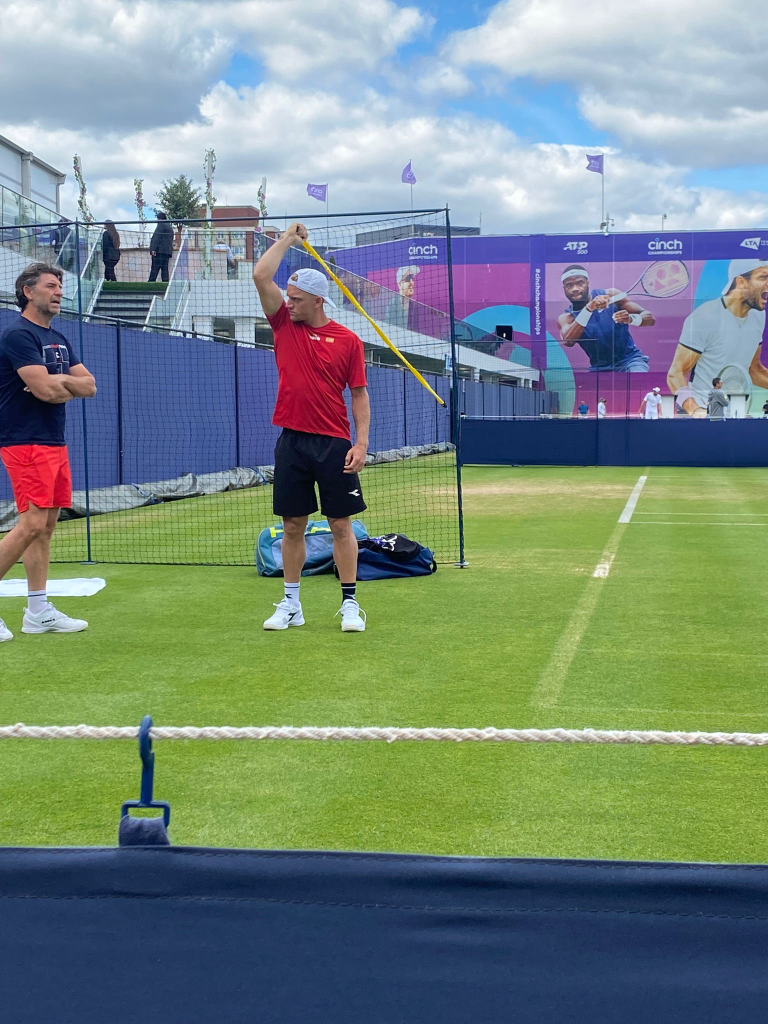
We decided to go check the rest of the courts before the match. To everyone’s surprise, two players who were already out of the tournament were practising on court: Diego Schwartzman and Lorenzo Sonego. My friend and I decided that watching these two practice together was more interesting than watching Paul-Wawrinka. There were a few people watching the practice session because no one expected them to be there. I was standing really close to them, behind the benches. I stayed for a full three hours watching them practise because every time I thought of leaving, my friend told me “we made it this far, we’re getting that picture”. Every time they came close to /us to drink water and rest, I would look at them and get my phone ready, but every time they quickly went back to practice. Eventually, Sonego’s coach noticed we really wanted to meet them. He smiled at us a couple of times, then when people started to leave to go to the first match, he took out a new tennis ball and threw it to me. It was very cool of him. When they finished practice, Lorenzo’s coach looked at me and said, “do you want selfies?” I said yes, he called Lorenzo and he came to take pictures with us. After he left, Diego was still there, I called him for a picture, he came and took a picture then signed the ball. It was so nice of them to do that, especially considering they had been spending all that time training in hot sunny London. I really want to stress how considerate Sonego’s coach was – I don’t think Lorenzo himself would have noticed us if it wasn’t for his coach. 

Remember Usher 1 from the Day 1 story? Well, as we left, we ran into him. He naturally remembered us and asked if we took any pictures/signatures. We gave him the whole story. He was very proud of us. 

We went into Centre Court and found ourselves sitting in a group of really cool Americans. I don’t think I’ve ever met so many Americans as I did today (which made sense considering the number of Americans who were playing at the tournament). Tommy Paul was already winning the first set by the time we went in. We stayed for the rest of that match, which Paul dominated throughout. The following match pitted Matteo Berrettini against Denis Kudla. As someone who hates tiebreaks, I had to watch many of them this week. (The worst one was Dimitrov losing the first set to Norrie. Thankfully, he went on to win the match.) Today, Berrettini lost the first set to Kudla. For most of the match, it looked like Kudla was going to win. Berrettini took a medical time out after the first set which was a bit worrying, but showed his mettle in the second set, which went to a dreaded tiebreak. These were the most stressful minutes of my day. Berrettini thankfully won, but made some classic errors at the most crucial of times. He also pulled some classic Berrettini-on-grass “what the fuck” moments. The cool thing was almost everyone in the stadium was supporting the defending champion. “Let’s go Matteo” echoed through the court, especially during that last set. It looked like it was going into a match tie-break, but Berrettini won 3-6, 7-6, 6-4. During that match, the doubles between Paul/Fritz and Norrie/De Minaur was on Court 1. I was talking to my friend about it and one of the American guys overheard and asked about the score and asked me to keep him updated, which I did on every set and match point. To his delight, the Americans won. We agreed that he couldn’t have all the wins, so he accepted the Berrettini-Kudla result.

It was very sunny and very humid, which tired everyone out. Many fans left after Berrettini’s win. Even Berrettini could barely catch his breath during the interview. He mentioned Kudla and acknowledged that he had been the better player. 

I didn’t stay for the last matches; the sun was too much for me. I was, however, very satisfied with the outcome. I took pictures with Schwartzman, Sonego, Tommy Paul, met Wawrinka and watched Berrettini live. It was a good day. 

Talk to you after the finals!

The Power of One

By Nigel Graber

It’s 2006. The tennis gods have just lit the kindling around what would become
known as The Big Four. (Forgive me that one – I’m a Murray fanatic.) I’m on
Centre Court at Wimbledon with my ten-year-old daughter. Ten? Jeez. Sixteen years on, she’s about to make me a grandad.

Down there on the turf, Federer’s making steak haché out of Reeechard Gasquet. I wanted more of a contest. I wanted my kid to be like me – lifted and lost in the
pendulous suspension of the moment.

Instead, her beak is buried in Harry Potter and the Order of the Phoenix. I can’t say I blame her. Up in row ZZZ, the court looks no bigger than an urban garden, the width of the shot-making is impossible to call, and Federer and Gasquet look like they’ve taken one of Alice’s shrinking potions from the Hall of Doors.

But there’s a bigger issue. The match doesn’t start immediately. Hell no. The players, who’ve been practising all morning, seemingly need a knock-up of another five minutes. This is routinely followed by fannying around in their kit bags, tying headbands, swigging potions and tossing coins.

Every two games, the players sit down for a bit of a break. When they serve, they bounce the ball ad infinitum, yip-like, as if physically unable to effect release. The first serve hits the net cord and falls. For some reason, they get another try at it.

One of the serves is a let, so they’re afforded three goes at starting the point. Hey, if their toss is off, they enjoy another stab at that as well. We wait while the ballkids retrieve the duds and scurry back to their spots. Fed bounces again. And again.

The iconic 2008 Wimbledon final between Federer and Nadal featured a great rally on the opening point. Before that, though, Federer hit a let serve. Screenshot: Wimbledon

In between points, they tie shoelaces, towel down, mutter imprecations up to their box, adjust this and that. If you’re Rafa, you adjust this, that and the other. And those as well. They summon the medics. They bust rackets. Query calls. Scream to the heavens.

For years, I lambasted footballers for their lack of stamina. Heck, the heavy lifting’s shared by eleven of them and they have to last just the 96 minutes. Tennis players? Whoa. Different story. Five, six-hour marathons? Just the two of them? Gladiators, the lot of them, living and dying in the bloodied dirt of the Colosseum.

The brutal truth is that not much tennis goes on in a tennis match. Back in the 90s, US tennis coach Vic Braden assessed the actual playing time in raw minutes. For a typical two-set match – let’s say 6-3 6-4 – he counted up five minutes of actual action. Five minutes.

In 2013, the Wall Street Journal timed the action in an Andy Murray match that lasted 2 hours 41 minutes. They needed a microscope to find only 26 minutes of play. That’s 16.4% of the match. Footballers, I salute you. You huff and puff for over 50% of the advertised time.

This ugly scenario for tennis fans is made worse by the advent of the lamppost pro. Back in Kenny Rosewall’s day, players were little more than average height. Today, throw an Isner and an Opelka into the mix and what little playing time unfolds will be devoted to the launch of invisible bullets and rallies strangled at birth.

Back on Centre Court, my daughter learns that Harry is plotting madly against Cornelius Fudge. It’s infinitely more fascinating than the stop-start, herky-jerky, endless cycle of bouncing, resting, swearing, tying, untying, towelling and adjusting that infests this beautiful sport.

The doubles that follows is even worse. There’s time for an actual point to be played, didn’t you know, in between the fist bumps, the chest bumps, the hushed tactical discussions from behind the tennis ball, the clipped last-minute commands while waiting to serve, the finger gestures at net. It goes on. And on.

Pre-Murray, I was once asked why I was an Andre Agassi fan. I thought for a beat or two and then said, ‘Because you see so much tennis’.

I’m not privy to the stats, but I’d wager this was true. Andre wasn’t gifted the Exocet serve that regularly reduced a point to a single swing of a bat. Hey, if Vicki Nelson or Jean Hepner had had a beefier delivery, they might never have needed to sweat over that sole point for 29 minutes and 643 shots.

For Double A, winning a tennis point was a beautifully attritional labour of devotion, an exercise in crisp, laser-guided, long-range precision that explored the outer dimensions of the court. It was chess in the fast lane. Tactical warfare in whites. Bookends driving each other ever-closer to the end of the shelf.

You know, I’ve had enough. I want to see more tennis. I wonder if my impressionable young daughter would have been more absorbed, more invested, more immersed (in the parlance of today), had we been able to nudge the playometer up to, say, 50%?

I feel there’s a way. How would it be if we removed the second serve? Permanently. Dump it in the courtside bins alongside the crumpled electrolyte bottles and the grip polythene. Of course, we’d effectively be ditching the first serve. It’d be just a serve.

No more one-shot rallies. Who’s gonna risk firing for an ace without a parachute? Every point begins with a 90mph invitation to engage in extended airborne warfare. You’d have longer rallies, more craft and less brute force, more tennis and less faffing around.

Pete Sampras once said a player is only as good as his second serve. And among the many nerd-feeding stats on the Association of Tennis Professionals (ATP) website lies the bare truth that landing first serves is no guarantee of success.

The Big Four were never close to the top of the first-serve chart. Indeed, Andy Murray’s average of around 60% brings him in at around 40th place. Even Federer finds himself down at 17th. So a big first delivery isn’t exactly sine qua non when it comes to legendary, all-time status.

It’ll never happen, of course. The cry for more action, longer rallies, more tennis is far from a universal one. To my amazement, there are genuinely people out there who enjoy seeing an ace fizz by. For me, if a rally is a beautiful conversation, then an ace is a full stop.

There are also folk who describe baseline trades as ‘mindless ball-bashing’. There are those who love what they call ‘craft and guile’: the kind of smart, chippy, all-court game popularised in the Pleistocene epoch of Hoad and Santana, and perpetuated through latter-day artists such as Martina Hingis and Fabrice Santoro.

Personally, I thought tennis in the pre-Open era was barely watchable. I was 13 in ’76 when Borg burst onto the scene and lit up my black-and-white world. Together with Connors and Mac, and then Lendl and co., they transformed the sport from a genteel summer garden party into a spitting, screaming, full-throttle rave.

But as the 80s and 90s unfolded and more viewing-platform options opened up, my love affair with the BBC-centric Wimbledon became more subdued. Clay and hard courts offered longer rallies, more variety, more tennis. Pre-rye grass Wimbledon was falling prey to the servebots and became a stiffer test of my devotion.

Entire decades of grass-court tennis were lost to ball-deforming human telegraph poles when a one-serve regime would have sidestepped these troubles nicely. Pete Sampras in particular nearly ended my love for the game.

But an obsession is an obsession. There was always stuff to salivate over: the ivy on Centre Court, the way the players looked like suntanned gods in real life, the brand logos on their sleeves, that Fila gear, the leather furniture next to the Patek Philippe watches on their wrists, the first delicious taste of spring in Monte Carlo.

That aside, I don’t feel it’s unreasonable to expect a greater proportion of my tennis viewing to be devoted to actual tennis. And for those who mourn the loss of the art of serving, perhaps there’s a conversation to be had about extending the service box?

My daughter became a good player, ranked 12 in the county as a junior. But she still watches little live tennis. It saddens me more than I can say.

Cinch Championship Diary: Ushers, Dimitrov, and the Sun

By Hanya El Ghetany

It’s that time of the year. It’s the time when the purple and green colours fill our lives, and we only eat strawberries. Buckle up, because grass season is here.  

I’m lucky enough to be in London, and today was undoubtedly one of the most enjoyable days I’ve had here. It all started when I arrived at Queen’s Club to see Fokina training with Musetti and a crowd of people milling around, sipping coffee, and watching the morning training sessions. Then I walked around the grounds and unexpectedly ran into Tommy Paul, who smiled and said hello after noticing how terrified I was. I blushed like a high schooler chatting to their crush. I saw Taylor Fritz, who photobombed my photo with Musetti. Casper Ruud, Denis Shapovalov, Reilly Opelka, Lorenzo Sonego, and Marin Čilić were all practising on the ground, and basically every usher was striving to help me run into Grigor Dimitrov, one of my favourite players. Here’s my story from the day.

People living in London will probably understand why I absolutely dreaded the idea of commuting for three days this week from a suburban town in West London and taking the daily route on Piccadilly Line to Queen’s Club. It wasn’t because I’ve been in London long enough to adapt to the locals’ attitude on the tube of hating it when people stand on the wrong side of the escalators, walk too slowly, or make eye contact or when they treat the tube as a social networking site or blast music and talk loudly. It was because the daily commute from where I live to Queen’s was about 50 minutes of this. However, there was so much that made the journey worthwhile. For starters, this was my first time attending an ATP event. Second, the entry-list for Queen’s was so exciting from the moment it was announced: Ruud, Berrettini, Norrie, Fritz, Shapovalov, Schwartzman, Opelka, Dimitrov, Murray, De Minaur, Čilić, Davidovich Fokina…it was a fantastic field. Buying tickets for Queen’s was also much easier and more straightforward than Wimbledon, not to mention cheaper. 

Summer weather in London fluctuates pretty wildly. It rains a lot in June. Last year, a couple of matches had to be cancelled and moved to the next day because there are no roofs at Queens. I was talking to fellow Popcorn Tennis contributor Vansh who was also making it to London during Queen’s, and I told him never to trust the weather app in London. Summer in London also means that it stays sunny till 9 PM. I’m still trying to get used to this, but I absolutely love it because I’m completely a morning and summer person. So, the few weeks it gets really summery in London, it’s heaven for me. This is the message on the Cinch championship website:

“If there have been no breaks in play it is likely that play will finish by approximately 7:30pm. However, play may continue as long as the light is good, which can be as late as 9pm. Unfortunately, we cannot confirm the exact schedule of play in advance as timings are very dependent on the weather and other conditions and are subject to change at the Tournament’s discretion”.

You get the gist.

Foki!

The night before the first day, I had a rough sense of who would be on the main court. First would be Opelka vs. de Minaur, then Fritz vs. Draper, followed by Dimitrov vs. Norrie and ending with Broady vs. Čilić. I was looking forward to watching them all play live for the first time, but Dimitrov vs Norrie was the match I was most looking forward to. I’m completely smitten with Dimitrov for obvious reasons. (Insert Taylor Swift’s “You Belong With Me.”) Like a friend put it, “He’s the level of hot that you can’t even look directly at him. Dimitrov = the sun”. 

There are three crucial ushers in today’s story who play an important role. One delightful security guard – who resembles my grandfather yet has the energy of my toddler cousin – was guarding the entrance where people stand to watch players train, plus two comical teenage ushers who were standing by Court 7, where the top-seeded players were training. Although it is impossible to see Court 7 up close, you may get an indication of when players begin and end their training sessions, as well as when they will depart the court. I’ll call the Court 7 ushers Usher 1 and Usher 2 for the sake of clarity. 

Let’s back up a few hours before I met Ushers 1 and 2. It took me a few encounters to summon the bravery to approach Musetti and ask for a picture. I first saw Fokina, then Tommy Paul twice, and the second time, he smiled at me. I was elated. When I turned around after taking the picture with Musetti, I saw Taylor Fritz standing just inches away from me. “Fuck, it’s on the fritz,” I yelled. I’m pretty sure I scared him away. Later, Claire Stanley made me realise that he photobombed my picture with Musetti. 

“All right, Hanya, calm down,” my friend told me. Usher 1 had noticed that we were trying to get close to the players for a picture. We probably gave him the complete entry list when he asked who we were most thrilled to meet. We stressed, however, that we were most excited to see Dimitrov. He told us where the players exited each court, that Čilić was currently practising on Court 7, and that Dimitrov would most likely arrive 2 hours before his match. I took a closer look at Court 7, and immediately recognised the left-handed one-handed backhand Shapovalov training. People acknowledged my sharp vision when I observed (read: screamed) who was playing.

We met Usher 2 closer to the exit of Court 7. We asked the same question and got the same answer. He asked me if Dimitrov is the Bulgarian dude and I felt slightly offended that he did not know who he was – but we laughed about it. There was still an hour till matches commenced at centre court, so my friend and I kept walking back and walked past training courts hoping to meet someone else. Whenever we passed by Usher 1, he told us who was training. Whenever we passed by usher 2, we were told if Dimitrov had arrived yet or not. One of these rounds, Usher 1 found us and quickly yelled that Dimitrov was leaving the training court. We ran to the exit, passing through Usher 2 who screamed “hurry up”. “Eye of the Tiger” was playing in the background. Unfortunately, as we made it, Dimitrov was already speed walking to where the muggles weren’t around to enter. We got to see him up-close though, and he was, in fact, “the sun”. Usher 2 left his post to ask us if we made it, and he was as disappointed as we were that we didn’t. It was so adorable. As play was about to begin, Ushers 1 and 2 said their goodbyes as they were changing shifts and introduced us to the new round of ushers as their best customers. I’m literally still crying from the cuteness. 

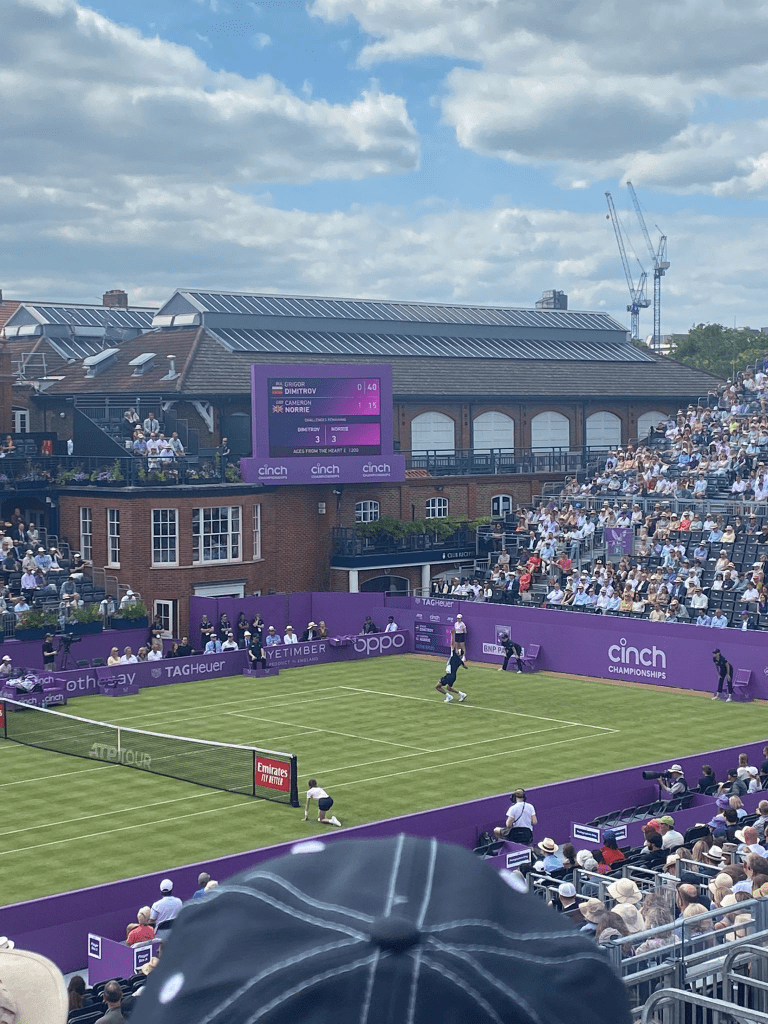
That’s about it for my teenage moments today. We went into Centre Court; it was very cosy and beautiful. The first two matches were quite straightforward. The two Americans (Opelka and Fritz) lost to De Minaur and Draper in straight sets in about an hour each. Dimitrov and Norrie took about the same time of the first two matches combined. There were many moments where we saw vintage Dimitrov. Norrie was quite decent. I mean, I like the guy, but c’mon, it’s Dimitrov. I kept my cool to respect the Brits in the stadium. The first set was as heart-breaking as any tennis match could get, mainly because Dimitrov was playing so well and lost in a tiebreak anyway. He went to win the following sets 6-1, 6-4. I was screaming so hard in the last set that the guy next to me broke silence and asked me “excuse me, I’m sorry if I’m being too forward, but are you Dimitrov’s girlfriend?” I daydreamed for a few seconds before I fell back to reality and replied, “I wish”. Not “no”, I said “I wish”. The guy laughed. By the time we got to Broady vs Čilić, the sun had eaten possibly every person on the court alive. I got a sunburn in London, which is a sentence I never thought I would use. 

Here’s a tip for Vansh and everyone else who is thinking of making it to the tournament: bring a lot of snacks, and a water bottle, as there are a lot of refill posts around the grounds. It took Čilić two hours to beat Broady in three sets. To be honest, at this point I was rooting for Broady because the Brits weren’t having the best of days, and honestly, they’re the nicest bunch to hang around. By the third set, we also heard that Murray pulled out of Queens. The cheers for Broady at that point were crazy. Čilić ended up winning the match, and the Brits still applauded him. Take notes, Roland-Garros crowd. 

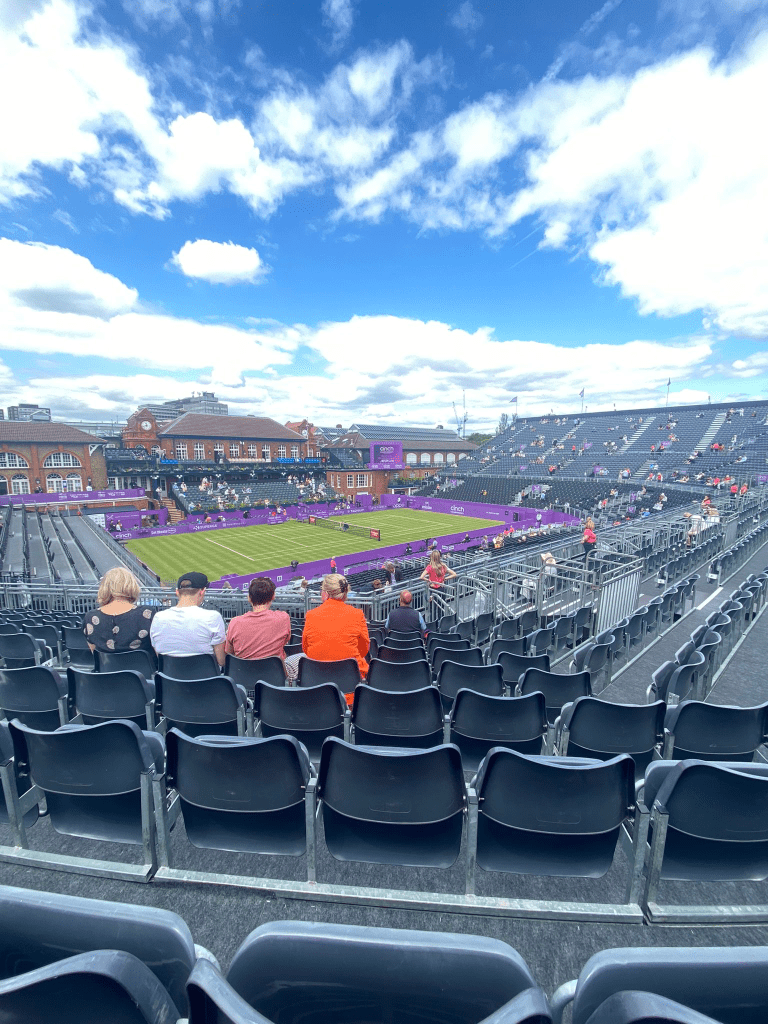
The day ended about 7:30 P.M. with the sun still shining. I had so much fun today. Queen’s Club is smaller than Wimbledon, but it felt much cosier. I took the Piccadilly Line back home, wrote this, sent it to Owen and Scott and will now watch the videos I took of the day. 

Let’s hope the quarters will have as many exciting stories as there were today.