It’s Not a Magic Wand, Part 6

Rarely does it feel like a major tournament is supposed to end a certain way. With 128 players in each singles draw, the potential for storylines and form and momentum is off the charts. Even if there’s a big favorite going in, they might lose, or their arc might be overshadowed by someone else’s. Whoever plays the best over the course of the two weeks deservedly lifts the trophy. Going into this Roland-Garros, though, there was a clear eventual winner, and that was Iga Świątek. She had won 28 matches in a row before the tournament even started. She had jumped to #1 in the world and was extending her lead in the rankings. Having won Stuttgart and Rome on clay (and before that Doha, Indian Wells, and Miami on hard court), many would have seen it as a disappointment if Świątek didn’t win Roland-Garros. She was simply so much better than everyone else that it was hard to consider any possibility besides a title-winning run. The feeling was inevitability, if not destiny.

Świątek delivered. Despite enormous pressure, she lost just one set — even in that set, not only was she playing a superbly in-form Qinwen Zheng, but Świątek had five set points and a 5-2 lead in the tiebreak — en route to the title. It takes a special kind of overwhelming favorite for a title run to pan out exactly as you think it will, but Świątek is a special player.

When she takes the court, it doesn’t take long to see how powerful and consistent and fast and absurdly well-rounded she is. Her opponents start to struggle to win games, then points. Świątek has dominated the forehand-to-forehand exchanges in her last couple matches, not only hitting more winners than her opponents, but donating fewer errors. It’s an unbeatable combination. You realize that what you need to have a chance is not your best tennis, but for your tennis racket to turn into a magic wand. And it is not a magic wand.
Świątek in trophy position.

This is hyperbole, obviously, but not by much at this point. Players are having to play their best just to stick with Świątek, so much so that the level required to actually make headway against her is currently an unknown quantity. Few have pushed this neo-version of Świątek, and many of those who have were helped by the woman herself having an off day.

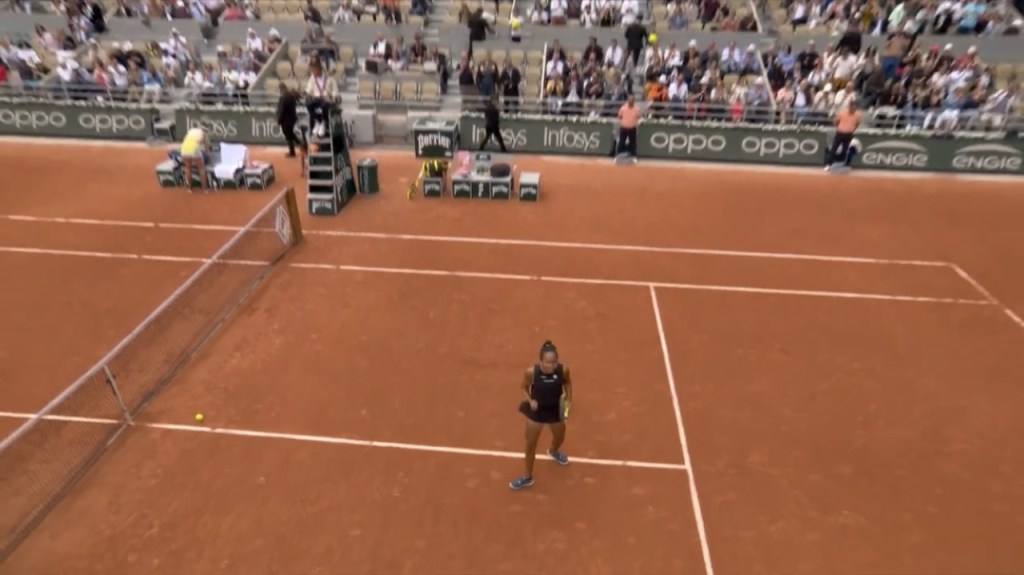
Coco Gauff, Świątek’s opponent in the final, brought plenty to the table — a better backhand than previous vanquished foes, better touch, more athleticism. It didn’t matter. Świątek won the first set 6-1, and it felt like she was playing at about 80% of her abilities. Gauff’s forehand is her shakier side, and against Świątek’s world-class groundstrokes, it unsurprisingly folded under the barrage. Gauff made a bit of headway in backhand-to-backhand rallies, and was able to score winners down the line, but her advantages were minute compared to Świątek’s.

Gauff likely has a fantastic future ahead. She’s only 18. Świątek told her after the match that at Gauff’s age, she had no idea what she was doing. Before she turns the age Świątek is now, Gauff could make enormous improvements to a game that was already good enough to get her to a major final. She will likely play Świątek many times along the way, which could create a long-term rivalry. Today, though, was about the 21-year-old Pole.

She’s won 35 matches in a row. 35! The winning streak is now made up of six titles, several of them big ones. The shift from hard courts to clay didn’t faze her. Neither did playing in-form players or especially pressured matches. Projecting what Świątek can go on to achieve makes me giddy; she’s 21 and already seems invincible. Her game is next to perfect; outside of the serve, how will she try to improve it? Grass courts are uncommon and she hasn’t played on them since last year, but mental/physical burnout aside, what can stop her from winning Wimbledon? Even if she doesn’t, she’s now won two Roland-Garros titles, and will be the favorite at the hard court majors barring a full Naomi Osaka resurgence or a seismic shift in her own level. Again, we don’t actually know what it will take to beat Świątek because no one has done it in forever. If she keeps doing what she’s doing — sure, you can argue that it’s unsustainable, but it’s worked for 35 matches in a row — this streak could reach galactic levels beyond its already spectacular heights.

Świątek’s victory was satisfying enough in the present. This title was about a supremely good player fulfilling her potential — not because everyone expected her to, but simply because she could. She did her thing. It was nice to watch.
Opportunism

By Siddhant Guru

Casper Ruud is in his first French Open Final. The Norwegian, who had never made it past the 3rd Round prior to the start of the tournament, beat Marin Cilic in 4 sets to set up a final clash against the ageless Rafael Nadal.

Ruud was in the much-derided bottom half of the draw and was, by far, the second best Clay court player in that half. Ruud hasn’t been particularly at his best in this Clay season with early losses to Dimitrov in Monte Carlo, Pablo Carreño Busta in Barcelona, Van De Zandschulp in Munich and to Lajovic in Madrid. Until Rome, his record in the Clay season was 4-4. Since the start of Rome, it is 13-1.

His comparatively slower start to the Clay season is somewhat reminiscent of post prime Novak Djokovic who usually takes one or two Clay court tournaments to make the necessary adjustments. I noticed the same problems as Djokovic for Ruud after Munich.

Ruud found that right balance at Geneva. Even in Rome, it wasn’t quite perfect though he managed to win against decently good opponents but Geneva was where he found his feet(Quite literally). He has carried that form into Roland Garros.

The Path To The Final

Ruud began his campaign with an emotional match against the retiring Jo-Wilfried Tsonga – tight 4 set match that saw Tsonga injure his shoulder just before the 4th set tiebreak – a sad end to the career of a magnificent player.

A relatively comfortable second round followed before an almighty scare against Lorenzo Sonego, with Ruud having to come from 2 sets to 1 down to sneak through into the fourth round – a key statistic from that match being that Ruud didn’t face a single break point in the last two sets and broke Sonego’s serve both times that he fashioned a breakpoint opportunities.

The Fourth Round was when chaos unfurled in the bottom half of the draw. Stefanos Tsitsipas, one of the heavy favorites for the title, fell meekly to 19 year old Holger Rune. 11th seed Jannik Sinner, was forced to retire in his match vs Andrey Rublev due to a left knee injury. Second Seed Daniil Medvedev, now considered as one of the favorites to make the final, was utterly defeated by Marin Čilić – If there’s an accurate personification of chaos, a randomly peaking Marin Čilić would be that person.

Amidst this, Casper Ruud quietly saw off the challenge of Hubert Hurkacz to make his first ever French Open Quarterfinal. What followed was a tense and bitter battle against Holger Rune with the 19 year old accusing Ruud of being… rude towards him during the match and in the locker room. A come-from-behind win against Čilić in the semifinals took him to his first Grand Slam final.

What has worked?

The Ruud serve has been the key shot so far. The following is a table displaying his serving numbers this season on Clay prior to Rome and his serving numbers since the start of Rome.

StatisticsBefore Rome MastersSince Rome Masters
Service points won percentage63%70%
First serve won percentage71%75%
First serve percentage60%69%

As we can see, there’s been a significant improvement in serving performance for Ruud since the start of Rome. His ace percentage has remained largely similar at about 6% (a very healthy number on Clay) throughout the season and his serve speeds have also remained about the same at an average of 185kmph. His improved first serve percentages have allowed him to then dominate with his Forehand as the first shot after the serve.

Case in point: 3rd set vs Holger Rune. After dropping the second set, Ruud put in a stunning serving performance, landing 75% of first serves and winning an equal number of service points, while also putting considerable pressure on the Rune serve. In the tiebreak, he didn’t drop a point on his own serve.

Or take his performance against Marin Čilić: After dropping the first set, Ruud hit 16 aces in the last 3 sets, outperforming Čilić 63-44 in the shorter rallies (<5 shots). To understand how impressive that is, it’s important to point out that Čilić actually had a higher first serve percentage in the match. Čilić’s contrasting victories over the Russian duo of Daniil Medvedev and Andrey Rublev had one thing in common – he had the measure of them in the shorter rallies, dominating with his serve. Ruud blunted that weapon with some very good returns and some errors from Čilić.

In this admittedly fortunate run for Ruud, two of his qualities stand out – his composure even when behind in a match as witnessed vs Sonego and Čilić, and his opportunistic nature, taking full advantage of a draw that opened up very kindly for him, as top players kept falling off.

What next?

Up next for Casper Ruud is the man who has stopped countless deserving players from winning a French Open title, the man who is going for a scarcely believable 14th French Open and the man who Ruud considers as his idol – Rafael Nadal.

Does Ruud have a chance? Honestly, it will take a miracle for him to win. They haven’t faced each other in a competitive match but have practiced together – Ruud says that the Spaniard “wins almost every set, even close ones”.

Ruud can take confidence from the fact that Rafa has been pushed the hardest by another player who put in a very strong display of serve + 1 tennis – Felix Auger-Aliassime. Ruud is currently ranked No 1 by Infosys in terms of first serves made and first serves won in this tournament. He will need to bring out his best serving display of the season on Sunday.

Casper Ruud will rise to a new career high of World No 6 on Monday. Regardless of the result on Sunday, he can be very proud of his season so far. He is only going to get better and better.

P.S. I can’t share a picture since it was a private whatsapp conversation –  Before the Clay season, one person whose opinions I respect, had said to me that Ruud’s serve + 1 has been the most effective weapon of any top player in the 2022 season. We’re seeing its effectiveness in this tournament.

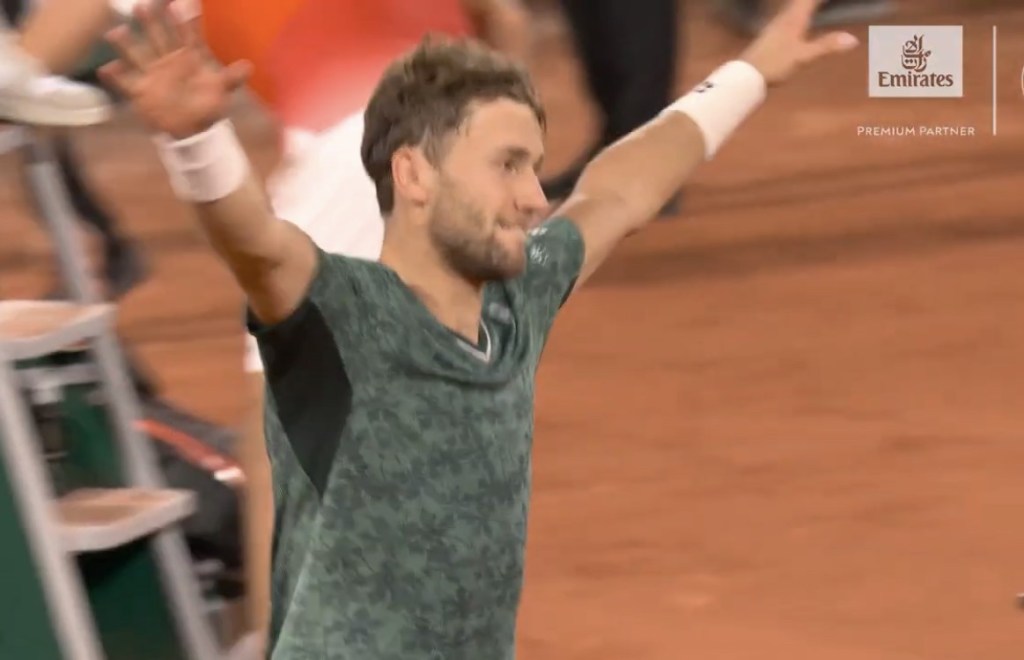
Ruud On The Rise: Casper Ruud celebrates reaching his first major final at the French Open. Source: French Open Youtube

It’s Not a Magic Wand, Part 5

World number one Iga Świątek has won 34 matches in a row, an astonishing streak that includes title wins on hard courts and clay. She won the Sunshine Double. When she’s near her best, she demolishes opponents — she tends to only lose five or six games per match — and when she isn’t, she outplays them on the big points. She is the most dominant, in-form player on both tours. She has been for some time. Yet it sometimes feels like her dominance is more counted on than appreciated, that as many people are wondering when she will lose as are praising her wins.

A notable line from David Foster Wallace’s famous 2006 essay on Federer is “Journalistically speaking, there is no hot news to offer you about Roger Federer.” News is in a similar position when it comes to Świątek. She might even be more difficult to write about at the moment, since she doesn’t have the obvious foil and rival that Federer did. (Her last loss, way back in mid-February, was to the dangerous yet inconsistent Jelena Ostapenko.) Świątek’s game is a sight to behold — her topspin groundstrokes are heavy and pacy, her movement and sliding skills are phenomenal — but a writer can hardly describe those qualities in every piece. Midway through this tournament, her form took a sharp dip, but she still didn’t come anywhere close to losing. It was just confirmation of what we already knew about Świątek: she is the best in the world by a country mile.

Świątek is reaching rarely-seen levels of supremacy. I watched her beat Daria Kasatkina from the corner of court Philippe-Chatrier today. Kasatkina had been having a great tournament, and she kept pace with Świątek for a bit, but once Świątek clicked into gear, Kasatkina could barely win points. The shift was palpable — Świątek stopped making errors at around 2-all in the first set. Once that happened, all the pressure was on Kasatkina, whose shots were less powerful but also less consistent. At one stage, her forehand trailed Świątek’s 4-9 in winners and had seven unforced errors to Świątek’s one. The overall point spread for the match was 59-29, which is about as lopsided as it gets. People on Twitter were critiquing Kasatkina’s errors — she missed a smash at 2-3, 15-30 in the first set — but to me, it seemed like she was overmatched with no path to success. Even an error-free performance would have resulted in a straight-set loss, just a slightly closer one.

Many tennis players are reluctant to reveal anything to the press, but Świątek has been open and personable. She does columns on BBC Sport where she talks freely about everything from her tennis to growing up. She wants you to know that she likes books. Gone With the Wind made her cry, Murder on the Orient Express did not. She is a big Rafa fan, which the press won’t stop asking her about. She doesn’t seem to mind. Anyone ranked #1 in the world deserves it, but Świątek is an ideal player for tennis to have at the top. She’s friendly, watchable, popular. A fan of hers has a Twitter account dedicated to posting her out-of-context moments (@SwiatekOOC). It has nearly 12,000 followers, despite, at the user’s admission, containing “traces of context.”

Roland-Garros is important for Świątek. In the eyes of many casual fans and even some pundits, her winning streak will lose some of its shine if she doesn’t win the Parisian major. This is unfair — she’s won 34 straight matches now, and the pressure is only going up — but also has some logic to it. In 1995, Andre Agassi tore through the North American summer hard courts with the goal of avenging a Wimbledon loss to Boris Becker at the U.S. Open. Agassi won four tournaments in a row, then beat Becker in the Open semifinals, but he lost to Pete Sampras in the final, which snapped a 26-match winning streak. “I’m 26-1,” he told the press according to his autobiography Open, “and I’d trade all those wins for this one.” There is no denying that majors are, well, major.

Świątek is a heavy favorite to beat Coco Gauff in Saturday’s final. I watched Gauff’s semifinal as well, and while she is a fantastic player, Świątek is simply on another plane. I’m not sure there’s anything Gauff does better. She may well get there in the future, but right now, Świątek’s shots have a little bit more heft, her slides a little bit more length. Even with her dip in form, there has been less uncertainty surrounding Świątek than Nadal this tournament, and Nadal has won the event four of the last five years.

It’s become hard not to take Świątek for granted. Her dominance has been so total that when I watch her, my mind sometimes assumes she will win this tournament and leaps ahead to project how she will do on grass. What will end her streak, a great performance from an opponent or a dip in form or motivation on her part? How many majors can she win? Who else on tour can challenge her? Considering her omnipresent winningness, wondering what will interrupt her rampage is almost as easy as appreciating her results. I think winning streaks are more revered in hindsight; as much as tennis fans bemoan a lack of consistency, many of us are drawn to chaos. People want at least a little bit of unpredictability, and Świątek is starving the tour of it.

All of this is to say that Świątek is not getting the hype she deserves, and what hype she is getting seems very conducive to pressure. Carlos Alcaraz, I think, got a bigger buzz despite winning less. Aside from the wins and titles and prize money (no big deal), when I wonder what it would be like to be in Świątek’s shoes, I don’t love what I see. My job would be to win every single match. Even some of my straight-set wins would cause some murmuring, because hardcore fans or journalists decided I wasn’t at my best, that 6-3, 6-4 wasn’t good enough. To some people, my entire winning streak — Doha, Indian Wells, Miami, Stuttgart, Rome — would take a backseat if I lost at Roland-Garros.

I would argue that Świątek’s biggest asset right now is the fact that none of this seems to bother her. She is, by all appearances, a stone-cold killer on-court and a happy-go-lucky person off it. At the start of the tournament, she was able to joke with Ons Jabeur — who had pushed her in Rome (relatively speaking, of course. Świątek beat her 6-2, 6-2) and was billed by many to meet her in the final of Roland-Garros before she was upset in the opening round — that Jabeur could beat her by slipping something in her water bottle.

Świątek said after her semifinal win that going into the tournament, she felt her winning streak could end soon, so she didn’t set any specific goals. It’s the perfect way to offset the rising demands from fans and pundits — by taking things match by match, she could see each win as an accomplishment rather than a mere fulfillment of an expectation.

All of this makes no sense to me (but then, very little about professional tennis does), as a mere fan of this sport and not a conqueror of it. Maybe Świątek is numb to expectations having been the favorite at Roland-Garros last year as well and feeling the disappointment of not winning the title. Maybe her work with sports psychologist Daria Abramowicz gives her a unique advantage. Maybe she’s just really good at living in the moment. Whatever the case, Świątek is absolutely acing every test she faces. Her opponents can’t knock her off course, and neither can the expectation that she win every match she plays. She doesn’t need our help.

It’s Not a Magic Wand, Part 4

The first four games of the Rafael Nadal-Novak Djokovic quarterfinal at Roland-Garros took 29 minutes to get through. This is too intense, I wrote in my notebook. Something has to give. The two titans had played through a multi-deuce opening game that featured more amazing rallies — Nadal ran Djokovic all over the place on the second point, and I swear, the crowd thought the point had ended three times before it actually did — than some entire matches. With Nadal serving at 2-1, they again dug in for a marathon game. This was a trend that lasted throughout the match. The second set, summarized by an ordinary 6-4 score, lasted almost 90 minutes. Six different games went to deuce. Had it gone to a tiebreak, the set could have approached two hours in length. Two hours. For one set. Think about that for a second.

Nadal and Djokovic have never had it easy against each other. When you mix two players who have bottomless reserves of will and tactical mobility, and are two of the most talented ever on top of that, you get dazzling tennis, but you also get matches that refuse to end before one player has absolutely emptied the bucket. I was in the stands for this match, and by the end I felt like I had a crater in my head even as I grinned deliriously. It was like taking a lava bath with a protective suit on that was strong enough to keep me alive, but light enough to deliver unfiltered sensation.

What the match would be like for Djokovic and Nadal themselves, then, I have no idea. Djokovic certainly looked gutted at the end — he embraced Nadal respectfully but curtly, then marched off court without waving. And who can blame him? He simply does not lose matches like the one he just lost. If you handed me a scoreline like 6-2, 4-6, 6-2, 7-6 (4) and told me that Djokovic had lost in over four hours, I’d think you were insane. When things get close, Djokovic edges out his opponents. When the points get big, Djokovic delivers. When matches get long and physical, Djokovic outlasts. In this match, though, Djokovic failed to convert two set points on serve at 5-3 in the fourth set, set points that would have put him in a fifth set against Nadal on Chatrier for the first time since 2013. The set went to a tiebreak — Djokovic excels in these against top players, whereas Nadal hadn’t won one against a top-10 player since 2019 — and Djokovic didn’t just lose, he fell behind 6-1. He played brilliantly afterwards: a backhand winner for 6-2, a service winner for 6-3, a holy-shit-what-just-happened forehand return winner off a Nadal first serve for 6-4. But it didn’t matter, he was too far gone. Nadal patiently opened up the court on his fourth match point and crushed a backhand winner down the line. (Credit to Djokovic for making Nadal play, by the way. From 6-1 up in a tiebreak, you expect to win it 7-1, not to have to play four more points and to have to win by going for your worst shot.)

*****

The match as a whole wasn’t an epic. I thought it resembled many of their past meetings at Roland-Garros at some point or another, only for the match to shape-shift thereafter. After the first set blowout, I thought of 2020. When Djokovic evened the match, I thought of 2021. As Nadal swept through the third (a stat: today’s third set lasted 38 minutes, the third set of last year’s semifinal lasted 97), turning a close match into a lopsided one, I thought of 2013. This match was certainly its own, though, featuring previously unseen passages of play.

For example: from a double break down in the second set, Djokovic embarked on perhaps the most dominant display of returning I have ever seen. From a double break down, a set is supposed to be over. Maybe, if you put together a couple really good games, you can get to a tiebreak. Djokovic, though, broke Nadal three times like it was nothing. Nadal. On Nadal’s favorite court. Djokovic simply fired perfect return after perfect return. Nadal made hard first serves, and loopy second serves, and even crushed a few second serves in an effort to throw Djokovic off. It didn’t matter. The ball came back to Nadal’s feet on the backhand side with hellish consistency. Nadal, who has won 13 Roland-Garros titles, was reduced to reacting to whatever Djokovic did. The Serb did employ the backhand jail tactic to some success, but it didn’t feel that important; Djokovic was giving himself so much time with his returns that he could have done whatever the hell he wanted. I was initially surprised when Rafa ran away with the third, but with Djokovic returning from heaven, the only way to go was down. It had to happen at some point.

The way he ramped up his returning reminded me of a scene from Thor: Ragnarok. Thor is fighting Hela, who’s noticeably stronger than he is. When they start dueling, Thor gets a couple good hits in, but Hela swings the battle by first blocking his strike, then counterattacking. The longer the fight went on, the bigger advantage Hela had. Djokovic had taken a huge blow in the first set and a half, but his response was so devastating as to erase a typically unsurmountable deficit.

This comparison eventually fails since the decisive passage of play was Nadal coming back at Djokovic after Djokovic came back at Nadal, but if you saw the match, you don’t even need the analogy. Good fight scene, though.

Another example: Nadal’s level during the first set and a half was inexplicably good. If there is anyone out there who goes into a match expecting to face a level that high, they are a hopeless husk. Nadal mauled forehands down the line and covered the court like a weighted blanket. He was so close to his best that it became impossible for Djokovic to be at his best — how could he have been, given how he had to hit practically every shot on the dead run? Djokovic is one of the fittest players on tour and has no issues with sprinting around the court, but I was genuinely worried for him after the first-half hour, he was running so much. The worst part was that his defense wasn’t even doing anything. He would repel a blazing forehand down the line with a squash shot, only for Nadal to run around it and drill the next forehand inside-in for a winner. Nadal’s god-mode tennis faded in the middle of the second set, though the damage had been done, both to Djokovic and Patrick Moratoglou’s “expertise” on the two titans.

It’s important to know that neither of these two would have played this way against anyone else. Against, say, Zverev, Nadal could get away with safer forehands and Djokovic would be fine hitting average returns rather than perfect ones. Against each other, though, they have to go for it. They have to throw their “high-margin aggression” mantras out the window and attack, all the time if they can. Whoever doesn’t rise to the occasion inevitably watches the opponent do just that.

*****

One of the most remarkable parts of this rivalry is the way it continues to evolve even in what is surely its final chapter. In 2019, Nadal bageled Djokovic in the first set of the Rome final. It was the first bagel of the entire rivalry. It was jarring, especially given that the last match they had played was the Australian Open final, a demolition in favor of Djokovic. Surely, the implication was, Djokovic wouldn’t beat Nadal on clay again. In 2021, though, he did it. He didn’t just beat Nadal at Roland-Garros, he did it from a set down, which had never been done before. Now, after being billed as the underdog by virtually everyone, Nadal has taken revenge. This rivalry is made up of two main segments: Djokovic trying and failing to beat Nadal with any reliability before 2011, and the roles reversing afterwards. Even within the segments, though, these matches are damn hard to predict. Djokovic and Nadal have now met at Roland-Garros the last three years, and many of us have gotten the pick wrong all three times. The tactics are well-established, but so many different things can throw a match into chaos. Most were confident Djokovic would win headed into this one, and Nadal tore up the script by playing at a superhuman level for the first hour and a half. You can’t predict possession-by-the-tennis-gods. Just ask Marin Čilić.

Another fascinating aspect of Djokovic-Nadal is the degree to which the matchup favors Djokovic. His return of serve is especially damaging to Nadal, whose serve isn’t the best, and whose groundstrokes need a lot of time to load up. His backhand neutralizes Nadal’s forehand, his biggest weapon. Djokovic’s forehand can break down Nadal’s backhand. It’s a tactical nightmare for the Spaniard, which is a big reason why he hasn’t won a set on hard court against Djokovic since 2013. Somehow, though, the head-to-head is 30-29. Sure, that’s partly because Djokovic took some time to grow into the rivalry, and because Nadal is so good on clay that he can beat Djokovic despite the bad matchup, but the underlying message is that great players can break bad matchups. No one else has even close to as many as 29 wins against Djokovic besides Federer (23). Even since 2011, when the Serb went into supersonic mode and took the upper hand in the rivalry, Nadal leads the tour in wins over Djokovic with 12. It’s a testament to them both — Djokovic did the tactical homework no one had done before to get a leg up in the Nadal matchup, and Nadal’s own tactical mind has led him to plenty of wins anyway.

This was maybe, I don’t know, the 10th best match Djokovic and Nadal have played. Even in what was for them a patchy few hours, though, the sheer skill they managed to display is astounding. It was almost hilarious how evident their superiority over the rest of the field was even during their dips. No other player is capable of going on the second-set rampage Djokovic managed. Afterwards, when it looked like he had all the momentum, Nadal casually won the first seven points of the third set. Each player took titanic blows to the midsection and continued to throw punches even as their bodies sank to the ground. Their rivalry is unique because they only see themselves — their prodigious endurance, intelligence, and shot quality — in each other. No one else comes close.

I can’t look away whenever these two play each other. I turned my phone off during the match and never had an urge to look at it. The crowd knew what they were witnessing — I didn’t see a single empty seat. At times, it was as if fans of the players were playing a match of their own, yelling when they saw an opportunity to lift their guy, raising the decibel level to drown out the other side. I brought a small notebook with me. It had 16 small pages, and before the end of the first game, I had filled two of them. The whole thing was full by match point. I moved it from my hand to pocket and back so many times that I chafed my finger on my pocket zipper. A bit of blood dripped onto the notebook. I didn’t realize what it was from until well after it happened.

Many of Nadal’s quotes this tournament have undertones of an impending retirement. His foot won’t leave him alone. Still, he’s the winner of the last major tournament, and the probable winner of this one. If he calls it quits soon, it won’t be because he can’t win anymore. Djokovic is an expert at rebounding from tough losses. He will be the overwhelming favorite at Wimbledon. Both guys have found a way to suspend their decline, replacing parts of their game as other components start to fail. Even now, with weary bodies and minds, these two playing is the greatest show in tennis. They’ve mastered everything that can be mastered. They make magic when they play.

The Tale of 3 Generations

By Owais Majid

This French Open has been a bit of an anomaly in that, due to the way the ATP draw shaped up, every alternative day is likely to be a bit of a dud. When the likes of Rafael Nadal, Novak Djokovic, Carlos Alcaraz, etc, are in action on the same day, there’s naturally going to be a bit of a drop off when it comes to the bottom half of the draw.

Yesterday seemed like one such day. Throughout Sunday and early Monday, all of the attention was on the blockbuster clash between Nadal and Djokovic on Tuesday, and to a lesser extent Alexander Zverev vs Carlos Alcaraz.

Stefanos Tsitsipas was expected to come through his contest with Holer Rune with relative ease and largely the same was expected of Daniil Medvedev who would be facing Marin Cilic later that night. In fact, the majority of the tennis community had broadly assumed that Tsitsipas would reach the final, probably beating Medvedev in the semis so there was little in the way of hype surrounding those matches.

Step up Messrs Rune and Cilic.

After coming through taxing matches in his first two rounds, Tsitsipas cruised through round three courtesy a straight sets victory over Mikael Ymer. Meanwhile Rune, who has been on the watchlist of many for a while, ousted Dennis Shapovalov in the opening round in straight sets which he backed up with equally easy victories over Henri Laaksonen and Hugo Gastan.

I expected Rune to push Tsitsipas early on, maybe taking a set off him but ultimately that the Greek’s experience would prove too much for the young Dane. And so that seemed to be the case. After initially going a break and 3-1 down, Rune showed some flashes of his ability early doors, befuddling Tsitsipas with some of his stroke play. He particularly utilised the drop shot to good effect and Tsitsipas was visibly frustrated on numerous occasions. The 19 year old managed to break back eventually before playing an amazing return game to go a break up 6-5 at which point he served the set out clinically.

Tsitsipas roared back in the second taking an early advantage with a break. At that point, we saw a few glimpses of Rune’s petulant side for which he is well known. His level suddenly dropped off significantly and Tsitsipas won that set with little trouble. Most of us would have expected him to wrap the next two up in routine manner, particularly given Rune’s issues with durability.

That couldn’t have been further from the truth. After the opening stages being fairly nip and tuck, Tsitsipas played a horror game to be broken for 4-2. With Rune animated and Tsitsipas conspicuous due to his lack of emotion, that seemed the first real turning point in this match and the first point at which many of us actually thought there was a possibility, if still a fairly small one, of a major upset here.

The early stages of the 4th played out in a similar fashion with one distinct difference. Contrary to what many of us would have expected, Tsitsipas was the first of the two to appear to fatigue. The eventual culmination of this was for him to once again throw in a terrible service game and hand the advantage to Rune. Not content with just the one break, Rune broke once more for 5-1.

As it so happened, that insurance break was a necessary one. Serving for the match, Rune’s level suddenly dipped. Whether that was due to nerves, his infamous cramps or a combination of the two, Tsitsipas retrieved one of the breaks to cling on to his hopes of going one better from last year and winning his first major.

But Rune, showing maturity exceeding his age and vastly exceeding what we have come to expect from him, served out a memorable victory at the second time of asking leaving Tsitsipas shellshocked.

Not for the first time, Tsitsipas has let a man his junior beat him in what could well be described as their breakout victory. There’s something a bit jarring about “next gen” simply coming up against players a few years their junior, let alone when those players are showing them up. In Alcaraz, at last year’s US Open and Rune here, Tsitsipas has suffered a pair of defeats that will erk him more so than any other defeat at a major because of what those players represent.

Tsitsipas and his peers were seen as those who would take the torch from the big three once they retired. Indeed, he himself fuelled that talk when he beat Federer at the Australian Open in 2019 in a breakout victory of his own. For what is effectively the “next next generation” to come and seem to surpass him must be an incredibly humbling and even humiliating experience.

The shock of that match soon gave way to talk of Daniil Medvedev, one of the other members of the next gen. Infamous for his revulsion of clay, the Russian was now being predicted to get to the final with a Nadal like certainty. After all, with his biggest threat out of the picture, the stars had aligned, or so we thought.

A few years ago, Marin Cilic coming up against the world number two would have us all frothing at the mouth. RECENTLY however, the Croat’s form has fallen off a cliff. Indeed, the last time he was in the top 20, many of us had never heard of bat soup.

In spite of Medvedev aversion to this surface, he was expected to beat this version of Cilic with relative ease.

Once more, how wrong we all were.

Every so often, Cilic brings out a level which leaves you wondering why he hasn’t won 25 Grand Slams, the 100 metre Olympic Gold and the football World Cup. Yesterday was one such occasion.

From ball one, he was hitting with a crispness we’ve scarcely seen from him. Though Medvedev was clearly not at his best, his performance was far from disgraceful. As it were, he was made to look distinctly average by Cilic. strutting about the court with a Djokovician confidence, Cilic broke the usually formidable Medvedev serve twice to race into a 6-2 lead.

A bemused Medvedev, chuntering at his coach, the umpire and himself, was left wondering what had hit him. If there was any consolation for him, it would have been that surely Cilic couldn’t keep this level up. 

However, if anything, Cilic raised his level even further. Medvedev’s serve was once more broken twice with Cilic almost showing off by the time he’d taken a two set lead in little over an hour.

Even then, Medvedev would have known that he’d beaten Cilic from two sets down at Wimbledon so he still stood a chance. What that required though, was for Cilic’s level to dip.

Once more, Cilic defied belief and somehow maintained his imperious form. At this point, Medvedev’s tennis seemed to be saying “what’s the point. This guy’s just on a different stratosphere today”.

It’d be harsh to accuse Medvedev of tanking, but he became considerably more disinterested in the third set. Given what he was having to contend with, its difficult to put too much blame on him for it. Cilic continued to roll through his service games in a Medvedev-esq manner. Medvedev was put out of his misery as Cilic completed a 6-2 6-2 6-3 beat down of the man who 4 months ago was two sets up in the Australian Open final against Rafael Nadal.

In his on court interview, Cilic ventured that it might have been the best performance of his career and it is honestly difficult to argue with him.

If Rune’s victory over Tsitsipas was a clash of generations, then this was certainly that, only on a more extreme level. Cilic was, and is, one of the unfortunate group given the tag of the forgotten generation. Along with the likes of Nishikori, Dimitrov, and Wawrinka, all for differing reasons, Cilic has escaped the memory of many a tennis fan. Cilic’s performance today was a reminder that the so-called forgotten generation haven’t gone away just yet.

If Rune’s triumph earlier was a “remember the name” moment, then Cilic’s was probably a “remember me?” moment. Though the two men are at very different stages of their careers, though the victories represent different things in some ways, there were many similarities between the results, not least this idea that the next gen, for all of their quality, haven’t as of yet met the expectations they were once given

Obviously, today was a freak day in that two of the most prominent members of the next gen lost out in disappointing fashion, but it’s interesting that, for all the hype this group of players has had, the results haven’t as of yet met that. Whether its from those who came before them or those whose careers are just beginning to blossom, competition for this generation is as intense as it ever has been.

Incidentally, today sees Alexander Zverev, arguably the next gen player who was expected to have the most success, come up against 19 year old Carlos Alcaraz in a match Zverev is widely expected to lose. If that plays out, it’s further evidence of how the ′next gen” appear to be being left behind.

If they’re not careful, they could quite conceivably become the second coming of the forgotten generation.

Days Of Future Past: Holger Ruun and Marin Cilic beat their favoured opponents yesterday. Source: French Open Youtube

Glorious Grass

By Claire Stanley

Grass court season is officially underway and – true to form – it took approximately one hour for the rain delays to begin. We’ve missed you so much!

The most important tournament of the week kicked off today in Surbiton, England, where former world number 1, three-time major champion, two-time Olympic champion, Davis Cup winner, and all-round legend Sir Andy Murray took to the glorious green courts to start his grass domination.

The number 1 seed took on Austria’s Jurij Rodionov in the first round, and safe to say it was an annihilation (6-2 6-1) – if Murray plays this way all tournament it will set him up nicely for the coming weeks. We’ve got a strong field this week – with players including Adrian Mannarino, Thanasi Kokkinakis and Denis Kudla – in Surbiton but judging by today’s performance, Murray has a real shot at going all the way.

As ever (ok, most of the time) Murray was a joy to watch on grass – his best surface and (personally) his best shot at glory once again. His movement was impeccable, his serving delicious (albeit with a couple of double faults) and the fire in his belly was well and truly burning. 

In previous Challengers many have commented that Murray doesn’t look as enthused as he would do if he were playing a slam, or a Masters 1000 – or even an ATP 250. Which is understandable, but something I felt he needed to get over – that enthusiasm was there today. He was fired up, fist pumping, cheering at the important points: he wanted the win. He wants to win the tournament. He didn’t go out there today to make up the numbers and he won’t go out there for his second round match to give his opponent target practice.

Green Green Grass: Andy Murray returns to competitive action yesterday on the grass court of Surbiton. Source: BBC Sport

A potential quarter final against the USA’s Brandon Nakashima beckons, a real rub-your-hands-together-in-anticipation match. Providing he reaches that stage – I’m certain he will – and he comes through it unscathed, I’m feeling pretty confident that we’ll see Andy Murray crowned Surbiton champion on Sunday.

And if not… well I apologise in advance for being the new Scott Barclay and jinxing my favourite by getting carried away.

It’s Not a Magic Wand, Part 3

Earlier installments: Part 1 Part 2

Watching blowouts can be fun. Tennis is at its best when two players meet on an even plane, but it’s enchanting to watch one player fire on all cylinders for an entire match, utterly mowing down their opponent in the process. This morning, Daria Kasatkina destroyed Camila Giorgi, who isn’t a player one typically destroys — Giorgi has a ton of power, so matches against her are usually won by forcing her to misfire often. Kasatkina elicited plenty of errors with both consistency and depth, but she was also offensive whenever she got a chance.

At first, the match was shaping up like a normal Giorgi match. She was blasting away, making a bunch of winners and missing a bunch. Kasatkina, serving at 2-1, 15-30 about 15 minutes into the match, hadn’t hit a single winner herself. From there, though, Kasatkina crushed a forehand winner down the line to even the game, then flashed several more untouched groundstrokes past her opponent in the next few minutes. Giorgi got her punches in, as always — there were plenty of awed gasps from the crowd at her outrageous winners — but she had Kasatkina’s offense to contend with on top of her own errors.

Early in the second set, there was already an urgency to the Giorgi fans’ applause. Her father vaped. It was obvious that Kasatkina was in the zone. Giorgi got into one of Kasatkina’s service games, at 1-2, but saw a pair of break points wiped away, and from there, the rout was on. Asked about her errors after the match, Giorgi simply said “this is me.” She was right — she played as she usually does, but Kasatkina blunted her weapons and struck back with some of her own. Now into the quarterfinals, Kasatkina has lost only 14 games this tournament, a laughable average of 3.5 per match. Next up is a very winnable match against Veronika Kudermetova.

During the night session, Marin Čilić dismantled Daniil Medvedev with such totality that I felt bad for Medvedev by the end. Čilić’s performance was less nuanced than Kasatkina’s in that he got to be the aggressor virtually the entire time (in part due to Medvedev’s lack of baseline power), while Kasatkina had to defend and attack well, but Čilić had the added challenge of going up against the world #2. Clay is not Medvedev’s best surface, but he made the quarterfinals at Roland-Garros last year, and has reached a general level of mastery that he should not be losing in straight sets to anyone, anywhere. Yet against Čilić, it didn’t even feel like Medvedev did much wrong, even though he won only seven games.

Čilić swept forehand after forehand past Medvedev. He won 90% of the points played behind his first serve, which is an obscene number in any situation, but especially against a great returner on clay. Medvedev’s fantastic defense didn’t get him anywhere because Čilić’s shots were too fast, too heavy, and too consistent. The match, scheduled for the marquee night session (I expected it to go four or five sets) was over almost as soon as it had begun.

The day featured all kinds of notable results — Iga Świątek lost a set, for instance! Qinwen Zheng saved five set points in their opener and rebounded from 5-2 down in a tiebreak to stun the 2020 champion, causing trouble with heavy groundstrokes and delicate drop shots. Though Zheng faded after the first set, impacted by cramps from the start of her period (as she stated in a brave press conference), the match was notable. It felt like Świątek, who hadn’t been near her best in the third round either, was starting to look vulnerable. Given her 32-match-and-counting winning streak and overwhelming favorite status at this tournament, vulnerability is potentially a huge deal.

That wasn’t all — the ATP side, after seeing few upsets in the first couple rounds, saw its second (Medvedev) and fourth (Tsitsipas) seeds bow out. Tsitsipas’s exit, in particular, felt important. For a while now, he’s been off his games. Since making the Roland-Garros final last year, it feels to me that he’s played his best tennis in just one match, the Australian Open quarterfinal against Jannik Sinner. This clay season, Tsitsipas had been able to fall back on his prowess and strong B level, but his best stuff constantly eluded him. The dip in form finally caught up to him, with Holger Rune taking him out in four. Tsitsipas had been the heavy favorite to make the final from the weaker bottom half of the draw, and this loss feels like a potentially crucial moment. He’ll drop over 1000 points from his run to the final last year, and considering he hasn’t improved much, if at all, in the past year, he may have to make some major changes to what he’s doing.

Still, even on a day that offered plenty of relevant news about the tournament’s future, what stuck out most were Kasatkina and Čilić’s masterclasses. The matches were sometimes hard to look at — such was the plight of their unfortunate opponents — but they were impossible to look away from. Tennis is all about errors. You’ve got unforced errors, forced errors, mental errors. Winning is often accomplished as much or more by simply not making a mistake than by hitting an excellent shot. Yet for a while, Čilić and Kasatkina seemed to have the game entirely figured out.

It’s Not a Magic Wand, Part 2

Click here for Part 1.

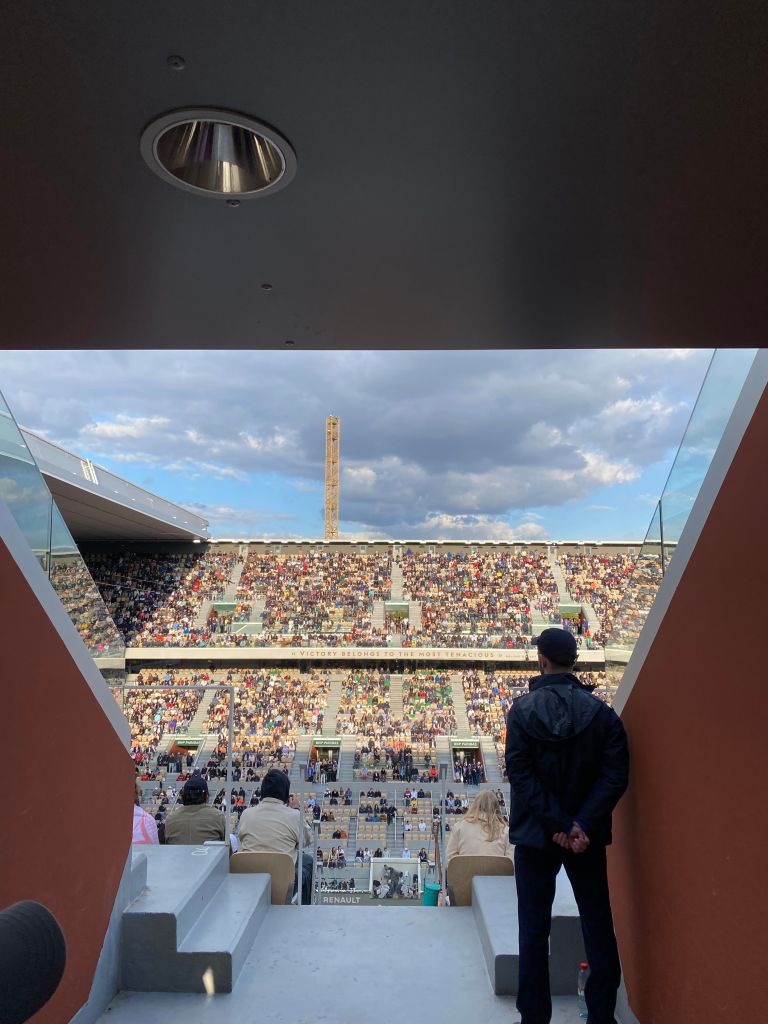
My mom and I stood in the tunnel just outside the upper seating at Court Philippe-Chatrier. Rafael Nadal and Felix Auger-Aliassime were locked in the initial stages of a fifth set, just the third fifth set Nadal had ever entered in 112 matches at Roland-Garros. My mom, a huge Nadal fan, was very nervous and needed some convincing to walk over to the show court and see if any departing fans were willing to give us their tickets. (May every deity in existence bless the nice man who handed us three tickets on his way out, one of which I quickly handed off to another hopeful fan.) She desperately wanted Nadal to win. I desperately wanted to see Djokovic — who had destroyed Diego Schwartzman earlier in the day — play Nadal for a 59th time in the quarterfinals. We couldn’t sit down until the changeover after the third game. Before the sit-down, more and more people built up in the tunnel. The live scores were a few seconds behind the actual match taking place mere meters away, so we tried to guess who had won points from what the crowd’s cheers sounded like. The nervous energy was through the roof.

From the endless wait before the changeover.

Once we sat down, the quality of the fifth set could scarcely have been better. Nadal and Auger-Aliassime traded easy holds at first, then the young Canadian dug in to close out a service game that Nadal dragged to deuce from 40-love down. The ratio of points ended by a winner or forced error to points ended by an unforced error was overwhelmingly high. At 4-3, Nadal broke serve with a trio of winners — a smash, a forehand pass, and a backhand flick hit on the dead run — and one forced error. In the final game, Nadal ascended even further. Down love-15, he crushed a huge second serve down the middle that Auger-Aliassime could barely get a racket on. A volley winner and a forehand screamer down the line followed. On match point, Auger-Aliassime left nothing in the tank, sprinting to retrieve a volley and a dink. His efforts left him sliding out of position, leaving Nadal with a forehand to hit into the open court. The moment seemed to last forever, with Nadal running into position to set up for the shot. He nailed it into the corner and raised his arms as the crowd screamed their relief.

It was an utterly clinical set from Nadal. He hit 15 winners and four unforced errors (he had 13 unforced errors in the fourth set). Auger-Aliassime had reason to feel good about his chances in the fifth — all the momentum was against him at the start of the fourth, but he broke Nadal twice and was unbowed when Nadal fought back to deuce in Auger-Aliassime’s service games after being down 40-love. In the fifth, though, the Canadian was under pressure most of the time. He had a one easy hold in the middle of the set, but couldn’t scratch Nadal’s serve and was pushed to deuce or break point in three service games.

Nadal’s ability to raise his level to meet the demands of a situation is nearly unparalleled. He’s done it dozens of times over the years. Somehow, though, it often feels surprising. There’s the obvious jolt of Nadal drastically improving mid-match, but the unexpectedness goes beyond that. He has a way of looking vulnerable even as he dominates — his record at this tournament, and on clay, should have put the result of the fifth set beyond doubt before it began. Yet there was very real tension during the decider. I felt nervous. The crowd couldn’t decide who to root for, alternately then simultaneously chanting “Rafa!” and “Felix!” Nadal celebrated with prolonged screams more than once. It felt like the match hung in the balance. In reality, though, it didn’t. Nadal had only lost three times at Roland-Garros. He’d won all the five-setters he’d ever played on clay. Every single stat pointed to him winning, and he did just that.

Nadal’s ability to play better with little to no warning is a mystery to me. It probably has something to do with his relentless intensity, though that’s a consistency in his game; it’s not that he starts trying harder, it’s that he starts executing better. He’ll often misplay a fairly big point — say, an early break point, or a deuce point in an important set — but he rarely misses on the most crucial points. Maybe, in convincing himself that every point he plays could be his last, he is able to play like every point could be his last. After this match, he said that his last time playing at Roland-Garros could come at any time. Still, he’s incredibly predictable in his amazing play, even as his future is difficult to extrapolate.

This isn’t a new phenomenon. During the fifth set of the 2017 Australian Open semifinals, Nadal found himself down 3-4, 15-40 against Grigor Dimitrov. Nadal saved the first break point with a clean backhand winner down the line, then romped to net on the second to put away an easy volley. Darren Cahill remarked that we had seen such clutch play from Nadal many times in the past, but it still managed to be surprising.

I met up with a friend from Tennis Twitter after Djokovic-Schwartzman. We talked about the Big Three for a while, and the way they’ve devastated career after career. (I floated the hot take that Murray was a better player than Agassi, which isn’t reflected in their stats due to the fiercer competition Murray consistently had to face.) He mentioned how frustrating it was that people criticized Jo-Wilfried Tsonga and Richard Gasquet for not winning a major without considering the impossible rivals they were up against. We lamented the “Baby Fed” nickname Gasquet and Dimitrov had to bear. Competing in the Big Three era, we agreed, was a trial by fire. Players would put up career-best performances against them and still lose, possibly even more than once. Of course that shattered careers — how are you supposed to go back to the drawing board when everything goes right and you lose anyway? The pain is too much for most players.

Nadal emerged from his trial by fire with barely a scorch mark. Even when he was losing again and again to Novak Djokovic in 2011, he would talk calmly about how he needed to improve. He seemed to relish each new chance to play the guy even as it looked impossible that he would win. In passages like this, and in his early years on tour, he developed a rarely-seen clutchness, a knowledge of what to do when things got difficult. I knew very well how intelligent and how skilled Nadal was.

Still, I found myself fooled at the end of the match with Auger-Aliassime. I genuinely wasn’t sure he would win. Maybe it was because I was emotionally invested in a potential Nadal-Djokovic clash and I wanted to prepare myself for disappointment, but I think it ran deeper than that. Nadal has this level-raising quality in spades, and yet he has always had doubters. Every year, there’s a group of fans or pundits who decide he isn’t the favorite at Roland-Garros, even when it’s clear as day that he is. Nadal even talks down his own chances, often rightfully, given his chronic injuries. All of this serves to create the impression that despite all his world-beating attributes, there’s something undeniably frail about his success. It sometimes doesn’t feel reliable until he lifts a trophy.

Auger-Aliassime, as well as he played — and he did play well, even at the end; he didn’t make a single unforced error in the last two games of the match — had no chance against the Nadal whirlwind. His serve, which had crashed successfully through the court for large chunks of the match, started to come back consistently deep. Auger-Aliassime directed traffic to Nadal’s backhand, a sound tactic, but saw the Spaniard hit back with angles and pace. Nadal is not a machine, but he played like one at the end of this match. It was a shade away from perfect tennis. Auger-Aliassime played one of the best matches of his life, and he lost. Nadal has done this to countless players, including Djokovic (Djokovic!) early in their careers. There was no reason to be surprised, yet after the match, I was exhilarated, as if something special or unprecedented had happened. Really, the outcome we got was the most likely one, but it didn’t feel that way at the time.

Nadal always leaves his lockdown mode quickly. Once his final forehand flew past Auger-Aliassime, he raised his arms briefly, then had an amicable exchange with his defeated foe at net. Minutes after that, he was chatting peacefully with Alex Corretja during the post-match interview. Nadal’s intensity was totally gone, replaced by the consistent platitudes he gives the press. He courteously complimented Auger-Aliassime. Asked about his upcoming match with Djokovic, he simply assured the crowd he would fight until the last ball.

This is Nadal’s thing. The narrative is simply that he fights, but he fights well, he fights intelligently. His intensity is always the same, yet his level rises on demand. We’ve known this for years, as Nadal does his thing time and again, yet we can never take him for granted. Maybe because he himself doesn’t.

It’s Not a Magic Wand, Part 1

I ran into Cam Norrie, the 11th-best male tennis player in the world, outside a coffee shop this morning. He was wearing a dark blue hoodie. I looked at him and said, “Cam Norrie?” and he answered “Yeah.” I was attending the night session later, so didn’t have tennis on the brain quite at that moment and proceeded to ask him the dumbest question possible: “Are you playing today?” He told me that he lost yesterday, which I knew — seconds after I walked away, I typed into my Notes app that I not only knew the result, but the opponent and the length of the match (Khachanov, four sets). Norrie had fallen down two sets, but fought back to win the third and force a close fourth. “Well, it’s fun to watch you play,” I said, trying to salvage something. He thanked me. He was a nice guy. I was sorry he had lost.

Norrie’s close third-round match stuck out amidst what was a slew of straight-setters. Six of the eight men’s singles matches played on the first day of the third round were over in three sets. Some of those results were due to a vast gap in skill level, but others were due to one player failing to convert their opportunities.

Holger Rune is a notable name among the few who hadn’t dropped a set through the first two rounds of the tournament. At 19, he was the youngest player to do so in the men’s draw. Losing a set early can sometimes help build form, but for Rune the straightforward matches felt important. Physical endurance is necessary (though not sufficient) to win a tennis match, and Rune doesn’t have it yet. He cramps in many of the matches he plays, sometimes extremely early in them. At the U.S. Open last year, he turned heads by taking a long tiebreak set off Novak Djokovic, but mousetraps attacked his legs shortly after, and he had to slog immobile to the finish line, which was still two sets off at that point. His propensity for cramping is nearing meme territory among diehard tennis fans.

This is a shame for Rune, because by all accounts, his tennis is very good. He’s ranked 40th in the world. He made such a big jump from last year that he decided to complain on Instagram when he didn’t receive the ATP’s “Most Improved” award.

Still, I didn’t feel too good about his chances in the third round against Hugo Gaston. Gaston is a rather diminutive player; his small frame isn’t the most conducive to power or great court coverage. He’s crafty, though, often floating upwards of 50 drop shots over the net in a single match. He also draws enormous energy from home crowds. Gaston is French, and his best career results have come in Paris. At Roland-Garros in 2020, he pushed the then-still-almighty Dominic Thiem to five sets (possibly contributing to Thiem gassing out at the end of a five-hour-plus marathon with Diego Schwartzman in the next round). At the Paris Masters last year, he broke Carlos Alcaraz’s brain with a bizarre, crowd-fueled comeback from 5-0 down in the second set of their match, leaving the young Spaniard with his head buried in a towel by the end. Though Gaston lost to Daniil Medvedev in the next round, he had set points in the first set and the second was close, as well.

Rune having to chase down dropper after dropper as the Parisian crowd roared for Gaston seemed like an uphill battle for the mercurial 19-year-old. Rune isn’t what most would consider “mentally strong” — he’s exceptionally confident, but that self-belief often seems to be misdirected. After offending many by berating himself with the f-slur during a match last year, Rune’s apology statement on Instagram included “Sorry for not being as perfect yet as you all expect.” He later edited the statement. He seems to think he is a better player than he actually is — before he rose to relative prominence for a young player, he publicly stated that his goal was to win more Roland-Garros titles than Nadal. (If he doesn’t win the next four Roland-Garros tournaments in succession, he will already be behind pace.) When his tennis and endurance catch up to how he views himself, he will probably be a fantastic player, but that point still seems a ways off, which can cast a slightly comedic veil over things when he talks about his tennis.

When thinking about Rune, my mind jumped back to the day before when our plane landed in Paris. Everyone shuffled off slowly. The space between the plane and the airport is a weird place — at the airport, everyone reverts to their unique lives, by meeting a specific person or making a connecting flight or entering the city to do a particular activity. But before that, while exiting the plane, everyone is a sleepy jetlagged passenger. As my mom and I stumbled through the tunnel, a man just ahead of us was trying to balance several bags. He was pulling a suitcase with one hand and kept letting go of it to adjust everything else. He could only achieve a temporary equilibrium; he was carrying way too much stuff for there to be a formula that worked for more than few seconds. Once he had achieved a momentary balance, he would take hold of his suitcase handle and keep walking. One time, he kept moving for a step or two after letting go of his suitcase, and when he reached back, it was too far away. His hand closed over empty air.

*****

My expectations for a competitive match faded after about ten minutes. It was painfully obvious, even from way up in the stands on Philippe-Chatrier, that Gaston was not an elite baseliner. His shots sounded like they were shanks even when they went in. Rune hit with flat, linear power, while Gaston’s groundstrokes looped into the middle of the court as if pulled by magnetic forces. His shots had so little mustard on them that Rune could stay stuck to the baseline, close enough to the net that even Gaston’s beloved drop shots made next to no impact. I realized that Gaston’s defense might be his biggest strength, and while he covered the court well, he wasn’t exactly Novak Djokovic. He had nothing to hurt Rune with.

Gaston predictably got all the crowd support, and the cheers helped him, but they were not a magic wand. Down a set and a break in the second set, he built a 15-30 lead on Rune’s serve for what felt like the first time in forever. Rune was ready to serve, but Gaston stepped back from his baseline and windmilled his arms, urging the crowd to go even more berserk. The fans happily obliged for a good minute, completely halting play. The cheers — induced by what felt like legal cheating on Gaston’s part — seemed like more than enough to rattle anyone, and Rune is just 19, but he responded with several purposeful, aggressive points. Gaston was never allowed to get a foothold in the match.

Rune’s only major blip was a two-game stretch late in the third set. He failed to serve out the match at 5-1, then let Gaston hold easily. During his second bite at the apple, at 5-3, Gaston played some great defense to get back to 15-all. The crowd roared as if he had won the tournament, and I had to roll my eyes a little. His performance had been shambolic. He refused to follow his drop shots into the net — even juniors know to do this, as it cuts down on the opponent’s potential angles. Gaston did adjust mid-match, slightly, by trying to put more pace on his groundstrokes, but it didn’t seem like he had given his all. Night climbing across the sky had not helped him. I didn’t feel he necessarily deserved the adoration he was getting.

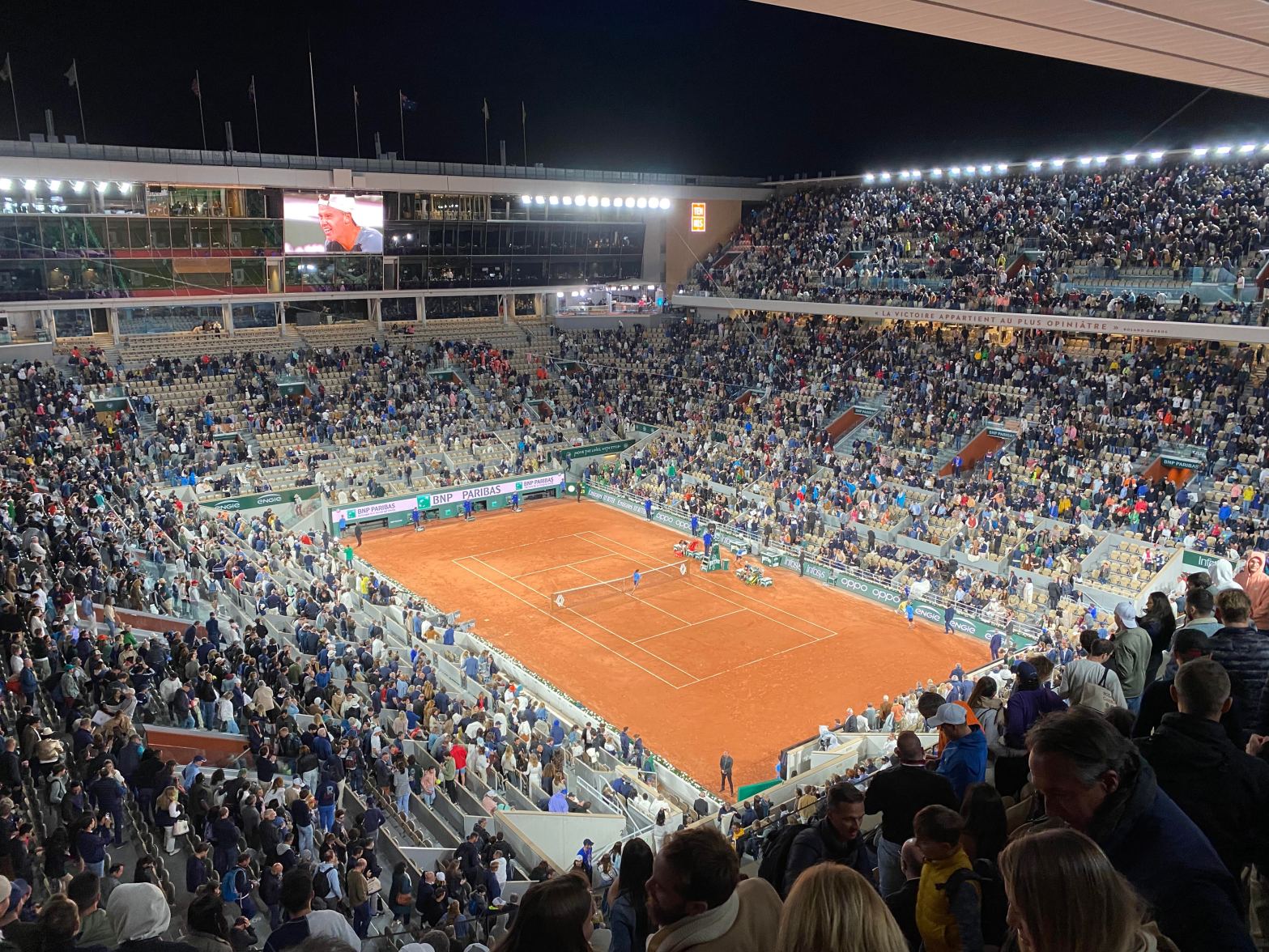
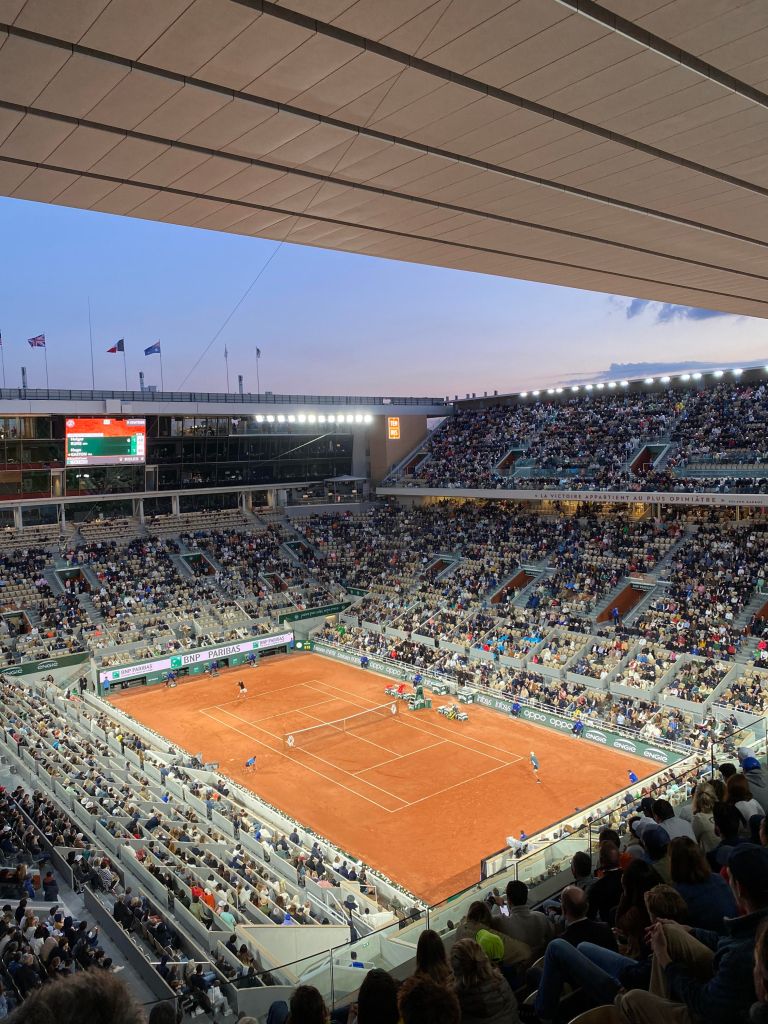
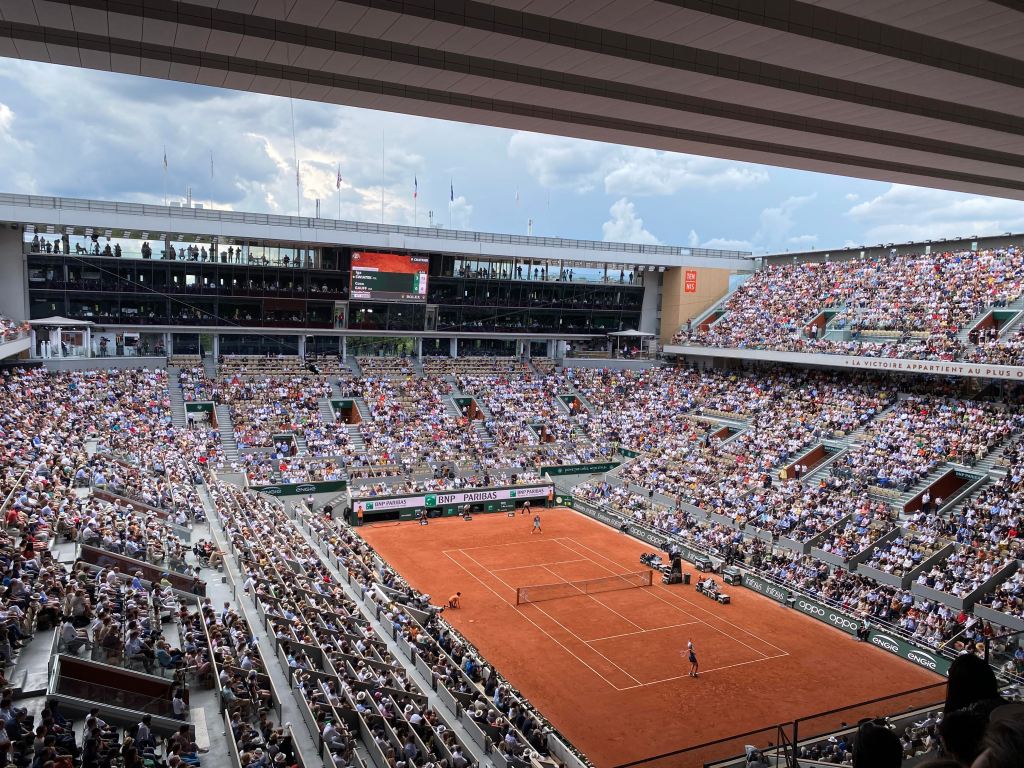
The match, despite its one-sided flow, was absorbing. Court Philippe-Chatrier is a gorgeous site for a tennis match. The sheer scale of the stadium is difficult to understand without being inside. There are layers upon layers. There are 30 or so entrances around the perimeter. My mom and I had to climb several flights of stairs to get to our seats. If there is an elegant way to stack 15,000 people in a giant box to watch two people hit a ball back and forth, Roland-Garros has it figured out with their show court.

In person, I noticed things a stream wouldn’t have told me — Gaston was practicing on the very court 45 minutes before the match, which I thought was a considerable advantage. The court was watered shortly after he left. The stands seemed quite empty for a while, then suddenly became quite full just before the players walked out. The rest of the grounds were also idyllic: stands sold (overpriced) crepes and ice cream, there was a tennis court everywhere I looked. Dozens of people wore RF caps, which surprised me a little — Federer has played Roland-Garros just twice in the last six years, and hasn’t been a relevant force on tour in a while — but there’s no denying his enormous impact on the tennis world.

The great man would have been disappointed with Gaston. Despite the Frenchman’s frustratingly inept performance, I found the crowd’s applause infectious. Wanting a competitive match, I spent much of the hour and 55 minutes yelling along with them. (Exiting the grounds after the match, I passed a pair of kids still chanting Hugo! Hugo!) In the last game, Gaston took a quasi-stand, winning a long rally with some exceptional defense and saving a match point with a backhand return winner. My heart didn’t let me cheer as ironically as I wanted to.

New York Vibes In Paris

By Nick Carter

I’m going to lead with my conclusion early on: Roland-Garros this year is looking set to be something special, a major tournament we’ll remember for some time to come. 

This isn’t unusual, we’re still talking about the last two editions of the event now. Roland Garros usually produces at least one contender for match of the year every time it’s held. 

However, this event is giving me very similar vibes to last year’s U.S. Open, which was one of the best two weeks of tennis I’ve ever seen. The short version of the story in New York was there was plenty of drama early on in the men’s event, usually centred around Stefanos Tsitsipas, before the women’s event exploded. The match between Leylah Fernandez and Naomi Osaka was what really kicked it off, as the teenagers took the event by storm. Emma Raducanu’s run took off, Ash Barty’s exit opened the draw up, Fernandez continued to battle, Maria Sakkari and Bianca Andreescu played another epic and there was a memorable tie-break between Iga Świątek and Belinda Bencic. It all culminated in a memorable underdog final. The stories of the men’s event were the breakthrough of Carlos Alcaraz, the prospect of the Grand Slam for Novak Djokovic and the ominous form of Daniil Medvedev. As a result, any matches that didn’t involve Alcaraz didn’t hold much attention other than to watch how the big names were looking. Then the semi-finals came and Djokovic battled Alexander Zverev which many enjoyed seeing. The final was hotly anticipated, and ended up being historic, but not for the reasons people expected. 

Roland Garros 2022 is set up just as intriguingly for broadly similar reasons, even if the stories are different. The men’s event is about watching the progress of a small group of contenders (Djokovic, Rafael Nadal, Alcaraz and Tsitsipas). The women’s event is proving to be highly competitive, albeit with a strong top seed that will take some beating, in this case Iga Świątek instead of Barty.  

There’s been plenty of drama early in the men’s event, but whilst it has involved Tsitsipas, the pool has widened. Tsitsipas, Alcaraz and Zverev have all come from behind to win in the early rounds. Alcaraz and Zverev had to save match points in their scares against Albert Ramos-Vinolas and Sebastian Baez respectively. Given all the big names are charging headlong into big quarter-final clashes, things could ratchet up even more. We’re all eagerly awaiting Djokovic vs Nadal, Zverev vs Alcaraz, Casper Ruud vs Tsitsipas and Jannik Sinner vs Daniil Medvedev in the quarter-finals, which seems pretty set on paper despite us only being halfway through round three. Djokovic, Nadal and Alcaraz all had very convincing wins earlier today, confirming their status as the lead contenders.  

Today showed you didn’t need big names to provide entertainment in the men’s draw. Spanish qualifier Bernabe Zapata Miralles defeated John Isner in five sets in a match that got very confrontational at points, which of course got the crowd involved. Later on, in a battle of the ‘random Masters 1000 champions’, Karen Khachanov and Cameron Norrie got into a real dog-fight as they went four sets in a match that featured multiple breaks of serve and emotional outbursts from both. Again, the French crowd loved it. 

It was the women’s matches today that made me think back to that 2021 US Open. On the surface, it was because today featured another vintage Leylah Fernandez battling victory. The teenage Canadian had a wonderful tussle with Bencic, which was defined by fast paced play and two big personalities going head-to-head. In the end, the Canadian scrapped her way to victory in a match that saw huge momentum shifts all the way through. This was then followed by an absolute marathon between Victoria Azarenka and Jil Teichmann, which lasted 3 hours and 18 minutes, by far the longest of the event so far. It was very reminiscent of Azarenka’s loss in the 2021 Indian Wells final, which also saw her lose a close, high-quality contest despite serving for the match. The Teichmann clash saw lots of big, clean hitting from both, building to an epic conclusion in a ten-point tie-break.  

Despite the bottom half of the women’s draw falling apart a bit, unlike last year’s US Open where the seeds actually held steady for the first couple of rounds, the quality of clashes has been very high. Look at Angelique Kerber’s memorable victory over Magdalena Frech in the first round, or Raducanu fending off emerging talent Linda Noskova despite the (slightly) younger player throwing everything she had at the US Open champion. Then there was Paula Badosa and Kaja Juvan in round two, which saw the Spaniard avoiding the shock defeats that befell her top ten counterparts Ons Jabeur, Sakkari, Garbine Muguruza and Anett Kontaveit. The two big matches today raised the standard even more. Even the Amanda Anisimova vs Karolina Muchova match was really good until the Czech’s unfortunate tumble made the result a foregone conclusion. Diane Parry also made a good go of coming back from 6-2, 5-1 down against Sloane Stephens in what was a dramatic end to their match. This is the benefit of having such depth of talent in the WTA right now, there are top quality matches almost from day one. If someone peaks high enough to push Świątek, that match will be awesome to watch. 

Whilst the ingredients are different, we’re starting to see a tournament with a very similar feel to the 2021 US Open. We saw the twists of Roland Garros 2021 during that second week, and how it made the event so special. Świątek’s exit opening up the opportunity for that feel good title for Barbora Krejickova, whilst the men’s event culminated in three very good matches, including that special clash between Djokovic and Nadal. If we see a repeat of those in 2022, it’s going to be a sporting masterpiece, combining the best elements of the best slams of 2021.

I’ve thoroughly enjoyed Roland Garros 2022 so far, and I can’t wait for what is to come in the next nine days.

On A Roll: Leylah Fernandez battled past Belinda Bencic to reach the fourth round of the French Open. Source: Eurosport