Fangs: The Mark of a Champion

By Archit Suresh

Grit. Toughness. Killer. The “IT” Factor. Clutch.

There’s a lot of terms that we use to describe the mentality of the top players in the game. Listeners of The Tennis Podcast will know about the idea of a player having fangs, a term first coined by Mary Carillo to make sense of something that is incomprehensible. Fangs is a term used to describe players who display ruthlessness and aggression to impose themselves and finish off opponents, making them greater than the sum of their athletic and tennis-playing parts. Fangs are the ability to bring out your best tennis when it is needed most. It’s the idea that no moment is too big, or no opponent is too good. If there’s anything we’ve learned over the course of this year, it’s that Carlos Alcaraz has fangs.

Well, he proved it once again yesterday in a gruelling, tough five set battle against fellow Spaniard Albert Ramos Viñolas. After winning the opening set in dominating fashion, Alcaraz was up 6-1 and seemed poised to hit cruise control and coast through the rest of this match. It was at this point, that the match completely turned around. At 2-2 in the second set, Alcaraz had two break points at 15-40 on his opponent’s serve. He then proceeded to hit two unforced errors off the backhand wing. After finding himself with another break point chance in that game, he missed a backhand return from a serve out wide. The inability to bring his best in the tight moments was a continuing pattern for much of the match for the 19 year old, as he went 8/31 on break point compared to a conversion rate of 6/7 from the 34 year old.

The problems didn’t just stop there for Alcaraz. His most precious and infallible weapon, the drop shot, couldn’t win him points easily. Once he realized he didn’t have it, the teenager became tense, losing the deft touch required to execute the shot against a quality clay court player like Ramos Viñolas, and soon started pressing when he didn’t need to. Alcaraz got antsy and began pulling the trigger too quickly from the baseline. His lauded powerful and consistent groundstrokes were traded for erratic and sluggish shots that couldn’t avoid the destruction of his opponent teeing off on his forehand.

And so the match went on down to the fourth set, where Alcaraz looked dead in the water, as he faced match point at 4-5* in the fourth set. Alcaraz survived when Ramos Viñolas blinked and netted a forehand. Alcaraz could have packed it in at this moment and accepted that he just didn’t have his game, and it was too much to overcome this veteran opponent playing inspired tennis. Instead, he did what the great champions of the sport do when their backs are against the wall.

He bared his fangs.

On Sunday, May 31, 2009, Robin Soderling had done the unthinkable. He had beaten Rafael Nadal at the French Open, becoming the first ever man to defeat the then four-time champion, who had a 31-0 record on the Parisian clay. Immediately, the focus shifted to Nadal’s longtime rival, Roger Federer. This was his chance! With Nadal out of the draw, who could stop him from getting his hands on the Coupe des Mousquetaires and achieving the Career Grand Slam. The next day, Federer started his journey to the title against Tommy Haase, the electric German who had come out firing, while Federer, very similar to Alcaraz, came out making more unforced errors than usual. His forehand was often misfiring, as he struggled to find his game. Having already lost the first two sets, Federer was down 3-4, and faced break points, virtual match points. After missing a first serve, Federer hit a heavy kick serve to the Haas backhand and back-pedalled to the Ad-side corner as Haas floated the return in hopes of getting it to the Federer backhand. In that moment, Federer did what so few players have the courage to do. He backed himself into the corner, and cleanly struck an inside out forehand, creating an impossible anger for a winner. The Swiss would then go on to scrap his way through the match, and ultimately to the title. However, had Federer tentatively struck the forehand, or stumbled in any way, he perhaps would never have won the French Open.

At 40-40 in the while his opponent served the match, Carlos Alcaraz, like Roger Federer, backed himself, as he somehow found it within himself to hit a smash that screamed past Ramos Viñolas, as well as later securing the break-back to take the match to a fifth set.

Even still, it wasn’t smooth sailing for the young Spaniard in the fifth, as his level once again deserted him, as his opponent raced out to a 3-0 lead. Carlos Alcaraz had spurts of brilliant play followed by waves of disappointment throughout the match. He didn’t have his A game at all. Quite frankly, he didn’t have his B game either. What he did have was heart, stubbornness, and legs that never seem to run out of charge. At 1-3 down, Alcaraz finally found a way to convert on break point. It wasn’t by crushing a forehand winner, or by peppering a drop shot right over the net.

Instead, Alcaraz stretched out to block back a forehand return, then sprints to the forehand corner to float one back into play. At this point, Ramos Viñolas has a forehand volley right on top of the net and places it in a spot that 99% of players wouldn’t even reach. Alcaraz, like a man possessed, churns his way to the other end of the court and uses his wrist to perfectly flick a down the line passing shot winner.

This next point encapsulates the match perfectly for me. At 4-4, Alcaraz has an opportunity to break so he can serve for the match. Midway through the point he tries a dropshot, but it just simply isn’t good enough. Recognizing this, Alcaraz understands that he just needs to find a way to survive and turns his side of the court into a fortress. He digs after every ball as his opponent continues to try to finish him off by any means. Ramos Viñolas plays at a magnificent level and does enough to put away almost any other opponent. However, Alcaraz simply refuses to go away and keeps raising the question. Inevitably, Ramos Viñolas fades and falters, unable to handle Alcaraz’s sheer doggedness. We see this often from the best players to play the game. The ability to just scrap their way to the finish line knowing that they have absolutely nothing in their toolkit to impose themselves. The greats find a way.

After constantly letting the adversary back throughout the match, Alcaraz pushed his game up a gear. In the final game when serving for the match, Alcaraz hit a serve plus forehand winner combo and three aces, including one on match point. Alcaraz, like the Big 3 and the other greats that came before him went in for the kill the moment he smelt blood.

At the end of the match, he smiled like he knew what that win meant. That he was alive to fight another day, and that he had just achieved a milestone, he now knows how to win even when nothing seems to be going right. Even if he doesn’t win this tournament, though I think he will as you can see in my earlier predictions, he’s proved that he has what it takes. The Fangs.

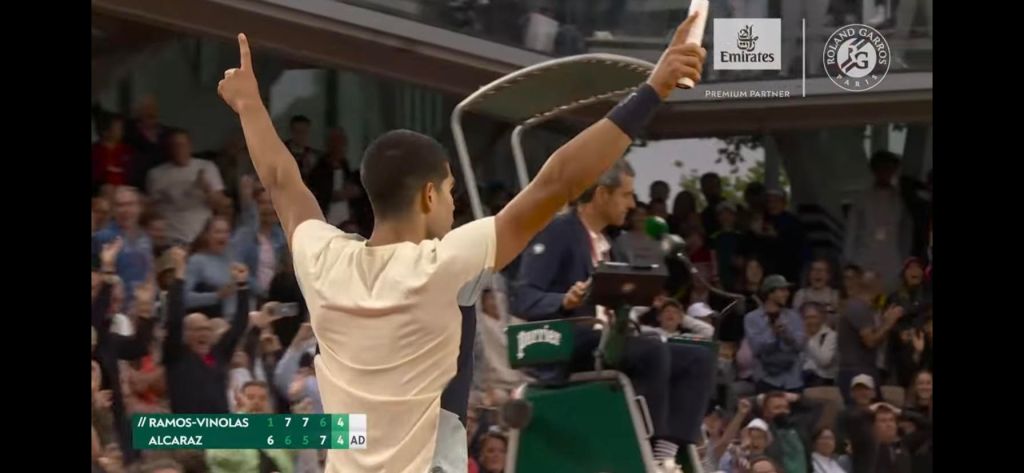
The It Factor: Carlos Alcaraz grinds out a 5 set win against fellow Spaniard Albert Ramos-Vinolas. Source: The French Open

Day Four Highlights at Roland-Garros

By Hanya El Ghetany

  1. Alcaraz, Zverev and Schwartzman survive scares

The match of the day was Carlos Alcaraz saving match point against Albert Ramos-Viñolas in a five-set thriller. The 19-year-old, who by many is considered a favourite to win the title despite his tough draw and relative inexperience, kept his dreams alive by forcing a fifth set and then recovering from a break down with a breath-taking variety of recovery shots to the pleasure of the audience. Zverev, just before Alcaraz took the stadium was down two sets against Sebastian Baez 2-6, 4-6. Baez had a match point in the fifth, but Zverev made a comeback, winning the remaining sets 6-1, 6-2, 7-5. Schwartzman survived yet another potential scare, making a comeback after being down 2-6, 6-7 to take the last three sets 6-2, 6-2, 6-2. 

Alcaraz celebrates after some truly mind-bending defense to earn a crucial break. Screenshot: Roland-Garros
  1. Raducanu and Sakkari Exit 

Emma Raducanu, the 12th seed, won the first set against Aliaksandra Sasnovich 6-3 with a brilliant performance. Raducanu’s dominance faded in second set where she was overpowered by Sasnovich and lost 6-1 in about 30 minutes. Raducanu struggled further in the third set, and you could visually see the pressure getting to her. Unfortunately, Emma could not rescue that set and went on to lose the third set in another breadstick. Maria Sakkari also lost her match, a considerable surprise given her semifinal run last year and high seeding, ending her Roland-Garros run at the hands of Muchova, 6-7, 6-7. 

  1. FAA, Isner through and Fritz out

In a somewhat easier match than his first-round encounter where he had to come back from being 2 sets down, Felix Auger-Aliassime won his second-round match against Ugo Humbert 6-0, 6-3, 6-4 in about two hours and 15 minutes. It was a very relaxed and easy match, and Auger-Aliassime will feel good headed into the third round off the back of his best performance in Paris so far. Meanwhile, while Felix signed autographs, the American John Isner was battling in a fourth set tiebreaker and reaching the third round by beating Barrere 6-4, 6-4, 3-6, 7-6. John Isner has not make it past the fourth round in any of his previous Roland Garros participations, but he tends to do well in Paris. Unfortunately, his fellow American Taylor Fritz did not make the cut, his journey ending with a 6-2, 2-6, 2-6, 3-6 loss to Bernabe Zapata Miralles.

4. Kerber and Khachanov

Kerber continues to impress and kept her bid for the Career Grand Slam alive by beating Jacquemot 6-1, 7-6. There is no doubt that Kerber has the support of the French crowd. Her best performance at Roland-Garros was reaching the quarterfinals in 2018, which she looks to improve upon this year. She meets the Raducanu-conquering Sasnovich next. who eliminated Raducanu today. Khachanov came back back from one set down to secure his place in the third round by beating Hugo Dellien 4-6, 6-4, 7-6, 6-3. He’s been lost in the wilderness for a while since his breakthrough in 2018, and runs like this will help him find his way.

Some highlights of players winning in straight sets, which may have gone under the radar amidst the deciding-set craziness:

  • Grigor Dimitrov again won in straight sets, beating Ćorić 6-0, 6-4, 6-3
  • Cameron Norrie beat Kubler 6-3, 6-4, 6-3
  • Novak Djokovic beat Molcan 6-2, 6-3, 7-6
  • Korda beat Gasquet 7-6, 6-3, 6-3, setting up a third-round clash with Alcaraz
  • Fernandez beat Siniaková 6-3, 6-2
  • Coco Gauff beat Alison 6-1, 7-6
  • Anisimova beats Vekić 6-4, 6-1
  • Azarenka beat Petkovic 6-1, 7-6
  • Bencic beat Andreescu 6-2, 6-4 in what was expected to be a heavyweight clash
  • Teichmann beat Danilović 6-4, 6-1

Sebastian Baez: Ready to Take Down The ATP Goliaths

By Jethro Broughton

With the amount of incredible (and mostly deserved) hype around Carlos Alcaraz, the spotlight has been far away from the new generation of ATP players coming through. The ascendancy of the young Spaniard has been so magnificent that players like Sebastian Baez have been somewhat cast aside on the hype train. 21-year-old Baez is due to play Alexander Zverev on Wednesday, and it’s time to have a look at what this guy can bring to a tennis court.

If you’re yet to know much about Sebastian Baez, here’s a quick rundown. He hails from Argentina, stands at just 5’7, and is an excellent clay court player. Remind you of anyone? Yes, Diego Schwartzman is the one you’re thinking of. Though they both share a gritty competitive edge, rally tolerance and an enormous will to win, this is where the comparisons fade away a bit. Baez, despite his stature, has some serious weapons in his game. 

He has a surprisingly big serve, and hits his spots really well. Where Schwartzman often struggles behind his serve with no big weapons to back it up, Baez has a phenomenal forehand that causes plenty of damage. I often find it tiresome when pundits only ever talk about a short player’s height, mostly because it comes across as immensely patronising. However, it is quite ridiculous how much power Baez possesses when you look at his frame – how on earth can he crush forehands the way he does? The man can absolutely blast winners off this wing from anywhere in the court in any direction he likes, and his backhand isn’t too shabby either. It’s truly refreshing to see a player not be pigeonholed into playing a certain way due to their size. Baez plays like he’s Juan Martin Del Potro, and I absolutely love it.

A reason as to why Baez isn’t particularly hyped up or well known yet is that this is his first full season on tour. He had an incredible 2021 on the Challenger circuit, notching up six titles. He started last year ranked at 309 in the world, and finished at 99. He capped off his brilliant year with an appearance at the ATP Next Gen Finals, where he reached the semi-finals. Now? He’s 36th in the world, and is on track to be a seed at Grand Slam level. His transition to the main tour in such a short space of time has been incredible, and far better than many players we’ve seen in recent times.

The Argentine has 21 total wins on the ATP Tour, 18 of which have come already this year. I expected big things, but I did not expect him to win a title on the main tour in the first half of the year – which is exactly what he did. He reigned supreme in Estoril in stunning fashion – beating Sousa, Cilic, Gasquet, Ramos-Vinolas and Tiafoe along the way. It was a stunning week for the Argentine, and it confirmed to me and plenty of others that he could well be a top player in the near future. It won’t be surprising to see him dominate the Golden Swing along with the likes of Casper Ruud for years to come. 

It won’t be long before Baez is having big success at Grand Slam level. In his first ever appearance at a major, he reached the Australian Open 2nd round. He took on eventual semi-finalist Stefanos Tsitsipas, where he took the Greek to four sets. This was on a less preferred surface, and he still made an excellent showing of himself against one of the top players in the sport. At such a young age with such little main tour experience, it’s hard not to think this guy is going to be an absolute force in tennis.

Due to play Zverev in the 2nd Round at Roland-Garros, this is a great chance for Baez to show his worth. He recently lost to Zverev in Rome, but made a decent match of it and took the first set to a tiebreak. Such have been his rapid improvements in recent times, I won’t be surprised if this is one hell of a contest. He’s got the firepower and can mix it up with his excellent feel and movement around the court. I firmly believe he can cause the 3rd seed plenty of trouble in this matchup. Will he win? It’s not particularly likely, but hopefully this is the match where he finally catches the attention he deserves.

Sebastian Baez: remember the name.

Up And Coming: Sebastian Baez is ready to do some damage. Screenshot: TennisTV

High Stakes

Losing to Novak Djokovic from two sets up at the 2021 Roland-Garros tournament is a strange thing to have in common with a peer. That was something Stefanos Tsitsipas shared with Lorenzo Musetti, though, as they stepped on court for their first-rounder yesterday.

Those matches were different — Musetti crumbled physically almost immediately after winning the second set against Djokovic. Indeed, he didn’t finish the match. Tsitsipas, meanwhile, stayed relatively competitive, forcing Djokovic to serve out the match in a tough deuce game. The matches weren’t totally dissimilar, though. In both cases, once Djokovic found his form, he stormed through the last three sets without facing a break point.

In beating Musetti from two sets down, Tsitsipas kept his bid for a Roland-Garros title alive. The match was strange. Musetti and Tsitsipas are cut from the same cloth. Though their one-handed backhands get significant attention, their forehands are their preferred weapon. They each have curly hair, Musetti’s restrained by a backwards cap, Tsitsipas’s by a headband. My mom said they looked like surfer boys. They are the kind of players who make commentators want to call drop shot winners “luscious” instead of “good”.

Neither player touched the sky — the first set was tense and tumultuous, then Tsitsipas lost his game in the second set and Musetti lost his shortly afterwards. It never came back. Tsitsipas’s floor, his B or C level, is high enough on clay that Musetti had no chance once his shots deserted him. The headline will be that Tsitsipas fell into a two-sets-to-zero hole, though.

When you get to the top, as Tsitsipas has, people expect you to win practically every match. Iga Świątek is in that phase right now, and is actually delivering — she’s won 29 matches in a row; when she will lose again is anybody’s guess. Tsitsipas might not be at that level, but he’s been firmly entrenched in the top five for a while. People have gotten used to his consistently strong results, especially on clay. He was a set away from winning Roland-Garros last year.

It was no surprise to me that Tsitsipas didn’t look elated after the win. His immediate reaction read of relief and even a bit of frustration. It was a difficult first-rounder, but the small ‘4’ next to his name on the scoreboard declared that if he lost to anyone besides Djokovic, Medvedev, or Zverev, he was underperforming (let the mention of Medvedev and Zverev rather than Alcaraz and Nadal be a plea for surface-specific seeding). There was no option but to win. During the match, Tsitsipas was fighting for his life, but afterwards, he had merely done what was expected of him.

Last year in Paris, Tsitsipas didn’t lose a set until the third round, then didn’t lose another one until midway through his semifinal. He was coming off the best clay-court season of his life. He won Monte-Carlo for his first Masters 1000 title. He made the final in Barcelona and almost ripped the rug out from under Rafael Nadal (on a court named after the guy, no less) after being down championship points in the second set. In Rome, he came within inches of putting away Novak Djokovic on several occasions, but failed to win enough of the big points. Even so, he had come damn close to beating the best two players in the world, and had easily established his superiority over everyone else. It was no surprise he did so well at Roland-Garros.

This year feels different. Tsitsipas defended his Monte-Carlo title. Hell, he even made the Rome final, whereas he lost in the quarters last year. But he hasn’t been playing that well, at least not by his lofty standards. He almost lost to Diego Schwartzman in Monte-Carlo after leading 6-2, 5-3. He was no match for Carlos Alcaraz in Barcelona. He lost to Zverev in Madrid. In Rome, he was about to beat Grigor Dimitrov, then suddenly and inexplicably lost a long string of points and ended up having to save match point to get over the line.

His results have still been great on the whole, but he doesn’t look imposing. He is playing like someone trying to cling on rather than someone trying to climb. I spent much of his match today trying to analyze his demeanor — he was really calm, even as he lost the second set. I wondered if that was because he still felt confident or because he wasn’t fully engaged. The fact that he came back to win certainly hints at the former, but I started to think about Tsitsipas’s year in general. Things have been rough: he got elbow surgery at the end of last year, likely killing his usual preparation. His title in Monte-Carlo was a high point, but even there, it didn’t seem like he was playing his best tennis. Tsitsipas is more than capable of beating most players without his A game, but better players will readily punish his B game. Medvedev beat him comfortably at the Australian Open, Alcaraz beat him twice in the span of three weeks, Djokovic bageled him in the first set of the Rome final.

To me, all of this is symptomatic of a larger issue. What, I’m not sure — maybe a lack of confidence, maybe a lingering elbow problem, maybe just a small dip in form. His results do seem to be affected, though. Considering his whole body of work, he has not improved from last year (in 2021, he also made the Australian Open semifinals, won Monte-Carlo, and did well across the board at the clay-court events). Yes, the bar is very high now, but it has not moved for a little while.

Tsitsipas’s win over Musetti today was potentially crucial. It keeps him alive in a Roland-Garros in which Djokovic, Nadal, and Alcaraz are on the other side of the draw. Considering his clay-court pedigree, another trip to the final seems more than possible. But he’s been without his best stuff for some time. He will need more help than a good draw to improve upon last year’s performance.

Musetti’s problems, besides not being at Tsitsipas’s level in general, are greater. This is the second year in a row he has faded badly after winning the second set of a best-of-five match on clay. It was as if he thought the finish line lay right after the second set. When the match became a scrap, Musetti fought, but his high level had disappeared and he couldn’t get it back. The loss to Djokovic last year was a bit uncomfortable in the end — Musetti’s early tennis was outstanding, but he could barely win a point after the second set, and his retiring a mere two games from the end of the match didn’t come off well. That he has to learn the importance of physical endurance and intensity again, even after the ordeal last year, is not a great sign.

There’s reason to be optimistic for both guys. Musetti is a fantastic shotmaker; when the head catches up to the groundstrokes, he will be a threat. Tsitsipas will probably progress deep into the draw. His next match is against Zdeněk Kolář, who is ranked 134th in the world. Still, I came away from the match feeling a bit empty, and I sense neither Musetti nor Tsitsipas was thrilled with their performance. There is a lot to lose and little to gain in the first round of a major when you are as good as either of them.

Late Night In Paris: Stefanos Tsitsipas shakes hands with Lorenzo Musetti after coming back from being two sets down.

Spare a Thought for Casper

By Owais Majid

In all of the excitement about Jo-Wilfried Tsonga going into his first-round match against Casper Ruud, it was easy to forget about the young man on the other side of the net from the Frenchman, facing what was a pretty big occasion for himself. While court Philippe-Chatrier turned out in great numbers to witness the end of one man’s journey on a tennis court, there was another whose quest had only commenced fairly recently.

Neither Ruud nor Tsonga would have been too pleased when they discovered they were playing each other in the first round of the French Open. In an alternate reality in which Tsonga is 10 years younger and Ruud is five years older, these two could well be fighting it out in the latter stages of tournaments but alas, they were facing each other at very different times in their careers. For Tsonga, the significance was obvious — would he keep his career alive or walk into the sunset — but it can be forgotten that this match held a great deal of importance for Ruud too. It was interesting, therefore, to see how Ruud dealt with the occasion.

The play was fairly even throughout the first set, with both men holding serve with relative ease for the most part. As you might expect, the crowd was one that wouldn’t have been out of place at a football match. The 13,000 or so inside Chatrier were making a cacophony of noise and needless to say it wasn’t in support of Ruud.

With an inspired crowd behind his opponent and the momentum very much against him, Ruud lost the first set tiebreaker and at that point, he couldn’t have been feeling too great about life. It’s impossible for pretty much anyone reading this (although hello, Novak, if you’re a loyal Popcorn Tennis reader) to appreciate how difficult it must be to deal with that sheer number of people in essence celebrating your downfall. As such, it shouldn’t be underplayed how much of a hurdle that must have been for Ruud. 

The second set followed in similar fashion to the first. On this occasion, though, Ruud was able to put Tsonga away in the tiebreaker to win a set in which he had definitely played better tennis and slightly lessened the crowd’s enthusiasm.

Set three was a far more comfortable task as far as Ruud was concerned. He ruthlessly took advantage of a dip in level from Tsonga to convincingly win that set by 6 games to 1, playing some really mature tennis along the way.

At that point, you’d have been forgiven if you’d have expected the rest of the match to play out in a similar manner to that of the third set. But Tsonga, being the champion that he is, refused to go away. The veteran Frenchman regained the level he was operating throughout sets one and two and that in of itself must have come as a bit of a surprise to Ruud. In spite of the crowd somehow managing to raise their volume even further and a rejuvenated Tsonga continuing to feed off of that, Ruud showed no signs of panic.

After being broken for 6-5, it’s honestly impossible to know for sure how Ruud would have reacted had Tsonga not suffered the injury, however if the rest of the match was anything to go by, you suspect he’d have dealt with it excellently.

It would have been completely understandable for Ruud, after finally closing out such a tough match, to let his emotions out upon victory. You’d even be hard pressed to criticise him too much if he gave a bit back to the crowd after how little he was appreciated throughout. However, Ruud barely acknowledged his victory, gave Tsonga a hug at the net and duly sat down in his chair to let Tsonga have his moment.

He then further endeared himself to everybody watching both within the stadium and at home in his on court interview after the match. Rather than talk about his own impressive performance, Ruud almost seemed to treat that as a side note from the real occasion, which in some ways I suppose it was. He regaled us all with an anecdote about how, as a child, Tsonga had made him, an avid Nadal fan, sad after he’d beaten the Spaniard in that memorable 2008 Australian Open run.

This spoke volumes about how self-aware Ruud is even in his young age. He said all the right things, acted in exactly the right way and put on an exemplary display during what must have been quite an emotional occasion for him too.

It’s important to consider this match from the Norwegian’s perspective. With the way the draw has landed and his love affair with clay, many have him going deep here and he will be well aware of that. That’s pressure he hasn’t previously had to contend with and we’ve seen time and again that players find it difficult to deal with that level of expectation for the first time. If you couple that with everything surrounding this match, it wouldn’t have been too farfetched to see Ruud struggle to deal with all of that emotion. But deal with it he did, in a manner reminiscent of a seasoned pro, not of a 23 year old in the infancy of his career.

One suspects that, as significant an occasion as this was for Tsonga, it was of paramount importance for Ruud too. This match will have done him a world of good. Even putting aside the wider context, playing an opponent with a level as high as that which Tsonga showed in a first round and coming through it can only be a good thing for Ruud going forward. Players past and present talk about how important match toughness can be for the latter stages of a slam and Ruud has certainly benefited in this regard against Tsonga.

So whilst all of the coverage will, understandably so, be about Tsonga, let us not forget about the man who put him into retirement today. He is undoubtedly a threat to the big names here. If that wasn’t crystal clear before today, it certainly is now.

When the Going Gets Tough

By Ashlee Woods 

Photo: Getty Images 

Tennis players rarely know how a match is going to play out. A player can scout, practice and simulate ahead of a match all they want. But nothing can really prepare a player for when they’re across the net from their opponent and none of the plans are working. The opponent has an answer for every question while you’re still struggling to put your name on the test. What a player does after this moment of realization is what separates the rookies from the rockstars. 

We’re through only one round in Paris, but the second slam of the year has provided several epic comebacks. On Monday, it was German Angelique Kerber. Her opponent across the net was Pole and world no. 87 Madgalena Fręch, who played more like a top-10 player through the first two sets. Fręch had two match points and looked to send the 2018 Wimbledon champion packing. 

Kerber had other ideas.

She saved both match points and fought her way to a gritty three-set win, 7-5 in the third. The Court 6 crowd spurred her on, chanting “Angie Kerber” throughout the final set. When Kerber seemingly had nothing left in the tank, she kept going, even resorting to moonballs to stay in rallies.

“I was just trying to enjoy this, because it was such a great moment on court with the fans,” Kerber said. “Yeah, it was unbelievable.”

Tuesday’s slate of matches were not to be outdone, however. On Court Suzanne Lenglen, the No. 7 seed Aryna Sabalenka stood across Frenchwoman Chloe Paquet. Sabalenka looked to avoid the same fate that befell Ons Jabeur, Barbora Krejčíková and Garbiñe Muguruza, all seeded players who were upset in round one. 

Like Kerber, Sabalenka found herself in a deep hole with seemingly nothing to help dig her out. As her double faults piled up, so did the pressure. A loss would have been the second time in the last three tournaments in which Sabalenka exited in the first round. Mental issues have plagued Sabalenka all season, as she often crumbles when nothing — or even not enough things — is going right. 

But she found a way. 

Down 0-2 in the deciding set, Sabalenka broke Paquet back and fought her way to a three-set victory, winning 6-4 in the third. 

It’s easy for us fans to sit back after a match has ended and nitpick every little thing a player did wrong. In a perfect world, the top players would cruise through the early rounds, but we don’t live in a perfect world and tennis is an imperfect sport. Few of us expected John Isner to push Rafael Nadal to five sets in the first round of the 2011 French Open. Even fewer expected Stefanos Tsitsipas to be ousted by Frances Tiafoe in straight sets at last year’s Wimbledon Championships.

Anyone can lose to anyone at any moment. What separates the good from the best is how they handle adversity. Both Sabalenka and Kerber could’ve conceded defeat like most fans did, but they didn’t. Finding a way to win when nothing is going right is what makes a champion. 

Sabalenka and Kerber may very well not win the title or even their next match. But if their first round showed tennis fans anything, it was that effort and determination can get you out of huge deficits.

Off-Court Moments at Roland-Garros

By Hanya El Ghetany

As we get approach the end of the first round of Roland-Garros, I’ve compiled my favourite off-court moments from the tournament — highlights that have absolutely nothing to do with the tennis matches themselves, rather, the events surrounding them.

  1. Au revoir, Tsonga 

After Tsonga fell to Casper Ruud in his last-ever match as a professional tennis player, the Frenchman was presented with a delightful retirement ceremony. Ruud, who was nothing but gracious, elegant, and respectful to Tsonga, talked about his favourite Tsonga moment in his post-match interview instead of his own victory. The farewell was emotional, drawing tears from both young and old. Tsonga’s family was there, as were his French pals and every single coach he had. The Big Four gave him a proper goodbye on a video highlighting his greatest moments. It was a very hard moment for every tennis fan, even those who didn’t get to watch the high points of his career. All I say is I wish del Potro had retired in a major to receive a similar farewell party. 

  1. Allez les bleus

For me, the French crowd are definitely the highlight of the tournament so far. Sometimes they are loud, passionate, and cheering the players on. Other times, they are just a challenge to deal with. If the French crowd loves you, you are in good hands. If you’re on their bad side, I hope you have the nerves to handle them. May the Force be with you if they’re rooting for your opponent! For whatever reason, Djokovic roaring loudly after a difficult point in his match against Nishioka drew boos from the fans, and then he continued to roar even louder in the next point, drawing even more boos. Leyla Fernandez called them a “football crowd”. One thing we know is to pray to God you never have to play a French player in Paris. I mean, watch poor de Minaur against Gaston. I’m also trying to understand their rule of choosing who to support if a French player is not on court. Still a mystery. 

  1. Coco Gauff teaching the world how to politely deal with umpires 

After the chair umpire gave Coco Gauff a coaching violation, Gauff told the umpire “I literally tell him [her dad] since I was eight years old, don’t talk to me in the match. I know you’re not accusing me of anything, I’m just letting you know that it’s the first time a ref has said this to me.” Then the umpire told her something along the lines of having to do something if it seems like he is coaching to which Gauff replied “at that point, just give me a coaching violation because I can’t control what he does on the field”. Take notes, ATP players. She was respectful while making her point, the umpire couldn’t help but smile. 

  1. How to beat Iga Świątek?

In a typically funny Jabeur moment, the press asked her how she thought she could beat Iga, who was standing aside during that interview. Jabeur acknowledged Iga and told her “They asked me how to beat you, can you answer them, I couldn’t find the answer” to which Iga responded “put something in here” pointing at her water bottle. Jabeur laughed and replied “obviously, since drop shots didn’t work”. I just love the healthy rivalry between those two, especially if no one decides to poison the other! Also, if someone can tell me how to get my hands on Jabeur’s “yalla Habibi” shirt, I would be eternally grateful.

  1. Kids in Action 

The famous Roland-Garros Kids Day returned after being cancelled the previous two years due to the COVID-19 pandemic. Bob Sinclair was alongside Big Ali and kept the crowd dancing. Celebrities, musicians, comedians and of course tennis players were all part of the day to make it a memorable experience for the kids.

Screenshot: Roland-Garros
  1. Happy Birthday, Djoko! 

Djokovic seems to be having a celebratory event with every tournament at this point, with his 1000th career win coming in Rome and now his birthday in Paris.

  1. There seems to be a lack of room temperature water bottles.  

I’m not sure what the issue is with Paris and water, but it seems to be an ongoing problem. A couple of players have had problems with the lack of room-temperature water, including Stan Wawrinka, who said “you are in French Open, and you cannot get normal water. You think it’s normal”. Even Morgan Riddle, Taylor Fritz’s girlfriend, went on Instagram to say that she is dehydrated because the water tastes so bad. What’s up with that, Paris? 

Swan-Tsong

This wasn’t a fairytale with castles and sparkles and shiny pretty trinkets of magic and beauty but it didn’t need to be.

Jo-Wilfried Tsonga played tennis throughout his career with a childish smile consistently flashing across his face and so he ended it in exactly the same way, as though he was simply happy to have been able to do this, to play this stupid little game that he loved so much and actually be good at it.

He brought it when he could today against Casper Ruud. The French crowd tried their hardest to carry their hero as well, screaming him on until their voices dried in their throats and their vocal chords rasped and whined for mercy and yet still they carried on calling out for a miracle. They knew that this man that had walked with their country’s colours draped over his shoulders onto some of the biggest battlefields of his sport for the past two decades deserved to have their wishes and hopes and desperate cries for something crazy majestic to happen for him.

Alas, tennis so rarely bends to the pressures inflicted by begging hearts.

***

Throughout his career, Tsonga drew eyes as much for his infectious energy as for his tennis. That’s not to say his game didn’t beggar belief at times, that forehand of his that punched through opponent’s defences like eggshells, leaving their insides spilling out and their minds a mess. Rather, his personality was one that just kept you coming back for more and more and hoping that good things would be waiting for him in his future.

And good things did come Tsonga’s way. Maybe not that elusive major title that remained forever out of reach but other things, other things that you just know that he will treasure now that his on-court playing journey is over. He beat all the top players and hugged them at the net afterwards before dancing in a celebration that will forever be immortalised in the minds of millions.

He won titles and travelled the world and entertained not just us but himself. He lived and breathed this game and made it clear he was having fun while doing it. So much serious and hard and then there would be Tsonga with a wink and a grin that melted cold dead concrete with its power.

I hope whatever Tsonga does next in his life, he dances and jumps and smiles even more than he did on court, for it’s so rare to have the ability that he does to look at the world with such an upbeat attitude and in doing so, carry others up to that level of optimism with you.

***

When he broke Ruud’s serve at 5-5 late in the fourth set, the crowd erupted but Tsonga himself did not. He knew what they didn’t yet, that his body had told him to stop while everything else was telling him to keep going. And that’s the story of tennis generally, that we so often are left waiting a lifetime for a dream that never quite materialises.

A player that brought us such joy had to deal with such sadness at the finish, a cold cup of reality that offered nothing more than the realisation that in actual fact, he had made the right choice to call it a day.

But in a way, I think, that’s maybe what will make this final trip OK for Tsonga. When the tears are dried and the noses are blown and he’s sitting at home with his beautiful family, I truly believe he’ll be able to appreciate that he made the correct decision to draw the line in the sand here.

We all wanted more and when Tsonga screamed “I’m back!” after taking a tumultuous first set in what would ultimately be the final match of his career, it was clear he did as well. But it’s absolutely fine that we didn’t get it and he didn’t get it. That’s tennis and that’s life and we’ll miss watching him play because he mattered to us.

***

Standing on court as the victor of this match, Casper Ruud represented us all as he spoke with care and attention to the man who’s career he’d just brought to a close. Everyone in tennis circles will right now be recalling their favourite Tsonga memories and Ruud was no different, mentioning a moment from his childhood when watching Tsonga on TV. He beat Rafael Nadal that day at the Australian Open and Ruud – a Nadal fan growing up – smiled us he brought up the anger he’d felt towards his fallen foe back then.

When you become so good at what you do that you become a memory-maker for the youth, you can close chapters of your story with the knowledge that you’ve left a legacy behind.

***

Beyond anything else, this is a man that embodied the phrase “don’t cry because it’s over, smile because it happened.” But while I feel that this hero of French tennis lived and breathed that sentence throughout his career, I think we can allow ourselves to cry for him now. I think he’d accept our tears as appreciation for his efforts.

Jo-Wilfried Tsonga left us wishing we could turn back the clock just for him and that right there makes this send-off just that little bit sadder and also just that little bit more alright.

Just One More Goodbye: Jo-Wilfried Tsonga takes a moment to process the finish of the last singles match of his career. Screenshot: Eurosport

The Future of French Tennis

By Nick Carter

The future of French tennis is not a subject often covered by English speaking media. This is for obvious reasons, our focus is usually on our home players, be they American, Canadian, British or Australian. Everyone has been raving about the Spanish tennis system for years now due to them consistently producing top ten level talents, and of course superstars such as Rafael Nadal and Garbiñe Muguruza. Italian tennis has been talked about more in recent years thanks to the emergence of big talents such as Matteo Berrettini, Jannik Sinner and Lorenzo Musetti. Usually around Roland Garros, the topic of French tennis usually comes up.

For many years, British tennis was seen as in the poorest state out of the nations that hosted major championships. The players produced by the LTA system didn’t really set the tennis world on fire. Then, Andy Murray came along and whilst he and his mother didn’t take the route through the official British system, they inspired the tennis establishment to get their act together. Now, Emma Raducanu has emerged as a super talent nurtured by the LTA with Jack Draper waiting in the wings to emerge in the men’s game. Cameron Norrie and Dan Evans have had a late boost to their careers, with Norrie in particular demonstrating himself as a solid top twenty player and a man who can compete with the best in the world. Harriet Dart also seems to be about to show how good she really is. Then of course, we have the British men’s doubles players, with Joe Salisbury, Neal Skupski and Jamie Murray all ranked as amongst the very best in the discipline. 

Today’s results at Roland-Garros mostly demonstrated this. Whilst it wasn’t a good day for Dart or main-draw fixture Heather Watson, there were wins for Raducanu, Norrie and Evans. All these victories were positive from a British perspective. Norrie and Evans won straightforwardly, and though Raducanu had more of a battle, the way she dug herself out of the hole of being a set and a break down to the fiery talent of Linda Noskova was another important piece of experience for her. Speaking of the future of tennis, Noskova’s performance in that two hour, 37-minute epic will have her on most tennis fans’ radar for the next few years. Raducanu wasn’t the only player to pull off an epic comeback, as other former U.S. Open champions Bianca Andreescu and Angelique Kerber came from a set down to reach the second round. Kerber was arguably the most impressive as she saved match points in her battle with Magdalena Fręch, one with a cold-blooded drop shot winner. It was Kerber’s second marathon three setter in as many days, following her triumph in the Strasbourg final (I suspect Owen may end up writing something about her at some point). 

Back to the French – with a recent Australian champion in Melbourne (Ash Barty this year), a British champion in London (Andy Murray in 2013 and 2016), and an American champion in New York (Sloane Stephens in 2017), France is the nation with the longest wait for a home major champion. By contrast, the last French women’s singles champion at Roland-Garros was Mary Pierce in 2000. On the ATP side, you have to go back to 1983, when Yannick Noah won his only title. Even if you take slams as a whole, the most recent Australian, British and American singles champions all came this decade. It’s been nearly nine years since Marion Bartoli won Wimbledon. The French have had recent doubles success with Nicolas Mahut and Pierre-Hugues Herbert but no one seems to be ready to follow in their footsteps. In women’s doubles they only have two players ranked in the top 100 (although Britain has a similar record and a much longer wait for major success in women’s doubles by comparison). 

This is a conversation that French tennis is revisiting as their ‘Golden Generation’ in the men’s game are set to retire. Jo-Wilfred Tsonga, Richard Gasquet, Gael Monfils and Gilles Simon all reached the top ten in their careers, and three of them reached major semifinals. Tsonga was the closest to actually lifting a major trophy as he reached the 2008 Australian Open final and showed he had the talent when he won the 2014 Toronto Masters, but he didn’t manage to quite produce the required level on the biggest stage. Baseline Media did an excellent video about how their relative underperformance (relative by comparison to the old ‘Big Four’ of Federer, Nadal, Djokovic and Murray) and the issues that this highlights for French tennis.

That being said, the French still produce a great breadth of talent, with 27 players taking part in the singles main draws at Roland-Garros this year. This is far more than the British have been able to get into Wimbledon in years. As of day two, with half of the first round still left to be played, half of those French players that have taken to the court have won. The French system produces talented players, but when will it produce its next world beater?

It’s been thought that they might find big success in the women’s game. In 2017 Kristina Mladenovic and Caroline Garcia got some big results but couldn’t sustain such form beyond that season. Fiona Ferro caught many people’s eyes at Roland-Garros in 2020 but has faded a bit since. In the men’s game, whilst players like Benjamin Bonzi and Corentin Moutet have raised eyebrows with some decent showings on the challenger level, they are not setting the world alight despite being in their prime. Hugo Gaston, another French player who made a big splash in 2020, is probably France’s big ‘NextGen’ talent, but is proving to be woefully inconsistent despite his spectacular highs. He’s certainly paling in comparison to Carlos Alcaraz (though he did beat the freak of nature in Paris last year), who, along with Sinner, looks to be the only player with the potential to be anywhere close to the talent of Djokovic and Nadal. Both these former champions won today, and comfortably in the end despite some challenges in their opening sets. 

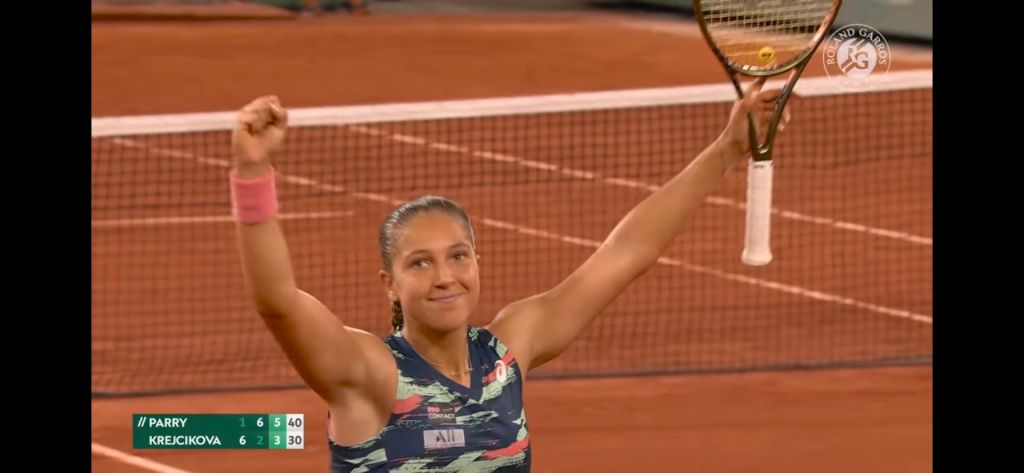
Today at Roland-Garros, there might be a glimmer of hope that French tennis has two stars of the future in the women’s game. Two nineteen-year-olds managed to get some big wins. Elsa Jacquemot took down the experienced Heather Watson in straight sets, which is a significant moment for the wildcard currently ranked outside the top 200. The bigger headline was Diane Parry, who upset the number two seed and defending champion Barbora Krejčíková. Some could say that this wasn’t that impressive given this was the Czech’s first match back since February, but that doesn’t do justice to what happened in the match. Krejčíková started way better than Parry, winning the first set 6-1 and seemingly confirming she belonged on the list of top contenders for the tournament. Owen even sent this now-unfortunate tweet. However, Parry steadied herself and came from a break down in the second set to level the match. Krejčíková fought hard but became increasingly erratic, her match rustiness coming into play by the end. Parry never counted herself out and wowed many with her powerful forehand and single-handed backhand, a shot noticeably absent from the top of the women’s game apart from Viktorija Golubic. Krejčíková’s exit wasn’t the only shock today though, as Anett Kontaveit (currently at number two in the live rankings) also went out at the hands of Ajla Tomljanovic in two close sets. It means that the bottom quarter of the draw does not have any top ten players left, with Victoria Azarenka now the highest seed, with a ranking of 15.

Diane Parry celebrates an upset win over defending champion Krejčíková. Screenshot: Roland-Garros

Parry and Jacquemot have their work cut out in the next round. Jacquemot is facing Kerber, who is in form (though also fatigued). Parry faces fellow young talent Camila Osorio, who is also on an injury comeback and is only nine months older. It’s a bit early to get too excited about these young players; they’re still growing into their tennis. We have to include them as ones to watch alongside players like Osorio, Clara Tauson and Marta Kostyuk. If they’re still in the tournament this time next week, we can start talking about them on the same terms as Raducanu, Leylah Fernandez and Amanda Anisimova. Of course, we’re still waiting to see who can emerge as a rival to Iga Świątek, who continued her awesome form today by winning her opening round, only dropping two games. The world number one is clearly enjoying being in Paris, and is handling her status as overwhelming favourite well so far. 

We won’t be able to make a full assessment as to the full French field until after tomorrow at the earliest as ten men and four women need to compete their matches. The real test will be to see if any make the second week. For now, French fans can make the most of the glimmers of hope they are seeing in their home players. The rest of the tennis fandom can readily get excited as well, because any new talent is always worth celebrating no matter where they hail from.

Getting Upset

I started the tournament with an all-nighter.

I was on the phone with a friend — break had started recently, so we had all the time in the world. As I often do, even to people who don’t follow tennis obsessively, I mentioned my irritation with tennis fans and commentators’ nature to fawn over one-handed backhands. My friend, though she isn’t a tennis fan, perfectly summed up the debate as a clash between “watchability and practicality,” with the one-handers being subjectively watchable but objectively impractical per my argument. I later brought up a racket smash debate I had with Scott and Blair Henley, which my friend pointed out fell under the same umbrella. Scott, and Blair to a lesser extent, found racket smashes entertaining, while I found them a waste of expensive equipment. Practicality is ideal, but from a fan’s perspective, watchability is key.

Anyway, we hung up somewhere in the sleepy ocean between two and three a.m., and with day one of Roland-Garros beginning at five, there was no way I was forcing myself to get up after only two hours of rest. There was plenty to do before the tournament started — I posted a couple pieces to the site, I listened to some music, and I thought about how in 2016, I only watched the last couple rounds of Roland-Garros, while this year I would be busting my sleep schedule to catch an opening match. And I didn’t want to miss that opening match. Dominic Thiem was playing.

A beautiful song I came across recently.

Thiem managed to take on and often beat Rafael Nadal and Novak Djokovic during his best years, 2019 and 2020. His stint near the top of the game saw him blend watchability and practicality smoothly. Thiem is one of the few players whose one-handed backhand can function as a strength rather than a weakness. It’s still a chink in his armor, but he hits it with such fierce power that he can use it to his advantage more often than not (that said, even Thiem has mentioned he would teach the two-handed backhand if he were coaching kids). The rest of his game was sensible — huge hitting, but to pretty safe targets around the court. His mix of power and reliability broke opponent after opponent, bringing Thiem to the 2020 U.S. Open title and a career-high ranking of #3.

Then injuries hit. Scott told me recently that Thiem had it all for about two minutes before having his prime ripped away. I wish I could call Thiem’s comeback from an injury-blighted 2021 stop-start, but it’s mostly just been stop. As someone who loves Thiem’s tennis, I’ve found his struggles frustrating enough to write a rant about how I wish he didn’t have to do this, and that was even before his losing streak reached the extent it’s at today. His game, so finely tuned at its best, has been sputtering since his comeback. His forehand is at 80 or 85% power so far, which is worrying. At his peak, Thiem would hit the absolute crap out of every single forehand, which constantly put his opponents on the defense. Now, though, the decreased power means he’s having to engage in many more neutral rallies, which his game isn’t built for. That crucial forehand has been decidedly off during all six of his comeback matches, each of which ended in a loss. His forehand just isn’t visibly progressing towards where it needs to be, creating a lot of warranted pessimism surrounding Thiem’s potential return to his best days.

It felt right that the tournament began with a Dominic Thiem match. Not only has Thiem done really well at Roland-Garros over the years — in 2016, 2017, 2018, and 2019, he lost to the eventual champion, twice in the semifinals and twice in the final — but the start of a major represents a blank slate. It’s an opportunity to turn things around, which Thiem desperately needs. Best-of-five represented a chance to, at the very least, lose in three sets instead of two. This last isn’t much of a difference, but momentum has to start somewhere. Maybe Thiem would find his somewhere in a third set.

*****

The very first point of the match reminded me why I love clay court tennis. Hugo Dellien, Thiem’s opponent, targeted Thiem’s fragile rapier of a backhand, making him hit six, eight, ten shots from that wing. Eventually, he approached the net, forcing Thiem into an errant passing shot. The rally was grueling. The stands were sparsely populated; Thiem isn’t the huge crowd draw he was a couple years ago. It was an instant clue as to what it would take to win the match — lots of long, patient points, without much rapturous applause from the stands to buoy the tired legs.

Down break point in the second game, Thiem lashed his backhand down the line for a winner, but it was clear already that the match was going to be a slog. The first two games took eleven minutes. Both guys were defending well — in the words of Rowan Ricardo Phillips’ The Circuit, “clay swallows winners and spits them back at the player who hit them.” Each point had to be earned, either by a spectacular shot or by methodically breaking down the opponent’s defenses.

Dellien won the first set 6-3, playing some fantastic tennis. He attacked with backhands down the line and kept Thiem on the move despite only hitting a few winners. Thiem had some vintage moments — a forehand winner down the line on the run, a couple backhand winners down the line — but the story was similar to his other comeback matches. There were no break points to capitalize on, there were few moments of pure confidence. It was as if someone was trying to do an impression of Dominic Thiem.

I felt good about Thiem’s chances to ease into the match after losing the first set, but he instantly committed the cardinal sin of falling down a break at the start of the second set. A line-kissing backhand winner at love-30 wasn’t enough to save him. The mix of practical consistency and eye-popping power was way off, with Thiem blending overly passive play with excessively risky shots. I started to drift off, nearly 24 hours without sleep taking their toll. When I forced my eyes open, Thiem was down 3-6, 2-6, 0-2. The match was all but over. I didn’t feel like riding along to the finish line, so I went upstairs to sleep for a few hours. When I woke up, I got to wonder for a moment if the scoreline had been a bad dream.

Dellien looked sympathetic towards Thiem as they shook hands at the net. Screenshot: Eurosport

*****

Upsets happen constantly in tennis. A lot of the time, upsets seem to have nothing to do with the players and more just the latest manifestation of the tennis’s unpredictability. At the 2016 Australian Open, Novak Djokovic hit 100 unforced errors in a match against Gilles Simon. The stat was so hilarious as to be almost unbelievable — not only is 100 an ungodly high number, but Djokovic was ranked #1 in the world and had just completed perhaps the best men’s tennis season ever. His performance was not watchable or practical. He was lucky to win the match. Then, a mere two rounds later, Djokovic took apart Roger Federer with one of the most terrifyingly great performances of all time. Federer had won 17 majors at this point, but he was a total bystander as Djokovic won the first two sets in under an hour. The shift from the error-fest against Simon happened as if by magic; it was as sudden as it was dramatic.

The first half of this video should really come with a warning label attached.

Stuff like this happens in tennis. Anything can go very wrong or right at any given moment. Really, it shouldn’t be a surprise when a top player gets overthrown by an underdog. And yet, every time a big tournament starts, I think a lot of fans experience some selective amnesia. We look at the draw laid out prettily before us, already looking ahead to the rounds when the favorites to win the tournament could play each other. The prospect is enticing enough for us to momentarily forget that for the aforementioned matchup to actually take place, each player usually has to win four or five matches to get to the late-round stage of the desired clash.

Ons Jabeur, after winning the Madrid Open and following it up with a runner-up performance in Rome, was the hot pick for the second favorite to win the tournament (behind Iga Świątek, of course, who has won 28 straight matches). Yet she lost in the first round today. The match was close — she led by a set and a break, and both sets she went on to lose were decided by fine margins — but she did lose, and her tournament is over. The shock is still settling in for me, because her exceptional Madrid and Rome performances are still recent, and it was only a few days ago that we decided she was the second favorite at Roland-Garros.

There were a litany of other weird results today — Alejandro Davidovich Fokina, who made the final in Monte-Carlo (a tournament which has very similar conditions to Roland Garros, usually meaning that if you can do well at one, you’ll do well at the other) lost meekly. Garbiñe Muguruza, the 10th seed and a former winner of this tournament, lost after winning the first set. Felix Auger-Aliassime, who is ranked in the top ten, had to win from two sets down. Jenson Brooksby, who has been having an excellent year, lost so badly that I could have played in his place and done only slightly worse.

Remember, this is all just day one of the tournament. Roland-Garros is two weeks — the first round isn’t even halfway over yet. So I can think about how Thiem’s loss this morning made me upset, and how he’s lost each of the last 11 matches he’s played, and how as much as I would like to imagine he’s a contender to do well at tournaments based on his resume, he’s not, he’s barely a contender to win a match at this point. If I do, though, I might miss something important, and by the time someone lifts the trophy at the end of Roland-Garros, Thiem will be a footnote on a footnote of how it happened. Contextualizing the disappointments is practical, and if done right, the rest of the tournament will become more watchable.