Jannik Sinner took down Nick Kyrgios in straight sets in the Round of 16 in Miami. The match, sublime in parts, will be remembered more for Kyrgios’s foul mouthed outburst on chair umpire Carlos Bernades.
The Beginning of the Match
Sinner served first to begin the match. He started off with a double fault but then found his first serve to comfortably close out the opening game. Kyrgios too held serve after a scratchy opening service game before conjuring up a break point on the Sinner serve. Sinner, cool as ice, fired down a strong first serve to save the break point before going on to hold for 2-1. The story repeated in the 5th game as Sinner once again faced break point before another first serve saved him. At this point, you could feel that Kyrgios was beginning to get frustrated. He saved a couple of break points to hold for 3-3 but Kyrgios was no longer in control. He got angry at how different (supposedly) Grandstand played from Stadium, missed a few routine backhands and was beginning to lose his cool.
The 9th Game
At 4-4 15-0, Sinner won a point he should never have won, with Kyrgios missing the final forehand by a few meters from the baseline. At this point, Kyrgios was angry at the crowd for their noises during the point. It’s more likely that he was in fact angry at himself for missing an easy forehand. Regardless, he made his displeasure known to Carlos Bernades in expletive-laden language. He received a code violation for it.
At 40-15, just as Sinner served, the walkie-talkie went off, creating a stoppage in play. Sinner finished off the game with an ace. Nick walked to the changeover, voicing his displeasure to Carlos Bernades about what had just happened. His words were, “How is this possible? In Miami, one of the biggest tournaments of the year? It’s a joke.”
Kyrgios loses it
Both players held serve to take it into a first set tiebreak. At 1-2 in the tiebreak, Kyrgios missed an inside out forehand and proceeded to slam his racquet. Normally, this would lead to another code violation which would have been a point penalty. Carlos Bernades, however, was lax about it and didn’t penalize Kyrgios. At 2-4 in the TB, Kyrgios crossed ends for the changeover, muttering to Carlos Bernades, “Pretty sad to be honest”. He then double faulted to go down 2-5 and then muttered as an obvious jibe to Carlos Bernades, “You have no idea what to do.” At 3-5 in the tiebreak, Kyrgios apparently said to his friend, “You could do the job of the umpire”. That was enough for Carlos Bernades to hand Kyrgios a second code violation, resulting in a point penalty. Kyrgios promptly double faulted and lost the set. He then got into an argument with Carlos Bernades about the code violation and then proceeded to smash his racquet into pieces, resulting in a third Code violation or a game penalty.
‘You could do the job of the umpire’ – what was said to my best friend that got me ‘unsportsmanlike code violation’ at 5-3 in the first set tie break. With 100 of thousands of dollars on the line that was the decision he made because the umpires ‘feelings got hurt. GET NEW PEOPLE
Any further transgressions would have probably resulted in a default. In the second set, Kyrgios, clearly angry, began hitting harder and serving bigger. His average forehand speed went up by 2 km/h and his average backhand speed went up by 6 km/h. His average first serve speed went up from 196.8 km/h in the first set to 211.2 km/h in the second serve. Kyrgios was taking all his frustrations out on the ball, leading to him losing only four points on serve in his first four service games in the second set.
To recap, Sinner-Kyrgios from 5-3 in the tiebreak
– Unsportsmanlike conduct, point penalty Kyrgios – NK DF on set point – NK shouts at umpire Bernardes – NK destroys racquet, game penalty *on his serve* – Fan runs on-court for a selfie – Sinner hasn't said a word, leads 7-6 2-0*
As a storm raged around him, Jannik Sinner was unperturbed. His game face never changed. His shotmaking was consistent. He skilfully penetrated Kyrgios’s defenses. His return of serve was superb. In 2022, Kyrgios’s average first serve win rate is 76%. In this match, it was 69%. Sinner was ruthless even as Kyrgios imploded. The match point was an encapsulation of the match itself. Sinner returned the Kyrgios second serve deep and central. He then probed patiently from the baseline, suffocating Kyrgios with variation in pace and depth. Kyrgios eventually tried to go big and missed.
It was a thoroughly professional performance from Sinner.
Nick Kyrgios will now skip the clay season. This is his third loss to a top 10 player this year.
Jannik Sinner moves to 16-3 for the season, by far his best start to a year. Blisters forced him to retire from his match against Francisco Cerúndolo, but big things are ahead.
P.S. Jannik Sinner was asked if he understood why Kyrgios was getting so upset. His response? “Oh, I don’t know. Ask him.”
P.P.S. At the end of the match, Kyrgios had some… colourful words to say to Carlos Bernades. I will not transcribe it here because it’s frankly disgusting. The following is a video of the end of the match.
Emma Raducanu, the British marvel, stunned the world in her first U.S. Open run. She won the championship, defeating Leylah Fernandez in the final without dropping a set and breaking many records with her first grand slam win – at just 18 years old.
Emma became the youngest player to win a Grand Slam singles tournament since 2004. She is the first singles qualifier in the Open Era to win a Grand Slam championship. She is the first woman to win the U.S. Open without dropping a set since Serena Williams in 2014. She is the first British woman to win a Grand Slam singles championship since 1977 and the first British Grand Slam singles champion since Andy Murray in 2016, both at Wimbledon.
Emma’s rise to fame began ahead of its time. The British public and royalty praised the U.S. Open champion, starting with the queen, who congratulated Raducanu on her victory in a public letter, calling her victory a “remarkable achievement” and complimenting her “hard work and dedication.” The Cambridges followed suit, and the wave of adoration continued with stars in different industries like Gary Lineker, Marcus Rashford, Ant and Dec, The Spice Girls, Harry Kane, and Piers Morgan, but that’s a different story for a different article. Following her success, Raducanu became a brand ambassador for LVMH brands, Tiffany &Co., Evian, British Airways, and Vodafone. In March 2022 she became a brand ambassador for Porsche. She was also sponsored by Nike and Wilson.
Raducanu jumped 332 places in the rankings because of her U.S. Open victory.
It was only the second grand slam event of her career
It’s important to realise that Emma’s run in the U.S. Open was not her first full tour. In June that same year, she made her Grand Slam debut in Wimbledon. She reached the fourth round with a wildcard entrance despite being ranked outside the top 300. After encountering breathing difficulties in the second set of her fourth-round match against Ajla Tomljanovic, she retired. Between Wimbledon and the U.S. Open, Emma changed coaches.
Since her success in Flushing Meadows, Raducanu has had to deal with various coach changes and injuries. Raducanu played at Indian Wells in October 2021, accepting a wildcard place in the main draw. She entered the tournament coach-less. She lost in straight sets in her first match against Aliaksandra Sasnovich. She played two smaller tournaments before finishing the 2021 season at a career high of world No. 19.
That’s it, that was her year.
Considering that it was her first time playing major events and that she changed coaches in between and after and still reached the fourth round in one and won the other, I think it was a pretty historic run.
The problem started here.
Fans of Emma, (or might I say Britain?) expected to see Emma make more runs with the same success she had in the U.S. Open and that’s an unrealistic expectation. It’s great that you want to see your country excel in every sport and I salute that, but it’s also important to understand the sport before putting such goals and pressure on players. Had she not won the championship or even reached the final, I expect the buzz around her would have been far less. She did, however, win. Not because she was lucky, but because she was simply the best. Afterwards, she had to deal with the pressure from the media and the fans who wanted her to win every tournament in 2022. Despite it being her first full year on tour, despite her still figuring herself out and deciding on a permanent coach and despite her still exploring the mental and physical challenges the tennis tour imposes on players. Emma herself did not put the same pressure and expectation fans had on herself, saying “This year is my first full season on the tour, all I want to do is get through it in one piece, and that is now my new goal. Just to get through it and survive in whatever way or capacity and if that means losing first round every week I don’t really care. It’s just to survive every single week trying to be injury free”
Leylah Fernandez’s run has also been amazing. She made her grand slam debut in 2020 at the Australian Open. She lost in the first round. Fernandez then advanced to the third round of the French Open in May. She then reached the final in the 2021 U.S. Open. Fernandez and Raducanu’s performances have been quite similar before their U.S. Open successes. Except Emma gets more heat and expectations for winning the championship despite Fernandez being considered an underdog and despite Fernandez beating Osaka, Kerber, Sabalenka, and Svitolina to reach the final.
Putting things into perspective and comparing her career to other grand slam champions helps Raducanu’s case. Sharapova played her first full season in 2003. She made her debuts at the Australian Open and the French Open, however neither event saw her win a match. She was given a wildcard to Wimbledon and advanced to the fourth round. The next year, in 2004, she won her first grand slam. Serena Williams began her professional career in 1998 and won her first grand slam the following year at the US Open in 1999. Which kind of brings me back to a sentence I used above: “Emma’s rise to fame began ahead of its time”.
If we look at the only “big” tournament she played twice, Indian Wells, Raducanu’s 2021 run saw her lose in the first round. Her 2022 run saw her advance to the third round. She defeated former world No. 4 Caroline Garcia in the second round for her first win at the event. She was defeated in the third round by Petra Martić in three sets. By numbers, her performance in Indian Wells improved from the year before.
Except for Wimbledon and the U.S. Open, the rest of the season for Emma this year will still be her figuring out each tournament with the challenges each city and court possesses. It’s important for fans to realise that. That includes her runs in Australia and Miami. In Australia, Raducanu was set to start the season at the Melbourne Summer Set, but withdrew, citing her recent recovery from COVID-19. She began the season at the Sydney International and lost to Elena Rybakina 6-0, 6-1 in the first round. She made her Australian Open debut and lost in the second round. She then entered the Miami Open where She lost to Kateřina Siniaková in three sets. That was one match in this season where we could pinpoint things that Emma needs to work out on to improve her performance. Siniaková fought like a gladiator and Emma needed to match that spirit. She didn’t. She was announced on the British team for the Billie Jean King Cup qualifiers. The matches will mark her first time playing in the competition as well as her first match of the season on clay. Following this, her clay season is set to continue with a debut at the Stuttgart Open in April.
Emma is 19. She is currently taking part in her first full year of tournaments, having already won a major and climbed to 12th in the world. People should check their expectations and allow her to breathe while she realises her strengths and works on her weaknesses and hopefully impresses us in the near future.
On Top Of The World: Emma Raducanu wins the US Open 2021. It hasn’t been the easiest of journeys since this win for the teenager. Screenshot: US Open
In an extremely exciting week of ATP Challenger Tour action, the headline is undoubtedly the comebacks of Dominic Thiem and Stan Wawrinka. Instead of kicking off from a big event like Monte Carlo, the two decided to start at the AnyTech365 Andalucia Open, otherwise known as the Marbella Challenger, one of the most stacked events of the year on the ATP’s secondary circuit. Let’s take a look at some of the top players that have also made returns from injury at Challenger events in the past.
Andre Agassi – 1997 Las Vegas, Burbank
In 1997, Andre Agassi’s career was at a low point. The American was struggling with a wrist injury, started using crystal methamphetamine, and had a number of personal issues in his marriage with actress Brooke Shields, losing interest in the sport a fair bit. By the end of October, Agassi had only played 24 matches all year and his ranking fell to World No. 141. That’s when he decided to find his form back through playing a couple of ATP Challenger Tour events.
“I’m ranked 141 in the world, the lowest I’ve been ranked in my adult life. (…) Sportswriters say I’m humbled. They love saying this. They couldn’t be more wrong. I was humbled in the hotel room with Brad [Gilbert], I was humbled smoking meth with Slim. Now I’m just glad to be out here.” writes Agassi in his autobiography Open. “Brad feels the same way. He doesn’t feel anything demeaning about the Challenger. (…) He’s excited for this Challenger, he’s coaching me as if we’re at Wimbledon. He doesn’t doubt that this is step one on the road all the way back to number one.”
Over nineteen days in November 1997, Agassi played nine matches, getting to the final in Las Vegas and winning his only title at that level at Burbank. “I reach the final, and then my mind gives out. Shaking from the pressure, the strangeness, the ridicule from the stands, I lose,” he wrote in Open. Despite getting defeated by then World No. 202 Christian Vinck in the championship match of the former event, this decision granted him plenty of playtime and sparked his inner fire for tennis again.
Due to his lack of form, Agassi missed a Davis Cup tie against Sweden, playing in Burbank instead. “It’s sad, but appropriate that I’m not there. I don’t belong there. I belong here, under this ridiculous courtside tree. Unless I can accept that I’m where I’m supposed to be, I’ll never belong there again,” Open details.
The next season fans saw a completely different side of Agassi, who wasn’t quite at his best yet, but still finished the year ranked in the top 10. It all led to the phenomenal 1999 campaign, which saw the American’s only finish as the year-end No. 1 and his completion of the Career Grand Slam.
Kei Nishikori – 2018 Newport Beach, Dallas
Just a quick message to say thank you for all the messages. I played these two challenger weeks to get matches and am very happy with my progress. I feel good and this week was important for my confidence. Thank you!
Over twenty years later, Kei Nishikori decided to go for a similar two-week stretch to start his season. The Japanese had been sidelined for a few months due to a wrist injury and while his ranking was nowhere near as low as Agassi’s (24th), he asked for wildcards to ATP Challenger Tour events in Newport Beach and Dallas to get some form going. These were his first appearances on that circuit since 2010.
The first attempt was a rather spectacular flop as Nishikori lost to World No. 238 Dennis Novikov in the opening round, but having a safety net paid off dividends. Despite drawing the same opponent in Dallas round one again, the Japanese was already a different version of himself, beating not only Novikov but eventually going on to clinch the title. What happened in the long run? Nishikori would go on to have a great 2018 campaign, reaching the finals at Monte Carlo, Tokyo, Vienna, making the semifinals of the U.S. Open, and qualifying for the ATP Finals in London.
Andy Murray – 2019 Mallorca
Andy Murray played two more Challenger events in 2021, but let’s focus on the one that helped him kick-start the comeback that sees him back in the top 100 today. After his “retirement” at the 2019 Australian Open (which now has to be considered non-canon), the Brit first played doubles only in the grass-court season that year, before going out in the opening rounds at Cincinnati and Winston-Salem, his first two singles tournaments since Melbourne.
But instead of playing the U.S. Open, Murray chose to compete in a Challenger event in Mallorca. Ranked World No. 328 back then, the 3-time Grand Slam champion received a wildcard to the main draw, competing in a tournament at this level for the first time since 2005.
While it wasn’t a complete success (a third-round exit to Matteo Viola), Murray won two matches and impressed particularly by defeating Norbert Gombos, seeded second for the event. “I think I did well, it was a tough match,” said Murray after the win. “He hits his shots very hard, so I had to do quite a lot of moving and defending…I don’t play tomorrow, so that’s nice to get a day to rest and recover. That’s important at this stage of my comeback.” It proved Murray still had something to show and by the end of 2019, the Brit had a spectacular run at the ATP 250 event in Antwerp, defeating Stan Wawrinka in the final, which ties nicely to the current events in Andalucia.
Dominic Thiem, Stan Wawrinka – 2022 Marbella
Following in the footsteps of Agassi, Nishikori, and Murray, Dominic Thiem and Stan Wawrinka chose to launch their comebacks at the Challenger event in Marbella. The Austrian hadn’t played in nine months, healing a wrist injury. With plenty of points still in the ATP Rankings, Thiem was top-seeded for the event.
Hi everyone, I wanted to let you know that I will be playing this upcoming week a tournament in Marbella, Spain. I want to start getting contact with the competition after all these months and I believe this is the right way to start.
Wawrinka had to undergo two foot surgeries and hadn’t played since March 2021. The Swiss is currently sitting at World No. 232 and required a wildcard to get into the main draw of the event. Eight years older than Thiem, it’s his ability to bounce back and reach the top level again that’s under a bigger question mark. “I see that I still have what it takes to be able in the future, if things go well in the other areas, to hang on against [the] best and win matches.
“[But] I’m not where I want to be in terms of fitness yet but my body allows me to push three to four hour training days,” he commented to a Swiss newspaper Le Matin, after practicing with the Austrian on Monday. “There with Thiem, it was two hours of high intensity and the level was there, now we will have to do it in matches, repeat it day after day. This is the goal for the next few weeks, see how the foot reacts in competition, as emotions cause the body to behave differently.” The Swiss came out on top in the friendly practice match.
Unlike Thiem, Wawrinka competed in a Challenger event quite recently – that’s the way he chose to grab form after the tour restarted from a pandemic break in August 2020. After struggling in the early rounds at Prague, the Swiss defeated Aslan Karatsev in the final and was supposed to face him again in the quarterfinals the week after, but opted to withdraw.
How did they fare?
Wawrinka was the first one to enter the Estadio Manolo Santana, playing Elias Ymer in his first-round match. The Swiss kicked off with a series of mistimed one-handed backhands and gave away the opening set mostly on his own errors. He was able to find more margin in his groundstrokes early on in the second though, going up 4-1 and a double break.
However, his consistency was understandably off and with Ymer raising his level again, Wawrinka wasn’t able to take even one more game. The Swede chased down a few incredible shots and returned more aggressively to break the veteran three times in a row. The 37-year-old will need to look at this match this way: he got an hour and a half of quality practice.
Thiem and Wawrinka after a practice at the Marbella Challenger. Screenshot: Jérémy Santallo
Thiem’s display was a little more of a shock – not only did he draw an easier opponent, Pedro Cachin, but as he’s significantly younger than Wawrinka, he was expected to handle the lay-off much better. The overall dynamics of their matches were similar though – lots of struggling to get the basics right with moments of brilliance in-between. Thiem went down 0-5 in the opening set and hit a stunning patch of play that made you believe he would come back, but the improvement soon faded away. He, too, lost in straight sets.
Both Ymer and Cachin deserve applause for treating these matches exactly like they would against opponents without Grand Slam titles on their resume. They executed their games very well and focused on staying consistent in it, which is always a good idea against rusty rivals. Neither one stumbled with the finish line in sight either – when you have a great player on the ropes, you gotta finish the job as soon as possible.
Perhaps the constant injury comebacks of superhumans like the Big Three created some unrealistic expectations about other top players. Thiem and Wawrinka clearly have a long way to go before they compete at their best level again. Even if they didn’t exactly get the match rhythm they wanted from Marbella, it’s probably still for the best that they tried a Challenger first. Imagine them starting at Monte Carlo, where almost every single player in the draw will be even better than Cachin or Ymer. That could have been a disaster.
It was June last year, and a gorgeous summer’s day for some grass court tennis at the Mallorca Open. I settled down to watch Dominic Thiem play Adrian Mannarino, praying that the Austrian’s run of poor form and mental/physical issues were a thing of the past. It hadn’t been easy going as a Thiem fan in 2021, with disappointing losses occurring far too frequently for a player of his calibre.
By his standards, the clay season was a big disappointment – his first-round loss at the French Open was especially tough to stomach. I remained hopeful, however, that he would surprise everyone with a storming run on the grass. After all, he won the title in Stuttgart back in 2016 – beating Roger Federer in the process. He’s always had the tools to exceed on the surface, but his preparation for it has often been hindered by his clay court endeavours.
With that in mind, I was highly optimistic when he went a break up against Mannarino, who is always a fantastic player on the grass. Unfortunately, disaster then struck. Thiem whipped a forehand and immediately pulled up in a great deal of pain. It was worrying. It got far worse however, when he uttered to the trainer that he felt his wrist “crack”, just as my heart did hearing those words.
Wrist injuries in tennis are historically a nightmare to return from (just look at del Potro). Particularly on a player’s dominant arm, given the amount of pressure, strain and pure hell the wrist goes through just to play a decent shot. I knew deep down that a lengthy spell off the court was inevitable for Thiem, but perhaps not quite to this extent.
Watching tennis without Dominic Thiem for the past 8 months or so has been truly painful. Ever since I first saw him play, I’ve been in absolute awe of his powerful groundstrokes and his ability to find an enormous winner from anywhere on the court, time after time. Whether he was crushing an almighty forehand or striking that beautiful one-handed backhand that he possesses, it was truly special. Before Medvedev’s rise to the top, he was the only player who could go toe-to-toe with the Big Three and beat them consistently.
The term “box office” gets thrown around in relation to certain players – but I can’t think of anyone more watchable than Thiem. Not only is his breathtaking power a sight to behold, the way he’s developed his game with more variety and skill just adds more layers to an already wonderful player to watch. He’s also a great fighter and just an all-round great guy. To put it simply, he’s sorely missed in the world of tennis (especially by me.)
The comeback has been delayed, delayed, and delayed again more times than I can count. It’s been a constant cycle of Thiem announcing a return date only to then withdraw at the last minute, citing a new injury or that he’s not 100% ready to return. Needless to say, it’s been a difficult period. Every time I’d be praying that THIS time would be different – only to see another selfie-style video on Thiem’s Instagram announcing his inevitable withdrawal.
Recently I began to wonder how much of this is simply down to physical issues. Often, his reasoning would be along the lines of not being 100% to return to the top of the game. I’m entirely sympathetic towards this and think it’s great that he wants to return right to the top of the game – but it’s going to be a difficult journey.
After such a devastating injury that’s kept him out of the game for so long, it’s hard to even comprehend how scary the comeback process would be. If he reinjures his wrist, then the rest of his career is in doubt. Given that, I can’t imagine he’d ever return absolutely 100% ready. He could feel 99% ready on the physical side, but the slightest of doubts in his mind about his wrist will be enough to dissuade him from returning. Surely, the mental side of things has been a factor in holding him back.
So, when he announced that he’d return to action at next week’s Marbella Challenger, I was thrilled. This is the ideal way for Thiem to start competing again, and find that confidence he’ll desperately need to climb back up the rankings. There will be little pressure on him (hopefully), and he can test out where his game really is against opponents that won’t push him as much as the top tour-level players. Match practice is often the best indicator of where you’re at, and doing this at a lower-level event is perfect for him.
Thiem’s been uploading plenty of videos of him practicing, and he looks in phenomenal shape. He’s looked well physically for weeks – so this decision may indicate he’s in a better place mentally now. It’s an important reminder that physical and mental health are JUST as important as each other. These guys are human beings and we should always be aware of that.
I’m not expecting him to win the whole tournament (though I really, really want him to), but if he’s back on court feeling confident again, that’s all that matters. I personally cannot wait to see him crushing tennis balls with that Thor-like power again. May the ATP Tour be wary – the Prince of Clay is back.
He bent over double beside his chair as though suddenly gut-punched, covering his arm with his chest in a roughly protective way and cradling himself inwards in a motion that immediately sounded alarms. Cameras zoned in at angles desperate but they needn’t have bothered as he straightened up awkwardly shortly thereafter, shutters clattering court-side to land the shot of wrinkled-eyed angst.
Holding his wrist as though it might suddenly crack between his fingers and shatter around his toes, Dominic Thiem’s grimace told a story of someone unfortunately all too familiar with what was happening. It’s July 2021 and this was supposed to be the year of sit-back-and-play-relaxed tennis for the then-current US Open Champion. But professional sport leaves no room for supposed tos and so the Austrian had instead found himself locked-up with his own body, parts of which appeared keen to devour his chances early in multiple events so far that season. Even his comfort clay couldn’t offer respite, instead tossing him a first round French Open exit that stung with an itch of having been two sets up.
And so he found himself on the grass, a surface that’s never offered titles freely and has always required specialised awareness of movement necessary to plunder wins openly. A hit-harder-hit-harder game like Thiem’s can absolutely overcome surface-based uncertainty but in doing so, it risks lodging itself into bodily cracks and prying away the floorboards, busting nails pinning muscle together and roughhousing joints amidst splintered screams.
And oh, how they did scream, so very loud they did yell as Thiem found himself pushed out wide on his forehand side on this pale sunshiny afternoon, taken there by a heavy and flat backhand crosscourt by his opponent, Adrian Mannarino. Thiem could only flick at the ball with his arm, framing it jarringly, and as he pulled up and out of the shot, his face told us that he knew.
Minutes later, he was leaving the court, retiring from the contest just a singular game away from winning the first set, just a whole world away from his body agreeing to take him there.
Had we known then what we do now, we may well have sat up just little straighter and watched just a little closer, drank just a little bit more from the mug of Dominic Thiem’s play, so fast would we need to grow used to his continual tour disappearance, so robbed of seeing what a man could do in the immediate aftermath of such notable major-winning ascension.
Tennis allows its participants to dream and on very rare occasions, to consistently achieve at the upper-most levels. Almost never however does it allow them to sustain, to thrive and grow roots in spots of outrageous success. So few have managed to do so and those that have have built houses there, placed down objects of such homely permanence that they are only ever really threatened by the passage of time and the ageing of their games. For Thiem, it felt like he’d only just lain his final brick across a finely applied layer of cement, completing a small but notable place for himself to live within these parts. He’d forged the key and opened the door that he’d fitted himself and looked upon the hallway of his career so far, the journey he’d made and suffered within, all the way up to the centrepiece, his US Open title sat atop his mantlepiece. He’d closed his eyes once, only once, just to take it in and digest what he’d achieved, to take a moment to acknowledge how very worth it the struggle had been, but when he opened them again after only a moment, it was all falling. The walls cracking. The carpets bursting. The roof sagging. In seconds, it was gone, leaving only Thiem in the doorway frame, a sinking feeling already dragging at him, desperate to take him down to depths unknown by the knowledge of just how many steps would now need to be retread and rehabbed in order to make it back to this point.
Since then, there’s been a shape where Dominic Thiem used to fit on the ATP tour, a place he used to occupy. Others have padded themselves around the edges, creating space for themselves and making their own presences felt in his absence but the Austrian with his tennis that used to roll clouds above stadiums high and clap down thunder that echoed through his matches has been very much missed.
And so tomorrow, as Thiem makes his return to competitive tennis action for the first time in nine months, his fans will be excited but weary and very much aware of how excruciatingly little can every really truly be taken for granted. They’ll just be happy to have him back and active, his immediate on-court success irrelevant when placed in direct comparison with simply being able to watch him play. For Thiem himself, however, this’ll be the first brick he’s successfully replaced on the plot of land that he used to call his own.
Finding out that Ash Barty is just going to retire as the world number one is about the polar opposite of finding out that Rafa ended a hot winning streak with a physical compromise, you could say it was unexpected to say the least. I’ve mostly watched her at the majors but when you’re watching a complete player you don’t have to watch too many matches. Everything about Barty displayed either maturity or completeness. Her persona on court and her backhand slice, those are the two things I’ll always remember about her. Whatever it is that Barty decides to pursue, I wish her well, for the grandest tennis courts in the world will miss her more than she might miss them.
Claire Stanley
On a sunny Saturday last July I was walking through Granary Square in London, having just met a friend for lunch. I thought if I hurried, I *might* be able to make it back to my hotel in time to see the last few games of the Wimbledon ladies singles final between Ash Barty and Karolina Pliskova. Approaching the bridge to Regent’s Canal I could hear cheering and gasps from a crowd I couldn’t see – but I could see what they were watching. A big screen was projecting the match across Granary Square and it had just gone to a second set tiebreak. I stood, transfixed. When it became clear this match was going all the way, I found myself somewhere to sit and drank it all in.
When Ash Barty held the Venus Rosewater Dish aloft I knew everyone watching was witnessing something special. Barty was, undeniably, the greatest female tennis player on the planet. I predicted many more major titles – well into double figures and a legacy that Australia would be proud of. When Ash went on to win the Australian Open this year in front of an ecstatic home crowd I was more certain than ever that she would go down in history as one of the greatest players ever – in fact I was convinced that this year she would win the calendar slam too.
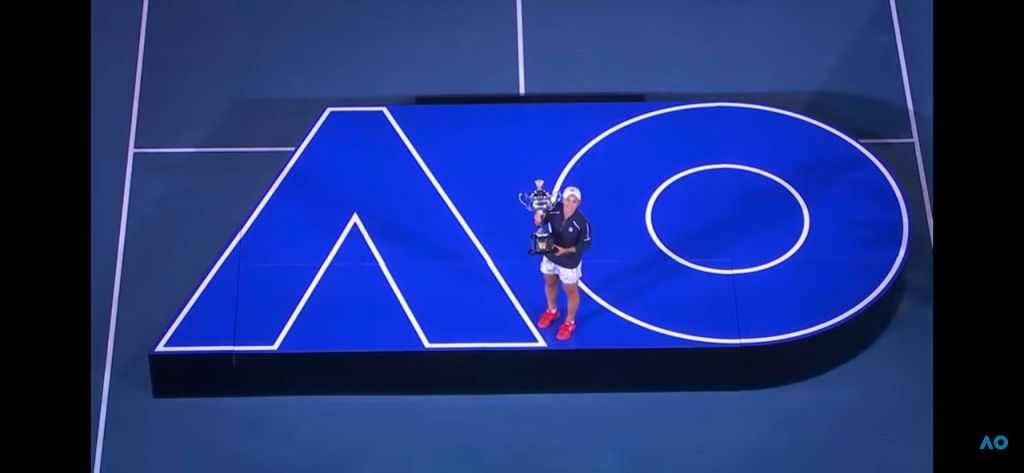
Barty lifts the trophy. Screenshot: Australian Open
How wrong I was. Waking up to the news that Barty – at the age of 25, triple slam winner, with a cool $23 million in the bank – has decided to retire from tennis, effective immediately completely blindsided me. I never saw it coming – I don’t think anyone did. Had she said she was going to take a few months off and come back for the US Open, I wouldn’t have been in the least bit surprised – she’s done that before, after all. Even if she had said she was planning to take the rest of the year off… but I never expected retirement. And yet her reasons behind her decision make so much sense: she’s achieved what she set out to do – she won Wimbledon, she won the Australian Open, she became the best female tennis player in the world – and now she’s ready to set some new goals and take on some new challenges. Knowing Barty and her insane level of sporting talent, it wouldn’t shock me to see her representing Australian cricket at the highest level, or deciding that’s she’s going to try her hand at Aussie Rules football. I’m still not fully convinced this is the end for her though – and it wouldn’t surprise me if she reappeared on the tour in three or four years time and casually won another slam before bowing out for good.
Whatever she does next, I have absolutely no doubt she’ll do it with her entire being and become the best of the best. I’ll miss her game immensely, I’ll miss her post-match interviews where she’s full of nothing but praise for her opponents and humility at what she’s achieved. Tennis’s loss is whatever she chooses to do next’s gain. In the words of Andy Murray: “Happy for Ash. Gutted for tennis. What a player.”
PS – time for the Australian Open to rename a certain arena to the Ash Barty Arena.
Siddhant Guru
On Ash’s retirement, it’s obviously a huge shock as we haven’t seen a player retire at 25 years of age in probably a decade. It’s particularly shocking given Ash has been at the very top for “only” 2-3 years now. For someone to lose motivation in such a relatively short period of time… it’s a little surprising. Nevertheless, it has been an absolute privilege watching her play. She has achieved so much in her career in such a short time. I have a faint hope she will reverse her retirement decision in a few years.
Damian Kust
Perhaps it shouldn’t come as this much of a shock given she already had a year-long break before, but it certainly caught me off-guard due to how dominant she was in recent times. Am I sad that I’m not going to watch her lead the tour in the years to come? Yes, because her mix of a big forehand and a deadly slice was so unique, also the way she was among the game’s best servers with her height blows my mind. But if she feels like she’s already achieved all she wanted and doesn’t think she can keep giving her best effort, we have to respect that decision. Even retiring at 25, she’s undeniably an all-time great and a champion we won’t forget easily.
Jack Edward
Watching Ash Barty the tennis player, this makes so little sense. She makes the game look so easy; gliding aces passed her opponents from just five and a half feet tall, opening up the court with her once-in-a-generation forehand, coaxing error after error with her wicked slice.
But listening to Ash Barty the person, this couldn’t make any more sense.
This is so Ash Barty.
I’m going to miss her a ton on the court but I don’t hold an inkling of a grudge thinking on what could have been. We can learn a lot from Ash: listen to your heart. If it doesn’t feel right, don’t do it.
Left feeling a mash-up of melancholy and motivation. Good luck Ash!
Josefina Gurevichand Shravya Pant
We are big Barty Party-ers; one listen to any of our Wimbledon or Australian Open episodes will prove that to you. Naturally, our first reaction to Ash’s retirement was pure sadness. It was the first time we saw one of our favorite players whose nearly full career we had been able to witness leave the sport – it leaves you with a different sort of emptiness. But beyond our initial instinctual sadness, Barty’s heartwarming video announcement filled us with sentiments that were much more positive: pride, admiration, and an appreciation for her – how do we put it – girlboss attitude (Danielle Collins put it best: “To retire at 25, I think it really speaks to the way our sport empowers women…I think it’s so cool being able to retire at 25. What other profession would you be able to do that in? There’s not too many. I think it’s incredible for our sport”). There was a beautiful simplicity in what she said; no care for what other people thought of her decision, just fulfillment in making the choice (the operative word here and precisely what Collins was speaking to) that was best for her physical and mental wellbeing. Ash, in those six minutes on Instagram, was admirably frank and honest, challenging the standard conventions of success, fulfillment, and the passion, drive, and love an athlete has for their sport in a necessary manner. Fitting, perhaps, as her signature slice was just as refreshing of an addition regarding her on-court impact.
Tennis means a lot to Ash, but it isn’t everything. Her actions put the life of a professional athlete in true perspective, emphasizing the importance of balance and variety, things we are too quick to disregard when it comes to watching these superstar athletes. But Ash’s advice extends to more than just these professionals: you can love something so much to want to never let it go, like Delpo, but you also so much that you realize you have given it your absolute all and are ready for the next challenge. The moral of the story is: respect. Out of respect to herself, Ash decided to retire. She had goals for which she aimed throughout her professional career, however as she said in her retirement announcement… she achieved them.
Ash has brought something completely new to the table, and that is, an athletic career doesn’t only have to be about longevity. It can be about the impact made in the moment, and she realized that after a certain point in her career, she wouldn’t have been able to pursue the longevity that other athletes strive and struggle for. In addition to that, out of respect to her fans (very much including us), she postponed her retirement in order to play this year’s Australian Open. And what a way to give us a “last hurrah,” and because of that performance, she was able to walk away knowing that her choice was the right one to make. It was never a matter of “giving up”, because what was she giving up? Her No.1 spot, probably as well as the position of best and most consistent tennis player in the world? Giving that up should not be considered “giving up.” Some goals have ceilings, definite ends, and while that is rare in sports, it’s possible and Ash has demonstrated it with such innocent simplicity. Most importantly, as her fans, it is our duty to respect that of Ash. For all she has done for the sport we love so much, it is time for the sport to let her do what she needs to do.
A rarely-seen photo of a young Ash Barty on the tennis court.
Owen Lewis
The more I think about Barty retiring, the more I think the timing was more shocking than the news itself. She’s always seemed so down-to-earth, not just in a humble way, but like she intrinsically understood the limits of what tennis could provide for her. From this perspective, I’m delighted for her. As a selfish fan, I think tennis will miss her badly. This retirement really shifts the landscape — Iga Świątek, who was the world #2 and had lost to Barty both times they had played, is now comfortably the best player in the world. Two of the next four major tournaments will be played without their defending women’s singles champion. Barty’s slice, which no one seemed to know how to handle, will now only bully players on the practice courts. She may have been the most skilled server in the world; her hitting a dot anywhere in the service box at just 5’5” will never cease to amaze me. I think women’s tennis will be absolutely fine — the depth of skill in the field would be ridiculous even if the entire top 10 called it quits — but I was excited to see how long Barty could stay at the top. That she stepped down from the podium rather than being pushed off is fitting.
Caleb Pereira
I can’t really say I was a Barty fan. I first saw her in that incredibly topsy-turvy Anisimova semifinal at Roland-Garros three years ago, the one with a set lost from 5-0 up. Over most of her reign, I didn’t believe she could keep it up, adamant that the typical WTA-throne chaos was always round the corner. She proved all of us wrong. I’m sure there will be talk about her slice, talk about her forehand, but can we talk about that serve? A 10.6% ace rate over the last 50 matches of her career! Only Plíšková beats that—and Plíšková stands half a foot taller! For context to the ATP, Novak Djokovic has an 8.8% rate, and he stands more than a foot taller (I know, I know, we’re not supposed to compare across gender categories, but it’s fun sometimes). When I began to watch Barty more often, I was genuinely offended that she got cheap points off that serve against my favorite players. I didn’t understand how a 5’5” individual could pull that off, but that’s what a great spot server can do to you. Many talented players have failed to span that last chasm (the serve), the one that takes you to the upper echelons of tennis greatness where dominance is sustained—Halep, Wozniacki, Nishikori, Ferrer, you get the gist. In my opinion, that serve is probably what’s most special about her from the technical side of things. Infuriatingly good. A fount of rich abuse from all her haters. I wish her well on this next phase of her life—and I’m almost certain she comes back sometime in the next 5 years!
Brenda Parry
4.35 a.m, Wednesday 23 March 2022, my eyes still half closed: this is when I learnt via the Popcorn Tennis WhatsApp group chat the news of Ash Barty’s retirement from professional tennis that has stunned the tennis world this week coming completely out of the blue. Ash Barty, WTA world No. 1, reigning Wimbledon and Australian Open champion, just 25 years old and dominant in the woman’s game with her unique style of play. Why?
Thinking about the person Ash Barty is, it isn’t difficult to understand why. Barty has never shied away from being different and doing things her own way. I have always admired her individuality and humility. It has also been clear for a long time what a home-loving person she is, an ordinary down-to-earth Australian girl who has remained true to herself and her origins despite the demands of competing all over the world at the highest level. As someone who lives away from her home and family, I can relate to this and the torment I frequently feel at being away from my family on a regular basis. Listening to her Instagram interview in which she discusses the reasons for her retirement with her long-time friend and former tennis player Casey Dellacqua, everything Barty said made total sense and I really admire her for having the courage to continue to follow her own path in pursuit of happiness.
Of course I am sad that tennis has lost such a humble and worthy champion. Barty has already achieved so much but could have achieved so much more and there’s no doubt that she will be sorely missed both on and off the tennis court. She is and will remain an inspiration for her impeccable attitude and commitment to the sport. However, I share her happiness and excitement that she is now free to pursue other dreams, whatever they may be, and I am convinced that she will embrace whatever life has to offer.
I wish her all the best for her forthcoming marriage to Australian professional golfer Garry Kissick and this new chapter in her life!
Thank you Ash.
Nick Carter
The news of Ash Barty’s retirement was a big shock to wake up to. It was a shock because she’s still young (25!), she’s at her peak and could have so much more success. Her potential benefit to tennis by continuing to play is huge. So, like the rest of the tennis world I was wrestling with the sporting impact of it all. Those of us who love the competition were wondering: “why?”
Then, I watched the announcement interview, and suddenly it made sense. I thought about who Ash Barty is as a person. She is motivated by dreams, not greatness. These are dreams of being able to play a sport she loves and to win the tournaments she grew up watching on TV. I don’t think being the best, and continuing to win over and over was really what was important. She’s competitive, look at those pictures of her at an AFL game a couple of years ago for confirmation. Barty likes winning and to be part of a winning team, but it’s not everything to her. Barty’s breaks to play cricket and during COVID were confirmation that tennis was not her everything. Ash the person has always come before Ash the player.
Now that Barty has got what she wanted out of tennis, I can see why she’s not as motivated to deal with the stuff she doesn’t like. Managing her body, the travel, long spells away from home. Struggling with the grind of the tour contributed to her first retirement. She’s never liked it. We also don’t know what long-term injuries she’s dealing with. Her statements up to now have hinted at something going on, and maybe her injury on the clay last year did some lasting damage.
We as fans of course are missing out on what would have been an incredible rivalry with Świątek this season and beyond. We are also missing out on seeing Barty clash with the other best player of her generation, Osaka, in a big match. That ‘Big Three’ would have been so fascinating. But this is not about us fans and our entertainment. This is Ash’s life, she gets to decide what she wants. She wants to be at home with her friends and family, by the barbie with a beer in hand. I can’t blame her for that, that’s all I want from life too.
So, let her be happy. Ash Barty is already an all-time great. She has three major titles in singles (plus one in doubles), an Olympic bronze medal and has been ranked world number one for three years. She is retiring not only on a winning streak, but technically undefeated at three major events since winning them (if you don’t count her Roland-Garros retirement in 2021 as a defeat). In my view, if you win three majors, you are officially one of the best players ever. Barty has nothing more to prove to anyone, including herself, which is most important.
Have a great life Ash. I wish you all the best and that you are happy.
Scott Barclay
Over the last week, many pundits have been quoted as saying that Ash Barty’s early retirement suggests that perhaps she never really loved tennis as much as some of our past champions. I’d disagree with that by instead offering up the idea that she absolutely does love the sport a great deal but maybe not in quite the same way as some of our past champions have. Love isn’t only represented by how hard you keep pushing yourself beyond boundaries that you’ve personally set for yourself. Instead, it’s about adjusting and shifting things around to make a comfortable relationship that everyone involved can feel at ease with.
This is best represented by Barty herself maintaining that this isn’t the end of her time with tennis, stressing on multiple occasions that she wants to help mentor younger up-and-comers as well as introduce tennis to areas where it can help improve the lives of people that are struggling.
Changing the world isn’t only done by showering yourself with the grandest of glories on the biggest of stages. It’s by working out of the spotlight to help others enter it.
Good luck, Ash Barty. We’ll see you down the line somewhere.
I really love tennis. Often, I would rather watch an old highlight video I’ve seen a million times than go out and talk to friends. I have even watched old highlight videos while talking to friends. (I was told it was annoying.) I let tennis occupy more of my life than anything probably should. I do try never to forget, though, that tennis is just a game. The sport might have the ability to create matches as complicated as wall-sized tapestries and to spin incredible stories, but at the end of the day, it is still people hitting a ball back and forth with webbed sticks. It’s a testament, or an indictment, to our society that we’ve constructed tours where people travel the world to hit a ball back and forth, standing on cement, grass, or clay (do watch this video to see the elaborate process of how court Philippe-Chatrier is made) to do so. I know spending as much time as I do being concerned with a game is a huge luxury.
So it’s pretty cool and lucky for tennis fans that enough people feel this way that the sport can exist on the widespread level it does. That people are willing to layer different rocks on top of each other and then cover them with crushed brick just so people can play tennis under certain conditions. This isn’t doing anything to help conditions for humankind in any way. As such, you’d think the least tennis’s organizations could do would be to protect those who take part and stand up for human rights issues. You’re playing and organizing a niche, inconsequential game on a global level, so just look out for the people within your weird elite bubble. Try not to break too many of your toys. That’s not too much to ask, is it?
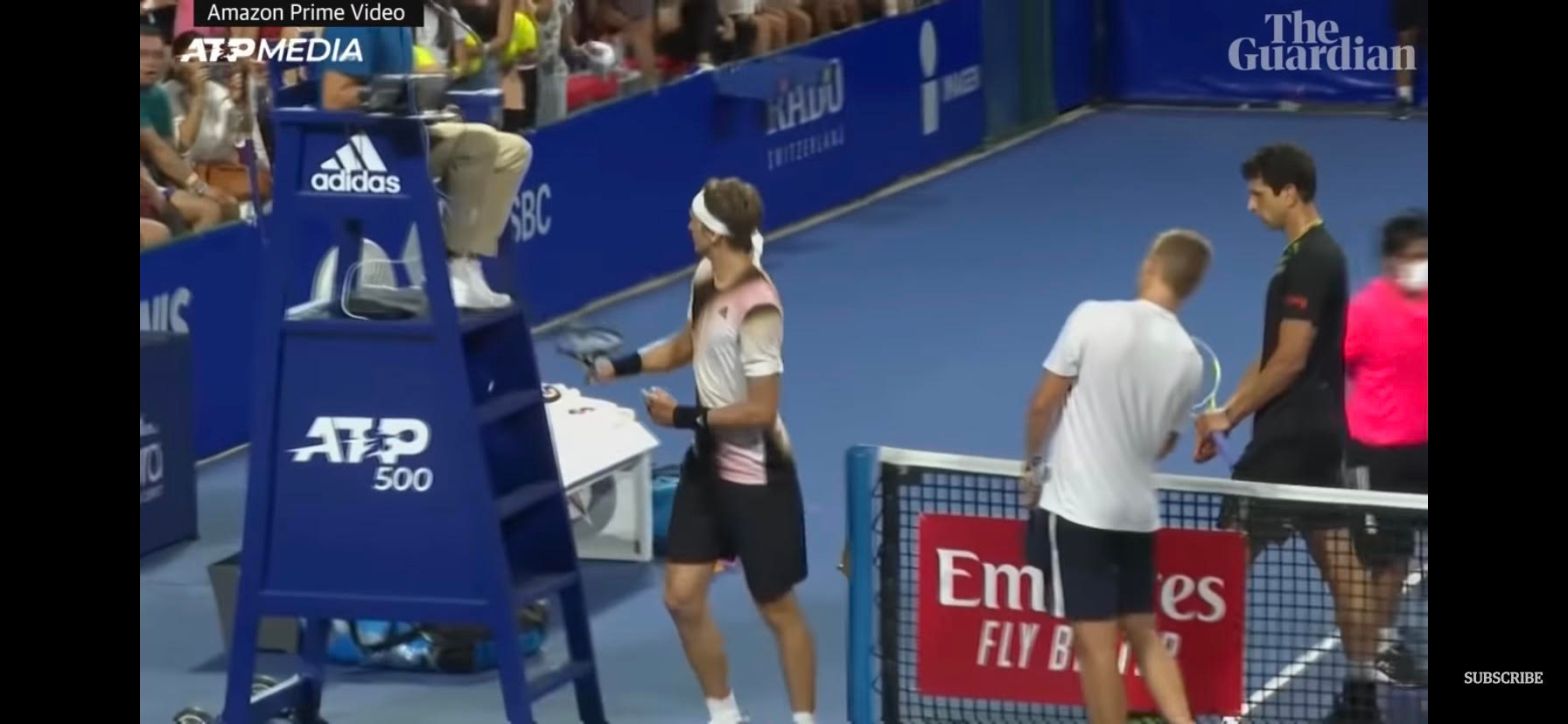
For the ATP, apparently it is. In Acapulco this year, Alexander Zverev disagreed with an umpire’s call during his doubles match. He proceeded to scream at the umpire for a while, dropping a couple f-bombs, even though there was no chance the call was getting overturned. (This never happens if a challenge does not prove the call wrong.) Minutes later, when Zverev and his partner Marcelo Melo had lost the match, Zverev walked up to the umpire’s chair.
He thrashed his racket — this being a hard, composite object almost the length of an arm — against the umpire’s chair. The umpire needed to lift his foot to avoid being struck (probably would have broken a foot or ankle if not for those reflexes) and fled the chair. Zverev continued to shout obscenities at the umpire as he did so. The tournament kicked Zverev out of the draw, but further punishment had to be forthcoming, right? This was an opportunity to say to everyone on the ATP that such treatment of one of their officials was not acceptable and would not be tolerated. It was a no-brainer. You can’t have an umpire’s ankle nearly get shattered and then not punish the person who nearly broke it. The punishment would come in the form of a suspension or a massive fine, we figured. And the tour would surely emphasize that the safety of their officials was paramount.
None of this happened. Zverev got fined $40,000, and the tour threatened him with an eight-week ban and an additional $25,000 fine if he got another violation in the next year. $40,000 is nothing for Zverev, who is a multi-millionaire living in Monte-Carlo, and even he probably isn’t enough of an idiot to become a repeat offender in the next 12 months.
What the ATP was saying, essentially, was that putting an official’s welfare in serious danger gets you a light flick on the wrist. Really, it wasn’t that surprising. In tennis, umpires make calls, and those calls stick. Challenging whether a ball is in or out is the limit of a player’s control over a call. Zverev knew, in other words, that his obscene rant was for nothing. He just decided to deliver it anyway. Watch the video for yourself to see how bad it was.
Umpires get screamed at regularly over the smallest of grievances, even though players know calls never get overturned. That the tantrums have continued tells us a lot — specifically, that the tour isn’t bothered enough to dissuade players from acting like violent children. Players feel okay, or not remorseful enough, about berating an umpire. These rants are fruitless! They don’t work! Even if you’re right about a call being wrong, if you don’t challenge it, that’s the end for the point. It’s over. Yet the screaming persists. Tantrums have even become a tactic for players to jolt themselves into playing better or to kill an opponent’s momentum. Whoever is on the receiving end of the abuse is given little thought.
With the ATP miserably failing to meet Zverev’s pathetic treatment of the chair umpire with a fitting punishment, a host of other recent incidents have followed. Nick Kyrgios spiked his racket into the ground so hard after losing to Nadal at Indian Wells that it flew all the way into the back wall (he was standing close to the net when he threw the racket). It missed a ballboy’s head by a foot or two, and had the kid not been attentive and quick enough to get out of the way, it would have hit him in the face. Kyrgios was fined $20,000 for the transgression. That was it.
A mere week later in Miami: Jenson Brooksby chucked his racket off the ground, and it bounced inches from a ballperson’s foot. The ballperson picked up the racket and handed it to Brooksby, who did not acknowledge him. (Brooksby later apologized to him in person — why this couldn’t have happened mid-match, I have no idea.) Brooksby did not get defaulted. He went on to win the match. He was fined $15,000.
Also in Miami: Jordan Thompson took an angry swing at a ball when he was near a ballgirl, causing her to flinch out of fear of being hit. These occurrences have been pouring in with such frequency that Andy Roddick took to Twitter to explain to players how to throw a tantrum safely, middle school-style.
While these events were jarring, they’re merely a by-product of the system tennis has created. Ballkids and adults have been treated like dirt for a while. Think about how hard their jobs can be: they sprint all over the place to pick up the tennis balls and have handed players sweaty towels for years without so much as a thank-you in return. Sometimes they get screamed at. Sometimes flying projectiles get hurled near them. Similarly, umpires are tasked with identifying whether a small sphere traveling at the speed of a car on the highway lands on top of or just beside a slim line. This is not easy! You’re entitled to a mistake or two! Yet when a call comes down to millimeters and the player thinks the umpire got it wrong, screaming often ensues. Brooksby was up a double break in the deciding set when he had his little tantrum. He was going to win the match (and he did). There was no reason to throw that racket, especially not in the direction of the ballperson, but he did it anyway, probably because he knew he could get away with it.
After apologizing during an interview at the Tennis Channel desk, Brooksby said “I was more frustrated with myself, and I just had to let it out that way.” He didn’t have to let it out that way. Of course he didn’t. He could have shouted, or held on to his freaking racket when he slammed it into the court so that it wouldn’t go flying at another person. Or — and stick with me here — he could have recognized that his error was unlikely to be consequential in the context of the match, and he could have chosen not to throw his toy.
This has become a problem. Everyone can see that tennis is setting the precedent for players to violently act out, then get away with next to no backlash. This behavior is going to continue.
Seriously what is it going to take …drawing blood …to properly punish a tennis player.
The younger McEnroe brother poses a legitimate question: what is it going to take? Some pretty nasty stuff can happen on a tennis court, what with players hitting balls at speeds of over 100 miles per hour. Denis Shapovalov hit chair umpire Arnaud Gabas in the eye when he angrily smacked a ball at Davis Cup in 2017. Gabas went to the hospital, where it was luckily determined that there was no lasting damage. (Per Eurosport, Gabas said “I feel quite lucky it wasn’t worse” after the incident.) So what’s going to put a stop to this? A broken limb? Something worse? Your guess is as good as mine, because I have no idea when the ATP’s morals will kick in.
*****
Some are arguing that these insufficiently strict punishments are unfair on Novak Djokovic, who hit a lineswoman in the throat with a carelessly swatted ball at the 2020 U.S. Open. He did receive the proper punishment in the form of a default, and players are recently getting away with smaller sentences for similar crimes. Consistency is good, sure, but feeling sorry for Djokovic because he got worse than a fine for injuring a linesperson is badly missing the larger point. The issue is making sure policy reflects a concern for officials’ health — hit someone, get defaulted — not pointing out a case where justice was served as an outlier. Whoever ends up being the last one to get away with a light punishment after acting out dangerously will be lucky, but stricter policies should be implemented as soon as possible. Screw precedent, just get it right as often as you can.
It’s also time to realize, I think, that fines are not the ideal punishment to ward off dangerous tantrums. If they were, incidents would be sporadic, not increasingly frequent. Why not make suspension the punishment? That way, everyone is deeply affected — act out in a way that puts someone else at risk? You’re off the tour for a while. Imagine working on court at a match featuring a volatile player and knowing that they are not sufficiently cowed by the rules for you to be sure they won’t hurl a racket in your direction. Those doing a service to tennis really aren’t protected by their employer, and there are plenty of other jobs out there that pay without potentially putting you in harm’s way.
Here’s my advice to ballkids, linespeople, and chair umpires: demand better terms for yourselves, because you’re doing your best to help tennis matches take place and you don’t deserve to be treated like dirt for that. Boycott matches, unionize, refuse to take the court unless the ATP disciplines players, default players instead of giving them additional soft warnings so that the crowd doesn’t get disappointed. Quit if the ATP won’t stick up for you. You’re too good for them.
And to the ATP themselves: this idea you have of tennis, this weird mini-hierarchical system with the players being absolved of harmful or near-harmful tantrums and those who work at matches being treated terribly, has to stop. You have fostered an idea that it’s admirable to take out frustration on surrounding figures if it helps someone start playing well. You have fueled the narrative that Nadal’s never-break-a-racket attitude is singularly remarkable rather than decent and achievable. In doing so, you are only serving to subject people to anger or danger. You want to market tennis, right? Cut down on incidents that don’t have to do with point play! When shit hits the fan, address it and try to do better instead of sweeping it under the rug. This is not a controversy — you obviously need to protect your officials better — so when you don’t address the problem, you don’t look like you’re taking a side. You just look lazy and morally corrupt.
You have the immense privilege of there being scores of people who love this silly game as much as you do. Please treat your employees with the respect they deserve. It is the least you can do. As of now, I have no idea why they’re working for an organization that neglects their safety, so give them a reason to stay before they leave along with swaths of tennis fans.
Angelique Kerber is in a strange place right now. She’s had an incredible career — this is a woman who won two majors in 2016, beating Serena Williams in the final of the Australian Open. She reached #1 that same year. Kerber has won three majors in total, across two different surfaces. Today, she is ranked 15th in the world, which is far from bad, but she is now regarded as more of a dark horse than a reliable threat to win big titles. Kerber showed flashes of form last year, especially at Wimbledon, where she made the semifinals before losing to the recently retired Ash Barty.
Kerber is a supremely skilled ballstriker. She is able to change direction of the ball at will and can see angles others wouldn’t dream of. Crucially, though, she doesn’t have a ton of easy power. She tends to have to slog through her wins, especially against top players. When she beat Serena in the 2016 Australian Open final, she played incredible defense (this is the other pillar of her game) to the extent that she got back in points she looked dead in. Sometimes Serena would even miss a putaway. It was amazing, but not particularly sustainable. Defense is crucial, a necessary quality if one is to succeed at tennis, but at the end of the day, doing it constantly is not where you want to be. Kerber avoids defending too much by staying glued to the baseline and taking groundstrokes on the rise, a tactic Leylah Fernandez has also begun to employ. In this way, she retains some control in matches against more powerful players, though it’s a fragile hold — if her timing is even a little bit off, things go awry in a hurry.
Kerber has been struggling so far this year. She has played five matches and lost three of them. She remains dangerous when playing well; she was up a set on Iga Świątek at Indian Wells, who went on to win the tournament. Still, it only gets more difficult to defend successfully as the years go by, and Kerber is now 34. You get the sense that her career doesn’t have too many years left.
Kerber played Naomi Osaka in the second round of the Miami Open, who in many ways is her opposite. Osaka is tremendously powerful, both with her serve and from the baseline. Unlike Kerber, she can fire away accurately and routinely close out matches in an hour. She is a better player overall, having won four majors to Kerber’s three (Osaka is also a decade younger), but especially on hard courts. In the last three and a half years, Osaka has won four majors on hard court, during which time Kerber has not made a major final on hard.
Osaka’s success is precarious in a different way than Kerber’s. Her game rarely flinches, but tennis hasn’t always been kind to Osaka, and its barbs have produced scars in the past couple years. At Roland-Garros last year, Osaka tried to preemptively withdraw from press conferences, but the backlash from the majors was so vicious that she dropped out of the tournament despite having advanced to the second round. Just two weeks ago at Indian Wells, a fan yelled “you suck!” to Osaka in the middle of her match, and she broke down mid-match and couldn’t recover. She said during press that her goal was to play as few tournaments as possible. It is becoming increasingly clear that Osaka’s mentality is not suited to the relentless nature of the circuit. She hasn’t won a tournament since the 2021 Australian Open.
So the Miami Open clash was intriguing not just because two multiple major champions were meeting, but because each was struggling, and in their own distinct way. Beating a fellow major champion can generate a lot of confidence.
*****
The match was over in an hour. Osaka hit winners with incredible frequency — 33 in total — and from impressive positions. She dominated with the one-two punch on both first serves and second serves. Several times, Kerber would hit a decent return, putting Osaka slightly on the defensive. Osaka would get back in the rally and crush a winner on the first ball Kerber left hanging. Kerber couldn’t do much to hit back, but it was less that she played badly than that she wasn’t allowed to play well. It’s hard to change the direction of the ball when groundstrokes are coming at you with enough force to knock you over.
The conditions were windy, but Osaka’s shots had such weight that they cut through the breeze. Early on, a Tennis Channel graphic showed that Osaka was hitting her forehands an average of 10 mph faster than Kerber, and her backhands 17 mph harder. Osaka could aim for pretty safe targets and hit winners anyway due to the pace on her groundstrokes. Every time a Kerber shot sat up a bit, you could have paused the stream and said “winner,” and seconds later, Osaka would deliver.
The match showed how easily the head-to-head stat can lose its relevance. Kerber led this rivalry 4-1, but Osaka had improved immeasurably since their last match in late 2018. There was no solace for Kerber in the head-to-head since the old patterns that had worked were no longer viable against the new version of Osaka. It was clear that Kerber had to put Osaka on the run to take some of the sting off the four-time major champion’s shots, but aiming for the lines isn’t Kerber’s style, and Osaka’s flawless play only increased the pressure.
Osaka just hits the ball so cleanly. Just overpowering Kerber so much that she doesn’t even need to get close to the lines.
— Tennis And Bagels Podcast! (@TennisAndBagels) March 24, 2022
Osaka made a bad mistake on her second match point, bashing a short backhand into the net. It was her first chance to really get nervous, but she coolly fired a forehand winner on the next point, then awaited Kerber’s error in a rally to close out the match. Kerber walked off the court quickly. She did not wave.
When Osaka plays this kind of tennis, the world (at least on hard courts) is hers. She seemed calm after the match, as though she had merely met the expectations she had set for herself instead of playing her best in at least a year. Distractions did not come into play; this match was only ever about the tennis. Waving to the crowd, Osaka smiled slightly. She looked comfortable.
One of the cool things on the really long list of cool things about Ash Barty is that she frequently rejects the expectations that the tennis world places at her doorstep.
Announcing her retirement last night from her current position as world number one, she seemed happy and at ease. Sure, there were a few quivers, a few signs of emotion here and there but generally speaking, she seemed so unbelievably sure of her decision, her words offering us no sign of any final doubts.
Indeed, in all of the immediate chaos of the announcement, only the person breaking the news remained calm, so obviously certain that this was the right call, that nobody could ever dare to question her further. This was retirement the Ash Barty way, with a smile and nod of the head and a knowing glint of the eye that told us that she knew this made sense.
***
At the top level, tennis demands and it keeps on doing so, throwing tantrums if it doesn’t get its way. Of its best players, it requires constant presence and intense commitment and damn all else. This is it and it’s where you’ll need to be. “Nothing else matters,” it’ll scream. “This is the be all and end all.”
And it will be that, it absolutely will be all of that, just as long as you let it be. For Ash Barty, she never really wanted to let it be for long. She wanted it to be her everything only periodically and it was to her absolute credit that she wrestled and fought for a balance that worked for her and made it happen, all the while refusing to obsess over the sport that she went on to dominate.
She took lengthy breaks. Spent time at home with friends and family. Retired once before and came back for just a little bit more. She held back from dedicating every possible waking moment to tennis and in doing so, reminded us frequently that it’s OK to have doubts about our choices, our careers, our lives, and that we don’t need to chase the grind and drag ourselves down trying to reach for things if we’re not even really sure that we truly want them. Barty did as only Barty could and was absolutely brilliant while doing it.
And she won! My god, did she win! A French Open trophy, a Wimbledon title and an Australian Open triumph scattered themselves across her career, a testament to just how good her variety-driven brand of tennis could be. She confused opponents, leaving them clueless and guessing and questioning. She inflicted the struggle of uncertainty on all who played her and rode up the rankings to #1 in the world over the shoulders of players who hit harder than her. Barty never needed all-power play, she just needed an array of difference which she could then weaponise as her own. She was difficult and she was awkward and this was represented best by watching her rivals fall before her.
Watching Barty engineer all of this sparkle for herself was fascinating but what’s more is that she did it while refusing to compromise all else to do so. Of course there were those unhappy about this, those who questioned her motivation and her drive and her personality and her tennis. Many thought her as undeserving if she didn’t see this as her whole world.
The best part though? She just didn’t seem to care. In the face of people asking for more, she kept offering only what she wanted and when she did give just a little bit, she often found herself as the last one left standing at trophy ceremonies.
In the end, perhaps that was why she was as good as she was, because she wasn’t utterly desperate for everything to fall into place for her. She was willing to wait and, yes, work for things, but not to the detriment of her own personal happiness. She spoke of achieving her dreams in this brief retirement interview but you also got the sense that if she had ultimately fallen short of those aspirations, she would have been alright with that as well.
And when you’re consistently at peace with yourself regardless of the outcome, it becomes near impossible to lose.
***
At 25, Barty is in what most would consider to be her prime. Any future potential she had in tennis will now become a top tier “what if?” discussion to be chewed over in the days, weeks, months and years to come.
Barty won’t be losing sleep over that though. She’ll be turning her attention to whatever she likes now that she’s closed this second tennis-playing chapter of her life. Barring another change of heart somewhere down the line, you really do feel like this really is probably it for her in our sport. And that’s fine. Sure, it’s sad for us but we don’t really matter because it’s relaxation for her, it’s fulfilment for her, it’s wanting something else for her and that is all that truly matters.
As much as this is a time of much shock and surprise and some tears as well, it’s also a point to celebrate an athlete realising that they no longer feel the need to pursue this messiness anymore. One of the most important traits of Ash Barty’s playing career is that it perfectly articulates to us all – even the most ardent of fans of this big-little sport – that there’s much more to life than tennis.
A career that has inspired the world 💙
Thank you @ashbarty, for everything. We wish you the best in your retirement, and we’ll always be here cheering you on for the next chapter.
Ash Barty has just retired from tennis in a most unconventional way. She is 25. She is the world #1, a spot she has held for over a year. She has won three majors, one on each surface, two of them in the last year.
Barty walks the Hall of Champions after winning the Australian Open. Screenshot: Australian Open
Barty has never had a typical career arc. She took a break from professional tennis in late 2014 and took up cricket the following year, a fact mentioned practically without fail by broadcasters during her matches. During earlier waves of the COVID-19 pandemic, Barty sat out of some big tournaments — the 2020 U.S. Open, the 2021 WTA Finals. Due to a slow physical recovery after this year’s Australian Open, she opted out of the Sunshine Double despite being the defending champion in Miami.
Barty’s game wasn’t typical, either. At a mere five feet and five inches, she developed one of the best serves in the world, utterly mastering the art of disguised spot serving. Her backhand slice was the most potent on tour, giving opponents fits. Her forehand was a heavy comet she could direct to any spot on the court.
She was simply unstoppable at her best. Iga Świątek has been on the rise recently, winning Indian Wells to ascend to the #2 spot in the rankings. Barty beat her in their only two matches, both played in the last year, without dropping a set.
So, from a tennis standpoint, the timing of Barty’s retirement is bizarre. She is leaving potentially dozens of big titles on the table.
Barty knows all this. Having cathartically achieved her childhood dream of winning Wimbledon, she started to consider retirement as early as last year. The Australian Open, she said, then acted as the last piece in the mosaic of her goals in tennis. She has checked all the boxes she set out to.
In the era of the GOATs, aspirations for towering major title counts and a place among the biggest legends in tennis history have become almost commonplace. Expected. With some exceptions, Serena Williams, Roger Federer, Novak Djokovic, and Rafael Nadal have been more or less perpetually dedicated to tennis. Major titles #1 through #19 didn’t deter their motivations enough to snuff out a burning desire for #20. You get the sense that the four of them will hang up their rackets when they feel they have accomplished everything they possibly could have, not before.
This attitude is incredible, not normal. Looking at the other 99.9% of players, even those who are also major winners, reveals that motivation is a complex, varying pull for those on tour. Not everyone aspires to be the best of all time. Not everyone even aspires to play for as long as they can. Tennis is demanding, but it’s also just tennis — when most players retire, they are not yet at the halfway point of their lives.
Barty has seemed to grasp this from the very beginning of her career. The spirit is evident from the way she carries herself to the way she plays — she plays tennis with force and purpose, but not with the frantic energy you see from Nadal, not that it’s held Barty back. She obviously wants to win, but it’s not the end of the world if she doesn’t. She strikes me as someone who could lose a close match and chat about it rationally over coffee with her team rather than dealing with it by throwing her tennis bag in a fit of competitive rage. Though the timing of Barty’s announcement is shocking, the substance of it makes some sense.
It will take some time for Barty’s absence to truly sink in. That the winner of the Australian Open without dropping a set, the reigning Wimbledon champion, and the longtime world #1 is no longer active on tour is not a thing that can be immediately digested. It might not truly hit until the clay season — we already knew Barty wasn’t playing Miami — but there will come a tournament, maybe one Świątek wins easily, provoking us to ask who can stop her, when the tennis world will collectively feel the absence of Barty’s tennis.
There is plenty of space for a comeback if Barty chooses to pursue one. Maybe she will feel the pull of tennis again when Wimbledon takes place without its defending champion, or when the Aussie crowd has to pick a new favorite. Maybe it will be bearable when she misses tennis, or maybe she won’t miss tennis much at all. I think Barty has considered all these possibilities and is fine with all of them, and therein lies the sense of her decision. I would wish her luck if she needed it.





 Popcorn Tennis