Not the catastrophic, career-ending kind. Not even the kind that takes a player out for a month. The minor kind, which the player can negotiate with over the course of a tournament, maybe even winning in spite of it.
The way tennis discourse operates surrounding these injuries is a problem. You’ll often see a player take a medical time-out to get treatment, then emerge from the break at least slightly revitalized. The player will begin to play better, and they might win. Then fans accuse the player of faking an injury to disrupt the flow of the match.
First of all, isn’t the point of a medical timeout, its very purpose, to produce this outcome? The physio or doctor or trainer is supposed to make an ailing player feel better so that they can continue playing at a high level. Medical time-outs are in the rules. Players are allowed to take them. So why the anger when they do?
It all starts with a misconception of sportsmanship. There have been many moments in the past when a player, especially in a final, is injured but elects not to talk about it after a match, so as to keep the spotlight on the winner. This is a nice sentiment, but it’s created a host of problems in injury discourse. Many now expect players to keep mum about their injuries, saying that if they don’t, they are somehow “classless.” That’s obviously insane — it’s not a player’s responsibility to not talk about an issue that affected a match they just played, no matter how awkward it might be to hear about.
This leads us into the second problem: many tennis fans would rather not acknowledge the fact that a player can win while injured. The reality is that some matchups have a skill gap big enough that even if the favorite is hurt, it may not affect the eventual result. At the 2021 Australian Open, Novak Djokovic tore an abdominal muscle in the third set of his third-round match against Taylor Fritz. Having won the first two sets, Djokovic started to struggle with his forehand and movement, and Fritz evened the match. The Serb managed to stage a comeback in the fifth, and swept through it 6-2.
After the match, Djokovic said he knew he had an ab tear (he was right), though he hadn’t been medically evaluated yet. This was met with widespread criticism — even David Law, an esteemed journalist, expressed doubts about the nature of the injury. Some fans accused Djokovic of faking.
Djokovic says in on-court interview that he doesn’t know if he will be able to take to the court against Raonic because injury is ‘definitely a tear’.
Players often say these things in the heat of the moment (ie ‘I don’t know if I’ll play Wimbledon’, and then wins Wimbledon). https://t.co/50ePBEvMeu
In the case of those accusing Djokovic of faking, the issue at heart is that acknowledging a player can win while severely compromised, especially one you don’t like, is an incredibly unsexy thing to talk about. However, it’s an occasionally necessary and insightful truth. Some acted as if the match had been stolen from Fritz. How, exactly? Did anyone in their right mind think that he was going to beat Djokovic at the Serb’s best tournament? There were even takes saying Djokovic had tanked the third and fourth sets only to pull the rug out from Fritz in the fifth, which is even more insane. With no disrespect to Fritz, a fine player who has only improved since this match, the gulf between the two players is so wide that it’s really not shocking at all Djokovic could overcome injury to beat him. Tennis is always hungry for competitive matchups, but at some point reality has to be acknowledged.
They have won as much as they have because they find a way to win despite physical hardship. All 3 of them. PLENTY OF TIMES. If you think your favorite Holy Triad guy has never been injured and somehow won a match (sometimes entire tournaments) while hurt, you're delusional. https://t.co/ijIWLYryw7
“If he was really, really injured,” Fritz said after the match, “he wouldn’t have kept playing.” Some saltiness after a loss is inevitable, but taking it out on the victor is hardly ever appropriate. The desire to simplify the issue is evident: if you’re hurt, you don’t play. But it’s more complicated than this — the pain an athlete feels from competing while injured is not linear; it can improve without much warning. Djokovic is also capable of playing incredible tennis while compromised. He’s that good.
Let’s look at another example. At Roland-Garros in 2020, Kiki Bertens beat Sara Errani 7-6 (5), 3-6, 9-7. Bertens was ailed by severe cramps towards the end of the match, but managed to struggle her way to victory anyway. She left the court in a wheelchair, then got 45 minutes of treatment after the match. This apparently wasn’t good enough for Errani, who insinuated that Bertens had been playing possum. Bertens was obviously compromised — why make a match more complicated than it needs to be? — just not by quite enough for her to lose the match. It happens. It doesn’t mean a player is faking.
When a player believes they can’t compete any longer, they retire. Some seem to have the misconception that if a player chooses not to retire, it means they’re not injured. This is not the case. More minor injuries can affect a match greatly, even if a player decides to compete through them. Taking the available options to stay on court — a medical time-out, a massage on the changeover, even something as simple as visibly showing pain — is not a failure in any sense of the word.
The reason I bring all of this up is that yesterday, Rafael Nadal lost the Indian Wells final to a brilliant Taylor Fritz. He cited a needle-like pain and difficulty breathing after the match, at which some fans jumped on him on Twitter to accuse him of making excuses. Well, today we found out that Nadal had stress fractured a rib, rendering him unable to play for four to six weeks.
Here’s a crazy idea: what if we believed the players? What if we took their word for it when they said they were injured? They are the ones inside their bodies, after all. Maybe, just maybe, when a player is visibly not right on court, we should worry about their well-being before trying to identify “patterns” of them taking medical time-outs. Popcorn Tennis’s very own Scott Barclay sarcastically tweeted that Nadal’s commitment to faking injury was so strong that he was willing to skip part of his beloved clay season — an obvious joke — and some people took him seriously, probably because there are fans out there who unironically believe what Scott tweeted.
I for one am very impressed by Rafael Nadal's commitment to feigning the injury that he sustained in the Indian Wells final to such an extent, that he's willing to miss a large portion of his most successful period of the calendar year to keep up pretences…
It would be really nice if every tennis match were a clash between two fully fit players, but it’s time to come to grips with the fact that not only is this not the case, but injuries probably happen more often than we realize. Our fantasies of an injury-free world are making ailments taboo to talk about, which harms the players and stigmatizes legal medical time-outs. So it’s time to take the misconception that injuries don’t play a huge role in the tennis world, shred it, then throw away the shreds and set the trash can on fire.
At the 2021 U.S. Open, Maria Sakkari split tiebreak sets with Bianca Andreescu in the fourth round. Andreescu won the first and was two points away from winning the second and with it the match, but Sakkari fought to level the contest. At 3-all in the third set, the match a three-hour slugfest at this point, Andreescu’s legs were gone. She fought gamely, but her face was a mask of agony for the final half-hour. At times, she was cramping after every point. It was painful to watch — Andreescu’s talent and will to win are nearly bottomless, but her body had been ground to dust. There was nothing left.
As Andreescu battled her failing legs, Sakkari looked fine. This is what she does. Physically, she has few equals on tour. Her arms are heavily muscled, but her cardiovascular capabilities are equally impressive. She never seems to get tired. Coupled with her easy power, she is a menacing opponent. She won the last three games of the match against Andreescu to move into the quarterfinals.
After outlasting Andreescu, Sakkari stepped on court against Karolina Plíšková, the Wimbledon runner-up. With a marathon under her belt in the previous round, the match looked likely to be a challenge. Instead, Sakkari dismissed Plíšková 6-4, 6-4. She lost eight points on serve. Against the 4th seed in the tournament. It was a dominant, dominant win, reaffirming Sakkari’s supreme serving ability. Her delivery is hard to read — she’s not an ace machine, but is a fantastic spot server. She has played many matches in which her serve has easily been the dominant shot on court. Not only is Sakkari a brilliant server, she has firepower from the baseline. She defends well. When she is on, there is no obvious spot to attack.
Entering the U.S. Open semifinals, there was a good argument that Sakkari was the favorite to win the title. Sabalenka, the second seed, was there, but Sakkari had been in better form. The other semifinalists were teenagers. Sakkari had made a major semifinal earlier that year at Roland-Garros and nearly won it. She looked primed to win her first major.
Instead, Emma Raducanu beat Sakkari 6-1, 6-4. Sakkari had a handful of break points early on, couldn’t convert any, and was against the wall from there. The only moments of tension were when she battled to avoid a double break deficit in the second set. Raducanu was flawless, yes, but Sakkari was unable to impress her game on the rising star.
It’s not that Sakkari is a choker — at times, she can be extremely clutch. Last year in Miami, she saved six match points en route to beating Jessica Pegula. She hit winners on five of them. Sakkari’s yips seem less about the immediate fear of winning and more about a wariness of what awaits at the upper echelon of the game. Sakkari is becoming more and more consistent — she became #3 in the world midway through Indian Wells — but it still feels a bit like she still sits on the second tier of stars, behind the likes of Barty, Osaka, Świątek, Krejčíková, Badosa, and other big title winners.
*****
Sakkari has been in imperious form during the Indian Wells tournament. In the semifinals — often the round that is a stumbling block for her — she clashed with Paula Badosa, the defending champion. Sakkari breadsticked her in the third set, serving out the match at love, feeling no nerves.
The final against Iga Świątek presented an opportunity for Sakkari to launch herself into the very upper reaches of the elite in one fell swoop. She would not only capture a first big title, but she would leapfrog Świątek to claim the #2 ranking. Sakkari had beaten the 2020 Roland-Garros champion in three of their four meetings, including a huge fourth-round upset in Paris last year. Sakkari being able to take her chances to win seemed a bigger question than whether or not she would have chances to win.
*****
It wasn’t that Sakkari seemed crippled by the nerves, but she never seemed to be totally free of them. Early on, Świątek struggled badly with her serve, double faulting four times in her first two service games. Sakkari broke her both times, but couldn’t consolidate. When the match settled into a more typical pattern late in the first set, Sakkari couldn’t find a way to win points on her second serve, and Świątek quickly broke to take the opening stanza.
Sakkari didn’t go away in the second set — at 0-1, she went for a big second serve and forced an error, then saved a two break points to hold. She crushed a couple forehand winners in Świątek’s next service game. The 2020 Roland-Garros champion then picked up speed, though, delivering an offensive and defensive masterclass. Two breaks of Sakkari’s serve came in short order.
This, I thought, was the biggest difference between the players. Sakkari, though she played well at times, was never at her best. Świątek found her top level early in the second set, then never let go of it. Every Sakkari miscue became that much more painful, since it was obvious she wasn’t getting any help from her opponent. Sakkari didn’t serve that well, but she hit her share of service winners. Her backhand was erratic for part of the match, but she hit some remarkable counterpunching shots from that wing. Sakkari’s plight lay in stringing such moments together rather than producing them at all.
Really tough windy conditions, but this was a really tough final for Maria Sakkari. Swiatek kept pinning her in the backhand corner, breaking down that side – which tends to be a lot flatter and doesn’t have as much margin.
Indian Wells has still been a productive tournament for Sakkari. Sure, she’s still without a big title, but it’s hard to imagine that will last much longer. The win over Badosa in the semifinals was one of the best wins of her career. She is #3 in the world and her game is without a big weakness. She continues to sail upwards.
Sakkari celebrates after whacking a forehand winner past Świątek. Screenshot: WTA
Her spotty performances in some big matches may not even be a big enough deal to be a cause for concern. Every player suffers from the fear of winning at some point (if that is indeed the reason Sakkari has struggled). Logically, it’s clear that being afraid of winning makes no sense, it is what all players aspire to, but this is a lesson that has to be experienced rather than learned. Sakkari breaking through for many big titles in the future looks likely. It will then become clear that she had no reason to doubt herself.
The top of the game is an unforgiving place, as Sakkari will know well after going up against Świątek’s flawless tennis in the second set of the Indian Wells final. Still, Sakkari need not be wary of what is to come. Her last opponent to overcome before winning a big title is herself rather than whoever is on the other side of the net. Any doubts Sakkari may have are conquerable because her tennis is ready.
A few days ago, Rafael Nadal overcame Nick Kyrgios in three tight sets to progress to the Indian Wells semifinals. As is often the case when Kyrgios is concerned, though, much of the focus was on him, regardless of match result.
Throughout the near three hour tussle, we were treated to the entire repertoire of Nick Kyrgios. From the brilliant to the frustrating, the absurd to the astonishing, there was no shortage in entertainment from Australian.
After racing into a 3-1 lead in the first set by breaking the Nadal serve following a double fault from the Spaniard, Kyrgios went on to hold serve with relative ease for the most part, throwing in a tweener underarm serve, a new addition to his substantial box of tricks. When serving for the set though, he played a couple loose points, and Nadal a few amazing ones, to hand the break back.
Kyrgios blasts a 109 mph forehand winner at 5-5 in the first set. Screenshot: Tennis TV
The tiebreaker played out in a fashion we’ve become accustomed to from Kyrgios over the years. After losing a couple of minibreaks early on due almost certainly to him still ruing the previous service game, Kyrgios tanked the back end of it to lose the tiebreaker by 7 points to 0. Facing six set points at 6-0 down, he told a member of the crowd to “shut the fuck up,” and was handed a point penalty (he had used his soft warning by smashing his racket earlier in the set) to lose the set.
Though he was dialed in for the majority of the set, there were still plenty of the usual Kyrgios antics. At one point, he demanded, not unreasonably, that the umpire silence a member of the crowd. He also branded Nadal lucky after a net cord winner and at another point spat on the court in a show of frustration.
At this point, history suggested that Kyrgios may have given up on the match, or else play expedition tennis with little care for the result.
To his credit though, Kyrgios remained engaged throughout. Maybe it was the clear animosity he has had for Nadal in the past, maybe it was the fact that his schedule now demands that he makes the most of his limited time on court, but there was determination about Kyrgios we rarely get to see.
After a nip and tuck set, Kyrgios did to Nadal what the 21-time Grand Slam champion does so often to his opponents – he broke at the end of the second set to take it 7-5 and force a decider.
The momentum was with Kyrgios at that point and this remained the case for the beginning of the third set as he earned himself another two break points. Nadal ended up fending both of these off, thus bursting Kyrgios’s bubble. The pendulum clearly swung in Nadal’s favour after that as he in turn broke the Kyrgios serve which had been so solid all match.
The aftermath was in many ways as interesting as the match itself. After Nadal sealed victory, Kyrgios smashed a racket which bounced wildly off the court and came within inches of hitting a ball boy’s head. Although Kyrgios did later apologise, it was still a worrying moment and one that could have potentially been really harmful.
If the ballkid wasn't paying attention, that racquet was heading straight at their head. Unfortunately, there is probably a greater chance of things like this ending up on TennisTV with a cute emoji caption than the tours making it clear that it is unacceptable. https://t.co/IrenrZk8pA
When he was asked about the incident in his press conference, Kyrgios was far from impressed with the question.
“Did I throw the racket anywhere near him originally? It landed a metre from my foot and skidded and nearly hit him. I’m human, things happen like that. If I do that a million times over, it wouldn’t have gone that way. It definitely wasn’t like Zverev. It was a complete accident.”
This wasn’t the first time, and almost certainly won’t be the last, that Kyrgios has had an issue with a journalist’s question. Often he has had reason to do so. This however was not such a case. This incident was the latest in what is becoming an increasingly worrying trend. The instance that Kyrgios alluded to with Zverev was undoubtedly far worse than what Kyrgios did but that by no means excuses his own behaviour.
A moment of needless recklessness could have seriously injured a ball boy. It should be said that Kyrgios did meet up with the ball boy the next day, giving him a racket, and by all accounts all was well that ended well but it could have been so different. More worrying than the actual moment was his failure to recognise the potential harm he could have caused. It seems that, only once something more severe does occur, will tennis address the issue of players endangering those around them on court.
The above all being said, Kyrgios did for the most part give an impressive account of himself and that shouldn’t be forgotten. As Nadal mentioned in his post match interview, a motivated Kyrgios is one of the most dangerous players on the tour and that was certainly what we got to see in his match against Nadal.
1. Comparing Alcaraz to the Big Three is not especially helpful. I read a YouTube comment a few weeks ago that described him as having a blend of Federer, Djokovic, and Nadal’s best qualities. This is clearly an exaggeration, and it’s easy to disprove — if Alcaraz really were a package of the Big Three’s best shots, he would have won majors already and would be on course to be a super-GOAT.
What does feel potentially instructive is comparing Alcaraz to other teenage prodigies of the past: namely, young Nadal, even though he is a Big Three member. Back in 2005 in the leadup to Roland-Garros, Nadal was taking scalps left and right. The way he won matches was intriguing — he had a great forehand back then (though it became better), but I think his most piercing weapon was his speed. He was so absurdly fast that no one could hit through him, but at just 18, he could also run at top speed point after point for five hours plus (see the Rome final against Coria). This is why some of his best highlight-reel points are from that year. He had the deadly combination of being lightning-quick and having amazing endurance. Any winner hit against him would have to be a beautiful shot, and even then, sometimes Nadal would sprint for it, swing, and barely miss.
When watching Alcaraz play against Norrie in the quarterfinals, his defense did remind me a little bit of what Nadal did as a really young player. He would make gets at the end of a long sprint, break into a violent slide, then sprint back the other way to get another ball back. At times, he made unbelievable gets to the point that he got back in rallies. I was amazed when Norrie kept his head to finish most of these points anyway.
Alcaraz makes five or six amazing gets in this rally. Afterwards, notice how he jogs a little bit more and doesn’t look out of breath.
All of this isn’t to say that Alcaraz is as good as 2005 Nadal, even the version from before he won Roland-Garros that year. But Alcaraz’s speed and willingness to run after unreachable shots does resemble young Nadal’s to me. It’s a kind of abandon that Nadal has had to give up in the past several years to protect his body. My point is this — Alcaraz may not have the endurance Nadal had (or he might), but a young, fast player willing to run for anything is a spectacle to watch, and an extremely difficult opponent. We’ve had other recent players on the ATP who are great defenders, notably Medvedev, but his style of defense feels different: it’s more reliant on his huge stride length and wingspan, whereas Alcaraz is more of a speed-based defender. Enjoy this part of his game while he’s in his physical prime, because it won’t last forever, or even for his whole career.
2. Alcaraz is the best young breakthrough prospect on the ATP in years. I think there are two main reasons for this. The first is that he has no notable weakness in his game: he’s a better offensive baseliner than Medvedev and Zverev, a better defender than Rublev, a better returner than Tsitsipas. The balance in his game means there is no obvious way to pick apart his game, and that he should be able to have success on all the surfaces, which we’re seeing some of already — when asked if he preferred hard courts or clay, Alcaraz said he felt really comfortable on both.
The second reason is his fantastic return of serve. This is the biggest deficiency in the current generation of ATP players. It’s the central weakness for top players like Tsitsipas, Shapovalov, and Berrettini. Alcaraz, though, is a great returner. In the past 52 weeks, he has the fourth-best return of serve rating on tour, trailing only Djokovic, Nadal, and Schwartzman. At the Australian Open against Berrettini, Alcaraz broke his rival four times despite the big-serving Italian nailing an incredible 71% of his first serves. With this asset, Alcaraz will rarely find himself struggling to break serve, meaning he’ll have an edge when his opponent serves to stay in a set or a match, along with feeling more comfortable in practically every matchup.
3. Going into the match, I found it difficult to imagine a scenario in which I would be disappointed with Alcaraz’s tournament. Alcaraz had been playing so well that he cast serious doubts over who the favorite was…and his opponent was 19-0 in 2022! That seems like a success no matter the result of the match. Plus, Alcaraz is 18 years old and has played a Big Three member all of once in his career (Nadal in Madrid last year). So while the match was a great opportunity to score the biggest win of his career, it also felt relatively pressure-free.
4. Similarly, though Nadal surely expected himself to win, I didn’t see it as a failure on his part had he lost. His winning streak, while amazing, also didn’t seem to carry a ton of pressure. His year has already exceeded expectations by a huge margin, and with the clay season ahead, a loss on hard court (even in a Masters 1000 semifinal) wouldn’t have felt that important.
5. On the first point, Alcaraz soaked up a couple crosscourt forehands from Nadal, then banged an inside-in forehand winner clocked at 95 mph. A few points later, he broke Nadal to 15 by obliterating a crosscourt backhand winner. So no initial nerves, you could say.
6. It was clear early on, like first-game early, that Nadal was going to have to play very well to make headway. The one point he won behind his serve in the opening game was when Alcaraz missed a forehand long that he should have hit for a winner.
7. Alcaraz’s forehand drop shot, a devastating weapon given the huge power he can produce from the same wing, made its first appearance when he served at 1-0, break point. It was a winner.
8. Indian Wells has windy conditions, and when the gales blew as Nadal crouched in his return position, it became clear just how little hair is left on that 35-year-old head.
9. A Tennis Channel graphic displayed that so far in the tournament (as of 1-0 and deuce #3 on Alcaraz’s serve in the first set), Alcaraz has been hitting his forehand both faster than Nadal on average, 76 mph to 73, and with more spin, 3143 RPMs to 3051. That is something.
10. Early on, Alcaraz was playing with relentless aggressive intent. He’s wasn’t being reckless — his shots were well within the lines — but he was trying to take control of every point, and his shots carried enormous pace. Nadal had to do a lot of defending, a trend that continued for much of the match.
11. Nadal tried to set up forehands a couple times by slicing to Alcaraz’s backhand, but the younger Spaniard’s incredible foot speed helped him move around the ball to crush a forehand.
12. Alcaraz consolidated the break from the first game after saving five break points. He looks so confident, all the time. Winner count at this moment: Alcaraz 8, Nadal 0.
13. At 0-2, 30-all, Nadal took a chance and tried a huge second serve out wide. He made it and dispatched the return with a swing volley winner. This speaks to his willingness to step out of his comfort zone, but that he was being made to do so that early speaks to what a brutal opponent Alcaraz is.
14. Alcaraz took lots of backhands early (as the match went on, Nadal had more success pushing Alcaraz back), which is important for two reasons: it takes time away from Nadal and prevents Alcaraz from having to hit backhands at head-height.
15. Alcaraz’s biggest challenge in this matchup seems to be holding serve. Most of his serves in the first set came back, and most of his second serves came back deep. After having to save five break points in his 1-0 service game, he got broken at 15 in his 2-1 service game.
16. Around the fifth game, I was reminded of how Alcaraz began his match against Berrettini at the Australian Open. Though he lost the first set 6-2, he actually started out in god mode — in the first four games, he played so well that I tweeted he would win the match, possibly in straight sets. After the fourth game, though, his level dove off a cliff and didn’t come back until the middle of the second set. In this match, it wasn’t as if he started to play badly, but his level did go down after the second game. It’s amazing that the 18-year-old seems not to suffer from nerves, but I wonder if redlining at the beginning of a match, even successfully, can affect him negatively when he starts to miss. Alcaraz starting a match in red-hot form and then cooling off fairly quickly may be a trend to keep an eye on.
17. Unforced error count as Alcaraz served at 2-3, 40-30: Alcaraz 14, Nadal 4. Moments later, Nadal engaged Alcaraz in a risky deuce-court rally (his backhand, his weaker wing, going to the stronger forehand wing of Alcaraz), and won it with a gigantic crosscourt backhand his junior could barely get a racket on.
18. Nadal had a patch of utter brilliance in the 3-2 game. After his huge crosscourt backhand, he passed Alcaraz with a crosscourt forehand to set up break point. Alcaraz unleashed a 114 mph second serve, and Nadal responded with a forehand return winner down the line. Y’know, run of the mill stuff.
19. Through the first six or seven games, Nadal served with much more success than Alcaraz. He made more first serves and was able to hold with less stress than Alcaraz, whose only service hold had come after saving five break points.
20. Alcaraz’s speed really limited Nadal’s ability to play drop shots. He ran down two of them successfully in the 2-4 game, contributing to the eventual break-back.
21. The first seven games took 48 minutes, an average of almost seven minutes per game. Early in the third set, the average game length had actually increased to a little over seven minutes.
22. Alcaraz really struggled with his serve in the first set — at 3-4, love-30, he had made below 50% of his first serves. The problem is, when he takes pace off the first serve, it comes back deep and Nadal begins the ensuing rally with the advantage. Alcaraz was hitting crazy speeds on the radar gun (up to 142 mph), but it’s not doing him any good since the serves he makes haven’t been that close to the lines.
23. Shortly after I typed that, Alcaraz hit a good slider out wide that set up an easy volley when down 3-4, 15-40, then followed it up with a service winner.
24. Alcaraz saved a total of four break points at 3-4 to hold serve again. Nadal has converted two of his first 12 break points. Alcaraz? Two of two.
25. Both players are so proficient at punishing the opponent’s second serve. Each of them was clearly aware of this, going for huge second serves at times in an attempt to break the pattern.
26. On his fourth set point and 17th break point in the first set, Nadal reached an Alcaraz drop shot in plenty of time, but overcooked his putaway. It was a bad mistake. Unswayed, Nadal then won the next two points to close out the first set, 6-4 (in 67 minutes!).
27. There are two ways to look at the first-set break point statistics from Alcaraz’s perspective. He saved 14 of 17 break points against one of the best players of all time. That’s great! But having to face 17 break points in a single set is far from ideal. Alcaraz played five service games in the first set. He got broken in three and escaped with the other two by the skin of his teeth, saving five break points to hold at 1-0 and another four to hold at 3-4. His serve was under an absolute siege. My suggestion would be to aim for the lines on his serve at any pace — Nadal seems unbothered by central serves, no matter how hard they are. Alcaraz needs to keep Nadal guessing rather than trying to overwhelm his elder with pace. (Alcaraz adopted this strategy to good success, starting in the second set.)
28. Nadal is better served trying to hit the ball past Alcaraz than by trying to fool him with drop shots. Alcaraz is too fast, and too good of a vertical mover, for them to work very well.
29. At 0-1 in the second set, Alcaraz finally held serve without immense strain, dropping just a single point.
30. Nadal’s baseline prowess continues to amaze, long past his physical prime. He won a 26-shot rally at 1-1, love-15 in the second set. This was the 13th rally of more than nine shots, with Nadal having won eight to Alcaraz’s five.
31. The wind kicked up fiercely at the start of the second set. The towels got blown off the players’ benches. At one point a wrapper of some kind flew through Nadal’s side of the court in the middle of a rally. Rallies grew more tentative, with each guy focusing on spin and margin for error rather than aggression.
32. Nadal’s rally shot, already difficult to deal with due to its spin, becomes truly hellish in the wind.
33. Alcaraz did a better job of this early in the match than late, but he hasn’t tried to pick apart Nadal’s backhand very much. His forehand is good enough to inflict some serious pain in the crosscourt pattern from the deuce side, but he hasn’t made the most of his potential profits. It doesn’t feel like he’s appropriately wary of Nadal’s forehand.
34. For all the (deserved) talk of Nadal being a great player in the wind, Alcaraz was the better player for the first few games of the second set, losing just one point on serve across two service games and breaking Nadal for 3-2. The 21-time major champion had a couple disastrous misses in the 2-all game.
35. Alcaraz’s inability to hold serve comfortably hurt him in this match in a bunch of ways, but perhaps most notably it stopped him from being able to hold on to a lead. Consolidating breaks is crucial, particularly against a better opponent. I was reminded of the Sinner-Nadal match in Rome last year — Sinner broke Nadal three times, but was immediately broken back twice and lost in straight sets. Holding serve and breaking serve are both vital, but on their own, they’re not sufficient to win a match. Despite Nadal being broken several times, it never really seemed like he needed to stress too much since he could usually count on a break himself.
36. Nadal usually does very well at net, in part due to him largely volleying behind great approach shots. He didn’t have a great day at net for most of this match. His timing was a bit off, but Alcaraz also got to some shots few others would have, and hit some great low passing shots.
37. The wind wrecked the very good quality of play achieved by both players in the first set. Shots were blown ten feet away from the spot they would have landed under normal conditions. The commentators started to entertain the idea that the conditions were too windy to be playable. A minute, or more, would go by between points (not that either player is at all at fault for this; it’s difficult to serve when dust has blown into your eyes. It just doesn’t make for the most interesting viewing). May Alcaraz and Nadal play again soon on a calmer day, or under a roof.
💨💨💨💨
The wind is blowing over ALL lose items besides those precious water bottles!
38. Paul Annacone: “I’m afraid it [the wind] is gonna blow the posts out of the ground.”
39. With Nadal serving at 4-4, 15-30 in the second set, a pole of some kind blew off the net. The chair umpire and a ballgirl worked together to reattach it. The crowd cheered. The fantastic tennis of the first several games of the match felt like they happened about a million years earlier.
40. Nadal and Alcaraz found enough consistency to play a long rally that ended with Nadal nailing a crosscourt backhand winner to save his first break point of the match (at 4-4, 15-40 in the second set).
41. Even in hurricane-force winds, Alcaraz produced a couple sterling backhands in the endless 4-all game and Nadal came up with a crazy reflex volley to save a break point.
42. The wind gave the match an almost comedic feel; it was hard to imagine either player getting aggravated over a miss, because any errant shot was at least partly wind-induced. Nadal saved six break points at 4-all in the second set, and the game didn’t feel like it had much tension, though it did feature some insane shots from both players.
OK, tbf the match is pretty entertaining in all of its terribleness.
43. On his seventh break point, Alcaraz broke Nadal with a beautiful backhand lob winner. At deuce in the following game, having lost out on two set points to great backhands from Nadal, Alcaraz hit an acrobatic stretch volley winner on a ball that looked to be past him already. That anyone could stay calm enough to hit hot shots in the eye of a storm is amazing, but Alcaraz doing it in the biggest match of his life is quite special.
44. Alcaraz outperforming Nadal at net was one of the more notable happenings of this match. He hit a couple incredibly low-percentage half-volley winners, he made most of his putaways, and he largely came in at the right times.
45. Alcaraz did a great job adjusting after the first set, taking pace off his serves for increased accuracy. He started to hold much more comfortably early in the second set, a trend that continued for some time.
46. When the wind did slacken, Nadal and Alcaraz treated us to some fantastic rallies, some stretching to over 20 shots. The quality of the match rose dramatically early in the third set.
47. Under pressure in the fifth game of the decider, Nadal did some amazing things, hitting winners at love-15, 15-30, 30-40, and ad-out. On the second deuce of the game, he hit a sprawling volley for a winner. Had you taken a photo of Nadal as he made contact with the ball, I’m pretty sure his body would have resembled an airborne spider having a seizure.
48. At least four or five games in the match went for longer than ten minutes. Ad-scoring forever.
49. I mentioned Alcaraz’s speed before, but his quickness totally transformed this match. It’s like he completely took away the drop volley option from Nadal. Time and again, Nadal would push him back and feather a volley short in the court, and time and again, Alcaraz would be up next to it, ready to take a swing before it even dropped below waist-height. Even when he didn’t hit a winning pass and Nadal ended up winning the point, it felt like a big statement had been made.
50. Much is made these days of Nadal’s net skills. On a day when he won a percentage of points at net far lower than he would find ideal, the man still managed to hit several reflex/stretch volleys that made fans’ minds explode.
51. With Alcaraz serving at 3-4, 30-40, Nadal found himself with his first break point chance since the middle of the second set. He crushed the first forehand he got a look at, then flew up to the net and dispatched Alcaraz’s sliced reply for a winner. It was brutal — just peak Nadal, hanging around until the opportunity presented itself, then taking it with both hands.
Serving for the match, Nadal held at love in what felt like 30 seconds. At 3-4, Alcaraz hadn’t done too much wrong — he double faulted on the first point, then went for too much on a forehand at 30-all, but hadn’t faced pressure on serve for an entire set. Nadal barged through the opening, winning six straight points in short order. Good match, kid, but you’ll have to do better than that.
52. Nadal has now won 20 matches in a row. He can equal Djokovic’s record of 37 Masters 1000 titles by beating Taylor Fritz in the final. The clay season is coming up.
Surely this winning streak will end at some point, but when? Nadal might well lose in Madrid, but for the next few months at least, he’s not going to play a match in which he’s not the favorite. I’m not saying he’s going to sweep the clay season, but I think a couple Masters 1000s and yet another Roland-Garros title are far from out of the question. He’s got more momentum behind him that he’s had for years. He would remain a solid underdog against Djokovic on grass or hard courts, but a matchup like that is on the horizon at the closest. If Nadal remains relatively pain-free (we know his foot has been bugging him a bit), it seems like it will take a monumental performance to snap this winning streak. Nadal says he doesn’t care about the #1 ranking, but he might well find himself there soon anyway. He’s got a huge lead in the Race that will surely extend during the clay season.
What is most impressive about this win over Alcaraz is that Nadal really wasn’t playing great tennis this tournament, yet when the situation demanded it, he played not just competently but brilliantly. I can’t get the way he played his lone break point in the third set out of my head — Nadal had been under pressure for most of the set, so much so that the break point appeared almost out of nowhere. Nadal banged a forehand down the line, appeared at net as if conjured from thin air, and put away the easy volley. As they say, he took his chances.
53. Alcaraz might still be shaking his head at how quickly this match slipped away from him — he served at 3-4, 30-15 after having barely lost a point on serve all set, then lost seven points in a row and it was over. That shouldn’t take away how well he played this match, though. Early on, his service struggles looked to be dooming him, but Alcaraz totally solved that problem by the second half of the match, beginning to hold easily rather than facing an epic tussle each service game. He wasn’t far away from winning this match.
Nadal said in his post-match interview that Alcaraz is already one of the best players in the world, and he played the 18-year-old as such. Nadal is right. Alcaraz will rise to 16th in the world in short order. He will probably be comfortably inside the top 10 come Roland-Garros. He played very well today, but there were things he could have done better — it was more that he didn’t play quite well enough than that he wasn’t a good enough player. At 18 years old (18 years old!) he forced Nadal into quite a few uncomfortable positions. Rafa saved himself from defeat with some extremely low-percentage reflex volleys and some fantastic opportunistic aggression late in the third. Who else of Nadal’s recent opponents can say this?
Returning to the initial thought on this list, the comparison to young Nadal: Alcaraz will probably not follow in his countryman’s footsteps by winning Roland-Garros. But his amazing sprint to the top of the game isn’t slowing. His speed, timing, return of serve, and coolheadedness played a huge part in this match; from that huge second serve at 0-2, 30-all in the first set to the reflex volleys in the third, Nadal had to adjust his game significantly to meet the Alcaraz challenge.
This challenge will only grow as the season progresses.
On March 16th, it was announced that the major championships would trial for 12 months ending matches with a 10-point tie-break should the final set reach six games all for both men and women. My immediate reaction, as was the case for many, was negative.
My first thought was that we would now lose opportunities for epic matches. Had this rule been in place much sooner, the classic men’s Wimbledon finals of 2008, 2009 and 2019 would all have been decided by tie-breaks. In addition, two of the best Nadal/Djokovic clashes, Roland Garros 2013 and Wimbledon 2018, would not have lasted as long as they did. The battles between Novak Djokovic and Stan Wawrinka at the Australian Open in 2013 and 2014 would have been disappointingly shortened. I need to rewatch those matches to decide if this would have made a significant difference, but I guarantee that amazing moments would have been lost and the flow of the match would have been very different. We definitely would not have seen Federer miss two championship points in 2019, instead just skipping to a disappointing tie-break earlier, at 6-all in the fifth. Likewise in the Wimbledon 2018 semi-final, we would have missed out on the epic Djokovic hold of serve at 7-7 (in which he saved three break points) and wouldn’t have seen Nadal win an epic rally at 7-8, 15-30, then save a match point later that game. A ten-point deciding tie-break would have changed the story of the match (not necessarily the outcome, that would have been even more up in the air).
The 12-all tiebreak will remain a one-time sight in the Wimbledon final. The 12-all tiebreak has taken place all of two times since its implementation before the 2019 Championships. Screenshot: Wimbledon
On an emotional level, I will miss the need to break serve to win the match in the final set. It adds that extra tension, that extra challenge. Now it’ll just come down to who plays better in a condensed shootout, which is a completely different dynamic. Tie-breaks can produce incredible drama if they’re close, but are far worse damp squibs when they’re not. There will also be fewer critical points happening in a match as it takes far less effort to earn a mini-break than to win a whole game against serve.
So, why have the majors done this? Well, as Owen has pointed out, we can thank John Isner for his role in their decision. He was involved in the two longest matches ever, both going on for hours and hours. The first (Wimbledon 2010) was a weird anomaly, the highlight of the tournament. The latter (Wimbledon 2018) resulted in a flop of a final. Now, Isner isn’t the only one who seems to drag matches out. Other big servers like Kevin Anderson, Marin Čilić, Sam Querrey and Ivo Karlović are to blame. You also have those fighters like Stan Wawrinka, Fernando Verdasco and Mackenzie McDonald who just will not give up and run everything down to the end.
Whether a player is just unbreakable on serve or continues to grind and not go away, the men have a way of extending their matches. The result is that we have very long matches which are difficult to market on TV. When I try to introduce my friends to the sport, they always ask “what time does it finish?” My answer is always “I don’t know”. For me, that’s one of the best parts of the sport. However, a lack of definitive end may put people off. I don’t think a match lasting four, five, or even six hours is a problem, provided it doesn’t go much longer. Whilst the existing fanbase is important, tennis cannot rely on it for long term success.
Where I do agree with the majors is having consistency between them in how matches are played and decided. Again, explaining to newer fans that different majors decide matches differently does overcomplicate things for them. So, from a perspective of trying to get new fans, the decision makes sense.
Let’s take a reality check, and ask whether the decision was necessary. Since 2008, there have been 151 major men’s matches that went past a 6-6 score in the fifth set (not including US Open tie-breaks). That’s an average of 10 to 11 per year across all majors. However, not all majors contribute to this equally. Roland-Garros doesn’t often produce matches with high game counts, whereas this happens far more at Wimbledon (probably because of the varying effects of big serves on clay and grass). Essentially, a marathon men’s match is now a regular event, which causes headaches for tournament schedulers and TV broadcasters.
It has to be said, we have romanticised these long battles to a certain extent. It’s very rare for such long matches to be high quality, unless it involves one or two of Djokovic, Nadal or Federer. The reality is, most of these marathons are played in the early rounds of a major, usually involving good players but none that are likely to win a big title. Dragging out a medium quality match isn’t necessarily a great spectacle, even if we love the tension and drama. In fact, of the matches that have gone really long (beyond a 12-12 score), only one could be seen as really special (Wimbledon 2009 final).
Most of these 151 matches that would now be in tie-break territory under the new rules were decided by a score of 8-6 anyway. To me, this suggests that a tie-break for those matches would produce a similar level of drama given the match was drawing to a natural conclusion anyway. So, I am willing to concede that introducing a tie-break into the deciding set might be a good idea. The impact on the overall sport, in terms of numbers, is minimal, and reduces the impact of some more frustrating elements.
However, I still can’t shake the sense that tennis is denying itself future classics. They’ve gone with the simpler method of the Australian Open model of deciding a final set. However, I’d suggest a hybrid of the AO and Wimbledon models. Of the 151 men’s matches mentioned, only 15 (so around 10%) went past the 12-12 score. This is still a very rare event, even more rarely are such matches classics. So, I think Wimbledon were right to put a tie-break at this point. Making this a ten-point tie-breaker extends that drama and makes a match’s final moments even more special. It adds a unique element that would only be seen in exceptional circumstances.
Of course, this has focused on the men’s game, which is where most of the delays come from. Looking at the women’s game over the same period, there have been 153 matches that went past a 6-6 score in a deciding set. The trends are much the same, but some are more exaggerated. The vast majority were decided by an 8-6 score, so a tie-break wouldn’t have much impact on many women’s matches. In fact, only four real marathon matches have taken place since 2008, going beyond a 12-12 score in the deciding set. These are Gorges vs Srebotnik (Wimbledon 2008), Kuznetsova vs Schiavone (Australia 2011), Rybáriková vs Muguruza (Australia 2013) and Halep vs Davis (Australia 2018). None of these involve a clash between really big names, except for the Australia 2011 match. In fact, most extended deciding sets for women in recent years happen in the early rounds. For whatever reason, the top players don’t often get epic scorelines playing against one another. Essentially, this rule change will probably have a much smaller impact on the women’s game in comparison. Extended deciding sets on the women’s side haven’t been as much of a talking point – even with a 15-13 final set, the best-of-three format keeps matches from reaching, say, four hours in length. However, this change could deny us an epic that could capture the imagination, and finally put the women on the same level as the men in mainstream media coverage. Imagine if we get a Barty vs Osaka Australian Open final ending with a 9-7 deciding set score. Or Świątek vs Halep at Roland Garros, Raducanu vs Gauff at Wimbledon or even Fernandez vs Andreescu in New York. We probably will never quite get this with a 6-6 final set decider. We would with a 12-12 final set decider.
In summary, once I get over the initial emotional reaction and look at the detail, I can see why the majors have made this decision and agree with a lot of their reasoning. I just feel we still need room for those special moments of critical and decisive breaks in a long decider that can produce really special moments. By introducing this hybrid AO/Wimbledon model, we still get our classics whilst also managing to put a lid on any match that looks to be going unnecessarily long or overly dragging out a mediocre contest.
Last Tuesday, Jenson Brooksby defeated his first top-five opponent.
The victim of his incessant fist-pumps and come-on-ing?
Stefanos Tsitsipas.
It had definitely been on the horizon. Brooksby has played three top-five players and won a set in all three matches – breadsticking Novak in New York, doing decently against Zverev at Indian Wells last October and holding match points against the umpire abuser in Acapulco (to think… if he’d converted one of those match points, that poor umpire probably wouldn’t have gotten the fright of his life as their match dragged on until 5 in the morning).
After being defeated by Brooksby, Tsitsipas was left scratching his salty wee noggin.
“He’s not a very explosive player… but he’s able to get balls back. He’s not the most athletic player, as well. He’s just able to read the game well, play with his pace, play with the opponent’s pace. He’s able to read the game well and stay consistent. There’s nothing that he has that kills, I would say.”
Not explosive? Not the most athletic player? Nothing that kills? Brooksby’s just defeated a top-five player, has won at least three matches in six of his last ten events and is the fifth-youngest player in the top-50…
… and like Tsitsipas, you’re probably wondering how he’s finding so much success.
Brooksby revealed his secret after the match.
“I think my superpower would be exploiting weaknesses in other people.”
Screenshot: Tennis TV
How Brooksby defeated Tsitsipas
Tsitsipas isn’t entirely wrong on some aspects of Jenson’s game.
But from the back of the court, I disagree with his assessment. Brooksby is able to attack on either wing – he can measure flat forehands into slowly opened up portions of the court and has an insanely versatile backhand, choosing either direction on the rise with confidence and throwing in the occasional disguised two-handed slice to keep his opponent pulling his luscious locks out.
But on serve, whoah boy is there work to do. Brooksby is… around 6’4”, supposedly the same height as Tsitsipas… Though the cover photo for this article would suggest he’s maybe a couple of inches shorter.
Either way, he’s significantly taller than the Diego Schwartzmans and Kei Nishikoris of this world yet held the fourth-lowest ace percentage of any top-50 player in 2021.
(Quick side note on this: Brooksby’s serve will definitely need to improve but he actually still won quite a few cheap points off of it despite it’s lack of explosivity – 20% of Brooksby’s serves went unreturned to Tsitsipas’s 19%… If you’re gonna get salty, at least prove your weapon is bigger than your opponents!)
The serve’s not where he has been winning matches nor was it what made the difference in this one. No, Brooksby has an innate ability to when and where to pull the trigger, of when to step into the baseline and when to hang back – as Tsitsipas said, his ability to read the game and to work with the pace of the ball.
It’s not something Tsitsipas really got to grips with, very frequently finding himself locked into a cross-court backhand battle.
Tsitsipas goes down the line to escape the uncomfortable ad-court duel, but in doing so leaves Brooksby the opening to hit a forehand crosscourt into open space.
I’d love the stats on Brooksby’s backhand placement because it felt like Brooksby found the width required to make Tsitsipas perpetually uncomfortable on this wing. This width meant Tsitsipas very rarely got the opportunity to hit an inside-out forehand without doing some tricky footwork and couldn’t go backhand line with as much ease as he is used to (at 4-2, 15-15, we actually heard Brooksby say “You gotta get to the backhand first” when he pulled the trigger too early on a crosscourt forehand that Tsitsipas rifled back crosscourt).
Brooksby again hits to Tsitsipas’s forehand after forcing that side of the court open.
The easy width Brooksby gets on his backhand is clear from the above rally. When Tsitsipas does go line, Brooksby gets the mid-court ball he’s looking for to attack the Greek’s stronger wing.
Drag him out wide, he’ll drag you out just as wide. Hit it hard, he’ll hit it just as hard but into a better spot in the court.
The other way in which Brooksby damages his opponent is in his ability to take on the return. Brooksby steps into the court before his opponent serves, using his momentum and ability to take the ball on the rise to completely neutralise his opponent’s serves, often on the second and sometimes on the first.
Tsitsipas finished the match with his lowest percentage of first-serve points won in any match this year (as Brooksby develops, I don’t doubt we’ll see him crack the top-10 in first-serve return points won).
Attacking the forehand, taking on Stef’s serve early… Brooksby exploits weakness his opponents didn’t even know were there.
The future for Jenson
Brooksby went on to lose pretty badly to defending champ Cam Norrie.
He was broken five times, his lack of serving ability leaving Norrie untroubled (9% of Brooksby’s serves went unreturned).
His usual strengths had little effect on his opponent’s leftiness – the width Brooksby can get on his backhand didn’t do damage to Cam’s forehand and his flat-attacking forehand was left a little ruffled by Norrie’s even-flatter-and-steadier backhand, the lack of pace on the ball almost doing him more harm than a typical blasted pro forehand cross-court.
He couldn’t slice down the line reliably to goad an error from Norrie’s low backhand due to having to go over the highest part of the net.
Still, even in this loss we could see the cogs whirring, Brooksby starting to work out an opponent that clearly wasn’t the best match-up for him. He switched from trying to attack from the deuce court into Norrie’s backhand to doubling down on the Brit’s forehand, looking for a ball he could go inside-in with – he found some success doing this but couldn’t maintain the level of execution required to pull it off.
I am left fascinated by how far Brooksby can go.
He is so ready and willing to change up how he’s playing to find a way to win. Surely, without something that can kill, without the explosive power of other players, the tennis IQ of the young man alone could see him in the top-20…
… within a year?
Stef – wash away that salt and give the guy a round of applause. Jenson Brooksby’s a better player than you’ve given him credit for.
Many of the familiar faces in tennis press conferences belong to older journalists who have been at their jobs for a long time. Tumaini Carayol stands out. He is not yet 30, but already has almost a decade and a half of experience covering tennis, from blogging to professional writing. His journey so far has taken him down a handful of different freelancing routes over the past ten years, before finally landing with The Guardian in August of 2019. He is now their only full-time tennis writer. As one of the youngest professional tennis journalists in the world, his career has many big moments to come. “To be honest, I still feel like I’m just beginning,” Carayol says. “I’m hoping [my proudest moment] is in the future!”
Carayol speaking with Frances Tiafoe. Photo via Tumaini Carayol
It’s safe to say, then, that Carayol is uniquely positioned to offer insight into the state of tennis. With all the controversy in the game over the past months – Peng Shuai, domestic violence allegations against Alexander Zverev, Novak Djokovic getting deported from Australia – what kind of place is tennis in? How is our sport doing?
“I’d say this hasn’t been the best period for tennis,” Carayol begins. “For whatever reason, the pandemic seems to have – and not in all cases, but in some cases – have led to a lot of issues and exposed a lot of issues within tennis. Certain things have come to the floor that I’m sure have made people – fans, followers – think about things other than tennis and look at their favorite players and the people they follow in a different light.”
It would be easy for Carayol to avoid mentioning specifics here but he embraces the opportunity to do the exact opposite. “In terms of a lot of those issues, there has been a lot of negativity and…it feels weird to group them together because a lot of them are very different things, but we’ve seen how the tours in some ways haven’t modernized, or aren’t in tune with how professionals and governing bodies are expected to act in 2022 or 2021. It took a year for them [the ATP] to even properly address the allegations against [Alexander] Zverev. Certain ways that the pandemic has been handled…of course there’s issues about things that we’re constantly talking about – the gap between earnings with the top of the game compared to the bottom of the game. So in that sense, I’d say that things have not been great.”
Carayol clarifies that it’s not all bad news in tennis currently. “I still do think that as a whole, there is a positive side, and we’ve seen how even when there’s nobody watching, even when circumstances are completely different to normal, how entertaining the sport is,” he says. “No matter how it’s packaged, tennis is still a great sport fundamentally. We’re at a point where the old guard and a lot of the best players in the world from the last couple of decades are coming towards the end of their careers. I think what is clear is what Rafa Nadal always says: that new players are coming along, new faces and interesting stories. From that side, I’d say there are positives and negatives.”
Carayol rounds out his answer by mentioning certain stories within tennis that have had the innate ability to transcend the sport. He pinpoints Djokovic’s recent controversy before citing Naomi Osaka’s Indian Wells heckling situation as “one of the biggest stories on The Guardian newspaper yesterday!” He finishes, however, with a hint of annoyance in terms of how stories such as these gain traction but offer nothing substantial when it comes to growing the sport. “In that sense, it’s not always a good thing, since people consume these certain stories – even if they’re not negative, they’re sensational stories, and it doesn’t necessarily mean that they’re going to watch the third round of Indian Wells, and that’s the frustrating part as well.”
*****
Carayol has been in close proximity to tennis since his childhood. “My mom used to play tennis and she got me into it from a young age,” he says. He started to play more and more often, going to his local tennis club six times a week to play. “It was all I was really doing.”
At 15, Carayol injured his back badly, meaning he could no longer play with such frequency. He turned to writing – first a blog called Foot Fault, which he used to cover his first tournament: WTA Linz in 2010. Carayol began university a few years later, but still tried to go to any event he could.
What drew him to tennis specifically? “Everyone I know plays football, I have a couple of footballers in the family, so I always wanted to just do something different to everyone.” He laughs. “So I played tennis.”
*****
Carayol’s first big break came when he began writing liveblogs for Eurosport in 2014. The first big tournament he covered – the Australian Open – coincided directly with his first year of university exams. “I went to university in Chester, which is towards the north of England, near Liverpool,” Carayol remembers. Eurosport’s offices were in London, making for a tricky commute. A less dedicated individual might have pressed pause on their career plans until more time opened up, but Carayol wasn’t going to miss out on this opportunity.
“I was daily going back and forth from Chester to London, doing my Australian Open shifts, starting at midnight, going to midday, then going back and doing an exam, then going back…so it was kind of crazy,” he says. Despite the hectic schedule, he has no regrets. Eurosport recognized his commitment and called him back to do more writing, some of it on-site.
Carayol notes that had he not spoken to the right people at a few key moments, his career might have panned out differently. “It’s a very closed profession, at least to me, it felt very hard, almost impossible, to break in at a lot of points,” he says.
Now, though, Carayol is firmly entrenched in tennis journalism. He has been writing for The Guardian since August in 2019. The full-time job comes with deadlines, which can be difficult in light of the wide range of how long a tennis match can be, but Carayol is yet to miss one.
He still writes some liveblogs, but also gets to do features, having recently covered the electrifying Jelena Ostapenko. Features have a more generous time frame; he has closer to five days to finish the piece.
*****
In 2013, Carayol covered the Madrid Masters for Tennis Panorama News. He sat in on a Roger Federer press conference and tweeted a quote from the Swiss. Neil Harman, then an established tennis correspondent for The Times, replied “I would like it if you would not put the whole press conference on Twitter. It is most annoying.”
This odd complaint highlights how social media has changed tennis journalism. Posting quotes or even entire transcripts on Twitter is now commonplace. There is less exclusivity surrounding player access; the pandemic has revealed that it’s very possible to cover tournaments remotely. “There was a lot of friction and a lot of people who were against it,” says Carayol with regards to Twitter journalism. “Things have changed now, and I hope that people are more accepting of younger journalists and people who are just there in the press room or virtual press conferences, who are just there to get experience and write more. I certainly wouldn’t ever try to be the way that people were in the past.”
Even in 2013, Carayol’s sentiment was echoed by many fans. The Tennis Panorama News tweet is still up, and the responses indicate people’s desire and appreciation for quick information. If exclusive access is necessary for certain tennis journalists to do their job, you could argue they could be positively replaced.
Federer: "I was lacking control from the baseline, and that pretty much carried through from start to finish."
— Tennis Panorama News (@TennisNewsTPN) May 9, 2013
Social media backlash continues to be an occupational hazard of sharing information or writing. “Obviously there are certain issues that people are not going to be happy about. I mean, the obvious example is Djokovic in terms of certain things that have happened over the past couple of years,” Carayol points out. He has been accused of bias by some diehard Djokovic fans, but has also written plenty of complimentary pieces about the great Serb. “You’ll get people who think that I’m always attacking Djokovic and so when I’ve been complimentary, you get people like ‘oh, he’s on Djokovic’s payroll!’ So if you’re pissing everyone off, that’s probably a good thing, I guess!” Carayol laughs.
In the end, though, Carayol is concerned with the truth above all else: “I’m fine with people getting upset. I am just trying to write what I think is correct and if people disagree, that’s fine by me, really.”
*****
Tennis is a difficult sport to write about. A seasoned fan watching the five-and-a-half hour Australian Open final between Rafael Nadal and Daniil Medvedev would probably have been transfixed, but capturing the essence of that final, especially to present to a casual fan or someone not connected to the sport at all, is a challenge. “I kept making notes of shots and points that seemed to be a defining moment of the match but then half an hour later, it was a footnote,” Carayol says.
The urge to capture a whole match is understandable, but recounting all the small chances and momentum shifts of the match would have been tedious to read. Just imagine: after going up a break in the second set, Nadal handed back the advantage, only to reclaim it by breaking for 5-3. He had several opportunities to close out the set, including a set point, but was broken back after a marathon game. Nadal then fought through a long service game at 5-all, alternating down-the-line missiles and tired shots into the bottom of the net. In the tiebreak, Medvedev fell behind 0-2 and 3-5, but launched a brilliant comeback to take the set, finishing with a sliding, acrobatic backhand passing shot down the line.
Some point description is nice, but that started to put you to sleep, didn’t it? And that lengthy blurb covered only part of the second set in a match composed of five long stanzas. “I enjoy writing that’s descriptive and is flowing and is pleasant on the eye but it doesn’t always have to be that way,” Carayol opines. “I think the best writing for me in some way captures the moment, the players, the different personalities and why people should care about it. I do think that there are many different styles of writing that can accomplish that and I think that’s probably the key.”
Carayol’s writing covers the full range of the sport, not just the forehands and backhands. His recent profile of Jelena Ostapenko didn’t just detail how aggressive her style of play is, but explained how her mindset enables her to try shots others wouldn’t dream of attempting and how her disdain for more passive styles accentuates her aggression. Players’ personalities do not mirror their styles, but there are often threads that connect the two, and seizing on these in writing makes accounts of the game more compelling.
*****
For the longest time, both the WTA and the ATP have been reliant on big names to promote the sport for them. The Williams sisters and Naomi Osaka have been standouts for the women, while the obvious domination of Roger Federer, Rafael Nadal and Novak Djokovic on the men’s side have threatened to overshadow all else in tennis for a decade and a half.
How does Carayol see the state of the game 10 years from now when these icons have hung up their rackets? He takes a moment to consider and smiles before responding. “You’ve seen the L’Equipe prediction from maybe 10 years ago. They predicted the rankings, and they had Benoît Paire as world number two. I hope this doesn’t end like that and someone sends me this article in ten years,” he laughs. “But I don’t think, at least for many years, there’ll be something like what we’ve seen in the men’s game like what’s happened with Federer, Nadal, Djokovic, all pushing each other – and Murray as well – to a point where they were all monopolizing these big tournaments… I don’t think we’ll see that again. I think there will be more parity.”
Oopsie.
If that’s the case, how will the game look to market itself in the absence of an all-dominating faction of players? “I think when the Big 3 finally retire, there’s an opportunity to think about what tennis is supposed to be. We’ve kind of seen with the ATP and how they’re trying to change the coverage of the sport with their “strategic plan” and we’re going to see how that plays out…” Carayol sounds unconvinced here that the ATP in particular have the right idea of how they’re planning on developing and improving in the future but he seems willing to wait to see the results before judging.
In the meantime, he’s hoping for a broader overall focus on those people that are rarely in the spotlight currently. He’d like to see tennis become “more sustainable for players not only in the top 100 but outside the top 100.” Despite much of his current career being spent covering the top players at the top events, Carayol is all for greater coverage away from those lofty heights and he clearly believes in the rarely publicized depth of talent that runs all the way down and throughout the world rankings. Those playing in the shadows deserve some time to shine.
*****
What does covering one of the major tournaments look like? How are Carayol’s days structured when he’s on site? “Well, first of all, it’s very long,” he jokes. “It’s really about just multitasking when the matches start. There’s the calm of the first hour or so, especially in the earlier rounds, but then there’s press conferences and so you’re going to press conferences. You obtain interviews by requesting the players you want to speak to and so you might have an interview with someone like a coach somewhere around the grounds but also you’re keeping an eye on the tennis and also keeping an eye on the clock because depending on the time zone, with newspapers, there’s different deadlines and so I have to make sure that what I’m supposed to be writing, that I’m going to give myself enough time to do that.” He talks this through quickly, reeling it out for us as certain memories come to him. It all sounds stressful but Carayol smiles constantly as he speaks. He loves this.
Carayol takes some time to address one of the most widely spread negative comments in relation to how tennis journalists go about their jobs, that they’re rarely at the matches themselves and often seem to be underprepared for certain press conferences. “It’s funny because when I was younger, one of the criticisms that I always saw tennis journalists get is that ‘oh, they’re never going to the matches, they’re always in the press rooms’ and it’s funny now that I realize there’s so much going on, it can be hard to actually do that.”
Through all of this, Carayol is well aware of just how lucky he is. He describes it as a “privilege” to be able to be at these big time events, to be able to talk with these players, to be able to cover this sport. He may still be in the early stages of his career but he’s already taking nothing for granted.
*****
Carayol’s description of the job paints a picture of a chaotic whirl rather than a glamorous stroll through a tournament, and with tennis being a global sport spanning the entire calendar, it’s easy to see the demands of the profession. Carayol has learned to multitask at tournaments to cover ground more quickly. “I always try to go and watch matches in person and also just bring my laptop with me and if I’m covering a match, write the piece on the court. But there’s a lot going on.”
His dedication is more than a match for the job. “The longest day I had at a Slam was actually Andy Murray’s faux retirement ceremony in 2019,” he says. Carayol was on site at the Australian Open, writing a piece on the end of Murray’s career and the attritional state of tennis for The Ringer. “Because of the weird time difference, I ended up finishing the piece at 8, 9 a.m. I was at the tournament in the press room the whole time from about 11 a.m. until almost 8:30 a.m. the next day,” he recalls.
“The cleaners were coming in and cleaning under my legs.”
Disclaimer: John Isner is a fantastic tennis player and in their own way, his marathons at Wimbledon were extremely impressive. This piece is purely satirical.
Today, Tennis Twitter was abuzz with the news that the four Grand Slam events had decided to homogenize their formats: in the case of a 6-6 deciding set, the match will be decided by a super-tiebreak, first to ten points. I’m not here to tell you whether to be happy or sad about this. I’m just here to tell you who is to blame for these developments, and that is one man: John Robert Isner.
Isner smiles with relief after beating Mahut 70-68 (SEVENTY TO SIXTY-EIGHT!) in the fifth set of the first round of Wimbledon, 2010. Screenshot: Wimbledon
Behind these pearly-white teeth lies a wicked soul. Isner has one of the greatest serves in the history of tennis and isn’t the best at breaking serve. This is a deadly-boring combination. Wimbledon, as you may know, required one player to win a deciding set by two games for quite a while. You could get a 9-7 fifth set, like the brilliant Federer-Nadal Wimbledon final in 2008. But you could also get an eternally long deciding set under the wrong circumstances.
If a player could hold serve indefinitely and fail to break serve indefinitely, the match could go on for hours too long: back, forth, back, forth, ace, ace, ace, nothing to see (or be interested by) here.
John Isner not only found himself part of those wrong circumstances multiple times, he created them like an evil tennis god hell-bent on boring spectators to death.
A moment of seriousness: I don’t fault Isner for playing this way, I really don’t. There’s only so much you can do when you’re six-ten. He has honed his serve into what many consider the biggest weapon in tennis, and it’s ridiculously hard to return serve well at such a height. He’s maximized the options available to him and has had a very good career.
With that said, Isner played a match against Nicolas Mahut at the 2010 Wimbledon that stretched to 70-68 in the fifth set.
It lasted three days.
THREE DAYS.
The worst part was that whoever advanced, leaving behind the bloody and bored corpse of their opponent, was obviously screwed for the second round match. Part of the tournament had to be put on hold for a match that was going to produce a doomed winner. Isner said as much — he was physically destroyed after edging out Mahut and hit zero aces in his second-rounder, which he lost 6-0, 6-3, 6-2.
He did get a moment of elation from the match, which he shared with every tennis fan on the planet, because they were all so damn glad the match was over.
Legend has it that Isner’s legs, too long to be contained by the picture frame, pierced the sky that day. Screenshot: Wimbledon
Isner is a vengeful god, and decided that the 70-68 marathon was insufficient punishment for tennis fans. In 2018, he made it all the way to the Wimbledon semifinals. He played Kevin Anderson. Viewers around the world sighed and threw tantrums, because they knew what was coming. We all knew what was coming.
A tiebreak. Then another one. Then ANOTHER one. The fifth set went to 6-all, but we were without our deadlock-breaking sanctuary, instead launched into a purgatory of aces and tired legs and shanked returns. Isner lost this match, but Anderson was so shattered from his 26-24 fifth set victory that he could barely move against Djokovic in the final. Jacob Steinberg of the Guardian liveblogged the final and had to field emails accusing him of bias against Djokovic since he couldn’t stop observing the disastrous quality of the final. Just look at these screencaps.
The most notable quote here is probably “this might be the worst final I’ve ever seen. Call it off.” Isner was out of the tournament, but as Steinberg discovered, chaos gods have power from beyond the grave.
Never mind that Isner has only played two insanely long matches at Wimbledon and that no other match at Wimbledon since 70-68-gate has even required a player to win as many 20 games in a deciding set, we decided that these matches were sufficient evidence to warrant a rule change, dammit. 2019 saw the introduction of a tiebreak at 12-all, even though Roland-Garros was the only other major with extended deciding sets. Despite there being only one match in the 2019 tournament that went to 12-all (the men’s final), that was apparently too much as well.
The majors tried to claim that the decision was made in the name of consistency, which would improve fan and player experience. I see through their façade, though. This was done in the name of John Isner. If not for him, would any of this have happened? His archetype — being great at holding serve and terrible at breaking serve — was so boring and/or physically taxing that the powers that be literally decided they had to change the rules to kill the possibility of further matches like 70-68 or 26-24. Those two matches had such disastrous ramifications that the remote possibility of another one taking place ended up being a non-factor.
From the 67-66 changeover during the 2010 Mahut match. Screenshot: Wimbledon
So in the end, Isner has managed to force his legacy on the tennis world even before he retires. His style of play was so intensely destructive that it broke the very fabric of the rulebook of the game.
Heat is baked into the name of the Indian Wells-Miami one-two. Warmth isn’t the only challenge at the latter tournament, though — Miami presents a much more humid heat than Indian Wells. Some players have mentioned that the balls can fly on them at Indian Wells, and the conditions have resulted in several upsets over the years. What impact does the air have on the speed and flight path of the balls? Baseline Tennis has the answers.
You might have heard of him, but by the end of this piece I hope you really (please applaud me for not impersonating BG and using Reilly instead of really) start to take notice of him.
Here’s a list of 13 men’s tennis champions you should definitely know of (in no real order but I’m putting one name atop because some fans read into the order of lists more than others):
Novak Djokovic Pete Sampras Andre Agassi Roger Federer Ivan Lendl Jimmy Connors John McEnroe Andy Murray Rafael Nadal Bjorn Borg Stefan Edberg Boris Becker Mats Wilander
Why them? 3+ Major titles, at least on 2 different surfaces, too many other significant titles, all of them have been ranked number one in the world, 500+ match wins, top 30 for all time titles, etc. These guys are for all practical purposes the cream of the crop to have ever played the game on the men’s side.
This isn’t about which of them is the greatest, this is more about how greatness looks before it punches us in the face and demands that we acknowledge it. It’s easy now to see these players as the greatest after all that they have achieved, but it wasn’t a guarantee for any of them that they would end where they did. Ask any of them. However, what if I told you that you could separate them from the rest of the pack within a couple of years on tour? Because you kind of can.
Look at this:
This chart shows the aggregated career win % of the 13 men I listed earlier. I did this by summing each of their individual results as a win or loss for their first 100 matches. So what you see is a constant improvement and that the average for these 13 men was a win rate of 69% (yes I rounded up because you can’t win half a match) at the end of their first 100 matches
Fun fact: McEnroe leads the pack; he had 72 wins in his first 100 matches on tour.
But these are the very best of the best, so to provide some further context, take a look again and now you can see how a great player like Juan Martín del Potro (JMDP) looked at this stage of his career:
This is a very respectable 55 wins in 100 matches, however, JMDP quite far off from the elite group after his 40th match or so. You can see the lines starting to diverge. Now that you have that context, here’s how Carlos Alcaraz (CAG) looks:
Note how Alcaraz isn’t just above the green line of greatness, he’s actually pulling farther away from it.
He’s ahead. Let me repeat that. He is ahead. As of right now he’s equal to the best performer of the lot at 61 career matches on the pro-tour, he shares the record of 42 wins in 61 matches with John McEnroe.
And if this isn’t enough, well.. game, set, and match (read it like Mohamed Lahyani is saying it).
The size of the bubble reflects the number of titles.
Even the likes of Nadal, Djokovic, Borg, Federer, McEnroe, Wilander, and Sampras had no titles to show for their efforts in their first 61 matches on tour. It’s quite normal. What’s new is someone winning 3 of them in as few matches and tournaments played. Sure, they aren’t “big titles” but there are players who have great and prolonged careers who have to wait to get to 100s of match wins in order to get a single title. Alcaraz already has 3 of them. He’s already got wins over multiple top 20 guys. He’s beaten Tsitsipas at the U.S. Open and came close to beating Berrettini (from two sets down!) in Melbourne. He’s beaten a former world number one in Andy Murray.
The only edge anyone in that elite group has over Alcaraz comes in the form of John McEnore having a better sets won/lost ratio, that’s it. Every other measure has Alcaraz in the mix or ahead.
Is it early days? Of course it is, but if you’ve watched the young Spaniard play, you know there’s a hint of something special here. He plays drop shots with the finesse of a tour veteran, he knows where his opponent is going to go with their next shot, he reads the game as well as I have ever seen any teenager read it, he’s already propelled his physique to a point where he can outhit and outlast his opponents. Endurance and power are not easy to develop together but CAG has put in the hard work and that should tell you everything about his state of mind and commitment to playing the long game. He’s not here to be a flash in the pan, he’s chasing after greatness and the sooner you recognize it, the more time you’ll get to spend watching him ascend all the way to the top of men’s tennis. I don’t know how many majors and Masters he will win but I am pretty sure that the 2020s will end up being remembered as a decade that saw the rise and dominance of Carlos Alcaraz Garfia.
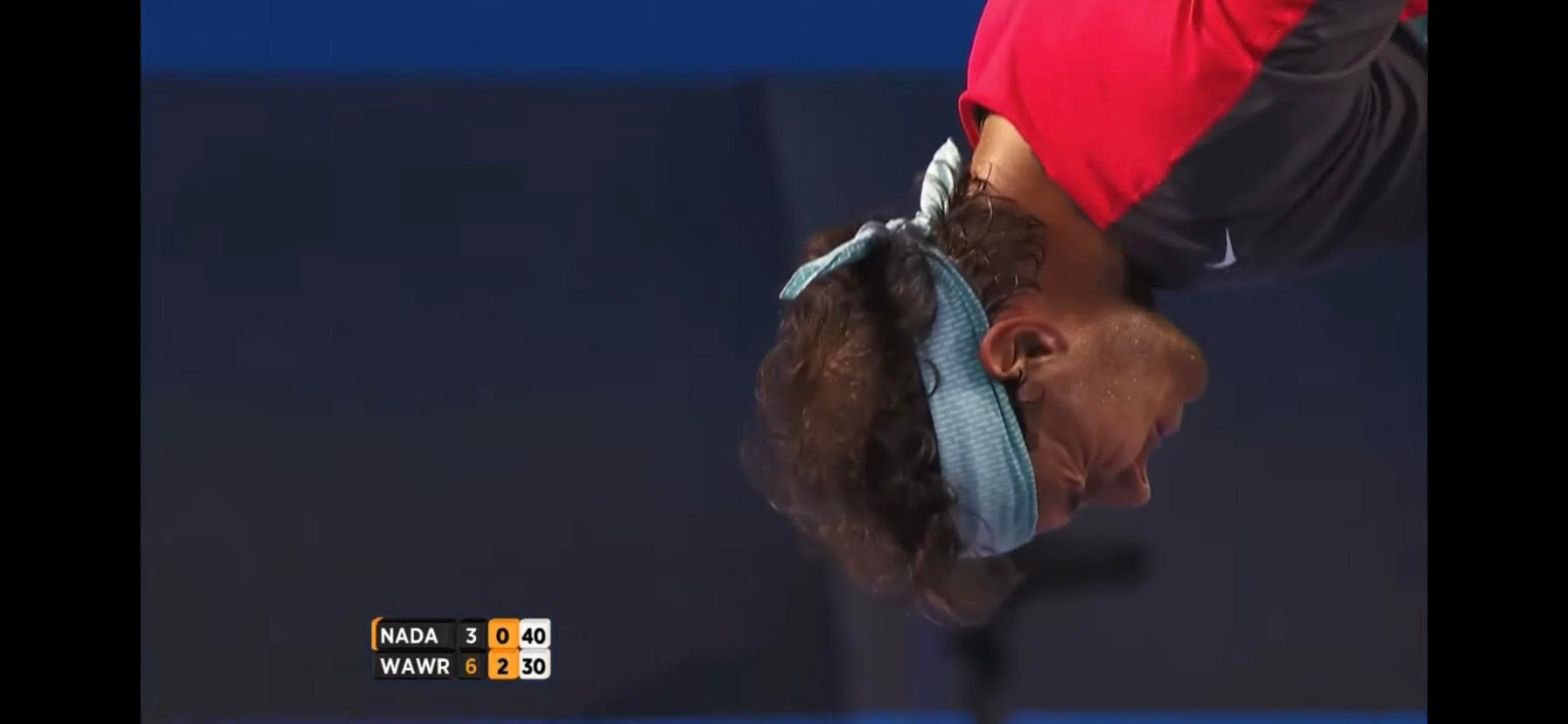

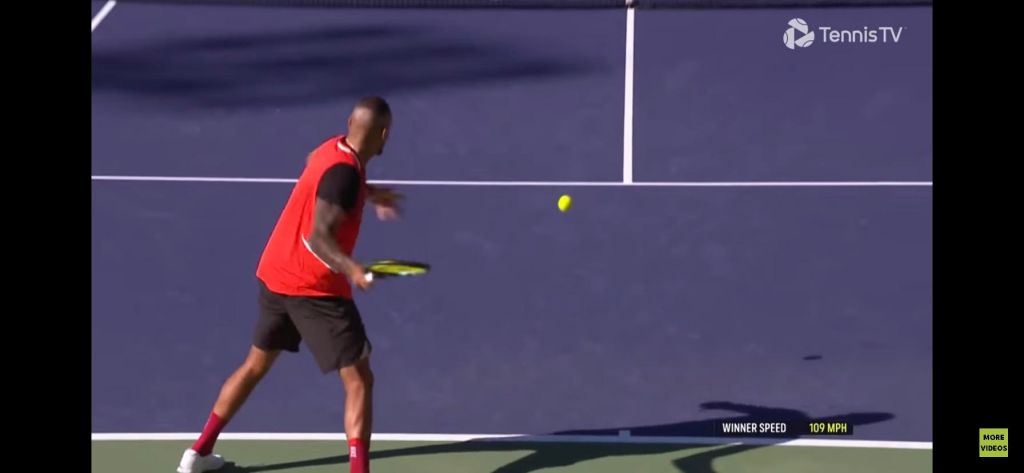
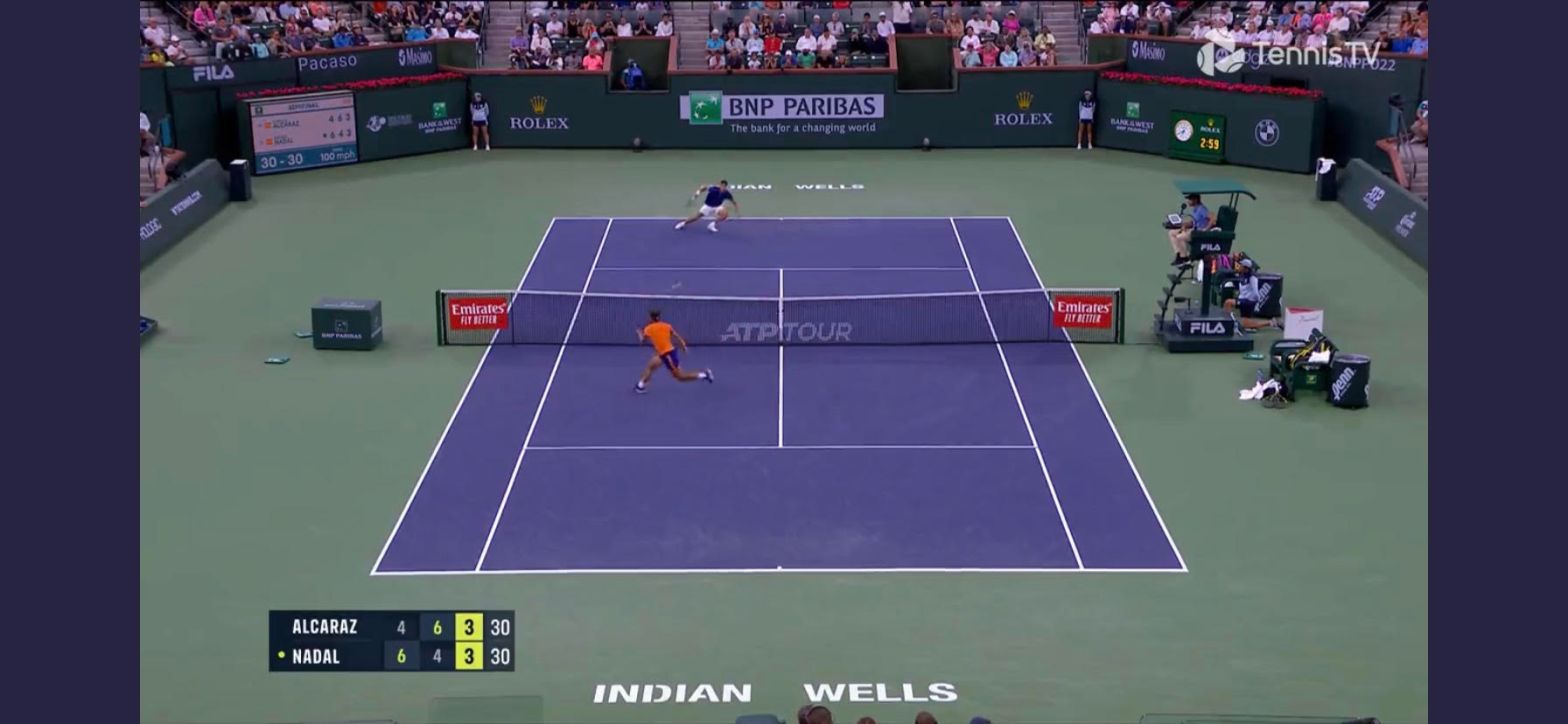
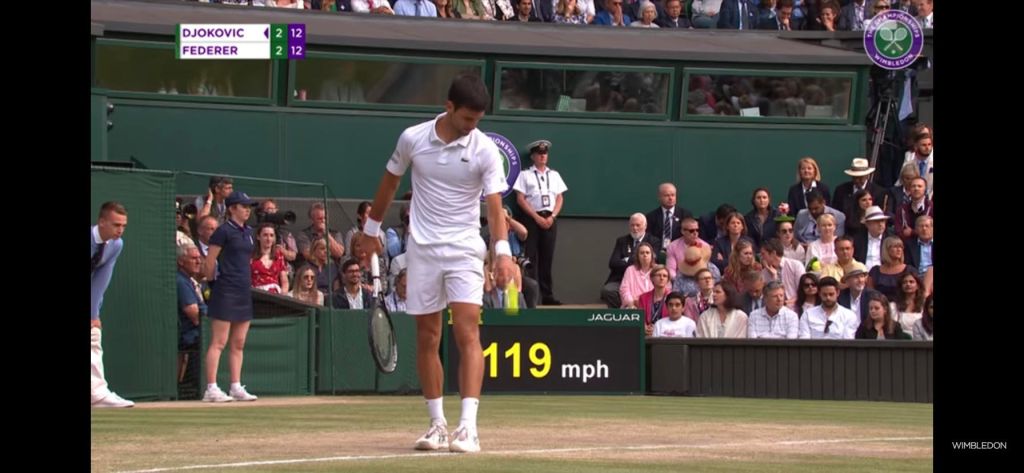
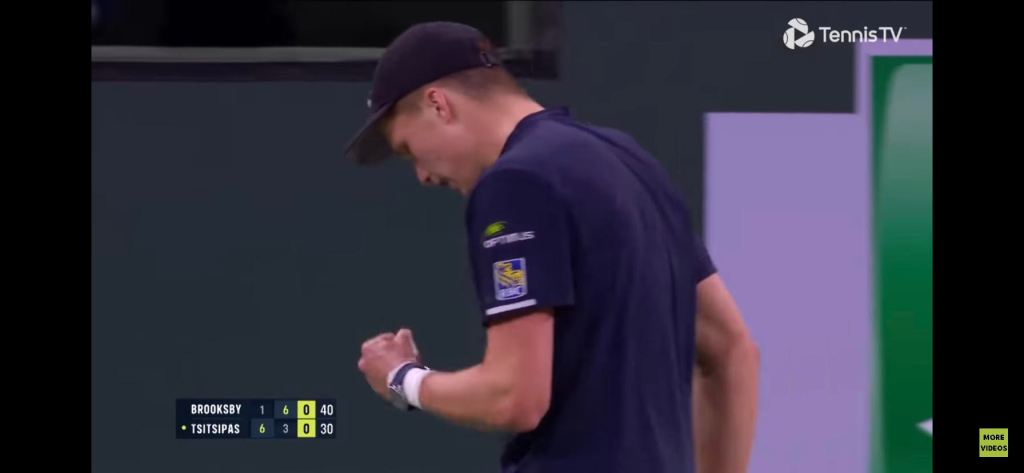

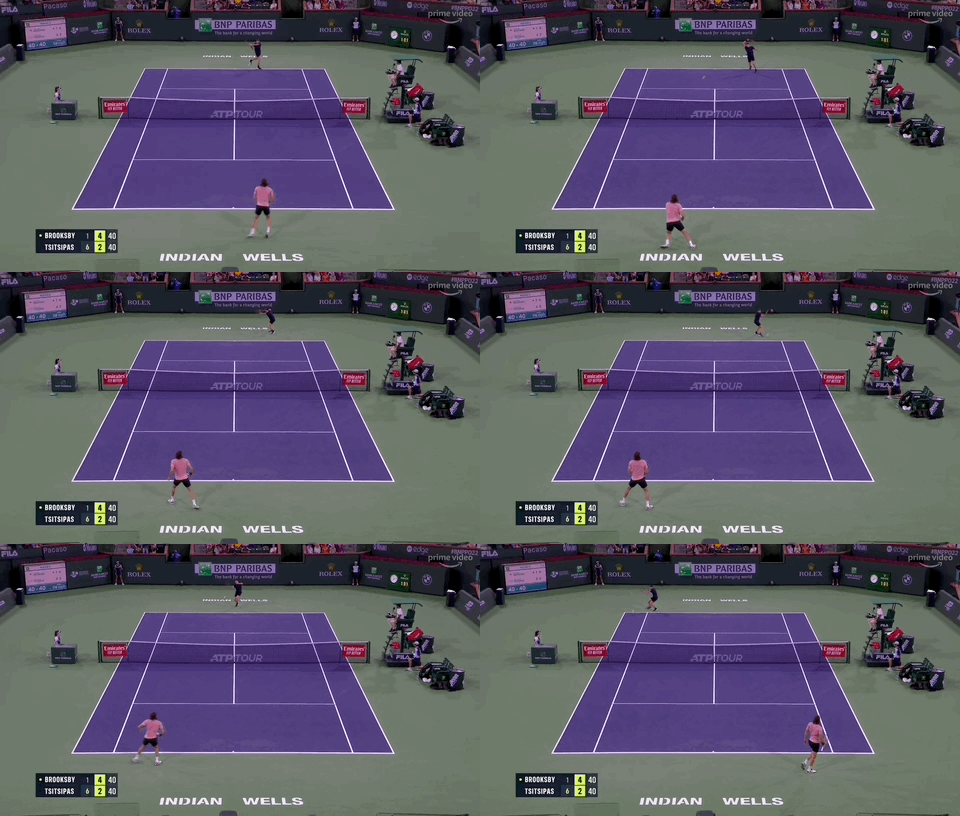
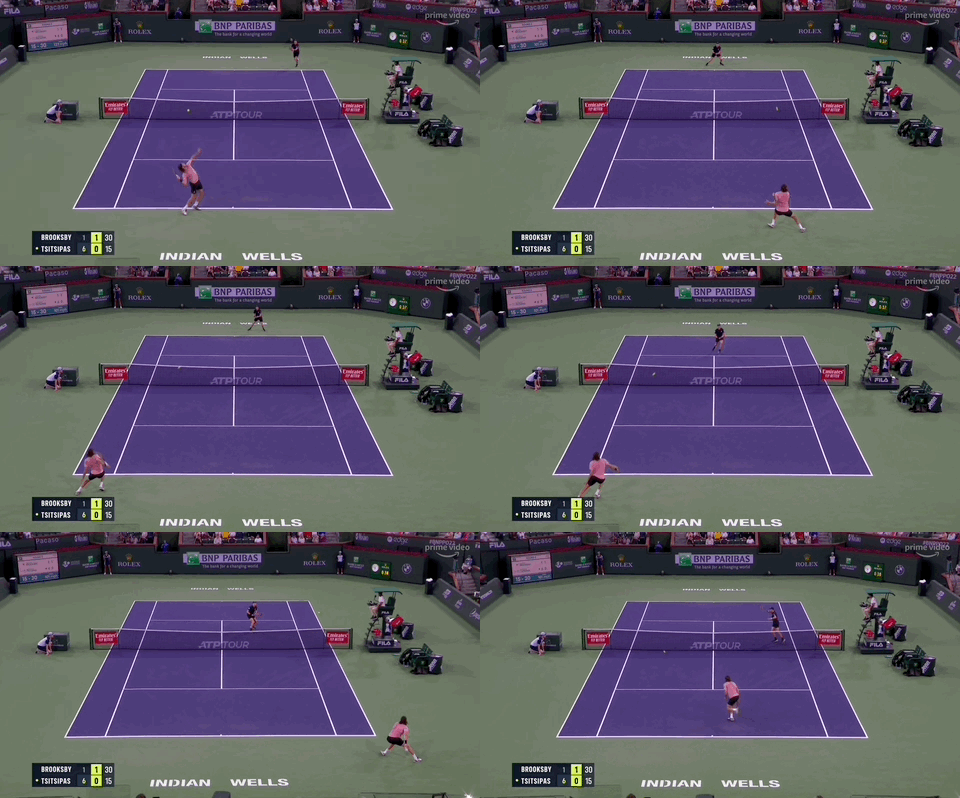
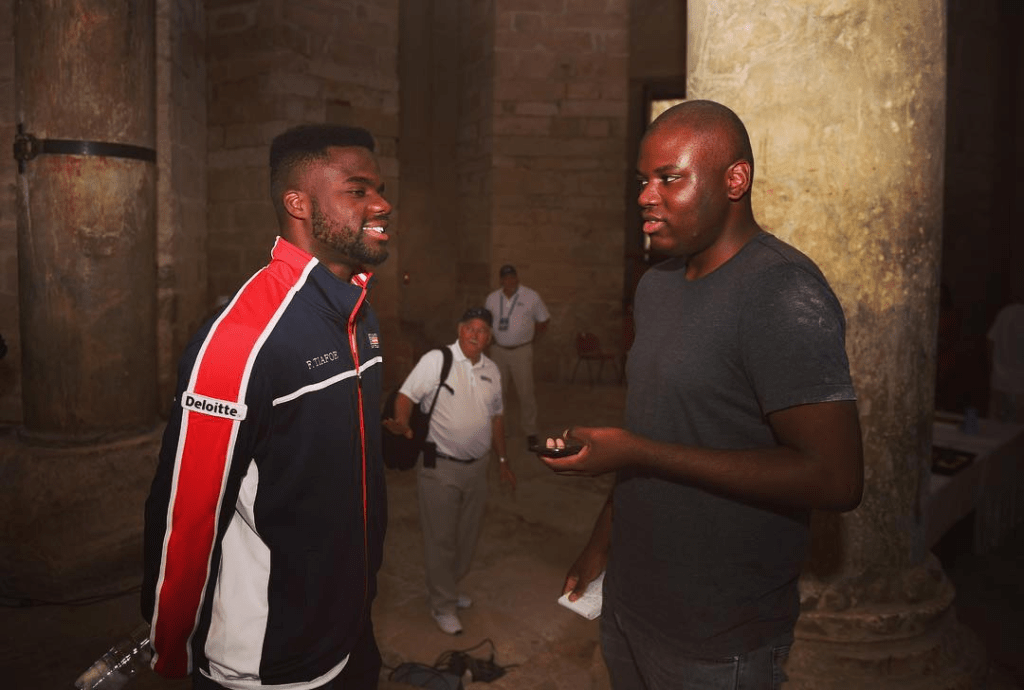
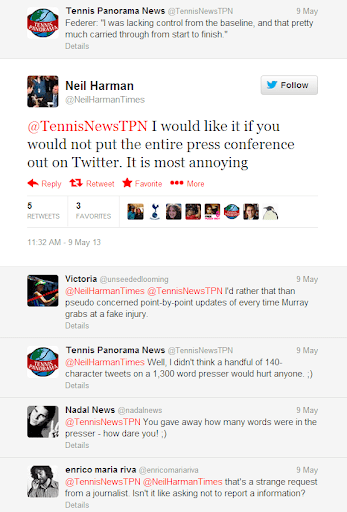
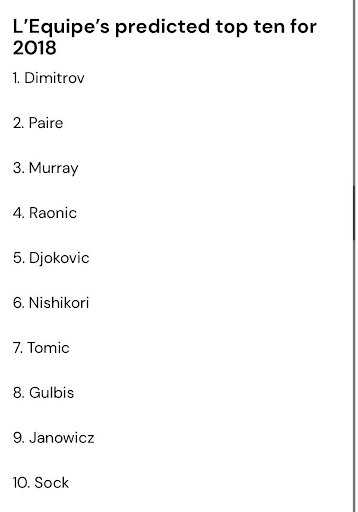
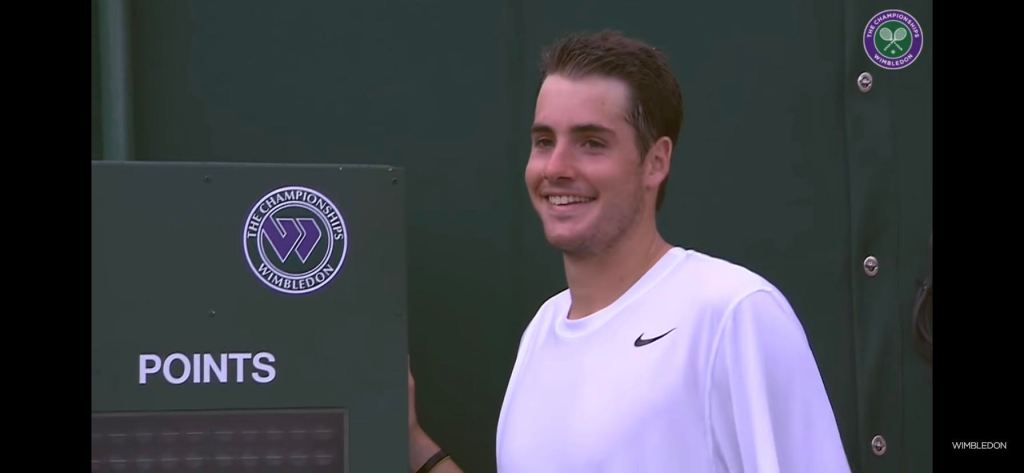


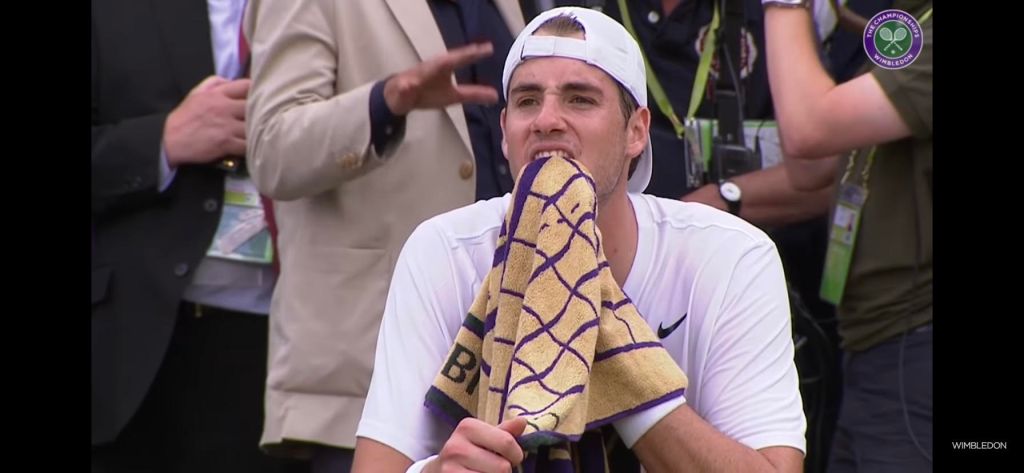

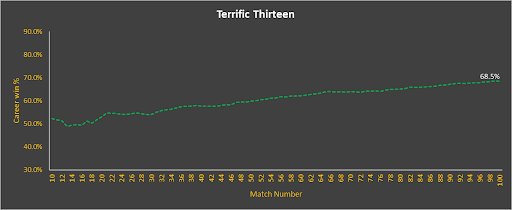
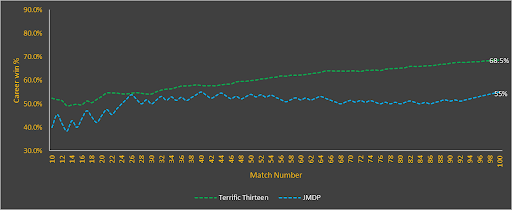
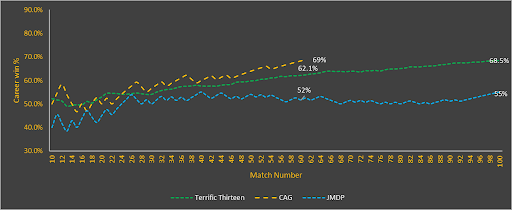
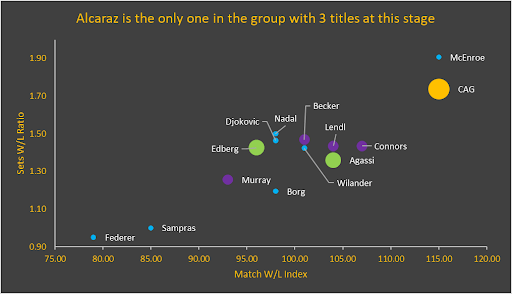
 Popcorn Tennis