A couple years ago, I ran a half marathon. I set out at a faster pace than I thought I could sustain, which felt okay for a few miles but caught up to me at around two-thirds of the way through the race. Beginning a long straightaway after finishing the 10th mile, my legs burned and my breathing was raggedly bursting from my chest. There were three miles left, enough distance that thinking about the finish line was fools’ gold. My body felt like it was melting. The most terrifying thing, though, was that I actually felt like I could last until the end of the race at my current pace. I knew it would take all of my willpower not to let my pace collapse like a half-baked pastry. I knew that I would feel even worse at the end of the race than I already did, and I started to cry a bit.
Playing Sara Sorribes Tormo, I imagine, must feel similar to this. She gets every ball back. She returns serve after serve until game point starts to feel like match point. It’s not especially hard to win a point against her, but the cumulative effect of trying to bash the ball through her smothering defense is exhausting. The worst part is that you can beat her, since almost everyone has much more firepower, and with this understanding comes the knowledge that if you don’t, it was probably because you weren’t willing to suffer enough.
Paula Badosa, the defending champion at Indian Wells, had the misfortune of playing Sorribes Tormo in the round of 32, and in the first set, Badosa suffered. She was broken in her first three service games. The rallies were expectedly long, but Sorribes Tormo was attacking more than usual, putting Badosa on the run at times. The defending champion hit a second serve ace at 4-4, 15-30 in a desperate attempt to avoid yet another brutal exchange. When she held serve after saving a break point, she pumped her fist at her box, but she looked close to tears. It was difficult, difficult tennis.
Badosa pulled out the incredible first set despite Sorribes Tormo saving three set points to get to a tiebreak (one of which with what felt like a thousand impossible volleys, another with an eternal rally that Badosa barely failed to win with an attempted backhand winner). On Badosa’s fourth set point, she forced Sorribes Tormo back with a deep backhand crosscourt, then lashed a forehand into the open deuce side. Only right that this set ends with a winner, I thought, except Sorribes Tormo ran it down and tossed up a lob that only missed by a few inches. Badosa pointed to her head in a trademark celebration, but then jabbed her head forcefully with her finger before slapping it in a kind of rapturous agony. I ran to the bathroom, then ate some chocolate ice cream coated in more chocolate. When I got back to my laptop, Badosa and Sorribes Tormo had already started the second set. They are good friends, apparently, which is odd to me since I don’t think friends are supposed to torture each other for fun.
How it feels to win that kind of set. Screenshot: WTA YouTube Channel
After the match, Badosa said “if every set is like that, I think I’m gonna die on the court.” It wasn’t, and she didn’t. Badosa ran away with the second set — she went for bigger, heavier shots, and Sorribes Tormo had no answer for the barrage. This isn’t easy for me to admit, since I root unabashedly for Sorribes Tormo due to her unique ability to use endurance as a weapon, but Badosa even managed to tire her opponent out first.
Badosa is ranked 7th in the world, currently in a minor dip from her high of #4 earlier this year. She is yet to make a semifinal at a major, but is by all accounts one of the best players in the world. The Indian Wells championship match last year was Badosa’s first big final, but she navigated the match like a seasoned veteran, playing the more purposeful tennis on the biggest points.
There are no technical weaknesses in the Spaniard’s game. She has been improving at a fierce rate: before 2021, she didn’t have a WTA title to her name, but ended that year as a semifinalist at the year-end finals. She has been to at least the round of 16 at every major besides the U.S. Open (and it feels like a matter of time until she makes a deep run there). At Roland-Garros last year, she was a few points away from making the semifinals. She has a penchant for being a fighter.
Naturally, defending a big title carries some pressure — maybe even more in the early rounds than the last few, given the amount of points Badosa stands to lose with an early exit. This won’t be an easy match to recover from physically, short second set notwithstanding, and her next opponent (either Leylah Fernandez or Shelby Rogers) will bring more firepower than Sorribes Tormo. Still, barring any physical issues, Badosa’s chances of winning this tournament — which hasn’t been defended by a WTA player for more than 30 years — seem as good as anyone’s.
The tennis statistics you see make up the tip of an iceberg.
You might already know this.
Big data is available to the players at a price.
But only a small fraction of this is accessible to fans like you.
You can find this small fraction usually in the Hawkeye analytics sections of the few tournament websites that offer it, 3 clicks away from the homepage—which might as well be 3 parsecs for the average tennis fan, who is not the most fastidious species in the sporting world.
But even if you could access the secret datasets that—possibly—contain all the ball trajectories of all the shots and all the steps taken by each player in every professional match, there are still secrets of the game that are impossible to understand without watching the tennis live.
Even a picture of the whole iceberg… is not the iceberg itself.
The statistics can hint at things that happen in the world of tennis, but they’re not the tennis itself.
Reducing the real-time action of racquet swishes and shoe-sole screeches and mood-altering grunts—reducing all that tennis into numbers, while occasionally necessary to babysit us into tennis’s system of meaning, can be one of the worst things to happen to the narrative surrounding the sport.
Especially when it’s used as a gateway drug for the sport’s new fans, urging us up short dopamine peaks to airily trophy-clutch our favorite player’s statistics over the rival fandoms below… while hidden in shadow are the far more important things we don’t know about our player.
We don’t know our favourite player.
I could bet most of you don’t know what racquet s/he uses.
*****
If your life’s worth of tennis-viewing reached, say, 300 minutes in total, you would have heard commentators hook the casual viewer with this “insight”:
The best tennis players are mentally stronger.
Why that term, Mister Commentator?
Perhaps, because it cloaks these talented pedants in a kind of Jedi-mind-trick mysticism, a way to sell the sport to the casual viewer—as if they could telekinetically choke their opponent from 24 metres away, or inexplicably make their attacking projectiles miss.
And it’s easy for the commentators to cloak tennis professionals in mystifying concepts.
In other sports, our eyes are always following a ball.
But, in tennis, after the point concludes, our eyes follow the disengaged player.
This person quietly strolls behind the baseline and scrutinizes their racquet stringbed. This person can nonchalantly splay 3 balls into a triangle with just one hand and then discard the ball whose green facial hair and skin seem to be unsexy, unworthy. This person is generally sexy: a powerful lower body, a lithe upper body, and toned legs to look at.
This person is, for the most part, inscrutable.
It’s easy to create mystery around this person.
This person might be mentally stronger.
This person might exert will over the weaker person on the other side of the net and puppet them into doing things they don’t want to do.
Seasoned fans will sigh at this point.
Because we know “mentally stronger” is an autopilot response that commentators fall into—insider doublespeak of the short-attention-span era that sidesteps the far more pertinent and hard-to-explain truth: the best tennis players are… better.
These perpetrators of mysticism deliberately don’t mention the best tennis players’ very physical, technical strengths that make them better.
Because these technical strengths are mindbogglingly complex in a mindbogglingly simple way.
These strengths will take an annoying, 15-minute-long article on Popcorn Tennis to explain, and the time-strapped commentator understandably will have nothing to do with belabouring the point, even though they already know the truth.
However, when you actually look into the truth, and you see what separates the best tennis players from the good tennis players, you see that the commentators’ mystifying narrative might have a point.
What the best tennis players do does in fact seem a lot like a Jedi’s—or Sith’s?—modus operandi.
The opponent does choke. The opponent’s projectiles do miss.
Why hide a good story?
*****
All the players you see on TV are talented.
The talents they possess live in the whole, wide world of less than a second.
That less than a second is what the opponent has to adapt to.
The opponent learns the language of the player’s talent—the various tennis strokes—and interprets what stroke might come next, and where to hit to, in the hope that it upsets the player’s balance.
But the star players we talk about just have a few more talents that they can stuff into that world of half a second, layers of tennis syllables and intonations to confuse the opponent as a Jedi/Sith might do to a weaker mind.
As the opponent is learning the star player’s far more nuanced tennis language, they cannot keep up, and its semantics overload them, creating a deer-in-headlights situation—or just a wrongfooted mess (see below).
Interpretation of the next move, when these star players are in the mood, is almost impossible, because they have so many options within that scintilla of time.
Guessing is often a fool’s errand.
It only takes a subtle twitch at the end of their stroke—a twitch with decades of muscle memory invested into it over a career—to “spread the play” as they see fit.
When honed inside an elite talent, like Nadal’s forehand, they can hit spot after spot at each extreme of the court.
It’s undefendable.
It overwhelms the opponent’s mind-muscle connection.
It’s what separates the good from the great.
Let’s start.
Matteo Berrettini is great.
He is the only active, under-30 male player to reach the quarterfinals of all 4 slams; only 31 male players have achieved this since 1990.
He simplifies tennis into serve+forehand rudiments so often, you barely have time to see why he’s so talented.
His talent in tennis is to reduce the tennis being played.
He is of the mold of other elite tennis-reducers like Juan Martín del Potro, Jo-Wilfried Tsonga, and the best reducer of them all, Roger Federer.
Matteo Berrettini has the best combination of serve+forehand in the world right now. His forehand particularly beats opponents with an unfair combination of pace and spin, even if they are positioned near where he hits the ball, as Nadal was in this frame. It takes less than a second for his forehand stroke mechanics to create that almighty thwack.
This Tottering and Leaning Tower of Italy (uncanny foundations for a tennis player, his calf muscles) may not be the most mobile of the great players, but his two strengths are extremely versatile: his forehand and his serve.
His forehand stroke is a blink-and-you-miss-it arc, a loose-armed whip cutting the air with ease so that the ball is sent at a destructive 60 revolutions per second to any corner of the court he so chooses, dipping down in time for the baseline due to the immense, downward Magnus Effect on it. This effect multiplies the number of spots on a court he can hit to, powerfully.
His first serve, coming down from his basketball-player-sized levers, is the best of the ‘Small 4’ subgroup of NextGen players (Zverev, Medvedev, Tsitsipas, and himself), regularly hitting his spots at 120+mph. His 2nd serve is not a weakness as it is for them. The effect of his height and his smooth serving motion also multiples the number of spots he can hit to, powerfully.
There has been a lot of debate over what exactly talent is in tennis, and, in my opinion, the ability to hit a variety of spots with regularity is what talent is—it’s not the flicks and the volleys and the soft parts of tennis, even though those are nice to have. It’s the must-haves that have to be quantified as being more valuable to the sport and its mind games.
The regularity of Berrettini’s variety sticks in the opponent’s mind with sinister influence in a way that statistics can’t really show.
So the opponent steps back and increases the thickness of the wall of air between him and Berrettini’s monstrous strengths, hoping it will slow down all that ballpower in time—and this allows Berrettini more space to work with…
… and the soft skill arrives, the dropshot.
But it is a direct result of his far more valuable hard-hitting skill: his serve and forehand.
The superior technical range of his serve and forehand creates a giant sphere of influence that the opponent cannot help but notice, and this allows other parts of his game to use up that sphere with little resistance. Nadal’s body was stuck 3 metres behind the baseline because his mind told him that he needed more time to defend Berrettini’s next shot which could easily have been a 90mph forehand at either side of the court.
As in the Nadal-Djokovic point, the technical range of the player confuses and/or freezes the opponent in time.
Nadal hits an inside-out forehand with a sickening combination of power and precision to pull Djokovic right, then a crosscourt forehand to pull Djokovic left, at which point Djokovic’s mind is rankling with Nadal’s ability to hit it to both sides: Where does Nadal go next? He can go at both sides because I’ve just seen him go at both sides.I have absolutely no idea.
When Djokovic’s body reflexively chooses to anticipate a Nadal inside-out forehand on the next shot, it loses its balance.
Because Nadal chooses to go crosscourt again, hitting a wicked spot near the junction of service box and sideline, a spot in an area he’s utilized better than any human has in tennis history (I’m not exaggerating).
Up another level in a player’s technical range, we look at the value of footspeed, and how that increases the sphere of influence.
If talent is the ability to hit to a variety of spots with regularity, then wouldn’t it be greater if the player can also do all that at a higher speed, at a higher tempo?
What happens when you marry Berrettini’s strength to… more urgency?
You get someone like Iga Świątek.
Like Berrettini, she has a loose-armed whip of a forehand that can do immense damage no matter the pace of the surface, but her well-drilled feet can get it to optimal positions quicker and, hence, take more time away from her opponent.
Aryna Sabalenka is visibly more powerful than our flying Polish goddess, so it is vital she doesn’t allow Sabalenka the time to set up those huge groundstrokes. This triple forehand combination forces Sabalenka on the backfoot in all three instances. She hits her spots with a palpable urgency—the spots are more about depth than Nadalian width, falling within a foot of the baseline each time.
Świątek is able to do this because, as she developed as a player, she lacked a 120mph serve to pamper herself with 2-shot rudiments in the way Berrettini has. She had to force herself to create more consistency off the forehand. She’s a rhythmic player who can hit multiple balls near lines at a higher tempo.
While he lumbers up to a ball and delivers attacks in a slower, more powerful punch, she’s a volume-puncher, able to hit a quick succession of semi-powerful shots, arguably more exciting to watch.
The X-factor is that she can do this even when her opponent puts her in a bad position, as Sakkari did with the initial backhand down the line.
A flurry of steps, an artful slide, a deliciously-angled crosscourt forehand to make Sakkari scamper more to the right, and she gains the advantage in the point. She would have been on the back foot in the next two shots if not for that bit of kinesthetic skill.
Superior movement entails you can hit from a greater variety of spots as well. And this plays havoc in the opponent’s mind; you only need to watch her winning match point vs. Kanepi in the 2022 Australian Open quarterfinal (too long to GIF!) to understand how movement can create an unforced error statistic out of nothing.
That’s what commentators mean when they say a player “shrinks the court”—the giant sphere of influence Świątek exerts on her opponent’s mind not only includes the massive area on the opponent’s side of the court created by her versatile forehand attack, but the massive area her legs can cover on her own side of the court, shrinking the opponent’s options in attack.
Lumbering, tottering Berrettini is scary to defend against, but a joy to attack against.
Świątek is scary on both counts.
A player’s sphere of influence is what gets lost in the “mental strength” doublespeak of the commentators.
This sphere is directly proportional to a player’s technical range—their arsenal of talents.
It’s like if you lived near the wetlands of South Asia, you would understand the sphere of influence of a saltwater crocodile; it travels at three times the speed of Phelps, so you’d stay out of the water for the most part. But you wouldn’t care about it on land.
Whereas, somewhere in Africa, a hippo’s greater “talents” make it a problem both in the water and on land.
The time structure of being living prey dwindles as the weapons of the predator increase. Your proprioceptive reflexes know what can end you, and if you do end up between Scylla and Charybdis, between Świątek’s destructive forehand side and her equally unattackable backhand slide, your conviction dies in that split second, and you do something stupid—you make an error off a sitter, as Kanepi did.
The best players make you look clumsy.
This makes them look mentally stronger because anyone can look mentally stronger than an apparent klutz.
But are they mentally stronger… or just better?
There is another last factor that creates a bigger sphere of influence in tennis: the ability to change the directions of the rally frequently while having Berrettini-like power in reserve.
This means the willingness to hit the difficult down-the-line and inside-in and inside-out options off each wing, to keep your opponent off balance.
Świątek has the ability to change direction in spades, but she lacks the Berrettini-equivalent nuclear power in the women’s game—i.e. Serena Williams power—and she lacks the big serve, which is the biggest reason for her failures against the top players.
There is one top 20 player who, I feel, has pretty much all the factors I talked about here (not including the four 20-slam behemoths we’ve seen in the last two decades), and he was the initial reason I had pottered around with the idea of technical range for a tennis article.
I watched the Rio de Janeiro Open last month, when unfairly talented Spanish teenager, Carlos Alcaraz, who has, in the last year, humbled top 10 mainstays far above his rank, showed how the tennisness of tennis was unable to be shown in the statistics. While watching the dude over the last 3 matches of his title run, what became clear was the assurance with which he played his drop shots, a signal that his technical range was firing on all cylinders.
In the final, he had the task of defeating the darkest balrog of the clay world, the lieutenant of all suffering and evil in tennis, the torturous creature who gave Suffering’s favorite son himself, Rafael Nadal, his toughest matches in the 2018 and 2020 campaigns for the French Open:
Diego “Goliath” Schwartzman.
Goliath is 5’6” but has the skills to jump off his backhand side and hit the ball at a fairly powerful pace from shoulder/head height, and because of this he can often win the Ad exchange with Nadal’s forehand on clay (a task nigh impossible for 99.9% of the top 1000 in men’s tennis on Nadal’s bad days—and 100% on Nadal’s better days).
So, when he was trying to trap Alcaraz’s backhand in the Ad exchange, it did seem like Alcaraz might come off as second best. Don’t get me wrong: Alcaraz certainly has an above-average backhand, but he tends to rely on his forehand to get himself out of trouble, a forehand that has Berrettini-like power to end rallies in one loud syllable of finality.
Some of our Popcorn writers have also noticed that Alcaraz tends to hit one too many forehands from his backhand corner, sacrificing positional balance, and while I agree with that advice on hardcourt, I don’t think that’s necessarily bad on clay (forehands have time to create more loop and spin on clay, which push the opponent back; anyway I’m digressing!).
As you can see, Alcaraz soaked up Diego’s targeted pressure at his backhand, and created two crucial inside-out backhands at two crucial points of that crucial first set. The ability to suddenly change the direction of the rally off what is considered a more difficult shot is what planted in Diego’s mind the belief that Alcaraz could and would do it again.
With the idea that Alcaraz can hit the backhand with solid depth crosscourt and inside-out,/down-the-line, Diego felt like he had to stay back to defend both possibilities, leaving Alcaraz the opening for the soft skill…
There needn’t be too many examples to show the range on Alcaraz’s forehand, which is already one of the best in the sport, despite its rawness.
Here’s an example of him hitting one of those “unwise” forehands from his backhand corner, the spin and power pushing Diego back into a defensive lob. Two, heavy forehands kept Diego back, opening up the space for the soft skill…
It’s a great thing that the surface was clay, where the tactical battles are always heightened, relatively unadulterated by the instinctive thwacks of the serve.
A Berrettini may dirty the sanctity of technical range with his height-boosted serve on grass or hardcourt, but on the clay is where his serve can no longer mask weaknesses. Berrettini lost to Alcaraz in the quarters of this tournament, the Spaniard targeting the Italian’s well-known backhand weakness.
Tennis in many ways is a sport of exerting uncertainty on the opponent.
It’s obviously not easy to do. It requires the honing of several talents over a decade that then have to work in perfect harmony on the big stage—during all the complications nerves bring. But once you master most of these talents, you can create a multicursal tennis language, a language that boggles for its multiple options.
A strange thing happened yesterday, which reminded me that it is far more frequent than is given credit for. Seb Korda, #38 in the world, almost beat #4 Nadal, in a rare reversal of this tennis language of risk and reward that I was elaborating out here. Korda has played and practised with Nadal a couple of times, and, in all their meetings, Korda said he lost pretty comfortably to Nadal.
Knowing that Nadal has access to patterns of tennis language he can only dream of, Korda decided to do what many less talented players do when they meet an obviously more talented player who is expected to beat them.
He decided to throw the kitchen sink at Nadal.
A tennis language of high risk and high reward—a loud and uncouth language, but also an occasionally overwhelming language.
And it worked.
Nadal seemed to be feeling the ball well in the early stages of the match, but as Korda persisted with this berserking gameplan, the GOAT’s conviction palpably fell, and a stream of inexplicable errors flew off his racquet. A group of Nadal fans and myself discussed the issue, and most of them assumed this was just a poor show of form on the Spaniard’s part, but I was skeptical of this just being a Nadal problem.
In my opinion, it just seemed that the “civilized” language that respects risk, that most tennis players use on most days, was being disrespected by Korda—like, if a boorish teenager talked down a well-spoken teacher—perhaps like that scene when Gillian Anderson’s character first addresses the Moordale Secondary School in Netflix’s ‘Sex Education’.
Her expertise is undeniable, and she is a hit among the other parents in the previous week, but as soon as she makes her first appearance among the students, they can only see the unserious side of the role she fills, and ride roughshod over her.
Korda absolutely respects Nadal, but when he plays the sport in a sane, risk-aware way, he will, 99 times out of 100, lose to someone of Nadal’s calibre.
So he had to change things up.
And, as players of Korda’s good-but-not-great calibre often find themselves in, his position was of a person who had nothing to lose, and that can work to your advantage if you let it.
His 90mph rockets off both wings created a sphere of influence that had Nadal overthinking his own shots in the urgency to create angles that weren’t inside Korda’s destructive wheelhouse. Hence, Nadal’s inexplicable errors—what some commentators, on their clever days, call “forced unforced errors.”
In the end, a player with a superior technical range will win most of the shot exchanges over a match, but there are those rare days of upsets, the days when the underdog snaps, their fear flatlines into fuck-it vehemence, and a stone-cold butcher is born.
Then, the versatile player will seem like the mentally weaker mess, when really, the underdog is using their lowly status to play at a high-risk, high-reward game.
It happened in the 2009 French Open fourth round when Söderling beat Nadal, it happened in the 2009 U.S. Open final, when del Potro beat Federer, and it happened in the 2014 Australian Open quarterfinal, when Wawrinka beat Djokovic.
Don’t forget that anything can happen. Tennis is still just a sport.
Roger Federer has often been called the most talented player ever, even when he hasn’t been ranked #1. I think this is down to his ability to end points in all kinds of ways, seemingly without much effort. He can kill a rally with a forehand from a not-especially-offensive position, he can draw his opponent in with a slice, he can charge the net and feather a drop volley winner.
But what is “talent,” at least in the tennis-y context we use the term? The Google definition amounts to “natural aptitude or skill,” as in abilities someone is born with rather than developed over time. This puts things in a new perspective — obviously Federer didn’t enter this world with a knife-like backhand slice, it was a skill honed over years of training. It’s just the apparent ease with which he hits the ball that provokes the use of “talent.”
I’ve always thought that emphasizing Federer’s talent as greater than all other players oversimplified the tennis landscape. If talent is natural, does that mean the reason Nadal and Djokovic were able to beat him is that they simply worked harder? It’s not that straightforward; tactics, health, and execution of core shots play a massive role in matches between the three titans. Talking exclusively about talent nixes the idea that other factors are important, which they of course are.
Talent can’t be defined only by natural ability, then, at least not if we want the word to serve us any purpose in conversations about tennis. Natural ability is completely unquantifiable, and as with the Federer example, it’s easy to say “he was born to do this,” when his smooth motions actually have a lot to do with years of training. There are players whose frames aren’t big or muscular enough to hit with the pace required to be a tennis champion, but in a discussion of those who are already legends, they’ve found a way to make things work.
In the case of Federer, “talent” actually sells him short. By deeming the great Swiss “the most talented player of all time,” we draw the implicit (and incorrect) conclusion that Djokovic and Nadal have surpassed him with less naturally strong games. This is an obvious oversimplification — the Serb and Spaniard have a wealth of talent of their own, plus brilliant tactical minds and endurance. Federer having superior hand skills and a more aesthetically pleasing game (to some, at least) isn’t even wholly natural. Somewhere along the line, “talent” has become associated with the flashier shots in tennis, despite the fact that those require practice to master just like any other shot. Not only does emphasizing Federer’s natural skill take the focus away from the way he’s honed his serve and forehand into two of the most devastating tennis weapons ever, it minimizes his rivals’ assets to work ethic alone.
So not only is “natural aptitude or skill” not a super useful definition with regards to tennis (or sports), the way we use the term isn’t even correct considering its definition. We either need a new meaning or a new word.
The video below sees cricketer Rahul Dravid talk about the excessively narrow way we judge talent:
Oh yes ,There is this nice video in which Indian cricket legend Rahul Dravid tries to explain how everyone including him uses or understands the word talent wrong. He is explaining in terms of cricket but I think it's summaries for every sporthttps://t.co/IJlr0ObHWB
Interestingly enough, this exchange about David Ferrer from 2013 on The Changeover poses some more useful definitions. Juan José says that in terms of weaponry in his game, Ferrer isn’t blessed with as much talent as the likes of Tomáš Berdych or Jo-Wilfried Tsonga. Amy counters with the question of what exactly talent is, and Juan José puts forth the idea that talent is the ability to win points as easily as possible. He theorizes that if given the chance, Berdych and Tsonga would never exchange their games with Ferrer’s. This is a solid hypothesis — Ferrer’s serve and forehand are far less powerful than his contemporaries’. Amy points out Ferrer’s superior consistency (in rallies and in 2012), something Berdych and Tsonga lacked to a degree. This also has a lot of truth to it, and gets us back to the initial conundrum: was Ferrer better in 2012 than his rivals simply because he worked harder? It can’t be that straightforward. Not only that, but Berdych and Tsonga’s easy power had to be developed. Their natural height surely helped, but no one is born with the ability to crush forehands. There are tall players with little power.
Easy power: Tomáš Berdych crushes an inside-out forehand past Rafael Nadal. Screenshot: ESPN
To Amy’s point, we have a tendency to call inconsistent players with high peaks talented far more than steadier competitors with more mortal A games. Jelena Ostapenko gets called talented far more often than Sara Sorribes Tormo, for example, due to her infinitely superior power from the ground. Sorribes Tormo gets credited for her far better consistency, but that attribute rarely falls under the umbrella of “talent,” perhaps because it’s a less flashy skill. Another example — Fabio Fognini gets called one of the most talented ballstrikers on tour every time he plays. He’s currently ranked 36th in the world, below Federico Delbonis, Alex de Minaur, Dan Evans, and Cameron Norrie, all players who don’t time the ball as well, but given the rankings, are currently better than Fognini is.
Mentality seems to be another attribute not included in whatever “talent” is made up of, probably because it takes time to develop rather than being natural. Djokovic had to build his flawless big point mentality brick by brick, through the pain of many failures. No one is born with that.
“Talent” often seems like it means more than it does. For years, Nick Kyrgios’ talent was talked about so often and so reverentially that you’d think all he needed to do was train hard to ascend to world number one. Some people even did say that. In reality, when he applied himself at Wimbledon in 2019 and the Australian Open in 2020, he lost close-ish matches to Nadal in the early rounds of majors. Underneath his reluctance to leave it all out there, his backhand is poor. His return game is poor. He is fast, but he doesn’t move all that well. These vital attributes are quieter than his booming serve and cute drop shots, though, so are talked about less.
James Shank of Tick Tock Tennis suggests the idea of “talent” as a backhanded compliment — that a player is naturally skilled but that they aren’t performing as well as their skillset would suggest. This does fit with the dictionary definition, and implies that the factors within a player’s control (work ethic, tactical acumen, etc) restrain a player from letting the factors outside their control (natural talent) define their results. Hence the backhanded compliment.
It always feels like specifically mentioning how "talented" someone is code for "not living up to their potential." Like… "their results don't suggest it BUT they're very talented."
Talent is one of the worst definitions I’ve ever seen. Talent is imo being good at something without ever studying it or picking up things super duper quickly, but then again this is very related to education especially as a kid. Talent can be applied to kids for sure, not adults
Mike introduces another great theory — that once someone grows old enough to practice something a great deal, “talent” no longer applies to them, since any natural skill gets dwarfed by the skills they have developed.
Talent isn’t meaningless, though — why do some players who work hard never reach the pinnacle of sport? I think Rama nails it with the tweet below. Effort is crucial, but something else is needed: the X factor, the “horseshoe up the ass” that Andre Agassi wrote about in Open. Maybe the best way to view this conversation is that both talent and effort are imperative, but it’s only in conjunction that they can make a champion. Talent is the base, but that base has to be honed into sharp skill with years of practice.
In professional sports even if all the players put in the same amount of time and effort the end outcome in terms of their performance might vary largely. That imo is talent/natural skill. Not many in the world can practice enough to reach levels of big three/Serena for example
The problem is that the difference between talent and the product of practice is impossible to quantify. When Federer hits a forehand winner down the line, injecting pace at what seems a random moment, is that 25% instinct and 25% studying match tapes and 50% the perfect motion and timing developed by practice? Those numbers are probably wildly off. Your guess of the right ones is as good as mine. So I think, since we can’t possibly know how much of success to attribute to one factor or another, we decided to assign talent responsible for the flashier shots and work ethic as responsible for the less obvious skills — consistency, endurance, etc.
My take on talent is simply that it is skills that are developed untraditionally. Maybe someone inherited amazing hand-eye coordination from birth. Maybe someone becomes a skier before committing to tennis, and the skills carry over. Maybe someone has unusually good eyesight, allowing for better timing of the ball. A natural element is preserved among these hypotheticals, but it’s still difficult to tell the extent to which this definition of “talent” is observable. We know that it’s there in some cases, but in what amount?
In the end, we probably exaggerate the ramifications of “talent” for the same reason we draw other sweeping conclusions in tennis: the game is so complicated and precarious that literal observations mean very little. Nadal has dominated Roland-Garros more than any player has ever dominated a tournament, but usually wins fewer than 60% of the points played in a match. In a non-tennis context, that doesn’t seem like much more than half. So we talk about him as if he’ll win every single point he plays on the Parisian clay, even though the reality is much more complicated. “Talent” is as complicated as any part of tennis. There’s no way to put a finger on how it manifests itself. In pretending that it is easier to identify than it is, we give our observations more meaning.
Every few months, a tweet pops up on my timeline saying that despite the statistical evidence against it, Roger Federer is better on clay than Novak Djokovic. This always bothers me a bit. Though Federer is unquestionably a great clay courter, I think the debate does a huge disservice to the Serb’s accomplishments. Let’s dive into why.
The Stats
There are four big tournaments on clay for ATP players: Roland-Garros, and the three Masters 1000s on the dirt: Monte-Carlo, Madrid, and Rome. Here’s the title breakdown for Federer and Djokovic.
Big title count on clay
Federer
Djokovic
Monte-Carlo
0
2
Madrid
2 (he won Madrid in 2006 as well, but the tournament was on hard courts at that point)
3
Rome
0
5
Roland-Garros
1
2
The Roland-Garros comparison is convincing enough, but check out Monte-Carlo and Rome. Not close. Federer has also won Hamburg three times, which was once a Masters 1000. He beat Nadal en route to winning his 2007 title. The tournament was downgraded to the 500 level starting in 2009.
As you can see, not only does Djokovic have more titles at every tournament, it’s not even remotely close: in total, Djokovic has won four times as many big titles on clay as Federer, 12-3 (or two times as many and 12-6 if you choose to include Hamburg). That alone should end the debate, but a key aspect of the Federer-is-better-on-clay side is extenuating circumstances, so let’s move on to section two.
Circumstances
An argument Federer backers will make is that he faced a better version of Nadal over the years, losing over and over to the young speed-demon version while Djokovic got to clean up against an older, weaker Nadal. And the point is not totally without merit — between 2005 and 2010, Federer had to play Nadal on clay 12 times and lost 10 of those matches. (That said, in their four battles on clay after 2010, Federer is winless.)
Djokovic, meanwhile, played Nadal on clay 9 times before 2011, and lost all 9 of those matches. It was only after 2011 that the Serb started racking up wins against Nadal on the terre battue, and rack them up he did: he’s now beaten Nadal on clay a staggering 8 times, at least twice as many times as anyone else.
You can argue that Djokovic’s wins over Nadal on clay in 2015 shouldn’t mean as much. (Some will lump 2016 in here as well, but the 2016 Rome quarterfinal between Djokovic and Nadal was played at a spectacularly high level.) I actually think this is canon in most conversations — even before Djokovic beat Nadal at Roland-Garros in 2021, his win in the 2015 quarterfinals wasn’t really talked about as the history-making achievement it was, because Nadal was so clearly diminished.
Here’s the thing, though. Djokovic has beaten Nadal on clay six times even outside of 2015. All of those wins were absolutely monumental, to boot. You have the pair of wins in 2011, both straight-set defeats of a Nadal who was still in the thick of his prime. You have the win in the 2013 Monte-Carlo final, which broke Nadal’s streak of — get this — eight straight titles and 46 straight wins at the tournament. You have the 2014 Rome final, won by Djokovic from a set down. You have the aforementioned 2016 Rome quarterfinal, which sparked tweets like this:
Best court position Rafa has held vs Novak in a long time. Rafa raised his level & made Novak lift late in sets. Both should be happy. RG!!
Lastly, you have the 2021 Roland-Garros semifinal. More on that later.
The other funny thing about the argument that Nadal prevented Federer from winning more on clay is that Djokovic has actually played Nadal more times on clay than Federer has: 27 to 16. Nadal has also beaten Djokovic on clay more times than he has Federer: 19 to 14. So if the great Spaniard weren’t around, it’s reasonable to assume Djokovic would still have assembled a larger trophy haul on the dirt.
If we pretend that, in a Nadal-less universe, Djokovic and Federer would have won every clay tournament in which they lost to Nadal, here is what the table from earlier would look like:
Big title count on clay (loss to Nadal = won tournament)
Federer
Djokovic
Monte-Carlo
3 (inflated by two losses to Nadal)
5 (inflated by two losses to Nadal)
Madrid
4 (inflated by two losses to Nadal)
5 (inflated by two losses to Nadal)
Rome
2 (inflated by two losses to Nadal)
11 (inflated by six losses to Nadal)
Roland-Garros
7 (inflated by six losses to Nadal)
9 (inflated by seven losses to Nadal)
Djokovic’s lead in big titles on clay extends from 9 to 14.
It’s also not a knock on Djokovic that he’s lost more to Nadal at the big clay tournaments. As we’ve established, he has a better win percentage against Nadal on clay than Federer. Djokovic has just had to play the Spaniard more.
Matchups
Another argument used to back Federer in this debate is that Nadal is a far more difficult matchup for the Swiss than for Djokovic. Nadal’s forehand tortures Federer’s backhand, while the Serb’s two-hander holds up far better. Not only that, but Djokovic, with his all-time-great service returns and ability to take time away from his opponents, is tailor-made in some ways to beat Nadal.
This is all true. It’s simply harder for Federer to win the matchup than it is for Djokovic. However, Nadal is good enough on clay to blunt the meaning of a matchup to an extent — Federer has had a terrible time trying to beat Nadal at Roland-Garros, but it’s not like anyone else has done much better. Djokovic, better matchup notwithstanding, lost his first nine matches to Nadal on clay. It wasn’t that Nadal played significantly worse when Djokovic finally beat him at Madrid in 2011, it was that the Serb had developed physically and stuck to the winning pattern of pinning Nadal in his backhand corner. Federer has never been able to show the same commitment to this tactic. His one-handed backhand makes hitting down the line more difficult, yes, but he also lacks the tactical discipline at times required to beat Nadal on clay. Despite playing the Spaniard at Roland-Garros four straight times and six times in all, he’s never really improved from previous performances — he took a set the first time they played in Paris and could never do more than that over the course of five more attempts in 14 years. Djokovic, meanwhile, has tended to do better against Nadal the more chances he’s had (with exceptions, notably the 2020 final in Paris).
Here is a breakdown of how many forehands and backhands Nadal has hit in his Roland-Garros matches against Federer and Djokovic. With the Spaniard’s forehand being his dominant shot, forcing him to hit more backhands can be seen as a strong or well-executed gameplan.
Nadal’s forehand-backhand spread in his Roland-Garros matches against Federer
2005
2006
2007
2008
2011
2019
# of forehands hit
302
269
314
173
304
244
# of backhands hit
221
232
212
162
241
151
Note that Nadal has always been able to hit more forehands than backhands, sometimes by a long way. The total breakdown here is 1606 forehands and 1219 backhands, an average of 1.317 forehands hit for every backhand. Stats are via Tennis Abstract.
Nadal’s forehand-backhand spread in his Roland-Garros matches against Djokovic
2006
2007
2008
2012
2013
2014
2015
2020
2021
# of forehands hit
138
235
277
374
395
290
233
225
303
# of backhands hit
120
200
242
308
354
196
164
227
323
Check out that last column. The total breakdown is 2470 forehands and 2134 backhands, an average of 1.157 forehands hit for every backhand. Stats: Tennis Abstract
This isn’t an exact science — note that Djokovic made Nadal hit more backhands than forehands in the 2020 Roland-Garros final and got blown out anyway, 0-6, 2-6, 5-7. And, ironically, Federer’s best attempt at making Nadal hit more backhands took place during his most lopsided loss (2008). Overall, though, the difference is clear. Federer has never been able to focus a strong enough assault on Nadal’s backhand, despite having perhaps the best forehand of all time in those 2005-2008 years (though you can ignore that 2008 final). He lacked a consistent backhand down the line, yes, but he also lacked commitment to the proper tactic. Djokovic has been the superior tactician — remember those angled forehands in the 2021 semifinal? The Serb was committed to pulling Nadal wide on the deuce side on every point he had an opportunity. Say what you will about Nadal having a bad backhand day and his foot possibly impacting the tail end of that match, but Federer has never hit such sharp angles against Nadal at Roland-Garros in this sustained fashion, despite having the forehand capable of delivering them. That’s not down to a bad matchup, it’s down to the gameplan he chose.
Nadal actually comes back to win this point, but observe how far away from the center of the court Djokovic has yanked him. This was a common sight during this match. Screenshot: Roland-Garros
Decided to make a supercut of a bunch of Djokovic’s angled crosscourt forehands (and some inside-ins), they key shot of the RG SF.
Not very well edited, but should show how much precision he was hitting this shot with.
Bad matchups are a nuisance, but the best players have to find a way to break them. Nadal on clay is a bad matchup for Djokovic as well as Federer, and only the Serb has managed to find a way out.
Head-to-head
The head-to-head between Federer and Djokovic on clay is 4-4.
Perhaps the most notable of these matches was the 2011 Roland-Garros semifinal. Djokovic was riding a 40+ match winning streak, and there were serious conversations about whether he was the favorite over Nadal to win in Paris that year. Federer played a dynamite match to take him out, though: 7-6 (5), 6-3, 3-6, 7-6 (5). There is a YouTube highlight video of this match called “The Day Roger Federer Played the Match of His Life.” I would point those who think this match means Federer is better on clay than Djokovic to their rematch the following year. Djokovic dismissed the Swiss 6-4, 7-5, 6-3, despite not playing particularly well up to that point in the tournament. This was also in a year where Federer would regain the #1 ranking and win Wimbledon, beating Djokovic along the way. The head-to-head, for me, doesn’t sway the debate much in either direction, though it has produced some very fun clashes.
Performance against players not named Nadal
Djokovic is 244-59 on clay in his career, good for an 80.5% win rate. If you take out his matches with Nadal, in which he is 8-19 (42.1%), his overall record improves to 236-40, or 85.5%.
Federer is 226-71 on clay in his career — note that despite being far older than Djokovic, he’s actually played fewer matches on the surface than the Serb (albeit only six). That’s a 76.1% win rate, which rises to 79.7% when his 2-14 record against Nadal is removed. He’s over five full percentage points below Djokovic.
Consistency
This gap in overall win rate will presumably close a bit as Djokovic continues to age. It’s worth noting, though, that he just won Roland-Garros at the age of 34. Dating back to 2006, Djokovic has made the Roland-Garros quarterfinals or better an outrageous 16 times in 17 attempts. Federer’s consistency hasn’t been on that level — after his first quarterfinal berth in 2001 (if this seems early, Djokovic made his first Roland-Garros QF in 2006, also well before he won his first major), he failed to make it past the third round the next three years. The Swiss went incredibly deep at every Roland-Garros tournament from 2005 t0 2012, but lost to Tsonga, Gulbis, and Wawrinka at the respective next three editions, in the last eight or earlier.
In 2017 and 2018, Federer neglected to play the clay season entirely. He was physically fit, but elected to use the time to prepare for Wimbledon rather than aim for titles on the dirt. Djokovic isn’t quite as old as Federer was in 2017, but he is still throwing himself into the clay season with considerable success — he won a Masters 1000 title on the dirt in 2019 and 2020. After Nadal waxed him in the 2020 Roland-Garros final, many (including me) thought Djokovic didn’t have a realistic chance of winning the Parisian major again, yet the Serb returned to take the title the very next year.
Conclusion
I can see how this would have been a fun debate in, say, 2015, but in today’s tennis world, the breakdown of Djokovic and Federer’s achievements on clay is not particularly close. Beyond the obvious and significant disparity in big titles, Djokovic has been more consistent and made a much bigger dent in Nadal’s empire, which isn’t only due to being a better matchup for the Spaniard. If that weren’t enough, it looks as if Djokovic’s longevity as a relevant competitor on clay will eclipse Federer’s as well.
Federer is a great clay court player. It’s not a disservice to him to say that Djokovic is better.
I thought it was time to take the plunge and put some tournament predictions on Popcorn. But I didn’t want to be boring and start with a slam. Let’s go with the more unpredictable 1000 events, and where more unpredictable than Indian Wells. Let’s take a look at the recent roll of honour since 2017:
Year
ATP
WTA
2017
Roger Federer
Elena Vesnina
2018
Juan Martin Del Potro
Naomi Osaka
2019
Dominic Thiem
Bianca Andreescu
2021
Cameron Norrie
Paula Badosa
It is fair to say that none of these players (with the possible exception of Federer in 2017) were the title favourites going into the event. They may well have been on the long-list of favourites, but not near the very top.
Now, predicting the ATP is easy. It is probably going to be someone in the top ten, most likely Rafael Nadal or Daniil Medvedev (although I will give you a free hot take and say Felix Auger-Aliassime and Andrey Rublev are the other big favourites). At Popcorn, we don’t do boring and straightforward. So, let’s predict the WTA, which is probably the hardest to call given that they have the most competitive field in the history of either tour. And I’m going to do this before the draw even comes out on Monday.
Genuinely, when I make a long-list of contenders before a major, it usually starts with about 40 names. But you don’t want 40 names. You want one name, the person who is the most likely to win the WTA Indian Wells title. I think that will be a stretch, even for me. So, I’m giving you a top ten of potential winners:
Maria Sakkari
Maria Sakkari somehow reached the top ten in 2021 without winning a title that year, and has only won one in her career to date. This is the perfect time for her to set the record straight, because frankly given how good she is that is a weird stat. The slower hard-courts at Indian Wells will suit her more and the likely craziness will give her a fantastic opportunity to go deep.
Ons Jabeur
Another player I’m surprised hasn’t won more titles in her career and Jabeur is due a big win. Again, she’ll be comfortable with the slower courts. If she can do it, she would be a very popular winner. She’s recovered from a slow start to the year after having to miss Australia, with quarter-final runs in both Dubai and Doha.
Marketa Vondrousova
You can sense a theme here with these first three players. Vondrousova is overdue a big title and, a bit like Sakkari, has underperformed in finals. She is a tricky player, and is likely to thrive in the California desert. Somehow she always manages a deep run every so often, such as in Dubai a few weeks ago, so winning a 1000 title is not beyond the realms of possibility.
Jill Teichmann
I know you’re here for the really spicy takes so here’s your first one! Teichmann surprised a lot of people by reaching the final in Cincinnati, but you can’t really say it was a complete fluke. She beat Osaka, Bencic and Pliskova, all very strong players. Her topspin forehand is going to be a real weapon, and will work well on the California courts. We’ve seen a glimpse of her potential when she reached the Dubai Quarter-Finals after having to go through qualifying. Don’t underestimate her.
Aryna Sabalenka
OK, so Sabalenka has won a 1000 event previously, however she hasn’t won a title this year yet. The world number three has been slowly regaining her form after some painful serving struggles in Australia. I can see her making a statement at Indian Wells and re-establishing herself as a leading contender on tour.
Veronika Kudermetova
Kudermetova has been impressive over the last 12 months. Her solid, powerful shots have been an increasing threat to the top players. She’s already won a WTA 500 and was in the final in Qatar a few weeks ago. I can see her breaking into the elite at Indian Wells.
Marie Bouzkova
This is the most out-there name on this list so hear me out. Bouzkova came off a second-round defeat in Australia, but went on a confidence building run in Mexico with a final followed by a very narrow quarter-final defeat. The Czech’s big hitting has already been shown to trouble top players, and don’t forget she has been a semi-finalist on a US hard-court 1000 event previously. In Canada 2019, on her debut at this level in singles, she reached the semi-finals, beating three major champions (Stephens, Ostapenko and Halep) and home favourite Fernandez as well, before taking Serena Williams to three sets. If she wins this, you heard it here first. She’ll have to come through qualifying to do it but it’s very possible on the WTA tour to do this at a big event.
Coco Gauff
People may roll their eyes at me on this one. However, I have never predicted Gauff as a title contender at a big event before. If Indian Wells is the ultimate breakthrough event, this is the one Gauff needs to win in order to make it clear that she is in the mix for majors right now, not in a few years’ time. Again, I can see the teenage American really taking to the California courts so watch out, Coco is coming.
Laylah Fernandez
After a bit of a slow start to the season in Australia, Fernandezhas showed that fighting spirit that got her to the US Open final. At time of writing, she is yet to play her singles final in Monterrey, but regardless of the outcome she has now built up some decent momentum. Fernandez also was playing really well at Indian Wells in 2021 before finally running out of steam (unsurprisingly). She’ll be fresher this time and if she’s still loving desert life then she has to be a real title contender.In fact, if she does win then I’d back her to complete the Sunshine Double in Miami.
Jelena Ostapenko
I feel like that, weirdly, Ostapenko is the safest bet on this list given her start to the year. After a third round in Australia, which was a solid result, she been to at least the semi-finals in her next three tournaments, including winning the title in Dubai. Right now, Ostapenko is too in-form to be ignored and don’t forget she has never won a 1000 event in her career so holding the trophy would still be a significant moment for her.
Well, I guarantee to you that you won’t have see a top ten list like this before. I should say that when I drew up the initial list, it was about 30 players. If the eventual champion was on the list, I of course will let you know. Am I insane for ignoring Iga Swiatek and Anett Kontaveit? Maybe but they’re almost too predictable. This is the WTA in 2022, anything can happen and usually does. That’s why I love watching it at the moment. Could I have been a bit more out there? Yes. You have no idea how close Dayana Yastremska and Beatriz Haddad Maia came to being on this list, but I will give them an honourable mention. Regardless, if any of these ten that I have listed win, I am going to be very smug. Who do I think is the most likely to win on this list? Probably Sabalenka or Ostapenko. Who does my gut tell me will win? Actually, Gauff or Fernandez. Regardless, we’re in for another wild two weeks of tennis in Indian Wells and I’m looking forward to it.
Two possible favourites for the Indian Wells 2022 title? Nick thinks so! WTAYoutube Channel
Scott and Owen got the chance to interview the fantastic Blair Henley, who has hosted, emceed, and written at tennis events. They talked to her about stories from her work, how to break into tennis, and their hot takes. Here is a condensed transcript of the interview.
Scott Barclay: As somebody who has built a really fantastic career for yourself in tennis media, what do you think is missing from tennis media? What’s an area that you can see for development, or what’s an area where you think work is needed in tennis media?
Blair Henley: The first thing that comes to mind is the problem a lot of people have mentioned over the years, and it’s that the tennis community is so small that it makes it hard to write something that might not be received particularly well, or might be critical, or that might be pushing towards change. Because you are potentially going to be employed by these people down the road! Even if I’m working under the journalist heading one day, the next week I could be the emcee for a tournament where in those cases I’m technically not operating under that definition, because I am getting paid by the people who run the tournament. I am essentially getting paid to make their tournament look good! So that week there are certain things that I won’t tweet, or that I will stay away from because I’m employed by the tournament.
I don’t know what the fix is for this. I totally understand why there is some fear, maybe, about digging deeper on certain topics, or certain players, or certain things behind the scenes, because it really could affect your access down the road. .
Scott: So is that something that actually takes place? So in me and Owen’s future, in Popcorn Tennis’s future, when it’s a hugely successful media enterprise, which is of course what we’re aiming for, if we’d written an article that was kind of a negative outlook on whoever, any player, and we wanted to interview that player for something, there would be a high chance of them being like “well, no, because we saw what was written about me a year or two ago,” is that something that would happen?
I wrote a piece on John Isner if anyone can stomach it. ❤️ you if you can.
"Isner – the number one men’s tennis player for his country – serves as a stark reminder that all the white man over-confidence in the world won’t stop a world-stopping virus."https://t.co/Gzvbt9cehf
Blair: I don’t know if I would say high chance, but there is a chance. It’s a balancing act. And it’s not like I support ripping players apart on a weekly basis, but I do think occasionally there are issues within tennis that require taking a more critical stance. I do think, for instance, that Jon Wertheim has done a good job of that in his columns. I do think he has been critical at times, but he also has earned great respect as a journalist. I think if you can attain that respect level and trust level with well-written and well-reported work, you have more leeway in the types of stories you can write. It is just a slow, challenging process, however.
Owen Lewis: Sometimes it kind of frustrates me how impermanent tennis media seems to be. I’m a more recent fan. I got into tennis in 2016. But I’ve gone and mined the archives of the tennis web, and I found articles on The Changeoverand Grantland, and it breaks my heart that those two sites aren’t active anymore, because the sites were so good-
Blair: So good.
Owen: -but it’s so hard for it to be sustainable, which is definitely the concern for us. *Scott laughs* So, Scott, I think the lesson here is like, we need a resume like Jon Wertheim’s, so we should find a way to copy-paste; do you know how to do that? *Everyone laughs*
Blair: Well, another challenge is going to be getting into media rooms post-COVID for those who are just starting off and building that foundation, and building that body of work. I was just telling someone this the other day: I feel for the people who are trying to build that body of work now. Because it’s harder to get in. And media rooms are where you meet so many people!
But I just think, especially at the smaller tournaments, that’s where the foot gets in the door. That’s where the players are more relaxed, that’s where you could maybe get an interview you couldn’t get at a slam, or you could write about something you couldn’t write about at a slam. So I think the smaller tournaments are still gonna be where it’s at for people starting off.
Scott: The question that I wanted to ask is that tennis media generally seems like such a circus, almost. It’s got so many different layers to it. What’s it like to be in that? What’s it like to be a fairly integral part of tennis media, what’s it like to kinda exist in that space?
Blair: I would say it changes by the week. It is a rollercoaster. (laughs) In my role, I’m a freelancer, and so technically every tournament I work, I have new bosses. There are new people who are in charge. Some people don’t care, they’re like “do your thing,” and some people are like “this is what your thing will be.”
I think tennis does its best. There are still a lot of areas where there just aren’t a ton of resources. It has actually provided the best possible training ground for me—to try to figure out how to make things happen when I don’t have any resources. I’ll never forget, one of the first tournaments I did was Houston, and at the time I was working for TennisNow, and we had a video component, and they were like, “here’s the video camera,” with the little flip-cam. Cut to me setting up the tripod, flipping the little thing forward, and trying to center Fernando Verdasco and I for a two-shot, (Scott laughs) and then being like “don’t move! I’m going to press record on the little recorder on the tripod!” Phones, thankfully, have come a long way, but at the time, that’s what I was doing. In hindsight, it was ridiculous. I mean, there was a time when I did a whole interview with Dustin Brown, who was lovely. Microphone didn’t work. He’s like “where’s the interview?” and I’m like “he-heh (points sarcastically at camera), never made it!” The interview was dead on arrival. There were a lot of frustrations, believe me—I mean, you guys can imagine.
Owen: Can you tell us a bit of what it’s like to talk to these players, these people who you’ve watched and idolized, and is it difficult to build working relationships with them?
Blair: For better or worse, I would say that I am not a person that gets starstruck often. When I’m in work mode, it’s even less so. I put the blinders on and know that I have a job to do, and I think I’m just focused on being the best that I can be at my job. If that ends up getting something great from the person I talk to, then great. Sometimes it does, and sometimes you can have the most well-thought-out question and you get a big old goose egg in terms of information. Other times you ask something totally inane, off the cuff, and you get this answer where you’re like I didn’t see that coming!
The relationships have probably been my favorite part of my job. Getting to know some of the players just as people. The more you see them, the more leeway I think you have in asking those off-the-beaten-path questions. There are some players at least who if you can build a little bit of trust, it gives you the ability to veer off the standard in terms of your questions, and in theory, that’s where you get to know people better. And that to me — I love the storytelling aspect — is the most rewarding part, is being able to have a fan be like haha! Liam Broady laughed about his hair!
I will say, I never take those unusual questions lightly, I always consider… How well do I know a player? Is this a comfort zone? Will this be something that goes over well? When you’ve been doing this for awhile, you usually have enough information where you feel comfortable going in those other directions and then how cool is it that random Betty from Dallas, Texas, has a new favorite player in Liam Broady because she, too, loved his hair. That to me is so incredibly rewarding, I love it.
Owen: So just to be clear, I make fun of Scott’s hair a LOT but if I got the chance to talk to Novak Djokovic, I shouldn’t do that, I should wait until we have a good working relationship?
Blair: Uh, yeah, don’t call Novak’s hair lego man hair!
Owen: Oh, but it is! It is and it all just stays in the same place and never moves. And then people ask him “Novak, are you a robot?! Is that why people think your game is boring?!” That was going to be my first question to him! But what you’re saying is that I shouldn’t do that?
Blair: Yeah… yeah, maybe doooon’t do that.
Scott: Are there any examples of things like that that come to mind or on the other side of things, are there examples of times where you’ve thought “hey, that did not go in the direction that I thought that it would but it was absolutely fantastic!”?
Blair: Oh yes, I have a fresh embarrassing story for you. One thing I will say is that when I’m MCing, when I’m doing stadium hosting, there are so many times throughout the day where you can make a mistake. The number of times you are on a microphone, reading, ad-libbing, interacting with fans, doing post-match interviews, telling people who’s coming up next–it’s a lot.
So it was one of my first days in Dallas and they had me doing a LOT of extras. Trivia, yelling, loudest fan contests, etc. By the time the last match came around, it had really been a day unlike any other. Probably hadn’t eaten enough and certainly hadn’t hydrated enough because I had a little bit of dry mouth. Cut to my post-match interview with Jack Sock and John Isner. The question was something like: “John, you have had success as a double player, Jack, a lot of people think you’re one of the best doubles players to ever play the game, but you’ve also had a lot of success together…” Unfortunately, “success” caught in my mouth and it did sound a bit like I’d missed a syllable in “success.” You can very much imagine what it did sound like I’d said… There was this tournament employee who shall remain nameless who was sitting off camera who literally and loud enough for me and John and Jack to hear said, “DID SHE JUST SAY SEX…?!?” I know John and Jack well, I’ve interviewed them so many times. If it weren’t on camera, I would probably have just laughed and said yup, that’s what I get for not drinking enough water today. Instead, I just wanted to die because I couldn’t acknowledge it, y’know? Just one of those days!
Owen: I think that YouTube clip of someone saying to Nicolas Mahut “congrats on the win!” And he goes “win? I lost!” has been seen by millions of people. *Scott laughs*
Blair: Because of my line of work, I feel like I give way more grace to other people [for instances like that]. I think of Stu Fraser when he recently misspoke in a presser with Rafa. He is obviously a fantastic journalist—it was a fluke oversight. I think a lot of people agreed with Reilly Opelka when he tweeted about it, thinking this is the media we have covering tennis? How awful! But when you think about how many times these people are in these pressers…it’s just a mistake. Unfortunately, the mistakes can be cut, clipped, and you can feel really terrible for them. So if somebody is not a repeat offender—and, to be clear, those also exist…
It's been a long week. Just told Rafael Nadal he hadn't reached the semi-finals of the Australian Open since 2009. Decent chance I'll be stopped at the border for that…
Owen: I think you’re talking to two of those people right now. *Laughs*
Blair: No, no, no. *Laughs*
Scott: The self-deprecation is brutal.
Blair: I just wish people had a better understanding of how much you are doing, as I said before, with probably not enough resources. Mistakes are just going to happen. I wish there was just a little bit more grace for those things.
Owen: Scott, every time we annoy a player, we rebrand. We’ll call our next version Sour Patch Tennis.
Scott:Sour Patch Tennis, or Burger Tennis, or-
Owen:Burger Tennis! *Laughs hysterically*
Scott:Burger Tennis, I dunno. *Laughs* If you have any ideas for us, Blair, feel free to let us know. But now that we’ve covered the embarrassing stories, what’s the opposite of that? Best memories of your time interviewing players, what’s the standout where you’re like I’m gonna remember that for the rest of my life for a good reason?
Blair: I feel like this is such a cliche answer, and especially because we don’t know if he’ll be back, or how long he’ll be back, but the times I’ve gotten to interview Roger [Federer] were pretty memorable for me. When I was at the ATP Finals in 2019, and we were on the boat on the Thames going to the O2 Arena, and I’m literally on a boat with…that was a star-studded year-end final. You had the new guys in Daniil, Stef and Matteo, plus Roger, Rafa and Novak…
It was one of the few moments where actually in the moment I was thinking this is wild that I am here right now…I used to film my own interviews with a flip cam! And now I am on a boat in London with the best to ever do it. Having Stef sing “I’m so excited and I just can’t hide it” on the boat…that was (laughs) the best thing that came out of that boat trip. I did interview Roger there, but the thing that has lived on is Stef doing this scavenger hunt of sorts. I had no idea if he was going to say yes to the concept. I was like, “can you sing I’m so excited and I just can’t hide it?” No hesitation. He just ripped it out. *Scott laughs* He did “I’m king of the world,” [from Titanic] That is also where I ended up with a selfie with Novak and Stef because one of the things he had to do was get a selfie with another player and have them put it up on their account with the correct tournament hashtags. It was pretty much me following Stef around with our cameraperson, making sure he goes down this list that my ATP colleague and I made up.
So he [Stef] went for Novak, and Novak was totally game, and they were like “you have to get in the picture!” And I was like “absolutely not. That’s a huge no-no in my line of work. Unless we are talking about someone like Frances Tiafoe, who is like a little brother to me at this point.
Blair at the U.S. Open. Photo courtesy of Blair Henley.
Scott: Does it give unprofessional vibes?
Blair: It can be viewed as unprofessional. I don’t think it always is, but if it can be viewed that way, to me, that is a danger zone, so I generally stay away from it. Unless it’s like, you know, Grigor [Dimitrov] getting out of the pottery factory in Cincinnati and being like let’s get a group picture! (Laughs) I’ll get in your pottery picture, Grigor.
So when [Stef and Novak] said “you have to get in,” I was like “no.” They were like “yes.” So at that point I said, “ah, okay!” So that whole boat experience was definitely a moment for me. Not only did I get to talk to some really great tennis players, but I got to show off one of their personalities. That’s my trifecta. You get the good interviews, you get to show off a player’s personality, and just get some really cool work memories. That was a big one for me.
Owen: That’s amazing. Tennis never stops, it’s constant. Have you ever struggled for motivation, maybe during a more busy period? Have you ever been doing an on-court interview after a match, and you’re asking “what were the conditions like,” or something maybe not the most important, and have you ever thought oh my god, I don’t want to be going this right now?
Scott: Yeah, what motivates you day-to-day? What are you getting up for every day?
Blair: Whoa, that’s a deep question, guys. *laughter* I…want to be the best I can be every day. My faith is a big part of my life, and I am extremely thankful for the doors that have been opened. So on the days where I do feel down, and those days exist for sure, I try to remind myself that if I had told myself ten years ago that this is what I would have been doing, I don’t know that I would have believed me. So I just think there’s an underlying thankfulness, that, again I sometimes have to remind myself dude, you have so much to be thankful for. This is such an incredible blessing you’ve been given to do this.
I’m a former athlete, I’m competitive in everything I do — I want to step up to the next rung in the ladder. Just like you guys are pursuing goals with Popcorn Tennis. I love what I do, but I want to grow. That could look like many different things. It could look like doing something outside of tennis. It could look like doing more TV inside tennis. Less of the live hosting, more broadcast. I definitely have goals, and some days it just gets discouraging when you don’t feel like you’re making any headway, but that’s where I would say, just like anything else in life, tomorrow might be the day that I do.
You never know when the next door is going to open, and so having some more patience than I maybe I naturally do, I think, is what I strive for in that department. *laughs* But there are definitely days when you’re like bleh, I just don’t feel like I’m doing anything spectacular right now. That’s when thankfulness is key, you know? And the patience.
Scott: Persevere through.
Owen: That’s awesome. Scott worships at the altar of Andy Murray.
*laughter*
Blair: He does? I’m shocked! Shocked to hear that!
Scott: I was gonna go back to the bit where you were talking about getting selfies with a player. Would it be acceptable for me, if I ever got to meet Andy in a press conference, would that be seen as reasonable to dive in there for a photo in that situation? Or are you recommending no for that?
Blair: If you have a credential around your neck…
Scott: No, are you saying no?
Blair: …it’s gonna be a no. You could actually lose the credential for that.
Scott: Interesting, okay.
Blair: But say you buy a ticket and sit courtside…
*laughter*
Owen: Now I’m just envisioning an Andy press conference, and he gets a couple legit questions, and then they say you, in the back, with the weird hair [Scott] and Scott goes, Andy, Andy, can I get a photo with you please? *laughter* And just goes running up there.
Scott: Listen, if it’s between me and you doing the Andy press conferences, Owen, in the future-
Owen: I’ll give it to you, I’ll give it to you.
Scott: You’ll maybe take that.
Owen: No, no, no.
Blair: That’s amazing.
*laughter*
*****
HOT TAKES
1. Wimbledon
Owen: We’ve now arrived at our hot takes section of the interview. We have a total of three here and these are opinions that might not be the most popular, but we wanted to get your thoughts on them.
Scott: But we legitimately do believe them. Owen really believes this first one, so let’s see.
Owen: I think Wimbledon, although it’s a really important part of tennis history, is now the most niche slam event, with the lowest level of play. Grass is barely featured on the tour anymore, it’s expensive, it’s slippery, it has a shelf life of about five minutes and its time has passed. It’s also well-documented that strawberries and cream are not that good. Switch Wimbledon to hard courts or clay. What are your thoughts?
— Wimbledon Groundsman (@AELTCGroundsman) July 11, 2019
Check out how the grass around the baseline compares to the grass a bit closer to the net.
*general disbelieving laughter*
Blair: That was more like a blazing take. Forget hot, we’re on the surface of the sun for this one. Alright, so… Where do I even start… I’ll agree with you on strawberries and cream! I did cover Wimbledon once as a writer. Funny enough, it was my first ever slam that I covered, and I applied for credentials thinking there was no way. I didn’t even tell my boss. But for some reason, I applied, they said yes, and my boss gave me the go ahead. I did try strawberries and cream and was very depressed to find that the cream was not sweet. It is not whipped cream, it’s just…cream. So I agree with you there.
*takes a deep breath before this next part…*
I think that… Here’s my thing about Wimbledon. For the people outside of tennis, Wimbledon is the most recognizable, notable thing about our sport. I think that any area outside of our little tennis circle, anytime they’re starting to keep an eye on tennis, that’s a good thing. And so that is my argument for Wimbledon. I’d also say that it’s a warm-up to the real marquee grass court event of the year at the Hall of Fame Open.
*laughter*
Day One of Newport, I always say, “welcome to the real finale of the grass court season, everybody!” But I definitely see your point too about how small of a chunk of the year it is but I think that for everyone, even the players, it just has this magical aura. It just does!
Scott: Look at Owen’s face when you’re saying this!
*laughter*
Owen: OK, but I really do want to beat this point into the ground. So I fully take your point that it’s still the biggest event in people’s minds, in or outside of tennis, but strictly from a practicality standpoint, if that weren’t the problem, if it’s seen as equal to the other [major] events, does it make sense to play a major on grass?
Blair: Have you been losing sleep over this, Owen?
Owen: I have! Lots of sleep!
*laughter*
Blair: Well, um… What surface would you like it to be?
Owen: Hard courts or clay, I have no preference.
Scott: And after all that, Blair’s just like “well, I like it!”
Blair: From a quality standpoint, I do see your point, I do see your point.
Owen: OK, I will take that.
Scott: Nice and diplomatic!
Blair: From the purely practical standpoint, I do, Owen. If that helps you sleep tonight.
Owen: And the counterargument is that it has a magical aura.
*laughter*
Blair: The aura, that’s right, it’s a very unscientific argument.
Owen: OK, but I will take that, I feel like I’ve gained some ground here.
Blair: Totally! No pun intended. You’re aerating the Wimbledon soil.
*laughter*
Owen: That’s perfect, thank you. I’ll cede the floor to Scott now, who wrote this next one just to annoy me.
2. Racket Smashes
Scott: I personally believe that there should be at least one racket smash per match and that very little tennis matches aren’t made better by a good old racket smash. I just think that they’re super entertaining and when a player breaks a racket, I’m like “Yes! Give me more of this, give me more!” Listen, a player smashes a racket on court, there’s a reaction immediately, everyone’s loving it, everyone’s up on their feet, everyone’s maybe booing but there’s a reaction and they come alive and there’s a real kind of mood swing of some variety so yeah, I’m campaigning for one racket smash per match to be first and foremost added to the rulebook. Thoughts on this, Blair?
Blair: I’m going to be more on your side with this than you might think and this is coming from someone who would flatline in terms of emotion on court, but I thoroughly enjoy the people who wear their hearts on their sleeves. Mostly because I think it’s relatable. I think that even if you know nothing about tennis, it stinks to lose.
Scott: Yeah, I’m thinking so, right?!
Blair: There are definitely lines that can’t be crossed in terms of racket smashes, but if it’s a pure racket smash, I’m not against it! Whatever helps you channel that negative energy.
Scott: Owen is not enjoying that response at all.
Owen: To weigh in slightly here, my beef with racket smashing isn’t necessarily that children are watching, it’s more that it’s just a waste of money, really. Like, rackets are expensive and in general, it’s not an issue with most pro players, but someone somewhere might be watching and would love to play tennis but can’t afford a racket and I just think the idea of destroying a $200 piece of equipment is not great.
Scott: That’s very much the Nadal mentality, isn’t it? That’s what Rafa got taught by Toni. I get that. But… it’s the heat of the moment, isn’t it?
Blair: I would say many of those players end up handing that broken racket over to someone.
Scott: That is true! That is true! Owen!
Blair: A gift of a lifetime…
Scott: Owen, Owen, Owen, say Andy smashes a racket, right, and he hands that racket to a kid in the crowd and that kid is then inspired to go home and pick up his own racket and get on the court and that kid then goes on to become the next Scottish champion to win Wimbledon. Are you saying then that racket smashes are worthless, is that what you’re saying, Owen!?
Owen: Well, the kid wouldn’t be able to use the racket because it was broken.
Scott: No, because he then goes to use his OWN racket.
Owen: I know, I was deliberately misunderstanding you.
*Scott laughs hysterically*
*Owen sighs heavily* I can’t deny that there is some appeal to watching it and people seem to love getting the broken rackets but we can agree to disagree on this.
Scott: We’ll never agree on that. The last hot take, Owen, on you go.
3. One-handed backhands
Owen: In conjunction with the Wimbledon one, this is gonna make it seem like I have it out for Pete Sampras or Roger Federer-
Scott: Yes, yes it is.
Owen: I think that the general aesthetic fawning over a one-handed backhand is abominable [Ed. note: this was way too strong of a word] to me. All things considered, they’re not as good as two-handers. You see it a lot with the NextGens, like Tsitsipas and Shapovalov, for example. Great players. They cannot return serve, or can’t return serve well. Mostly because of their backhands. So I think that when they step out on court and a commentator says “such a beautiful stroke. So nice to see a one-hander,” that kind of hurts tennis because… they’re not great shots. *Scott giggles* Two-handers might not be as pretty to look at, but they’re better, and I think that’s not as widely recognized as it should be.
Blair: Ooh, man. You guys brought it with these. So you’re talking to someone with a one-handed backhand…
Scott: I KNEW IT! I thought that was gonna come up!
*laughter* [Ed. note: at the time, Owen thought Blair was asking him to imagine talking to a pro player with a one-handed backhand. When watching the interview back to transcribe, he understood what had really happened and cringed. Many times.]
Blair: But I think I have a really realistic take on it, and I would say that the return of serve is one of the tougher areas for a one-hander. I also think, though, that you cannot compare Denis Shapovalov with a two-handed backhand to Denis with a one-handed backhand. Because we’ve never seen him with a two-handed backhand. So to me, it is 100% possible that Denis — and I don’t want to pick on Matteo — might have a Berrettini-esque two-hander.
I would also say that there are ways to improve the one-hander. Roger explored that in the latter part of his career. Denis has sliced a lot less in the last couple of years and I think we’ve seen the results of that as well. So I think that you get other marginal benefits from the one-hander. You have a little bit more reach, it may be easier to learn the backhand volley, you possibly can disguise your slice better, or it’s easier to adjust between the two.
Owen: Those are all great points. The one about not being able to compare a one-hander to what-if-they-have-a-two-hander I hadn’t considered, especially. I guess my gripe with it in general is when people advocate for it just because it’s pretty.
Blair: And that’s fair.
Scott: Those were our hot takes. Do you have a controversial opinion on anything that relates to tennis, anything major that would kind of ruffle some feathers in tennis?
Blair: Let me think about that for a second. While I’m thinking, that backhand thing, that backhand question, that’s an article that should be written.
Blair: I think it’s a very fair point. I think a lot of two-handers would agree with you there. In terms of controversial opinion…
4. Blair’s Hot Take
Blair: This isn’t necessarily controversial, it’s just something that’s come up many times in my roles: I’ve wondered if it’s better to hire inside or outside tennis. Think of any other major industry where you could be super successful and have an awesome track record and have done innovative things. It’s just come up, where I’m like, is that helpful in tennis? Can that translate to tennis?
In theory, I feel like it should. In practice, I don’t know that it does.
Scott: I think I speak for both Owen and myself, we hope that it’s not beneficial to go looking for that, we hope that they can find people within tennis, hopefully like ourselves *laughter* who can come in with some interesting takes.
That’s an interesting one. Does that happen quite often? Them reaching over and bringing people in who’ve covered other sports? That’s a thing, really?
Blair: I just worked with a bunch of people whose background is hockey, in Dallas. And certainly, things like the ribbon boards in a 250, that’s not something you see very often. And it does add a multimedia element. They were doing clap, clap, clap-clap-clap on the one-game changeovers, and they had the clap graphics on the ribbon boards around the court. There were definitely pieces of something more like hockey that you could see. They wanted to make it more of…
Scott: a spectacle.
Blair: Yes. Maybe a mixture of backgrounds is okay, but you have to have the tennis person who can say so we can do this to this point, but then you have to rein it back in because that’s not going to fly with the tennis community at large, or the players for that matter.. On the flip side, maybe we shouldn’t even care what the tennis people think?
But, yeah, this is the thing I wrestle with often. What does tennis need? And I do think, by the way, one of those things that we’ve seen especially in the Twitter and social media spaces: great if you can make the jump to official media, but the fan perspective, and the fan feedback, and the fan conversation? That drives a lot of engagement for tennis. And I feel like that’s where the old school media mentality can be hurtful to the growth of tennis as a whole, because there are more things than just longform profiles to make people interested in tennis players!
Scott: I think your hot take is actually not so much of a hot take, it’s like a…yeah! *laughter*
Blair: It’s just tennis’s own inner struggle. Especially when you’re working with one foot in the broadcast space and one foot in the social space, I find myself thinking about it often. You keep pitching, and you keep trying for new things, and some people will say no, and maybe one person says yes, and that ends up being a very cool thing.
So we keep soldiering on.
This interview has been edited and condensed for brevity.
Of the four debuting players at last year’s ATP Finals, Norwegian Casper Ruud may have been the most surprising. Sure, Cam Norrie came out of nowhere, but he was an alternate that only played after Tsitsipas withdrew with an injury. But here was Ruud, at the tender age of 22, making his finals debut. His five titles in 2021 tied him with Novak Djokovic and put him one behind Alexander Zverev, both of whom shared the center stage at the ATP Finals with him. But what makes his qualification different, and why isn’t he talked about as one of the more exciting up and coming “NextGen” players? Let’s take a look at Ruud’s resume.
To start, Ruud is a clay specialist, and there aren’t many who are better than him on the dirt. He’s made the semifinals in the last three clay Masters 1000 events he’s participated in, earned his first career top five win over Stefanos Tsitsipas in Madrid last year, and all but one of his seven career singles titles have come on clay. He is the first clay specialist to reach the ATP Finals since probably Thiem in 2016, although the Austrian had won titles on both grass and hard courts that year.
Being such a fan of the clay, though, is something people use to try to discredit Ruud. Some may say that the anti-clay bias was a way to discredit Nadal early on in his rivalry with Federer, but it certainly hasn’t been helped by a few high profile cases of clay-hating players making quite clear to the public what they think about the surface. There was Medvedev, who straight up said in a press conference, “I’m not hiding this — I don’t like clay.” Then there’s Nick Kyrgios, who’s been critical both of clay and Ruud himself. Whether we like it or not, some amount of fan perception of a surface will be shaped by these players’ opinions and Kyrgios’s comments on Ruud’s 2021 were far from glowing. Though he did say that Ruud was a “good player” he also added, “we all know you stealing points through those tournaments,” referring to Ruud’s clay tournament titles.
Let’s talk about those tournaments. Ruud won five titles in 2021, four on clay and one on a hard court, and they were all 250-level events. His first of the year was in Geneva in the run up to Roland Garros and was set to be the triumphant return of number one seed Roger Federer on home soil. Those hopes were dashed when Federer lost to Pablo Andújar in round one, and Ruud capitalized, beating Andújar in the semis and Denis Shapovalov in the final. No criticism so far. But what brought on Kyrgios’s comments came later in the year, during the bizarrely positioned clay court swing that comes after Wimbledon and before the U.S. Open. These smaller tournaments did not attract a particularly notable field, and the highest ranked opponent Ruud played across all three events was Benoît Paire. It’s a busy part of the calendar, and players have to pick and choose which route they take, but with Ruud’s first title of the three coming while higher ranking players took part in the 500 event in Hamburg, and his third coinciding with the Tokyo Olympics, the competition was perhaps not as fierce as it could have been. This maybe wasn’t as impressive as some others’ tournament wins, but hey, three titles in a row is a great show of consistency.
What Ruud needed was a good showing on something other than clay, both to prove to the world of tennis that he wasn’t one dimensional and also to gain the ranking points necessary to make the top eight by the end of the year. And he did that… kind of. He won his fifth title of the year in San Diego, beating Murray, Sonego, Dimitrov, and Cam Norrie to do so. Not a half bad run, and his first non-clay title to boot. His disappointing second round exit at the US Open notwithstanding, he managed quarterfinal appearances at the final three Masters 1000 events of the year, losing to Tsitsipas, Zverev, and Zverev again in Toronto, Cincinnati, and Paris respectively. All of these losses were straight sets and not particularly competitive, however, putting doubt on his ability to make much of a dent at the ATP Finals he had qualified for.
Did he prove the doubters wrong at the finals? Well again… kind of. He got out of his group as the eighth seed in the tournament, which I suppose exceeded expectations. But he certainly benefited from Tsitispas’s injury withdrawal which left him facing alternate Cam Norrie instead. Once he reached the semis, he was swept aside by Daniil Medvedev in short order.
So Ruud had a breakout season in 2021, there’s no denying it. But how much faith can we put in his rise going forward? His hard court results have been better, but he certainly doesn’t stack up on the surface with other young talents even a tier below the big title contenders. And that is partially down to his style of play and the weapons at his disposal. In his own words in an ATP interview, “I’m not the big, you know, flash player with the big shots and the big trick shots.”
It’s true that he doesn’t wow you with any one shot. He doesn’t have the powerful groundstrokes of someone like Jannik Sinner or the serve of someone like Hubert Hurkacz to compare him to some of his young contemporaries. If there is one thing that stands out about his game, it’s his big forehand and his movement (especially on defense), two skills that compliment his clay court game very well. However, he tends to get overpowered on faster courts. Additionally, while his clay results have been good, he has never made it past round three at Roland-Garros. He’s a tough one to gauge, and could easily be seen as an anomaly in the top ten, a flash in the pan who took advantage of some sub-par competition in a year where many top players were injured or otherwise who will fade back into the lower rankings.
But Ruud doesn’t see it that way. In that same interview, he talked about how he sees himself as someone who’s worthy to be out there with the best on the big courts. He even points out how players like Rafael Nadal and Dominic Thiem were once considered clay court specialists, and look how they turned out. It’s a lofty comparison to make, but is it possible? Maybe. He’ll have to undergo a transition much like Thiem did in the past few years. He’ll need to flatten out more of his shots and develop his groundstrokes to take advantage of faster courts. He will need to put some work into his serve to make it work for him more than it does now. He’ll have to elude injuries as well as he can.
Injuries are a caveat attached to projections for all tennis players, but Ruud has had a few scares already at 23. He had to retire from last year’s Australian Open and Acapulco tournaments due to injury, and missed this year’s Happy Slam as well due to an ankle injury obtained before the event began. In the intervening month since missing the year’s first slam, Ruud added another title to his mantle. It was a 250 event, played on clay, his second such title earned in Buenos Aires. And while that certainly reemphasizes that Ruud can beat solid but not spectacular fields at these smaller events, it doesn’t prove anything new, at least not to my eyes.
The moment of victory from Buenos Aires. Screenshot: Tennis TV
Casper Ruud seems for all the world to be a likable guy. And he clearly is a good tennis player. But these days, to be exceptional you have to play well on all courts. You have to do more than just one thing well. If he wants to follow the trajectory of a Nadal or a Thiem, proving to the world sooner rather than later that he isn’t as one dimensional as he sometimes seems is a must. He has a full season ahead to prove that his top ten finish in 2021 was no fluke. Can he rise to the challenge?
Earlier today, early-access tickets for the Laver Cup 2022 went live. Those that curiously clicked the emailed link to take them to the selection sale screen quickly had their eyes dragged out from their skulls and expanded in shock, their wallets and purses in their pockets and bags cowering away in darkened corners, begging not to be reached for.
Roger Federer’s brainchild is asking rather a lot of those that wish to attend it for all three of its days, handing out bills requesting £300 for the highest of the high seats, those rafter neighbours that require binoculars if you’d like to see the actual action taking place below. From there, of course, the price only increases as the levels descend, taking us down to courtside as our accounts empty of thousands. Should we wish to sit on the ground level, we’ll be forking out over £3000.
In reality, this was to be expected. Since its inception in 2017, the Laver Cup has grown from strength to strength as far as relevancy goes, doing so primarily by offering unique moments of player-to-player coaching rarely seen anywhere else. This is spearheaded by Federer and his rival-turned-business-bromance-partner Rafael Nadal. The two have played doubles together at the tournament and have been the faces of the Laver Cup as it has attempted to drag itself out from beneath accusations of being a glorified exhibition event.
Indeed, a big step towards validation was taken when the ATP accepted the Laver Cup as a formal tour event back in 2019. It finally really mattered because those in charge of the actual ATP said it did. We cared because they were telling us that we should. We should watch because it was on and it was now proper tennis.
And so we did. Regardless of what you make of the Laver Cup, it’s been a success in terms of seemingly managing to turn itself into something many doubted it could be: an actual permanent thing. The fact that the initial plan for it – to bring tennis to places that don’t necessarily have easy access to the sport – seems to have fallen by the wayside doesn’t really seem to matter to those whose pockets are being lined.
We can only imagine then that Federer will be doing everything in his power to be able to play at this year’s edition after missing out in 2021. The 20-time major winner’s presence will be relied on a lot for ticket sales here, especially currently with no formal line-up announced outside Federer and 21-time major champ Nadal. Perhaps they alone are seen as enough to encourage tennis fans to shell out for the Laver Cup. Two of the biggest names in tennis history, right? That should be enough for you to be tempted to sink willingly into your overdraft, right? You could sell your grandmother’s jewellery and come, right?! Right?!
Roger, who books the practice court? You or me? 😉looking forward to playing again with you my friend! 💪🏻👏🏻
It might well be that Federer is planning on this iteration of the Laver Cup playing a significant role in the swan-song of his career. With question marks being polished to a fine-shine every day over when we could see the Maestro on court again, it’s this uncertainty that bosses will be hoping to drive sales up and up.
“HOW MANY MORE TIMES MIGHT YOU GET TO SEE FEDERER IN ACTION?! DON’T DELAY, CONFIRM YOUR TICKET TODAY!”
***
Let’s be realistic and say that the Laver Cup 2022 will probably sell-out. London is a city with a love affair with tennis and an abundance of upper-class fans willing to part ways with their cash in order consume it. Growing the sport for future generations by presenting ageing legends outlasting their younger opposition is an interesting tactic but when those legends are Federer and Nadal, I guess that it works.
Let me stress here that it’s perfectly OK to charge a lot to attend your event. It’s absolutely OK to do that, especially if you know that people will come. People will be there and people will cheer you and people will be happy, both in the stands and on the court and good energy will undoubtedly be created by it all. Just don’t pretend to be catering to anyone outside of a certain pay-grade when you’re not. It’s an elite event with an elite price tag that’s fun for the elite players and elite fans that can be there and – at its best – an enjoyable watch on TV for the rest of us.
Many – including myself – will not be able to attend the Laver Cup in person this year. Many – including myself – will complain at length about the ticket prices of it and campaign for the event to do more to achieve what it set out to do in the first place. Many – including myself – will label it a cash-grab, a way for only money to be made under a guise of funny side-show giffable fun-loving tennis content. And many – including myself – will still be grumbling about it as we sit down to watch the first day of Laver Cup action on our TV screens later this year.
February 2, 2004 – Federer wins the Australian Open and claims World No. 1
Roger Federer took over the World No. 1 spot for the very first time, winning the 2004 Australian Open (his second Grand Slam title). Andy Roddick was leading the table before the tournament, but lost to Marat Safin in the quarterfinals. Federer defeated the eventual world No. 2 Juan Carlos Ferrero in the final four and went on to clinch the top spot in the rankings for the very first time, something he would hold on to for the next 237 weeks.
2004-2008 – 237 consecutive weeks of ranking dominance
Before the U.S. Open in 2004, Roddick came a few hundred points away from taking the #1 ranking back on a few occasions. However, most of them took place during the clay-court season, where the American never had that much say at the biggest tournaments (no finals above the 250 level, only one fourth-round appearance at Roland Garros). After Roddick dropped his U.S. Open points, Federer’s lead became very sizable.
Rafael Nadal first entered the World No. 2 spot in July 2005 and remained there all the way until he took the top spot for the first time in 2008. The rivalry between him and Federer might have been lopsided in his favor in terms of the head-to-head, but the rankings didn’t really reflect that early on. By the end of 2006/early 2007, Federer had practically twice as many ranking points as the Spaniard.
Federer’s lead dropped below 1000 points after he lost in the 2008 Australian Open semifinals to Novak Djokovic. Nadal couldn’t really make up the difference during the clay-court season, but he repeated his dominance in that part of the calendar and was perfectly positioned to battle Federer for the top spot.
August 18, 2008 – Nadal goes on a crazy win streak, clinches the top spot for the first time
Nadal defeated Federer in the 2008 Wimbledon final, a 4 hour, 48 minute thriller that is widely regarded as one of the best matches in the history of the sport. This was a part of a 32-match win streak (the longest one of the Spaniard’s career). It eventually got him to the World No. 1 spot for the very first time, a position he would hold onto until July 2009.
July 6, 2009 – Federer wins the Channel Slam to regain the top spot
2009 was the year of a huge ATP ranking reform with the points effectively doubled, leading to much bigger differences between the players. Nadal started the season with about a 3000 points lead over Federer and Djokovic, but couldn’t defend his French Open and Wimbledon points – he lost in the fourth round in Paris to Robin Soderling and dropped out of the latter due to a recurring knee injury. Federer won both events and swiftly regained the No. 1 spot, maintaining it for almost a year.
June 7, 2010 – Nadal back to winning ways in Paris, back at the top of the rankings as well
Just a month earlier Federer had held a 4000 points lead over his biggest rivals but one clay-court season changed it all. The Swiss failed to defend his Madrid Masters title and, more importantly, the French Open, while Nadal had an unbelievable run of 22 wins and 0 losses on the dirt, destroying the competition at Monte Carlo, Rome, Madrid, and Paris. Was this the best version of Nadal ever? Quite possibly. The Spaniard only dropped two sets in that whole run. Federer remained close until Nadal followed it up with a second Wimbledon title, adding all 2000 points to his ranking after missing the Championships the year before.
July 4, 2011 – Djokovic wins Wimbledon, leads the ATP Rankings for the first time
2011 was the true breakout season of Novak Djokovic, the moment when we can say that the Serb entered his prime. He began the year with a 43-match winning streak and while it was over by the time we reached Wimbledon (broken by Federer at Roland-Garros), his first title at London gave him the top spot. With Nadal unable to gain any points during the clay-court season (but defending almost everything), Djokovic left Paris just 45 points behind the Spaniard. Regardless of the result of their final at Wimbledon, the Serbian would have still clinched the World No. 1. The victory only made it sweeter and for the first time in over seven years, someone not named Federer or Nadal held the top spot.
July 9, 2012 – Federer’s 17th Grand Slam title puts him back in the driver’s seat
Wimbledon was the center of action again with the semifinal between Federer and Djokovic proving to be decisive (although the Swiss still had to lock up the no. 1 spot by defeating Murray in the finals). A seventh trophy at London allowed Federer to edge his rival by just 75 points at the beginning of July. It all led to a pretty intense battle for who would finish the year as the World No. 1.
November 5, 2012 – Federer pulls out of Paris, Djokovic claims the year-end No. 1
It remained very close until the end but with Federer withdrawing from the BNP Paribas Masters and not defending his title (citing the need to rest up before the ATP World Tour Finals), Djokovic took back the top spot and was mathematically safe to clinch the year-end No. 1, regardless of what happened at the O2 Arena (where he won anyway, defeating Federer in a great final).
October 7, 2013 – Nadal dominates the 2013 season
Injuries forced Nadal to start the year in February and while his first tournament ended in a loss to Horacio Zeballos (albeit in the final), the Spaniard was just unbeatable for most of the season. By the time he regained the top spot in the ATP Rankings, Nadal had a win/loss record of 65/4 with two of these losses coming to Djokovic. Ironically, the tournament that got him the No. 1 ranking back was the China Open, where he reached the final and lost it to the Serbian. All he needed was the runner-up points, though. At the beginning of February that year, he trailed Djokovic by about 7600 points.
July 7, 2014 – Djokovic begins his reign of 118 consecutive weeks
Just like on a number of previous occasions, Wimbledon proved to be the key to the World No. 1 spot. Djokovic found himself just 170 points behind Nadal following the French Open and the stakes were high at SW19. With the Spaniard suffering a shock defeat to then-world No. 144 Nick Kyrgios in the fourth round, Djokovic still needed to win the title, but he delivered on that with a five-set thriller over Federer.
2014-2016 – Peak Djokovic?
This question has been discussed plenty of times and there are arguments both in favor and against, but some things cannot be disproven – this is the period where Djokovic held all four Slams at the same time. More to the topic of this piece, it’s also the moment when the lead over his competitors in the rankings got to astronomical levels. In November 2015, he mirrored Federer’s 2006/2007 achievement of having double the points of anyone else. In June 2016, he would reach 16,950 ranking points, which remains the all-time record to this day and will be extremely tough to crack. Earlier that year, in April, he held 16,540 of them to then-world No. 2 Andy Murray’s 7,815.
The numbers were incredible. The lead seemed too huge for anyone else to even have a shot at taking back the World No. 1 position by the end of the year, but a loss to Sam Querrey at the 2016 Wimbledon was the moment everything cracked for Djokovic. Be it motivation issues after dominating the tour for a long time, be it injury struggles, it wasn’t quite the same player we had followed in the previous two seasons.
November 7, 2016 – Murray’s best season, Djokovic falls off
That doesn’t take away from how good Murray was in the 2016 campaign. With a 78-9 win/loss record for the year, the Brit was making his move and it suddenly turned out that he might still have enough time to catch Djokovic before the end of the season. Murray gave himself a huge workload following the U.S. Open that year, earning 25 consecutive wins in less than two months (Beijing, Shanghai, Vienna, Paris, ATP World Tour Finals). Poetically, it all came down to one last tie between Murray and Djokovic with the Brit triumphing 6-3 6-4 in the final match of the season, claiming the No. 1 spot for the first time.
August 21, 2017 – Nadal’s resurgence, Fedal take all the Slams again
Both the dominators of 2016 struggled with injuries the year after, cutting their seasons short following Wimbledon. It coincided with a resurgence of Nadal and Federer and while the Swiss came up with the neo-backhand and suddenly dominated the rivalry that gave him so many issues in the past (he went 4-0 against Nadal that year), he played a lighter schedule and didn’t quite manage to reach the No. 1 ranking. The one to pick up the pieces after Murray was Nadal, who took two Slams and aside from completely dominating the clay season again, produced excellent results on hard courts all-year-round.
2018 – Nadal and Federer going back-and-forth
Federer got his shot at the top spot for the first time in six years at Rotterdam, right after defending his Australian Open title. The Swiss needed to reach the semifinals and defeated Robin Haase in the last eight to become the oldest World No. 1 ever (his last week came at 36 years and 10 months of age). Between February and June that year, Federer and Nadal swapped positions six times and seemed on track to finish the year as the top two players again.
November 7, 2018 – Djokovic comes back with a bang
Despite being at just six wins and six losses at the beginning of May, Novak Djokovic entered his terminator mode again and claimed both Wimbledon and the U.S. Open that summer, with the 10-8 in the fifth classic against Nadal in London perhaps the one to have the biggest implications for the future. Both Djokovic and the Spaniard were in contention for the world No. 1 coming into the Paris Masters, but Nadal was forced out of this event (and the ATP Finals) due to an abdominal injury. The Serb defeated Joao Sousa in his opening match in France and regained the top spot again.
November 4, 2019 – Nadal and Djokovic share the slams, The Spaniard gets year-end No. 1
The next season gave us another thrilling battle for the year-end No. 1, one that probably wouldn’t be possible without Nadal claiming the title at the U.S. Open, forever ending any claims that he’s not an all-time great on hard courts. The Spaniard was back to the top spot after the Paris Masters with Djokovic requiring a strong ATP Finals campaign to get it back. However, the Serbian was eliminated in a group stage (after an iconic winner-takes-all scenario vs Federer) and Nadal secured the leading position for 13 weeks, despite not getting out of the round-robin stage himself.
February 3, 2020 – Djokovic wins 8th Australian Open title, back to the top spot for 86 consecutive weeks
The Australian Open has always been Djokovic’s favorite hunting ground and it was his eighth Melbourne title that got him back to world No. 1 for the last time (for now). With Nadal eliminated by Dominic Thiem in the quarterfinals, Djokovic needed to win the whole event to regain this honor, and he went on to fend off the Austrian in five sets to earn his fifth stint as the world No. 1.
2020 – 2022 – Frozen rankings, a non-Big Four No. 2 for the first time in 16 years
As the pandemic halted professional tennis events for over five months, the ATP decided to freeze the rankings for the period without any action. For 22 weeks, no points were added or subtracted from anyone’s tally, leading to a couple of months that were basically an interregnum. Djokovic had a small lead over Nadal before the restart, but almost instantly extended it with the Spaniard taking a longer break until Rome.
No one came too close to Djokovic until 2022 as he dominated the field again, coming one match away from a Calendar Grand Slam. It’s worth pointing out that in March 2021, Daniil Medvedev became the World No. 2 as the first non-Big Four player since Lleyton Hewitt in 2005. Perhaps that’s the stat that illustrates best how these four legends dominated the sport.
February 28, 2022 – The end of an era?
Novak Djokovic lost 2000 points by not being able to defend his Australian Open title, which ultimately led to a very tight battle between him and the runner-up of that event, Daniil Medvedev. With the Russian playing in Acapulco and the Serbian in Dubai, Medvedev needed to win the title to clinch the leader spot regardless of his rival’s results. Both players were still in their respective tournaments on Thursday, but Djokovic’s loss to Jiří Veselý in the quarterfinals meant that Medvedev was already safe to clinch the World No. 1 for the first time. 18 years and 26 days after Federer kick-started the Big Four dominance over the top-ranking position.
There’s a new man at the helm of men’s tennis. Screenshot: ATP Tour
Will this be the last time we see Djokovic, Federer, Murray, or Nadal at World No. 1? Probably not, although the chances mostly lie with the Serbian and the Spaniard. Djokovic’s unvaccinated status might lead to him missing plenty of big events over the next few months, which is going to make this quest a lot harder. Nadal is off to a wonderful start this year, currently on a 15-0 win/loss record and has a lead of over 1000 points on Medvedev in the ATP Race.
In the case of Federer and Murray, while you can never write off a true champion, they’re much more capable (if health allows) of producing one big run than a series of excellent results that can take you to World No. 1. At this stage of their careers, the chances are practically non-existent.
World number seven Andrey Rublev won his tenth career title in Dubai this weekend, a second tournament win in a row for the 24-year-old. He won fairly easily. His opponent, qualifier Jiří Veselý, couldn’t get his game off the ground after his fairytale run where he had seen off world number one Novak Djokovic in the quarterfinals. Rublev broke early in both sets, and despite one dodgy service game where Veselý broke for 3-3 in the second (helped along by umpire Carlos Bernardes missing a clear let call on a Rublev serve, giving Veselý a free point), Rublev never seemed to lose grip of the contest. It was a straightforward match, and it was another ATP 500 title for Rublev among several earned over the last few years.
But the circumstances surrounding Rublev’s week in Dubai were anything but straightforward.
Earlier in the week the Russian had learned along with the rest of the world that his country had launched an invasion of neighboring Ukraine. It’s a conflict that has shaken the lives of thousands around the world already, and it is a subject impossible to avoid when you’re an athlete representing a country which has just invaded another. Daniil Medvedev, playing in Acapulco, had been asked questions about the invasion in press and had advocated for peace. But, crucially, Andrey Rublev had been the one to go viral.
With a simple gesture that belied its significance, Rublev turned to the camera after winning his semifinal match against Hurkacz and began to write on its face, something he and other tennis players have done hundreds of times. And when he was done, the world saw his simple message.
“No War Please”.
A treatise on diplomacy it was not, but it got noticed. At least here in the U.S., tennis news rarely gains traction in the mainstream sports press with a few exceptions (mostly Serena Williams). ESPN’s article on Rublev’s message garnered thousands of retweets. In the context of the chaos of the past seventy-two hours it was a message that so many people could get behind, regardless of their knowledge or enthusiasm about tennis itself. And while many other athletes, Russian and Ukrainian alike, have spoken out against the war over the past few days, Rublev had become a prominent anti-war figure overnight. It can’t have been easy. It’s not as if Russia is known to idly suffer political or social dissidence, and to so publicly rebuke the nation’s foreign policy took more courage than many people can even comprehend.
Mental toughness is a cherished quality in sport, regardless of discipline, and it is somewhat of a cliche in tennis to say such things as, “the game is as much mental as it is physical”. But Rublev’s mental toll was on another level this week. For one, flying into Dubai and playing your first match that very day, managing the emotions following last week’s win in Marseille, and refocusing on the task at hand after barely over twenty-four hours to celebrate his last title are already barriers that would have safely explained away an early exit here. But given the events that followed, those obstacles were of little consequence. On Thursday, the day before Rublev wrote his now famous message on the camera, the Russian was already stating in press that he had been receiving negative messages online following the invasion. Now, if I had to read angry DMs about America’s terrible foreign policy from my Instagram followers on a daily basis, I might just have a nervous breakdown. I have 158 Instagram followers. Rublev has 324,000. He must’ve wondered exactly what people expected him to do, as a 24-year-old tennis player, to fix the situation. He spoke up for unity and peace in that same press conference. But that’s not the message that reached the masses.
“No War Please”.
And with all that added pressure, the uncertainty of his reception back home, and the eyes of tennis fans and outsiders alike keenly fixed upon him, Rublev won. It’s not hard to see the toll this week took on him. Compare this moment to last week’s finals win in Marseille. After winning the match in a tiebreak, he allowed himself a quick smile before jogging to the net to shake his opponent’s hand. In Dubai he dropped to his knees, his forehead touching the court, his face a mask of relief interwoven with ecstasy.
We don’t know what happens next. We don’t know what repercussions Rublev might face back home, and I’d be willing to bet that Rublev is wondering the same thing. There’s no way to know whether Rublev’s anti-war stance will have any effect whatsoever, as it hardly seems reasonable to expect Andrey’s simple gesture to move Russia’s leadership. But what Rublev did show this week in Dubai was his character. His mental toughness, in a truer sense than any tennis match could show, was on full display for the world to see. Rublev saw injustice and evil in the world and, at potentially significant personal cost, he spoke out against it. And that is worth any title in my book.
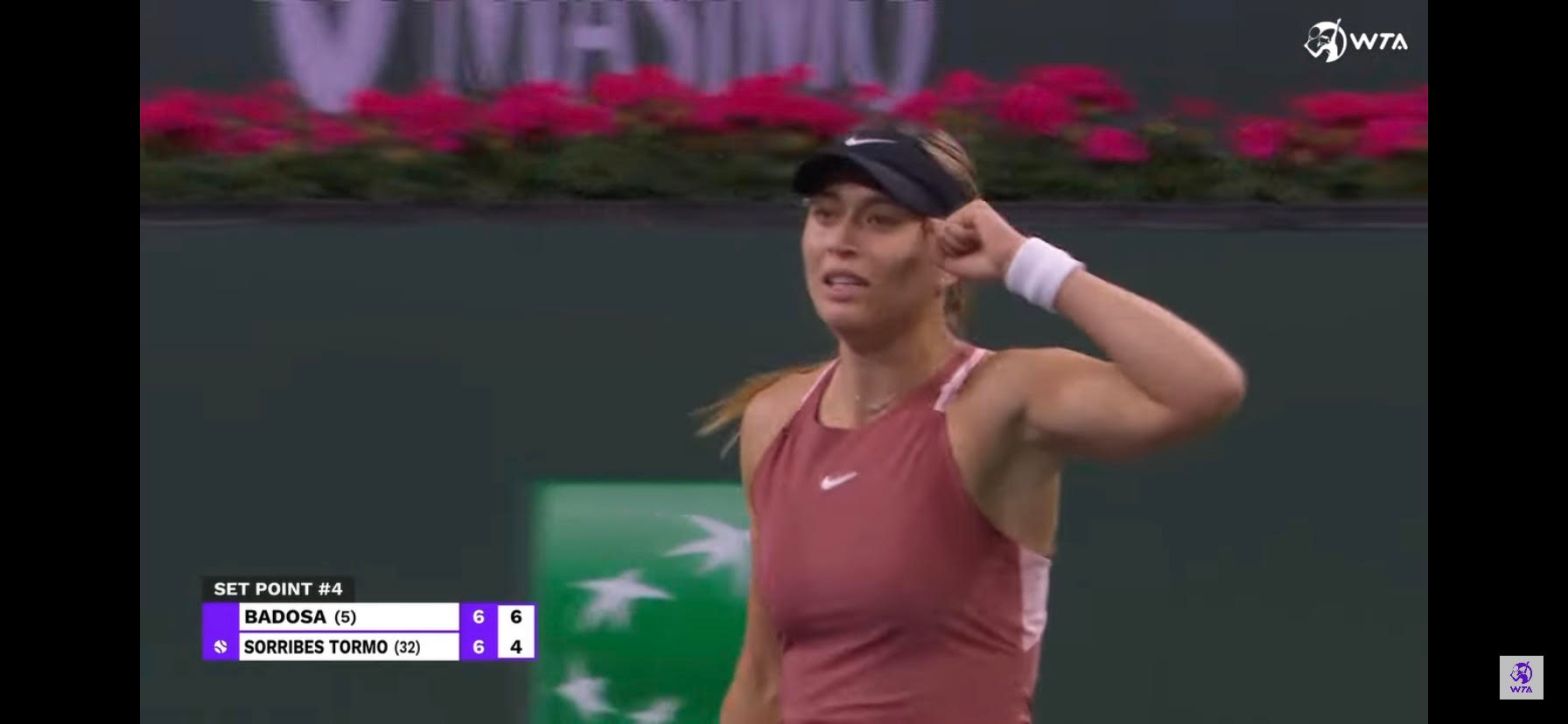

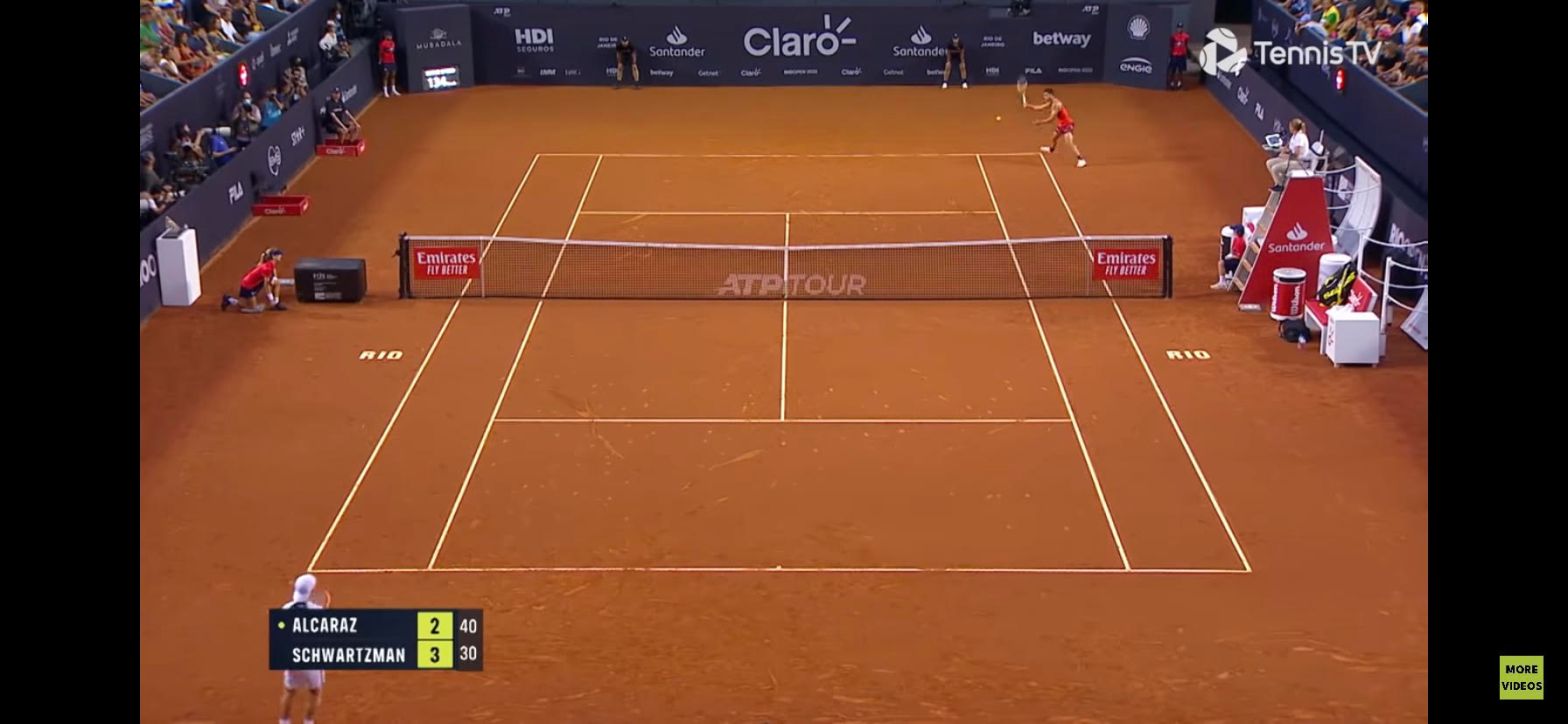


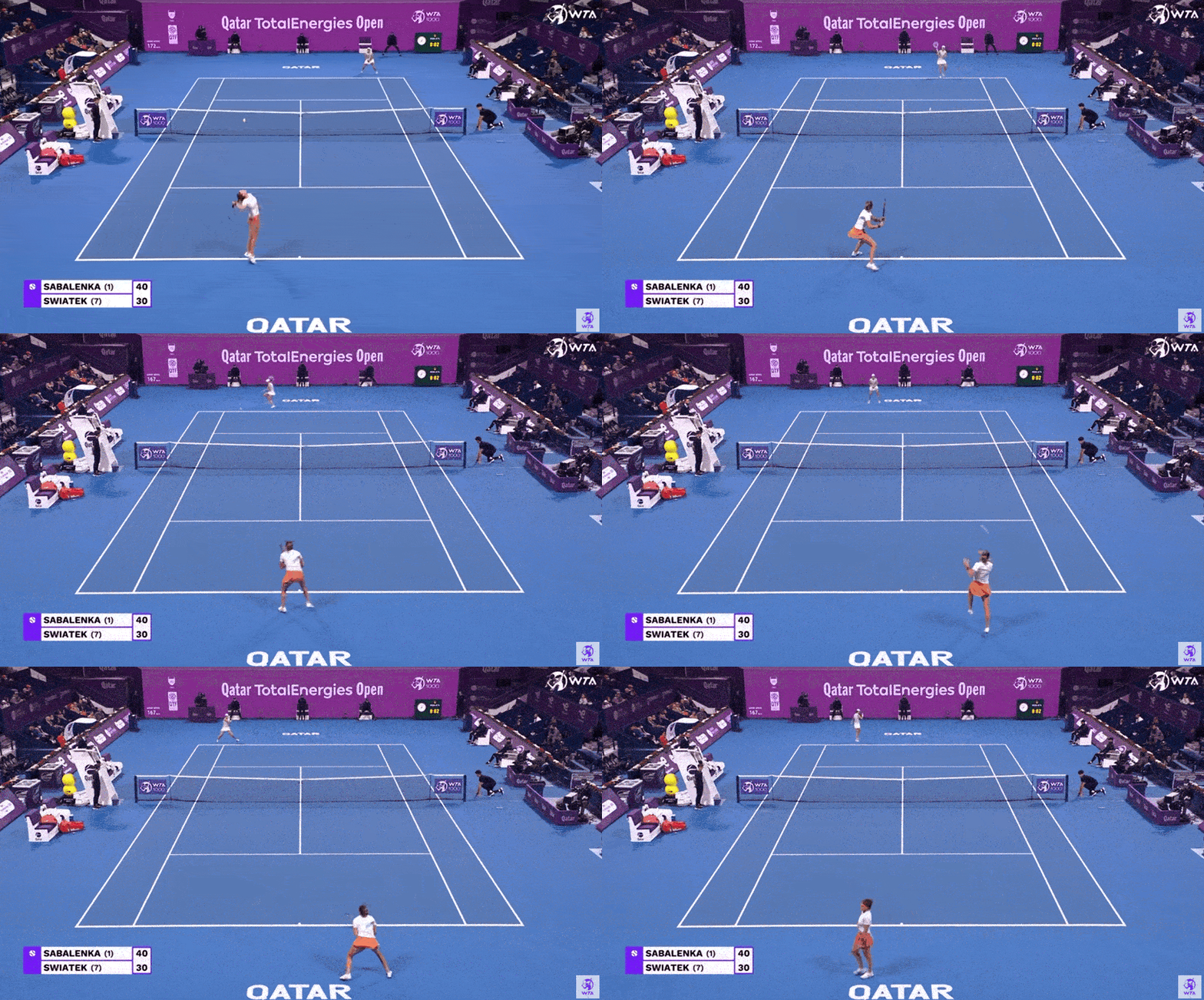

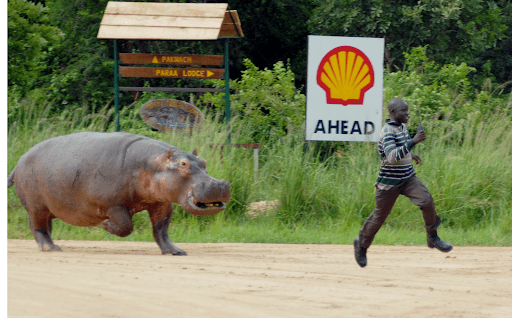
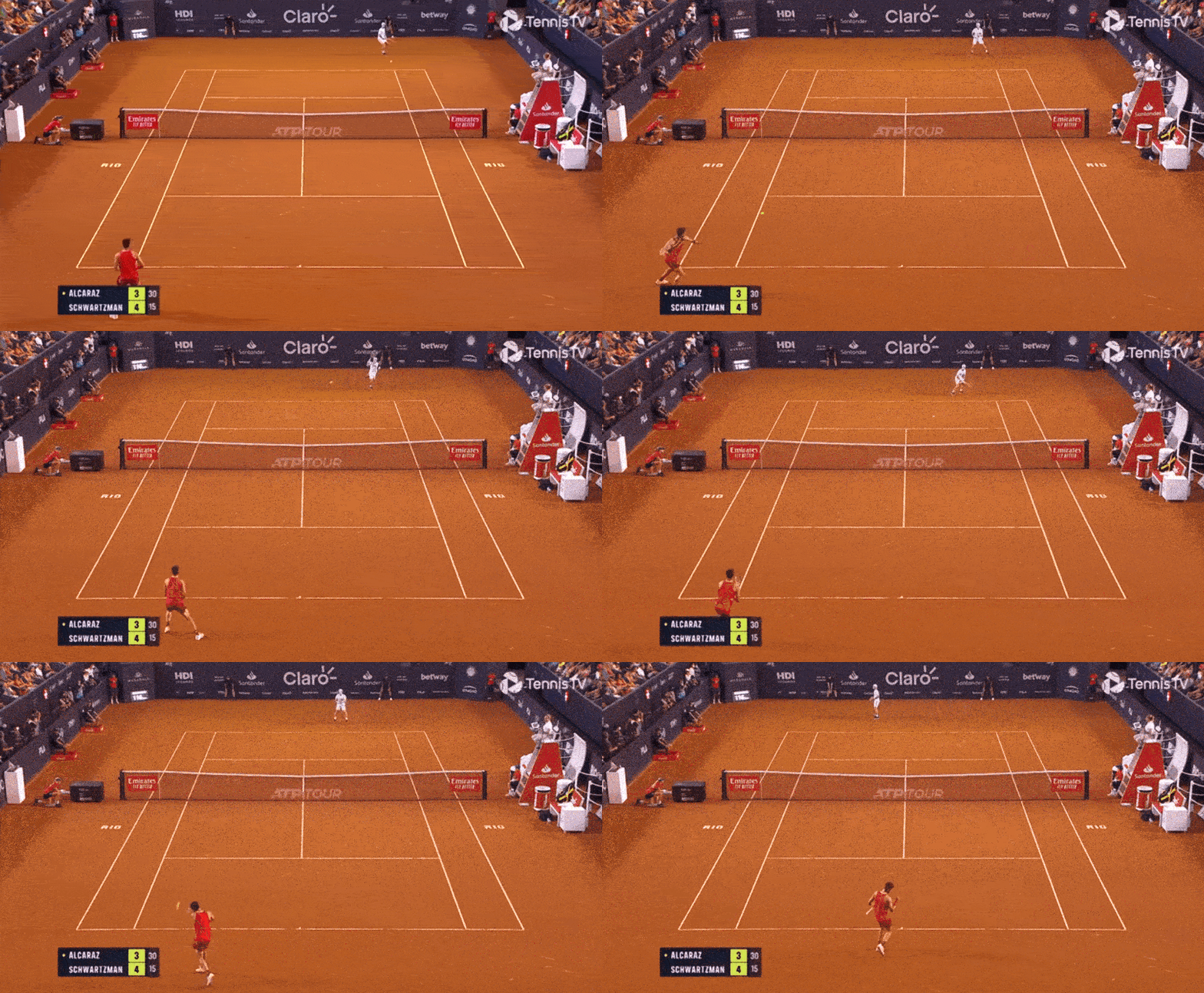


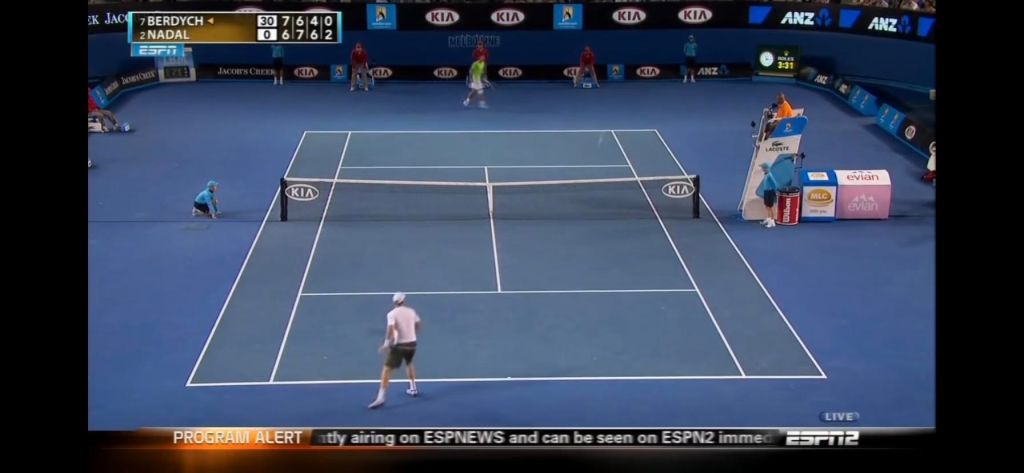


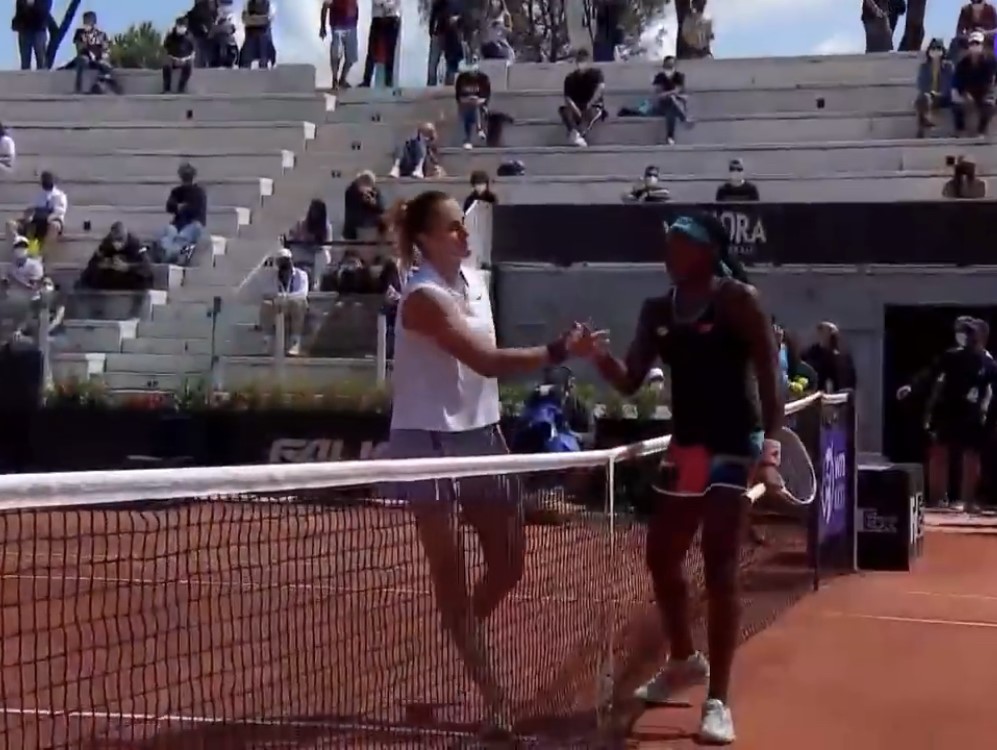
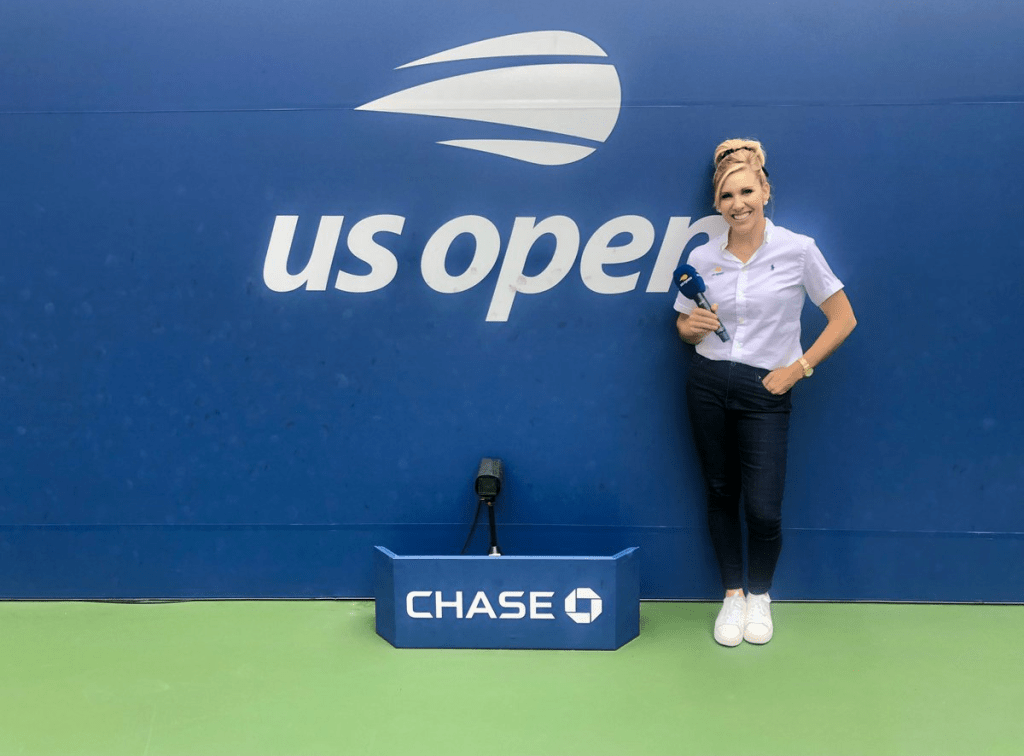
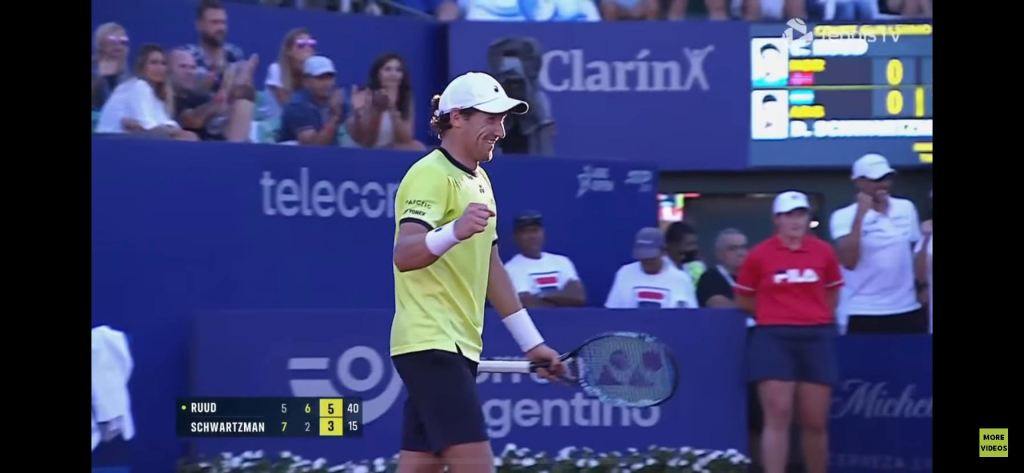


 Popcorn Tennis