Elegance in Tennis: A Must?

By André Rolemberg

Ed. Note: Owen, a longtime believer that elegance means nothing in tennis, felt his brain ooze out his ears as he formatted this.

Everyone knows Roger Federer is regarded as one of the most elegant tennis players, if not the most, in the history of tennis. Not off-court, where money can buy photographers, suits, boots, good lighting, which make just about anyone incredibly distinguished. On-court. His shots, his movement, his je-ne-sais-quoi that earned him nicknames such as Maestro, and his game the descriptor of “poetry in motion.”

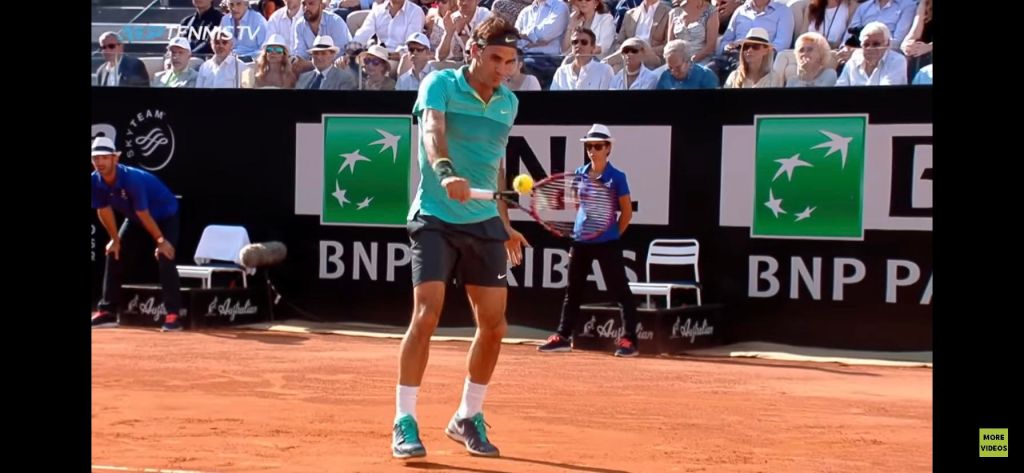
Federer makes contact with a backhand winner down the line against Djokovic in Rome, 2015. Screenshot: Tennis TV

Federer, from 2009 to the late 2010s, was regarded largely as the Greatest of All Time (GOAT for short, ironically, since one does not exactly imagine a goat munching on grass as the epitome of elegance). His game style was, or is, a major part of why people like him. A carefully curated persona around his game helps this: Federer as the timeless classic image of a man, the tennis equivalent of James Bond without the political issues around him (he is Swiss, after all).

Federer was a devastatingly effective tennis player who, in the beginning of his reign, went unchallenged. No one came near the player Federer used to be. He crushed his opponents by being a player who was not only fighting, playing intelligently and hitting impossible shots, but did with little perceptible effort. No sweat. The world was in slow motion, and Federer danced his waltz in perfect tempo. The best of drummers jealous of him, he doesn’t even need quantizing! It’s all live, and with improvisation weaved into the hours of practice.

The elegance of Federer is mesmerizing. He wins, and wins, and is hardly beaten by anyone, no one except the ones willing to make a god suffer, and who have enough strength to do so. Nadal and Djokovic are Kratos to Federer’s Zeus. Zeus dies in the God of War video game series, by the way, which is a perfect demonstration of the willpower of Nadal and Djokovic, who have eclipsed Federer, putting him as a clear 3rd best of all time.

The beauty in tennis is not necessary to win matches, to win titles, to win Grand Slams (probably the least of all things you try to improve in order to win a major is how pretty your forehand looks).

But beauty is a sign. A delicious visual representation that confirms ability, that a player like Federer has not only mastered the elements, the game, the mind, but also perfected the body, perfectly (or peRFeclty) in tune with the tactics and technique.

Federer’s technique is nearly impeccable, an early sign that he was made for the game. The brilliance of finding a player who had all the qualities to become great. Of course, Roger was just a boy once, and a pretty rebel one. Surely, broken rackets, disobedience in youth, mental weakness and a backhand topspin drive that was far less than impressive in his early days, were not quite the signs of 20 major titles and 310 weeks at number one in the world, 237 of which held consecutively. But he looked like he was made for the sport.

Beauty isn’t necessary for tennis. Not for the athlete. But recognizing the beauty in Federer’s game is seeing that he has achieved great control of his body. It is equated to art, like dancing, where we literally notice how the people on stage mastered the full control of their bodies in a way that the audience is tricked into thinking it takes no effort. But God knows if you try a ballet step your body is not ready for, you might get a stiff back for a week.

Tennis, however, is a sport. It doesn’t matter if you hit pretty shots, it doesn’t matter how effortlessly you move. If you lose, it’s of little consequence how effortlessly you played. That is the sole reason why Federer’s elegance and poetry-in-motion qualities do not weigh into how great a tennis player he is, meaning how good he is at playing and winning matches. It is beneficial, though, to assess how great an athlete he is. It is easy even for the most untrained pair of eyes to see that Federer is, in fact, a good tennis player. Why he kept losing to Nadal, on the other hand, is a matter of actual tennis knowledge. Nadal was fast and exploited weaknesses in Federer’s game that are unrelated to the latter’s ability to move around the court like he was gliding.

To conclude this piece, written on whim in about 20 minutes in a café, no, beauty and elegance are not necessary in tennis. (Unless you’re only playing exhibitions, in which case the competitive aspect of the sport is lost.) But beauty is important for many fans, and so long as we can appreciate that Federer really is a wonder to watch and still understand that this isn’t what won his matches and in no way makes him better or worse than Rafael Nadal or Novak Djokovic (who also mastered their bodies to play the game, just in a different way), we can all get along, appreciate one-handed backhands, lefty forehands with impossible RPM’s, and sliding double-handed backhand passing shots.

Tennis is beautiful. Just in many different ways.

Baseline Media: Dominic Thiem

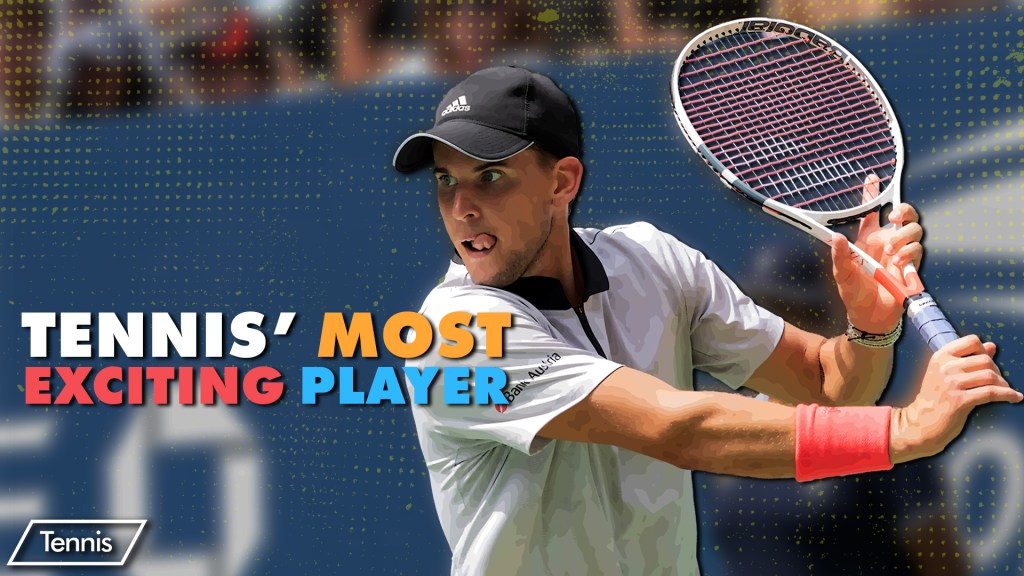
When Dominic Thiem was playing at his best, he climbed into the top five in the world and had exciting rivalries with Novak Djokovic, Rafael Nadal, Roger Federer, and Daniil Medvedev. He was the runner-up at Roland-Garros two years in a row. He was a set away from beating Djokovic in the 2020 Australian Open final. Though he fell just short of winning the World Tour Finals in 2019 and 2020, he was arguably the most explosive, in-form player in each tournament. He was the heir to the Big Three.

Then he got hurt.

Baseline Media takes a look at what Thiem brought to the game, what tennis misses about him, and what he’ll bring on his return.

Click here to watch on YouTube, or watch at the embedded video below.

Taking Responsibility

By returnwinner

Who’s responsible for Novak Djokovic being deported from Australia last month?

Ask any Novak fan and a menagerie of odious characters and shadowy entities emerge: Craig Tiley and Tennis Australia, Australian Border Force, Australian Prime Minister Scott Morrison, Immigration Minister Alex Hawke, the Victorian state government, the Australian public, journalists in the media, Novak’s agent, Ben Rothenberg’s Twitter account, a poorly thought-out Instagram post, and so on.

But as tempting as it is for fans to seek nuance, devising an ever-expanding list of figures to blame obscures Novak’s role in this entire saga.

Novak has long been a believer in the idea that ‘everything happens for a reason.’ It’s an outlook I’ve long despised because it reframes what is typically needless, avoidable suffering as a virtuous event in some divine (albeit always hidden), grander narrative.

But make no mistake – Novak’s deportation was avoidable. Had Novak gotten the vaccine, he would have frictionlessly entered the country and played the tournament as 99% of other players did. He chose not to and bore the very brutal, public brunt of that decision.

Without knowing Novak’s precise reasoning for not getting the vaccine, it’s hard to decipher what argument or evidence would persuade him, though he says he remains open-minded on the topic.

Strictly medical or scientific arguments seem doomed to fail – there are simply too many outliers or excuses one can make to wriggle out of being convinced. Indeed, the responses to this earnest tweet should give a good indication of the wild trajectories this approach is likely to yield.  

The strongest arguments, to me at least, have always had a pragmatic element: your career requires you to travel, many countries require vaccination to enter – vis-à-vis you either get vaccinated or you’re effectively semi-retired.

And yet, Novak said he will forego competing in any slam or tournament that mandates the vaccine, easily defanging any leverage this approach had. For Novak fans who want him to get vaccinated, it’s hard to know where to go from here.

Novak did not make this decision on a whim – he understands the gravity of his choice and the impact it will have on his career and legacy. For Novak fans like me, the fact that he’s considered this issue carefully only makes his ultimate decision harder to comprehend and rationalise.

Sticking to one’s principles under both great pressure and incentive to cave is an admirable quality, and certainly, one lacking in today’s atmosphere of conformity and group-think – especially online.

Yet understanding this concept in an abstract sense does not make it any less devastating that none of the slam titles, the glory, the hard-fought victories, and the heart-breaking losses that mean so much to me were enough to sway him towards getting the vaccine. It is painful to see something so valuable, and the potential for more, being tossed around as though it means nothing.

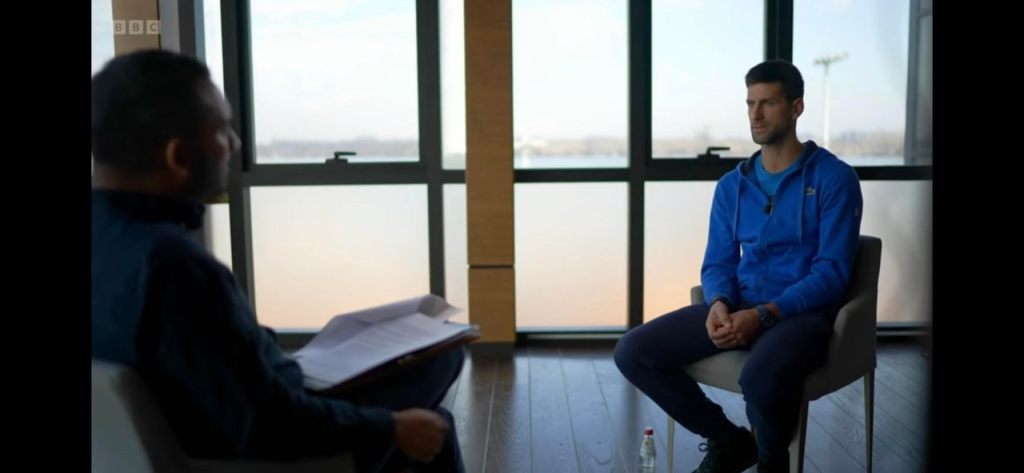
Novak speaking to Amol Rajan of the BBC.

When your favourite player errs in judgement, fans are wont to search irrationally for external factors to scapegoat their favourite. But once the heat dies down most fans will typically, albeit often quietly, accept whatever role their favourite played in any given scandal and silently pray that a lesson will be learned for next time.

Yet a very vocal subsection of his Twitter fanbase is celebrating Novak’s decision as good, actually. This group of fans has taken to attacking other fans, myself included, for having the gall to hope he changes his mind or expressing even the mildest criticism of the self-destructive path he’s chosen.

Having spent the last fortnight arguing with my online interlocutors on the other side, I have nothing useful or productive to add to what I’ve already said:

Looking for others to blame and downplaying the very real agency Novak had in determining his destiny in both Australia and beyond does him no good. Nodding along to every reckless decision he makes and saying it’s valid, righteous, and ultimately justified does not make you a good fan. It makes you a yes-man.

When you truly love someone, that means you care about the choices they make. You have to tell them things that are painful and uncomfortable. As much as Novak may not want to hear it, you might even have to tell him ‘no.’

First Title Prospects on the ATP

By Damian Kust

In light of the recent maiden ATP titles for Felix Auger-Aliassime or Alexander Bublik, I decided to look for players who still haven’t reached that milestone but are likely going to do so sooner than later (for the purpose of this article, let’s say I think they have a good chance to have that box checked by the end of the year).

  • Jenson Brooksby (0-2 in ATP Tour finals)

It’s still a little bit of an enigma whether Jenson Brooksby will be able to contend for big titles, but one of these 250s in the United States will soon be his. Both finals he’s been in so far had him take on a big server – Kevin Anderson in Newport, Reilly Opelka in Dallas, and falling in straight sets, mostly due to lost tie-breakers. The American’s consistency and unique strokes make him an extremely tricky opponent to face. If he can keep working on getting more free points, it’s no question in my mind that he’ll lock up his maiden title soon. Fantastic competitor.

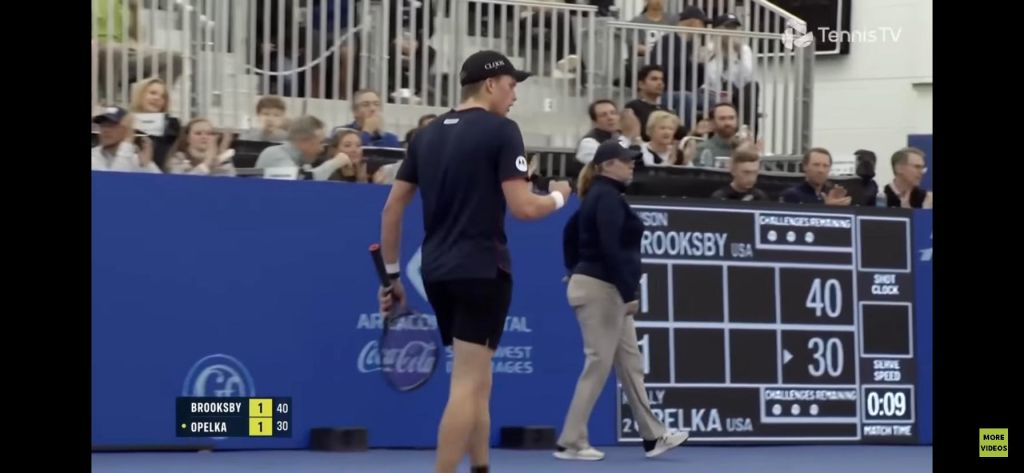
Brooksby in action at the Dallas final. Screenshot: Tennis TV
  • Brandon Nakashima (0-2 in ATP Tour finals)

Starting the list with two Americans – Brandon Nakashima lost to John Isner in Atlanta and Cameron Norrie in Los Cabos last year, but he’ll surely get more opportunities than that in the future. With perhaps the best backhand out of all the active players from the States, the 20-year-old is bound to continue his forward progress and seems far too talented to keep missing out on his first title. As with Brooksby, the best opportunity should be at American 250s. 

  • Botic van de Zandschulp (no finals yet)

Ever since his breakout US Open run, Botic van de Zandschulp has been proving that he absolutely belongs at this level. He hasn’t come close to a title yet, only reaching one semifinal in Saint Petersburg, but has impressively won his opening match in all but one event. The Dutchman has just one ATP Challenger Tour title, but was always very good at winning at least one or two matches in all tournaments played. I suppose his main tour career might follow a similar pattern. 

  • Lorenzo Musetti (no finals yet)

This is certainly a little optimistic, counting on the fact that Lorenzo Musetti will find his way again. The talent is there but his game is so varied, to an extent that makes it somewhat hard to execute, especially when he’s been struggling for confidence (like in the past year or so). The clay season is coming, though, and that’s obviously where the Italian will always be dangerous. Recent weeks showed some improvement in Musetti’s game, so let’s see if it continues. 

  • Arthur Rinderknech (0-1 in ATP Tour finals)

Since the former Texas A&M standout emerged onto the tour, he’s been making quarterfinals literally left and right. He only got his first ATP win in Marseille last year, but has already managed to reach the final eight at this level of competition a total of nine times. So many appearances at the business end of 250s make me feel like a title at one of them is inevitable. The only final so far had him lose a tough three-set battle to Thanasi Kokkinakis in Adelaide. You’d think that with his serve and forehand Rinderknech would be less likely to succeed on clay, but he actually enjoys the extra time to set up his strokes and protect the backhand better, still throwing in plenty of netplay. That makes him dangerous in all conditions.

  • Filip Krajinovic (0-4 in ATP Tour finals)

I think Filip Krajinovic missing out on an ATP title would be a travesty, he’s also the only player on the list with finals above the 250 level (1000 in Paris and 500 in Hamburg). The Serbian’s peak playing strength is incredible, but he’s always been brought down by his mental issues, blowing leads, particularly against higher-ranked opposition. Time is running out for Krajinovic and with every new season, the chance that he’ll ever be crowned an ATP champion gets smaller. 

Notable skips? I reckon players like Sebastian Baez, Holger Rune, or Jiří Lehečka might have to wait some more, I could be underestimating Lloyd Harris but his early days of 2022 have been rather poor and I’m not sure he’s capable of having such a good season again. Alejandro Tabilo came so close in Cordoba, but with the Golden Swing coming to an end, maybe not this year. Jan-Lennard Struff is probably one of the best players without a title in terms of the overall resume, but if I had to make a pick I’d say he might have missed his best chance already.

Weekly Tour Roundup: February 7th-13th

By Stephen Ratte

WTA 

St. Petersburg

Winner: Anett Kontaveit

Runner Up: Maria Sakkari

Kontaveit in Control

Is there a player in the world in better form than Anett Kontaveit. I mean sure, Ash Barty, but anyone else? 2021 was a breakthrough year for the Estonian in her eleventh year of professional competition. Having only won a single title prior to last year, she won four in 2021 alone. She also reached an additional final that was canceled due to COVID-induced scheduling conflicts with the Australian Open, after which she and her opponent both received the winner’s points and prize money. She reached the WTA Finals as the eighth seed, but beat everyone in the tournament she faced not named Garbiñe Muguruza to finish as the runner up. Including this past week, Kontaveit has now won twenty consecutive matches on indoor hard courts, the most since Justine Henin won twenty-two straight from 2007 to 2010 (thanks, Wikipedia!) A disappointing Australian Open notwithstanding, Kontaveit has largely picked up where she left off last year and won perhaps her first of many 2022 titles in St. Petersburg. 

She certainly didn’t have an easy road. She faced five straight opponents inside the top thirty-five in the world, and had tough tests in Ostapenko in the semis and Sakkari in the final. The final in particular was an extremely tense affair, with Sakkari winning the first set after going down a break. In the second and third sets, it was Kontaveit who fell behind by a break, but she battled back both times and won by a scoreline of 5-7, 7-6, 7-5 in one of the early contenders for match of the year. These two have played a total of thirteen times, with the head to head swinging just slightly to Kontaveit seven to six. After watching this final, I’d take thirteen more in a heartbeat. Kontaveit’s single grand slam quarter final appearance is mind boggling when you watch her performance in St. Petersburg, I’d be willing to bet this is the year that all changes. Likewise, Sakkari could very well take that next step in 2022 after two slam semi finals last season.

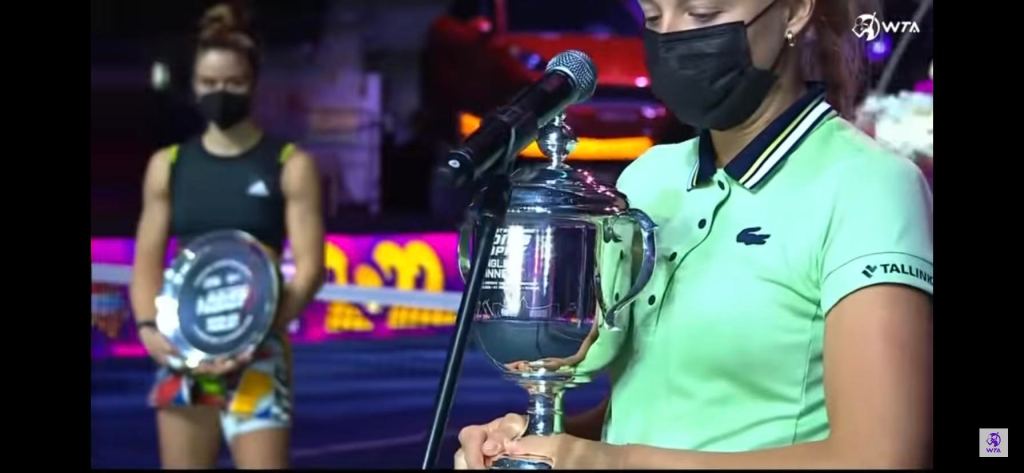
A tale of two trophies. Screenshot: WTA YouTube Channel

On Sakkari, the 26-year old world number six continues to impress with her form, but still seems to struggle when the pressure is at its highest. She had a stunning 2021, making two major semifinals (she served for one of them, coming as close as two points away from the Roland-Garros final). Her serve is one of the best in the world — at the U.S. Open, she clashed with Karolina Plíšková in the quarterfinals and lost eight points on serve. Eight. She’s an endurance beast; she had Bianca Andreescu cramping after practically every point at the end of their U.S. Open fourth-rounder. Despite the physical exhaustion of the three-and-a-half hour match, Sakkari returned two days later to serve Plíšková off the court like it was nothing. Her game and physicality, I think, are where they need to be to win big titles.

Curiously, though, Sakkari doesn’t have any. She won the Morocco Open in 2019, but besides that is title-less on the singles tour. She served for the St. Petersburg title at 5-3 in the third against Kontaveit and even went up 15-love, but couldn’t close the deal.

It’s not as if Sakkari isn’t clutch — against Jessica Pegula in Miami last year, she saved six match points, five with winners. But she clearly has some shakiness when on the cusp of making a breakthrough. She served for the Roland-Garros semifinal against Krejčíková last year and was broken, after holding the break since nearly the beginning of the set. Dealing with the infamous fear of winning is incredibly hard, but for now it stands in the way of Sakkari and a breakthrough title. Still, with her skillset, it seems like a matter of time until the barrier falls.

Quick Hits:

  • Another player on the rise, Elena Rybakina, has had an awful time with injuries these last few months. She looked incredible in Adelaide to start the year until running into Ash Barty in the final, but she was forced to withdraw from the Australian Open and now St. Petersburg with injuries. Here’s hoping she recovers soon and can realize the potential she’s been hinting at for the past year or so.
  • Petra Kvitová is a bit out of sorts of late, and she was beaten soundly by Camelia Begu 6-4, 6-0 in round two. It’ll be an uphill climb for Kvitová to match her year end ranking of seventeen from last year given the form she’s been in so far in 2022.

ATP 

Rotterdam 500

Winner: Felix Auger-Aliassime

Runner up: Stefanos Tsitsipas

A First for Felix

Canadian sensation Felix Auger-Aliassime has been a tantalizing talent on the rise in tennis for years. He’s certainly been well on his way to recognizing his enormous potential over the last six months, with quarterfinal or better showings in his last three slams. However, one question lingered for the twenty one year old: when was he finally going to get over the line and win his first ATP title? 

Well that question was answered in Rotterdam, as he won his first title in his ninth career ATP final in convincing fashion. Not only did he survive last year’s champion Andrey Rublev after losing the first set in the semis, but he comprehensively outplayed Tsitsipas in the final 6-4, 6-2. It feels like an important moment for Felix, who showed nary a sign of nerves despite having lost his previous eight ATP Finals without winning a single set. This combined with Canada’s ATP Cup win and a strong showing at the Australian Open seems to herald a new peak for Auger-Aliassime. The clay season may slow down his ascension, as he has never won a main draw match at Roland Garros and doesn’t have much to show for his efforts at any of the three clay Masters 1000 events, but he will be one to watch as he makes a push for Turin in the back half of the calendar. With the pressure to win a title relieved by this win, who knows what he can accomplish for the rest of the year?

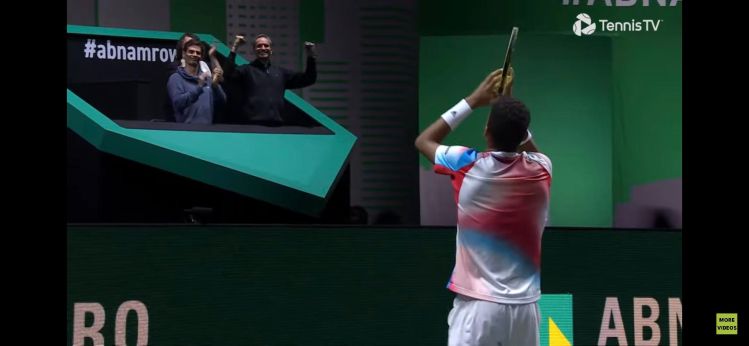
Breaking through. Screenshot: Tennis TV

One Canadian Rises, Another Falls

While his friend and U.S. Open Juniors Championship doubles partner was winning the title, Denis Shapovalov was reeling from a loss to Czech Republic’s Jiří Lehečka. It was Shapovalov’s first court appearance since his quarter finals loss to Nadal at the Australian Open, and it will hardly alleviate the sting he felt losing that five setter after calling the chair umpire “corrupt.” While Shapovalov has had his ups over the last few years, notably a semifinal berth at last year’s Wimbledon Championships, his last title win came in October of 2019, which is by far the longest title drought of anyone in the top fifteen.

Still, things could’ve been worse. Aslan Karatsev, one of the other seeds to be unceremoniously ejected from the draw in round one, lost in brutal fashion after squandering several match points on his serve and failing to win a single point in the third set tiebreak. The Aslan roller coaster ride is a wild one. He followed up a convincing title run in Sydney to open the season with a decent but not spectacular third round showing in the Australian Open. Since then, however, he has lost in two consecutive first round matches in Pune and Rotterdam to players well below his ranking of world number fifteen. It’s a microcosm of the Russians 2021 season. When he’s on, he’s on and can well and truly look like one of the best players in the world. When he’s off, it’s simply brutal to watch. In his loss to Griekspoor, he hit thirty two winners to thirty seven unforced errors. Such a peak and valley low margins playstyle can produce some mind boggling highlights, but it remains to be seen whether he can sustain a high level over the course of a full tennis season. 

Leheck(of)a Good Run

The semi finals lineup in Rotterdam consisted of first seed Stefanos Tsitsipas, second seed Andrey Rublev, third seed Felix Auger-Aliassime, and… Jiří Lehečka? Ranked 137 in the world, Lehečka went on a tear in Rotterdam. After upsetting Corentin Moutet in qualifying, he upset Shapovalov in round one before two three set wins over Botic van de Zandschulp and Lorenzo Musetti saw him in the semis. He even gave the top seeded Tsitsipas a scare by winning the first set before ultimately fading away and losing in three. Still it was a week to remember for the twenty year old and marked his first entry into the world’s top 100. Additionally, his name provides plenty of punny opportunities, so here’s hoping this isn’t the last we see of Jiri Lehečka. 

Quick Hits

  • In one of tennis’s strangest “rivalries,” Andrey Rublev and Márton Fucsovics met yet again, with the Russian avenging last year’s Wimbledon defeat and putting Fucsovics on the wrong end of a 5-2 head to head score.
  • It’s time for this week’s Murray-watch. The good: the former world number one beat Montpellier champion Alexander Bublik in straight sets to open his Rotterdam campaign. The bad: he was soundly beaten in round two by Auger-Aliassime. At least Felix went on to win the title?
  • Remember Lorenzo Musetti? He was all the rage a year ago at the age of just nineteen with wins over players like Dimitrov, Tiafoe, and Schwartzman. He was even up two sets to love over Novak Djokovic at Roland Garros before he physically broke down in five. And lest we forget his Elegant One-Handed Backhand™. Well he beat Hurkacz in round two before losing to Lehečka. So that’s something.
  • Since declaring in 2019 that in regards to Auger-Aliassime “I have to accept that he’s better than me. I may never beat him,” Stefanos Tsitsipas had beaten the Canadian five straight times. Maybe it’s time for another pessimistic press conference after this finals loss?

250 Dallas

Winner: Reilly Opelka

Runner Up: Jenson Brooksby

Big Man, Bigger Serving

Reilly Opelka is tall and he hits a huge serve. This is hardly a new observation, but watching him over the week in Dallas just puts into perspective how good his serve really is. Over the eight sets he played throughout the week, he hit 100 aces and a single double fault. While I’ve thought of Opelka as a bit of an Isner-lite on serve in the past, I think he has definitively shown that he is the biggest server on the tour right now. Oh yeah, and he won the title.

It’s become a bit of an annual tradition for Opelka, as his three career titles have now all been won in the month of February on US soil (2019 New York Open, 2020 Delray Beach, 2022 Dallas). And while his serve was the highlight, it was hardly the only thing he offered in his matches. He will surprise you with his movement at times for a man his size, and he’s clearly got power off both wings when he has time. While he will probably never be a great watch, the self professed “servebot” is back in the top twenty with this win and remains a player I’d imagine no one would want to see in their draw.

His finals opponent, twenty-one year old Jenson Brooksby picked up right where he left off last year. The young American was a revelation in the latter half of 2021, reaching his first career final in July and winning the opening set of his surprise fourth round US Open clash with Novak Djokovic 6-1. While he missed the Next Gen Finals last year due to injury, his return to ATP main draws in Dallas was a resounding success, and two tight 6-7 set losses to Opelka is hardly a reason to hang your head in shame. While he doesn’t have the serve of American contemporaries like Opelka, Isner, or even Fritz, Brooksby makes up for it with better than average defensive play and some baseline winners that will take your breath away. While he clearly has a lot of growing to do as a player, Brooksby is one of the most exciting young American prospects on the tour today.

Have I Mentioned the Serving?

Do you like breaks of serve? Then Dallas was not the tournament for you. We had Anderson vs Querrey as an appetizer in round one and we were off the races. Opelka and Stebe played a nearly two hour match in the second round where neither player generated a breakpoint. Then there was a rematch of an infamous 2018 Wimbledon semi final between Kevin Anderson and John Isner, a three setter wherein one breakpoint chance was generated (and saved). Not enough for you? Can I interest you in the longest tiebreak in ATP history between Isner and Opelka in the semis, with an astounding second set tiebreak score of 24-22? If only the organizers had the foresight to grant wild cards to Raonic and Karlovic, they could have rebranded as the ATP Servebot Masters. I jest. Kind of.

Final fun fact: Reilly Opelka’s 100 aces in Dallas is more than Diego Schwartzman hit in all of 2021 (88).

250 Buenos Aires

Winner: Casper Ruud

Runner Up: Diego Schwartzman

A Ruud Awakening in Argentina

For the second time in his career Casper Ruud hoisted the trophy in Buenos Aires and he looked rather good doing so. The Norwegian was an absolute menace to the home crowd, defeating Coria, Delbonis, and Schwartzman in the quarters, semis, and final to kill all dreams of an Argentine victory. Ruud now holds a 7-2 record in ATP finals with six of those seven titles coming on clay. If there was ever a time for him to solidify his position in the ATP’s top ten, it would be in the upcoming European clay court swing where he has made fewer inroads over the past few years. Most surprising for Ruud is the fact that he has never been past the third round at Roland Garros, which should in theory be his best slam. If his performance in Buenos Aires is anything to go by, he stands a good chance of going much deeper if he’s on his game in Paris.

While he did win in Buenos Aires last year, Diego Schwartzman has to be disappointed to lose a third career final on home soil. Still, he did have some special moments during the week. He was in real danger in the quarterfinals against Francisco Cerundolo, but came back from a set down to win a three hour thriller that featured twelve breaks of serve. Likewise, he survived some adversity in the semis against Lorenzo Sonego where he lost the second set. He was also the only player to take a set off of Ruud throughout the week. With Ruud’s penchant for winning clay court 250’s and Schwartzman being only twenty-nine, one wonders whether we will see many more finals meetings between these two on this same court in the future. 

Del Potro Says Goodbye

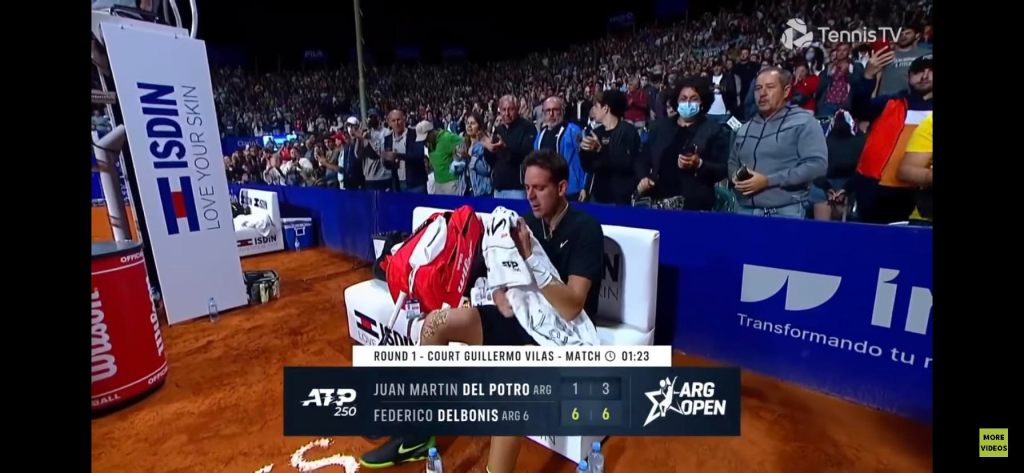
Sure Ruud won the title, but the story of the tournament was Argentina’s favorite son, Juan Martín del Potro, announcing his impending retirement from the sport prior to his first round match with Delbonis. I won’t speak too much more about del Potro. Other writers on the site have done an excellent job eulogizing his tennis career. However, I am happy that he got to go out on the court as opposed to in a hospital bed, as he has been so often injured these past few years it seemed as though he may never take to a tennis court again. He is a true giant both literally and figuratively in modern tennis, and it was a pleasure to watch him play for all the time he could bear it. And on the subject of some (ridiculous) protests on Twitter regarding Delbonis playing to win the match, I am glad that del Potro got a definite conclusion out of this. Had Delbonis pulled punches and allowed Delpo to win, it would’ve been a hollow victory, a false hope for the future that would have perhaps made Delpo question if he was doing the right thing. When he laid his headband on the net following the defeat amidst a standing ovation from the crowd it felt fitting, like he had achieved a real closure. Perhaps it wasn’t the ending to his career that he would have once hoped for, but at least he got to see the love his fans bear for him in that moment. One last time.

What a career. Screenshot: Tennis TV

Quick Hits

  • Casper Ruud now has the same number of ATP titles as Stefanos Tsitsipas. Chew on that for a moment.
  • Thirty-eight year old Fernando Verdasco won his first two rounds in Buenos Aires, marking his first and second ATP main draw wins since May 25th of 2021. Good for Fernando, who must certainly be nearing retirement himself.
  • Unfortunately for thirty-six year old Pablo Cuevas, he couldn’t match Verdasco’s success and his main draw victory drought, which is ongoing since the first round of last year’s Roland Garros, continues into its ninth month.
  • While checking where Diego Schwartzman’s 4-9 finals record put him all time, I realized that Thomas Muster holds the career best winning percentage in finals (minimum of 15 finals played) with 81.5%. That’s ten percentage points higher than Nadal or Djokovic and fifteen points higher than Federer. Fun fact to impress your tennis nerd friends!

Novak Djokovic, the Enigma

By Owais Majid

Almost a month after Novak Djokovic’s deportation from Australia was confirmed once and for all, he has finally broken his silence on everything surrounding the matter in an interview with the BBC which aired on Monday night.

The interview itself, which lasted around 30 minutes, was a fascinating watch. Amol Rajan grilled Djokovic on everything from his stance on being vaccinated, to what the future holds, to everything that led up to Djokovic’s deportation.

It was as confusing and frustrating as it was insightful. On countless occasions, Djokovic opened his answer with the words “I understand and respect” or variations of that sentiment. Despite this though, Djokovic didn’t particularly demonstrate that he truly understood the ramifications of everything that had happened as a result of his beliefs.

At one point, Djokovic said “I understand the consequences of my actions” before later contradicting this by taking no responsibility, at least outwardly, for the antivax protests that ensued following his visa being declined. Somebody who was so keen to stress how self aware he is showed very little in the way of it here, and it was quite revealing about Djokovic’s mindset and how unwilling he is to change it in any way, shape, or form.

Throughout the interview, one of the recurring themes was that of him insisting that “I have always supported the freedom to choose what you put in your body.” This was yet another instance of Djokovic’s apparent ignorance. The larger issue here isn’t that of him simply having something injected into his body. His claims about being reluctant to take something that may or may not affect his health, which he holds of paramount importance, aren’t without their justifications. But Djokovic failed to acknowledge the fact that his actions have been endangering other people besides him. I found this to be at best a bit tone deaf and at worst pretty entitled and selfish. Surely someone as intelligent as Djokovic has been on so many occasions should be able to understand something which is seemingly so obvious. His inability or refusal to do so is genuinely baffling to me, and I’m sure to many others who were listening to his every word with bated breath. 

Here lies the enigma with Djokovic. This same unfaltering belief in his own, well, beliefs that maddens us so much has been one of the biggest reasons for the wealth of success and accolades that he has amassed. Djokovic’s methods up until this point, regardless of how unconventional they seem to us, have been so successful that it’s little wonder that he seems reluctant to move away from them. The same stubbornness that he’s displaying here is the reason why he has so often fought back from situations that seemed terminal.

Be it an improbable comeback from two sets down in a grand slam, or finding a way to rediscover his best tennis after a year and a half in the abyss or conquering the many Everests he has, Djokovic has pulled off numerous superhuman feats. One commonality with all of these that whenever they are talked about, we always hail Djokovic’s mentality as being arguably the biggest factor.

All elite athletes have to have a certain element of single-mindedness about them. They wouldn’t be as successful as they are if they didn’t possess this trait in some capacity. Djokovic embodies this phenomenon possibly more than any sportsperson has ever done both on and off the court. As such, even if he might make us want to tear our hair out at some of his actions and comments, it isn’t particularly surprising. 

There’s also another factor which I believe gets massively overlooked when it comes to understanding the many nuances of Novak Djokovic’s character. Tennis is a sport where the vast majority of players who are at all successful come from a fairly wealthy background. On the outside, it is viewed as a sport that caters only for the elite. In Djokovic, we have arguably the greatest male player of all time coming from an extremely troubled background.

As Djokovic alluded to in the interview, there were days where simply being able to come by any form of nutrition was difficult. When you’re constantly on the move, with no semblance of normality in your everyday life, it’s unlikely if not impossible that you’re going to have the same attitude and psyche as those who have had a far more conventional upbringing. Djokovic’s character is bound to be impacted. As incredibly frustrating his fans and tennis fans as a whole find his stubbornness, there has to be an element of acceptance that Novak Djokovic just isn’t what we perceive as “normal.”

Speaking about his younger years, Djokovic said “I became self reliant from very early on and I think that helped me to establish my own character from very early on and just hold my ground.” 

For the majority of us, we’ve had an adult to shape and refine our beliefs, to teach us certain values one simply cannot self teach. The fact that Djokovic lacked this to some extent will undoubtedly have had a major impact on the person he is now. It is particularly apt that he used the term “hold my ground,” as that has been the crux of what his career and this interview has been about. Amidst everything telling him otherwise, Djokovic has persisted and more often than not prevailed. 

If this formula that he has established for himself has brought him so much success, it’s kind of understandable, if still extremely naive, as to why he holds the beliefs that he does.

Towards the end of the interview, Rajan asked Djokovic the question many of us have been wanting to ask him for so long. Upon Djokovic claiming that he would sacrifice the opportunity to become the greatest of all time in order to uphold his values, Rajan simply asked “why Novak, why?”

Djokovic’s reply reaffirmed what he had been saying throughout the interview. “Because the principles of decision making on my body are more important than any title. Or anything else.” 

So in spite of everything Djokovic said about remaining open minded, it’s pretty clear that it’ll take some drastic change to sway him from his current beliefs.

I think I can speak for the majority when I say it would be a great shame if Djokovic were to relinquish the opportunity he has to etch his name even further into tennis history. Whether you love him or hate him or you stand somewhere in between, tennis is a far greater spectacle when Novak Djokovic is a part of it, and not when he is departing the scene of the spectacle amidst controversy. 

The Emotional Intensity of Live Tennis

By Jack Edward

Trigger warning: profanity is used throughout this piece.

At around 3pm on Wednesday, Andy Murray started his match in Doha against Taro Daniel. An hour and a half later, he emerged victorious and I hadn’t seen a single point of the 6-2 6-2 drubbing.

Whilst our hero was (apparently) running circles ‘round his conqueror from Australia, I was in a dreary leisure centre in Scotstoun, Glasgow, watching my first professional match in person since filling my life entirely with tennis about a year ago.

The Scotstoun Leisure Center.

For those unaware, my time is taken up coaching wee ones, writing analytical pieces on professional matches, or hosting a podcast on tour tennis. I’m from an engineering background so melding my passion with my expertise made sense – I’ve gotten decent(ish) at scrutinising matches from a technical perspective, looking for patterns of play and tactics. When a match is done and dusted, I can sip a black coffee, lean into a swivel chair and get to work on a tidy article.

Today’s experience called for a far less organised, non-technical piece. Today’s experience pushed me out of my comfort zone. Not only did I have no coffee to guzzle or a lovely office chair to recline it, I was forced into feeling the match instead of dissecting it.

I hope you enjoy my retelling of a rollercoaster of a day watching live tennis and that Andy can forgive me for missing his match.

*****

The tournament was a W25 ITF event, one of the lower tournaments on the rungs of the professional tennis ladder.

I was there to watch someone from my local tennis club compete in the first-round – Anna Brogan, world #917, qualifier, fantastic tennis player. Ordinarily however, from the comfort of my home, Anna would be just another name, just another ranking, another set of strengths and weaknesses to compare to another set of strengths and weaknesses.

I sat myself down, front row, a metre away from the court, a smattering of spectators muttering behind me. I tried not to make eye-contact with Anna as I sat down. I had told her I’d try to attend one of her matches this week but all of a sudden I was there and I didn’t want to put her off and she probably wouldn’t even wave back if I waved – in fact she DEFINITELY wouldn’t wave back, she’s a professional, for fuck’s sake!

I looked over my right shoulder to find somewhere else to look. Anton Matusevich (the ATP world number 460) was standing waiting at the sidelines with his arms crossed. 

Right, refocus. I could treat this like any other match, right? I’m here to support Anna but why not do a bit of analysis at the same time??? 

***You can’t switch this shit off for one fucking match, for someone you actually know and like, you fuck?!***

Well, maybe a post-match breakdown could help Anna… or at the very least, you could pretend this counts as work…

Fine.

*****

I studied away to myself for the first set (which Anna won 6-3), taking notes on my phone.

Anna Brogan: World #917, 23 years old, laser-like backhand, quick around the court, spectacular defensive skills, stubborn rally temperament, slightly vulnerable when pulled off the court, relatively better at returning than serving.

Jasmine Conway: World #1028, 17 years old, tall enough to win cheap points on serve, decent two-hander with the option of a well-controlled slice, could be rushed/generally more erratic on the forehand.

I was trying to come up with a gameplan/work out if Anna was following one. There seemed to be some intent to find the forehand on her own serve and to neutralise the serve with her return rather than all-out attack it. Anna certainly seemed to be coming out on top in the longer rallies, so it was best just to negate a serve + 1 from her opponent rather than take unnecessary risk with an aggressive return.

Other coherent thoughts crossed my mind as I caught glimpses of the other two matches on courts in the background.

Henri Squire, a tall German bloke, was bombing serves against Omni Kumar, a 20-year-old with one of the most unorthodox double-handed-to-single-handed backhands I’d ever seen.

Tara Moore was packing plenty of explosiveness from court-level, her one-hander a beautifully fluid stroke – it looked as though she was having a bit of a bad day, berating the chair umpire for failing the impractically assigned task of calling most of the lines from his perch.

I loved the intimacy of it all – it was so much easier to fully wrap my head around what was going on.

It was simultaneously bewildering that Anna and her opponent were left unrattled by the venue. The umpires screaming from other courts were frequently mistaken by me for the one officiating this match, line calls were definitely quite often incorrect, rogue balls from other courts would result in a let-call, the other players pumping themselves up with regular “Come on!”s…

I caught myself mid-marvel as I realised Anna had 15-40 5-6 on her opponent’s serve.

Two match points.

*****

In the blink of an eye, my feeble attempt at analysis, the notes on my phone – ALL OF IT – were completely forgotten.

Okay, second-serve… Double fault, double fault, double fault… Shit. Okay Anna, win this rally, win this rally, win this rally… shit, fuck. Okay, this one, this one, this one… Oh nice return. Oh nice backhand… Oh shit. You can get to that drop-shot Anna, come on, come on – FUCK. A fucking drop-shot? Who does this girl think she is?

Conway held serve. My brain revolved hapless thoughts round my head like a washing machine.

Win the next point… Okay’s let win the next point… Fuck – okay this point… Well done – now this point… Ah, shit.

Conway won the tiebreak – and I didn’t have a fucking scooby how she’d done it.

*****

I’d experienced moments like this at home. Andy is always my best example to draw on when talking about the raw enjoyment of a tennis match – a beastly serve here, a crunched backhand there and, quicker than Andy can say “Let’s go!”, you can find yourself lost in the match.

Not a problem. I often welcome it in fact – enjoy everything now and a grainy mental reel of the match should provide enough landmarks for me to quickly dissect a replay.

But here, in the heat of the match and without the option to pause, practically on the fucking court… Anna went a double break up and I really was gone, clapping loudly for every point won that wasn’t an egregious error by Conway whilst losing all feeling of what had actually gotten Anna ahead.

I started to refocus as things went awry – some long service games didn’t go Anna’s way prompting me to remember my (sort of) task for the day.

… Another backhand about one inch above the net?!… Conway’s not missing any of the shots she’s supposed to be missing… Another fucking break of serve? What is going on??? What the fucking fuck is going on?! WHY ISN’T SHE MISSING?!

A double break lead turned to 4-4. I couldn’t figure out for the life of me what Anna could do differently. Conway had simply… raised her level. 

*****

Anna went on to lose the match 6-4 in the third.

I’d seen her pull a face like fizz missing off a drop-shot deep in the third but only once did she actually shout at herself.

When she lost the match, she remained stoic, head dipped in disappointment walking up to Conway but eventually raised to meet her gaze, a consummate professional even in defeat.

Meanwhile I was at the sidelines fucking apoplectic at Jasmine Conway.

What the fuck did she do? She didn’t deserve to win that match, Anna was FAR fucking better!

I had been nervy, ecstatic, anxious – now I was angry – and during all of it, I hadn’t been able to draw a single useful conclusion from the tail-end of the match. All I could think was “Jasmine Conway rAiSeD hEr LeVeL”.

To tour coaches across the world, I salute you. How you sit court-side and do anything but internally combust is beyond me. My first self-assigned rodeo was a stark realisation that trying to solve a tennis match with any emotional investment involved was an extremely tough exercise in focus…

… and, of course, to tour players across the world – to Anna – I double-salute you. I barely coped with the pressure of that match from the sidelines. It is absolutely astounding that these players can string together a coherent inkling of a tactical thought staring match-point in the face.

*****

At the end of the second-set, I noticed a couple of kids I’d coached that morning watching from the elevated pathway behind the courts. I stuck my tongue out at one of them, to which she replied in kind.

These kids didn’t have a solitary technical thought about this match. They were here to see the ball go BOOM off the strings and to feel the mid-match wins and losses of their preferred player.

From behind closed doors, I can remove myself from the feeling of a match. At the very least, I can keep my head above water. But there’s nothing like taking the plunge, of truly immersing yourself in the feeling of every point – of getting completely lost in the ups and downs of a fucking tennis match. Go try it sometime if you can, because the experience is vastly different from watching a match on TV.

*****

I waited for Anna outside to tell her thanks for playing a brilliant match. She thanked me for showing up before I could thank her. Her dad shook my hand. I really wanted to say I FEEL EXHAUSTED ANNA WHOAH BOY I CAN’T IMAGINE HOW YOU FEEL but I thanked her quietly, sheepishly waddled off and tried to process what had just happened.

Degrees of Aggression

What is the right degree of aggression? Go too close to the lines or hit too hard and you might miss; hit too softly and the ball will be thwacked past you. Where’s the happy medium?

The answer lies somewhere between Simona Halep and Jelena Ostapenko. Halep, despite being offensively minded, lacks easy power, so when she plays someone with the same mindset and the game to match, she doesn’t have much choice but to take the defensive role. And her opponent today, Ostapenko, has all the power in the world. Like, if you hit a shot to Ostapenko that is the slightest bit too slow, she will crush a winner, and it will look demoralizingly easy. The problem is, Ostapenko is wild — when you massacre every ball, you will miss a lot. The court’s not that big. 

Halep-Ostapenko matches, then, tend to be characterized by the former keeping the ball in play for as long as possible, trying to elicit an error from the latter. If Ostapenko is having a good accuracy day, there’s not much Halep can do in the face of the barrage. But if she isn’t, Halep can go into error-free mode and let Ostapenko self-destruct. 

Option two tends to happen more often than option one, in the grand scheme of things. Focusing power, especially as much as Ostapenko has, is hard. Halep has had a more successful career than Ostapenko despite having to work harder to win points. She’s way more consistent, and reliability pays in tennis. 

So when Halep takes the court against Ostapenko, she does have reason to be confident. But I can’t shake the thought that there’s an air of uneasiness around her when the two play. There’s the lingering knowledge that if Ostapenko has a really good day, Halep is probably toast, since she can’t boss Ostapenko around, only react to her more powerful shots. That’s not the most encouraging information. What must Halep’s game plan look like? Serve well, get good depth, run everything down…oh, and hope to God that the woman on the other side of the net doesn’t peak. As a professional tennis player — a two-time major champion and former world No. 1 at that — this can’t be easy to deal with. 

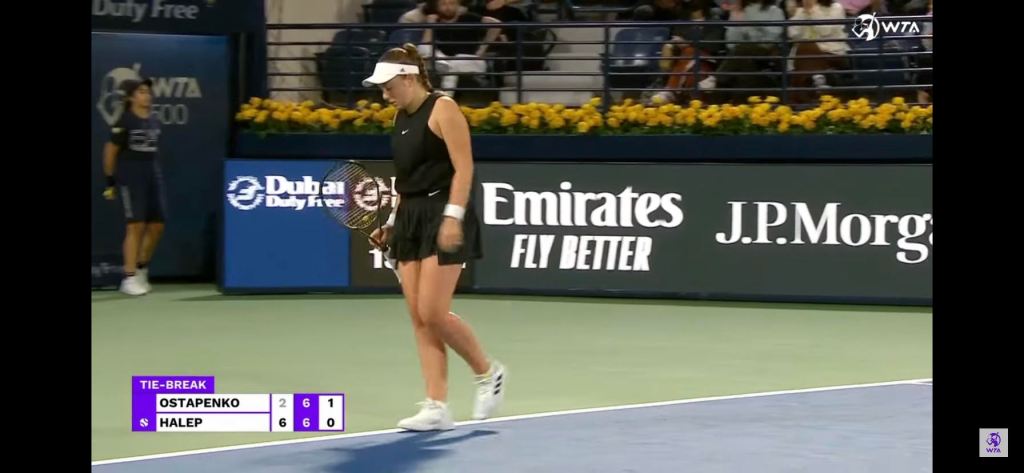
Halep and Ostapenko clashed in the Dubai semifinal today. Halep won the first set 6-2. In the sixth game, there was a moment when she had two unforced errors and Ostapenko had 15. Even then, the match felt a bit precarious to me. Ostapenko, due to her far superior power, basically got to decide how points ended — sure, she missed a lot, but had I been writing a live report, I’d have been typing either “Ostapenko misses” or “Ostapenko hits a winner” after nearly every point. (Halep hit just eight total winners during the match, five of which were aces.) Even if things aren’t going your way, having that level of control on a match has to be reassuring. 

The classic Ostapenko-Halep match (though they’ve only played three times, including today) is the 2017 Roland-Garros final. For a set and a half, Halep had control of proceedings. After 59 minutes, Ostapenko trailed 4-6, 0-3, ad-out. If the match wasn’t already over, it would have been had she lost the next point. Instead, she destroyed a forehand winner down the line, while on the run. From there, she simply blasted away, aiming for the corners in a stunningly brave performance. Halep was up a break in the third set, but was never in the driver’s seat — per Tennis Abstract, Ostapenko hit 50 winners (not including aces) and Halep hit 8. There’s been some controversy surrounding Ostapenko’s quotes this week, which included “she [Halep] can’t handle my pace.” When the pace lands between the lines of the court, this is true.

Ostapenko got her act together in the second set of the Dubai semifinal. Halep did well to even the set after falling behind 3-0, then resisted pressure admirably to save set point to get to a tiebreak. Halep had the momentum and the lead; there was every reason to think she would close out the match. Instead, Ostapenko stumbled upon a laser-like level of accuracy, blasted a few winners, and whitewashed the tiebreak 7-0. 

Seven-zero. Halep hadn’t done anything wrong, exactly, Ostapenko had just started doing everything right. When that happens, a match can slip past in a hurry. Ostapenko broke Halep twice to open the third set, going up 3-0 in nine minutes. 

Nothing to see here, just Jelena Ostapenko after crushing an extraordinarily difficult crosscourt backhand winner on the rise. She did not celebrate the miracle shot. Screenshot: WTA YouTube Channel

Ostapenko doesn’t often react wildly to her successes, which must make her a freaking intimidating opponent. On the one hand, Ostapenko is disappointed when she isn’t playing well, which is often. But when she is — and for her, that means blasting unreturnable bullets from both wings — it’s terrifying. This blinding level of play might be very difficult to achieve, but it is what she expects of herself. 

*****

Halep is more susceptible to losing to a redlining opponent; Ostapenko is only susceptible to herself. In this matchup, that tends to favor Ostapenko, who’s now won two of their three battles. Overall, though, Halep has had the better career. She’s won two majors to Ostapenko’s one. She’s been world number one; Ostapenko has “only” been as high as #5. Halep is a perennial contender at majors; Ostapenko has lost in the early rounds several times. All things considered, Ostapenko’s game is a bit too risky — dominant as she is when at her best, she’s not at her best that often. Halep’s peak level might be less godlike, but it’s easier for her to achieve. 

High-margin aggression is the happy medium in tennis, but low-margin aggression (when it works) is the most difficult tennis to play against. Not a lot you can do when shots are flying into the corners of the court at high speeds. The high risk of the strategy is enough to dissuade most from trying it, especially when the pressure’s on. The best players of all time are living proof that sustainability is crucial, and low-margin aggression is anything but. 

All that said, Ostapenko won the third set of today’s Dubai semifinal 6-0 in barely over twenty minutes against one of the best players and defenders in the world. Which feels like a big deal.

0 to 360: Novak Djokovic Statistics

By Aoun Jafarey

How can you get from zero to 360?

Zero to 60? That’s what you care about for a decently fast car. Got something more serious, maybe a zero to 100 time. Supercar? 0-200 would be more apt.

But what if you have a hypercar? The kind you see once in a blue moon (unless you live in Dubai, Hong Kong… or Monte Carlo). You’d probably be interested in the top speed more than anything else. At least in the case of the McLaren F1, that was the stat that mattered the most, it became the first car to cross the 360 kmh top speed barrier by topping out at 387 kmh. Men’s tennis now has something comparable to what the auto industry had when the McLaren F1 first came out: a man who has made it to 360 weeks at number one.

That man is none other than one of the most decorated tennis players of all time, Novak Djokovic. I know that right now media coverage of him is exploding for his opinion on vaccines and his travel to Australia, but as much as that might be consuming your timeline or newsfeed, the thing to really focus on when it comes to Novak Djokovic is his tennis.

With that cleared up (seriously, let go and let’s get back to tennis), here’s a look at some of his greatest accomplishments, some (hopefully) surprising stats in numbers, and a little jab for fun (not the literal kind before you decide to quote tweet this piece without reading the rest of it).

*****

0 – The number of COVID vaccinations he’s going to take and the number of times he’s responded to taunts from Nick Kyrgios

1 – His highest rank

2 – The number of times he has won Roland-Garros, Monte Carlo, and Cincinnati, the trifecta of his least successful “big titles”

3 – Number of games he won in his first ever match at a grand slam (R128 loss to Marat Safin) and the number of games he lost in his first ever win at a grand slam (R128 win over Robby Ginepri)

4 – The number of attempts it took for him to win a match at the Australian Open (hilarious given what happened after this)

5 – Number of times he’s won the World Tour Finals

6 – The most number of times he’s lost a final at a tournament, six each at Rome and the U.S. Open

7 – Number of times he’s finished the year end number one (most in the Open Era on the men’s side), the fewest number of games he’s ever won in a grand slam final, and the number of tournaments he is undefeated at*

*Beijing as an ATP 500 and Beijing Olympics are not considered to be the same tournament. If you have a problem with that, take it up with the ATP.

8 – Number of wins over Nadal on clay, more than a combination of any two other players

9 – The number of Australian Open titles he has won, his most at any tournament and the most by any man at the Australian Open in the Open Era

10 – The number of players who hold a winning head-to-head record over him

11 – The number of finals he has played in Rome, the most for him at any tournament

15 – The number of times he’s lost in straight sets to Nadal and Federer each

18 – The most number of wins he has over a player with 0 losses, the record is against Monfils

20 – The number of grand slam tournament titles he has won, joint for second most on the men’s side

21– The number of matches it took for him to win 10 matches

23 – The number of times he has lost to Federer

27 – The number of times he has defeated Federer

28 – The number of times he has lost to Nadal

30 – The number of times he has defeated Nadal (no other player is even at 20, Federer is second-most with 16)

31 – The number of grand slam finals he has made, joint most with Roger Federer and the number of times he has played the #1 ranked player

32 – The number of matches it took to make his first semifinal on tour (Zagreb)

37 – The number of Masters 1000 titles he has won and the number of finals he has lost on tour

49 – The number of matches he has lost to players from Spain (the most from an individual country)

50 – The gap between him and Federer for weeks at number one

51 – The number of matches it took to make his first quarterfinal at a grand slam tournament (Roland-Garros)

54 – The number of Masters 1000 finals he has played

57 – The number of countries he has played different players from and also the number of wins combined over Nadal and Federer

62 – The number of matches it took to make his first final and get his first title on tour (Amersfoort)

72 – The number of wins he has over players from the United States

78 – The number of players he has lost at least one match to

79 – The number of match wins he has at Wimbledon

82 – The number of singles matches he has won (including opposition retirements) at each of the Australian Open, Roland Garros, and the U.S. Open. Talk about symmetry. 

86 – The number of titles he has won on the pro tour

89 – The number of matches he’s played at Wimbledon

90 – The number of matches he’s played at the Australian Open

91 – The number of finals he has won (including his personal match wins at team events like ATP Cup and Davis Cup)

95 – The number of matches he’s played at the U.S. Open

97 – The number of matches he’s played at Roland-Garros

102 – The number of singles matches won on grass, tied with Pete Sampras

103 – The number of sets he’s won in his 199 losses

104 – The number of matches he’s lost to players ranked in the top ten

106 – The number of matches he’s lost in straight sets

116 – The number of wins he has over players from France

123 – The number of singles finals he has contested on the pro tour

131 – The number of wins he has over players from Spain

144 – The number of indoor matches he’s won in his career

157 – The number of matches it took to make his first final at a grand slam tournament

174 – The number of times he’s made it to the SF of a tournament

182 – The number of top five ranked opponents he has played, the most amongst any man in the Open Era

187 – The number of indoor matches he’s played in his career

198 – The number of times he’s made it to the quarterfinal of a tournament

199 – The number of professional singles matches he’s lost

200 – The number of players he has played and never lost to

234 – The number of matches he’s played against an opponent with an ELO rating of at least 2200, the most of any male player

248 – The number of singles matches he’s won on clay, three more than McEnroe and Becker combined

268 – The number of players he holds a winning record over H2H

271 – The number of players he has defeated

278 – The number of sets lost in grand slam matches

319 – The lowest ranked player he has ever lost to, Filip Krajinović (it was a retirement, but it counts)

325 – The number of singles match wins at grand slam tournaments 

335 – The number of top 10 ranked opponents he has played, the second most, only eclipsed by Roger Federer who has played 352 (in case you were wondering)

360 – The number of weeks he’s been ranked number one in the world by the ATP, standalone record

*****

Next week, Djokovic will finally be back to the kind of court we’ve all grown used to seeing him on, a tennis court. It’s been a long wait, and while you can disagree with his politics and opinions, you cannot disagree with the fact that he’s been a pivotal contributor to the game and one of the greatest athletes you will ever see across any sport. Let’s focus on that instead. Congratulations on an illustrious career to date, Mr. Djokovic, along with making it to 360 weeks as the world number one, a record that might outlive most of us reading. Looking forward to your tennis in Dubai.

After a rather fateful Wimbledon final in 2019. Screenshot: Wimbledon YouTube Channel

Also, thank you to Ultimate Tennis Statistics (www.ultimatetennisstatistics.com) for providing match by match data with scores. 

Andy…F***ing Andy

By Claire Stanley

When Andy Murray steps onto the court, I always believe – truly – that he’ll emerge victorious. He’s been through too much, picked himself up again too many times, loves the game too much for me to believe it’ll go any other way.

But recently it’s been harder to believe. When I say it out loud I sometimes wonder who am I trying to convince more: those around me, or myself?

Andy Murray is a finite resource. I know he’s not going to be around forever, as painful as it is to admit to myself – he’s a regular human being, after all. Except he’s actually slightly superhuman and has defied a lot of odds to still be on the tennis courts today – and three years ago many wondered if he would ever play tennis professionally again.

Three years ago I was desperate for any update, any snippet of news, any sign that he might be hitting a ball. Just over two years ago I was simply delighted to see him back on court, it didn’t matter if he lost, he was there, he was fighting, he was playing and he was pain free. Last year some of the losses were a little hard to stomach but the blow was softened often by how well he was playing, how quickly he was moving, that it looked like – with just a little bit more time and matches – he would be fighting his way back to the top of the game where he belonged.

Seven weeks into 2022 and I’m feeling deflated. Like I’m having the same bad dream over and over, except it’s not actually a dream. With the exception of a great run in Sydney before the Australian Open, it’s been a difficult start to the year. With each passing R1 or R2 loss I find it harder and harder to just smile and say “but oh, isn’t it great to see him back on court?” – because truth be told, it’s not. It’s not great to see your sporting hero look like a shadow of his former self, being run into the ground, outclassed and outgassed by someone he would, under normal circumstances, beat nine times out of ten.

Andy has played five tournaments so far this year: Melbourne Summer Set, Sydney Classic, Australian Open, Rotterdam, and most recently Doha. In all but two, he has lost in the second round – in Melbourne Summer Set he lost in round 1, and in Sydney gave us hope when he went all the way to the final for a respectable (if still disappointing) loss against Aslan Karatsev.

He hasn’t made the majority of matches he’s won easy on himself: long, gruelling three setters (an even longer, gruelling five setter in the first round of the Australian Open) – until he found himself up against Taro Daniel in the first round at Doha; the man who disposed of him so efficiently in R2 in Melbourne. Murray exacted his revenge, taking the Japanese player out cleanly in 80 minutes. Was this an indication the tide was turning?

To be blunt: no.

Much like the aftermath of his stellar R1 victory over Alexander Bublik in Rotterdam, Murray simply fell apart at the seams in R2. This particular match, against Roberto Bautista Agut – the man who almost retired Murray in 2019 – was hard to watch, even for the most optimistic of Andy fans.

It took RBA just over an hour to demolish the man who plays so well in Doha, with conditions that suit his game perfectly. Just over an hour to reduce Murray to a player who couldn’t be further from the man who took to the court 24 hours earlier against Taro Daniel. Just over an hour to win 12 games, allowing Murray just one. Five breaks of serve. A first set bagel, a second set breadstick. An annihilation of a once-great warrior.

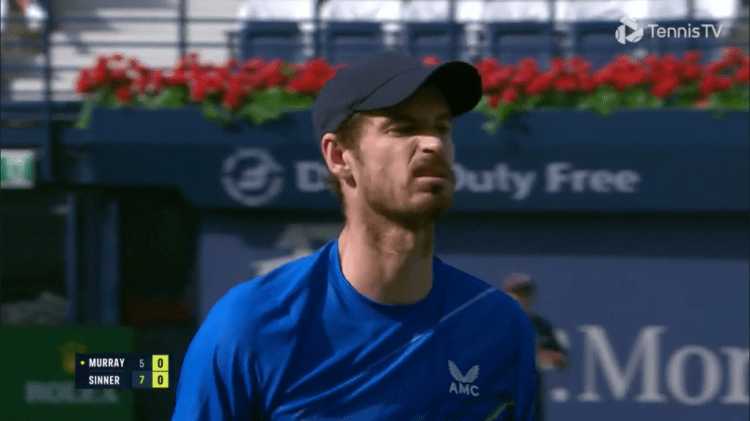
After playing one of his better points of the match, Murray gets passed by a Bautista Agut slice. His body language sags. Screenshot: Tennis TV.

So the question is, what’s the problem? What changes in 24 hours? Is that not sufficient time for Murray’s body to recover from any match now – and if so, how does he overcome that? Most of the tournaments outside of slams don’t have the same recovery window, you may get a day here and there, but for the most part a player is on court day after day after day – fatigue isn’t really an option.

And if it’s not fatigue and lack of recovery time, what else could it be? Is it a mental block? Is it the absence of a permanent coach? If it’s a mental block, how does he get past it? I don’t know the answers, I wish I did. The only thing I’m absolutely certain about at this stage is that Andy needs consistency – on the court and off it. He needs a coach, someone who isn’t afraid to tell him where he’s going wrong and what he needs to do to fix it. Someone who isn’t afraid of a challenge – because, let’s face it, right now Andy Murray is a challenge.

I hope there’s someone out there willing to take it on. Until then he’ll push on as he always does. And I’ll try to keep believing.