Every grand slam is a fantastic grand slam. Usually, it ends with Nole, Nadal or Roger (RIP) winning the men’s draw and a teenager sensation winning the women’s draw, but what really matter is the pathing, it’s the R2 matches, the epic semifinals or the weird upsets that make a slam tournament simply the best sight in sports history tied with the football world cup (Very biased opinion).
In 2022, it felt like we lived seven tournaments in one: the Australian Open.
I should begin by saying that, as we know, the Aussie swing is terrible for most of us. The time zone is insane. At the Australian Open, early round matches began at 9 PM (great!) but blockbuster action on Rod Laver Arena started at 5 AM. If you spent the evening watching tennis, you don’t really have a reliable brain at 5 AM. I napped constantly through matches. I remember in 2021, I saw Djokovic going two sets up against Fritz. I napped and woke up to both playing a fifth set. It’s mental.
On the court (not in court), it was grand slam tennis. Superb.
It wasn’t quite like the U.S. Open, with a qualifier winning the women’s draw, but it had some big upsets.
From Raducanu winning a top-ten worst match I’ve ever seen against Stephens then losing in the second round to Kovinić using 90% forehand slices because of a nasty blister to Osaka and Auger-Aliassime losing after match points up, a Mannarino resurgence, #21 and a famous deportation, the two weeks felt like six months…
But nothing, in my honest opinion, trumps the men’s doubles.
Ok, the men’s singles final was pretty awesome. Glad my sleeping brain allowed me to watch full three sets and a half, buuuut, in the back of your mind, you could see Nadal winning #21. Why not? He’s that good.
You could see the Osaka upset. You could see Collins in a major final. You could see Medvedev choking a two set lead. I don’t think anyone saw Nick Kyrgios and Thanasi Kokkinakis as grand slam champions.
You could also see Ash Barty winning without dropping a set, but that goes into the same category as the men’s doubles, with a little less disbelief.
A very deserving #1 with 113 weeks on the top spot of her sport, she was and is amazing. But better with the crowd.
Pressure is no privilege. Ask Djokovic as he attempted the calendar grand slam last year. But Barty didn’t feel it. Neither did Kyrgios/Kokkinakis, which are the focus of this commentary.
Let’s call them KokKyrgios for short. This isn’t much shorter is it? KyrNakis? ThaNick?
Firstly, I have no idea how they defeated the #1 team, Mektic/Pavic, gold medalists and the best team by far, in the 2nd round. Mainly because I didn’t watch it.
It was, like, in straight sets. They hit SEVENTEEN aces. I slept through it, because I never thought they would win it and you have to store energy in grand slams. Woke up to this amazing surprise.
If you watch the highlights, which don’t tell the whole story, the key of that match and for the whole tournament was: serving + Thanasi’s forehand + Kyrgios’ backhand.
If Kyrgios’ backhand has an awkward look to it, with a very short swing and flat strokes, it’s absolutely golden, especially on the return. The Croatian team was lost, constantly serving to that wing, with Kyrgios nailing spectacular returns. Since Mathew Willis tweeted how much better Kyrgios is returning on his backhand than on his forehand, I couldn’t unsee it. Spot on.
Kokkinakis’ forehand was absolutely popping. He had just won a title the previous week, in singles, but couldn’t handle the physique of his round one match, losing in straight sets. Nick had a good first round win in singles, but faced the world number two, Medvedev, in the second round. He even got a set! It’s safe to say that it was in this match that the pandemonium started, along with a grand slam dream. Nick played Daniil on Rod Laver Arena, the biggest of the Australian complex, to a rowdy crowd. Excited by Nick constantly, as he urged them to roar and yell every time he did something crazy, this atmosphere, despite not being able to distract Medvedev for long, would be a key to KokKyrgios’ doubles run.
As the commentator said before their third round match against Behar/Escobar: ‘’Welcome to the jungle, aka Kia Arena’’. The brand new stadium sponsored by Kia was the showroom for some comedic, and eventually awesome, tennis.
Kokkinakis the Serious, Kyrgios the Jester. With every single point followed by the ANNOYING and UNBEARABLE ‘’Siiiuuu’’ (I always thought it was “SIII,” I have no idea where this U came from), they defeated four seeded teams from the 2nd round to the semifinals. With NINETY FIVE aces in the campaign, they found an absolutely delightful groove. They played tennis, good tennis.
Hate the player, don’t hate the game. What Kyrgios is of a skillful player, he’s a prick. Pardon my Australian. He’s got quite an unflattering history, from randomly and audibly bringing up Donna Vekic in an R-rated context while playing Stan Wawrinka to throwing a chair on court. And he was not immune to annoying antics this tournament. He complained to umpires, threw rackets and, the cherry on the pie, exposed locker room heat with another team coach and went after one of his opponents in the final, all on social media.
Petty, small, egocentric. If his focus on his ego would go to his tennis…
Regarding his tennis, I’ve never seen him serve so well. He managed to hit 38 aces in two singles matches, being in the top 20 of ace leaders this Australian Open. In doubles, if he wasn’t acing, he was making sure Thanasi had a sitter on the net, exactly how it happened on their championship point.
Thanasi, on the other hand, was not behind on the quality of his serving and hit some of the best forehands I’ve ever seen him hit, while smiling seemingly uncomfortably as Kyrgios did his bits. They took their chances and played break points and other decisive points super well. You didn’t see this coming, did you?
I knew that Tennis Twitter wouldn’t be ready for Nick Kyrgios as a grand slam champion. I totally get it. Especially since we talk so little about doubles. (We should change that.) But for me it was like a car crash I couldn’t look away from. One of those scenes you have to see to believe and when you’re actually seeing it you still can’t believe it, especially since Nick’s on court reaction was like ‘’What, like it’s hard?’’ Well, it was supposed to be!
The title didn’t seem to change Nick that much. He still posted some controversial things on Instagram, but that won’t change if he’s slam champion, or #300 in the world. Thanasi had his story crowned with this amazing comeback story, since struggling so much with injuries. A three year period of struggles reminding us of Juan Martín del Potro, who just this week announced a very likely retirement, which left us all in tears. Thanasi, though, is younger and seems to be on the right path of a safe return. A singles and a doubles title in three weeks is not bad at all!
Neither won alone. A perfect storm to crown a crazy grand slam.
Nadal, Barty, Krejcikova/Siniakova…. Kyrgios/Kokkinakis… Aussie Open champions. There’s no place like home.
It was the best of times, was the worst of times, it was the age of wisdom, it was the age of foolishness, it was the epoch of belief, it was the epoch of incredulity, it was the season of light, it was the season of darkness, it was the spring of hope, it was the winter of despair.
I wish I could say I wrote that quote, but of course that would be plagiarism. I’ve got Charles Dickens to thank for this paragraph of literary wonder that pretty much sums up every feeling I have when I watch Andy Murray play tennis.
Just yesterday we experienced some of the best of times watching Andy devour an in-form and recent Montpellier champion, Alexander Bublik, in straight sets. Like our Dickensian counterparts, this little morsel of goodness left us begging “please, Sir, I want some more…”
Alas, it wasn’t to be. Felix Auger-Aliassime embraced his role as the villainous Fagin and sent our hero packing with a one way ticket out of Rotterdam Central back to London. The spring of hope quickly became the winter of despair as Murray simply couldn’t keep up with the young Canadian in the first set – one break of serve from the steely Scot simply wasn’t enough to counter FAA’s early double break and the Montreal native wrapped the set up efficiently with Murray managing only one winner. The 6-3 scoreline flattered Andy, who had to grind from 4-0 down to avoid a bagel or breadstick.
The age of foolish, the epoch of belief, returned – as we entered the second set Murray seemed to be getting into his stride. The fire in his belly was back and he was ready to fight. We started to believe he could do it in three. Felix had other ideas. A break of serve from FAA, an immediate break back from Andy – this set had tiebreak written all over it… until Felix broke again and the season of darkness descended. All hope was lost and we were clinging on for dear life.
Running till the end: Murray throws himself beyond the tramlines in an effort to make Auger-Aliassime play a tough volley on match point. Screenshot: Tennis TV YouTube Channel
Yes, reader, I know I’m being dramatic, but let me wallow in my own self-pity for a moment.
I’m disappointed Andy couldn’t go further in Rotterdam. I’m disappointed he doesn’t get a rematch with Tsitsipas. I’m disappointed that my bracket – in which I so confidently (stupidly?) predicted Andy would win the entire tournament – is in tatters. But mostly I’m disappointed that I won’t see another one of Scott Barclay’s “Happy Andy Murray plays a tennis match today day” tweet for the rest of the week.
So there is many a headache here at Murray Musings HQ currently, either from one too many last night or from heads being bashed against keyboards by an unknown assailant yesterday morning…
Anyways…
HAPPY ANDY MURRAY PLAYS A TENNIS MATCH TODAY DAAAAAAAAYYY! 🎂 🥳 🎉 🎊
But what I can take away from the start of this year is that with every passing tournament we see more grit, more determination, more will to succeed. We don’t always get the results we hope for, but those flickers of Murray magic we saw so infrequently last year are starting to come at us harder and faster – soon those flickers will turn into flames, and when they do we’ll still be here, watching, cheering, ready to fight.
I fought back tears when Juan Martín del Potro embraced Andy Murray at the net following their epic Olympic gold medal match in Rio in 2016. There was so much emotion between them in that moment, that it’s hard to believe they weren’t always like that with one another.
My first memory of the Tower of Tandil is – admittedly – not the best. If you’ve read my writing before, you’ll likely have realised by now that most, if not all of it, links back to one man: Andy Murray.
And it’s with Andy that my Juan Martín del Potro story began.
The first time I saw Delpo – who I now know to be as giant in heart as he is in stature – play, was against Andy in the first round of the Rome Masters in 2008. He was 19 and seemed to be full of bravado and attitude – allegedly even trash talking Andy and his mum. I remember watching that match thinking “who does this guy think he is?” And – “WHO is this guy?” Simultaneously.
I couldn’t get over his audacity towards Andy, whilst at the same time being utterly mesmerised by his tennis. He was officially on my list – but I was undecided whether it was my shit list, or my one-to-watch list.
In the end it was the latter. I watched in awe as he won his first ATP title against Richard Gasquet in Stuttgart and back that win up a week later with his second title in Kitzbühel. His back to back titles in Los Angeles and Washington had me thinking he was going to cause an upset at the US Open – before he ultimately lost to Murray in the quarterfinals. But by then, I was hooked.
I loved Andy Murray, first and foremost, above anything else. He was scrappy, grumpy, Scottish, a sore loser – I related to that. I loved Djokovic – shallowly, because when I was 22, I thought he was a “total babe” (his tennis definitely came second back in 2008) – but I loved Delpo because his tennis blew me away. I had no links to him, he didn’t have the sort of fanfare that came with Federer or Nadal at the time, that just encouraged you to support him – he was just another player on the tour. But he wasn’t just ANY player on the tour – he was going to be one of the greats. And every time I watched him play I could feel a bubble of excitement growing in me, getting bigger with each passing shot. This guy who dared to talk smack to Andy Murray might just be one of my favourite players.
I predicted he would win the 2009 US Open to anyone who would listen to me (that wasn’t many) – and when he did, when he achieved what was almost impossible in 2009, beating Nadal and Federer on his way to lifting the trophy, I knew that one day – soon – he would be sitting on top of the world rankings with multiple slams under his belt.
I could never have predicted the injuries that wreaked havoc on his career. In my head it should all have played out so differently: we would talk about the big five – those five incredible players who fought it out between themselves over a decade to win tennis’s biggest prizes, constantly swapping rankings, the year end number one spot always up for grabs as the ATP Tour Finals came around. Federer, Nadal, Djokovic, Murray, del Potro. Some may chastise me for missing Stan Wawrinka out of the mix, and I mean no disrespect to the great man, but I think in my scenario of Delpo (and the rest, let’s face it, they’ve not all been without their woes) being fully fit for his entire career, as a group they wouldn’t have given Stan an inch.
I count myself lucky to have watched Delpo play at his peaks – in 2009 and again during his resurgence between 2016 and 2018. Rio 2016 will live rent free in my mind forever – I wanted Murray to win that match so badly, and yet I still felt the heartache of Delpo’s loss. He is the only player to ever go up against Andy that I haven’t, in the heat of the moment, despised – even just for a split second. Even when he beat him in that gruelling five set Davis Cup match in Glasgow. There’s too much about Delpo to like to even consider relegating him to the sin bin.
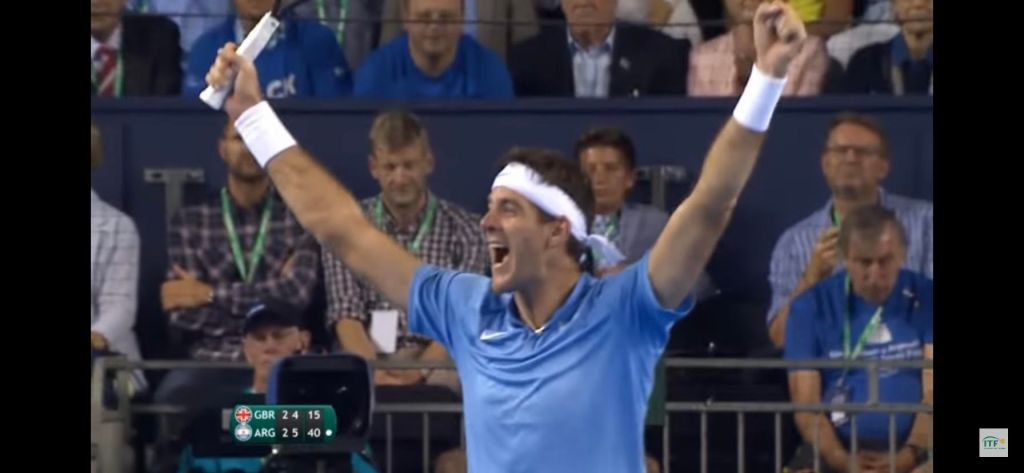
Delpo celebrates a whale of a win against Murray at Davis Cup: five hours, seven minutes, after being down two sets to one. Screenshot: Davis Cup YouTube Channel
I’ll let you in on a secret. I’m not really a crier (that’s not the secret, anyone who really knows me will tell you I’ve got a heart of solid stone, it takes a lot for the waterworks to come) – but in 2019 even when it looked like it was all over for Andy Murray, I didn’t cry. Maybe it’s because I knew it wasn’t really the end. I didn’t hear the bell. I refused to hear the bell.
But when Delpo made his announcement earlier this week that he would likely retire after playing the Argentina Open in Buenos Aires I cried. I cried for him, for what he missed out on, and I cried for tennis fans and what they never got to see. The crushing pain and heartbreak was laid out on the table for us all to see, and it was shattering. In his post-match interview he said “maybe I don’t have the strength that everyone thinks I have” – and I would agree with that. Because he has more strength than any of us could ever imagine. He has it by the bucketload. He fought, he endured, he pushed himself to his limit and he achieved such greatness along the way. Imagine what he would have done if he had been fully fit. The tennis world was a better place with Juan Martín del Potro in it.
Delpo deserved so much more than he got. He deserves to have his name spoken alongside the greatest of the game. I wanted so much more for him. But as Mick Jagger once said, you can’t always get what you want. Thank you for the memories Delpo – you really are juan (sorry) of a kind.
Another grand slam has been and gone and it has been yet another that has given us plenty of storylines surrounding a group of players likely to dominate the men’s tour for the next decade or so. As such, I thought I’d take a look at the respective campaigns of these players, giving them a rating out of 10 for good measure too. I should preface this by saying that these players have been rated relative to expectations surrounding them rather than compared with each other. You won’t agree with all of my ratings, you may not agree with any of them but I hope I can give some justification to my choices.
Jannik Sinner: 6.5/10
Sinner progressed through his opening rounds with fairly little stress. The highlight of his tournament was probably in the round of 16. He beat Australia’s Alex de Minaur in three fairly comfortable sets which seemed like a statement victory. There was quite a lot of anticipation surrounding his quarterfinal clash against Tsitsipas. Given how well Sinner had played up until that point and the uncertainty regarding Tsitsipas’s elbow, it was thought that Sinner may even come out on top but this match was a bit of a dud. Tsitsipas cruised through in straight sets and although he did play very well, Sinner’s overall performance was pretty disappointing so he gets the slightly harsh rating of 6.5.
Denis Shapovalov: 7/10
Despite being around for what now seems like an eternity, Denis Shapovalov is still very much part of the next generation. Since he burst onto the scene in 2017, Shapovalov’s career has had its highs and lows and this tournament was in some ways a microcosm of that.
His straight-sets victory over Alexander Zverev in the round of 16 was one of the most impressive victories of his career to date. His performance included some of the glitz and glamour we have come to associate with him at his best. He had the world number three befuddled and on that form, it seemed as if he could beat anyone.
This optimism was dampened significantly about an hour and a half into his quarter final match against Nadal when he found himself two sets down. His on court demeanour wasn’t the best either as he complained on numerous occasions about the time Nadal took in between serves. At one point he even claimed that “you guys are all corrupt” to the umpire.
When it seemed as if he would fall to a straight sets loss, he fought valiantly to take the next two sets, at which point he had all of the momentum going into the decider. Being the champion that he is, Nadal of course had a major say in that fifth set as he won it in pretty resounding fashion, but make no mistake, Shapovalov very much lost that match on his own terms. His reaction at the end was testament to as much as he destroyed the racket that had let him down in that final set.
Shapovalov’s discipline has often been questioned and the aftermath of that loss to Nadal was a case in point.
Let’s not get it twisted, it’s incredibly difficult to be magnanimous after suffering a crushing defeat like that. It can often take a while to process what you’ve just been through so I don’t want to criticise Shapovalov’s conduct too much. That being said, his behaviour both at the end of the match and in his press conference where he doubled down on his comments about Nadal left a sour taste in the mouth.
Effectively using the time Nadal takes between points (which I concede must be quite irritating to deal with) as an excuse displayed a certain naivety which doesn’t bode particularly well for him going forward. Whilst his complaints may have been valid, Shapovalov lost that match largely due to his own mental failings. Failing to recognise that, externally at least, is quite worrying and it is for that reason alone that Shapovalov only gets a 7.
Stefanos Tsitsipas: 7/10
You may raise your eyebrows at the fact that Tsitsipas only gets a 7 despite going further in the Australian Open than everyone else on this list. As I mentioned at the beginning of this piece, these players will be rated relative to expectations of them at the start of the tournament. Some had Tsitsipas going all the way here, even taking into account the injury to his elbow. Given that that appeared not to hamper him in any way, it was then a bit of a disappointment that the campaign ended in the manner that it did.
His five-set epic with Taylor Fritz was one of the matches of the tournament. Tsitsipas showed great physical and mental durability as he came back from two sets to one down to beat an opponent who was playing the match of his life.
In beating Sinner in straight sets in the quarterfinals, Tsitsipas looked like he could really give Medvedev problems in his next match. Although he did to a point, it still seemed a slightly futile effort after the promise he had shown in the previous round.
After he levelled up at a set all, the way he fell away so rapidly in the next two sets, particularly the fourth, was very anticlimactic. So although he reached the semifinals after only recently having surgery on his elbow, ultimately the end of that match meant he only earns himself a 7 here.
Carlos Alcaraz: 7.5/10
After a quarterfinal run at the US Open which included a seismic victory over the aforementioned Stefanos Tsitsipas, it wouldn’t have come as a major shock if Carlos Alcaraz had a bit of a dip at his next grand slam event. The best of players have been prone to succumbing to the pressure after performing well at a major so it would have been perfectly normal for an 18-year-old to go through the same thing. However, Carlos Alcaraz had no such problems. In fact, there’s an argument to suggest that his performance at the Australian Open was more impressive than his achievement of reaching the quarterfinals at last year’s US open merely because of the added expectation upon him now.
In his opening two rounds, Alcaraz demonstrated a ruthlessness rarely seen among teenagers as he dispatched both of his opponents mercilessly in straight sets. It says a huge amount about how far he has come in such little time that he went into his match against Berrettini only a marginal underdog, even as the favourite for some.
Throughout the four-hour-plus epic, Alcaraz displayed another trait which is frankly mind blowing for someone his age. After losing the first two sets despite not playing especially badly, it would have been absolutely understandable for him to fade away in the Melbourne heat with thousands of spectators watching the man 8 years his senior stamping all over him. A gnarled, battle worn competitor may have wilted in those conditions, let alone someone who was barely old enough to have a driving licence. But Alcaraz dug in to play some sublime tennis as he went on to win the next two sets with Berrettini all at sea.
Alcaraz celebrates winning the third set. Screenshot: Australian Open YouTube Channel
He fought tooth and nail in the fifth, somehow not fading even slightly as he eventually lost in a match tiebreaker. It felt extremely cruel that in the end, the match was decided on an Alcaraz double fault after everything he had put in but in spite of that, he left the Rod Laver Arena that day with his head held high. Even though Alcaraz was the first departure of the tournament from those in this list, he earns himself a 7.5 rating due to how he performed considering his age.
Felix Auger-Aliassime: 8/10
Although this wasn’t actually the deepest Auger-Aliassime has gone in a Grand slam, for me it was more of a breakthrough than the US Open semifinal he reached last year. On that occasion, he lost in fairly tepid fashion in straight sets to Daniil Medvedev. This time round, he came out a different man as he progressed through the first week with very little fuss, playing especially well in his dismantling of Dan Evans in the third round.
In the quarters, he was tasked with facing the man who had beaten him so easily at the last grand slam but this time it was a different Auger-Aliassime that Medvedev had to contend with. He won the first two sets after playing tennis worthy of a champion.
Now, on the face of it, losing the next three sets isn’t the best look, but he failed to go away throughout, making Medvedev fight for every point. Over the course of that match, Auger-Aliassime demonstrated a mentality previously unseen from him. The quality of his tennis has been long known by keen followers of the sport so it wasn’t this that was surprising about Auger-Aliassime’s run. Whilst we’d seen that before, we’d never really seen the grit he showed throughout that defeat and it is for this reason that I rate him higher than all of his peers.
***
As I mentioned, you probably won’t agree with all of my ratings or even my order, so feel free to drop yours in the comments.
Juan Martín del Potro covered his face in his towel. It quickly became clear that this was not a brief cry but a long, messy cry, tears brought on by the pain and the crowd’s support and the pain and the moment and the pain and the sheer injustice of the years of injuries. Trailing his countryman Federico Delbonis 1-6, 3-5, it was obvious the match was over, and with it possibly del Potro’s entire career. Life comes at you fast, and for del Potro, it had sped by on the court in all the worst ways.
In his press conference, Del Potro said he will always leave the window open for a miracle which might allow him to return.
But also that he needs to put tennis to one side and to find a solution for his knee to live without pain.
Delpo’s career has been characterized by lost potential. As a baby-faced 20-year-old, he became the first man to win a major by beating both Federer and Nadal. Just one player has equaled that feat since (you can probably guess who). In the twelve-plus years to follow, del Potro has been assailed by injuries. He has impressed during his fleeting healthy periods, but the Big Four challenger he once appeared to be has been lost to the ghosts of the hypothetical.
It’s a testament to del Potro’s immense skill that he’s one of just five men (the others are Wawrinka, Čilić, Thiem, and Medvedev) who have broken through the Big Four stronghold to win a major in this era, and what was taken from him is arguably talked about more than what he has. When healthy, he was a privilege to watch, when not, his perseverance was an inspiration.
His latest injury, to the knee, kept him out of the game for another long stretch. Fans were elated to hear about his presence at the Buenos Aires tournament, but the glow turned to horror quickly as del Potro announced his return was more a farewell than a comeback.
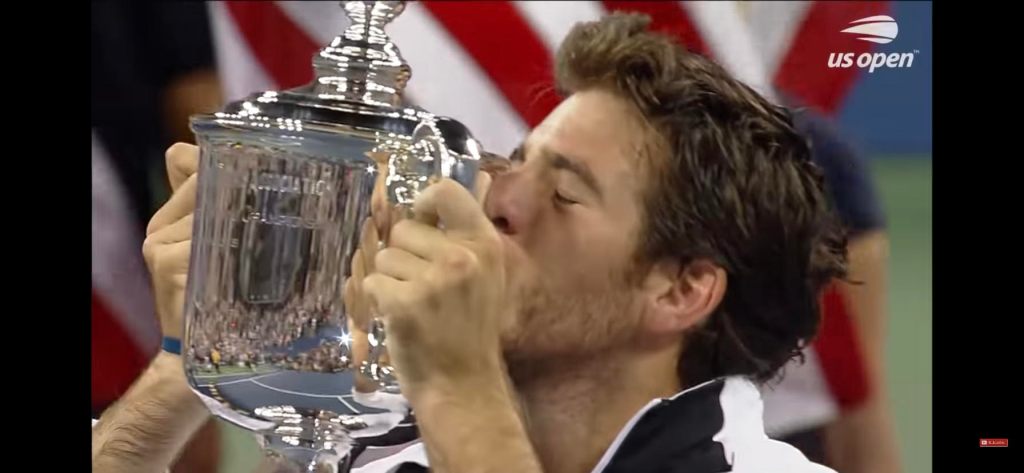
Juan Martín del Potro, awash in happy tears, kisses the U.S. Open Trophy. Screenshot: U.S. Open YouTube Channel
Really, it’s no surprise that del Potro returned to the court even physically diminished. “Tennis is my life. It’s my passion,” he said in Spanish during press on February 5th. He knew his time was up, but there was simply no way he was going to say goodbye to his career off-court. He loves tennis too much for that.
*****
The match itself was alternately difficult and joyous to watch. Delpo was incapable of running around to hit forehands from the ad side, but nostalgia crept in as he managed to blast a few comets past Delbonis. Delpo’s body couldn’t sustain his game of old — he could run a bit, but not quickly and not far. His serve and backhand lacked pace. He had obviously put everything into his comeback, allowing himself to fall apart on the court with the knowledge that this was as good as it would get.
Delbonis got trigger-happy with the drop shots, especially once it became clear del Potro was struggling with his movement. Some suggested they were disrespectful, but I’d argue the droppers showed del Potro the utmost respect. However diminished he may have been, he is a legend of the game, and Delbonis decided he simply couldn’t take any chances. I can’t fault him for it. I was watching on TV when del Potro beat Thiem 1-6, 2-6, 6-1, 7-6 (1), 6-4. Besides, a tennis match is a tennis match. Players don’t open the door for their opponent out of respect. It might have sucked to watch the drop shot torture, but neither tennis nor Delbonis exist to be my emotional pillow. He gave the match his all, as I’m sure Delpo would have wanted him to.
*****
Delpo said after the match that he may not be as strong as some people think. I’d argue the opposite. He could have called it quits in 2010. Or 2014. Or 2015, or 2019, or last year. He’s talked about not being able to sleep without pain. His body has betrayed him in pretty much every way imaginable, and yet he’s tried to tame it, tried to bargain with it to let him play the game he loves once or twice more. He’s overcome obstacle after obstacle. He’s revived his career every time it tried to suddenly die on him.
We don’t often take into account the lengths athletes will exert and push and sacrifice their bodies for their sport, so often leading to long term ailments.
Juan Martin del Potro simply wants to SLEEP without pain now.
We can focus on the fact that Delpo was robbed of an exponentially more impressive career. But equally salient to me is that while this ending is painful, it also represents a great triumph. Through the brief spells during which his body would oblige his efforts, he did amazing things. He beat Djokovic and Murray at Indian Wells in 2013, then almost beat Rafa as well. Later that year, he dueled Djokovic in one of the all-time best matches at Wimbledon. Five years later, he had an equally outrageous match with Nadal. At the 2016 Olympics in Rio, Djokovic entered as the world No. 1 and winner of four of the last five majors. On the hunt for his first gold medal, he could hardly have been more motivated. Delpo beat him.in the first round. In straight sets. Not content with that, del Potro went on to beat Nadal in a classic semifinal and gave Murray a hell of a fight in the gold medal match. Unbowed by the loss, Delpo beat Murray in a staggering five-hour, seven-minute match at the Davis Cup a mere month later.
There was one point in that match that I won’t forget. Two points away from losing, Murray locked into wall mode. Three times, he ran down a del Potro missile to the open court and threw up a towering lob just before the ball bounced twice. It was defense at its finest. Delpo, unimpressed, eventually crushed a smash winner. He pumped his fist, totally focused. Then he bashed an ace down the middle to win the match.
The aforementioned point against Murray begins at 3:51.
In that moment, del Potro was as relentless as a player can be. His forehand may be the purest form of firepower tennis has ever seen. He once hit a forehand winner against Federer at the 2017 U.S. Open that was so violent — Federer’s racket thwacked the court sharply as he tried to reach it — that I worried the Swiss had hurt himself. (It happened when Federer served at 5-all, 30-15 in the first set.)
Somehow, del Potro has managed to blast his world-beating forehand past just about everyone while maintaining an image as a gentle, kind soul. When he slams a 100 mph bomb on the run, his opponents don’t curse the gods and devils they believe in, they look over the net at him and smile. It’s paradoxical and enchanting to watch, but mostly it’s just nice.
If I'm Del Potro, I'm retiring and never shutting up about that time I beat Roger Federer in a Grand Slam final in a five set epic on the biggest stadium court in the world. For real, go annoy your friends and family by forever reminding them that you did that, big man. 💕
Endings are messy, and this is one of the messiest I’ve seen in tennis. What-ifs will rightfully ring out for years to come. Still, I think there’s a happy story in here somewhere, or at least a thread of one. Juan Martín del Potro had every reason to shut down his career years ago, yet he persisted. The great Argentine gave us a vault of memories remarkable in its depth considering how few matches he has been able to play. He walked a glass-littered road with bare feet and covered an astonishing distance anyway. He did it. And now he can rest.
0-40. What does this score mean? If you’re serving, you have your heart in your mouth. You can’t afford to play a bad point now. You have to maximize the advantage of serving. If you’re returning, you have a lot more margin. You have done the hard bit of putting the opponent under pressure. Now, all you need to do is apply the finishing blow in this game. You have three chances to do that.
An average tennis player wins about 65% of their service points. Mathematically, there is about a one in five chance for a player to come back from 0-40 down. Obviously, this number varies for every player. Someone like Ivo Karlović has a better chance of coming back from 0-40 than someone like Diego Schwartzman.
Tennis is cruel and unforgiving. One of the major reasons for that is its quirky and unique scoring system. In tennis, you “merely” need to have the last word. You “only” have to win the final point of the match. Not all points are made equal. A point won at 30-30 is far more significant than a point won at 30-0. As such, for the server, winning a game from 0-40 down is huge. As a returner, breaking the opponent’s serve to love builds momentum in the set. This is especially true if it is a Grand Slam final.
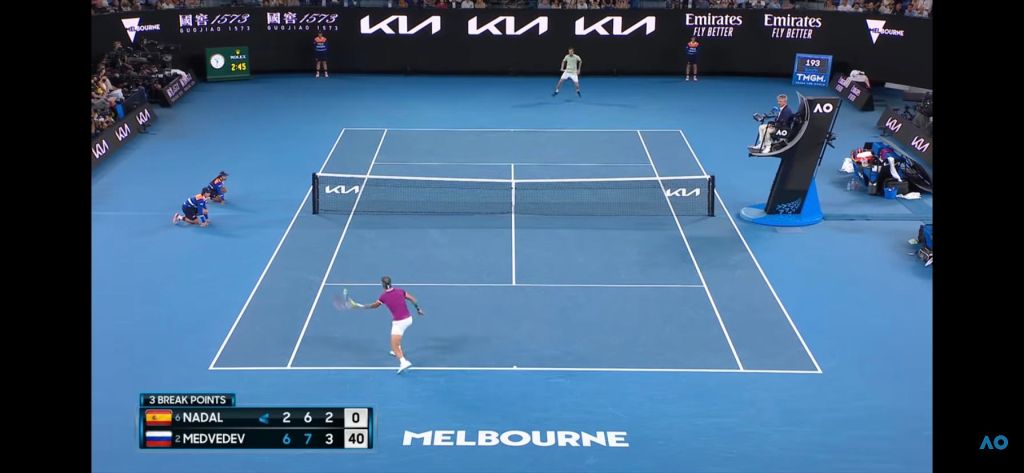
Okay, why have I written a whole load of obvious nothingness? That is because these 0-40 games (which are few and far in between) are sometimes the key turning point in a match. One of those – 2-3 0-40 in the third set of the 2022 Australian Open men’s singles final. Rafael Nadal saved those three break points, held serve and went on to win a record-breaking 21st major title.
With his back against the wall, Nadal looks to the drop shot to save the first of three break points. Screenshot: Australian Open YouTube channel
My first instinct when Rafa saved those break points was, “He’s going to win this now”. As the dust settled on that historic night, I revisited my instincts. Why did I feel like that? From the evidence of that match, there was nothing to suggest Nadal would win, even after that big hold. Medvedev had a read on everything Rafa threw at him, he was clutch when the situation demanded him to be and up until then, he had put up one of the finest backhand performances I have ever seen in a Grand Slam final.
Yet, my first instinct was that Rafa had become the favorite. At that time, I chalked it down to my respect for Rafa as a competitor, his vast experience in these situations and most importantly that he is Rafa. All of that is true. However, none of that was sufficient for me. So, in these past few days, I have taken a dive into some of the Grand Slam finals that Rafa has played in. I didn’t get into the finals which he won or lost in straight sets since that obviously meant either he was too good for the opposition or that his opponent was too good for him. I however did include “virtual finals,” i.e. a semifinal against a Big Three counterpart. Why did I do that? My main motive was to check for 0-40!
Going through these finals, I found that Rafa has won almost 30% of all his service games when he fell 0-40 down. In contrast, until 2019, he had failed to convert 0-40 opportunities in a return game only twice in all his Grand Slam finals. I leave it as an exercise to the reader to find out those two games.
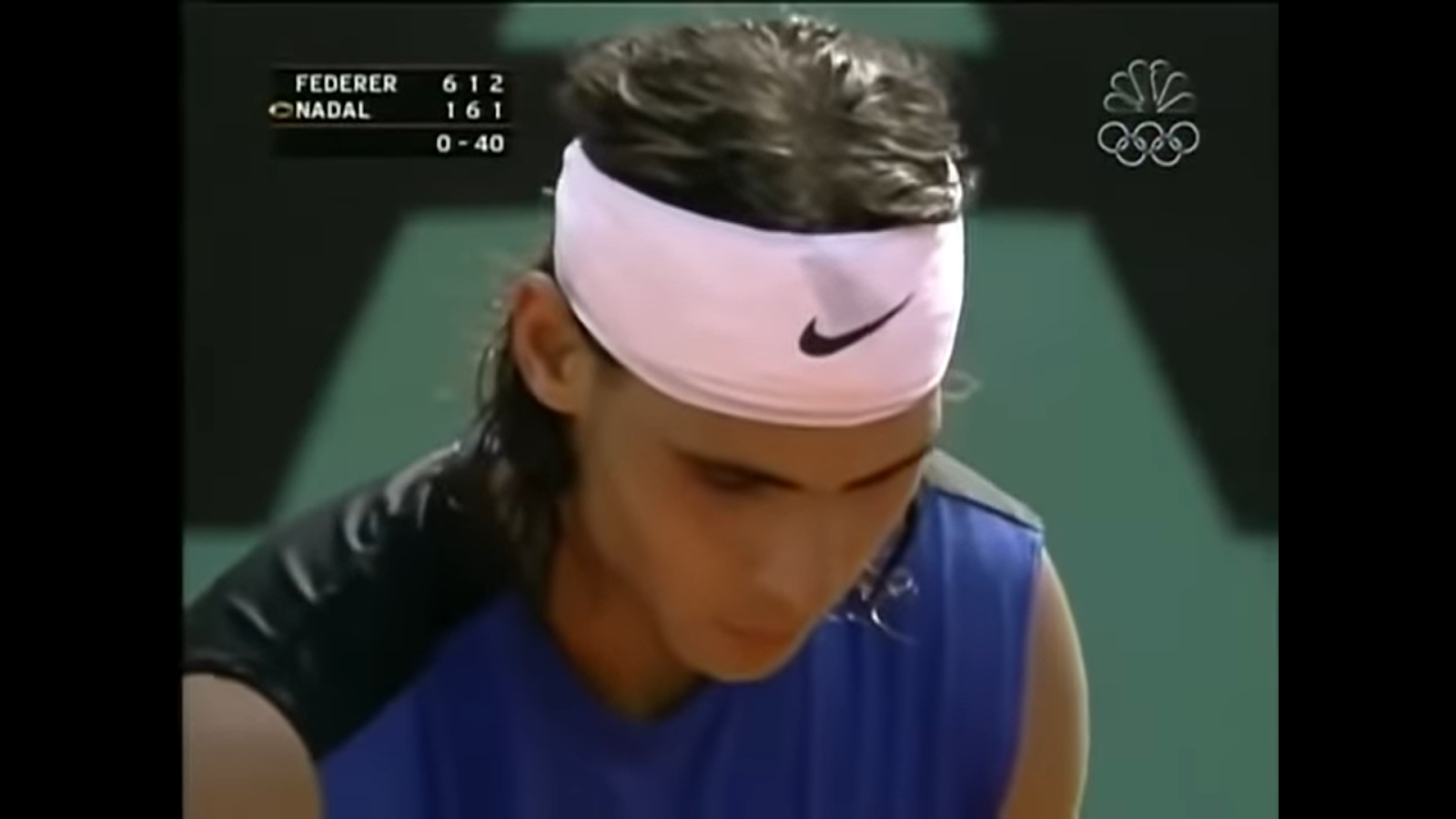
Naturally intrigued, I then decided to look at how the specific 0-40 games affected the dynamics of the respective matches. It’s of course not all that helpful if you survive 0-40 only to get broken in your next service game. I found out that every time Rafa held serve from 0-40 down, he went on to win the set barring one exception(Australian Open 2022 first set). In the 2006 and 2007 French Open finals vs Federer, Rafa saved 0-40 twice. In 2006, it was in the third set at 1-2.
Figure: French Open 2006 Final, via the NBC broadcast.
He then broke Federer in the next game and went on to win the set.
In 2007, it was in the first set at 4-3 right after he had broken Federer’s serve for the first time in the match. Rafa saved the breakpoints, then went on to break Federer’s serve again and won the set.
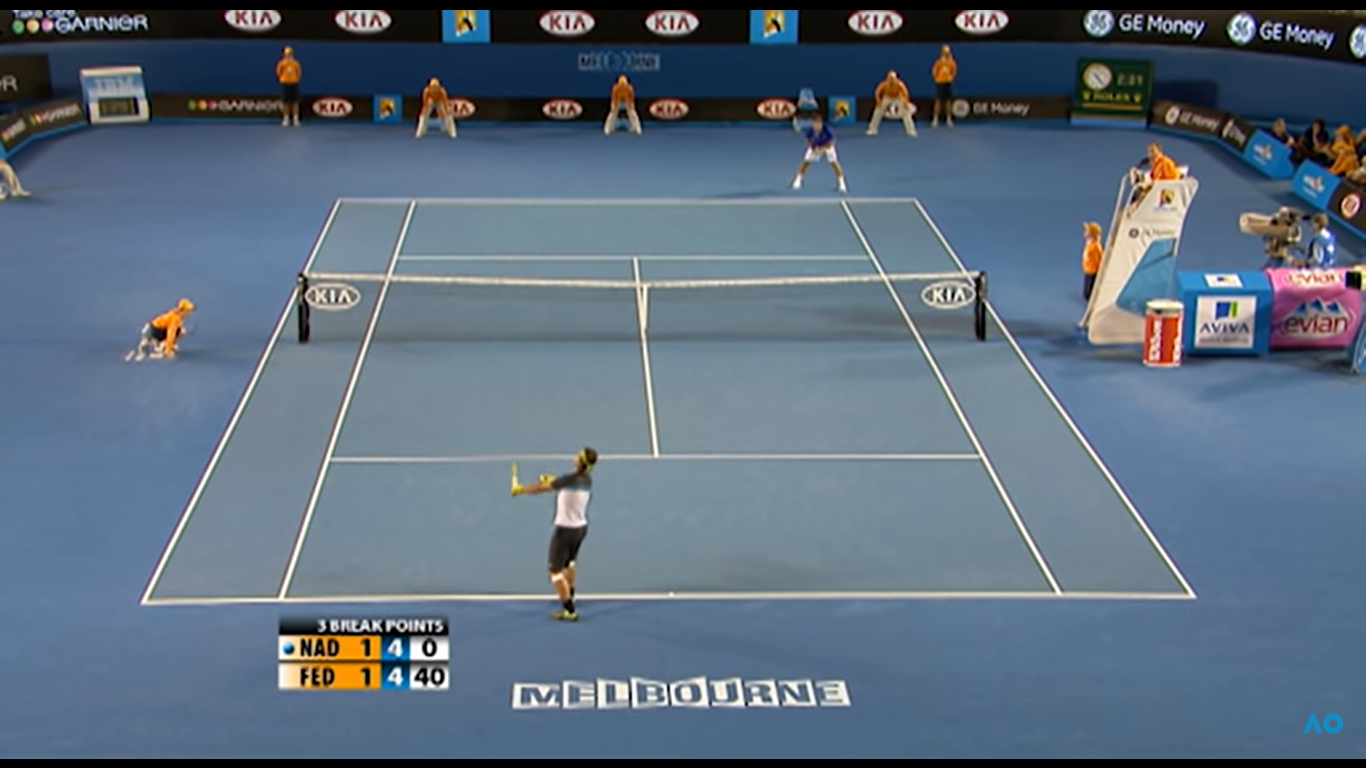
When it comes to the majors on hard courts, Rafa came back from the brink in the 3rd set of the 2009 Australian Open final, which was widely regarded as the turning point of the match.
Figure: Australian Open 2009 Final, via the Australian Open YouTube Channel.
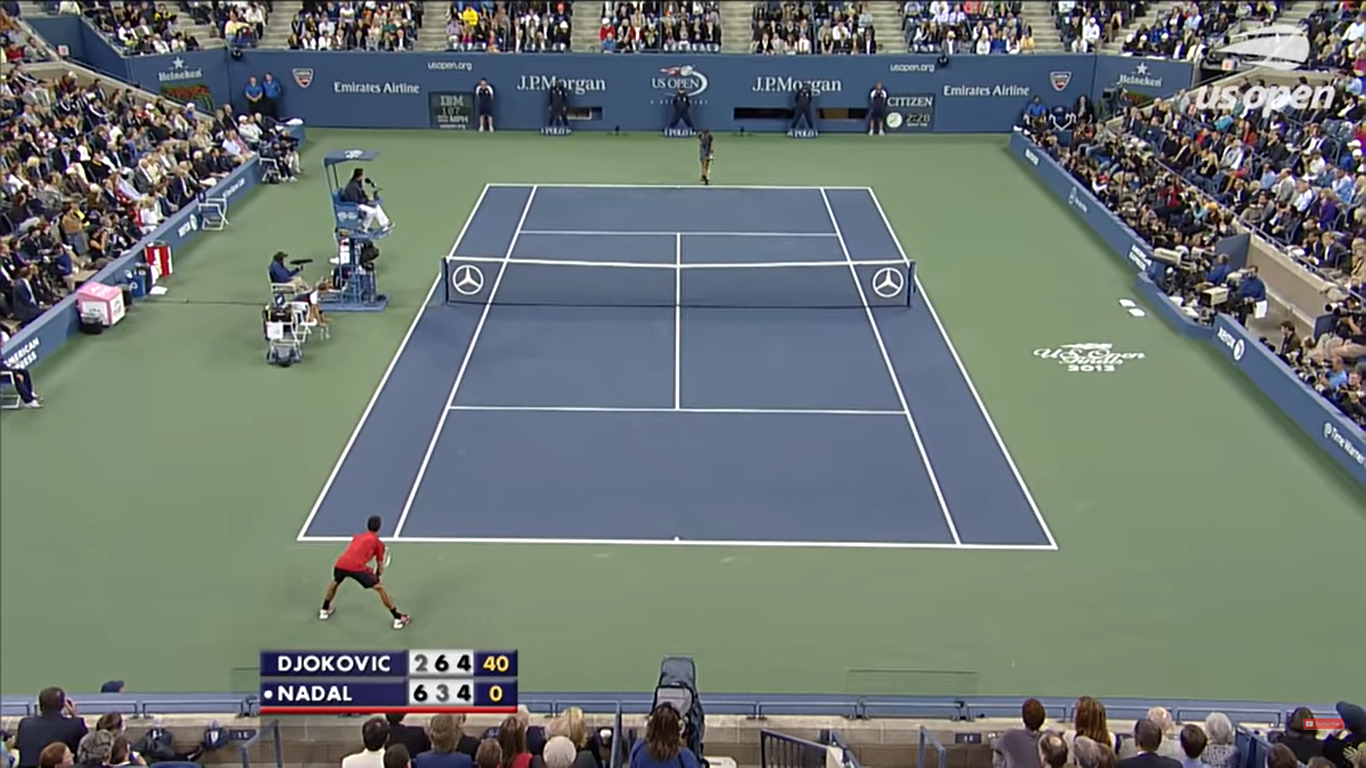
The same happened in the 2013 US Open final, again in the 3rd set.
Figure: U.S. Open 2013 Final, via the U.S. Open YouTube Channel.
So far, it was clear to me that Rafa is absolutely elite at converting these huge opportunities. However, I didn’t fully understand the significance of “30%”. Was it better than his career average? Was it better than the tour average? I didn’t have an immediate answer. In search of this answer, I stumbled into this piece from Jeff Sackmann. It shows numbers from about six years back but I think it’s not unfair to assume that those numbers haven’t changed all that much.
In Grand Slam finals, Rafa is about +7% on his career average in winning games from 0-40. In tennis, that shift is hugely significant. It’s the difference between #20 and #21. As it turns out, that ability of his, to keep defying his opponent, may well have made him the greatest ever.
At this time, I can now understand my instinct. When his back is against the wall, Rafa produces his best tennis and reverses the momentum of the set, dealing a significant psychological blow to his opponent. He hangs around long enough for his opponent to start seeing ghosts where there are none.
One of the greatest strategies of all time is to simply hang around. When things are not going your way, just hang around. Don’t go away. Things change. Seasons change. Night can turn to day. 20 can turn to 21 if you just… hang around. 🇪🇸🎾. Congrats Rafael #Nadal 👏👏 #AusOpenpic.twitter.com/yCppdZgVg1
At the end of the 2022 Australian Open final, Mark Petchey summarized the match as, “The line between desolation and elation was almost invisible.” In reality, it was visible. That line, for Rafa, was 2-6, 6-7, 2-3, 0-40.
How seriously you want to take these is truly up to you. Feel free to guess who wrote these as well.
1. A match gets played. The losing player, usually the favorite in this scenario, doesn’t play very well. “This is to take nothing away from the winner,” a pundit begins, then proceeds to repeatedly take credit away from the winner by listing everything the loser did uncharacteristically badly.
2. “Siuuuuuuuuuuuuuuuuuuuuuu!”
3. A player picking the wrong side for a putaway more than once in the same match.
4. “Richard Gasquet has one of the best backhands in the world. It’s just so nice to see one-handers on tour.”
5. “Nick Kyrgios is good for the game.”
6. The crowd “oooooh”ing when more than one slice is hit in a row in a rally.
14. “Wimbledon is the most prestigious tournament.”
15. Commentators referring to an old match and getting the year wrong.
16. Benoit Paire tanking.
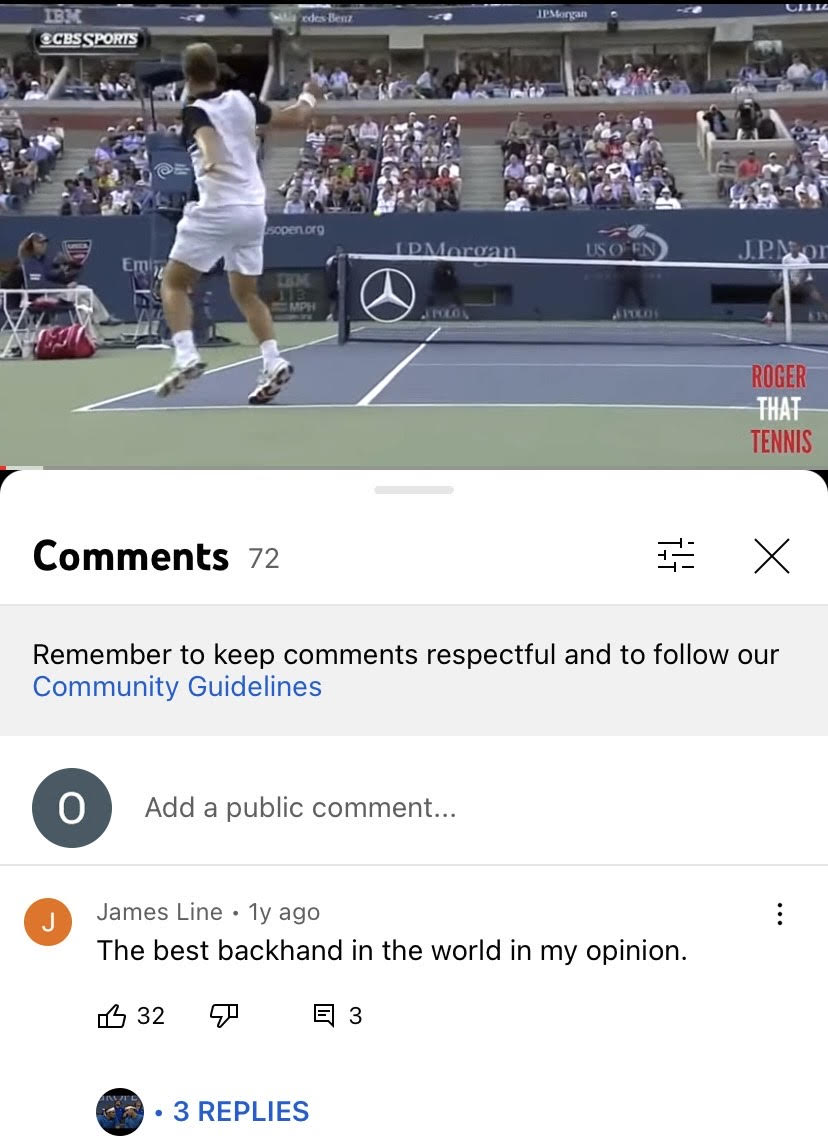
17. The notion that beauty isn’t subjective, but that effectiveness is. “Medvedev’s backhand just looks so weird, John!”
18. The coin toss before a match to decide who serves. That’s a game of luck, come on. Have them fight for the honor.
19. Or at least have them do rock, paper, scissors.
20. Best out of three, obviously. Best of one is a sucker’s game.
21. “About to join the Zoom call, buddy!” Then Scott proceeds to take another half-hour, tweeting during the process – I follow the guy! Does he know I can see his tweets?
Photo: Scott Barbour/Getty Images
22. Acting as if it isn’t annoying that Nadal takes hours between points. Yes, the shot clock is annoying, but yes, it is a rule, and yes, he constantly takes longer than he should.
23. Tennis Channel: “and our match of the decade is…the 2019 Wimbledon final!” The second set was a breadstick, guys.
24. A five set match finishes. Commentator: “and that is one of the best matches YOU WILL EVER see.”
25. A player double faults on match point after a brilliant contest, and the commentators repeat a variation of “what a shame” for the next five minutes. “What a pity,” “you hate to see it end that way,” “how must they be feeling?” For God’s sake, we get it.
26. Commentators just kind of ignoring that the return of serve is a relevant factor in matches.
27. Brad Gilbert’s nicknames for players. They are not and have never been funny.
28. The fact that Tennis Channel or Tennis.com hasn’t reached out to us to offer paying our writers handsome salaries yet.
29. Putting your heart and soul into a piece, proudly posting it on Twitter, then checking back in an hour and seeing that it has more obligatory retweets than likes.
30. Alongside name, age, ranking and titles won, why don’t they tell us every player’s favourite popcorn flavour? This is the important info we really need.
31. Ben Rothenberg taking shots at best of five set tennis whenever he’s bored.
32. That photo of Ash Barty as a child holding a trophy. Yes, I have seen that before!
33. Kyrgios having more Australian Open titles than Andy Murray.
34. Players interrupting the flow of a match to talk to the umpire. It raises the possibility of a match-altering disagreement. It also makes me cringe.
35. “American men’s tennis is really on the rise.”
36. Injuries.
37. The lack of opinion pieces in tennis media. There are match reports all over the place that take three minutes to read and provoke no thought. I saw the stat sheet as well, ESPN Associated Press. I know Barty hit 24 winners.
38. John McEnroe’s commentating.
39. Yes, we all know Diego Schwartzman is short.
40. Yes, we all know John Isner is tall.
41. Yes, we all know Andy Murray has a metal hip.
42. Yes, we all know you think the game is corrupt, Pavvy.
43. Yes, we all know you think one-handed backhands are pretty. They still tend to suck at returning serve. I mean, explain this.
This is talking about Gasquet. GASQUET.
44. Owen mentioning Sorribes Tormo every five seconds.
45. Scott tweeting that stupid “HAPPY ANDY MURRAY PLAYS A TENNIS MATCH TODAY DAAAAAY!” thing only for Murray to lose in the first round of the event.
46. Owen suggesting we write a list of 69 tennis pet peeves and us getting stuck on 46 for ages.
47. See 46.
48. The fact that Roger Federer hasn’t responded to our requests for an interview. Unbelievable.
49. When Scott’s “HAPPY ANDY MURRAY PLAYS A TENNIS MATCH TODAY DAAAAAY!” tweet gets two hundred likes and your thoughtful take on Sorribes Tormo gets five.
50. People who disrespect Challenger events.
51. As Nadal and Djokovic enter the peak phase of their latest fantastic match, a tweet pops up on the timeline about how Paolo Lorenzi is on the upswing in a Challenger event.
52. Fans disparaging one surface or another based on which Big Three member they like the best. All surfaces are fantastic and deserve to be treated with respect.
53. Clay courts. Why anyone would want to play on mud is beyond me.
54. The lack of Dominic Thiem currently on the tour.
55. Rain delays. Technology has come a long way. Forget a roof, find a way to control the weather, tennis.
56. Seeing NFTs in the tennis sphere, in any context. Our sacred bubble must be protected. Talking to you, Rafa and Stan.
57. The lack of ridicule for Wawrinka’s new profile picture. It’s a monkey. AN ANIMATED MONKEY.
58. The fact Gael Monfils doesn’t have a major title.
59. The fact Juan Martin del Potro only has one major title.
60. The lack of adequate praise for the Nadal-Verdasco 2009 Australian Open semifinal as the greatest tennis match of all time.
61. Ratio-ing John Isner on Twitter and seeing that people have stopped heralding you for it a mere two years later.
Glad you enjoyed it, John! I'd say the same about a Grand Slam trophy for you but we're being realistic here and, well… Anyway, have a nice day!
62. “Maybe if they break a racket, that’ll relieve some of their frustration!” Destruction of equipment that costs hundreds of dollars, toddler-tantrum style? Hell yeah, encourage that!
63. People who dislike a good racket smash.
64. Shut up, Scott, this is supposed to be collaborative!!!
65. A commentator notices a trend on one point, starts to talk about how important and meaningful and incredible that trend is, completely unaware that the match has changed while they’ve been talking.
66. The spinelessness of the ATP, from refusing to do anything to put pressure on the CCP to give better evidence of Peng Shuai’s well-being to refusing to acknowledge that Zverev is under credible accusations of domestic abuse. Tennis TV tweeted “Go Sascha” the other day.
67. Patrick Moratoglou.
68. The repeated use of “underrated” such that the thing in question becomes overrated. Like Nadal’s volleys.
69. The fact that tennis media seems to think making 69 jokes is funny. We know Popcorn Tennis is on the 69th day of its lifespan, but come on, have some professionalism.
In middle school, a friend invited me to take cross country with him after school. I got ready, did the mandatory physical and all, and on the first day I was laughed at. I felt out of place and was around people I knew who had bullied me. I couldn’t go back.
Fast forward a few years: running past the tennis courts in 10th grade as I took cross country instead of tennis, a pang of jealousy overwhelmed me. I saw friends on the other side of the fence having fun and smiling, waving at me.
Would I be accepted for who I was? Would a ball hit me and I’d get laughed at? As everyone knows, teenagers can be brutal and I didn’t want to be another target of jokes about my athleticism, or lack thereof. I didn’t get into actually playing routinely until I got to college with the tennis courts just a bus stop away from my dorms, but that day really was the start of it.
I persisted in wanting to be a part of the sport, especially with the Williams sisters battling it out at the US Open piquing my interest and making me engage in the sport like never before. Venus, exuding her calm demeanor, poise and strength, made me love it & I’m ever thankful for her as a role model.
That’s how I wanted to play the game. Quite a bit more genteel and on the fringe than the more popular football games that are always played under the Friday night lights in my small Texas town. I reveled – and I still do – in the uniqueness of all that tennis encompasses.
Another player that made me more engaged in the sport was Justine Henin. I started really playing on the courts at my university at least 3-4 times a week and I wanted a backhand like Justine. I woke up incredibly early to see her defeat Mary Pierce in the 2005 French Open final. I loved to use my Justine-inspired backhand to throw off my friends. At first I was told to use a two-handed backhand for more control. But I persisted in slicing the ball and drop shotting my opponents with glee; Justine became the blueprint of how I wanted to play on the court.
In 2006 a new tennis player emerged who captivated me: a Scot named Andy Murray. He caught my eye when he beat Andy Roddick in San Jose and then went on to win his first ATP title by defeating Lleyton Hewitt in the final, a player he admired so much he named his puppy Rusty – Lleyton’s nickname.
But what sealed my adoration for Andy was after he won championship point he went over to his then girlfriend – now his wife – Kim Sears and gave her a kiss. It was so wholesome, pure and sweet. I knew I had found a gentleman to root for. He gave me another sense of what tennis could be like. A warrior’s spirit, persisting through adversity. Exuding a calm demeanor at all times isn’t possible. Andy let me see that I could channel my anger and frustration into hitting the ball and making it like boxing, a sport that he enjoys watching.
From 2014 until the Irving Tennis Classic moved to Phoenix in 2018, I was the DJ at the challenger event situated in a city close to Dallas, placed perfectly right in between the “sunshine double” of Indian Wells and the Miami Open. That time in my life was perfect. It married my two joys in life, tennis and music. That time period made me see the hardships that living on the Challenger tour was like for the guys struggling after college, coming back from injury and trying to just make a living. But it also gave me a greater appreciation of the game.
Indian Wells: Tennis Paradise. You can see Andy Murray in the lower right!
Since moving on from being a volunteer DJ I’ve had other great moments; being a guest on a few podcasts and ultimately being a co-host of the only (we believe) Andy Murray podcast on the market, Murray Musings. I was no longer the outsider looking in, running past tennis courts being the embarrassed teen wondering if I’d fit into the tennis world. Getting a chance to talk about my favorite tennis player and meeting him in person a few times are core memories that bring me joy every time I think of them.
Backing the Brits in Cincy.
I’ve come far from entering the Tennis Channel brackets in its heyday and being top 5% out of thousands, getting second place at the Australian Open bracket in 2012. Nowadays I get to talk about the Australian Open on Murray Musings, interview my favorite people, including just recently Judy Murray, who said “I feel like I know you” due, in small part, to me giving Andy Odor Eaters for his infamously stinky shoes in Indian Wells. Being someone who’s seen in this world is an amazing feeling.
I’ll leave y’all with one of the best quotes from my favorite book, The Perks of Being a Wallflower:
“Standing on the fringes of life… offers a unique perspective. But there comes a time to see what it looks like from the dance floor.”
I’m no longer on the fringe of this sport I love so dearly, on the outside looking in. I may not be the main character with the spotlight shining on me, but at least I’m still dancing.
Tennis has very rarely gotten the Hollywood treatment. Until the 2010s, the most well-known film about the sport was Wimbledon, a 2004 romantic comedy starring Kirsten Dunst and Paul Bettany. In recent years, however, movies have been made based on the incredible true stories that have come from the sport. Movies like Battle of the Sexes, Borg vs McEnroe and most recently King Richard have all been released to varying success. King Richard has of course received much critical acclaim which is nice to see. Just for fun, however, let’s pitch the ultimate tennis sports movie that, whilst completely fictional, is based loosely on some real-life stories. Whilst this will be pretty generic, I hope that the actual tennis elements will be compelling.
Photo: Wikipedia
The movie opens with a black screen, and all that can be heard is a tennis ball being hit: the sound of the ball hitting the strings, then bouncing on the surface. It’s not the echo-y sound from a stadium but the quiet thunk-thunk you’ll hear on a practice court.
Now the camera opens and we see two male tennis players but they aren’t on a practice court. It’s a match court but with only a handful of spectators. The two are in a neutral rally, neither really going for it. Both men are tense. The camera focuses on their eyes. In the end, one puts a ball in the middle of the court, and the other sees his chance. The camera goes to slow motion, as we see his feet adjust to make sure he is in the right position. His eyes zone in on the ball and his right hand takes his racquet back. We return suddenly to normal speed as he hits through his forehand and hits a blazing winner up the line. The umpire calls “Game, Set and Match Lloyd.” The winner celebrates by quietly punching the air, then runs forward to congratulate his opponent at the net.
Cut to the man in the locker room. He is stretching, making sure to properly recover. He has a shower. Then, once dressed, he collects his kit and makes his way back to his hotel room. Once there, he sits on the bed, scrolling through his phone. We flash back to when he was a kid, holding a tennis racquet, hitting balls, big smile on his face. Cut back to the hotel room. The man is not smiling now.
We see the player do his morning routine: stretching, going to the gym, then heading back to the courts. He takes to the court again. A quick play montage ensues, and it’s clear this is not his day. We see him frustrated as he’s not reaching balls in time or he’s missing ones coming off his own racquet. He goes to shake his opponent’s hand, who is doing a quiet fist pump himself. We then see much the same routine again.
The difference from the previous night is that this time, the player is in a bar, drinking beer. He’s joined by a friend, who is pleased to see him but commiserates him for his loss. The Friend asks the Player where his next tournament is. The Player says Phoenix in two weeks, he needs to go home for a bit first. The Friend says he has an extra ticket for a concert the following night and he should go with him.
The guys go to a concert the following night and get talking with a couple of women in line with them. The conversation gets to jobs. The two women, Bonnie and Cara, work as a teacher and a junior account manager at a PR Company respectively. The Friend, Pete, says he’s a physiotherapist. Cara asks the Player, Lewis, what he does. Lewis replies he is a tennis player. Bonnie asks if he’s famous, Lewis just laughs and says no.
The new group have a great time (cue concert/music montage), after which they head to a bar. Pete and Bonnie get a drink, leaving Cara and Lewis at a table. Cara asks him more about tennis, and Lewis explains that he’s been playing since he was five years old. He turned pro aged 17, and is now playing on the Challenger Tour. Cara asks if he’s played at Wimbledon, and Lewis confirms he has. Cara asks if he’ll be at the U.S. Open this year and Lewis says probably not as his ranking is outside the top 250.
The next day, Pete and Lewis are heading back to their home. Pete is pretty upbeat but Lewis just seems tired. They touch back down and are picked up by another friend, Jonny. As they are driven to where they need to go, they travel past a tennis court, which Lewis looks out the window at, triggering another childhood flashback to happier days on the court.
Jonny is hosting a barbeque at his home for his friends. During the reunion, Lewis admits he’s thinking of quitting tennis. He says he hasn’t been the same since what happened and he doesn’t have it any more. Pete and Jonny persuade him to keep going until at least the U.S. Open. Pete then takes Lewis to the old tennis courts and they hit together. The old friends get talking when packing up, Pete saying he was so proud of his friend for making it pro and offers to join him in the summer swing.
At the Phoenix Challenger, Lewis is playing well and reaches the final. When he arrives on court for the Championship match, he is surprised to see Cara in the stands. Lewis doesn’t start well though, going 4-0 down in the opening set. He’s making silly unforced errors. His opponent having just held, he now must serve. Just behind him, he hears “Come on Lewis!” He makes a first serve and then finishes the point with a forehand. Lewis quietly shakes his fist, and the fightback is on. He eventually wins the match and the title 2-6, 6-4, 6-3. As he is holding the trophy, he breaks down in tears.
After the event, Cara catches up with Lewis and explains one of her clients was a sponsor of the event and so she got tickets through them. She admits she looked him up on Google and says she had no idea how big a deal he really was. It is revealed Lewis Lloyd was a very promising player at the start of his career. He reached the quarter-finals of the Australian Open aged 18, won a couple of ATP 500s and reached the final of the Shanghai Masters. Cara said she watched highlights on YouTube of his matches, and was mesmerised by the things tennis players could do with a ball. Lewis asks her if she also saw what happened and Cara says she watched that too. Shortly after turning 21, Lewis played Wimbledon but slipped during a match and severely injured his knee. He was rehabbing for almost a year, as every comeback had a false dawn. By the time he did come back, he had been out too long to keep a protected ranking and the wildcards quickly dried up as he kept exiting in first rounds. Now he is close to 25 and he’s still on the Challenger Tour. He admits to thinking the dream is over. Cara says today was the first time she had seen a tennis match in person, but she saw the magic and he was part of it. She suggests he’s not done yet and needs to see the magic for himself again.
Soon after, Lewis gets an email telling him he’s been given a wildcard into Indian Wells qualifying because of his recent Challenger results. He calls Pete to tell him, and his friend flies to California to join him. Lewis wins his opening match but then loses his next one. However, as he is leaving the locker room he’s approached by the Italian player Fabio Bianchi, who is ranked world number three. Bianchi is a multiple major champion but hasn’t won one for about two years. This is due to the world number one, Julian Meyer, being able to outhit him most times they play. Fabio saw Lewis playing on a live stream of the Phoenix Challenger and saw his forehand, and wants him to be his hitting partner for the week. Lewis agrees.
As they practice, Fabio gets Lewis to go for his forehand more and more. They enjoy their sessions together, both clearly having fun. Eventually Fabio realises he needs to take risks and attack the forehand wing if he is to beat Meyer. They meet in the final, and Fabio uses this tactic to win. After winning the title, he asks Lewis if there is anything he needs help with.
Lewis soon finds himself back in the top 200 and decides to travel to Europe. He begins building more results, eventually qualifying for an ATP event in Munich. Main draw appearances in Paris and Wimbledon are still out of reach, but he’s still hitting with Fabio. One day, after a practice session, Lewis is exhausted and asks Fabio why he’s been moving him around so much. Fabio explains that he noticed that movement was a critical weakness for Lewis, and he needs to reach balls quicker if he is use his forehand effectively. He’s a step slower than he was at 21 but even before the injury it was a problem. Lewis watches from the player box as Fabio is beaten in four sets by Meyer in the Wimbledon final.
On his return to the United States, Lewis goes to see Pete and Jonny. This time, Cara and Bonnie have been invited too and everyone has a great time. Cara offers to join Pete and Lewis on the US summer swing and they accept. Cara soon starts doing some admin for Lewis, allowing him to focus on tennis. He also starts giving her a little bit of coaching as she has picked up a racquet now. By now, Lewis is enjoying life more, as his friends are with him on and off the court. He wins another Challenger, getting himself into the top 120, and qualifies for the Cincinnati Masters. However, he loses in the first round 6-0, 6-1, also falling during the match. Pete, Cara and Fabio find him leaning against an outside court looking in. Lewis tells the story of how he used to do the same thing at his local courts, until a local coach offered to give him a free lesson. He loved the feel of the racquet in his hand, he loved feeling how he could make the ball spin in different ways and how in control he felt. We see this through flashbacks as well. Lewis knew then that playing tennis was what he wanted to do. He goes on to say days like today make him wonder why he did.
Fabio hands him a racquet and sends away Pete and Cara. Under the floodlights, with no-one watching, they just play. Fabio isn’t going for it; he’s playing to rally. Lewis does likewise, but the more he plays, the more into it he gets. Fabio doesn’t try to beat him, just match him. By the end, Lewis has a big smile on his face.
The trio of Lewis, Pete and Cara head to New York for the U.S. Open. Pete takes Lewis aside and asks if this is the last stop. Lewis says he doesn’t know where is next, but he will probably be playing pro tennis next year. This pleases Pete immensely. Lewis plays in qualifying and manages to get through. This makes headlines that a former American prodigy is returning to the U.S. Open, and suddenly Cara is having to help manage media commitments. Then Lewis is placed in the draw: his first-round match is against Julian Meyer. Now this being hyped as the biggest match of the opening day.
Lewis is nervous, he hasn’t played a US Open main draw match for two years. After an interview, Lewis and Cara manage to find a quiet moment away from the busyness. Cara tells Lewis that this has been the best summer she has ever had, and she doesn’t know where tennis has been all her life. Lewis says he’s glad she’s enjoyed it, prompting Cara to ask if he has too. The day before the match, Lewis and Fabio practice together. The night before, Lewis and Pete just relax together. They joke about how even if he loses, Lewis can afford to pay Pete for all the free physio he’s given over the years.
The scene shifts to Arthur Ashe stadium, at night. Lewis and Meyer are waiting to be introduced. Lewis walks on as the announcer excitedly announces him to the crowd, who receive him with loud cheers. Meyer by contrast gets a more muted reception, including some boos. Somehow, Lewis seems to relax, the cheers boosting him rather than making him nervous. He ends up serving second, and holds to love. It’s not long before Meyer has break points on his serve: 15-40, 1-2. Lewis serves an ace to save the first but then is forced to rely on a second serve on the next. They get into a rally, and Lewis’ improved movement allows him to chase down and scoop a ball back past his opponent. Lewis then holds for 2-2 and then immediately breaks the next game. Meyer was only briefly rattled, but doesn’t make much impact on the return the rest of the set, meaning Lewis takes it 6-4. Meyer comes out swinging in the next set though, and before he knows it Lewis is at a set all with the score 6-4, 2-6. The next set is more competitive, but Meyer breaks near the end and serves it out 6-3.
The crowd is now more muted, although some still try to will on the American underdog. Cara and Pete are still trying to cheer their man on, but both faces show they are not sure he can come back from this. At the change of ends, Lewis looks up at the floodlights, and remembers his hit with Fabio back in Cincinnati. He starts the set on his serve, and gets the first point. However, Meyer has clearly decided to break his spirit and gets it to 15-30 thanks to some brutal attacking play. Lewis decides to counter with unbelievable defence, just hitting everything he can to the Meyer backhand. He digs himself out and holds to 30. The two then tussle, the physicality level rising, both countering each other. Lewis begins visibly smiling, and his forehand is in the zone whenever he has a shot on it. The set goes to a tie-break, which remains 3-3 at change of ends. Both men hold the next two points, before Lewis hits an unbelievable winner to get the mini-break for 5-4. It’s tense, but he manages to serve out the tie-break and take it to a fifth set.
The atmosphere is now electric. It’s 10pm, they’ve been on court almost three hours. Meyer holds convincingly to start the set, then breaks Lewis immediately. Suddenly its 3-0 in the set and Meyer is three games away from winning yet another match. Lewis comes out and holds serve to get on the board. As he’s waiting to return in the next game, he’s suddenly focused as he’s gifted a second serve opportunity straight away. A cross court forehand return deep puts Meyer off balance and it’s 0-15. The German gets a first serve in next but Lewis blocks it back into play and they rally. Lewis goes for a big crosscourt forehand, attacking his opponent’s biggest weapon, and again this catches the number one off-guard and he nets. 0-30. Meyer wins the next point, but then makes an error going for an early winner in the following rally. 15-40. On break point, Lewis gets his return in play but Meyer is hitting to the backhand to prevent him getting his strength into play. Lewis just keeps the rally going, forcing Meyer to try to change direction and putting the ball into the tramlines. Suddenly, they’re back on serve. The crowd, in particular Pete and Cara, are roaring as loud as they can at the change of ends.
The match remains on serve until 5-5. The two players have been engaging in brutal cross-court forehand exchanges, both trying to break the other down. Both are sweating, breathing heavily between points. Meyer’s serve starts breaking down and Lewis capitalises, attacking the return. He earns a break point, but loses it when he tries to overthink and hit to the backhand instead. Lewis then goes game point down but then saves it. At the second deuce, Meyer gets a first serve in but somehow Lewis hits a slice forehand back that puts him off balance, netting. Another break point, and then the unthinkable happens: Meyer double faults. Now, Lewis is serving for the match at 6-5. After the changeover, he serves an ace and the crowd goes wild. But Meyer is not done, and he starts going for broke, hitting winners from nowhere. It wins him three points and its now 15-40. Lewis serves another ace to save the first, but the next point goes to a rally. Lewis manages to reach the attacking forehand from Meyer, scrambling it back short and the German comes into the net to finish. Lewis again manages to somehow reach the ball and hits a high lob that lands right on the baseline for a winner. Meyer cannot believe it and nets his return attempt on the next point. Now it’s match point for Lewis, for the biggest win of his career. He misses the first serve and has to rely on his second. Lewis serves, Meyer gets it back into play and Lewis decides to move his opponent around, forcing him to rally. In response, Meyer decides to hit a go-for-broke shot and it lands just out. The crowd roars, almost drowning the umpire out as he says “Game, Set and Match Lloyd”. Lewis breaks into a beaming smile, standing on the baseline taking it all in. Then, he runs to the net to shake hands. Having done this, and put his racquet down, Lewis turns to his box to see his friends screaming in elation, and he punches the air with both fists and roars in celebration. The camera freeze frames and fades to black as the credits roll and uplifting music plays.
I played tennis today for the first time in over a year. It’s always an odd conversation when I meet someone and mention that tennis is my life, because their first reaction is to ask about me playing the sport. My response tends to be that I prefer watching to playing, followed by a joke about how it’s because I suck at playing. But I can tell you about this forehand del Potro hit during the 2009 U.S. Open final!
While it’s true that I like watching more than playing, and for many reasons, it is also true that I suck at tennis. Most club-level players have a bad backhand. I have a bad forehand, to the extent that I can’t even picture my motion in my head. If you rush me on that side, I am more screwed than you can imagine. Like, I will not make a single shot.
Luckily, it takes people time to figure this out. Many opponents default to attacking my backhand, which is a shot I can hit passably on a good day. My biggest asset, though, is my tactical mind. I’ve watched enough tennis to know how to break an opponent. If I see that they have an iffy backhand, I will hit literally every shot to that side for stretches. I have a background in distance running, so I’ll try to make matches physical. A few years ago — I would’ve been around seventeen — I played an adult in an outdoor match on clay early in a tournament. He was way better than me; he’d entered in a higher-level bracket and was playing both tournaments at the same time. He beat me — 6-1, 7-5 — but I made the second set miserable enough that the match felt close. He wound up withdrawing from one of the tournaments, presumably to save his legs for the other one.
One of my favorite wins was against a much taller guy, a lefty with a huge first serve. He would float in his second, though, and when we played competitively I hit a return winner on the second point of the match. It shook him so badly that he went for aces on second serves for the rest of the match. He must have double faulted 15 times, and I beat him 6-1, 6-1.
You get the point by now. Besides decent endurance, I have no real physical assets. I haven’t taken lessons in years. I didn’t even play on my high school team. If I beat someone on game alone, you can assume that person is either under the age of ten or broke both their legs. Possibly both. When a recent acquaintance and I struck up a conversation about tennis and he asked if I wanted to play, I was excited — it had been a while — but also apprehensive.
*****
We got to the indoor court and quickly saw that we’d have to set up the net. After about 20 minutes of fiddling with it (the net looks all square and nice when it’s taut between the posts, but before that it’s a gnarly, rough thing) we decided to play without a net. This went surprisingly smoothly. Neither of us was trying to kill the rallies too quickly. My practice partner didn’t hit with overwhelming pace or weight, so I could stay in points. I hit one inside-out backhand winner, my favorite shot. When he went to chase the ball, I pumped my fist a bit. At one point, I got pushed out wide to my forehand corner and tried to hit a Delpo-esque crosscourt screamer. Somehow, it kind of worked, and the ball didn’t come back.
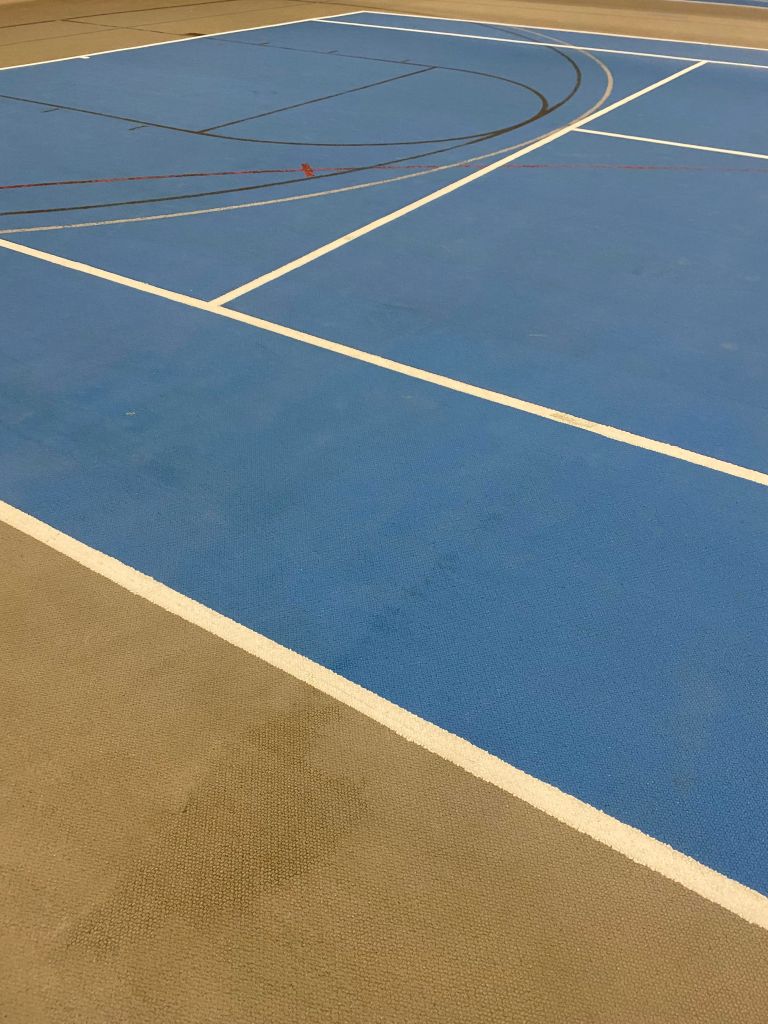
This is what the court looked like. Not your typical indoor surface, it was mostly firm but had a tiny bit of give to it. The basketball (?) lines on the court pained my soul.
My game had its hitches, of course. Even with time, I wasn’t really sure what to do with my forehand, though I did manage to hit a couple winners. I kept stepping too close to the ball. The biggest problem, though, I didn’t discover until we started a practice set: I could not return serve.
I think I shanked my first five returns, on both first and second serves. The ball was just coming in too fast for me to handle. This destroyed the rest of my game — increased pressure to hold serve and win rallies once I got them going, etc. I knew I needed to focus on every point, every shot, but I was powerless to stop the stress. I lost the set, 6-1. It was fun.
Then I checked my phone and saw that Juan Martín del Potro was retiring.
*****
I did not see any of del Potro’s 2009 peak as it happened. I also missed his resurgence in 2013. I saw some of his second really successful comeback in 2017-2018, but I was mostly rooting against him when I watched, because he played Federer five times in that period. I’ll never forget checking my phone during a tennis lesson and seeing that Federer was serving for the 2018 Indian Wells final at 5-4, 40-15 in the third. Then I checked again after it was over and saw Delpo had come back to win a deciding tiebreak, 7-2. I couldn’t believe it.
Delpo’s decision didn’t surprise me. He is 33, and practically every part of his body has violently rebelled on him at one point or another. This time, it’s his knee. Why push through that after all he’s been through already? Many would have stopped eight years ago.
Tennis is not fair… but ESPECIALLY not to Delpo. Just not fair.




 Popcorn Tennis