When No Points Come Easily

Despite it being very compelling to watch a player run back and forth across the baseline a few times in an effort to keep a point alive, the vast majority of players would prefer to win points more easily. Winning is criteria No. 1, as always, but second is probably winning while hurting as little as possible. There are times, however, when it’s simply not possible to get across the line first without suffering a good deal. Simona Halep’s match with Viktorija Golubic in the quarterfinals of the Melbourne WTA 250 seemed to be one of those times.

I could only watch the last five games of this match, but that half-hour showcased more beautiful rallies than many entire matches. Neither Halep nor Golubic possess overwhelming serves, and on several points it seemed that the first shot of rallies were just that — a point-starter, nothing more. Serving for the match at 15-30 late in the third set, Halep hit a second serve at 104 km/h — 65 mph — and won the point.

This is not criticism, just the opposite. The lack of free points for both players meant that extended rallies took place on practically every point. Not only that, but Golubic and Halep were defending brilliantly, managing to get back somewhat deep, penetrating shots even from way behind the baseline or from astonishingly low positions. Each player was keeping points alive as if their lives depended on it, flicking back the opponent’s laser-like backhands down the line. It’s my favorite kind of tennis to watch, a glorious antithesis to the serve-dominated men’s Wimbledon finals of the nineties (which I wasn’t alive to be disappointed at in real time).

With Halep serving at 3-4, Golubic murdered a crosscourt forehand winner off a deep backhand that didn’t look particularly attackable to go up love-30. On the next point, Halep poured herself into a backhand down the line — I gasped at the linear pace of the shot, its relentless parallel path to the sideline — but Golubic got it back deep, then feathered a drop shot winner two shots later. Halep, whose frustrated reactions during matches are well-known, didn’t react after either point, as if to say I’d like to be annoyed, but I couldn’t have done anything better there. Halep looked toast at love-40. Yet after a succession of points in which Halep’s serve had brought her little advantage, the Romanian cranked out three consecutive serve-plus-one plays (two winners, one forced error). She would escape the game after saving a fourth break point thanks to a missed second serve return from Golubic.

Halep carried her momentum from the difficult hold into the 4-all game. She struck a clean backhand passing shot down the line while on the dead run, making contact with the ball somewhere around shin level, sneaking the ball through a rope-thin lane on Golubic’s right side. She would break serve after a point in which she appeared to have been crossed up multiple times, yet got back low slice after low slice, eventually passing Golubic with another backhand.

It was that kind of match, where one player sets a standard that looks impassable until their opponent nails an even better winner on the next point. Camera angles showed the player’s heads drifting in the outrageously blue area behind the baseline. They looked lost at sea; they were actually well-armored ships firing accurately at each other, waiting to see who would sink first. Down break point in the final game, Simona Halep, who has built her empire in large part due to effective high-margin aggression — attacking with safe shots — nailed a first serve onto the sideline, then followed it up with a forehand winner that clipped both lines in the right corner. Golubic sank to her knees in despair, her hull crippled.

When Halep broke at 4-all and screamed in elation, I couldn’t help but think of 2018. That year, the Romanian went into the Australian Open as the top seed, but her path was anything but easy. She saved three match points in the third round and two more in the semifinals, both after extended deciding sets of the same kind of exhausting rallies she took part in against Golubic. Lauren Davis almost left toenails on Rod Laver Arena during her match with Halep; Kerber fell to her knees after winning a surreal 26-shot rally with an acutely angled backhand winner. It was stunning tennis that clearly required immense effort to produce. After a similarly draining final, Halep went to a nearby hospital to be treated for severe dehydration.

I don’t need much encouragement to think of Halep’s 2018 run in Melbourne; it was one of the greatest physical efforts I’ve ever seen on a tennis court. But the reason I thought of it this time was that I couldn’t remember Halep celebrating as emphatically as she did against Golubic in any of those incredible marathons, despite each being far more important than a mere 250 quarterfinal.

Halep suffered from injury in 2021, missing much of the year. Maybe she’s simply thrilled to be back, to have the confidence of scrapping through an intense match, regardless of the stakes. But as Halep celebrated and the commentators trotted out the over-overused adages about how she had trusted her game in the big moments (this diminishes the actual spectacle the way intense sleepiness dulls awareness), I wondered if the stage had to do with Halep’s excitement. Maybe she felt the pull of the tournament to which she gave so much four years ago, emerging with a silver plate as a reward after Caroline Wozniacki snatched the title away after Halep came within two games of it. This is the tournament where she has played the best while still falling short of a title. Maybe she feels, like I do, that it feels slightly wrong that she has never won the Australian Open despite her outstanding play there, that she may well have played better there than some players who do have Australian Open titles. (In 2019 and 2021, she lost to Serena Williams, and in 2020, she lost an extremely close straight-set semifinal to Garbiñe Muguruza, having multiple set points in the first set and serving for the second.)

Either way, Halep beat Golubic 6-2, 5-7, 6-4. She is back in Melbourne with her well-balanced game, some shots ready to pick up the slack if others falter. She will want to avenge her ghosts from previous editions of the Australian Open more than anyone, which is a dangerous prospect for everyone else in the field.

Halep celebrates the decisive break. Screenshot: Tennis Channel

Berrettini v Medvedev: Who Has The Best Shot?

By Jack Edward

Earlier today, Daniil Medvedev defeated Matteo Berrettini in a crucial three-set singles match, keeping Russia’s hopes of qualifying for the semifinals alive (which they went on to do).

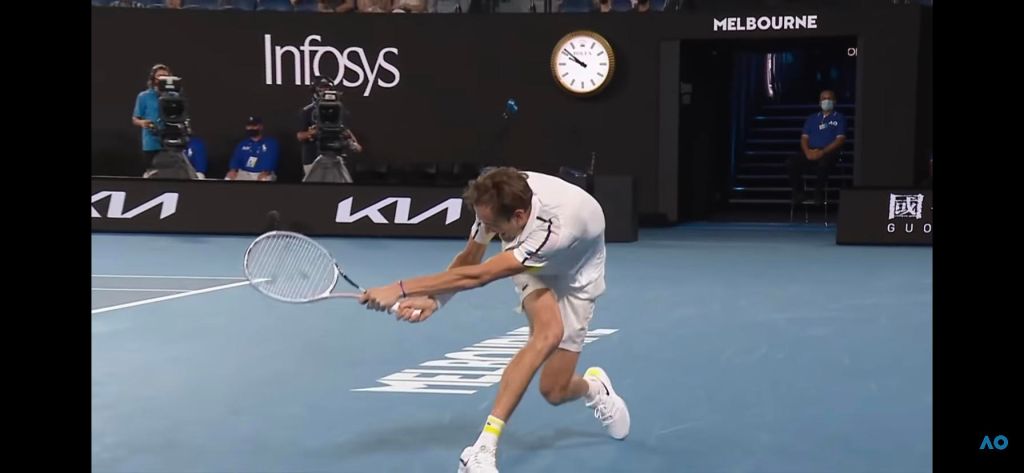
Daniil Medvedev engaging in one of his classically odd, octopus-like celebrations. Screenshot: Amazon Prime Video

Tied at one set apiece, Berrettini having raised his level to take the second set, the commentators had a little natter on which player had the best shot.

“John Fitzpatrick: Who has the best shot and what is it? And how does it affect the outcome of the match?

Jim Courier: The best shot on the court for me is Medvedev’s return of serve.

John Fitzpatrick: Petch?

Mark Petchey: Honestly a little bit left-field, I actually think Berrettini’s slice backhand is the most important shot for me out here. It allows him to stay in the longer rallies without running out of air, you’re able to hit it and doesn’t take as much energy out of you, keeps the ball low, Medvedev can’t step in –

Jim Courier: It’s not what he asked. He asked what’s the best shot, not what’s the most important shot. Come on counsellor, don’t sidestep the question.

Mark Petchey: Berrettini’s forehand then.

John Fitzpatrick: I think it’s Berrettini’s forehand. I mean I hear that return of serve, he’s a genius at it but if Berrettini gets his forehand, the racket-head speed, if he makes it, if he starts making it which I guess it’s impossible to do, if he makes such a high-percentage – gee he can cause some damage.”

A fun debate with a classic bit of Courier-ribbing! Fitzy put them all on the spot so they might all revise their answers having had a little pause for thought. Either way, I’ll take their answers with a pinch of salt and throw my hat in the ring


Berrettini’s Best Shot

Let’s start by determining the best shot from each player.

Berrettini’s arsenal is pretty difficult to assess, most of his shots erring on being tailor-made for grass-courts:

  • The first serve can be untouchable on grass when he gets it right.
  • The slice can be incredibly effective, skidding low on the turf.
  • Though the forehand is extremely loaded with spin and tends to bounce through at a hittable height, this point is fairly moot – Matteo hits it so big, he can dictate points with it regardless.

But it’s only a relatively small portion of the year. And in the Wimbledon final, Djokovic exploited the slice, (somewhat) neutralised the first serve and (somewhat) overheated the forehand.

A player’s best shot totally depends on who they’re playing and where they’re playing. For me, the question has to be: who has the best shot on the court? (It has to be, right? Someone argue with me for fun!)

With that in mind
 in his match-up with Medvedev, Berrettini’s best shot is either the first serve or the forehand.

I know what I said on Twitter

Image


 but when Berrettini placed his serve better, as he showed he is capable of doing consistently, this dynamic completely changed. 

Chalk it down to nailing the wide serve, 66% of Berretini’s serves went unreturned from thereon in. He complemented the serve with some repeatable forehand approaching brilliance, mopping up another nine service points on the + 1 shot.

Here’s how we can argue which shot is better in this match-up – the forehands that immediately proceed the first serve are really crediting the first serve. Let’s compare how often Berrettini used his forehand to graft an advantage in a neutral rally (basically all forehands that weren’t a +1 to his serve) to how often Berrettini missed a makable forehand (basically all forehand unforced errors).

  • 16 forehands used to win neutral rallies (roughly)
  • 21 forehand unforced errors

In my opinion, making more mistakes off the forehand than winning neutral rallies puts Berrettini’s first-serve top of his list – I must stress – in this match-up.

Once it got going from the second set onwards, he was only broken once. He only dropped four more points when he landed the first serve and the game in which he was broken was riddled with three forehand unforced errors.

Berrettini’s first serve steps into the ring.

Medvedev’s Best Shot

For the life of me, I couldn’t believe the commentators didn’t mention Medvedev’s backhand. It may not always blow your socks off but, boy, has it won him a ton of matches.

For me, Medvedev’s best shot is either his backhand or his return (the quality of his serve could also be argued). Which was more important in this match-up?

Here are a few stats:

  • Medvedev backhand unforced errors = 6
  • Medvedev backhand forced errors + winners = 15
  • Medvedev returns made = 75/105 = 71%

Given Berrettini’s biggest weapon is big enough to trouble Medvedev’s return (71% is low given the Russian’s ridiculous returning record), there is absolutely the potential for Berrettini to scrape his way through a match under the right conditions on his first serve + forehand combo alone.

The reason the stars are unlikely to align for Berrettini is the same reason many a foe have had running into Daniil – his backhand is the best in the business and, in this match-up, trumps Berrettini’s by a country-mile.

Six unforced errors on this wing throughout the match. 

Plenty of points injected with a bit of backhand brilliance. 

Medvedev faced two break points because he was able to lock Berrettini into the ad court over and over again. Even when Berrettini found his range on the slice, Medvedev dealt with it better than I expected him to (I definitely think he has been working his ass off to improve his counter to the slice).

This is why Matteo’s forehand was so loose. This is why when the rally extended past five shots on Medvedev’s serve, Berrettini could only win 32% of the points, so often losing the point in the ad-court.

It’s difficult for me to convey the gravity of Medvedev’s backhand without pulling the match apart point-by-point. So often Medvedev won points by hitting to the Berrettini forehand, the Italian expecting the shot to go to the ad-court, Medvedev’s huge brain plus his backhand equalling even more free points


And was it the weakness of Berrettini’s backhand rather than the strength of Medvedev’s backhand that won this mini-battle?

Who has the best shot?

This self-indulgence could go on for hours so I’ll come to a conclusion.

Berrettini is yet to prove to me that any of his shots have the wherewithal to sway the outcome of this match-up.

In my opinion, It’s Medvedev’s backhand. It was the the Lynchpin holding together his surreal game, the seminal foundation on which every point was somewhat influenced. I could even see Medvedev beating Berrettini on clay using this shot alone!

I might post a whole analysis of this match later in the week depending on whether or not it’s relevant i.e. Russia win the ATP Cup. If they do, be sure to look out for it! In the meantime, fight me on Twitter on my thoughts on this article @jackedward1994!

Speak soon,

Jack

Tennis and Bagels: The Djokovic Saga

Vansh Vermani and Owen Lewis talked about the recent Djokovic chapter — the mistakes he made, the mistakes Australian governmental organizations made, and why we absolutely should not look to athletes for absolute political, social, or medical guidance. Plus some speculation on how Djokovic’s now-likely absence will affect the ATP side at the Australian Open. Here are links to listen:

Spotify

Apple Podcasts

Anchor

It’s… Complicated

With the arrival of many players in Melbourne last week in the run-up to the first Major of the year, it was an absence that was most notable.

Videos circulated online of Novak Djokovic, training on hard courts and hitting with Australian Open approved balls but from what appeared to be a tennis club over in Mallorca in Spain.

Prior to this, questions upon more questions rotated around his plans, stirred-up by Djokovic’s tight-lips, his decision to remain steadfast silent in the face of the many who pushed him for clarity.

He would not be able to play the Australian Open – an event he has won a record nine times – without being vaccinated, a rule that local health authorities and the government were implementing together. 

So was Djokovic vaccinated or wasn’t he?

***

To say Djokovic has a chequered past when it comes to the topic of Covid-19 would be an understatement. 

His charity tournament way back in the summer months of 2020 is still talked about today for all the wrong reasons, an outbreak of the virus at the event where spectators were allowed to mix with players freely now infamous in its memorable absurdity.

Accusations of having opinions typically associated with those deemed as anti-vaccine, Djokovic struggled to shift the label last year amidst quotes of his that only stressed that he was against mandatory vaccination.

Perhaps then, he was tempting fate with his words, as his favourite major tournament announced that it would be the first of its kind to implement exactly that.

So would he or wouldn’t he?

***

The end of the 2021 season swung around and still Djokovic’s we’ll-wait-and-see response held firm, closing out all further questions as tennis entered its end-of-year downtime.

Throughout the next few weeks, happenings did happen however.

WTA player Nata Vikhlyantseva of Russia announced that she’d be missing the first 2022 Major, not for want of desire to compete but because her Sputnik vaccine has not as yet been deemed acceptable by Australian health officials.

French ATP doubles specialist Pierre-Hughes Herbert released a statement saying he’d be skipping the Australian Major due to his personal decision to remain unvaccinated.

ATP rising star Aman Dahiya of India had to withdraw from the junior event because of his inability to get the vaccine in his native country yet due to his age.

There were others as well, all of them falling back from participation for an array of reasons, all of them coming together to suggest that there was absolutely no way through the approved vaccine mandate.

Either you got the one they wanted you to get and played or you didn’t and you didn’t.

So would Djokovic or wouldn’t Djokovic?

***

Seeds were planted just a few short weeks ago, quickly sprouting and blossoming into something much more, leaves and flowers that read “medical exemption?!” cropping up as journalists questioned health officials.

So seemingly there was a way through all of this after-all, a medical exemption that was entitled to players that fit a specific criteria.

However, surely Djokovic would not go this route to avoid vaccination whilst accepting participation? There was laughter at the thought of one of the fittest athletes in the world successfully getting an exemption, a perhaps unfair reaction given the numerous almost-infinite array of conditions a healthy human can have. 

But it was also somewhat understandable as well given the aforementioned shut-outs and stone-walls.

Even the local Victorian government seemed to scoff at the suggestion, implying it was exceedingly unlikely that any player who is unvaccinated would be allowed to enter Australia, let alone the tournament in question.

…and yet…

***

Earlier yesterday morning, Novak Djokovic confirmed that he was flying to Australia to participate in the tournament having received a medical exemption. He did not expand further.

The instant reaction online was of course one of well-reasoned and grounded discourse and debate… Indeed, Djokovic’s fans could be seen celebrating in the showers of an outpouring of annoyance and frustration from more general tennis watchers, differences of opinion on a tennis related subject never starker than this.

It’s important to stress here that Djokovic’s exemption did have to be approved by independent panels anonymously and so claims of immediate bias or tailored systems should have probably been taken with at least a few pinches of let’s-just-wait-a-moment salt.

But there was a larger picture to take in here as well and the result of doing so should have meant eyes of judgment turning steadily upon the Australian government. If a player such as Vikhlyantseva can’t compete when legitimately vaccinated, should exemptions even have been considered for those that weren’t?

These were the kind of queries that many thought would take us all loudly into the opening week of the Australian Open 2022…

*** 

Of course, no good story is complete without one final plot twist to properly rattle minds.

Having seemingly been flying above the criticism of his medical exemption directly towards Melbourne Park, Djokovic’s chances of winning a record 21st men’s Major title were wrestled and torn to the tarmac Down Under.

On his touchdown in Australia earlier today, Djokovic was blocked from entering the country at border control, his pathway barred by a giant neon sign that read “WRONG VISA, PAL!” in scarily big font.

With his flight arriving in the early hours and no staff on hand to help him, Djokovic was stranded in the airport and questioned by security patrol, handcuffed there only by a handful of seemingly bizarre issues that meant that his medical exemption didn’t match properly with his visa paperwork.

One thing after another for the world number 1, much of it blockades that could likely have been avoided with a fraction of forethought from a selection of different people.

As the sun rose on the predicament, the utterly obscure became somewhat clearer and the unbelievable become very much possible as Djokovic looked to somehow overcome this unexpected monument of an obstacle that represented what was in all reality his biggest challenge between him and lifting the trophy he’d flown there to win.

But as the clock ticked on and the morning slowly took its leave, it was officially confirmed that Novak Djokovic’s visa was cancelled. He would be expected to depart on a flight home to Serbia directly.

***

This soap-opera-like story is clearly not yet over and tangible clarity of the whole situation may as well be non-existent, floating out of reach of any and all that are looking for it.

There have been mentions of appeals, Djokovic’s father calling for protests, the Serbian Prime Minister throwing his weight behind his countryman, all of this and then some, a swirling mass of statements clashing together to represent frustration in the face of a system many have dubbed corrupt, unfair or – at the very least – confusing.

Through it all, one thing is apparent: Djokovic’s ability to collect headlines like trading cards is as strong as it’s ever been. The man incites emotions of a very mixed variety with his words off the court even as he wins titles on it.

With that said, his chances of winning a 21st major title at the 2022 edition of the Australian Open appear to be hanging from a thread so thin that any mere push may send it breaking into oblivion.

***

However this plays out, the Happy Slam will begin in a few short weeks, with or without the presence of Novak Djokovic. And yet, it’ll be hard to shift the memories of this moment of significance and you feel that the immensity of questions that surround it will hang high in the skies above Melbourne long after the closing fireworks fade.

Happier Times: Djokovic with his most treasured of trophies at the 2022 edition of the Australian Open.

The Duncan Show

"It's all true. It's all real. Nothing here is fake. Nothing you see on this show is fake. It's merely controlled." -- Marlon, The Truman Show
"Who the fuck is Chris Forbes..." -- me to Claire Stanley and Peter Childs on a Twitter Space, after finding out that Duncan Murray is not a real person and is, in fact, played by a comedian named Chris Forbes.

I love the Duncan Murray bit. I’ve quoted the videos to friends, even ones not into tennis. “His mom pretends to hate him!” I said, laughing, not caring that my friends were confused and/or bored. I cracked up when Duncan presented Judy with a shovel for Christmas, with only the tip of the shovel wrapped. I howled when Judy used a Scrabble turn to spell out “tit,” looking pointedly at “Duncan.”

Anyway, during Andy Murray’s match last night with Facundo Bagnis, I was gushing about the Duncan and Judy bit to Claire and Peter. We quoted a couple of the clips and laughed about how great it was, how funny, how inventive.

Then things took a surprising turn.

“Did you know people actually felt bad for Duncan? That his mum was keeping him locked in the basement or something?” Claire asked. I laughed. Judy obviously didn’t really hate her son. Ha, ha, gullible watchers of the Duncan Murray bit. But then, Claire mentioned that Duncan Murray, a man who I saw as a not only real but integral part of human society, was not real.

I don’t remember exactly how she revealed this. Bits of my brain have been wiped clean and chafed raw by pure, unadulterated shock. I think she mentioned how he resembled the Murrays, to which I said something like “wait, he’s not actually related to them?”

At first, Claire and Peter thought I was stringing them along. This is usually one of my favorite jokes — play dumb until people buy into it — but this time, I was being dumb, not playing at it. This was real, realer than my untrimmed facial hair and excessive tennis addiction. A quick Google search revealed that Duncan Murray is played by a dude named Chris Forbes. He’s a comedian, apparently. He also said of those who believe Duncan is real that

"It has been quite odd. A lot of people think Duncan is real. While that is quite concerning, it is also quite sweet." 

(Get off your high horse, man. Your act is more convincing than even you know, apparently.)

Claire and Peter found this hilarious, as did innumerable others on Twitter. All was not hopeless, however. James from Tick Tock Tennis shared my utter disbelief that Duncan wasn’t real.

"I...feel like a kid who found out Santa isn't real," he messaged me. 

Without further ado, here are some of the best tweets that ensued from my confession that I had thought Duncan Murray was a real person. I was laughed at and laughed with. I was surprised that more people weren’t in the same boat as me. I had trouble forming coherent thoughts, a phenomenon that has continued into this piece. Enjoy.

The reveal.

Finally, the man himself weighed in:

So the mystery continues.

What Makes Tennis Such a Demanding Sport?

By Jake Williams

When it comes to the game of tennis and its labors it is very easy to discuss the mental and physical aspects which take a toll on the body and mind. Any tennis player could tell you how physically demanding the sport is, and those who have played competition and have experienced nerves will also tell you how mentally challenging the sport is. 

However, there are certain aspects of being a tennis player which are rarely discussed outside of the tennis community. It is important that these are brought to light as they can turn out to be some of the determining factors of a tennis player’s game; whether or not they decide to continue their career. 

Like most sports, travel plays a huge role in an athlete’s career, tennis is no different. That said, with team sports you are travelling with more people which can make it easier. Tennis, on the other hand, is an individual sport and a lot of the time you may find yourself travelling alone. This can be especially difficult when going abroad. Not to mention travelling all that way to a different country only to come up short on the day and having to travel home can be incredibly disappointing. Unfortunately, that is one of the many challenges a tennis player must face. 

This court may be pretty, but tennis players spend a lot of their time traveling between their playing sites. Photo: Owen Lewis

As a tennis player you can constantly be on the road for weeks at a time with little rest, which can really bring down someone mentally. Which brings us to the next point: burnout. In layman’s terms, burnout is when an athlete experiences overwhelming exhaustion due to constant training and competition. Unsurprisingly, this exhaustion can have a negative effect on their motivation and overall interest in the game. There are many factors which can cause burnout, one of them being high expectations which aren’t met. As a tennis player you set yourself lofty goals in hopes of achieving them one day. Imagine training day-in day-out only to notice little to no improvements: it just isn’t enough and can cause a tennis player to lose all love for the game. 

Earlier it was mentioned that some causes of burnout are unavoidable, and by that point most accept defeat and give in on pursuing their career. One factor that would probably stand out to many is costs. As an individual athlete there is a lot more to consider when funding your career. What’s more, at the higher levels of tennis you have an entire entourage behind you, coaching and aiding in your development. Some of the top 200 players are spending serious amounts of money on a coaching team, and at that level and ranking it’s hard to fund forever. A lot of players will consider a fitness coach, nutritionist, tennis coach, hitting partners, and a psychologist. To you, this may seem over the top, but for them it is all necessary in the hopes of being at the top of the game someday. Tennis is a very demanding sport and can take its toll on a lot of players, but it builds character and shapes them into the person they end up becoming. Without the challenges and setbacks they can’t truly develop as a player and learn from the experiences.  

Title or Bust

Never mind that it’s been eons since an ATP player won a second major immediately after their first, I’m growing increasingly convinced that anything less than a title at the Australian Open for Daniil Medvedev will be a huge disappointment. Andy Murray was the last one who had a shot at the instant major two-peat at the 2013 Australian Open, but a four-hour semifinal with Roger Federer ensured the depletion of his legs midway through a slog of a final with Novak Djokovic, and Murray fell two sets short. Several things are different now, however, not least that the Big Three is now a Big One in the form of Djokovic.

It’s a daunting task, but Medvedev just seems ready. At 25, he is the recent U.S. Open champion, a former World Tour Finals champion, and he owns four Masters 1000 titles on hard court. He has experienced enough varied disappointment — a brutally close loss to Rafael Nadal in the 2019 final of the same tournament, a drubbing at the hands of Novak Djokovic in the final of the 2021 Australian Open — to teach him the ins and outs of tennis’s tendency to serve up devastating losses and opportunities to choke. Medvedev is fit; he serves and returns well; he has the reach of a servebot but moves like a grinder. When his first serves are painting the lines and he’s in full roadrunner mode, the combination feels almost unfair. Most of his shots are unbelievably solid. And he usually hits the ones that aren’t (his forehand and volleys) with enough conviction to convince us that they actually are unbelievably solid.

Medvedev also seems to grasp something about tennis that many players seem reluctant to act on, even if they believe it: that as long as you win the last point, there are parts of a match when you can do whatever the hell you want. It’s a decidedly displeasing mindset to watch as a fan, but a very effective weapon to have as a player. Djokovic let plenty of first sets go this year, and look how his season turned out. Against Jannik Sinner in the World Tour Finals, Medvedev put on an exhibition, or something, of how to win while seeming not to care.

Sinner was playing at home. After getting bageled in the first set, the young Italian got his teeth into the match. For an hour or so, he kept his head down while he tried to crack Medvedev’s brick-wall defense, celebrating his successes and shaking off the disappointments. Finally, Sinner won a tight tiebreak in the second set. He screamed in triumph, turning in a half-circle to observe the reactions of the ecstatic crowd. It was obvious that simply winning one set meant the world to Sinner. As the players crossed paths to return to their chairs for the break between sets, Medvedev yawned.

He yawned! In the middle of what had become a thrilling match against another top-ten player. Now, you might think that Medvedev yawned to make light of the situation, to ensure he made it back on Tennis TV, bro. I have a different theory. I think he yawned because he genuinely didn’t give a shit that he lost the set, and he wasn’t too fussed about everyone being aware of his indifference. Medvedev, unlike Sinner, had already qualified for the semifinals of the tournament. He knew that the matchup was heavily tilted in his favor, and that letting an inconsequential match go wouldn’t come back to bite him. Winning would feel nice, sure — he doesn’t like to lose, as he said after the match — but he also described his struggle to care about a “dead match.”

Medvedev also detailed his displeasure at getting dragged into a two-and-a-half hour dogfight, but raised the valid point that he didn’t have to be out there at all. “I could have retired,” he said, “basically say before the match that I have a headache, just not go out there, still be the first in the group.” Again, this economical mindset is not sexy, but is no less legitimate for the desire to save energy.

Towards the end of the final set of the match against Sinner, Medvedev looked completely unhinged; his typical patient rallying having descended into ball-bashing insanity. Yet somewhere within the sinews of his fat-free frame, he found something resembling the ideal balance between good shot selection and not giving a shit and saved a couple match points with risky shots before taking the deciding tiebreak 10-8. On the ultimate match point, Medvedev initially reverted to being patient — he got in a few deep groundstrokes, giving Sinner a chance to miss. When Sinner didn’t, Medvedev unexpectedly leaned into a backhand, launching it down the line for a winner. He smiled briefly on the way up to the net. That was fun, wasn’t it? Sinner looked at the ground, likely shell-shocked. That maniac beat me, playing like that?

Medvedev not only didn’t collapse into a pile of mangled tendons and broken bones moments later, he stood tall and waved his arms octopus-style at a thrilled crowd on Rod Laver Arena, celebrating a spectacular backhand pass that set him up to serve for a semifinal victory against Tsitsipas. At the end of the year, Iga Úwiątek would dub Medvedev “the pretzel.”

Medvedev knows that not every point matters like some players seem to believe, and he plays as such. He doesn’t even care about looking pretty while winning the points he does care about. Think of a student strategically failing assignments, only to ace enough tests to scrape through a class with a passing grade. A teacher might feel disrespected, but they wouldn’t be able to argue with the results. Most of the time, Medvedev can win with his B, C, or D game. He can pass tests without studying. When his A game does show up in a match where he’s the clear favorite, things can get ugly for his opponents.

This isn’t to say that Medvedev is perfect. Weaknesses on his forehand side can be exposed under certain circumstances. If an opponent turns the tables on him, digging every ball out of the corners, he can struggle offensively. Sometimes he blanks out on an important question and can’t steady himself in time to think of an adequate answer. In the final of the 2021 Paris Masters against Djokovic, Medvedev’s game went haywire in the third set — his typically flat backhand started to loop bizarrely, he missed first serve after first serve — turning a close final into a drubbing.

The rivalry with Djokovic has served as the barometer for Medvedev’s ascension on hard courts. At the 2019 Australian Open, the world number one took out Medvedev in four sets, but the Russian’s willingness to engage in attritional rallies made tennis fans all over the world take note of his unorthodox game. At Cincinnati later that year, Medvedev nearly went down a set and a break against Djokovic before deciding to start going for aces on second serves. A slew of them landed in, and after an hour a stunned and impressed Djokovic was waiting at net to shake hands to mark the 6-3, 3-6, 3-6 defeat.

In 2020, Medvedev fell to Djokovic 1-6, 7-5, 4-6 at the ATP Cup, but Djokovic had been forced to play at his best for virtually the entire match. In the last game, the great Serb went up 30-love, but Medvedev refused to fold, forced Djokovic into a grinding duel of long rallies and hot shots, and the legend escaped only after saving three break points.

For my money, this was the best tennis match of 2020. This whole video is worth watching, but the true madness begins at around four and a half minutes in.

And in 2021, after getting thrashed by Djokovic in the Australian Open final, Medvedev responded in kind at the U.S. Open, putting on a serving clinic. His loss in Paris, though surely disappointing, was a testament to how far Medvedev had come. Djokovic won, yes, but he was so clearly outmatched from the back of the court that he turned to serve-and-volley for sanctuary. It worked, but read that again — Djokovic, possibly the best baseliner in history, ditched his comfort zone regularly in favor of the net, which has historically been far more unkind to the Serb. At the least, Djokovic had to step way out of his comfort zone to escape.

Medvedev has leapfrogged everyone except for Djokovic. Let’s set aside the fact that the best male player to pick up a racket may not play the Australian Open for a second. Presumably, these two will mow down everyone in their paths (barring an unlikely intrusion by Zverev, who is on the rise but lacks the big match experience of both guys and is at least as prone to mental disarray as Medvedev) and meet in the final for a second straight year. Medvedev knows practically all there is to know by now. He’s been in three major finals. He’s played Djokovic ten times, twice on Rod Laver Arena. He knows he can outlast Djokovic from the baseline. If he can nail enough passing shots, victory seems not only possible, but likely. Djokovic may well still beat him if they play — he’s 27-1 at the last four majors and has won the last three Australian Opens — but Medvedev will probably still feel that he should win.

Medvedev just went down to Ugo Humbert at the ATP Cup in a weird match that he was twice two points away from winning. He struggled in the heat and with most of his shots at one point or another. Considering that this was his first match of the season and the increased margin for error in best-of-five, the effects on Medvedev’s Australian Open prospects should be minimal. Even when cramping or fatigued, the Russian can often find a way to play effectively.

Daniil Medvedev may not give his all on every point, but he’s stumbled, sprinted, and squirmed his way to a ruthlessly effective game anyway. It’s title or bust for the world number two at the Australian Open, and if he can corral that enigmatic head of his into a disciplined state for two weeks, it may well be title.

Why No One is Talking About Nick Kyrgios

By Owais Majid

Nick Kyrgios has been one of tennis’s biggest enigmas for some time. Whether mesmerised by his tennis, amused by some of his remarks or appalled by his behaviour, the public have rarely stopped talking about him one way or another. Tennis fans, sometimes in spite of themselves, have always had an opinion on the Australian maverick but there has been a distinct lack of conversation surrounding Kyrgios recently. With the Australian Open, his home slam and the one that has produced more of his highlights than any other approaching, you’d expect there to be some speculation about how he will fare, or indeed if he will even play. I thought I’d take a look at why this may be the case.  

Doubtless, Kyrgios’s inactivity is a huge factor at play here. Since the outset of the coronavirus pandemic, he has expressed his displeasure at playing in front of no crowds and thus has rarely been seen on a tennis court recently. He sat out the vast majority of 2020 for this reason, returning with somewhat of a bang at the 2021 Australian Open.

Many were swept up by his exploits at said tournament. His second round five-set epic with Frenchman Ugo Humbert on the John Cain Arena, a stadium Kyrgios has made his own, was one of the most uplifting matches of the tournament. It served as a reminder of how much capacity crowds had been missed and it seemed fitting that it was Kyrgios through whom this was realised. He followed this up by contesting another thrilling five-setter as he was edged out by Dominic Thiem in the third round. 

After losing to Karen Khachanov in Cincinnati — a match in which Kyrgios screamed at the chair umpire and destroyed his racket — the controversial Australian hands his mangled racket to a grinning kid in the crowd. Still: ESPN

Kyrgios then skipped the clay court season and played Wimbledon with little to no preparation (by his own admission). Although he won his first two rounds with little fuss, he was forced to retire very early into his next match against Felix Auger-Aliassime due to a suspected abdominal injury. 

He did participate in the Laver Cup, though he revealed afterwards that it may have been his last appearance at the event and retirement in the near future was a very real possibility. This was one of a few occasions in which Kyrgios has hinted at retiring sooner rather than later, citing a lack of enjoyment for the sport in its current state as well as his mother’s ill health as the main reasons. It is no secret that he sees tennis as far more of a hobby than a job, nevertheless talk of retirement when he is still so young was quite a revelation.   

The most notable publicity Kyrgios has received of late, besides his bizarre sledging of Casper Ruud on Twitter, has shed him in far from positive light. Back in October, his former partner Chiara Passari made some not-so-cryptic remarks about her relationship with the now 26 year old likening him to Alexander Zverev who the ATP are currently investigating for domestic violence. On Kyrgios, she said “If those speculations and reports were true about Zverev, then his behaviour is very similar to Nick’s.” Though she did not elaborate on this, such a comparison is worrying, particularly with what we know about the allegations Olga Sharypova, Zverev’s ex-girlfriend, made about the German. Kyrgios has been a character who has always divided opinion, but a matter as serious as this is likely to sway even his most loyal supporters.

Furthermore, it is feeling increasingly as if the void left by Kyrgios is no longer as apparent as it once was. While this is partially down to the fact that we have become accustomed to his sporadic appearances on the tour, there are more factors at play. Kyrgios was previously hailed as being one of the few unapologetically open and interesting personalities on the ATP Tour. This is arguably no longer the case. There are now numerous players on the tour who aren’t shy to express themselves, so it feels like Kyrgios’s presence isn’t required anywhere near as much as it once was. 

For example, Frances Tiafoe has emerged as the heir to Kyrgios’s throne in many ways. Although he doesn’t possess the natural talent that Kyrgios does, the way he utilises the crowd to his benefit is very similar. Tiafoe has the Kyrgios-like ability to make the viewer care when he is playing and he undoubtedly plays that up, sometimes even to the irritation of his opponent. Moreover, Tiafoe doesn’t really bring the added baggage that has frustrated so many about Kyrgios throughout his career. He has endeared himself with fans with his ability to simultaneously come across as both charismatic and humble and his story is one as inspiring as any.  

Another player whose personality seems to have made up for Kyrgios’s absence is the world number two Daniil Medvedev. The Russian is unapologetic in his honesty which appears to know no bounds. Like Tiafoe, his character, particularly the way in which he is one of the most self-deprecating players out there despite his success, has resulted in him being one of the most liked players by fans. Whilst not afraid to speak his mind, he is self aware enough to admit his own flaws, something which should not be underestimated.

 As such, the elements of Kyrgios that made him so watchable, even necessary for the growth of the sport at one point, are now manifested in other players, who are far less prone to the outbursts that he has become synonymous with.

Kyrgios’s career-high ranking is 13th in the world. There have been players who have reached #1 who don’t have 25-minute videos dedicated to their tennis.

All this being said, it would be the most Nick Kyrgios thing imaginable for him to reel us all in by playing an epic at the Australian Open on a bouncing John Cain Arena in a couple of weeks’ time. The ATP Tour continues to market him heavily. His nature is such that often when we feel as if we are finally done with him, he produces something that gets us all back on board the Kyrgios train, even if we know that it is destined to be driven off the tracks at some point.

ATP, You’ve Let Us Down

By Josefina Gurevich and Shravya Pant

​​There’s a certain type of innocence that comes with being a fan; you assume that the person, team, or sport you love is perfect. When the two of us, Josefina and Shravya, first became friends and started bonding over our shared love of tennis, we, too, were full of this innocence. In our view, the world of professional tennis was without flaw, inclusive to men and women, a champion of equal pay, and leading the sports industry with its history of activism. We were excited to share this wide-eyed love for the sport and voice that excitement in our podcast’s coverage of the latest tennis news on and off the court. In our tennis fan infancy, never did we suspect the dark underbelly of tennis. 

The past year or so has exposed some of tennis’ deepest flaws, particularly on the ATP’s side. Tennis is a sport that consistently portrays itself as an advocate for gender equality, which can be credited to the Original 9’s trailblazing activism, and recently has even emphasized unity between the ATP and WTA through the “Tennis United” marketing merger. But don’t let this all fool you. To put it bluntly, the ATP has made it clear that it holds zero regard for women. As multiple active ATP players facing domestic abuse allegations from ex-female partners remain unscathed and the organization refuses to take action on the Peng Shuai situation (so much for “Tennis United”), the men’s tennis tour has served a devastating blow. Watching the organization remain unmoved by the testimonies of Olya Sharypova and Neli Dorokashvili and prioritize business in China over standing up for Peng was a necessary reality check to our innocent tennis fandom. No matter how much we love the sport, its social flaws, particularly within the ATP, are indefensible. 

Domestic Violence Allegations 

In November of 2020, the story of Olya Sharypova’s domestic violence allegations against Alexander Zverev took the tennis world by storm. The two of us were shocked to see this, just a couple months after we had watched his roller-coaster US Open men’s singles final match together on Zoom. “Olya’s Story,” New York Times tennis journalist Ben Rothenberg’s harrowing interview with Sharypova, was published in Racquet Magazine on November 5. Sharypova detailed the abuse she endured during her and Zverev’s relationship, including specific events at the 2019 US Open and Laver Cup. Zverev later came out and denied all allegations while the ATP remained silent; the German lost none of his sponsorships. Sharypova’s (who decided not to press charges against Zverev as speaking out about her experiences was her main goal) testimony held little significance in the eyes of the ATP, Zverev’s sponsors, and the structures of misogyny engrained in the tennis world. 

But tennis fans didn’t remain silent; the hashtag “#IStandWithOlya” emerged and eventually the story reached the mainstream, particularly during Zverev’s run at the 2020 Tokyo Olympics. The second part of Rothenberg’s interview with Sharypova was published in Slate Magazine in August, just prior to the US Open, which discussed further instances of abuse Olya experienced following the 2019 US Open, substantiated by photos and screenshots of text messages. Four days before this article was published, the ATP (which had been inquiring about the release date of Rothenberg’s second article) stated that it would be doing a review of its “safeguarding” policies, including those surrounding domestic abuse. As a result of this “independent safeguarding report,” the ATP announced an internal investigation into the 2019 Shanghai Rolex Masters domestic violence incident Sharypova described in the Slate piece. While a crucial step, it took 11 months from Sharypova’s initial interview for the ATP to take any meaningful action. And since October 4th, the ATP has released no further information, calling into question the nature and integrity of the investigation.

What makes the ATP’s attitude towards this incident even more disappointing is that Zverev is not the only one of their players to face allegations like this. Brazilian player Thiago Seyboth Wild is currently being investigated by police in Brazil after his girlfriend, Thayane Lima, accused him of physical and emotional abuse. In June of 2020, this year’s Indian Wells finalist Nikoloz Basilashvili’s ex-wife, Neli Dorokashvili, charged him with domestic violence. The Georgian athlete was arrested but then released on bail. Considering Basilashvili’s celebrity status in Georgia and the ATP’s pattern of silence, he faced no significant repercussions, certainly none within the tennis world. 

The ATP needs to seriously look into their environment and rules and take action against these players. Belated investigations and reviews of “safeguarding” policies are reactive moves; the organization needs to examine how it can proactively change its culture, a culture that clearly does nothing to protect the women involved in ATP players’ lives. With their track record even from just this year, it’s clear that the ATP does all it can to protect these male athletes while paying no heed to women, and this pattern extends to issues beyond domestic violence, as well. 

Peng Shuai

“There is nothing more important to us than the safety of our tennis community. We have been deeply concerned by the uncertainty surrounding the immediate safety and whereabouts of WTA player Peng Shuai,” said ATP chairman Andrea Gaudenzi, regarding the Peng Shuai situation on November 15, 2021. While the statement may seem benevolent, since, the ATP has failed to step up and take action for their words. 

People far past the ‘tennis world’ have felt the impact of Peng’s story in recent months. She was the first Chinese tennis player to achieve the No.1 ranking spot in doubles. She holds two Grand Slam doubles titles and is a former top 20 player in singles. She was a star athlete and a prized athlete of China. On November 2, Peng posted on Weibo (a Chinese social-media site) accusing retired Vice Premier of the Chinese Communist Party, Zhang Gaoli, of sexually assualting her. The post was deleted shortly after, but not before gaining international traction. Following this event, Peng was not heard from for several weeks, causing panic as to the safety of her whereabouts. Slowly, she started making appearances in public media again, but with a concerning outlook on her previous statement. Ever since she posted the allegation on Weibo, she has denied it. It is clear that Peng is not intentionally denying her past claims, but has instead been forced to succumb to a position of contradiction at the risk of sacrificing her safety. 

Whether or not Peng is currently safe is not clear whatsoever, so governing bodies of tennis, or even athletics in general, still have the duty to stand up for human rights in her name. Recently, the WTA’s chairman, Steve Simon, made the ultimate decision to suspend all WTA tournaments in China in Peng’s name; note that the WTA, and tennis world on a larger level, has significant financial stake in China, with the WTA Finals and several Masters tournaments set in the country. Previously, Simon had demanded the ability to communicate privately with Peng and for Chinese officials to conduct a transparent investigation into her disappearance, however neither were complied with. He accompanied the announcement of the suspension with, “In good conscience, I don’t see how I can ask our athletes to compete there when Peng Shuai is not allowed to communicate freely and has seemingly been pressured to contradict her allegation of sexual assault.” Simon’s decision is arguably the most powerful stance taken by any leader of sports organizations, regarding not only players’ rights, but human rights as well. 

Unfortunately, in comparison, we’ve also seen some weak takes, especially from fellow professional tennis governing bodies. The ITF has refused to pull their tournaments from China, stating they “don’t want to disappoint 1.4 billion people.” The ATP took a similar stance, saying, “having a global presence gives us the best chance of making an impact.” However, when presented with a situation to support the efforts of “Tennis United,” the ATP failed to act. Their reaction (and lack of action) was extremely disappointing, and they have been rightfully criticized for it. The worst part is that we half-expected this from the ATP considering their previous stances on issues of violence against women. Even when the entire world, past just tennis enthusiasts, has united to support efforts in ensuring Peng Shuai’s safety, the ATP has failed to stand up for basic human rights for a player that is part of their “Tennis United” community.

So What?

The ATP is one of the largest global governing bodies of professional tennis. They claim that their “mission is to serve tennis,” and “inspire the next generation of fans and players.” Yet, they have neglected countless opportunities to uphold the principles on which they claim to stand. 

Not only are we tennis fans, we are young, female tennis fans and our podcast has given us keen insight to the ATP’s true colors. We’ve had to report the ATP failing to stand up for women being assaulted and harmed by players of their own organization. We’ve had to report the ATP failing to stand up for a woman being silenced and censored. So what’s the message here to female tennis fans like us? Women’s basic rights as human-beings mean nothing to one of the most powerful organizations in our sport? While this may not be the message the ATP sends with their words, it is certainly the message we’ve received through their actions. Until we see a change, we will continue to hold the ATP accountable for their lack of human interest. 

Josefina and Shravya are the co-hosts of Hold On to Your Racket, the podcast for Gen Z tennis fans. We hope you liked this article. If you’d like to hear more from us, check out our podcast! You can follow us on Twitter @HOTYR_TennisPod.

Mental Toughness: Separating the Wheat from the Chaff

By Vansh Vermani

An earlier version of this piece was submitted as a school assignment in 2017.

We marvel at the pros on TV. We aspire to be just like them when we step on the court. They make it look so easy. We idolize them, sometimes in a religious manner. Sports, especially tennis (an individual sport), have an emotional attachment where we admire players who overcome difficult obstacles. Some players demonstrate this quality during the course of a single match, while others overcome numerous long-term physical injuries to make their comeback to the sport. 

So what defines a top female or male tennis player? What intangibles do they possess that the rest of the field, who is close in talent, is lacking? These players, the likes of Federer, Nadal, Djokovic, and the Williams sisters, all have this “it” factor. They have the ability to find that zone of mental calmness, which enables them to play some of their best tennis under tremendous pressure and expectations. For example, at a crucial juncture in a match, where they are in danger of letting the match slip out of their hands like at 5-5 in the fifth set. This is when everybody sees why they are called champions. Brad Gilbert, a well-known sports analyst, former player, and commentator, wrote in his famous book Winning Ugly: “to me, absolute greatness is defined at the highest of levels, when other people will say things are going a million miles per hour, for them it actually slows down to where they actually become absolutely clearer what they are going to do.” Their opponent on any day may be very close to them in talent, but when it comes to crunch time in a big match or occasion, the underdog’s inability to stay calm under pressure may get the better of them. The underdog usually makes a bad decision that costs them the chance to pull off a major upset, and potentially turn their whole career around. When this happens over and over again in tennis, it can be incredibly frustrating and difficult to rebound from, and you find that oftentimes you lose belief in your abilities more and more, losing to players who are ranked below you. It takes a special mindset to break this losing cycle, and start gaining back the confidence. This is the foundation of mental toughness. The willingness and commitment to accept the obstacles that come one’s way and embrace them, for the purpose of personal improvement. 

A good example of a professional player who has had to deal with this pressure is Bulgarian player Grigor Dimitrov. Dimitrov was always touted as the next big thing. The next future star with a game that very closely resembles Roger Federer in playing style and a one-handed backhand, a shot that is rare these days on the pro circuit. The media dubbed him “Baby Federer.” At the age of 23, in 2014, he started to make a push in the rankings, and made the semifinals of Wimbledon, losing an extremely close match to world No.1 Novak Djokovic. It was a match where he had multiple chances to close out the fourth set, which would push the match to a deciding fifth set. After this devastating loss, Dimitrov’s confidence began to fade away. He began losing close matches, time and time again failing to close out wins that were sometimes easily under his belt. He would crumble and wilt under pressure as matches progressed. After two more years of hard-enduring defeats, and crushing blows, Dimitrov began to understand his game more, and switched coaches and racquets. With his new coach, Dimitrov went back to the drawing board, and worked on the basics of his game, starting with his fitness, and making his serve stronger. Dani Vallverdu, a coach who has worked with former top 10 players, got him to push harder in training and helped Grigor develop joy in working hard off the court. He helped his player understand that he belonged at the top of the game. In the beginning of 2017, Dimitrov started showing flashes of the form that got him to the semis of Wimbledon in 2014. He began playing more fearlessly, stepping in and attacking each ball. He seemed to be playing with greater self belief and purpose. He looked stronger as the matches went on. He won a tournament at the start of the year, beating three top 10 players, whom he had never won against. He was starting to play consistent tennis at all his tournaments. He won four ATP titles and finished the season at a career best ranking of 3rd in the world. Dimitrov showed incredible mental strength and maturity during a long process. Two years of struggle cost him many matches, and he dropped out of the top 40 at one stage, but he continued to believe and worked as hard as ever to turn around his fate. Now 30 years old, Dimitrov is ranked 28th in the world, and though a return to the top five looks unlikely, Dimitrov continues to fight for results.

Though he lost in the end, Dimitrov played a fantastic match in the 2017 Australian Open semifinals.

Tennis is not so much a numbers game as people make it sound. At the end of the day, it isn’t about being the greatest player of all time, getting to number one, winning majors. It isn’t a race. It is about maximizing your potential. That can only happen if you build a strong foundation of your mental psyche which can keep you grounded and dedicated to improving for improvement’s sake. In order to be mentally strong and maximize your potential as a tennis player, you must think long term for perspective, but only focus on short term goals. It is important to focus on the process of improvement on a day-to-day basis, without worrying about immediate results. 

So how exactly does a tennis player achieve the zenith of mental strength? The first step is the most difficult bit: training and physical strength. This is also the biggest factor, as a huge part of mental toughness is the feeling of knowing that no matter how long the match goes, your back, legs, shoulders, and muscles don’t get sore and affect your point-for-point intensity. A lot of mental frustration stems from not having the endurance and strength of being able to close out tight matches. Training hard and working out in the gym are the first steps. Once you develop some of that confidence in fitness/training, then it has to be carried over to practice. This may take time, but it is very important for a tennis player to have a long term perspective. You may not win many matches right away, and you may lose a lot of close matches, or you may get completely thumped. That is okay, because that actually gives you more information to work with. Once you discover your niche and where your strengths lie, you then have to deal with the nerves of playing in a match. This is something much harder to deal with at first, because while you were training and winning practice sets and points, there was nothing on the line. Now you must prove yourself and adapt your game to your opponent. It takes a while for every player to maximize their skillset. At first, they may feel overwhelmed, thinking they are expected to hit spectacular shots and outright winners to beat their opponent. However, what usually works best is keeping it simple and sticking to your gameplan. Sometimes though, your game plan might work well, but then your opponent finds your weaknesses. The best players will accept that they are not playing their best tennis, and find solutions to slow down the opponent’s rhythm. Instead of attacking a player’s backhand which may be the weaker side, they think hard in the changeover breaks and realize that their opponent is always hanging on the weaker side, expecting every ball to go there. So they try to mix it up and stretch them wide to the forehand. It is this kind of problem solving that wins matches in tight situations. Many of the best players pump their fist when they play good points, and are mellow and keep a poker face, rather than showing negative emotion. They look at the positives and demonstrate a short memory when it comes to their mistakes. It is very easy to get frustrated over one bad decision, and let it linger into other parts of their game. When I think of mental strength, I see someone who is tough, match in and match out, and says “okay, no problem, another long match, let’s grind it out.” 

Another example of staying mentally tough is not getting affected by the emotions on the other side of the net. Knowing that your opponent is struggling physically, it is easy for a player to relax and say, “I’ve got them now since they are hurt.” But a mature and mentally tough player realizes that there could be a rain interruption, the opponent could start to feel better, they could get lucky with a few return winners and play with nothing to lose, knowing they are unable to  move at 100%. The next thing you know, your level is dropping since you are waiting for your opponent to miss. To prevent this, the mentally strong player who knows their opponent is hurt keeps pressing on and puts pressure on where it hurts. This could mean trying variety, like hitting drop shots if the opponent is injured and their movement is restricted. Or, simply just maintaining high intensity between the points, encouraging yourself to only focus on your side of the net, and not get distracted by the emotions of your opponent. 

The phrase “mental toughness” is sometimes incorrectly associated with only the best players of the world. Mental toughness is shown in incredible ways, not based on results, but on the effort and willpower to change your story and past tendencies. For this, a player must figure out what works for them, and have the patience to put in the hard work and wait for the results. Grigor Dimitrov had low expectations in match play, but he always expected himself to give 100% in training and discussing tactics with his coach and team. He was not content at being ranked 50 in the world. His road back to the top was long and hard. Though he might not stay at the top forever, or have the success many predicted when he was a teenager, he will always have the satisfaction of knowing he took the right steps to get there. 

The common theme of every example of mental toughness is accepting the ups and downs, and showing the grit and determination to bounce back. Taking the expectations and pressures of tennis and embracing them as a challenge to get better is what separates the great tennis players from the rest. 

We must not forget that tennis, after all, is just a sport. But the difficulties that one faces while playing the sport and the tools one learns to overcome them are a vehicle that can help one to succeed in any job or endeavor in the future. Mental toughness is needed in all spheres of life to succeed. Without mental toughness, humanity will struggle to evolve and mediocrity will be the summit for success.

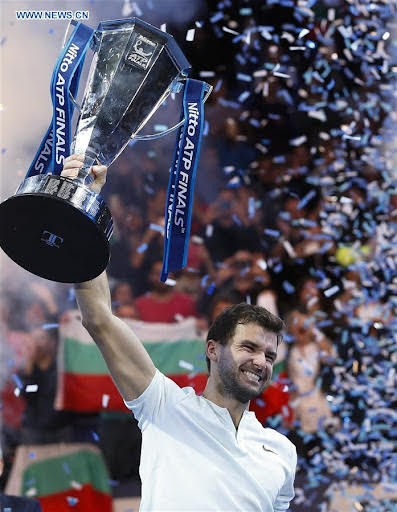
Grigor Dimitrov lifts the 2017 World Tour Finals trophy. Photo: news.xinhuanet.com