The teams from Tennis and Bagels and Murray Musings ranked the top five moments of the year on both the ATP and WTA side to round out the 2021 season. Like in part one, chaos and laughter is abundant. Here are links to listen.
Tennis is a lonely sport. You are on your own: it’s only you, your opponent, and the thrill of trying to battle through a match. There are no coaches, no teams, and no help once you step on court, except the stringer who works almost non-stop during a match (and might deserve a bit more credit than we give them).
But are we really alone? So often we forget that you can actually play doubles in tennis. There is literally a team version of tennis, and communication is key, as is positioning on court and where you place the next shot. At its worst, doubles is a highly strategic game and more akin to a chess game than singles, due to the think-a-move-ahead quality which is absolutely crucial. At its best, it is the fastest form of tennis, and the players’ reflexes are likely unmatched in comparison to singles players.
Why, then, does doubles seem to always take the back seat in tennis? With all the skill and brain game involved, it should be attractive to many audiences, even more so due to its quick nature, where matches normally finish within a reasonable hour-and-a-half (the length of a soccer match, and not too much longer than a hockey game).
Of course, singles gives a different vibe to the sport. The rhythm and shots are different. Players covering the court, doing it all by themselves, makes a huge difference and some rallies and shots show a form of athleticism that is, sometimes, as the legendary tennis commentator Rob Koenig puts it, “near the gods, where no mortal may approach.”
But that should not be enough reason for a doubles team to make half the amount of money a singles player makes for reaching the same round, or in the extreme case of tennis, be almost entirely forgotten in the greatness conversations. Doubles specialists are rarely mentioned when we talk about achievements in our sport. Often, the highest regard given to doubles prowess is when talking about great singles players who have done well in doubles too. Martina Navratilova, Venus and Serena Williams, John McEnroe, and even this year’s double Roland-Garros champion Barbora Krejčíková have their doubles achievements mentioned as addendums, or tie-breakers for how great they were.
Bob and Mike Bryan perform their iconic chest-bump after winning an incredible point.
Or have you never heard something like:
"Navratilova and McEnroe were incredible players. It’s amazing what they accomplished,and on top of that they had amazing doubles results too."
Why is doubles such a secondary modality in tennis? How did it become a sport without a spark, without any “wow” factor?
I would argue that it is an idol problem.
It is quite hard to identify with a sports team if they don’t have a name.
You can admire a doubles team, only to see them play with a different partner the next week. The lack of consistency in doubles, the constant changing of partners without further notice, is very hard to follow and frustrating for fans.
Unless you are a die-hard fan of a specific doubles player, you would not know why they changed partners. And consequently, a horrible question would pop out: “Oh, I thought they were a team?”
There is no sense of continuity, no sense of belonging in doubles. Fans simply can’t relate. A singles player will always be themselves even if they change part of their identity. They will always be the same person. Roger Federer, Rafael Nadal, Novak Djokovic, Andy Murray will always be themselves. That’s easy to track, easy to remember, easy to relate because you always see the same game style. They implement new things, but you witness their growth and decline.
You might argue that team sports also have a high turnover rate. It is true, and it is also true that Cristiano Ronaldo and Lebron James’ fans will still be their fans even if they get traded. But these are not the norm in team sports, they are outstanding people who have a specific following.
However, rarely is a team sports fan following a single player. They have something that will never change, or will change rarely and in very slow and noisy fashion: a team name.
The name, the brand, the jersey. The history remains, everything will be written under the name of the team. Real Madrid is not the same it was 10 years ago, but it was still Real Madrid. Manchester United has decades of history, despite having had hundreds of different players. Ronaldo played in both teams.
What does doubles have that give any sense of consistency? If a player plays for their own name, the other becomes just a tool for winning, a necessary annoyance. Might as well play singles. But doubles players are team players. They change partners to try and get a good fit, a good partnership that will allow each other to bring out their best individually and as a team.
Without something to play for, a consistent narrative, something that will remain no matter what, fans just lose interest. They do not sense the team is really a team, just some short-lived business venture. You help me out, and I help you in exchange. Where is the glory in that? Where are the ideals?
Good examples of successful doubles partnerships have that in common, that they always give out a sense of something more, beyond just a contractual partnership. The Williams sisters were trailblazers who fought for themselves, defended themselves and their families from outsiders and racism. They were a team. The Bryan Brothers were twins who grew up playing together, who had something special that was unique to them, almost a mystical connection. They were a team. The “Woods” were a friendship formed by fate, a partnership that was destined for greatness, with the magical connection between their names. They were a team.
Fans hearts will be broken, but a simple “we decided this partnership already gave everything it could” then moving along like nothing happened, is a horrible way to break a fan’s heart. They didn’t support the partnership only to see the players show quickly how unimportant it was to them, it was merely a business thing. They can be friends all they want, this is not a group project in university, it is a professional sport that has to potential to inspire and bring happiness to millions.
Without a sense of playing for something greater, there is no connection. Without significant history, there is no build-up. Without work, tears, and precious moments together over many years, there is simply no way a relationship can be built. One with each doubles player, one with their fans.
The impression that is left is apathetic. Doubles does not matter. It is simply a money grab, where players who didn’t succeed in singles go to in order to keep playing tennis.
And the saddest part is that this couldn’t be farther from the truth. I opened this piece by praising doubles players for their insanely good reflexes, their sharp minds and strategic thinking, their immense and underappreciated talent.
These players are hungry for win, they love the fight and the grind just as much as the singles players.
However, doubles has the fundamental problem that it is a true team sport, still living in the mentality that it is an individual sport. And that, as you may have guessed, does not make any sense.
Crumbs had fallen, patterning down my chest, a peppery twist of biscuity brown popping against the navy blue dark of my school uniform jumper as they raced each other down folds and creases that were crying out to be ironed flat.
There I was sprawled, a young boy returned from battle having walked through the combative minefield of double afternoon first year mathematics, fingers aching from thumbing calculator buttons in the search for answers that screamed to be found amongst layers of hieroglyphic-like workings out.
Maths was not, is still not, and likely never will be, my forte, and so as my eyes flitted with every flickering passing of every TV channel skipped through, my brain lay dormant, debating – in the rather overdramatic fashion only really capable of 11 year olds – if life were altogether worth living if it required us all to understand the hidden language of numerological whisperings.
A screen of green suddenly caught my gaze, dragging my mind from the pits of desperate yearnings for a day devoid of school the next day and up to breath amidst an air of a curiosity that tickled at my thoughts.
My engagement with tennis until that point had been a sporadic mix of bored backyard plastic bats-and-nets pasted over with a dreary array of tarmaced local public courts often puddled and flooded-up with seemingly endless Scottish damp, long-faded-yellow tennis balls abandoned in muddy corners left over from some time long ago and painfully rubber-stamping the severe lack of general club usage.
Now, sullenly sinking myself through a packet of chocolate digestives masterfully snatched from the biscuit cupboard while my mum was looking the other way, I sat up slightly to take some notice.
For who was this spindle-legged youth, wearing a shirt and shorts a size or two too big, cap wrapped around curls spilling out sweat and framing a face that growled in its movement at points ending regardless of won or lost, celebration or devastation, almost claustrophobic in its intensity that gripped camera lens edges and engulfed the match coverage with unfamiliar bubbling-over temperament?!
A fist-clenching, teeth-gnawing display of watercolour emotion followed, that clouded and drifted untamed but was spiralled through with potential, unburdened yet by expectation that would soon building-block its way across his shoulders and pressurise him steadily full of impatiently waiting childish hopes and dreams of a nation, all of it hand-crafted through years of yearning desperation.
This was a boy and his love for a sport, intertwined so closely in the heat of competition that it sometimes looked like he hated it all, screams of words that hung in the air around his head like angry red stamps of parental over-protective disapproval that would go on to attach themselves to him in the form of unshakable criticism throughout the early stages of his career.
They would dog him consistently and bark at his victories, baring teeth that dripped saliva wet with tut-tuttings reserved only for those that they felt didn’t represent good-and-proper, something they’d held dear throughout the Henman-era before.
Back then though, I knew not what was to come drifting through the future night, only what was playing out in front of me on the grass of the here and now, and what I saw grappled me still, hooking my skin and rooting me there, a biscuit forgotten and powdering into pieces as they were ground into the cushions on the sofa beneath my hand as I leant slightly forwards.
And forwards and forwards, I did fall, right into being a fan of Andy Murray and all the unpredictable that came with it.
…
From that point onwards, I began watching tennis regularly, expanding out from that singular moment to become something of an obsessive, letting my enjoyment of the sport guide me through the rest of my school years.
Indeed, tennis followed me as I went to college in search of something. It was there as my heart broke and I embarrassed myself on the dance-floors of nightclubs of uni nightlife. It comforted me during many a morning-after-the-evening-before, easing the dullard ache of the one-too-many. It was there as I took a risk and went to London driven only by a willingness to keep chasing failure in hopes of stumbling somehow someway on success. It’s outlived friendships and family members, attending the funerals of those who passed away, standing at the back of church halls in all-black, its hair done up real nice, its hands clasped in front, head bowed in a solemn show of unseen-by-all-but-myself respect. There it was, condensationing against my windscreen, trailing little rivers through the trials and tribulations that seemed to consume my whole world in the moment but looking back, were the very definition of the absolute nothing much. And it’s here with me nowadays, through the job rejections on job rejections frustrations, watching my face fold with ugly tears endless in their ability to grip my whole body and shake me silly with repetitive angst.
…
I’ve co-founded a podcast and recorded near 50 episodes made of much madness and laughter. I’ve watched my favourite player win Majors thrice over, become world number 1 and string Olympic golds around his neck. I’ve been lucky enough to attend Wimbledon, the Davis Cup and numerous exhibition events, losing my voice to noise levels intense. I’ve written match previews and racket reviews and transcribed interviews. I’ve coached the game to young Autistic adults at summer camps in America, sat back and watched them outperform their own expectations of how great they could be. I’ve tuned into tournaments in other time-zones until the sun rose, light catching itself between the blinds of my window and casting shadows across my face, highlighting bags beneath my eyes darkened with the delirious. I’ve been late to work and had my boss sigh with knowing understanding, a “tennis again?” worn only by the partly-amused. I’ve met some of the very best people, all of us fortunate enough to find this sport and hold it close. I’ve been eye-rolled by loved ones who don’t quite get it but always at least try to anyway and for that, I only thank them. They know who they are.
…
When things get hard, I climb into tennis and shut the lid above my head because it’s easy and always, the calendar of the season stretching wildly longer than many others. It’s there consistently regardless, it’s simplistic rhythmic back-and-fourth standing solid in its place amongst all of the ever-changing.
And so once in a while, I try and write about it and I’ll be the first to admit that I find doing so tiring at times, trying to put it down on page, trying to fit it all in, wrestling with my use of language in order to try start something, try spark something, giving up often and leaving things in drafts to gather nothing but dust, dammit, words crunching against each other on pages in ways that don’t quite work.
But let me tell you, it’s worth it for those moments of the few-and-the-far-between, where you look at the completed, the finished, the something you’ve written about the something you love, the final sentence of the final chapter of the final version of your work and allow yourself to smile if only a little
…
At 28, I haven’t yet got to the point where I truly believe that what I write about tennis is worthwhile but I hope to one day get to the point where I do.
And I hope Popcorn Tennis – and those who are helping shape it – can be a part of that process for me.
“Scott, can pick a nice professional photo to go with your piece?” “Sure I can!…”
Tennis, like life, can be confusing. There are apparent absolutes that end up revealing themselves as mere hypotheses in the middle of a big match. In a match in which one player’s backhand is clearly better than another’s, you might think the better backhand will come out on top all the time, or the vast majority of the time. The margins often end up being thinner than the facts suggest.
As Roger Federer hits his first serve on his first championship point for a ninth Wimbledon title, Novak Djokovic leans to his right. Federer’s serve smacks the net tape, a likely ace had it gone over. Not too far from Center Court, England is about to edge New Zealand in a super-over to win the Cricket World Cup.
In the third round of the U.S. Open, eventual champion Emma Raducanu beat Sara Sorribes Tormo 6-0, 6-1. There were 93 points played in the match, with Raducanu winning 60. Sorribes Tormo won just over 1/3 of the points played, yet she won 1/13 of the games played. Such is the nature of tennis’s unforgiving scoring system: play your best on the big points, or the points you win will cease to mean anything.
Returning to the backhand example, Daniil Medvedev and Stefanos Tsitsipas clashed in the Australian Open semifinals this year. Medvedev’s backhand is one of the very best in the world, even statistically outperforming Novak Djokovic’s in the final of that tournament. Tsitsipas’s, by comparison, has some holes, most notably when he is pushed wide and on the return.
From this, it seems like Medvedev’s backhand would always overcome Tsitsipas’s, either by forcing an error or outlasting it. But tennis swings on errors. Medvedev’s backhand isn’t perfect: his mistakes might be few and far between, but they do happen. Tsitsipas might take a chance with his backhand and hit a shot down the line. This might not be reliable, he might miss often, but it does happen.
Take this 25-shot rally from the match. Shots 3-10 and shots 14-20 see the players trade backhands. The first ad-court exchange ends when Tsitsipas hits a short slice, leading Medvedev to attack with a crosscourt forehand. The lack of pace and proximity to the line on the forehand, plus Tsitsipas’s speed, allow the Greek to get to the ball fairly easily, so the rally goes on. The second ad-court exchange ends as Tsitsipas cracks a backhand down the line, forcing Medvedev into a running forehand. Finally, the rally concludes as Medvedev chases down a sub-optimal drop shot and lifts a backhand winner into the open court.
Medvedev’s decision to move to the right of the service line to hit a backhand on shot seven is an odd one, and might just be a weird lapse in judgment, but his immense trust in the consistency of his backhand may well have had something to do with it.
It’s been established that Medvedev has the better backhand, but from this rally, you might not know it. In professional tennis, the margins are so small. Tsitsipas’s short slice, while a mini-loss in the mini-battle of the ad-court duel, wasn’t poor enough that Medvedev could end the rally with the ensuing forehand. Tsitsipas also made up for his lesser consistency on the backhand side by taking a chance with a down the line shot, which landed in.
This is one example, of course. Tsitsipas made plenty of backhand errors in this match. But even big discrepancies in shots on the tennis court often take some analysis to be made apparent. There are fans out there who don’t understand that Djokovic is a better returner than Federer (including yours truly for quite a while), which might seem insane at first glance. But there are commentators that don’t point this out; there have been matches in which Federer broke serve more than Djokovic; there have been matches where Djokovic returns better but the difference is small enough not to be obvious.
*****
This nature of tennis as an extremely competitive conglomerate of shots, where even shots clearly better than other shots don’t always come out on top, makes it hard to make sense of the sport. Sometimes, stuff happens that just makes very little sense. To return to the Federer-Djokovic rivalry, there’s the fact that across 50 matches, Federer has won 73.1% of points in which he makes a first serve. Then there’s the fact that at the U.S. Open semifinal in 2011 and the Wimbledon final in 2019, Federer had four match points, two in each match. He made first serves in three of them, and he lost all four of those points. A difference in mental strength? Sure. An anomaly? Maybe. Bad serves? In at least one case. All of this aligning, though, feels like only the beginning of an explanation as to how something like this can happen.
What is the answer to this question? I have no idea. Probably a mixture of confidence, a very calm mind, a lifetime of experience playing tennis and facing adversity, benefitting from a bad approach shot from Federer, and the well-practiced technical motions required to nail the pass. Maybe none of this was what made the difference. It says a lot, I think, that after the 2010 U.S. Open semifinal, Djokovic said simply that he was closing his eyes (!) and hitting his forehand as hard as he could.
These moments, and the reception to them, are interesting — it’s the other four-hours-plus of this match that’s easier to comment on. Djokovic having a poor day and Federer having a great one is explicable. Everyone has bad days on court; everyone has great days on court. This five-second point, though, is shrouded in mystique, even though Djokovic’s affinity for saving match points is well-known (especially against Federer). How often does Federer lose a point after making a first serve and hitting a forehand on the first shot? Not often. How often does someone make a passing shot, even a simple one, to save a match point? Not often. The odds of this outcome happening on this point seem so astronomically low that I think while we can theorize about why it happened, we’re really just guessing. We could write pages and pages on what we do know, yet this ability is overshadowed by the desire to pin down the things we don’t. It’s probably self-defeating at times, but it’s irresistible (think of Kyrgios unnecessarily hitting a tweener on a big point in an important match at a major).
All this adds to the intrigue of tennis. Not only is there a physical and mental trial, there’s this invisible, abstruse land in which amazing things happen on match points, or a player chokes violently as the finish line comes into view, or a random error at 2-3, 40-15 in a deciding set ends up being the straw that breaks the camel’s back. Trying to figure out the “why” of any of this is like standing in a pitch-black room with lights flashing intermittently, and with every new flash the exit has moved to a different place.
I’m as spellbound now by the mystique of tennis as I was when I initially started watching the sport, but I don’t feel as if I’m any closer to putting it into words. I don’t know that any players are, either. Part of the lack of meat to Djokovic’s answers is surely due to a desire to be classy, but when asked about his remarkable escape from the 2019 Wimbledon final, the Serb said this:
“In these kind of moments, I just try to never lose self-belief, just stay calm, just focus on trying to get the ball back.”
And this:
"It was kind of a flashback to US Open when I saved the two match points against him, as well."
I mean, does this really tell us anything? This is how the man with the best view of this holy-shit moment describes one of the biggest moments in tennis history? What I want to see is an explanation, something that logically breaks down the illogical, something like this:
"My god, I'm in shock. The 2011 U.S. Open semifinals felt like a one-time thing. To save two match points against one of the most difficult serves to read ever required me to lie to myself, to think that there was nothing on the line instead of a 15th major title. Had I not done that, I could never have landed that passing shot inches away from the line. Imagining getting nervous at that moment and hitting the pass miles out makes me shudder. The experience was terrifying; I might have a good return game, but the returner usually has so little control over how points get played against a serve as good as Federer's. I was fortunate that Federer missed his first serve on match point #1 and hit a central first serve on match point #2, and I hit good returns on both points, plus the passing shot. I think Federer had to have remembered the U.S. Open, otherwise he'd probably have won the game even from deuce. But even knowing all that, it feels like all the planets in the universe had to align for me to win this match."
Even an answer that complex doesn’t get much closer to explaining what happened. Plus, Djokovic probably doesn’t have much motivation to guess. On some level, he knows how he did it, even if he can’t explain it. We know players aren’t the ones to ask about this kind of thing. David Foster Wallace theorizes that the ability to perform these impossibles is inextricably tied to the inability to describe them. I would agree, and posit that maybe it’s because the player’s sole motivation is winning, not figuring out how to win after they have won. The fans are probably the ones best equipped to answer their own queries.
Rafael Nadal gives several interesting thoughts on his 2018 Wimbledon loss to Djokovic in an uncommonly instructive press conference.
*****
Maybe explaining things is just an insufficient way of communicating understanding. Since I’m not a professional tennis player, I can only look to other areas of life as a comparison. From what I can tell as a relatively unexperienced 20-year-old, love is another uncommunicable topic. It seems like even those who end up in happy partnerships for life get there by experiencing painful disappointment after painful disappointment, then a combination of the knowledge from failed relationships and luck result in a happy ending. But even if the process is evident, things have to be felt, not heard. “It will hurt” falls way short of explaining the dozens of moments when it feels like a vacuum is sucking the air out of your chest, resulting in a sensation somewhere between vertigo and anxiety. If experience is indeed the best teacher, tennis fans who aren’t professional players will never understand what they want to know. (Speaking for myself, at least. Other armchair analysts might miraculously start hitting their backhand like Djokovic, but I know it won’t happen to me.)
It’s a frustrating bind — players know the answers but can’t put them into words (maybe there aren’t words to communicate these answers), fans want the answers but have no means to find them. Those who want the key to the door have to work hard to even find clues to its location; those who know where the key is have no desire to go get it. The contrast seems like a slightly-less-morbid version of the coffin riddle.
Maybe David Foster Wallace’s theory — that dry answers like Djokovic’s are actually extremely thorough, such is the ability of the athlete to vacate the mind — is the perfect resolution to this annoying puzzle. But seeing an incredibly rich and vivid series of shots play out on court, then get summarized with “I got lucky on a few of the big points” is endlessly irking. I feel like there must be more to it than what’s been said, even if that information is in a place that no one will ever reach.
I plan on trying to find it for as long as I remain a tennis fan.
Welcome to the last part in our ‘Losing to a Tournament’s Eventual Champion’ series.
I take it you know how this works by now – you wanna get down to the nitty-gritty of the players that couldn’t stop losing to TECs, the real casualties of the tour…
I GET IT.
You want me to shut up and get on with it…
Have it your way!
Joint-Second: Six Losses
At joint-second, we have three players with six losses to TECs this year! Our first two share similar(ish) stories…
Ons Jabeur (#10):
Sabalenka in Abu Dhabi (3R)
Osaka at the Australian Open (3R)
Sharma at MUSC Health Open (F)
Ostapenko in Eastbourne (2R)
Muguruza at the Chicago Fall Classic (F)
Badosa in Indian Wells (SF)
Barbora Krejčíková (#5):
Muguruza in Dubai (F)
Świątek in Rome (3R)
Barty at Wimbledon (4R)
Bencic at the Olympics (3R)
Barty in Cincinnati (QF)
Badosa in Indian Wells (3R)
Both Jabeur and Krejčíková broke out this year, the latter of course taking the French Open title.
Amidst all of their winning, they happened to run into tough opponents early in tournaments – Jabeur was particularly unlucky to run into Sabalenka, Osaka and Ostapenko in Abu Dhabi, Australia and Eastbourne, respectively.
The warning signs were there for Krejčíková’s opponents after she’d narrowly missed two match points against Iga Świątek in Rome. It was after winning the French Open that Krejčíková will be feeling most aggrieved – despite the ranking bump, Krejčíková lost to Barty at Wimbledon and Cincinnati, lost early to Bencic at the Olympics and was taken down by Badosa in the third-round of Indian Wells.
Both players deserved better than this surely?
Then there’s *ahem*…
Katerina Siniakova (#49):
Gauff in Parma (SF)
Kerber in Bad Homburg (F)
Barty at Wimbledon (3R)
Krejčíková in Prague (QF)
Kontaveit in Cleveland (QF)
Kontaveit in Moscow (1R)
Poor Siniaková definitely didn’t deserve this. Like Alexandrova in part one, Siniaková was repeatedly handed shite draws, Barty in the third-round of Wimbledon being the hardest to stomach and the end of her season spoilt by two losses to Kontaveit in red-hot form.
Here’s hoping a change in fortune awaits the world #49 in 2022!
First: Seven Losses
And finally…
Anastasia Pavlyuchenkova (#11):
Osaka at the Australian Open (1R)
Kasatkina at the Phillip Island Trophy (3R)
Kvitova in Qatar (2R)
Sabalenka in Madrid (SF)
Krejčíková at the French Open (F)
Ostapenko in Eastbourne (1R)
Bencic at the Olympics (QF)
Anastasia Pavlyuchenkova tops the list with seven losses to a TEC this season!
The Russian couldn’t catch a break at the start of the season, her loss to Osaka in the first-round of the Australian Open probably the worst of the lot. Even after reaching the top-20 following the French Open, she was given a cruel first-round against Ostapenko in Eastbourne and came up against an inspired Bencic in Tokyo.
What was a good season could have been a great season if she’d been more fortunate. Fingers crossed for 2022…
Losing to a TEC in 2021
That’s it!
Of all the players mentioned, I feel the most sympathetic towards Siniaková. She lost a lot of close matches this year to superb players, surely deserving a higher spot than #49 in the world.
Kateřina Siniaková shakes hands with Ash Barty after a 3-6, 5-7 loss in the third round of the 2021 Wimbledon Championships. Photo credit: Getty Images
Do you feel sorry for any of these players or is there a black void where your emotions should be? I can’t help you out in the case of the latter I’m afraid.
Do you want to know your own favourite player’s record this season? This I can help you with – shoot me a wee tweet and I’ll gladly respond (@jackedward1994)!
Speak soon,
Jack
Jack Edward can be found @jackedward1994 on Twitter. He is the author of the ‘On The Line’ blog and the host of the On The Line Tennis Podcast. His work features plenty more deep statistical dives and a very fine attention to detail. You can check out each of his creations here.
This essay was originally written in 2017 as a school assignment.
The dumpster is associated with filth, disgust, and rotten food. I reminisce about the fondest memories of my childhood, which all started at the local dumpster, two blocks from my house. It was one sweltering hot summer day in 2008. The sun shone brightly overhead and the sweat poured down my forehead as I slouched in my front yard in boredom. No person in sight, no friends, and no routine.
Life in the summer was getting dreadful and I was dying to go back to school. With nothing better to do, I walked down the street, wanting to lie down in the grass two blocks from my house, to cool off in the shade. I walked past the cul-de-sac and noticed something peculiar lying flat on top of the local dusty green dumpster. I picked it up and stared in awe at it. It was an old Prince tennis racquet. What was a perfectly good tennis racquet doing on top of the dumpster? Without any qualms, my little seven-year old self picked it up and ran back home. It reminded me of the tracquet that my dad used when he played tennis with his friends on Saturdays. The intricate pattern of the strings and its complex design and colorful frame aroused my curiosity about the game of tennis. I wanted to learn how to hit the tennis ball with the strings. So I moved some boxes around in the garage until there was an open space to run and move. With the space in front of the cabinets now clear, I grabbed a tennis ball and watched as I whacked it as hard as I could with the racquet strings. Almost like a golf swing. From then on, I would hit against the cabinets everyday for hours and hours upon end. My hands would tire and my palms would blister from so much practice. This did not deter me. The whole house had to endure the sounds of the ball cracking the cabinets with immense force. Despite the cacophony, my parents were satisfied I had finally found something to do.
Playing against a wall gives a tennis player a unique opportunity to get a feel for the sweet spot of the racquet. The physics of tennis begins at the foundation of this central spot. As I hit the ball for hours, I started to turn earlier and plant my feet in position at just the perfect moment so I could transfer my weight as the contact of the strings and the ball was straight ahead. I felt like Superman for a second. I practiced coiling my shoulders as I took the racquet back parallel to the ground, and turned sideways. I used my hips and shoulders to rotate my whole body while the shot was being hit. This was the start of my own version of a tennis swing. It was certainly exhilarating as the adrenaline rushed through my veins while I tried to compete against the wall, a contest I was destined to lose every time. I eventually made up my own unique hand-eye coordination drills with the wall, as I would hit backwards or behind the back. It was all physically exhausting yet engaging, as my eyes never wandered from the tennis ball.
Weeks and weeks of constant and repetitive sound of the ball hitting against the cabinet was all that could be heard as my parents left for work in the morning and came back in the evening. I had found a true passion, and the real tennis hadn’t even begun yet. Little by little, tennis was becoming the love of my life. I was constantly practicing the swinging motion whenever idle, such as when walking around the house. Then, after about six months of playing this kind of tennis-squash in the garage, at 8 years old, I went to an actual tennis court for the first time with my father and his friends. Amazed at its symmetry, I started running around like a kid in a candy store. It was much different than I had imagined. The tennis court was vast from a distance but appeared to shrink as I took footsteps closer in. I noticed the two sidelines on each side of the net, as my dad explained the difference between the singles and doubles alley. I watched in awe as my dad and his friends moved around the court. Looking back now, I realize how flawed their technique was, but their relentless will and determination to keep the ball in play allowed for many intriguing rallies and unpredictable shots.
Obviously not the Prince racquet, but a symbol of how I got into tennis nonetheless!
A few days later, the following week, my father and his friends were in our house watching a legendary tennis match: a historic contest lasting almost 5 hours between the two best players in the history of the sport. Sitting down with my dad that day I watched the agony and ecstasy of tennis. We were witnessing the mesmerizing 2008 Wimbledon final between Rafael Nadal, a powerful and muscular Spaniard with an irresistible amount of tenacity, and Roger Federer, the Swiss maestro. Federer was a five-time Wimbledon winner who glided around the court effortlessly. At the same time, he was ultra-aggressive with all his strokes, always rushing his opponent. The Swiss champion’s textbook all-round game coupled with the flair and relentless fighting spirit of his Spanish rival was a masterpiece to the eye. It was a contrast of styles, an intriguing match-up hailed as the “beauty and the beast” of tennis. After this nearly 5-hour classic showdown was over, it was hailed by many pundits as the greatest grass court match ever witnessed in tennis history. Rafael Nadal became the first Spaniard in 42 years to capture the Wimbledon crown, and did it over his greatest rival, Roger Federer, denying him a chance to win it for the sixth straight time.
I felt motivated and inspired by these two greats of the game, who used every ounce of their energy on the court. I had my heart set on becoming a professional tennis player. I was willing to go to extreme lengths to achieve it, and I wasn’t going to stop until the day I tasted the bitter-sweet grass at the lawns of Wimbledon and held up the grand slam trophy. How ironic that a dumpster, a receptacle for unwanted and discarded waste, would become the source of my new ambition and motivation for success. My future was set in stone…until things began to steer away from me.
Melbourne, 2009. The Australian Open was coming to a scintillating end, with Rafael Nadal defying the limits of his physical endurance as well as fierce performances from Fernando Verdasco and Roger Federer to win his first and only major title Down Under. Coincidentally, my family was on vacation in Melbourne that very week. We didn’t have tickets to the tournament, but my parents were spellbound watching those last two matches on TV. My dad rooted for Federer in the final, my mom for Nadal.
My seven-year-old-self was asleep in the next room of our hotel.
Most of what I remember from that week was the insane heat. Every day we were there, I think, the temperature hit at least 43 degrees Celsius. It topped out at 47 — 117 degrees Fahrenheit, the hottest weather I’ve experienced to date. The simple act of stepping off an air-conditioned bus into the thick heat made me tired. I recall a kind stranger wafting air towards me with her fan and being grateful, but too lethargic to express my thanks beyond a weary smile.
While I was longing for stronger air conditioning, Rafa was racing around Rod Laver Arena in the slightly cooler night temperatures. He won his semifinal and final in five sets, playing for over nine hours across the two matches. Around eleven years after this, I watched his semifinal match with Verdasco in full on YouTube. For five hours and 14 minutes, I was spellbound: at the lefty patterns, at Verdasco’s bravery to go for risky winners constantly (he would hit 95 of them before double faulting on match point), at Nadal’s willingness to sprint for bullets or tightly angled shots until the last ball. It was the greatest tennis match I had ever seen, its consistent quality easily exceeding that of the Federer-Nadal Wimbledon final in 2008 in my view. (People seem to forget that Federer lost five straight games to lose the second set.)
Sadly, I had to wait a while before becoming a huge tennis fan. Had I stayed up late one summer night in 2009, it may have happened much earlier. I would have been able to watch the legendary five-hour, 53 minute Djokovic-Nadal clash, Serena Williams coming within inches of the Calendar Slam in 2015…I would have been able to witness the Golden Era. These hypotheticals are starting to bum me out, so let’s move on.
*****
I actually have one other tennis memory from 2009 — my parents told me that Andy Roddick had lost to Roger Federer in a very close Wimbledon final. I was deeply disappointed. My family lived in New Zealand until early 2010, and while we still lived there, I had this idea that the US was the greatest place on Earth. I was born in Washington, D.C., and always wanted to move back. In a moment of unfortunate irony, I didn’t realize that New Zealand was actually preferable to me, with nicer people and better food, until we actually did return to the States. But in 2009, my America-bias was still raging, so I was sad about Roddick losing.
“Will he ever have a chance to win another one?” I recall asking my parents in a moment of distress.
“Probably not,” they responded. It was my first taste of how infuriatingly conclusive tennis matches can be. Some create intrigue for the next matchup; others seem to say the winner could have won by even more, and they’re never going to lose to that opponent again. Still others are more about the stage than the result, and in retrospect, it was apparent Roddick’s last, best chance to win a Wimbledon final had passed. (Roddick at least got that elusive win over Federer in Miami three years later, though I was unaware of it at the time.)
In 2013, I started taking tennis lessons at a club, where my peers would mention professional players. I didn’t follow tennis myself, but Tennis Channel would play inside the club, so I would inevitably catch bits of whatever match from the archives was playing. As the Federer-Djokovic rivalry ramped up towards the end of the 2015, I recall rooting for Federer out of sheer name recognition from that Roddick memory six years prior. Federer had been the best back then, so I wanted him to be the best now. As Djokovic repeatedly beat Federer at the majors, my preferences strengthened. I didn’t want Djokovic to catch Federer in the head-to-head; I didn’t want him to win any more majors. Federer kept going deep in the big events, but why couldn’t he beat Djokovic? It annoyed me, and I didn’t even watch these matches, I only heard about the results.
*****
Federer-Djokovic might have drawn my attention towards tennis, but the first tennis I watched at length was the Wawrinka-Murray semifinal at Roland-Garros in 2016. It wasn’t the amazing physicality of elite clay tennis that stuck out to me while I watched, it was the scoring system. The fight. As I watched Murray put on a virtuoso display to take a two-set lead on Wawrinka, I craved more drama. I wanted a closer match. With Murray cruising, it didn’t look likely. In the third set, though, Wawrinka started going for more on his shots. He fist-pumped often, pointing to his head and shouting “allez!” The celebrations didn’t strike me as over-the-top, they looked incredibly cool and confident.
I was spellbound. Here was a player who was clearly dead in the water, yet he was playing and acting as if he could still win. If he was faking it, he was a fantastic actor. Not only that, but the sport was telling me that no matter how far behind someone was, if they started to play better than their opponent, comebacks were possible. This wasn’t the case in several other sports. Tennis, I could already tell, was something special.
Wawrinka won the third set — giving me hope — and lost the fourth to another burst of error-free tennis from Murray. I remember watching Murray knock clay off his shoes with his racket before serving and thinking he looks invincible, a feeling that stuck with me for hours after the match. I remember Martina Navratilova casually saying “flawless tennis” as a stat popped up showing Murray had made something like two unforced errors in the fourth set. Djokovic might be the #1 seed, I thought, but there’s no way this guy is losing the final.
Murray did lose, of course, despite winning the first set. I was irritated at how big the difference evidently was between the #3, #2, and #1 seeded players. And Djokovic’s tennis, even more solid in its metronomic reliability than Murray’s, annoyed me as well (though I did admire the disguise on his backhand drop shots). There was also an allure to my frustration, though. Those seeding numbers clearly had to have been earned, matches clearly had to be closed out even after building leads. Plus, the way Djokovic had fallen to the clay after winning the final had been intriguing. I wanted to see a celebration like that again.
After Roland-Garros, I started to watch the ATP players at the majors with increasing frequency. At Wimbledon in 2016, I got to watch Federer in real time for the first time. I loved his coolness on court, which made it more special when he fist-pumped or yelled. I loved the crisp sound of racket meeting ball when he was connecting cleanly with his groundstrokes. He beat Marin Čilić from two sets down, saving three match points. It was incredible. The next round brought me crashing down to earth: Federer lost to Milos Raonic, squandering a two-sets-to-one lead and getting injured early in the fifth set. I was devastated — at the blown lead, the injury, and at Raonic’s comparatively flat final performance after his dynamic takedown of Federer. The sadness didn’t kill my enthusiasm for the sport, though. I watched more men’s tennis through 2017, being thrilled at Federer’s legendary Australian Open victory and taking plenty of schadenfreude from his revenge win over Raonic in the Wimbledon quarterfinals that year.
In 2018, the Australian Open on the women’s side wowed me as Halep, Kerber, and Wozniacki showed near-superhuman endurance to play a plethora of epic matches. The Halep-Kerber semifinal, in particular, blew my mind. Both players saved two match points in the middle of the deciding set, one with a winner and one via the opponent’s unforced error. The symmetry was stunning, and it had happened in the middle of a set of some of the most amazing long rallies I had ever seen. Halep eventually fell two games short of winning the title after playing for three and a half hours to beat Lauren Davis in the third round, then another two hours and 20 minutes to beat Kerber in the best match of the tournament. It was one of the best physical efforts I had seen, leaving me devastated for Halep despite not rooting for her at the outset of the tournament. After this Australian Open, I watched both men’s and women’s tennis.
Besides this video coming from one of the best matches of 2018 and of the 2010s in general, rarely does a major put this much effort into making a good highlight package. If you won’t watch this because of my recommendation, please watch it simply because of that.
*****
The more tennis I watched, the more I felt my preferences between players fade. I still considered Federer my favorite player through the end of 2018, but over time tennis became less about him and more about the sport. It wasn’t that Federer ever did anything that made me like him less, it was just that I started to notice and like other players as well.
My interest was also drawn more towards tactics as I watched more epics. When I saw a great match, I wanted to understand as much about it as possible: I wanted to read articles breaking down the crucial stretches, I wanted to hear the players talk about what went right and wrong. My hunger to consume tennis media was often unsatisfied by what was out there, so I decided to try my hand at tennis writing.
My articles were confused at first, but over time I started to think about how I wanted to write when I watched matches, which I think made my writing more tightly tailored to what was happening on court. I still struggle with organization and outlining my pieces, but I’m happy with how far I’ve come in the two and a half years since I started writing about tennis.
During the pandemic, Andre Rolemberg contacted me on Twitter to see if I wanted to make a guest appearance to talk GOATs on his podcast, Tennis and Bagels. I couldn’t believe it. I’d been engaging in some pretty involved debates on Twitter around that time, but someone was seeking out my point of view on the subject? I can still remember how nervous I was — I sweated a lot — but I had a great time. Looking back on that time compared to where I am now is a bit surreal; I’m now a co-host of Tennis and Bagels with Andre and another good friend, Vansh Vermani.
https://t.co/htZTZMXUnQ Had a great time talking GOATs with @AndRolemberg! You can listen to the podcast here 🙂
In March this year, I was procrastinating on work and reading articles by Juan José Vallejo. Many of his pieces were written at the analytical level I wanted to read; I learned a lot from his tactical breakdowns. Plus, his pieces lacked the vexing I-don’t-want-to-offend-anyone-so-I’ll-avoid-saying-anything-interesting-at-all spirit present in so many mainstream articles. I went through Juan José’s pieces pretty quickly and wondered if he’d written any more things. Before long, I came across The Changeover. Juan José had something like 200 pieces up on the site, and there were many other fantastic articles by the other co-founders, Lindsay Gibbs and Amy Fetherolf, plus new writers who had joined the site over time. I read and reread Juan José’s LiveAnalysis pieces. I found an article Lindsay wrote about the social media endeavors of Fernando Verdasco (on his Facebook page, he wrote an exclamation point after his name) and couldn’t stop laughing. I pored over the pieces for weeks, loving everything I read and being inspired to take my own writing to the next level.
A couple months later, I applied for a media credential at the Newport 250 ATP tournament, though I would only be able to be on-site for two days. In a pinch-me moment, my request was accepted. I spent the night before the first day of the tournament doing research on everyone in the draw to write in a little notebook, then reading Juan José’s on-site coverage of the 2013 Houston 250 for inspiration. Like with my first podcast appearance, I was incredibly nervous — I walked past Blair Henley, who I recognized from Twitter, and was too shy to say anything — but loosened up with time. I talked to Kevin Anderson, I watched Jenson Brooksby beat Evgeny Donskoy. I consumed far too many blue Jolly Ranchers in the media room and didn’t use the bathroom at all on the second day. I wrote eight articles in just over two days. The experience was one of the best I’ve had, reaffirming a realization I had come to a while earlier: I wanted to be a tennis journalist.
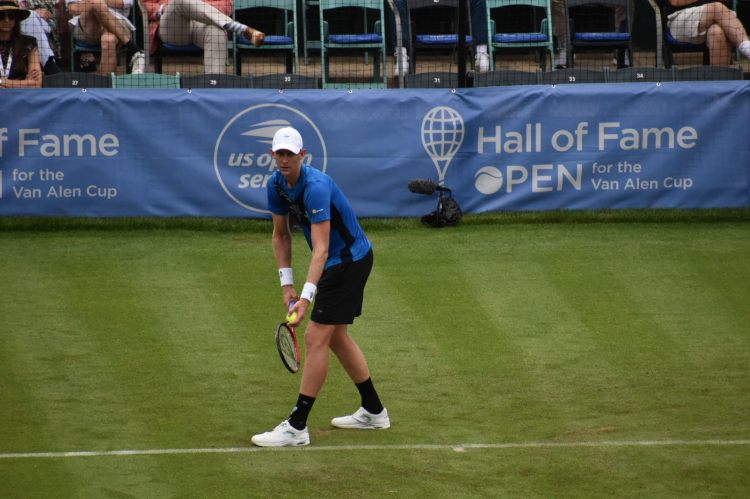
This is a photo I took of Kevin Anderson serving at the Hall of Fame Open in Newport. I tend to be bored by matches involving a huge server when I watch tennis on TV, but watching a tall player (or anyone) blast aces in person is quite an experience.
Midway through the tournament, I messaged Juan José to see if he wanted to guest on Tennis and Bagels. I had wanted to talk to him since reading his pieces way back in March, but wasn’t able to muster up the courage. Sitting in the stands on the show court in Newport, the time seemed good — I wouldn’t have been where I was without taking the chance to apply for a credential. He agreed to come on the podcast, leading to a three-hour conversation containing pretty much everything I had wanted to say, a rare example of when a highly anticipated event ends up being as great as it is in the head beforehand. Again, I was absurdly nervous prior to the Zoom, but I had no reason to be — he was incredibly cool.
Owen got the chance to talk to his idol — @jjvallejoa, who has done a ton of brilliant tennis writing for The Changeover, Rolling Stone, and his Medium account.
— Tennis And Bagels Podcast! (@TennisAndBagels) July 17, 2021
It’s this spirit that I’m going to try to embody moving forward. Tennis doesn’t inspire the live-and-die-with-your-player feeling in me that it used to, but there are new areas of the sport I’ve been able to explore, and even more that I want to in the future.
I might have missed the end of the 2009 Australian Open, but the Happy Slam has since become my favorite tournament to watch — fresh players battling it out on ocean-blue courts with relatively unproblematic crowds shouting from the stands. It’s my goal to one day return to Melbourne to cover the tournament. Like Nadal in 2009, Halep in 2018, Djokovic in 2012, Federer in 2017 and so many other champions, I hope to leave nothing on the table as I pursue my goal.
As you may have already seen, I released a couple of pieces on Popcorn Tennis detailing the ATP players that had lost the most times to a tournament’s eventual champion (TEC).
Having come to some pretty interesting conclusions on the men’s side, it would be remiss of me to overlook the WTA.
Photo credit: AP Photo/Alexander Zemlianichenko
Before we dive in, please note this does not include team/exclusive entry events/tournaments that didn’t finish i.e. WTA Finals/BJK Cup/ATP Cup!
Now without further ado…
Joint-Fourth: Four Losses
At four losses each to a TEC, 14 players made it to joint-fourth on our list.
Too many to rifle through the lot but at a quick glance…
Muguruza (#3)
Ka. Plíšková (#4)
Sakkari (#6)
Rybakina (#14)
Mertens (#21)
Gauff (#22)
Bencic (#23)
Kasatkina (#26)
Azarenka (#27)
Collins (#29)
Vondroušová (#35)
Garcia (#74)
Bouzková (#89)
Kozlova (#144)
Unsurprisingly, the top-10 are comprised solely of top-30 players with Vondroušová sneaking the #11 spot at #35 in the world.
It’s worth taking a closer look at our last three players, however, who made the list despite being ranked outside of the top-70!
Caroline Garcia:
Mertens at the Gippsland Trophy (3R)
Osaka at the Australian Open (2R)
Krejčíková in Strasbourg (2R)
Kontaveit in Cleveland (2R)
Caroline Garcia’s gruelling comeback continues. Though she played some shockers this year, her fans can take plenty heart in knowing she was frequently handed some pretty tough draws.
Marie Bouzková:
Barty at the Yarra Valley Classic (3R)
Kasatkina at the Phillip Island Trophy (F)
SST in Guadalajara (SF)
Tauson in Luxembourg (QF)
Marie Bouzková started the year with a bang, only being beaten by some of the best players in the world in the first few tournaments of the year before losing a lot of momentum.
Kateryna Kozlova:
Cirstea in Instabul (1R)
Konta in Nottingham (3R)
Putintseva in Budapest (SF)
Zanevska in Gdynia (SF)
Kateryna Kozlova, ranked as low as #144 in the world, lost to four TECs this year! Istanbul and Nottingham were particularly unlucky – when she did make deep runs in Budapest and Gdynia, it took three sets and the TECs to put a stop to her.
Joint-Third: Five Losses
Two players share joint-third on five losses to a TEC.
Elina Svitolina (#15):
Mertens at the Gippsland Trophy (QF)
Barty at the Miami Open (SF)
Barty in Stuttgart (SF)
Świątek in Rome (QF)
Krejčíková at the French Open (3R)
Bar an Olympic bronze (still essentially a glorified semifinalist), by her standards, Svitolina had a pretty unremarkable 2021. Gael will take heart in some closely contested matches against these TECs, serving for the match against Barty in Stuttgart and pushing Mertens to a match tiebreak at the Gippsland Trophy.
Ekaterina Alexandrova (#34):
Tauson in Lyon (2R)
Krejčíková in Strasbourg (QF)
Krejčíková at the French Open (2R)
Tauson in Luxembourg (2R)
Kontaveit in Moscow (F)
Alexandrova had a ton of good wins this season but unfortunately this didn’t translate to a ton of deep tournament runs. In fairness to her, she came up against both Krejčíková and Tauson twice whilst they were ranked relatively low. In her one final of the year, she came the closest of anyone to beating Kontaveit indoors but ultimately lost from a set and a double break up.
She’s been trapped in top-30-to-40 purgatory for three years now – her luck will surely change at some point!
Losing to a TEC in 2021
Let’s go a bit easier on these folks, eh? Particularly Garcia and Alexandrova, who have had some very tough draws this year.
Okay, after your moment of silence for our poor TEC-victims, you’re probably hungry to find out who has been even more aggrieved than them.
You sick bastards.
Join us in part two for the three players in joint-second and the ONE player in first. Any guesses?
Jack
Jack Edward can be found @jackedward1994 on Twitter. He is the author of the ‘On The ‘Line’ blog and the host of the On The Line Tennis Podcast. His work features plenty more deep statistical dives and a very fine attention to detail. You can check out each of his creations here.
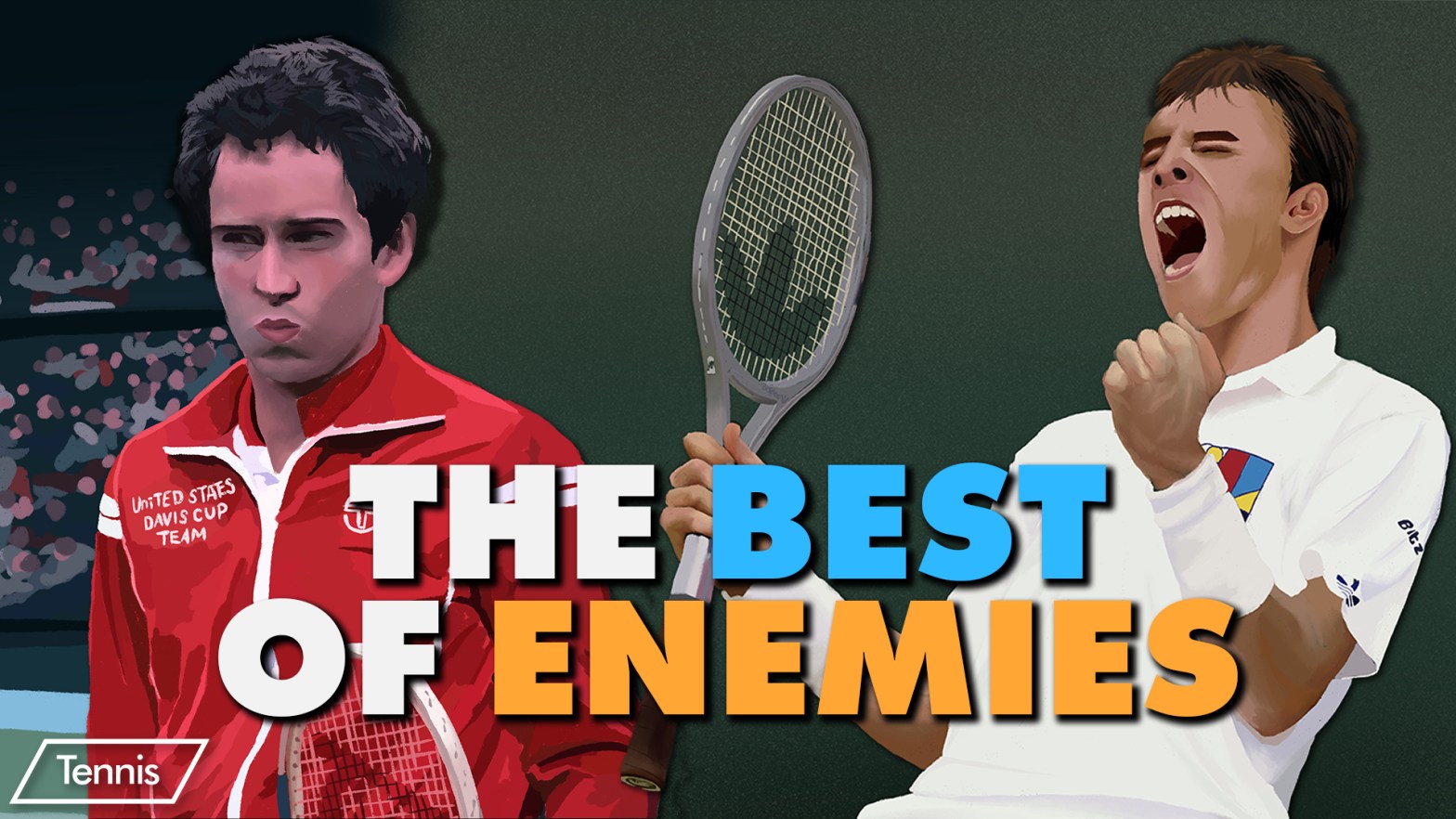
With several legends contesting for the biggest titles on the ATP in the 1980s and 1990s, there were a few fantastic rivalries. McEnroe-Lendl was somewhat overshadowed by the trio of rivalries involving two of McEnroe, Borg, and Connors, but it was a brilliant clash in its own right. Lendl would up winning the head-to-head 21-15, but it took a series of epic matches and no shortage of drama to get to the end of the road.
Baseline Tennis has broken down the rivalry in their latest video. You can watch it here, or at the video embedded on this page.
The thick brown canned coffee stains the sides of the glass, bubbling up slightly.
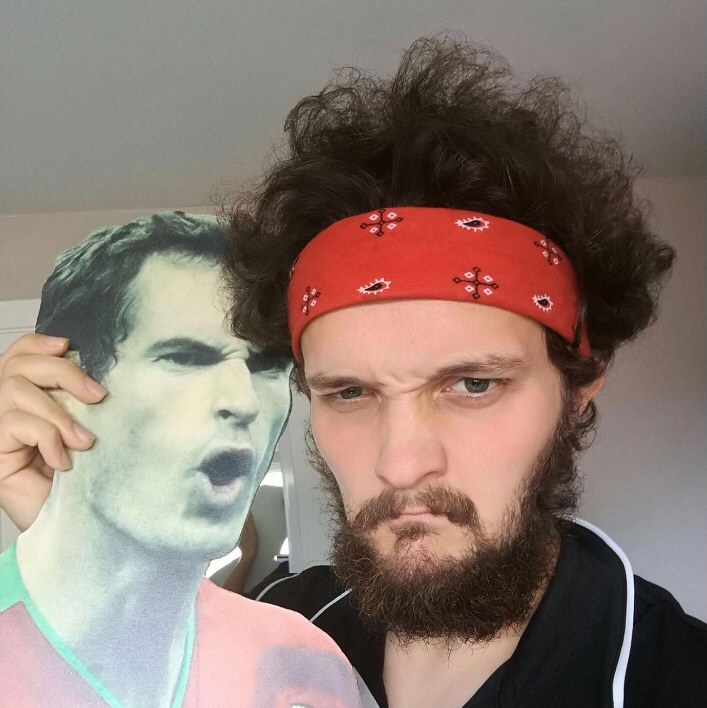
It’s an unfamiliar drink for Owen but in his defence, it is 4.15am for him and he’s only just about awake. He’s also nervous, as is Scott, his partner and co-interviewer in this, the first of hopefully many attempts at a professional sit-down chit-chat with someone who works in tennis. The time zone difference means that for Scott, it’s a much more reasonable time of 9:15am. Despite this, however, he still looks as though he’s just rolled out of bed, hair tangled at all angles, unshowered and unshaved…
*****
Our worries are very quickly put at ease with the arrival of the man we’re speaking with today.
Saša Ozmo joins our call and through initial patchy connection issues, warmly introduces himself as he finds a quiet spot to speak to us from. His words have the air of someone who’s been looking forward to this, a talk with two relative newbies trying to find their way in the complex world that is tennis media. Despite the fact that he undoubtedly has a lot on his journalistic schedule currently, Ozmo takes his time with us, asking us questions about ourselves and informing us that he’s already visited the Popcorn Tennis homepage and has enjoyed the pieces that he’s been able to read there.
In case you’re unfamiliar with Ozmo’s work, he’s a successful Serbian sports journalist. Having been fascinated with sporting coverage since he was a teenager, he worked at the B92 Serbian broadcasting company for over 10 years, before going on to find a home writing for Sportklub, a popular subscription channel that began back in 2006 and is currently available in an array of different countries. Alongside this, he also keeps a blog updated with more analytical writing, predominantly in the realms of basketball and tennis.
In short, he has experience that we’re more than interested in hearing about.
Ozmo’s tennis fandom began in childhood. He describes a move from Belgrade to Cardiff during the NATO bombings when he was a kid, where he would watch Eurosport’s coverage of Roland-Garros and sometimes Wimbledon. “I used to plead with my aunt to not go to school, to watch tennis,” he laughs.
What’s the best match he’s ever seen start to finish? “Djokovic-Nadal, Australian Open final 2012,” he says. The match in question is a five-hour, 53-minute package of draining rallies in which Djokovic and Nadal pushed the boundaries of what was previously thought physically possible on a tennis court. The final ended when Djokovic banged a big serve down the T (in a last lovely bit of parallelism, Nadal’s return landed short in almost the exact same spot on Djokovic’s ad side service box), then put away an inside-out forehand winner.
“Such a crazy day for Serbian sport,” he goes on. “The Serbian water polo team played the finals of a big tournament that day. And our handball team was playing the finals of the European championship, which was here in Belgrade. And I actually had tickets to go to the finals, but I was so exhausted after Djokovic-Nadal that I watched it on TV and gave my ticket to a friend. It was like I was playing for six hours.” Ozmo can hardly be blamed for his exhaustion. The rallies were so grueling that at 4-all in the fifth, Djokovic crumpled to the ground after losing a 31-shot exchange, and a few minutes later, he sent a rocket return at Nadal’s feet, who was too exhausted to get out of the way and simply volleyed the ball back from the baseline. That point devolved into a 19-shot rally, after which Nadal hunched over from a leg cramp. The match was surreal, and is a more-than-worthy choice for the best one has ever seen.
Both Scott and Owen have aspirations to be sports journalists, and Ozmo is a perfect person to ask about everything from his career to advice on writing. Ozmo has written a book in Serbian called Sport Journalism. “The idea first came to my mind when my professor of Political Sciences in Belgrade invited me to hold a lecture for her students,” he remembers. “So the first time I did it, I went there unprepared, y’know, told some anecdotes and blah, blah, and it was fun for them but I did not think in the end that it was very useful. And so the second time that they invited me, I thought ‘OK, let’s do this properly.’ And so I sat and made a presentation and that turned out to be a blueprint for the book.”
We saw an opening in this line of conversation to ask whether he can give us any advice. It would have been very easy for him to tell us to go and buy his book to get the inside scoop but Ozmo isn’t like that. Just the opposite, in fact. “Yeah, I can, of course,” he says. “But it’s a bit longer, we can do this Zoom some other time to talk closely about journalism.” Rather than leaving it there, he goes on to expand and offer some valuable insight.
“One thing that worked quite well for me, which I note because I do a lot of mentorship as well, in the two newsrooms I’ve been to during my career, usually every time a new kid comes, they’re all ‘just give him to Saša.’” Ozmo clearly has instincts as a mentor that run deep.
“I’ve seen they don’t take criticism too well. At least that’s what it’s like in Serbia. So in my book, before journalism, you need to be open to constructive criticism. Because I know for myself, if I haven’t listened to two people’s advice to me in regards to what I was doing wrong, I mean…They helped me so much. So sometimes I try to pass on that knowledge and it does not get the same reception and that’s the key.”
It is the consistent desire to better oneself that Ozmo underlines as the most important element when looking to kickstart ANY career path, not just one within journalistic circles. He wraps up this section of the interview by reiterating his offer from earlier, entirely unprompted, to speak with us in greater detail at some point in the future to help us further.
*****
A big aspect of Ozmo’s job is to cover Novak Djokovic. He’s the world number one, a 20-time major champion, and the best Serbian athlete of all time.
Djokovic’s rise and continued success inadvertently helped Serbian journalists such as Ozmo to be able to pursue their passion for tennis as a full-time career. “I love doing what I do for a living and thanks to Djokovic, I am able to travel so I’m really, really grateful to him.” Ozmo takes a moment and smiles before going on. “I know he didn’t really do it to help me, you know, but he did, he helped me along with many others because without him, we are not such a wealthy country… He helped me achieve my dreams and without him, I do not believe that I would be travelling, especially not to Australia. Maybe some other places, like France or London which are closer, but not Australia.”
I don’t underrate my work – I am sure in myself that I do my job with dedication and genuine love. That being said, were it not for Novak, my career would most likely look rather different, and there may well not have been a book. 1/2 #Djokovic#NittoATPFinalspic.twitter.com/Fan9sV4gQU
Naturally, much of Ozmo’s tennis coverage centers around Djokovic. And naturally, we were deliriously excited to not just be one degree of separation from the world number one, but to be able to talk to someone zero degrees away. Ozmo remembers his first interaction with Djokovic well. “My first one-on-one interview with him was Roland-Garros 2015, after his second-round match. It was quite a big deal for me back then because that was my first tournament that I covered on site…it was very important for the rest of my career to cover on site. So we arranged that interview. It took a while. His PRs told me ‘we have ten minutes,’ and we ended up talking for 22. It was a great interview; I’m proud of that interview.”
The interview helped propel Ozmo’s career upwards. “I don’t have those butterflies and stuff like that, but it meant a lot. Before the interview, I told him ‘this is like a Grand Slam final to me,’ and he laughed and said ‘don’t worry, it will be okay.’So we spoke for 22 minutes and it was a huge boom in Serbia and the international media took parts of the interview and it was a sort of beginning for me.” Ozmo is equally generous with his time, talking to us well beyond his initially outlined time frame of half an hour.
As a result of his numerous interviews with Djokovic over the years, tennis fans have frequently asked Ozmo to pass along their messages of support. “We are not buddies. We have a really good professional relationship,” Ozmo clarifies, laughing. Journalism is often a profession of objectivity.
*****
For years, Djokovic has been under fire by media outlets, sometimes fairly, sometimes unfairly. His treatment by the press has become such a debated topic on Twitter that we knew we wanted to get Ozmo’s expertise on the subject.
“I don’t want to generalize,” Ozmo says, “because there is a lot of fair treatment of Djokovic, and I think some of his fans on Twitter don’t realize that…I have a lot of friends in the Western media, and they do write really great articles.”
“But in some parts of the media, there is this portrayal that goes on, that they always pinpoint the negatives, and they put the positives in the second plan…with Federer, and mostly with Nadal, it’s the other way around.”
“Of course he’s not flawless, he’s made a bunch of errors,” he tells us, making it clear that despite Djokovic helping his career, Ozmo is aware of his imperfections. That doesn’t mean he thinks Djokovic is always done justice by the media, however. “Sometimes I do feel it’s unfair. For example, sportsmanship award: he never gets nominated. Nadal gets the award, he did not play for half of the year.”
“As far as the relationship with the fans, and I’ve been to many tournaments, and believe me, I know how some players behave when the camera is turned off. And I know how Novak behaves when the camera is turned off.” Ozmo leaves this quote open ended but it’s very easy to read between the lines here. It’s no secret that Djokovic makes time for his fans and many players reportedly don’t make the same level of effort.
Worst, though, are when media outlets tell outright falsehoods in an effort to smear Djokovic. “In some examples,” Ozmo says, “there are some blatant lies as well. That ‘pressure is a privilege’ quote that went viral…some people apologized afterwards, but in the world that we live in with social networks and everything, it’s a bit too late. You have to be more responsible, especially when it’s such a touchy topic.” His answer brings to mind Erica Albright’s quote from the 2010 film The Social Network — “the Internet’s not written in pencil, Mark, it’s written in ink.”
“Just to conclude, I really don’t think this matters so much. And the fan sport, o-kay. Obviously Novak has millions of fans around the world. But if he does not get crowd support in the stadium, it does not matter. He’s won a million times against the crowd support, and then the crowd supports him against Medvedev and he loses, three-love in the finals. At the end of the day, who cares, you know?” And as for wanting to be liked, as so many claim about Djokovic, as if it is a negative characteristic: “Sometimes people in Serbia say ‘why do you care, why do you give a fuck? You can be like Ivan Lendl.’ But he’s not that kind of personality. He wants to be liked. I mean, I want to be liked, everyone wants to be liked.” We can attest to all of this, but especially that last bit…
(Please, please retweet this article for us.)
“But the good thing is, he stopped caring, I think,” Ozmo concludes. “In the early stages of his career, it bothered him a lot more.” It’s here that Saša finishes his answer, but we can tell that if he wanted to, he could easily go on.
*****
Ozmo’s job extends far beyond covering Djokovic. “There are different aspects of the job. Most of the people see when I’m on-site, covering tournaments, but that’s not the high percentage of my job. Most of the time I’m just sitting at my computer typing news, doing interviews, and writing blogs — I’m not complaining, I love doing that — but when you’re on site, that’s a completely different story, and the reason why I pursued this line of work since I was in high school.”
“My favorite part of my job is the first few days of Grand Slams, especially the first two rounds, because it’s so crazy. If Djokovic is not playing, I’m always on the outer courts and never on the biggest courts. I have to of course watch Djokovic because of my work, but if not for that I would always be on the outer courts for the first few rounds. That’s the greatest experience one can have at slams. And when someone asks me ‘when should I come?’ I always say ‘the first few days, and don’t even bother buying the ticket for the biggest stadium.’”
Ozmo specifies that watching players yet to reach the spotlight allows spectators to hear every bit of the action, including the athletes’ mannerisms. “I remember watching Shapovalov vs. Tsitsipas in the junior semis, and it’s a pretty cool thing, watching those players when no one’s basically heard of them.”
“In Paris, I watched Kecmanovic, who’s a Serbian guy, playing Shapovalov in the semis of Roland-Garros. I watched Felix in New York, all when they were juniors.”
Ozmo has familiarized himself with all levels of tennis, always being open to watching and learning from matches that aren’t the most publicized. “I must say, I was pleasantly surprised at how much wheelchair tennis can be interesting,” he tells us. “It’s amazing the skill those guys have, and the strength of their arms…I mean, the guy hits the ball harder than me. It’s crazy. It demands so much skill…when people ask me what to see, I tell them ‘go at least see a set of wheelchair tennis if you have time.’”
*****
Djokovic has received some blowback for his lack of transparency over his vaccination status in the run-up to the 2022 edition of the Australian Open, the first Major tournament to introduce a vaccine mandate for players.
To bring things to a close, we return to Djokovic, asking Ozmo his thoughts about the world number one keeping his vaccination status to himself until as close to the Australian as possible. Ozmo’s answer is immediate and concise: “My thought is that I want him to reveal his decision as soon as possible so that I know if I should apply for a VISA or not.”
We all laugh. Ozmo has more at stake in Djokovic’s decision than most of the rest of us.
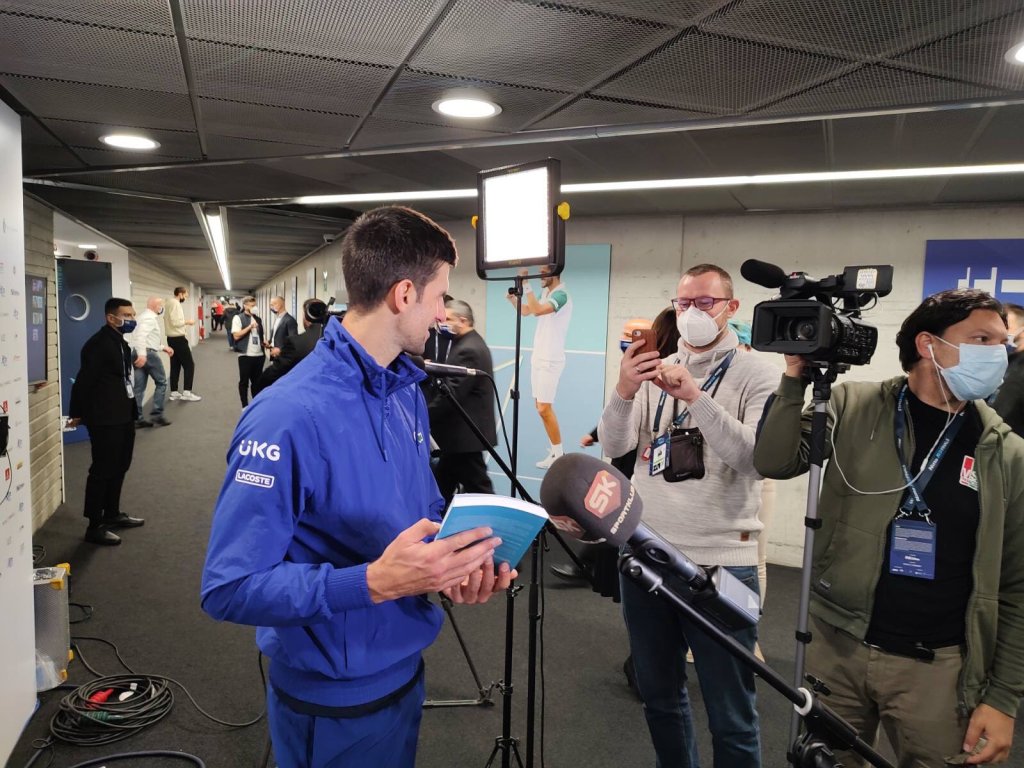
Saša Ozmo gives Novak Djokovic a copy of his book at the 2021 World Tour Finals in Turin. Photo is from Saša’s Twitter account, @ozmo_sasa.



 Popcorn Tennis