The U.S. Open’s AI-powered IBM Insights give Laslo Djere a 24% chance of beating Novak Djokovic in the third round of the U.S. Open tonight. This is obviously bullshit. Yes, Djere played Djokovic close in their only previous meeting, winning the first set 6-2 before falling in a pair of tiebreaks. But I could fling any number of stats at you to prove that Djokovic’s chances of losing are essentially negligible. He has not lost in the third round of this tournament since 2006. He has not lost before the fourth round in any major since 2017. He is 20-1 in his last 21 matches at majors, and that one loss was a nail-biter to Carlos Alcaraz, who is ranked just the 37 spots higher than Djere. Djokovic would not lose this match once if he had to play it four times, no matter what the odds tell you.
But the more conclusive reason that Djokovic has no chance of losing tonight is that he is simply on another plane than Djere. You hear a lot that at the top of the rankings in tennis, the difference between the players is more mental than physical or technical. This is mostly bullshit, too. Djokovic’s return of serve is infinitely better than 7th-ranked Stefanos Tsitsipas’s, his forehand is miles clear of #3 Daniil Medvedev’s, his movement could make #9 Taylor Fritz cry, and his firepower is to #13 Alex de Minaur’s as a firework is to a party popper.
Djokovic does have the mental edge as well, of course. Still, that mostly comes into play against the few rivals who, over the course of the last 15-plus years, have been able to match his technical skills on a given day. Most players on tour can’t come close to equaling Djokovic’s mastery of the game — once Novak punches their serve back into play, it’ll become apparent that they can’t hit aggressive backhands consistently, or once he gets them on the run, he’ll expose that they can’t defend. Tonight, Djere will lose because it will become painfully obvious at some point during the match that he can’t possibly match Djokovic in a crucial area. Maybe it’ll be the serve, maybe the movement, maybe the consistency, but it’ll be something. Djere isn’t going to lose to Djokovic because he choked on a big point.
Iga Świątek is on another plane from most, too. Her demolition of Kaja Juvan (her best friend!) today should become instantly legendary, even as far as tennis demolitions go. Świątek won a staggering 50 of the 66 total points played. Winning two-thirds of the points in a match is usually sufficient grounds to shower the loser with pity — I’ve never seen a player win a percentage as absurd as Iga’s 75%. Juvan was completely and utterly screwed from the start.
So clearly we’re dealing with a hierarchy here. Some players are better than others; some players are completely and irrevocably better than others.
Another soundbite tennis people like to throw around is that players truly believe they can be the best in the world at some point. Take Tommy Paul, who clearly believes the sky is the limit for his career. He’s having a great year. He got a profile in New York magazine. Ranked 14th, Australian Open semifinalist, recent conqueror of Carlos Alcaraz. But he’s never going to get to #1 in the world.
It’s nothing against him, it’s just that the task is so monumentally tough. I was at Paul’s Australian Open semifinal against Djokovic, then the top-ranked player on the ATP, and it was a pretty painful watch. Paul clawed back from 1-5 down to 5-5 in the first set, but after that, only managed to win three of the last 17 games of the match. Djokovic would hit repeatedly shots like the return below that had Paul walking to the other side of the court in defeat before the point was over, shots that Paul just wasn’t physically capable of. To be clear, getting crushed by Djokovic isn’t a death knell for your hopes of winning a major. But to get crushed by him when you’re already fully developed and reasonably experienced on tour might be.
Here’s my theory: A player’s undying belief that they can one day be ranked #1 in the world is more productive in blunting the psychological damage of a loss than in actually helping them get to #1. It’s impossible for most players to reach #1, really. Lest it seem like I singled Paul out, Andrey Rublev, Taylor Fritz, Frances Tiafoe, Karen Khachanov, and Alex de Minaur, who are all ranked higher than Paul, are never getting to #1 either. (And that’s a conservative list.) Everyone knows fairly early on whether or not a player is or is capable of living on that first tier. Alcaraz was immediately and blindingly special, as were the Williams sisters and the Big Three, as was Świątek when she won Roland-Garros at 19. Some players need a little longer to round out their games — Stan Wawrinka didn’t hit his prime until he was 28 (though even he never attained the top ranking) — but for the most part, it doesn’t take much to differentiate players between #1 material and everyone else.
And I think that the players know this too, in a place deep and dark that their delusional belief in themselves covers as best it can. There is no way Paul and de Minaur, who Djokovic pummeled in Melbourne even more viciously than he did Paul, could have taken beatings that brutal to Djokovic and come out of it thinking they could beat him the next time. The professional tennis tour isn’t a living ecosystem of superpredators who can all eat each other; the Challenger Tour may be like that. The two or three players who marry hard work with genetic luck feast while everyone else fights for scraps.
Think about how hard that must be — Paul essentially said in his presser after the Djokovic loss that his gameplan fell to pieces almost immediately, and he couldn’t do anything thereafter. That, to me, sounds devastating. You spend your whole life trying to perfect a craft. You master it better than anyone in the city you grew up in, maybe the country for a moment. You get your shot against the all-time-best player in a major semifinal. And you get demolished so thoroughly that it’s clear you had no way to win from the beginning. Short of a complete physical transformation, you’ll never beat that guy.
And yet, Paul seems unbothered. Sure, he’s had some bad losses this year. But he’s ranked at a career-high, nearly beat Alcaraz twice in a row during the North American swing, and is into the second week at the U.S. Open. How is he doing it? The logic says that if he keeps winning, he’ll run into Djokovic, at which point he’ll get pulverized again.
I think it’s that his belief in himself defies logic. By maintaining hope that he can one day attain the top of the pyramid, a loss to Djokovic becomes a roadblock rather than stark proof that he might be able to crack the top five in the world, but never the top two. I don’t see any other way that a player can keep going without dragging their feet when it’s so apparent that the standout players on each tour are blessed with something all the hard work in the world could never produce.
*****
I hope I haven’t disrespected the players not ranked at the very top of the game. Really, I admire them, maybe more than the all-time-greats. What better example of perseverance than the pursuit of a task that may not just seem impossible, but might literally be impossible? What better way to pay respect to the difficulty of conquering a sport than to keep trying in the face of that impossibility? It’s far more than I could ever do, even if I had all the athletic gifts in the world. These players won’t reach the summit they’re chasing, but I’ll remember that they tried.
And I wish less of the tennis world would exaggerate the odds of the underdog. I understand it, obviously — drama sells. A commentator declaring a match a foregone conclusion kind of leeches the competition out of the competition. But I think that minimizes what the underdog is up against. It’s the impossibility of their task that makes it so amazing when they take a meaningful step towards it. So part of me hopes for a day that a broadcaster asks their partner what a hopelessly trailing, overmatched opponent can do to beat Djokovic, Alcaraz, Świątek, or another all-time-great, and gets the boring and cruel but ultimately honest answer:
Carlos Alcaraz stunned Novak Djokovic in five sets to become the first player in 10 years to defeat the Serb on the Wimbledon Centre Court and in a Wimbledon final, and to also become the first player outside the Big Four to win The Championships in 20 years. This officially marks the changing of the guard in men’s tennis……right? Wrong.
Whenever statements like that are made, it is usually a result of historical significance and context being thrown out the window. It is quite frustrating, to say the least, when one result is extrapolated beyond the realms of reality and is also used as ammunition for some convenient revisionism of Djokovic’s legacy. Like I mentioned in the first and only piece that I have written for Popcorn Tennis so far, recency bias is a disease. It was not long ago that Djokovic looked borderline impossible to defeat at the slams, and he did win the Australian Open and Roland-Garros. You would think that he was, at some point, bound to lose a match that was decided by the finest of margins. Holding off all challengers until he lost that match to a generational talent in Alcaraz is beyond admirable.
To the delight of the entire tennis fraternity, Djokovic and Alcaraz met once again in the final of the ATP Masters 1000 in Cincinnati. And to my personal delight, it was Djokovic who edged Alcaraz in a clash decided by the finest of margins. Djokovic won 133 points to Alcaraz’s 128, and the difference in points won was entirely due to Djokovic’s edge in both tiebreaks (9-7 and 7-4 in sets two and three, respectively). Djokovic collapsed to the ground after converting his fifth championship point after three hours and 49 minutes, recovering from 5-7, 2-4 down and from saving a championship point in the second set.
That was not only yet another enthralling match between the two but also was a stern reminder to the detractors, who had his tombstone ready, that Novak Djokovic is not going anywhere and that he could not be farther away from being done. He may be 36 years old, but his longevity is simply unfathomable. One Wimbledon final loss in five sets, which is supposed to be the norm, does not change that. That said, his clashes with Alcaraz are a memorable rivalry in the making.
Yes, I am going to address the proverbial elephants in the room. Firstly, even though some are shying from doing so due to the 16-year age gap and the fact that they are both from different generations, I’ll freely call this a rivalry. Secondly, I’m assuming that the two put themselves in a position to contest for the biggest titles on tour on a regular basis. Let us not forget that we had to wait more than a year for another match between them after their epic Madrid semifinal in 2022, which the Spaniard won in very similar fashion to Djokovic’s Cincinnati victory.
This rivalry is a marketer’s dream. I had already mentioned at the start of this piece that Alcaraz climbed what is currently tennis’ Mount Everest: Beating Djokovic in a Wimbledon final and beating him in a Grand Slam match that went to a deciding set. Only one man managed to do the latter since the Djokovic renaissance in Wimbledon 2018, and that was Dominic Thiem in the 2019 Roland-Garros semifinal. Not to mention that only one man had previously defeated Djokovic in a Grand Slam final that went five sets: Andy Murray at the 2012 U.S. Open. However, Djokovic has also proven to be something of a kryptonite of Alcaraz’s.
While Djokovic was heavily backed to win the Cincinnati final considering how underwhelming Alcaraz was prior to the final and in Toronto, the odds were actually in the Spaniard’s favor. He was 6-0 in Grand Slam finals and Masters 1000 finals combined, and since his breakthrough he simply has not lost a match that has ventured deep into the deciding set. Enter Djokovic, who tore up that script and handed Alcaraz a defeat that was the first of its kind. It is quite understandable why the Spaniard was in tears following that match.
In every aspect, including trading the No. 1 ranking multiple times over the span of several months, these two players have matched one another pound for pound. Remember when we were all upset that Alcaraz cramped at the beginning of the third set of their Roland-Garros semifinal this year? Well, it’s safe to say that we have been more than compensated for that. May the tennis world be blessed with many more Novak Djokovic vs. Carlos Alcaraz epics, and thank you to Alcaraz for filling that void whose existence we feared after the Roger Federer and Rafael Nadal era.
The advent of social media and the democratization of information through a decentralized system known as the Internet could only mean one thing. No, not the incredibly fast advancement of society as a whole with ever expanding knowledge being shared and tested, standing thorough scrutiny.
It means more people get to share their increasingly mind-blowingly dumb opinions, standing by them no matter what. Possibly worst of all, way too many people agree with those terrible opinions.
Ahem… sorry, I’m here to talk about tennis. Excuse me. Let’s begin.
What in the fuzzy yellow f*** is good for tennis?
This get thrown around a lot, and unfortunately within the realms of twi… X, what truly matters to people is the short, “witty” opinion, as if it was groundbreaking. That being said, let’s get this straight: if someone effortlessly fills up a stadium, it doesn’t mean they’re good for tennis — it means they’re great for business, now. This is not a bad thing, it’s just not the whole story.
Nick Kyrgios
The fiery Australian, flashy shot-maker, controversial superstar of tennis, or however you want to call him. One thing truly is undeniable about Nick Kyrgios: he fills up the stadiums. In fact, he overflows them.
Let me paint a quick picture.
At the National Bank Open, also known as the Canadian Open, in Montreal in 2022, Kyrgios was scheduled to play a match on Centre Court, but due to rain delays, he got downgraded to Rogers Court, the second-biggest court on site. It holds about 4000 seats.
This is how Rogers Court is set up: it’s the dug-out stadium style like Pietrangeli at the Italian Open, but with a structure that wraps around about half the court for a second level of seats, above ground level. The blue seats inside the dug-out hole are the 100 level, for which you need assigned-seat tickets. The top structure is the 200 level, and anyone with access to the site can go up and take any seat (Centre Court ticket holders and ground pass holders alike).
Good ol’ Rogers Court was not made for Nick Kyrgios. The 200 level filled up within minutes for his match. People were standing around the edges of the crater-like structure to watch him. Even the top-level on Centre Court, which gives a clear view of Rogers Court, was watching Nick and not what was happening on Centre.
Whatever opinion anyone has on Kyrgios, whatever he might have done in the past, that player is a magnet for fans on site.
Is this “good for tennis”? Yes, obviously — in the short term at least. For tennis to grow, it needs money, and a lot of money is made with ticket sales. The business side of tennis can and does take advantage of players who sell themselves and do so effortlessly. Remember Roger Federer and Rafael Nadal? They also have this inherent ability. They just care that their public image remains neutral, unlike Kyrgios.
However, there’s two problems with that: 1. tennis is not just a business, and 2. the business of tennis can’t rely on these external factors which cannot be controlled for its growth and profit.
These problems are tough to see because they are exclusive to a short-sighted view of the sport — long-term thinking is hard. Kyrgios fills up a stadium, but not only does he not play tennis very often, he also does not have the intention of playing for too much longer. Strategizing around Nadal and Federer made sense because while they could lose early or suffer and injury that would see them withdraw from a tournament or even a longer period of time, they were committed to playing and winning — you knew what to expect from them. It is not the same with the Aussie.
A player like Kyrgios is not the main ingredient, they are a bonus. You prep your whole strategy around what you can control, then if Kyrgios says he will show up, sell the tickets! If not, the tournament will be a blast for fans regardless, who will be willing to come back every year to see who else is going to be the big story, long after the outspoken, opinionated bad-boy (or girl) has retired.
Iga Świątek
Świątek has two problems: 1. She is a woman, and 2. She is very professional and cares that what improves is her tennis.
Notice something? These are not problems. The first real problem is that far too many people still think women’s tennis and sports in general is inferior to men’s. And the second problem, entirely dependent on the first, is that Świątek does not assign to the “drama” expected by many in her matches and press conferences. You see, the tennis itself does not matter, what matters is the petty feud between players that so many want to see because apparently female players can’t be competitive and good friends (or even just co-workers) at the same time.
Sure, it is fun to see the the press conference where Serena Williams talks about how Dinara Safina won Rome and Madrid in a sarcastic tone, while she has the Grand Slams titles (and Safina has none). This was also in reference to what Safina said in a previous answer to a question about whether she deserves to be #1. However, these are things that are not under anyone’s control, and Serena spoke also out of her frustration with the structure of points awarded in the WTA — and ranking points vs titles is always a point of contention.
You cannot force someone to be what they are not. And why in the world would anyone want to change who Iga Swiatek is? She is one of the best role models in modern sports, she is a phenomenal tennis player and dedicated to her craft. She is reserved, but open about her ideas, problems, frustrations, and does not put blame on anyone for losing except herself. If that reminds of you of someone, it’s because she probably sees Rafael Nadal as an inspiration for her and great influence not only on her tennis, but work ethic.
Iga Świątek is the world number one. She works harder than many. She makes sure to keep improving every day in her job, which is to play tennis better than anyone. And this is what Serena Williams did too, though she has a very different personality.
And THIS is the core of tennis: the sport itself.
While a Nick Kyrgios may appear every once in a while to disrupt the status quo and fill stadiums just by being who he is, it is not sustainable to rely on him by saying “this is what is good for tennis.” We cannot change who people are; what we can do is focus on telling stories. Nick is easy. Tennis needs the ability to flourish in tougher circumstances.
And by the way, Iga Świątek is massively popular and fills up stadiums as well. Some people (not many) find her style boring, but one opinion is not the truth — equal to how some people may find Roger Federer annoying. And we all know the power of the RF brand, including the Rolex executive team.
The Core Product
The core product of tennis is simple: the sport itself. Good tennis attracts people. Even bad tennis attracts people. Tennis is an awesome product. What is good for tennis in the long run, at least on the professional side of things, is to captivate people with stories from athletes, to touch fans and prospects deeply in their emotions so that they would not only come for the sport, but also deeply care about the results.
Iga Świątek took over the top position in women’s tennis in a historically significant way, from the equally significant, shocking retirement of Ashleigh Barty. Świątek went on a winning streak that seemed almost endless, has now held the #1 ranking for 72 consecutive weeks and counting, and already has four major titles to her name. Regardless of her personality, any good story-teller would easily be able to produce something that would captivate tennis fans and sports fans with this information. Couple that with a proper marketing strategy and align the whole with social movements promoting women’s sports and there are millions of people that can be reached and can elevate Iga Świątek to the divine realm, making her a timeless idol.
Screenshot: Roland-Garros
A marketing strategy and a good public relations strategy are not simple, to be sure, especially at a global level. However, there are many millions of dollars running in this industry. It is possible, if not absolutely necessary, to find the best people in the business, to form the best team to market tennis players.
Tennis is good. It is undeniable that we have a phenomenal product in our hands. Our athletes are better than ever, and every generation now is more eager to chase the super-human records of the previous generation. Iga Świątek and Nick Kyrgios are not the only players either. There are many great players, great personalities, great stories to be told. Millions of fans are just sitting, waiting to be captivated by them, with the help of the monumental history that tennis boasts with active tournaments going back well over 100 years.
Social media bites are cool and necessary. But marketing cannot end there. Tennis needs people to care about it deeply. Tennis needs stories that will make even casual fans have heated debates about, and want to witness more history being made — on both the men’s and women’s side, but especially on the women’s side. Fans need to see just how advanced women’s tennis is, that every story is attached to how well they are playing, how titanic their matches are, how skillful they are, and how incredible the records they are chasing are.
It doesn’t even need to stop with the highest level. Across the board in professional tennis there are amazing stories to be told that people would stop to hear.
What I think is good for tennis is more people caring about it. More casual fans to know what’s on the line. More people wanting to play and realizing how dang hard it is to do what these athletes do every day. More people understanding that they cannot possibly win a game off a professional player. If the world of tennis is divided between “die-hard” fans and people who basically just know Roger Federer, Rafael Nadal, Maria Sharapova, and Serena Williams, this is not-so-good for tennis. Even less if all they know is that Nick Kyrgios plays crazy shots at times and has a bad-boy personality.
In the end, what is good for tennis is, in essence, that a lot of work be put into it to make it better every day for fans, prospective fans, and amateur and pro players alike. Thank God we can still communicate in longer formats like this — if we only ever debate on Twitter, we would all just be complete imbeciles and tennis would deserve to die.
This is part of a series of texts inspired by Djokovic winning his 23rd Grand Slam title. This one in particular has been a long time coming, and it examines the “secret ingredient” that gives the greatest ATP player of all time his edge (spoiler: it’s not his diet). It’s a long read, but I like to think it’s worth the insight. Hope you enjoy it.
What is Inat?
Inat is a tricky word to translate. As a Serb, for me it carries much more weight than the simple translation offers — spite, defiance — it is those things, but also is not. At least, it is much more.
One of the tricky parts about translating inat is trying to instill the deep historical and culturological significance of the word. You will hear it treated as a virtue often, but just as often it is treated as a failing, a sin. This is because it is extremely potent in both its positive and negative form.
This article perfectly encapsulates just what inat is (with a lot of context); it’s a great write up that I would urge you to read. But if you’re short on time, a short way to describe inat follows:
Inat is loosely translated as “stubbornness” or “defiance” in English. Yet often it signifies a sense of spite or resentment towards someone or something – a good example of this is described by a helpful internet commenter on Quora wrote:
“It might be described as defiant stubbornness in behavior or attitude in spite of that attitude being detrimental to the interests of that person.. A person is said to be “inatitise” when pressures from other people to change his/her behavior or attitudes have an opposite effect and reinforce such behavior. But for such reinforcement to be “inat”, that persistence and refusal to change attitude or behavior has to be illogical or even detrimental to the interests of the person.”
Historically, inat is what makes the Serbian people somehow treat a catastrophic defeat vs the Ottoman Empire — and the subsequent five-century long Ottoman rule — as a triumph. It can be theorized that the same inat is what made it possible for the Serbian people to survive this with their culture and language retained (so arguably indeed, a triumph). Inat is what made Serbian people, even families and young children, wear shirts with targets and banners with targets on them as they congregated on bridges and other suspected targets of NATO bombing. “We are here. We see you. We defy you.” That’s inat.
It’s obvious that inat is both a good thing and a terrible one. At its best, it is the fiery spirit of resistance against what seem like insurmountable odds. At its worst, it’s a delusional pride that leads to an ugly fall, a pointless belligerence.
There is no better embodiment of the potency, and downfalls, of inat then the greatest male tennis player of all time: one Novak Djokovic.
The Spark
It’s impossible to talk about Novak Djokovic without the wider context of the Big Three. While this is not a Big Three article (though I will write one eventually), an important aspect of their domination is what I will, for the purpose of this text, call “The Spark”. To transcend from “tennis great” to the level of the Big Three, one needs 3 crucial ingredients. Two of them are needed for any true tennis great: an intense love of the sport and desire to win.You have to live and breathe tennis — and enjoy doing so — to be able to be one of the greats. Desire to win is a force that defeats all others, the compulsive drive for victory that trumps logic or points or titles. The third one is a secret ingredient that elevates someone from a great tennis champion to one of the best ever: The Spark.
Each of the Big Three needed that extra little something. For Federer, that extra something was a kind of confident arrogance. Federer never truly believed he should ever lose. He was so sure of his talent that this allowed him to not only convince himself that each match was on his racquet — but more importantly, he emitted this aura. This is part of what allowed him to win a match even before stepping out on court, and those infamous FedExpress one-minute holds of serve; when you look across the net, you see someone that already knows they’ve won. To his credit, Federer later realized this “God-Given Talent” aura was beginning to harm him, and in the later stages in his career constantly insisted on “how much work” he is putting in – might sound paradoxical that the player with the most talent is constantly accenting his hard work and training, but it makes sense…he didn’t want to be remembered as the “lazy one just touched by the tennis gods.”
In his salty post-match conference after Djokovic hit The Shot, Federer insisted that “this is not the right way to play,” referring to Djokovic (presumably) hitting blindly and relying on luck. (Juan Jose Vallejo has written an excellent breakdown of why The Shot may have been more calculated than anyone realized.) What lay behind this (other than the obvious anger at losing the match) is the secret knowledge that this trope of “I was simply born amazing and able to hit miracle shots” — ever his vibe — was now being used against him. At its best, Federer’s secret spark allowed for an aura of complete dominance…at worst, it would render Federer petty and shell shocked after a loss.
Nadal’s extra “spark” could not be more different – a combination of extreme humbleness combined with a willingness to suffer. The humbleness functions both as etiquette and a pressure valve: if Nadal is never the favorite, he never has to feel the pressure of being the favorite (or he can at least minimize it). The more important part of his “spark” is his willingness to suffer, the “hunker down” approach where you are prepared to go through physical and emotional stress in an almost masochistic fashion in order to win a tennis match. This creates a competitor with a willpower so daunting, few can match it. This is why Rafael Nadal was, for years, an insurmountable obstacle for Novak Djokovic (and still is for most on the tour). Rafa is the perennial “What do I have to do to BEAT this guy?!” character.
Nadal even had a special appreciation for those that also liked to “suffer” – after being defeated by Gilles Simon in an attritional match in Madrid (this was when Madrid was still on hard court), Nadal said (paraphrasing) “I like to make the opponent run left and right, control the point… but he like to run, no?” – Nadal was smiling when he said this.
Both of these elements of Nadal’s “Spark”, like with Federer and like we will see with Djokovic, came with a downside: the humble bull would sometimes be so humble that it would start to instill doubt even in himself (if you believe you can be beaten, you open the door ever so slightly). His willingness to suffer has had the most obvious downside out of all of them. Nadal’s physical ailments are well documented (and will lead to his eventual retirement, as things stand).
For the record, I feel Alcaraz’s spark is the ability to keep smiling, an evolution of love for the game. But that is a story for another day…
Which leaves us with Djokovic. Djokovic’s spark… is INAT.
The Contrarian
I think the most obvious example of Djokovic embodying inat is, of course, the 2019 Wimbledon final – an event that also produced my favorite Djokovic photo of all time.
This image should be placed next to INAT in the dictionary.
However, as someone that has followed Djokovic since his very early forays into the top echelons of ATP tennis – it’s been a staple of his tennis since day one. Be it my favorite little anecdote, when he wrote NOLE on his shoes with a sharpie to emulate Nadal’s custom Nikes, orThe Shot heard around the world, it is clear Novak thrives in adversity; the more you hate on him or the worse the odds, the more it triggers Novak’s inat.
This inat actually allowed Novak to throw himself onto the rocks of the Fedal duopoly and crash like a wave over and over and over again. The fact that Fedal were so deeply entrenched in the hearts of fans was only fuel to the inat fire. Contrary to popular belief that Djokovic was obsessed with people loving him, with only Fedal getting the love, in Djokovic’s younger days he was viewed as a refreshing young upstart there to shake things up. His impressions of other players and interactions with the crowd were seen as funny. The inat started to flare up more when Novak would rake up the results, and yet not receive 20% of the Fedal acclaim (outside of Serbia). Were this any other, less inat-fueled, player, the innate spite would not have pushed them through the Fedal wall. As we’ve seen so many times, to win against Murray and then one of Federer or Nadal was a feat that, if accomplished, would end careers — but Novak just went “I’m not done here”.
So this inat thing sounds like a great superpower to have, right? Well…
A double edged sword
The signs were there early on. It can be debated that Djokovic inherited his inat from his father – a man whose every action depicts the downsides of the belligerent “inaćenje” (being full of inat/doing inat). Where Djokovic was happy to let his game do the talking, his parents hit the ground running with “The King is dead long live the King” spiel the moment their son beat Federer in the 2008 Australian Open semifinals. (As it turned out, Djokovic would need three years to win his next major, while Federer racked up four more in that period.)
For most of his early career, the downsides of Djokovic’s inat were not evident nor had any negative effect on his life and results. His grace when losing, which he retained to this day, helped this further.
The first serious sign of inat’s dark edge harming Djokovic’s career came along with his 2016 elbow injury. Djokovic’s dubious health/lifestyle beliefs clashed with his obvious need to have surgery on his elbow. His coach, many of the people around him, urged him vehemently to just do the surgery, his misguided beliefs about how “opening the body” was harmful be damned. This, perhaps predictably, triggered his inat. Djokovic would hold off on surgery for far too long until eventually succumbing, rather than risking his livelihood. Sources close to him say he cried after the surgery; he cried for being forced to violate his principles and ‘releasing the energies in his body’ with this invasive surgery. Recall that “violate his principles” is a recurring line Djokovic refuses to cross — an inat special.
Thus we get to the Australian debacle and Djokovic’s vaccination status in general. This is not a text about either of those specifically, but it is another clear representation of his inat. When asked about if “violating his principles” and getting vaccinated was an option — otherwise he’d have to miss out on important tournaments and maybe even the GOAT title — Djokovic defiantly said: so be it, if that’s how it is I’ll take the hit to my legacy. This is textbook inat.
If we combine the unnecessary time it took for Novak to do the surgery, plus all the issues his vaccination status caused, I feel comfortable saying Djokovic’s inat has deprived him of at least two major titles, if not a couple more.
Considering how much his inat has given him, in slam count… it seems like a worthy trade, no?
Future defiance
So where does that leave us? I think Djokovic’s “36 is the new 26” credo, and his joking dismissal of the Next (and Next Next) generation is also inat-fueled — and this has allowed him to sail into uncharted waters of dominance. He’s been told he’s old and the new kids are about to wrestle the torch from his hand for a decade. Until his defeat by Alcaraz, Djokovic has been definitely flaring his inat to make those claims untrue. Even now, Djokovic fans, such as myself, are hoping that this recent defeat to Carlos Alcaraz will also fuel and trigger his inat, allowing him tocast himself as a wave onto a new kind of rock. The wish remains that the opportunities for the darker sides of inat to appear remain few and far between, so that, in spite of everything and everyone, Djokovic can cement his legacy as the GOAT.
It’s been a couple weeks since Carlos Alcaraz beat Novak Djokovic 1-6, 7-6 (6), 6-1, 3-6, 6-4 in a scintillating Wimbledon final. I wrote a piece the day after the match, which you can read here. But matches like this, with so many twists and turns, deserve a closer look, hence my decision to closely rewatch the match and record a long list of observations and thoughts. I will not attempt to write poetically in this piece (not that my attempts at that are ever successful). No, this is a space for nerding out over the match of the year. You will see hyper-specific point analysis. You will see theories. You will probably see stuff nobody cares about but me and maybe a couple others. Let’s jump in.
1. Did anyone have Carlos Alcaraz winning this match before it started? Hell, did anyone have him winning before he claimed the second set? Novak Djokovic had won Wimbledon in 2018, 2019, 2021, and 2022 (the tournament didn’t take place in 2020). He hadn’t lost a match on Centre Court since 2013, and that match came shortly after Juan Martin del Potro forced every ounce of strength from Djokovic’s legs in a four-hour, 37-minute semifinal, so there’s even an argument to disregard that one. Alcaraz was favored in his Roland-Garros semifinal with Djokovic, and even before full-body cramps crippled his chances of winning, he looked to be outmatched — on a surface that was supposed to be more favorable for him. On grass, a surface Alcaraz is a newcomer to and one Djokovic has long mastered, the former was a huge underdog.
2. Djokovic, all-told, didn’t have a great forehand day. But he has an all-time-great forehand. It’s not the greatest forehand ever, not by any means, given how shaky it was early in his career. It’s now one of the greatest ever, though. From the straight-up liability Djokovic’s forehand was in 2010, arguably no individual tennis shot has improved more in the past decade-plus. (Novak’s serve is another contender for most-improved.) Djokovic’s forehand is at its best when it goes toe-to-toe with another brilliant forehand, often thought to be better than his – it has more than held its own with Roger Federer’s forehand, with Dominic Thiem’s, with Stefanos Tsitsipas’s. With Alcaraz serving at 0-1, love-15 in this match, Djokovic chased down a very good crosscourt forehand and found an obscene angle for his own crosscourt forehand, which went for a winner.
Some shots get called underrated because they’re generally thought to be sub-par when they’re actually solid. Medvedev’s volleys are sometimes called underrated because people still seem split on Medvedev being completely inept at net or being a sneaky genius with his volleys (it’s probably a bit closer to the former than the latter). Djokovic‘s forehand is underrated because it’s genuinely one of the best in the world and doesn’t always get talked about as such. He can hit down the line, inside-out, inside-in, crosscourt, all with vicious pace when he chooses. He can find brilliant angles. His forehand defense may be the best ever. As a whole, the shot is bordering on legendary.
3. Despite Alcaraz having moments in the first few games, Djokovic got off to his trademark fast start, racing to a 5-0 lead. The fact that he lost this match notwithstanding: Djokovic still has the highest peak in men’s tennis. For much of this five-game stretch, Novak wasn’t even at his sharpest. But when he fleetingly hit his peaks, Alcaraz was helpless, like any opponent would’ve been. It all starts with the first shot Djokovic hits — he is a superb spot server, and the sheer depth on his returns freezes even players with the fastest reflexes on tour. From there, he dictates the point, and he’s not one to play with his food.
4. There is a point with Alcaraz serving at 0-5, 30-all in the first set in which he yanks Djokovic well outside the left doubles alley with a great angled crosscourt backhand. He follows it up with a backhand down the line that lands near the right sideline. Djokovic covers the distance from outside one sideline all the way to the other — significantly more than the 27-foot width of the court — in seven enormous steps, then launches into a long slide and recovers to get ready to return an overhead. That’s why he’s so difficult to hit through. Alcaraz had to put away a great smash to win the point.
5. After the first set — I’ll admit it — I thought the match would be a whitewash. Djokovic looked infinitely more comfortable than Alcaraz, and a comfortable Djokovic has pretty much never lost a tennis match. If you want a prayer of beating Novak, you have to knock him off his game for a while (and then play your very best tennis during his lapses). Alcaraz didn’t look capable of doing it, and I couldn’t imagine anyone else doing it, either.
6. The opening set was a great advertisement for spot serving over power. Alcaraz was massacring serves all over the place at 130 mph, but they weren’t nearly as effective as Djokovic’s pinpoint-accurate deliveries in the low 120s. Professional tennis players are incredibly adept at handling balls flying at high speed. What’s more difficult is guessing which side to make a sprawling lunge to, then hitting a return at full stretch. Even if you guess right, your return is unlikely to have much pace on it if the serve hits a corner. There’s a reason Roger Federer was such a dominant server for so long, and why Djokovic is now — it ain’t power, it’s having an unreadable toss and great accuracy. Give me that any day of the week over the ability to hit 135 mph on the radar gun.
7. The most impressive touch moment Alcaraz had at net all day was the gymnastic backhand stretch volley winner at 15-all in the last game. The second most impressive came at 15-all in the first game of the second set. Alcaraz approached the net with an inside-out forehand; Djokovic zinged a backhand pass that dipped to Alcaraz’s feet before the Spaniard could even get inside the service line. Anyone not exceptionally talented at net is sunk in that position — it’s near-impossible to get enough pace or spin on a half-volley from mid-court to stymie a defender like Djokovic. Looking as relaxed as a bored student aiming a piece of chalk at a friend’s head across the room, Alcaraz somehow bunted a forehand half-volley directly onto the baseline. The depth on the ball handcuffed Djokovic into a netted pass. The volley wasn’t just an astonishing show of skill, it launched a mini-run for Alcaraz, who won 11 of the following 16 points.
8. Comedy watch: Djokovic hit a second serve straight into the middle of the wrong box to start his 0-1 service game in the second set. It missed by about six feet.
9. Alcaraz got sharper in the second set. He stopped banging the ball mindlessly and started waiting for openings. He’d crush the backhand down the line when Djokovic moved to his left, which opened up a gap to hit into, rather than trying to produce a winner with Novak standing in the dead center of the court. It was a smart adjustment, but I couldn’t help but think that Alcaraz was one of a very few players who had the privilege of wanting to lengthen rallies against Djokovic. Most are told to shorten points because Novak’s athleticism and consistency from the baseline is too hard to match. Alcaraz is one of the rare few who can match him (and beat him for power), to the point that it’s actually preferable for him to have long exchanges with Djokovic. Novak is so damn good at the serve-plus-one and return-plus-one — Alcaraz said to his box that he couldn’t beat Djokovic by playing first-strike tennis while getting his ass kicked at Roland-Garros — that if you can, rallying with him is the better option. It’s just that most of the tour doesn’t have the skills to do that successfully.
10. After breaking Alcaraz at 0-2 in the second set to get back on serve, Djokovic allowed himself a prolonged roar of celebration. Much later in the set, on a much bigger point, Djokovic won a 17-shot rally with a passing winner to give himself a set point and didn’t react at all. I’ve tried for a long time to figure out a pattern from the points Djokovic celebrates and the ones he doesn’t, and I’ve come up empty. I think this is a little part of what makes Djokovic so hard to get in a groove against. Sometimes Djokovic plays perfect tennis and doesn’t celebrate, sometimes he struggles and celebrates emphatically, and it can be difficult to tell exactly how hard Djokovic is trying and how invested he is. As an opponent, that makes it hard to know what’s coming next — is Djokovic going to hit four beautiful returns and break you easily or will he cruise and let you hold at 15?
11. A titanic 29-shot rally took place with Djokovic serving at 1-2, break point. Of the 15 shots Alcaraz hit during the exchange, 12 were backhands, the last of which drifted long. It was a clinic on how to play a big point in a neutral position from Djokovic — even if the opponent’s “weaker” side is excellent, you hit the ball there again and again and again until it cracks. You hit there with pace, angles, and spin, and anything else you can produce. Djokovic used this tactic to even greater effect in his Roland-Garros match with Alcaraz. Time and again on break point, he’d just spam the ball to Alcaraz’s backhand, which would eventually lose patience and miss. The Spaniard was much calmer in this rally and it still didn’t work out for him because Djokovic made him hit so many backhands.
12. Alcaraz went up love-30 with Djokovic serving at 2-3 by playing two impressive, purposeful points that ended with winners. When Djokovic won the next four points (two with second serves), Alcaraz successfully returning just one serve among them, I thought we might be looking at a case of a Djokovic opponent simply not being sharp enough to take advantage of their successful patches.
13. Some of the rallies in the second set were absurd. Djokovic and Alcaraz are the two best athletes on the ATP Tour, and they covered parts of Center Court with their incredible movement that most players wouldn’t touch in an entire career. Djokovic is the king of sliding on grass, Alcaraz is an heir apparent. That married to the remarkable speed of both produced some patterns that simply shouldn’t have been possible.
14. Watch the point Djokovic plays to hold for 5-all in the second set and tell me his defense has declined significantly from his peak. The man’s movement is remarkable. If you look at the way Nadal’s exceptional defense has declined with his injuries and age – he doesn’t slide much on hard courts anymore, and his movement off clay doesn’t compare to the wizardry he produced in his prime – Djokovic’s decline is much, much less significant. He may be ever so slightly slower, but the contortionist flexibility is still there, as is the sliding, as is a lot of the quickness. Juan José Vallejo, who has written what I consider to be the single best technical article in existence about Djokovic’s tennis, said to me on a podcast two years ago that Djokovic hadn’t lost half a step, or even a quarter of a step. I feel more or less the same right now. Djokovic has lost an eighth of a step, maybe a quarter. Not much more than that.
15. One such rally from #13 takes place with Alcaraz serving at 5-all, love-15. The young Spaniard hits a wonderful angled crosscourt backhand, like the one mentioned earlier in #4, that pushes Djokovic beyond the doubles alley. Djokovic responds with his trademark sliding backhand down the line, which he executes perfectly, forcing Alcaraz to sprint to his right instead of feasting on what should have been an advantageous position. Alcaraz’s blinding speed gets him there in time and allows him to hit a good crosscourt forehand, sending Djokovic at a dead run all the way into the other corner. Novak tries a highlight-reel forehand down the line and it just hits the top of the net tape. Go watch the rally — it’s a stunning cross-section of athleticism from the two best movers in men’s tennis.
16. I think Carlos Alcaraz has the best forehand in the world. You frequently hear people herald Stefanos Tsitsipas’s drive as the tour’s finest, but Alcaraz regularly outguns him for power – he hit 27 winners to Tsitsipas’s seven in their Barcelona match last year, for example – and, in my view, versatility. Tsitsipas’s inside-in forehand may be better, but Alcaraz returns far better with it, has the drop shot option, likely defends better from that side, and probably has more directional options. Not only can Alcaraz hit comets to any part of the court, he’s also capable of loading a slower forehand with spin and depth, as he did a few times in this match (see the point at 1-1, 15-all in the fifth set on Djokovic’s serve), crowding Djokovic for space and jamming him into a loopy, defensive shot. Alcaraz hits the forehand well on the run; just look at a few of those lasered running crosscourt passing shots from this match. Novak’s is close, but given how well he uses the forehand drop shot to mix in unpredictability to the power shots, I’d take Alcaraz’s forehand over any on tour right now.
17. I didn’t feel good about Alcaraz’s chances going into the second-set tiebreak. I felt even worse about them after he erred on a backhand down the line to open proceedings, then Djokovic predictably hit two unreturnable serves to go up 3-0.
18. As impressive as Alcaraz’s performance was — and I’ll get to that — Djokovic had a death grip on this match and let it go. It is very, very rare that he fails to close a tiebreak from 3-0 up. Besides a couple tiebreaks against Dominic Thiem at the World Tour Finals in 2019 and 2020, I struggle to think of any recent ones.
19. I would love to scrap the serve clock. Djokovic got the first and only time violation of the match at a huge moment: 4-5 in the second set tiebreak. Every time there’s a violation at a big moment, we have to listen to half of everyone watching complain that the umpire should have used their judgment, then the other half of the audience complains that rules should be applied at all times. Say all you want about attention spans, I really don’t think many people turn off a tennis match because Djokovic or Nadal is taking a few extra seconds to serve. Just leave it up to the umpire – if someone is taking an egregiously long time, warn them. If not, let the match happen.
20. Alcaraz grew considerably more comfortable at net in the second half of the match. A few times early on, he’d start to charge the net and then bail when he realized his approach shot wasn’t good enough (which stranded him in no-man’s-land and killed his chances of winning the point). At both 4-5 and 5-all in the tiebreak, he did the opposite, making a belated net charge when his forehand was better than anticipated. That screwed him as well when he couldn’t get close enough to the net and Djokovic twice passed Alcaraz with his backhand. There was little of this in the last three sets; Alcaraz made purposeful net rushes to put away easy volleys and closed down the net better so that he could produce more acrobatic volleys even when his approach shots weren’t ideal.
21. At 6-5 up in the tiebreak – set point for an insurmountable two-set lead – Djokovic netted a rally backhand. Alcaraz’s shot had been deep and took a slight bad bounce, which, though Djokovic usually makes those backhands anyway, could be a half-excuse for the unforced error. At 6-all in the tiebreak, Djokovic netted a rally backhand that was as bad a miss as I’ve ever seen from him on that wing.
Djokovic’s backhand is widely thought of as the best ever. In three tiebreaks against Roger Federer in the 2019 Wimbledon final, not only did he make no unforced errors with it (or any other shot, for that matter), he came up with a pornographic backhand winner down the line off a Federer forehand to set up championship point. To watch that same backhand crumble here, for no apparent reason, was the second-most shocking moment of the final. (For those wondering, first was Alcaraz putting himself in a position to serve out the match, then doing the damn thing.)
22. Paul Annacone once said on a podcast that he coached a player to serve-and-volley more through a set. The player thought it was a failure because they got passed all four times. “But you got two double-faults from the opponent in the tiebreak,” Annacone told them, making the point that the mere threat of the serve-and-volley produced those misses. A strategy can work indirectly. I know I wrote that Djokovic’s backhand imploded “for no apparent reason” in the last point, but I wonder if Alcaraz’s misguided net rushes put some inadvertent pressure on Djokovic’s backhand to be extra-precise. Since he’d just had to hit two great passing shots with it, maybe Djokovic felt that his backhand needed to be perfect all of a sudden, which resulted in some additional pressure or nerves that led him to miss rally shots. I can’t be sure that this is why the best backhand of all time went haywire in a huge moment, but it’s the best theory I can come up with.
23. Djokovic started the third set lethargically, going down a break (and nearly another) even before losing an astonishing 27-minute war in his 1-3 service game. He’d eventually lose the set 6-1, fully tanking the set after getting broken for the second time. Novak’s tendencies to budget his energy and focus in best-of-five are well-known. He has such extreme confidence in his abilities that he’ll let go what appear to be vital sets of vital matches, only to win the contest in the end. This is the third time he has lost a 6-1 set in a Wimbledon final, and the second time in the last four years. Djokovic won the 2011 final despite surrendering the third set to Nadal 6-1, and the 2019 final despite Federer crunching him 6-1 in the second set. He had reason to think he could tank the third against Alcaraz and still win.
That said, with the benefit of hindsight, I don’t agree with the decision. Djokovic had been ahead in 2011 and 2019 when he took a set off; in this match, the score was knotted at one set all and Djokovic willingly accepted a deficit. It cut his margin for error to paper-thin pieces. Though Djokovic nearly came back to win the match anyway, being down two sets to one meant that he couldn’t afford any major mistakes, like the swing volley he missed up break point early in the fifth set.
I’m not saying that Djokovic would have won the third set even if he’d gone pedal-to-the-metal. He might have been gassed from the brutal, hour-plus second set and needed a break to reset, in which case putting his all into the third set only to lose it probably would have resulted in a four-set loss instead of a five-set loss. But willingly falling behind against such a dangerous opponent in Alcaraz might have been too risky of a play in retrospect. Winning the third set would have been difficult; winning the fourth and fifth sets against Alcaraz was too difficult.
24. That marathon 1-3 game nicely encapsulated why Djokovic doesn’t play like a ballbasher most of the time. Usually when the Serb employs that strategy, his superb ball control allows him to make a few video-game winners, but over time the increased risk on his shots starts to tell. Though Djokovic hit a few stunning shots in this game — a missile of an inside-out forehand winner, a backhand winner down the line that found a home centimeters inside the chalk — by game’s end, he was missing forehands all over the place. Djokovic tends to ballbash when he’s seriously overmatched (he did the same thing in the second set of his four-set loss to Nadal at Roland-Garros last year, and while it worked for that set, his dip afterwards was arguably what cost him the match as Nadal remained much more consistent). Alcaraz smartly stayed steady, which eventually forced Djokovic into wild misses.
25. Alcaraz’s return performance was absolutely destructive. He limited Djokovic to a paltry 62% of points won behind the Serb’s typically imperious first serve (thanks to Jack Edward and Vansh Vermani for pointing that out on an episode of the On The Line Tennis Podcast). He broke five times (on grass!); Djokovic had only been broken three times in his previous six matches combined. When you consider that Rafael Nadal broke Djokovic seven times in Novak’s last loss in a major, it seems like the most reliable way to beat Djokovic when it counts is to win the return of serve battle. And since Djokovic is the best returner in tennis history…yeah, it’s not easy to beat him in a major.
26. Want to hear something scary? Alcaraz missed quite a few second serve returns in this match. Certainly more than he had to. He can still get better even in the areas he excels at most.
27. Everyone knew Djokovic had to make an adjustment after having the brakes beaten off him in the third set, and boy, did he make one. Already the king of taking the ball early, Djokovic relied fully on his timing and hit on the rise as much as possible – instead of hitting rally balls, he’d take the backhand early and crank a vicious angle that sent Alcaraz flying past the doubles alley. Watch the first point in the 0-1 game (which Alcaraz actually wins, thanks to some insane defense) and the last point in the 1-2 game from Djokovic: he’s just brutally running Alcaraz from side to side.
28. You can’t say enough good things about Alcaraz’s conditioning and nerve management in this match. This point has been well-documented by others, but it bears repeating here: Alcaraz’s ability to improve quickly may be his biggest asset. He understands his weaknesses, has no problems digesting defeat, and carries an intense desire to get better. Some laughed when he seriously said that he was a very different player after the Wimbledon final than he was at Roland-Garros (a mere five weeks earlier), but you know what? He was right. He made improvements on grass in two weeks that his contemporaries haven’t been able to make in two years.
29. Though Djokovic won the fourth set 6-3 (by two breaks), and pulled away at the end, Alcaraz made him work like hell for it. Djokovic had to save two break points at 0-1, then battled through a tough deuce game at 1-2. Even when he got the break at 2-all, Alcaraz saved a couple break points. Though the match was unfolding like the 2020 Australian Open final with Dominic Thiem, I noticed how much harder Djokovic was having to push to make his comeback, whereas in other matches he would start to look unstoppable even when he was still behind in the score.
30. Djokovic’s hold at 0-1 in the fourth was incredible. Alcaraz had reached 15-40 with a combination of defense that stymied Djokovic into a volley error and some fierce depth that set up his own offense. The seven-time Wimbledon champion actually looked outmatched. But he responded with a 105 mph second serve followed by a backhand down the line that was virtually a winner, then banged another huge serve. It’s a testament to Djokovic’s immense resume of great escapes that in the moment, I had expected nothing less.
31. This match was an interesting data point in terms of Djokovic’s possible decline. He’s been so dominant over the past couple years that there’s a very persuasive theory, which I believe in many respects, that Djokovic is better than he’s ever been. I think his defense has barely declined, if at all — watch his matches and you’ll still see him make belief-defying retrievals every single time. Maybe he’s not quite as quick as he was in 2015, but to me the difference is so small as to be basically negligible in the face of his improvements. The serve is far better than it used to be, the forehand has improved massively, the touch around net is sharper, and Djokovic has been more clutch the past few years than he was even in his physical prime. Overall? I’d say that’s a net positive.
But Alcaraz may have exposed in this match that Djokovic’s stamina isn’t what it was a few years ago. (The reason I say “exposed” is that Novak simply hasn’t played enough marathons recently to reliably indicate the level of his long-match fitness.) 2015 Djokovic would not have taken most of the third set off, and might even have had some extra juice for the fifth set. Decreased endurance is the main argument for Djokovic not being as good as he used to be, and even that is only apparent against the very best opponents (Alcaraz here, Nadal last year).
Djokovic faced much better competition in the 2011-2015 years than what he’s had to deal with in the past few seasons. Some of Djokovic’s late-round matches in majors have been so comfortable that it’s difficult to judge whether Djokovic is better than ever or if his competition is just sadly lacking. Still, I’d argue that at the least Djokovic is more efficient than he’s ever been, and that many of his shots are firing at all-time-highs as well. This match certainly dented the case that 2023 Djokovic is prime Novak, but for a 36-year-old? My lord, has he stayed near his best for a long time. You could make the case that he should have won this final — against someone 16 years his junior.
32. Matteo Berrettini managed to beat Alcaraz in five sets at the 2022 Australian Open, just before Carlos started winning Masters 1000s at will and rocketed into the top 10. When will be the next time someone wins a five-setter against Alcaraz? He’s the best player in the world, he’s got superb endurance, and there are no holes in his game. It could be years before he loses a deciding set at a major. Just how many is anyone’s guess.
33. Though Djokovic has the highest peak in men’s tennis, Alcaraz is right there. Djokovic went up 30-love in the first game of the fifth set and looked to be cruising to an easy hold — and then Alcaraz fired back with a forehand return winner, a delicate volley winner set up by a great backhand approach, and a backhand pass down the line. Even for all-time-greats like Federer and Nadal, it’s an extraordinarily rare occurrence for someone to produce three straight winners against Djokovic’s serve. I remember Alcaraz doing this to Djokovic at Roland-Garros as well, barreling three straight forehand winners to earn three set points at 5-4 in the second set, but I have no idea when it last happened besides these two instances. I wouldn’t be surprised if it was a few tournaments ago.
34. The break point Alcaraz saved in the fifth set was about more than just that game. Djokovic was coming on – he’d won the fourth, he had set up the break point with a classic baseline-kissing return followed by an unreturnable forehand, he had broken Alcaraz in two of his last three tries. Winning the point wouldn’t just have put Djokovic up 2-0 in the fifth set, it would have built his already-considerable momentum into an unstoppable tidal wave.
35. Djokovic’s biggest mistake on the break point was netting what should have been a putaway swing volley or overhead. But earlier in the rally, he pulled Alcaraz wide with a crosscourt forehand, and when Alcaraz sent back a hard-but-central forehand down the line, Djokovic had a look at a crosscourt backhand winner – the entire deuce court was open as Alcaraz scrambled to recover his court position. The shot would have been risky, and aiming for the line on a big point isn’t Djokovic’s style. But he played the backhand relatively passively, hitting deep but nowhere close to the sideline. Alcaraz was quick enough to get it back, and eventually Djokovic failed to put the point away. He hits that crosscourt backhand a little harder and with a better angle, maybe he’s the 2023 Wimbledon champion.
Djokovic had the open court……and chose to go for depth over width. If this ball landed a few feet to the right instead of where it did, there’s a chance Alcaraz wouldn’t have gotten it back.
36. Alcaraz made his phenomenal defense on the break point count: he followed it up with a drop shot winner at deuce and a rocket of a running forehand winner down the line on game point. He’d never face another break point in the match.
37. Part of what makes Djokovic and Alcaraz so great is their ability to defend against superb returns of serve. I tell anyone at the club level who asks me about tennis (not many) to focus on getting returns to their opponent’s backhand; often, low-level players just don’t know what to do when they can’t follow up their serve with a forehand and their brain short-circuits. For some pro players, it’s not all that different – get the majority of returns to their weaker side, and though they won’t crumble the way a club player will, you take away their ability to attack effectively. With Djokovic and Alcaraz, the equation changes. You can hit a fantastic return and still lose the point because their incredible defense will immediately get them back into the point. (I’d say this is the most underrated key to Djokovic’s dominant serving in the late phase of his career.) On the latter point mentioned in #35, Djokovic begins by scorching a backhand return down the line that would have instantly won him the point against most. Alcaraz got there and slid into a deep sliced reply, then banged the forehand winner two shots later. Once, Kevin Anderson hit a forehand return right into the deuce corner against Djokovic, only for the Serb to clock a crosscourt backhand winner. It’s a demoralizing skill to have to play against.
38. Djokovic was getting passed cleanly almost as often as he was when he played 2006-2014 Nadal on clay. I can recall at least six separate occasions off the top of my head, some of which were on big points. (This may not sound like many, but it is given Djokovic’s style of net play — he rarely comes to net if he doesn’t have a comfortable volley, so it’s relatively uncommon to see him get passed easily.) The ultimate: after a great rally at 1-all, break point in the fifth set, Djokovic approached the net behind a mediocre inside-out forehand. Alcaraz had all the time in the world to measure his backhand down the line, which he sent flying past Djokovic before the Serb could even make a move for the ball. Credit Alcaraz’s passing shots, but also the Spaniard’s baseline prowess making Djokovic uncomfortable enough to approach the net behind such poor shots at times. If you took snapshots of some of Djokovic’s approach shots, then time-traveled to before the match and told him he’d be coming to net behind shots of that quality, he’d be wincing. But he didn’t have all that much choice in the moment.
39. On Djokovic not having much choice besides charging the net: earlier in that break point rally, he raked a crosscourt backhand that appeared to hit both the sideline and the baseline, and Alcaraz got it back. Djokovic couldn’t hit through him.
40. Djokovic demolishing his racket on the net post after getting broken in the fifth was high on the list of the dumb tantrums he’s thrown during his career. (And it’s not a short list.) There was a bit of talk at the time of the love being some kind of psychological stroke of genius, since it turned the cheers for Alcaraz’s passing shot into a wave of boos. Djokovic missing forehand returns and shaking out his wrist in the following game dispelled that idea pretty quickly. Any pain that may have been caused from the racket smash was Djokovic’s own fault, obviously.
41. Djokovic’s return pressure wasn’t exactly stifling in much of the fifth set. He had 15-30 on Alcaraz’s serve at 3-2 down and biffed a second serve return, then missed a forehand right after making a great return at 30-all. Then there was a missed second serve return at love-15 up in his next return game, and a backhand unforced error at 15-all. In hindsight, those were Djokovic’s last chances to make an impact on a big point, given how Alcaraz dictated all four points he won in the last game.
42. That said, can we appreciate the fact that Djokovic made zero unforced errors in the final game and Alcaraz held anyway? So many players get to the doorstep of finishing Djokovic off, only to lose their way when he stops missing. Federer in 2019 did exactly that. So think of what must be running through Alcaraz’s head when, after Carlos had produced a gorgeous lob winner and a filthy backhand stab volley, Djokovic returned a 130 mph serve like it’s nothing and followed it up with a forehand winner to get to 30-all. Alcaraz’s response? A service winner and an unreturnable forehand to close the show. This last game has been covered in detail (check out Igor Lazić’s article on Popcorn Tennis and Vivek Jacob’s Substack), so I won’t spend more time on it here, but if anyone ever calls Alcaraz overhyped again, sending them the YouTube clip of the game should shut them up.
43. If you ignore the 2007 Wimbledon semifinal, in which Djokovic won the first set but had to retire due to injury, Novak had never lost at Wimbledon after winning the opening set. In 2018, Nadal had break point to serve for the match on five different occasions in the fifth set, which would have broken that streak. In 2019, Federer had two match points on his serve to break the streak. And you know what? Neither of them could put Djokovic away like Alcaraz did.
44. I hope Jannik Sinner watched this match and fumed for every minute of the last four sets. Sinner was 0/6 on break points against Djokovic in their semifinal, missing rally forehands on a few of those opportunities. Is Sinner as good as Alcaraz? No. Could he have beaten Djokovic on his best day? Probably not. But Alcaraz showed what can happen when you play without fear, and most importantly execute your best shots well on big points. Sinner certainly should have pushed Djokovic harder than he did, and if he thought, that could have been me while watching his younger rival win Wimbledon, it might provide him with more motivation, which would be good for the sport.
The tennis world needs this Jannik Sinner…
…not this Jannik Sinner.
45. It’s fascinating to predict how the Djokovic-Alcaraz rivalry will evolve from here. Usually, in a matchup with this kind of age gap, the younger player gains full control after winning an epic. But Djokovic is no ordinary rival. He leads his head-to-heads with all his remotely major rivals (Andy Roddick, who beat Djokovic five of nine times, was not a major rival) for a reason. You can bet that Djokovic will do everything in his power to figure Alcaraz out for their next meeting. We’re already thinking ahead to a possible U.S. Open final between these two. But I have to say – I’d favor Alcaraz fairly clearly in that matchup. Djokovic, for a variety of reasons, has rarely been at his best at the U.S. Open. Alcaraz has shown that Djokovic needs to be near-perfect to beat him.
46. Alcaraz has the best chance to defend the U.S. Open of any man since…Djokovic in 2012? Djokovic in 2016? No ATP player has won two consecutive titles in New York since Federer won five straight from 2004 to 2008. I’ll go ahead and say Alcaraz will be the one to bust this streak at some point, it’s just a matter of time as to when.
47. The amount of times the players slipped in this match — and risked serious injury while doing so — was frankly farcical. I counted five full slips to the ground for Djokovic (the best-ever mover on grass, let’s remember) and two for Alcaraz. Venus Williams, a five-time champion of the event, got injured by a slip, as did Serena two years ago. I think it’s time to have serious conversations about adapting the surface to make it less slippery. I don’t care how – use a different grass seed, use artificial grass, use whatever. At some point, a player is going to break a leg or something.
48. If you’ve gotten to this point in this article and somehow want more reading about the Wimbledon final, Giri Nathan wrote a beautiful piece for Defector. It’s also worth reading Giri’s Week One piece. Note that bit where Wimbledon turns their pretentious dial up to eleven when responding to his request for press credentials. I hate Wimbledon sometimes.
Photo: Defector.com
49. I don’t think this match will trigger a more significant decline in Djokovic’s tennis, but if this match is the end of his second prime, I want to take a second to highlight the enormity of what he’s achieved since mid-2018. Djokovic has won 11 majors in the past five years, all after turning 30. He has won each of the four majors at least once in that span, and three of them at least twice. He has spent a remarkable 166 weeks at #1. He beat Federer at Wimbledon in 2019 – an all-time-great mental performance – and Nadal at Roland-Garros in 2021, a legendary all-around performance (even with Nadal’s foot issues in the fourth set). It’s just a staggeringly good few years Djokovic has had. I’d wager that his post-30 career has been as good as anyone’s in any sport already, and it’s probably far from finished.
50. There’s been some debate over whether this match was really a passing of the torch given that Djokovic likely still has a lot in the tank. But it absolutely is. The player handing off the torch doesn’t need to be completely shot; Sampras won another major after losing to Federer at Wimbledon in 2001 and Federer won another eight after losing to Nadal at Wimbledon in 2008. We always thought Alcaraz was different from the endless line of very good ATP players who couldn’t beat Djokovic when it counted. After Djokovic rolled him at Roland-Garros, we wondered if even Alcaraz would just have to wait for Djokovic to retire to fully take over men’s tennis.
Now, that question has been answered: Alcaraz is capable of ruling men’s tennis, Djokovic or no. Djokovic is going to win more majors, but he’s 36; Alcaraz is 20. The Australian Open is where the 23-time major champion is at his very best, but he’s arguably been more dominant at Wimbledon in the past couple years. Taking it back to point #1, grass was thought to be the one surface where Alcaraz had next to no shot of beating Djokovic. But Alcaraz did it, breaking Djokovic’s titanic winning streak on Center Court, and is #1 in the world to boot. Novak may make successful adjustments in the matchup in the short term, but this matchup is only going to get more difficult for him as he ages and Alcaraz matures. Many in the tennis world have been waiting for a young guy to score a clear, meaningful victory over a game Djokovic for years. You won’t get a better example than this.
For someone who idolizes Roger Federer and Andy Murray, citing clay as one’s favorite surface might appear to be an oxymoron. And yet this mixture of crushed stone and brick has always appealed to me immensely.
My preference for the clay is probably linked to the style of my own amateur game: slicing and dicing, oftentimes running around my one-handed backhand (which I instantly took up at the chagrin of my coach after setting eyes on Roger Federer for the first time and have stubbornly refused to change ever since) to hit inside-out forehands, and also because of the forgiving nature of the surface to my admittedly weak serve.
With regards to elite clay court tennis, I relish the deployment of long winding groundstrokes, the high bounces and heavy topspins galore, the scintillating long rallies, the strategic building up of points only to be finished off with a well-disguised drop-shot leaving the opponent stranded far behind the baseline to the immense elation of the crowd. And how symbolic that after each set the footprints and the sliding marks are swept away and the war of attrition can start afresh!
Clay court tournaments are certainly not underrepresented during the long tennis season and the ones taking place after Wimbledon and before the beginning of the U.S. hard court swing have been criticized. Oftentimes arguments like “but they are just stranded tournaments, not leading up to a Grand Slam crescendo” or even just plain sneer and jeer like “the …Stad tour; you know Bastad, Gstaad and the like” are uttered by casual fans and tennis aficionados alike. Based on my recent experience visiting the Hamburg European Open these past few days, I would like to make the case for the contrary.
The Hamburg European Open am Rothenbaum is one of the most prestigious German tournaments and the oldest tournaments worldwide. It celebrated its 117th edition for male players this year, while female players have joined for the last 21 years. Though the tournament has been home to some memorable moments, taking immense pride in Steffi Graf’s unforgettable six titles in a row and certainly seeking to forget the abominable stabbing incident of Monica Seles in 1993, my personal most vivid memory of the Hamburg Open up to now had been beyond doubt the 2007 final between Roger Federer and Rafael Nadal which put an emphatic stop to the Spaniard’s outrageous series of 81 wins on the surface to my immense joy at the time (I have grown to deeply appreciate and respect Rafa in later years).
Upon arrival, I was very impressed by the venue. The newly renovated Center Court with its retractable membrane mushroom-like roof and sitting capacity of 10,000 is a sight to behold, while the additional four outside courts are easily accessible and their attendance is included in Center Court tickets. Nevertheless, given that I attended at the latter stage of the tournament, I was mostly focused on the Center Court and it is from there that my two stand-out stories derive. There is a common overarching theme to both: the fearlessness of youth. I am sure that fans having their eyes on their tournament during the week can pretty easily guess who I am referring to: they are both 19 years old and have lit up Hamburg.
I must admit that I had never heard of Noma Noha Akugue until this past weekend, but I consider her to be the story of the tournament. Having won the 2020 German National Championships and having mostly played lower-level ITF events since then, she was eliminated in qualifying at both Roland-Garros and Wimbledon. Nevertheless, she was given a wild card by the Tournament Director Sandra Reichel, possibly also because she lives and trains in Hamburg, and what an astute decision this has proven to be! I had watched the highlights of her two-hour, 42-minute quarter-final battle of attrition against Martina Trevisan and was impressed by her poise and easy power blasting left-handed winners, and seeing her live in the semi-final against Diana Schneider consolidated my original thoughts. Schneider certainly did not have one of her best days, her game being impaired by numerous double faults and slow reactions to the drop shots Noha Akugue was throwing at her, but the German teenager showed impressive defensive skills (open-stance reminiscent of Serena Williams, whom she cites as one of her idols) as well as some ferocious baseline play intertwined with courageous serving (ace on second serve included!). As the match closed at 6-3, 6-3, Noha Akugue clearly overcome by emotions, she received a standing ovation from the crowd and pledged to return the next day to claim the title.
The next day was a completely different affair against the experienced 32-year-old veteran Arantxa Rus. As symmetry would want it, Rus had been a prodigious young talent herself having won the 2008 Junior Australian Open title and been a former Junior World No. 1, but failing to make major strides on the main tour, most of her titles deriving from the ITF circuit. Right from the start of the match, it was evident that Noha Akugue was extremely nervous. Her shoulders sunk and face was distraught; 20 minutes into the first set she was already 0-5 down and could not find her rhythm, overhitting her forehand that had served her so well on the previous days (she finished the match with 46 unforced errors). Rus on the other hand was clinical, especially on the forehand side (with both players being lefties, there were some pleasantly uncommon baseline patterns) and very quick to react to the tentative drop-shots of Noha Akugue and put them away for winners. After what must have been a harrowing experience for her, she went shortly away from the court after the first set to re-compose herself.
I have often thought that it takes an immense amount of mental fortitude and self-belief to recover from a 0-6 set and start afresh, but then again, elite tennis players are to my mind not mere mortals. As if on cue, she played a much closer second set, breaking Rus at the beginning of the set, having to concede the break back and even fending off a couple of match points at 5:4 to retain serve and push the match into the tiebreak with the crowd urging her on. In the tie-break, Noha Akugue saved a couple more match points before Rus capitalized on the fifth opportunity to become one of the oldest first-time winners of a WTA main tour title. Conclusion? Not the final one would have predicted, but an amazing one to have witnessed for the breakthrough of a precocious young talent and the redemption story of a veteran player-both unknown to me before this week.
Noha Akugue finds an angled forehand winner against Arantxa Rus.
The second stand-out match of the tournament for me was the last men’s quarterfinal: Ruud vs. Fils. I have to start with a disclaimer: I am a Casper Ruud fan. I enjoy his brand of tennis – him being somewhat of a clay court specialist and encapsulating many of the attributes I have listed above – but I also appreciate him a lot as a person, his quiet ambition, his easy-going yet diligent manner, the way he lets his tennis talk for itself, his sportsmanship and camaraderie. Thus, I went into this match having a clear favorite in my head, also consolidated by the erroneous belief that Arthur Fils is mostly a hard-court player (seems that I had wiped the Lyon title out of my mind!).
Little did I know that Arthur Fils would set the Hamburg night alight! Being in danger of committing a gross offense with this comparison, I believe that Fils played Alcaraz-esque tennis on Friday night. Yes, Casper Ruud was not fully mentally and physically there, especially in the first set, yes, his movement was not point-accurate and he was not able to run around his backhand and bring his world-class forehand into play, and yes, he mostly deployed loopy, paceless shots. But Arthur Fils was a true revelation, playing fearless and inspired tennis, with tremendous depth and placement of his shots (as if aiming for the back of the lines). I lost count of the running forehands and jumping backhand winners and marveled at him never backing out of smashes and swing volleys even when facing the blinding receding sun. The last game of the second set, won by breaking Casper Ruud to love was a microcosm of it all, and being fortunate enough to have a sit courtside I saw the sheer determination in his eyes and instantly knew the experience and sang-froid of Ruud did not stand a chance at that instance. I am well aware of what transpired in the next match against Alexander Zverev, and I am always fascinated by how tennis is all about the match-ups. But something about Arthurs Fils saving multiple match points in the last game with scintillating rallies gives us a glimpse of his precocious talent, his fighting psyche and what a player he is about to become once he learns to adjust to different kinds of opponents.
My overall take of the past few days and experience at the Hamburg European Open? There are true gems hidden in the obscure clay season between the grass and the hard courts. One just has to look close enough to find them.
The grass-court season has passed. Wimbledon was a fun ride! Now, the summer swing of the North American hard-court season is underway. As someone living in America, this is my favorite part of the tennis season. The daily start and finish times are the most convenient for my sleep schedule.
This year’s summer swing looks different in one aspect than it did in years prior: there is no Mubadala Silicon Valley Classic. There is no WTA event happening in the San Francisco Bay Area.
This is the first time the WTA Tour will miss a stop at the Bay Area since 1970 (with the exception of 1978 and 2020). Over the last half century, this tournament was held in various places in the region: San Francisco, Oakland, the campus of Stanford University, and most recently, San Jose.
The Mubadala Silicon Valley Classic is combining with the Citi DC Open to create the Mubadala Citi DC Open, the only 500-level combined event on tour. For more information follow us at @mubadalacitidcpic.twitter.com/cJGwg8R7I7
— Mubadala Silicon Valley Classic (@MubadalaSVC) June 1, 2023
Before its departure from San Jose, the Silicon Valley Classic arrived in the city in 2018 and was located at San Jose State University’s tennis complex. I remember how intrigued I was when I first heard the news that the event was moving from Stanford (where it took place from 1997 to 2017) to San Jose. I grew up not too far from Stanford, but never had the opportunity to visit and watch professional tennis matches in the summer.
But I did manage to attend the Silicon Valley Classic in 2018 and 2019. I made the decision not to attend in 2021, before returning for last year’s edition. The 2022 Silicon Valley Classic was my first attendance at a public event since the start of the COVID-19 pandemic, and it was a different adventure than my previous trips.
Last year, I went to the Monday and Tuesday daytime sessions. Both days were for the opening round main-draw matches, and the tickets I bought for both sessions were not too pricey (about $30 each). It took me three hours to travel from my house to the tennis complex in San Jose, and three hours to head back home.
Each day when I arrived at the site, the first thing I would do was head over to the practice courts and see which players were out there. I took photos with a couple of players before or after their scheduled practice times, such as Naomi Osaka, Coco Gauff, Ons Jabeur and Bianca Andreescu.
Taken at last year’s event: a lucky fan receives a signed ball from Veronika Kudermetova after her win over Camila Giorgi.
At other times, I would sit in the bleachers for portions of different matches, and I noted the differences between watching tennis in person and on television. I observed how different the ball-striking sounds, and how the tennis ball looks when it travels through the air. Being there live is a more dimensional experience.
Also, it was really hot outside! I was thankful to have hats, towels, sunscreen and water.
My personal experiences from last year’s tournament really put into perspective how I view both my home and the sport of tennis. Attending the Silicon Valley Classic after the start of the pandemic made me realize how much I missed traveling, seeing new things, and being around amazing people. It has also fueled my desire to visit larger tennis tournaments one day. The two tournaments I want to visit the most are Indian Wells and the U.S. Open. Right now, it’s too difficult for me financially to go to either tournament, and the absence of professional tennis in the Bay Area makes it tougher for me to watch WTA/ATP-level tennis in person.
I understand that sometimes, business talks. I also understand that it’s easier to travel to the upcoming National Bank Open event in Montreal or Toronto from Washington, D.C., than it is from San Jose. Nevertheless, it’s a crummy feeling to know that the Bay Area is without a WTA event, after the ATP event left the region years before then. It may not be as large or extravagant as cities like New York City or Los Angeles, but I believe the Bay Area is a great and worthy place to continue displaying women’s tennis.
Now, I appreciate the tournament more than I did when it came to San Jose in 2018. As time passes, I also appreciate my home region more than I did when I was younger.
I love watching tennis. I love the Bay Area. I love seeing the presence of tennis in the Bay Area.
Farewell to professional tennis in the Bay Area … at least for now. I sincerely hope a WTA event comes back to the Bay Area in the very near future.
Only the sound of opening a bottle of wine, the unscrewing of a cork lodged in more than 20 years ago, and the moment of perfect silence that comes after are comparable to the sound of an ace in a Wimbledon final. This was Roger Federer’s second in a row and 23rd of the match. Two match points.
July 14th, 2019. 15,000 people inside Centre Court and a few more thousand around the stadium and on Henman Hill are on the edge of their seats, as if the captain of England is on his way to shoot the deciding penalty in a World Cup final at Wembley.
Most of the people reading this already know what I’m talking about, and quite a few had their heart skip a few beats at the thought of one the most remarkable matches in tennis history (I’m sorry Roger fans. I love you.).
Four years and two days later, as Novak Djokovic took on Carlos Alcaraz in another Wimbledon final, all I could think about was that match. The story was writing itself. A king, basking in his throne and all of its glory, once again doing the impossible and refusing to die.
Some 2.000 kilometers away from me, Alcaraz, the young Spanish contender, was walking towards the baseline gathering his thoughts and trying to calm himself down. He took four balls from the ball kids as he usually does, found the two he wanted to start the most important game of his life with, and thought to himself, How the hell did I get here?
Love-15
Three weeks and a couple of days before the Wimbledon final, Carlos Alcaraz walked out on Centre Court at Queen’s Club with mixed feelings. He had been having the best season of his career so far, coming to London with a record of 35 wins and only four losses, with four titles next to his name. The only accolades escaping him in 2023 were the two things he probably most desired at the start of the year – a Grand Slam title and the number one ranking in the world. All of those things were held by one man: Novak Đoković.
It was the third grass tournament of the Spaniard’s life. Like many promising talents before him, Carlos also struggled to find his footing on the sport’s most challenging surface to conquer. “The undercard” to Wimbledon’s “greatest tournament in tennis,” Queen’s, was supposed to give the world number two a couple of matches to transition from clay to grass, in hopes of improving his best result at the third Grand Slam of the season (R4 in 2022).
Alas, his first round match against the Frenchman Arthur Rinderknech didn’t start the way Alcaraz imagined. Just 40 minutes into the contest, he was down a set after losing consecutive service games at the end of it. He was struggling to translate his powerful game onto grass, often being half a second too late and more often than not having trouble moving swiftly on the slick grass court. After lengthy and exhausting second and third sets, chair umpire Mohamed Lahyani roared the most exciting six words in all of tennis – SIX. GAMES. ALL. FINAL. SET. TIEBREAK.
Exactly twenty-six days and eleven straight wins later, Carlos Alcaraz was looking Novak Đoković dead in the eye, ready to win one more game which was going to give the Serb his first Wimbledon defeat after 2,194 days. He served a 201 km/h bomb down the T, and after a decent backhand return by Đoković, Alcaraz went immediately to his bread and butter – the dropshot. No matter how hard you try, you can never be fully prepared for the first time in your life when you serve for the Wimbledon title. Alcaraz netted the drop shot. Love-15.
15-all
Have you ever managed to achieve your first childhood dream? If not, have you ever gotten close to attaining it? For most people, their first childhood dream consists of something so magical and unattainable, their older selves would not even dare to think about. Carlos Alcaraz is not like most people.
Born a son of a former professional tennis player, the young Carlitos made his first steps on a tennis court very early in his life. He had gotten his first tennis racquet at three, and started playing the year after. While Đoković was busy coming back to the top of the tennis mountain and beginning his streak of four straight Wimbledon titles, Alcaraz started making history.
With a wildcard into the qualifying of a local F5 Futures in Murcia, even before he started playing on the junior circuit, Carlos left everyone in awe. A wee, scrawny kid, barely bigger than the tennis bag he carried so proudly, he managed to get into the main draw with three gutsy victories, two of which came after losing the first set.
In the first round, the young Spaniard defeated the second seed and a Top 300 player at the time, Federico Gaio, in another three-set-thriller, which saw him become the first player born in 2003 to win a professional match and earn himself an ATP point. He managed to get another victory, before running out of steam and losing in the quarterfinals at his first pro tournament, at only 14 years of age.
So, when the Wimbledon crowd started chanting “Nole, Nole” after the Spaniard’s dropshot landed in the net, Carlos Alcaraz knew what he had to do. The track record was there. Every single hurdle he faced up to that point, he had cleared with astonishing success. He closed his eyes, composed himself quickly and decided to once again show the world he was the living, breathing example of his grandfather’s saying – cabeza, corazón, cojones.
Carlos found another great first serve, but the greatest returner of all time had an answer ready. A short cross-court backhand rally followed, before the Spaniard delivered the first of the two incredible moments of the game.
Novak’s shorter, not-as-usually-sharp backhand cross-court gave Alcaraz enough time to run around his backhand and feather a forehand dropshot. Which sane person, half a minute after giving away the first point of the single most important game of your life with an errant drop shot, decides to hit another one?! Carlos Alcaraz is not your ordinary human being.
Đoković got to the ball, delivered it deep into Spaniard’s side of the court, only to shortly realize he was the prey in a situation where he had found himself as the hunter oh-so-many times. Carlos delivered a picture-perfect lob over Novak’s backhand side, much to the delight of 15.000 souls sitting at Center Court. 15-all.
30-15
It is said that in moments of pure bliss, right after achieving a dream or a major goal, amid all the clatter and celebration around it, people tend to drown out the noise and reminisce about all the things that happened along the way and brought them to the exact place they were in.
The astonishing journey that began in 2018 and continued throughout the years became gradually more impressive. At only 15 years old, Alcaraz won his first challenger match, in a showcase that life really is a funny little mistress – it happened against none other than Jannik Sinner. 2019 also saw him win his first futures tournament, but 2020 was the year where the wider audience would get to know Carlos.
The still-underage Spaniard got a wildcard into an ATP 500 tournament in Rio, where he defeated Ramos-Vinolas in a grueling three-set, three-and-a-half hour thriller in the first round, which finished around 3:00 a.m. local time. Later on, he went on to win four Challenger events and lose in the final of the fifth, which propelled him up the ranking enough for a place in the Australian Open qualifying at the start of 2021.
Carlos got his first Grand Slam victory Down Under and by the end of the year, he had already managed to win a match at all four Slams, the biggest being the upset of the year on Arthur Ashe in R3 against Tsitsipas in a match-tiebreak. He won his first title at the end of July in Umag, before dominating the Next Gen ATP Finals with five straight wins with a single lost set.
By that time, Carlos Alcaraz had become a household name (among tennis fans, anyway). Raw power behind his shots comparable with the likes of Gonzalez, del Potro and Wawrinka, combined with the elegance and poise of a ballet dancer who has practiced the same sequence tens of thousands of time, all put together by lighting quick movement of one of the world’s best sprinters, made this young man an absolute must-watch every time he stepped foot on a tennis court.
It was only a matter of time before Carlos would start winning the world’s biggest tournaments, and the events of 2022 were somehow even more impressive than all of the ones before. His first Masters title came in Miami, where he became the third youngest player (Chang, Nadal) to win a Masters tournament, only to one-up himself only a month later. He won the Madrid Masters defeating Nadal, Đoković and Zverev back-to-back-to-back, in a showcase that left many people saying he was the number one favorite at Roland Garros.
That was proven an overstatement when he lost in the quarterfinal to Zverev, but what failed to happen in Paris happened in New York. 12 months after announcing himself at the biggest stage, Alcaraz shook the tennis world with another gargantuan earthquake, winning the U.S. Open by defeating Casper Ruud in the final. That victory also meant he was the new number one, becoming the youngest male tennis player to do so in the Open Era.
Whoever came up with this idea of all these thoughts and moments going through your mind as you’re slowly getting your fingertips onto the holy grail of your dreams was probably a low-level writer like myself, who just needed a poetic way to create a magical story. Because, truth be told, there was no reminiscing in the mind of Carlos Alcaraz as he waited for Fergus Murphy to silence 15,000 untamed souls in the Mecca of tennis. All he was probably thinking about was the next point, and my God what a point did he produce.
This time he went with a slice serve out wide, and after seeing Novak slip after the return, he immediately rushed the net. The approach shot wasn’t the best, which gave Đoković time to get back into the point and launch his signature sliding cross-court backhand passing shot, a shot so inconceivably difficult, yet made to look so easy every time the Serb wins a point with it. What came next was probably one of the best under-pressure shots of all time.
Fully stretched, nearly tumbling forward, barely getting a racquet on the ball, Alcaraz found an exquisite, Federer-esque backhand drop volley that fell barely halfway into the service box for a winner. 30:15.
30-all
This was not the first time Djokovic found himself with his back against the wall. In fact, one could argue his entire legacy was built on the foundation of some of the most remarkable comebacks and feats of mental strength ever seen on a tennis court. Every single fan of the sport around the world knows that you cannot write Novak Đoković off until you hear the words “game, set, match.”
However, the beginning of the match did not give off an impression that Novak was going to need to pull another one of his rabbits out of the hat at any point in the contest. A first Wimbledon final is a nerve-wracking experience to start, and many have failed to meet the occasion on their given day.
After saving a break point with a great serve in the first game of the match, Novak found himself in command of the set very quickly. A couple of deep returns combined with some unsettled unforced errors by Alcaraz, and Đoković had already broken in his first return game of the match. The rest of the set followed the blueprint of the first two games. Novak was able to find answers to some big serves from Alcaraz, and the Spaniard was too tight from the baseline and wanted to do too much too early. With another break that saw him race to a 5-0 lead, the Serb was able to close out the set in which he only made 2 unforced errors. The 6-1 scoreline didn’t bode well for an epic final, or Alcaraz’s chances.
For some of the older fans who were there to witness the Federer-Nadal trilogy from 2006-2008, this match had a very similar energy from the get-go. A young Spanish apprentice trying to dethrone the older, more experienced master who was dominating the Wimbledon courts in previous years. The first set of the 2006 final saw the Swiss bagel Nadal before fending off a potential comeback in four sets after having a two-set lead.
Just like his idol managed to bring the fight to Roger by getting the second and third sets to a tiebreak, the 20-year-old from Murcia was able to do the same in the second set against Djokovic. A streak of 15 consecutive Grand Slam tiebreak victories was on the line for Novak, dating back to the second round of Australian Open when he lost a second set tie-break to Enzo Couacaud.
Đoković raced to a 3-0 lead, like he usually did during the streak, and it seemed he was once again on the brink of a dominating win in a tiebreak. After a couple of good serves from both sides, some failed drop-shots and tense back-and-forth exchanges and the giant shiny scoreboard behind showed a 6-5 lead for the Serb.
Nearly three hours later, while 15,000 tennis lunatics could not believe their eyes at the volley they’ve just seen, Novak found himself in a well-known position. The last time the Centre Court crowd was in such a state of frenzy was four years earlier as Roger Federer served his second ace in a row and got to 40-15, two championship points. He’s already been here before. He already knows what he has to do. He’s done it before. He can do it again.
A flat bomb serve out wide was met with one of the best backhand returns of the match, falling just in front of Alcaraz’s feet. The Spaniard barely managed to get the ball across the other side of the net, and an easy forehand putaway by Đoković followed, reminiscent of the world’s best strikers that have just wrong-footed the goalkeeper. 30:30.
40-30
Michael Jordan, Serena Williams, Tiger Woods, Michael Phelps…The list of some of the clutchest athletes of all time simply would not be complete without naming Novak Đoković. Saving two match points not once, not twice but three times in the span of 10 years against one of his biggest rivals and going on to win all three matches, saving some crucial break points in the deciding set against Nadal in the epic 2018 Wimbledon semifinal, which propelled Djokovic’s return to dominance, the Shanghai Masters finals against Murray in 2012..
I could probably spend another 45 minutes just naming all of the unbelievable fightbacks this man had throughout his career, with each being more unique and unforgettable than the last. So, when he found himself two points away from defeat, I should’ve had all the belief in the world he could once again prove that impossible doesn’t exist in the mind of Novak Đoković. That he would break serve and come back to win the match.
But I didn’t. At least not like I usually do. Because he didn’t feel like the Novak Đoković we usually see on the court.
I’ve watched hundreds of Novak’s matches and I could probably recall all of his Grand Slam finals, even though I was only 8 years old when he won his first. Most of his matches have some sort of a pattern and it is more often than not too hard to guess what will happen next.
When he was 5-4* down in the second set tie-break, there were two possibilities. He loses one of his two serves, completely goes off the rails and with all of the momentum in the world, Carlos wins both second and third sets and he now has to win two in a row for his fifth straight Wimbledon. The other option was: he wins both points on serve, grinds out a mini-break to close the second set and goes on to win in straight sets.
What I didn’t expect, however, was exactly what happened next: Đoković won two very intense rallies, secured himself a set point, only to net consecutive practice-level backhands and give away a set point. This from a man who went three straight Wimbledon-final-tie-breaks against Federer in 2019 without a single unforced error, and seven straight tie-breaks during Roland Garros without one.
Unfortunately, when Carlos won the second set with a backhand return winner off of a very poorly thought-out attempt at a serve-and-volley from Novak, what followed wasn’t exactly quantum science. Đoković went completely missing, rushing with his serves with almost no breaks in between points, looking completely disinterested after falling a double break behind off the back of a brutal 26-minute service game. Merely an hour after having a set point for a 2-0 lead, Novak Đoković went to the toilet after Fergus Murphy announced Alcaraz’s third-set victory.
A fifth great first serve followed, but the Serb had no answer this time, sending the stretch return long. 40-30. The first championship point for Alcaraz’s maiden Wimbledon title.
During a seven minute break between the third and the fourth set, a good friend of mine, who follows tennis only during the Wimbledon fortnight, sent me a message: Are you anxious or do you think [Novak’s] got this?
Most of my friends who have any interest in tennis know how calm I am while watching Đoković’s matches – I’ll get annoyed at an unforced error or two, but deep down there is this unshakeable belief that he can win every single match he participates in – mostly because he actually has done everything there is to do on a tennis court.
But this time – this time was different. This was unknown territory, a new challenger who was not only not backing down, but kept marching forward even with every lost point, carrying a smile that showed he was relishing every damn second on that court, all while Novak was starting to look like a regular 36-year-old athlete who was losing a battle with Father Time.
So, I’ll admit it: No, I was not sure if Đoković had got it.
The start of the fourth set only managed to shake my belief up even more. With each passing point, there was this all-too-well known feeling of inevitability that I had while watching Đoković lose to Nadal year after year at Roland Garros at the start of 2010s, while getting so damn close each and every time.
When Alcaraz got to two break points in the second game of the set, there were only two possible roads from there. Either he breaks and dominates the fourth set, or this was the moment that ends up on those “Tennis moments that precede unfortunate events” Twitter pages after Đoković makes a comeback and wins in five. Yet again, neither of the two happened.
Novak did manage to grind out that game and get himself a little bit back in the match, but we’ll get to the other point later. He started reading Carlos’ serves once again, the Spaniard’s intensity dropped, and for the first time since the fourth game of the match – Đoković was able to get the break.
A couple of easy service holds followed, with Alcaraz having an atrocious game while serving to stay in the set, and we were going to see a deciding set in Gentlemen’s Final for the first time since 2019 (seriously, Federer fans, I promise there will be no more references to that final).
***
My phone went off once again. “He has this in the bag easy – 6:3.” My father, after declaring Novak would lose and should probably go home just half an hour ago, was proudly shouting at the TV predicting “6:2, at worst.” Me on the other hand – I was still unsure of anything that was going to happen, because the second half of the fourth set felt more like an Alcaraz energy drop than a Đoković resurgence, and the match still wasn’t in Novak’s hands.
A break point was saved in the first game of the fifth. A break point chance was created in the second game of the decider, and my God will that point haunt the dreams of many Đoković’s fans. Novak had that point won three or four times, only to have to hit another shot each time. The last one, a forehand drive-volley off a lob that looked like it was maybe going out (though slo-mo replay suggests it would have hit the line), ended up in the net.
We could discuss whether Novak had an idea he was standing near the baseline, whether he should’ve let it drop or whether he would’ve hit an overhead winner if the wind didn’t cause the ball to suddenly dip. We could, but there would be no point.
A clutch moment in the match so many times seized by Đoković, slipped out of his hands this time – for the second time that day. Alcaraz, carried by a delirious crowd that viewed him as one of their own during a Sunday afternoon, played a near perfect return game and all of a sudden it was 1-2* instead of a three-game lead for Novak.
There were no break points in the following games, but it would be dishonest to say there were not any chances for Novak to fight for the break back. At 3-2 and 15-30 on Alcaraz’s serve, Novak made two forehand unforced errors, followed by an ace from Alcaraz to win the game. At 4-3, 15-love, it was the backhand which failed Djokovic once again with two more unforced errors, which were followed by a drop-shot winner and an ace from Alcaraz to seal the game.
When you produce seven unforced errors at different key points during the match, you’re bound to be punished at some point. Add in two forehand unforced errors on break points in the third, before the set got busted wide open, that now becomes nine situations in which Đoković simply did not live up to his standards or the ones necessary to win a Wimbledon final – and it was painfully obvious.
But as the camera was panning from an unsatisfied Novak Đoković, to the family of the young Spaniard and his mentor Juan Carlos Ferrero, who looked as stressed as you’ve ever seen him before, as Carlos Alcaraz threw that ball up to the sky, as his sixth straight first serve landed inside the service box, this one at 207 km/h, with Novak’s return landing barely halfway inside the court – somewhere deeply buried inside of me, underneath a giant pile of counter-evidence and logic, there was still a part which believed in miracles from a man known for turning water into wine on a tennis court.
„The King is dead! Long live the King!“ shouted 15.000 ecstatic souls jumping from their seats at the world’s greatest tennis stadium. After 20 long years of the same, well-known four rulers, London had a new King.
While Alcaraz laid down in disbelief of what he had just achieved, much like Federer did exactly 20 years ago as he won his first Wimbledon championship, there was a feeling of unfamiliarity in the air. With Roger being retired, Nadal recovering from a surgery and preparing for what should be his last professional season on tour and Murray struggling to find pieces of his old self, the last string attaching us to the greatest era of men’s tennis is indeed Novak Đoković.
I get it. People tend to get bored of old faces, especially after such a long time. Change is good. Change is natural. But when everything you’ve ever known starts to slowly disappear, you try to hang on to the familiar by any means necessary.
I won’t get into detail whether or not this was a passing of the torch moment because, to be honest, that expression is massively overused and there isn’t a clear consensus on its meaning anymore. What I will say is that this feels like a canon event in tennis history. I don’t think this is the last time we see Novak break new records and fight for Grand Slam trophies. Just this year alone, he has already won both the Australian and French Open and was on a 27-match winning streak at Grand Slams.
However, this final changed something. Do you remember the time you realized your parents were no Gods, but mere humans with the same problems and doubts just like you? The aura of invincibility around Đoković, usually there even at 36 years of age, wasn’t present this time. Wimbledon is his second home, just like the Rod Laver Arena. There is no tennis court in this world where he feels safer, more at peace than the stadium where he won some of the biggest battles at different points in his career.
To come into another man’s sanctuary, where the best of the best failed to bring him down to his knees, and do it successfully the first time? That is nothing short of extraordinary. Just like any other puzzle before him, I’m not doubting that Đoković is also going to solve the Carlos Alcaraz riddle. What I do have doubts about is exactly how successful he is going to be at it and what effect it will have on other players.
Because one thing is certain – the Tsitsipas’, Medvedev’s and Zverev’s of the world will have watched this final and thought to themselves – Novak is mortal. He is beatable.
While the keys of men’s tennis are still in one man’s hands, it finally felt like we have gotten a worthy successor. I do not know when the keys will irrevocably change hands, or how long we are going to be blessed by watching this rivalry unfold – but I do know one thing.
Ladies and gentlemen, welcome to the last act of the single greatest show you will have ever seen.
In the 2015 Australian Open final, after winning the first set, Novak Djokovic dropped a tiebreak to Andy Murray in the second. When Murray went up a break in the third, he looked capable of running away with the match. Djokovic reeled him in and won the last 10 games in succession so decisively that some wondered if the earlier vulnerability was a sham.
Five years later, in the Australian final against Dominic Thiem, Djokovic slipped further, losing the third set as well as the second. He looked bizarrely low on energy, and when Thiem produced a break point early in the fourth set, the end seemed nigh. Djokovic saved it with a serve-and-volley play and waltzed through the final two sets to win yet another crown in Melbourne.
And here’s another (you might not know this one): up a set on Roger Federer and leading 5-4 in the second set tiebreak in the 2015 Indian Wells final, just two points from victory, Djokovic somehow managed to double fault twice in a row. Federer promptly won the second set, leaving what should have been a mentally fried husk on the other side of the court. But Djokovic, at the very peak of his powers, won the third set 6-2 as if nothing had happened.
Djokovic always has his dips, and sometimes mini-chokes, in long matches. But he always comes back from them. What was different in his 6-1, 6-7 (6), 1-6, 6-3, 4-6 loss to the sensational Carlos Alcaraz in the Wimbledon final was that Alcaraz matched Djokovic when Novak was coming back from his dips. Yes, it was jarring that Djokovic’s streak of perfection during tiebreaks came to a grisly end (more on that in a bit), and yes, it was unsettling to see Djokovic looking gassed in the middle of the 26-minute marathon game in the third set. But he would have gotten away with those lapses against anyone else in the draw. Alcaraz’s punishing tennis is the story.
The most jarring aspect of the final to me was the ways in which Alcaraz won decisive points — namely, by excelling at the very shots Djokovic has become known for during his all-time-great career. Alcaraz out-defended Djokovic, tennis’s greatest-ever defender, and on a surface that he had barely played on before this year. (Djokovic is a seven-time Wimbledon champion and had won the last four in a row.) Alcaraz broke serve in the fifth set with a backhand-down-the-line passing shot, another Djokovic trademark. He won the second set with a crackling return winner, again off the backhand side. Sliding on grass is Djokovic’s calling card, but Alcaraz did it more frequently in this match than I’ve ever him do it before, to the point that his movement jumped out at me more than Novak’s.
And when you mix in Alcaraz’s nuclear forehand and soft touch, it was all just too much for Djokovic to handle. The first set was a bloodbath; Djokovic reeled off three games without nearing his best and then released his handcuffing deep returns to befuddle Alcaraz. But from early in the second set, the match was played on Alcaraz’s terms. While he had rushed to attack in the first set, he grew more patient, letting his own defense do some work as he searched for openings rather than forcing them. He voluntarily stretched out rallies against the endurance king. In the third set, throughout that agonizing 26-minute game on Djokovic’s serve, Alcaraz stifled Djokovic with his defense. He slid into backhands. He ripped passing shots that Novak sprawled for but couldn’t touch.
A fun way to measure how hard someone is pushing Djokovic is to pay attention to how many elements of his game he’s forced to make use of. We know Djokovic’s versatility is off the charts, but he only has to use a couple of his layers to crush most of his opponents. Increasingly, he just serves his opponents off the court. Even seeing him have to defend (often en route to a highlight-reel worthy winner) seems a rare occurrence against many challengers. So keeping watch for how many tools Djokovic feels the need to use is instructive to how hard he’s working. Is he having to run a lot? Is he having to hit difficult shots after the serve? Is he using the drop shot as a deadly weapon or a bail-out because he seems uncomfortable in long rallies? In this match, Djokovic had to scrape the very bottom of his bag of tricks early in the fourth set. When Alcaraz had him pinned with two break points up 1-0, up two sets to one already, Djokovic missed his first serve. He answered with a beauty of a second serve, a slider that painted the line at 105 mph. It was a serve that no one could have expected him to hit given the moment. But Alcaraz got it back, and forced Djokovic to hit a stunning backhand down the line to win the point. I’d never say this was the moment I knew Alcaraz would win, but Djokovic was having to produce so much quality to win individual points that I wondered if the work rate was sustainable, even for the best tennis player ever.
I’d be remiss if I didn’t mention Djokovic’s lapses. In fact, this is the first match in ages that he had a death grip on and lost. After winning the first set 6-1, he let Alcaraz back in with a dip early in the second. He led the second-set tiebreak 6-5 and — shockingly — authored the death of his own outstanding winning streak in breakers by blowing consecutive rally backhands. (You read that right, Djokovic’s famously solid two-handed backhand actually atrophied in a huge moment of a major final. First time for everything.) Up break point early in the fifth set, Djokovic forced Alcaraz into a backhand exchange, then outmaneuvered him with a massive inside-out forehand. Many probably thought the point was over. But Alcaraz got it back. Faced with a high putaway shot, Djokovic elected to try a swing volley and it limped into the net. He would never have another break point.
The key takeaway from the match, though, is that Alcaraz took advantage of those lapses. He is the only one, sans Djokovic’s legendary aged rivals, who could take advantage of those lapses. You could even argue that the might of Alcaraz’s game provoked some of those lapses. What it comes down to is this: Alcaraz served the match out, and did so with the kind of brilliant, low-margin aggression that always seems to collapse in big moments against Djokovic’s defense. Alcaraz missed a drop shot for love-15, then responded with a lob winner, a glorious volley winner off a classic dipping crosscourt backhand from Djokovic (the one that everybody, I mean EVERYBODY, dumps into the net), a massive serve, and an unreturnable forehand. He closed the deal against Djokovic in a fifth set of a Wimbledon final, which Roger Federer, the king of Wimbledon, famously fell whiskers short of doing in 2019. There can be no more ignoring the hype, or denying it. Alcaraz is a pressure-proof hyperathlete who has the game to win majors on all three surfaces. Say hello to your next GOAT-level player.
Besides 2017, Djokovic has won at least one major tournament every year since 2011, often two or three. The first inkling that a new guard might be incoming was in 2014, when he and Federer looked set to meet in the U.S. Open final only to lose to youngsters Kei Nishikori and Marin Čilić, respectively. But Djokovic then responded by having the singular greatest season in the Open Era by an ATP player in 2015. Each time a bright-eyed challenger has emerged, Djokovic has held them off, often with superior movement and stamina despite his advancing age. He is 11-2 against Stefanos Tsitsipas, who was once touted as the next big thing.
It has become increasingly clear over the years, as Djokovic continued to not just win but dominate late into his 30s, that a special player would be required to displace him. After the Australian Open — which Djokovic won easily despite a hamstring tear — Sports Illustrated published an article headlined, “Novak Djokovic is going to win 30 majors.” So sure were they of his superiority over the opposition.
How do you beat the perfect tennis player? Raw aggression results in frequent misfires when Djokovic’s peerless defense sends your best shots trampolining back at you. Passivity gets you killed by Djokovic’s own aggression. Trying to make the match a track meet might tire him for a little, but you’ll end up losing your legs for good before he does without fail. The answer, if you are not Rafael Nadal playing on a clay court, is to play his game, only even better. To somehow out-defend him. Outgun him for power, even against his now all-time-great forehand. Have weapons so devastating that Djokovic has to take a deep defensive position but also have a drop shot so delicate that he has to shadow the baseline.
You have to be every bit as perfect as Djokovic is. And it’s an impossible task, which is why excellent-but-limited players like — well, all of the NextGen — can’t beat him when it matters with any regularity.
Carlos Alcaraz is that guy. It was so clear he was that guy early on that the hype around him grew to fever pitch even before he won anything of note. I wrote a piece called “The Golden Boy” after he won his first Masters 1000, a tournament casual fans probably didn’t even take note of. Before winning Wimbledon, all before the age of 21, Alcaraz had already bagged a major, a few more Masters 1000s, and the world #1 ranking, a resume that easily surpassed those of his mid-twenties rivals. The hype had already been validated.
But after what Alcaraz did yesterday, you simply cannot say a negative word about his tennis. He has scaled the pinnacle sooner than anyone thought he possibly could — remember, after Roland-Garros, we were wondering if Alcaraz was going to be yet another of Djokovic’s pigeons. He has mastered the one surface it didn’t seem like he was going to take to immediately. Now, there’s no tournament that Alcaraz doesn’t have a fantastic chance of winning. We’re going to get to watch him build a legend in real time.
“Alcaraz is what the ATP have been craving since the Big Three got old, and there’s not much more to say than just sit back and enjoy the show as the next Golden Boy tears up the world,” I wrote after Alcaraz won Miami, 15 long months ago. The world has already been cut to ribbons, and I can’t wait to see what Alcaraz does with the shreds.
Watching Andy Murray lose on Centre Court last week, it was easy to get lost in nostalgia. 10 years ago to the date that he won Wimbledon for the first time on that famous sunburnt afternoon, he instead found himself forlorn and doubting, head hanging low in despondent acknowledgment of a battle lost that he once would have won. That’s the easy part to say though, isn’t it? Easy to excuse this defeat as yet another example of the clock having its way with us all. Everything else is getting harder.
Murray has this way of making us give a damn about him even if we’ve long ago lost faith in his chances to actually win the whole thing again. His ability is still there, hidden beneath a body ached and pained into submission. Imprisoned in metal, it peers out at the world in spotted moments of sunlight beaming through branches high with clouds passing above, now and then scorching, more-often-than-not simmering in hot-shot clips that still has us wondering how a forever December cold town in Scotland could have birthed such ferociousness? Perhaps it shouldn’t surprise us. Grit breathes with its ugly talent of survival. It’s doesn’t quit. It hangs in there. That’s Murray.
Following this loss though, the sand felt worn away slightly. No finger-holds felt promised as he was questioned on his motivations to continue.
— Andy Murray Fan Club (@MagicMurrayFans) July 7, 2023
“I don’t know right now.”
This has been a theme of his career, an uncertainty that spins on a dial almost week-to-week. From “when will you win Wimbledon?!” right the way on through to “is this your last Wimbledon?!” It’s annoying and unhealthy, mentally taxing in its persistence to crack the shell of a man determined. It’ll split him open if he lets it but he’s experienced and so he refuses, slapping plasters over ever-growing grazes that peel his skin back and maroon his arms. He’d drip red over courts long into the future if he thought it worth it.
What’s refreshing about Murray is that he’s no pretender. He’ll show us his bruises and tell us the story behind each of them. He changes his mind, most obviously evidenced in his retirement-oh-not-so-fast announcement at the Australian Open back in 2019. He feels disappointment and lets us in on it, refusing to smoke-and-mirror. He plays a game for his work, he need not bother here. And so when he says he’s uncertain on what’s to come, I believe him. It makes him all the more real because we’ve all had our belief in ourselves rocked before and asked with our quiet inward voices if there’s even a point in trying to claw it back?
It’s fun to get lost in the past of a grizzled veteran trying to reclaim a portion of what he had. Murray’s tale winds us through failure and superstardom and dips its toes through pieces of his heart as its pumped past its breaking point far too many times. He’s broken us a little too, left us unreasonable and unruly and wanting of more when he’s already given us most. Alien expectations of a man dusted.
This is what we subject our aged greats to, these questions as to when they’re wrapping it up as though they’re embarrassments to us now they can’t keep to the standard. We try to usher them off-stage, celebrate their past while glancing from their present. They can no longer provide and so we no longer care, keen to hand the walking stick over as soon as they say the word. We ruin their legacies for them.
Murray’s cried far too many tears for him to let this all go without an absolute war. Indeed, far too many for him to let us take it all from him. I don’t know him but I feel like I do and for what that’s worth (and I know that’s not much), I think that he’ll work out in the next few weeks that the highs these days maybe shorter but these ones have loop-de-loops.


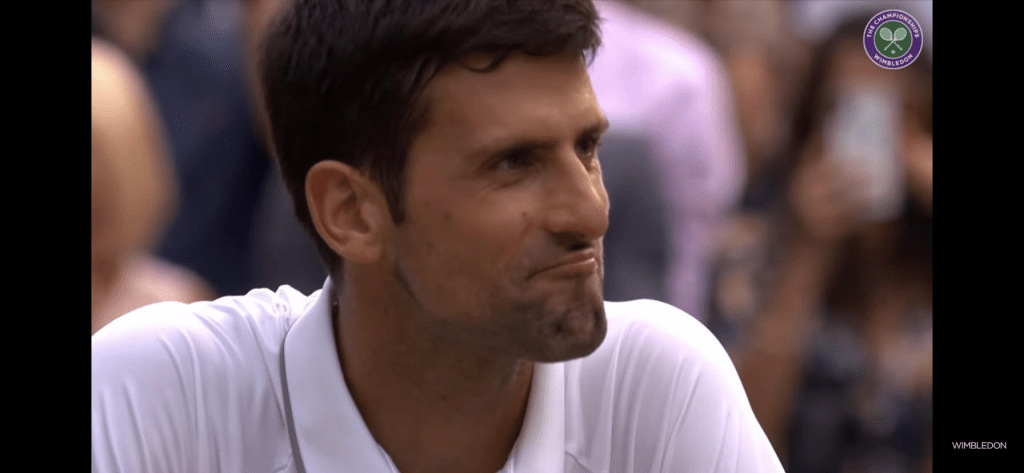


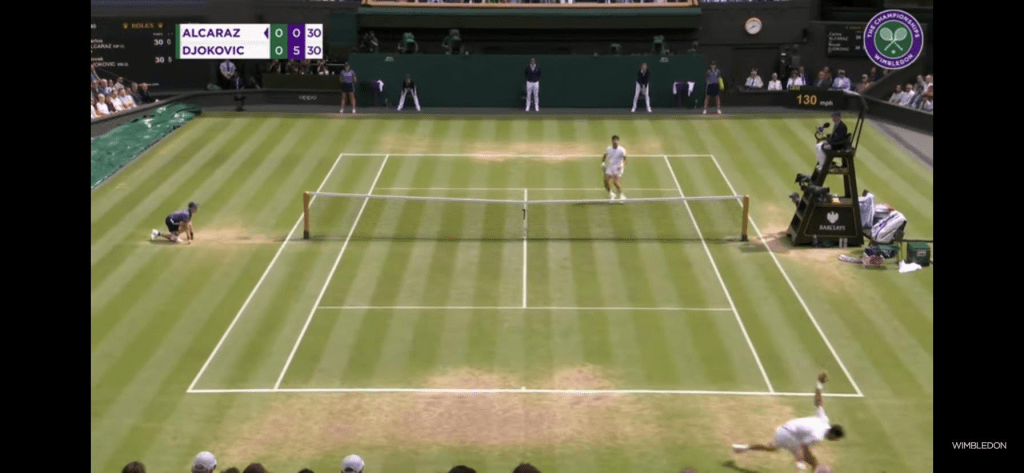
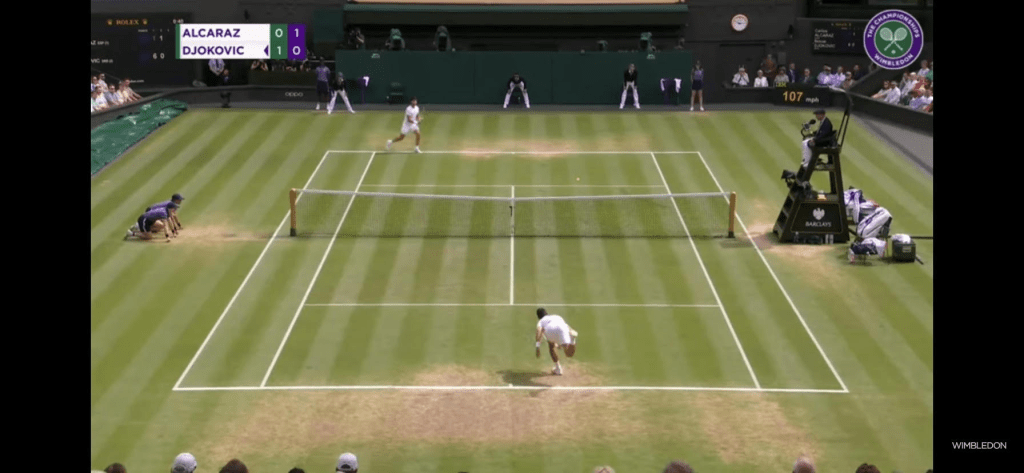
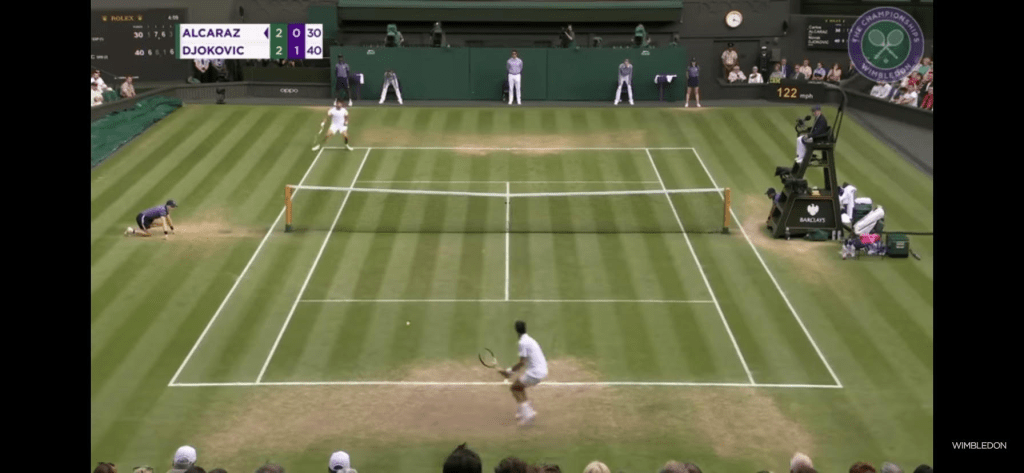
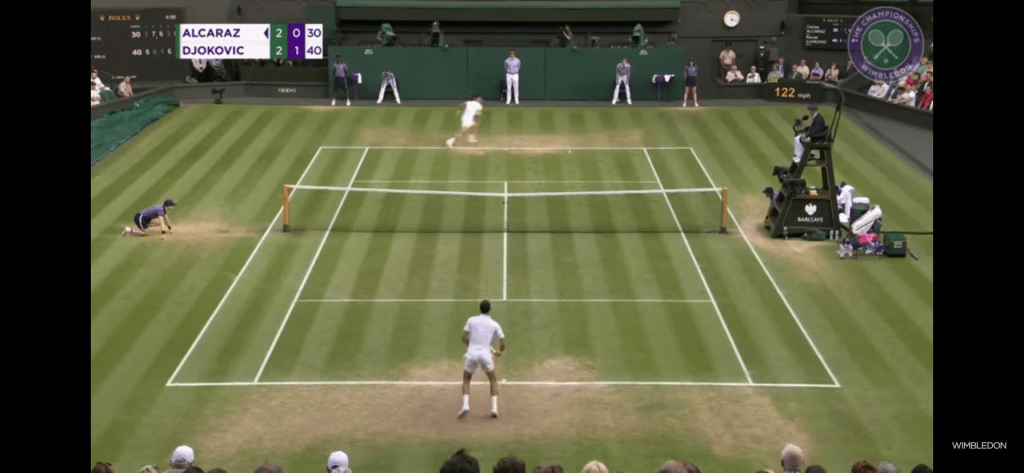

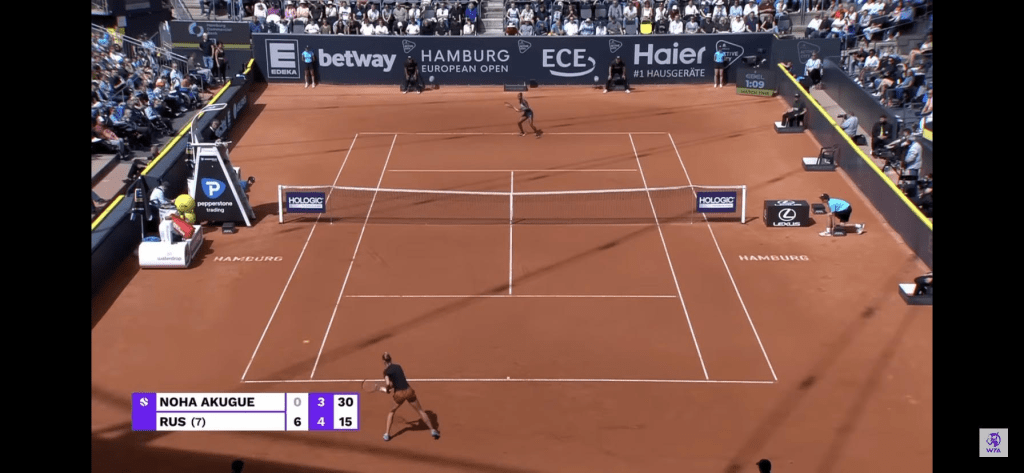
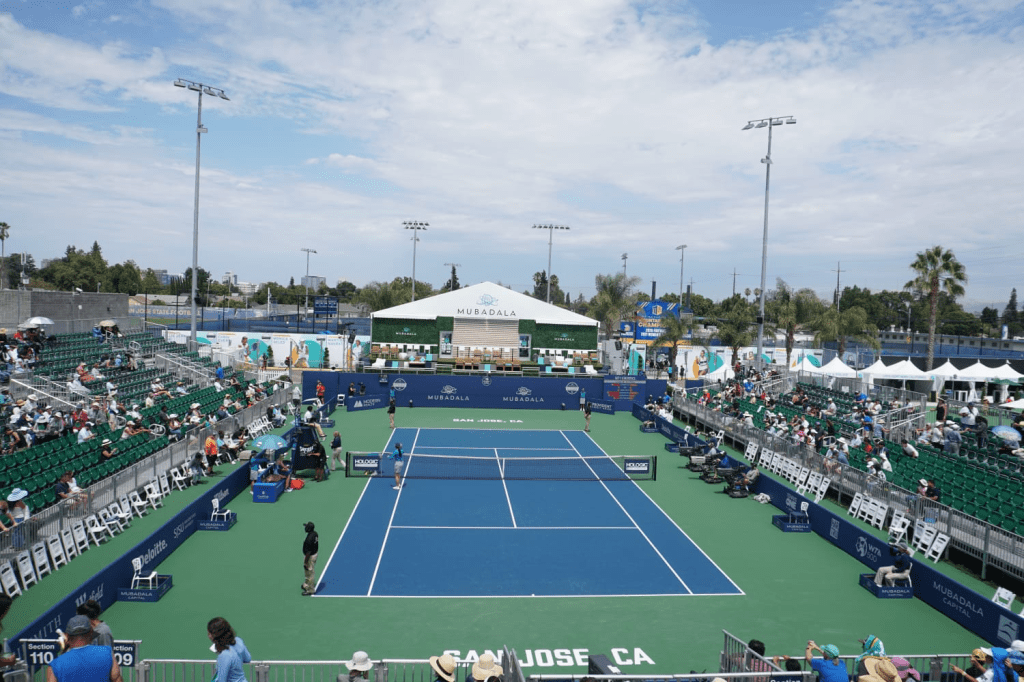


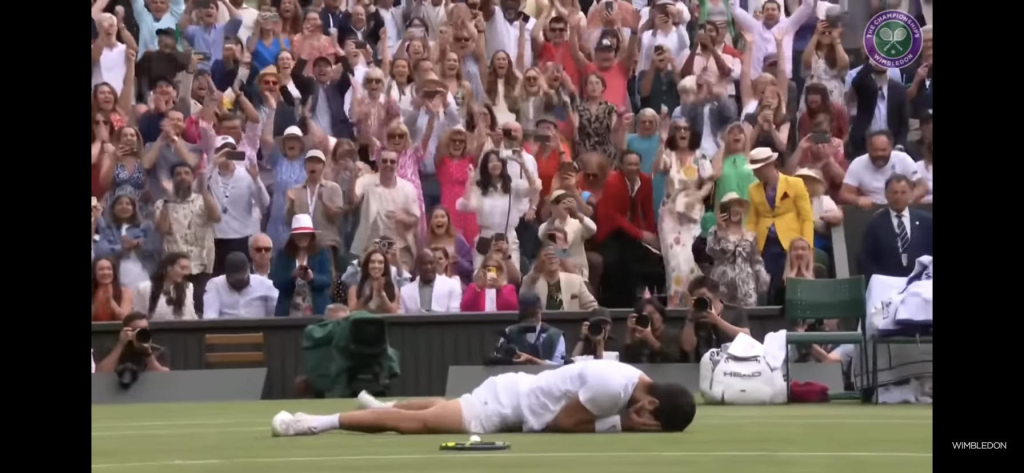

 Popcorn Tennis