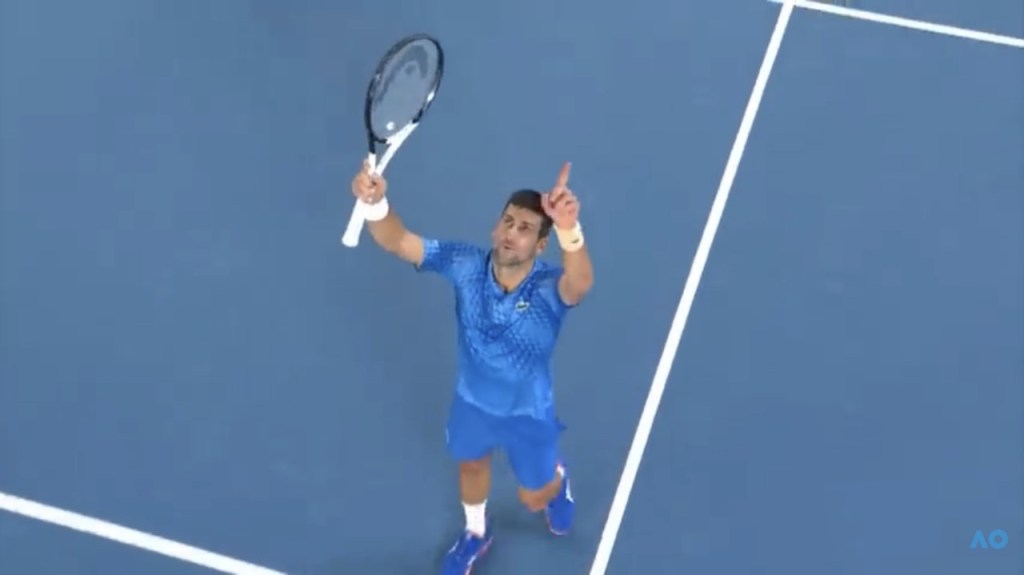
It got him then, right there where he stood, surrounded by a team of those he loved, and the effect was instantaneous, sending him down and to the floor where he lay and wept openly as the world looked on from the camera above.
An often polarising figure, Novak Djokovic has never found it difficult to be open with his opinions and thoughts but this here and now, in the shadow of his 22nd major title and ascension back to the world number 1 position, was a peeling back of the skin to show the heart that beats and tries and tires and cares beneath the surface of a man frequently described as an undeniable forever-there of a player.
This reaction was not altogether unexpected. Djokovic’s tears reflect back a year and more, taking into account his deportation from Australia at the start of 2022 and further back still into his at times frosty relationship with the media throughout the pandemic that threatened to skew his portrayal from less of a misunderstood individual into a more villainous anti-hero. Now though, his emotions continued to fall when he was back sitting courtside as he struggled to contain all that he was feeling, his towel marked with a damp map of the journey he’d been on. Lost opportunities and future possibilities will leave you grieving just a little even in victory.
Novak Djokovic sobbing uncontrollably with his team after winning the Australian Open. A very emotional celebration from the new/old World No. 1, by far the most emotional of his career. pic.twitter.com/JOGgIXo7Y1
I don’t believe Djokovic has gone about everything over the last few years in the ways that he should have done. At times, I’ve been frustrated with his attitude and refusal to switch things around so that tennis could be the primary focal point of his life. But in my inner-conflict, my love for him grew because my god, I adore my messy protagonists, those ones that leave you questioning desperately to the heavens as to why they are the way that they are but knowing deep down that if they weren’t, if they changed even for a moment, even for a second, they’d lose the thing that makes them go. It’s that refusal to cave even when you think that they should that keeps you coming back with an eye-roll and slight smile of annoyed acceptance. I need my players to irritate me to no end and to have me wondering why I even bother sometimes. I want them to shake my head for me in disappointment and then have me forget it all in a moment of their genius. I want them to send me to bed telling myself that I’m done with them, only to have me getting up the next day praying that they’ve won. I need flawed brilliance and dented perfection. I’d implore you to try disagreeing with your favourites once in a while. It’s fun, I promise!
In any case, Djokovic’s abilities seemingly know no earthly boundaries whether you like him or not. He seems monstrously content with weathering storms both on and off the court, gazing up at the thunder and lightning dark with a confidence ready, as though poised to climb right up there among them if he needs to. And he has needed to, so many many times to sort out issues in his tennis and his personal life, rewiring the sky to give himself a bit more sunlight to work with. And in the end, the man so well known for laughing in the rain finds himself in tears now when the clouds have washed themselves gone.
To see Djokovic succeed here again, in a place that represents many career highlights and one of his very biggest career lowlights, demonstrates a mental ability to move on when so many are still desperate to remind him of his past. It bookends a year that had victory for him and many of them but felt tied to its opening chapter of visa issues and vaccine statuses. This win felt cathartic, shaking him to his knees with a distinct gratifying heaviness that can only really be defined as a promise to step forwards from all of this.
I feel Djokovic needed this tournament. To see him get it is a reminder that while writers of history may fall at times, their pens so very rarely quiver.
Novak Djokovic accepts applause after winning his 22nd major title at the Australian Open 2023. Screenshot: AO Youtube Channel
Novak Djokovic is a better player now than he was ten years ago.
It took me a while to believe this. My brain would melt when I’d watch clips of his gymnastic retrievals from 2012 and 2013, and as impressively as he defends now, it’s not quite as insane. (Look at some of the stuff he does here, for instance.) But everything else has gotten better. His serve, once an unreliable shot in the dark — he hit more double faults than aces in the entire 2010 season — is now one of the best in the world. Combine that with a forehand he can paste as hard as anyone, and you have a serve-plus-one game that is very much in the Peak Roger Federer mold.
That alone makes Djokovic good enough to beat most players on tour. He didn’t lose his serve once in the 2019 Australian Open final against Rafael Nadal, he only lost it twice in the 2021 final against Daniil Medvedev. But then you have the return of serve, arguably his greatest asset. No matter who you are, Djokovic will eventually get a read on your serve. You’ll thwack a 135 mph bullet down the T and Djokovic will send a comet back at your feet. His first service game is usually easy, a hold at love or 15, while his opponents immediately find themselves dragged to deuce or worse.
Just listen to what Medvedev says about his first service game in his 2021 final loss to Djokovic at 5:20 of this video — he wasn’t tight and made all his first serves, only to get broken anyway.
There’s the backhand, unrivaled in its consistency and timing. The feathery drop shot. The continuously improving touch at net. The ability to change direction off both wings at any point in a rally. The smothering depth on his groundstrokes.
What makes Djokovic most amazing is not any one of these attributes. In fact, none of them in isolation are exactly paramount to his success anymore. His true superpower is that his game has become balanced enough that a couple central parts of his game can go completely haywire and he can still beat almost anyone. At this tournament, Djokovic suffered from a hamstring injury, hampering his ability to pull off his trademark backhand defense in the open stance. Typically, Djokovic can send back shots three-quarters of the way to the baseline from incredibly uncomfortable positions on his backhand wing; there’s minimal difference in his shot quality whether he’s doing the splits or standing stock-still. But over this fortnight, Djokovic had to abandon that fantastic skill and send back defensive slices, which had more air under them and were easier to attack.
And it didn’t even matter. You can blame Djokovic’s opponents for failing to rise to the occasion, sure. Grigor Dimitrov had chances in the first and third sets and blew them epically, losing in straight sets. Andrey Rublev was always playing from behind in the quarterfinal and couldn’t muster up as many as five games in a set despite being seeded just one spot below Djokovic. Arguably the best performance against Djokovic this tournament came from Roberto Carballés Baena in the first round — the Serb was never in danger of losing there. But let’s take a second to appreciate Djokovic’s ability to get by without certain parts of his game. Not having his open-stance backhand defense barely seemed to make him easier to beat. Djokovic had so many backup plans, such sharp tactics, such an ability to expose the shortcomings in his opponents’ games, that he was untouchable anyway.
*****
No ATP player, past or present, can match Djokovic’s peak level on a hard court (especially not this hard court). Djokovic once reeled off two sets against Federer on Rod Laver Arena in under an hour. He beat Nadal 6-3, 6-2, 6-3 in the 2019 final. He has beaten Andy Murray in straight sets in an Australian Open final, twice. In the fourth round this year, he beat Alex de Minaur badly enough to make Australian fans cover their eyes. The poor underdog won five games total in three sets, he could not hit a single winner past Djokovic from the baseline (literally), and he was clearly dazed in press.
Djokovic did all that to de Minaur with a negative winners-to-unforced-errors ratio.
Some are bemoaning the lack of competition for Djokovic this year — Tommy Paul as a semifinal opponent is not in the same league as Federer, Murray, or Stan Wawrinka. They’re right. But the way I see it, Djokovic has earned this. He waded through the lava during the early years of his career, losing again and again (and again) to Roger and Rafa. He overcame them, outlasted them, and this is his reward.
But I think that Djokovic has attained such a high level at the Australian Open that who he plays doesn’t matter much anymore. It’s similar to Nadal at Roland-Garros in his best years; from 2005 to 2014 (and then again from 2017 to 2020), his draw was basically irrelevant. He beat Federer and Djokovic at Roland-Garros in 2006, 2007, and 2008. In 2013, he had a hellish draw, culminating with a 4.5-hour marathon with Djokovic in the semifinals, ran through all of it, then beat poor David Ferrer in a straight-set final. With Djokovic, does anyone really have the tools to beat him at the Australian Open right now? How would you have an opponent, even the most quality competition in the draw, go about beating him? I just don’t see it.
The simple fact is that there is no working blueprint for beating Djokovic at this tournament. You have to hope he self-destructs. Tennis analysts and strategy coaches beg his opponents to come to the net more often, but like Tommy Paul alluded to in his post-semifinal presser, you can’t come to net if you’re constantly being pushed behind the baseline. Serve-and-volley is a suicide mission when Djokovic is taking his huge cuts on the return of serve. If it were me, I’d try to hit drop shots on every single point to make Djokovic as miserable as possible, but the guy is faster than most players on tour, even at 35.
Paul touches on what I think is the most difficult part of playing against Djokovic: He hits so consistently deep that his opponents don’t have time to implement their gameplan, almost regardless of what that gameplan is.
The Paul match was a good example of how gigantic Djokovic’s margin for error is. He made something like 25 unforced errors in the first set, practically throwing away four games in a row after having set point at 5-1. Then he held easily at 5-all and broke Paul from 30-love down at 6-5. From there, he lost just three games for the rest of the match. If Djokovic’s backhand is misfiring, like it was in the very first game of the match, he’ll throw down a few huge first serves. If the serve is off, he’ll dig in for some long rallies. If the rallies aren’t going his way, he’ll toss in a drop shot, give a little bit of ground, then suddenly be willing to play a 40-shot exchange on a big point. And when things are working, when he builds a lead and starts taking every ball early, going for return winners on first and second serves, it’s video game tennis. There is nothing anybody can do in response.
Djokovic rarely hit his video game peaks in the final against Stefanos Tsitsipas, but managed to win in straight sets anyway. It’s a favorable matchup for Djokovic; he can ruthlessly expose Tsitsipas’s weaknesses (the backhand and the return of serve) while offsetting his strengths (the serve and forehand). Djokovic only dropped serve once in the final and reacted by breaking back immediately. The scoreline — 6-3, 7-6 (4), 7-6 (5) — hints at moments of tension, but Djokovic led the second-set tiebreak 4-1 and the third-set tiebreak 5-0. He was never letting go from there. Match point was emblematic of the way Djokovic breaks his opponents down: He hit a big serve to Tsitsipas’s forehand, which came back. He rallied to Tsitsipas’s backhand twice, tempting that wing to break down. It didn’t, so Djokovic simply ripped an ultra-risky inside-in forehand that Tsitsipas got a racket on but couldn’t navigate between the lines. Djokovic will pick on your weaknesses, but even if they hold up, he’ll just produce the necessary brilliance from his own game.
Djokovic’s motivation used to be fragile at times — after winning the 2016 Roland-Garros to not only complete the Career Grand Slam but the non-calendar Grand Slam itself, he had a two-year down period. When he crushed Nadal to win the 2019 Australian Open, his third straight major title, he wasn’t quite himself for the next couple months. I thought he needed to be threatened by a rival to play his best tennis. But he seems to have overcome that. I think he needs to win a crazy number of majors (say, 25 or something) to truly get the mainstream GOAT honor that he craves, and I think he knows that. So despite already having won more than enough to deserve the accolades, he’s intent on not just beating records, but putting all of them out of reach.
He’s well on his way. This title marks Djokovic’s 10th Australian Open and his 22nd major overall, tying him with longtime rival Nadal and foreshadowing a mouthwatering duel at Roland-Garros to decide the race to 23. Djokovic is certainly the more in-form player and has been the better player overall for quite a while, but every time he’s looked in position to run away with the Grand Slam event race, Nadal has come back at him. In 2016, Djokovic pulled within two, having won the last four in a row, only to slump until 2018. At the end of 2021, Djokovic tied Nadal for the first time, winning three straight majors to create a deadlock at 20, only for Nadal to win the first two majors in 2022. With Roland-Garros being the crown jewel of Nadal’s empire, and unlike his matches at this tournament, Djokovic will need to be at his best to win that hypothetical clash of the titans.
That said, Djokovic has built an already-majestic career that, unlike Nadal’s, seems nowhere near over. I don’t want to be hyperbolic here, because 19-year-old phenom Carlos Alcaraz couldn’t play this tournament, and after winning the U.S. Open and reaching #1, he was going to be Djokovic’s biggest threat in Melbourne. But as for the rest of the tour (at least for now), it is clear that Djokovic, despite his lengthy tenure at the top of the game, cannot be dragged down from the summit. Everyone might just have to wait until he decides to descend on his own terms.
You knew it was never going to be easy. Aryna Sabalenka had spent much of the past 12 months ironing out the many kinks in her second serve, but if anything was going to bring back the yips, it was the possibility of winning her first major title. She tried for a huge second serve on championship point #1 and missed it, bringing back memories of Goran Ivanišević trying to serve out the 2001 Wimbledon Championships. On Sabalenka’s second and third championship points, she made second serves but lost the points. Finally, on the fourth attempt, she was pulled wide by Elena Rybakina’s angled crosscourt forehand but got it back, and Rybakina missed her next shot. Sabalenka sank to the ground in exhausted elation.
Having touched on the end of the match, I just need to say it: Damn, this was a good final, and it required a heroic effort from Sabalenka to win. Rybakina looked unflappable — hell, she looked near-invincible — in the opening set. Her serve was spitting aces left and right, and the one time Sabalenka managed to break her in the first set, Rybakina promptly broke back. When Rybakina had served out the opener and went up 15-40 on Sabalenka’s first service game in the second set, I thought a repeat of the semifinal against Victoria Azarenka was on the cards. Rybakina is dangerous enough at the beginning of a match, but with a lead she can become untouchable.
Instead, Sabalenka launched a sustained assault from the back of the court, hitting her groundstrokes with so much furious pace that even Rybakina buckled under the siege. Sabalenka routinely got her opponent’s huge serves into play, and once she did, got to work overwhelming Rybakina in the baseline exchanges. If Rybakina has a slight weakness in her game it’s her defensive forehand — she often goes for running winners but rarely makes them, and Sabalenka drew those errors time and again. Rybakina, the Wimbledon champion last year, had been pushed earlier in the tournament, but this was the first time I saw her truly on her heels. She fought gamely in the second set, saving three break points at 1-4 and two more at 2-5. But Sabalenka had a vise grip on the match and refused to let it go, serving out the set confidently.
Besides her issues with the second serve, the main reason Sabalenka was yet to win a major until last night was the riskiness baked into her style of play. She hits with enough power to overwhelm anyone, but there’s a very fine line between precision and wild inaccuracy when you hit the ball as hard as Sabalenka does. And yet she finished the night, the most pressured of her tennis career, with an astonishing 51 winners and 28 unforced errors. Harnessing so much power on such a big stage — she was hitting her forehand harder than the men, regularly going beyond 85 mph — is as impressive as it gets.
While Rybakina did well to hold her first three service games in the decider, Sabalenka was inevitable. Her break at 3-all had been a long time coming. When she stepped to the line to serve for the title, she had played so well for so long that I tried to imagine Rybakina breaking her and couldn’t.
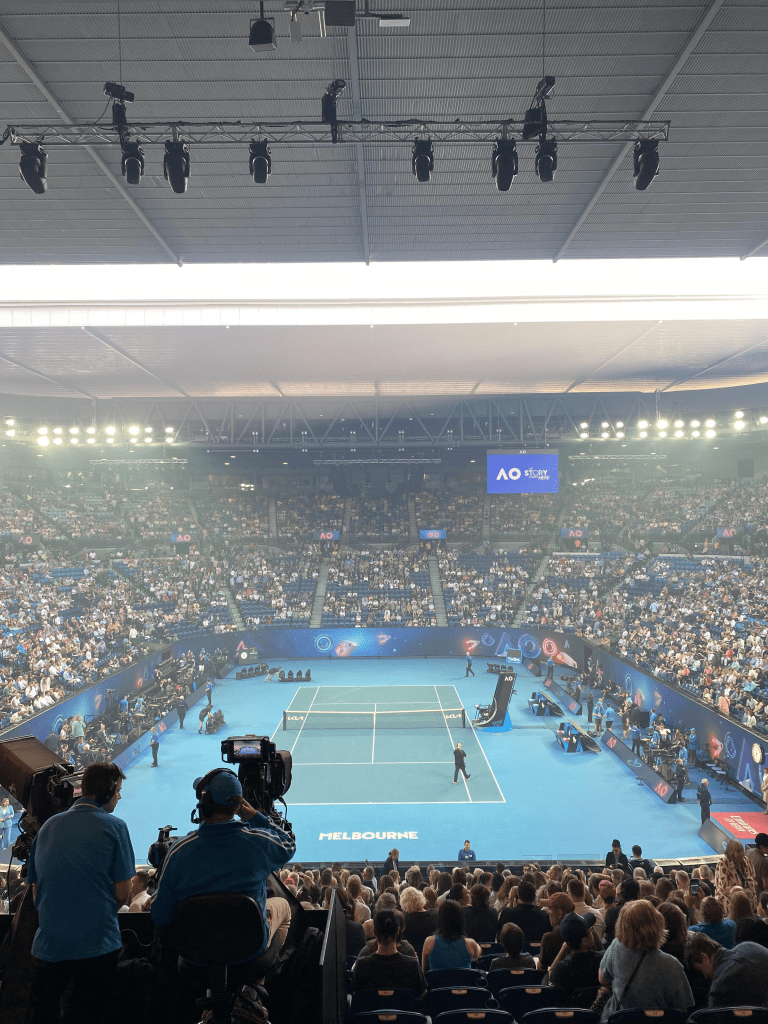
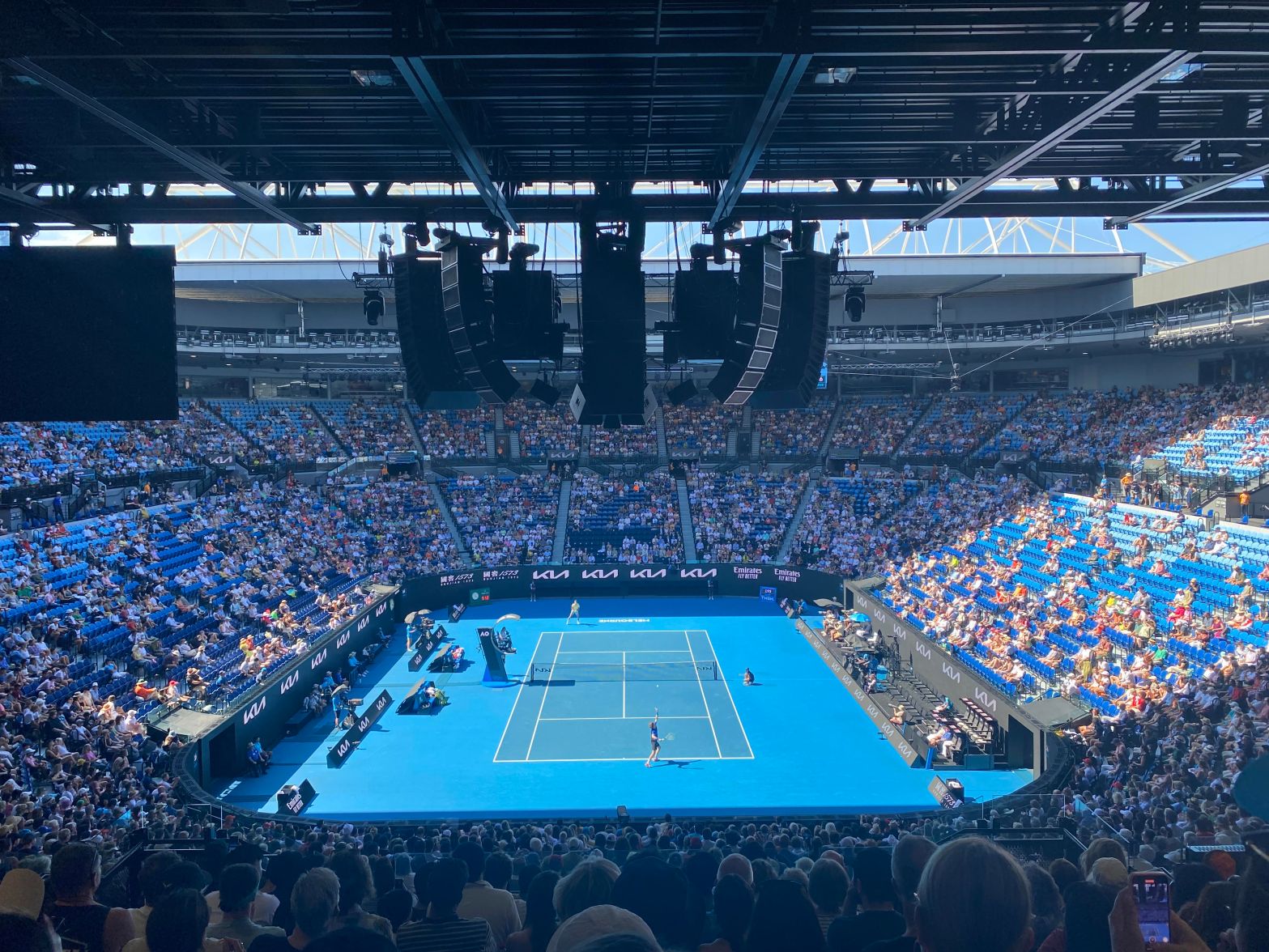
But this is tennis, a sport that forces viewers to imagine the unimaginable. Though a player can win four points in under a minute, winning the final game can also be an impassable chasm. Rybakina went up 15-30, then had break point after Sabalenka’s first couple championship points passed her by. I watched the final from Kia Arena, where they were showing the main event from a couple big screens. There weren’t many others there — maybe fifty — and we had no reason to cheer, being far enough away from Rod Laver Arena that the players would never hear our shouts. Still, what I will remember from the final few minutes of the match is the way we gasped when Sabalenka smashed a big serve and put our heads in our hands when she failed to take a championship point. I think she had won over most of the tennis world before she even put the match to bed.
*****
It’s hard to imagine a better start to the year for the women’s game. Rybakina had an opportunity to win a second major and receive the deserved amount of acclaim for the first time — her Wimbledon title was practically swept under the rug — but I daresay the run to the final alone gained her the rightful recognition. Her run was impossible to ignore; she went through 2022 finalist Danielle Collins, world number one Iga Świątek, power player extraordinaire Jelena Ostapenko, and two-time Australian Open champion Victoria Azarenka. And despite playing a superpowered Sabalenka, she was three games away from the title. The loss will sting, but this was not a choke, nor was it a gigantic missed opportunity. For me, this was a rare final that generated only positive emotions — I’m thrilled for Sabalenka and proud of Rybakina, and I think both will win more majors in the future.
Świątek is still the world number one, and while a portion of fans will surely say Sabalenka is the best player in the world having won this title, Świątek’s consistency is still a bar no one else on tour has reached. But she has a chase pack breathing down her neck now. Sabalenka and Rybakina have both beaten her recently, the latter in the fourth round of this very tournament. There’s Jessica Pegula, Victoria Azarenka, Caroline Garcia. Ons Jabeur and Maria Sakkari might not have lived up to the Netflix-high expectations this tournament, but they’ll be back, as will Coco Gauff and Collins and the injured Paula Badosa. The potential for rivalries is huge. Who wouldn’t say yes to a Sabalenka-Rybakina rematch, anytime, any place? Wish this cast of characters good health, because the rest of this season could be a truly epic battle royale.
For now, though, everyone has a while to enjoy the afterglow from what was the best major final in some time. It was arguably the best match of the tournament, which is all you can ask for in a championship match. Both players hit their peaks and both felt the wrath of their opponent. The title was well deserved — it’s a tribute to Sabalenka grinding through match after match of hitting 20 double faults until she fixed the glaring hole in her game. The memories will last a lifetime. And our fingernails will not finish growing back until Roland-Garros.
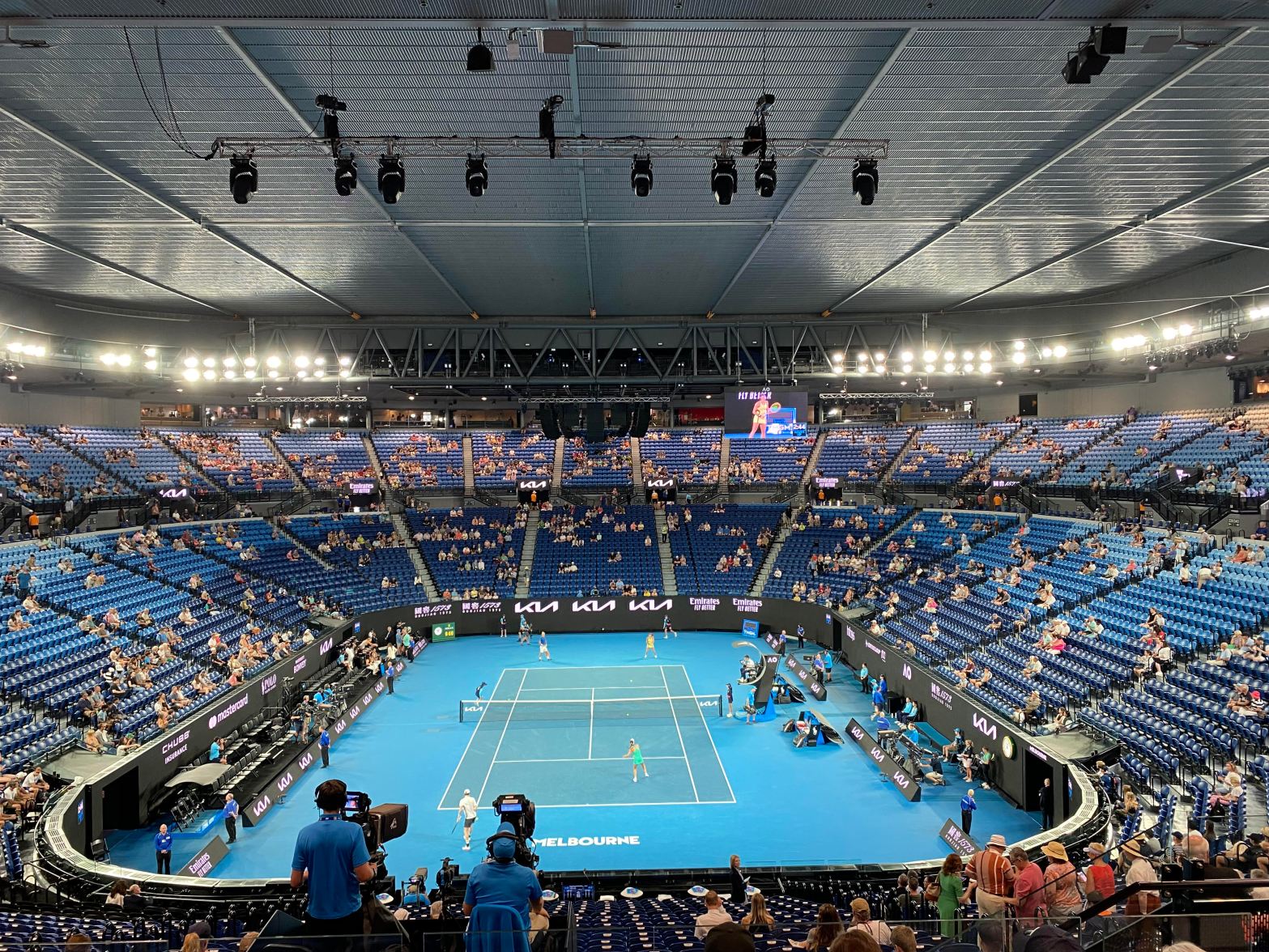
The stands on Rod Laver Arena were sparsely populated enough for the mixed doubles quarterfinal between Australians Lisette Cabrera and John-Patrick Smith and Brazilians Luisa Stefani and Rafael Matos that I was able to waltz down to a prime seat without worrying about its owner showing up. It’s no surprise, really — odds are you don’t know any of those names. I sure didn’t when I sat down to watch.
And I’ll admit that I was initially disappointed the first match for the Rod Laver Arena day session was mixed doubles rather than singles. The tennis powers that be likely would have had the same feeling in my position — some formats are prioritized over others, and it certainly isn’t mixed doubles at the top of the pile.
The numbers can back me up. Prize money for the mixed doubles winners at the Australian Open ($157,750), once split between the partners, is less than what an adult singles player earns from losing in the first round. Losing in the first round of the mixed tournament nets a team a whopping $6,600, which, once divided between partners, might not even be enough to cover the cost of airfare and time in Melbourne. It’s extremely unequal, but singles players objectively do get much more attention. Just look at freelance journalist Ben Rothenberg’s recent tweet about doubles:
Yeah, doubles specialists aren’t gonna pack stands in most scenarios. But singles stars reliably do in any format. https://t.co/HgRiDVpU1n
You read that right — singles players taking part in doubles garner more attention than doubles players taking part in doubles. This is the case for any number of reasons, one being that tennis is marketed as an individual sport, “gloveless boxing” (though it’s not nearly as violent, to the point that I don’t think it deserves the comparison to pugilism) as some call it. Having teams of two face off kind of kills the mano a mano aspect.
Doubles is really a different sport. You’ve got the balls and rackets, yes, but the dynamics of the points don’t resemble that of singles at all. The court dimensions are even modified, with the alleys getting involved. Players’ reflexes are tested more. At least one player is almost always at net, which can result in dizzying exchanges of quick volleys and soft lobs. There is less running and more use of angles. Few of the characteristics that make singles tennis what it is feature in doubles.
That’s not to say doubles isn’t worth watching. On the contrary, some prefer it to singles — the manic exchanges that take place when all four players are at net are played at a speed singles can only produce in its dreams. Even granting that there are only two players on court in singles, they find their way to net less and less frequently these days. The power baseline era, brought on by incredible string technology, makes some of the extreme angles players used to only be able to find at net possible from the back of the court. In doubles, though, net approaches are necessary to find the angles to punch the ball past a pair of opponents. The strategic elements are fascinating; partners huddle up quickly to talk tactics and then flash hand signals to each other before every point.
I’m watching some mixed doubles on RLA, and Luisa Stefani and Rafael Matos are really really good. This was the only point I filmed, but they just won a rally in which they both returned smashes and eventually got an error. pic.twitter.com/yh1JEr6k2C
Whether doubles’ relative lack of popularity is due to the nature of the format failing to appeal to as big an audience as singles does or tennis just not marketing doubles properly, there’s no doubt which format garners more attention. And even among doubles tennis, mixed is the black sheep. The “Doubles Tennis” subsection under Wikipedia’s “Types of Tennis Match” heading begins, “Doubles is played by two teams of two players each, most often all-male or all-female.” The only tournaments in which you can even play mixed doubles are the majors, and more recently United Cup. (The revived Hopman Cup should also feature the format.) While women’s and men’s doubles have rankings, mixed doubles does not, seedings at the Australian Open being decided by players’ ranking in single-gender doubles. Matos and Stefani had only played together once prior to the Australian Open, and that was mere weeks earlier at the United Cup.
It’s a shame that mixed doubles is such a low layer in the lasagna of what is prioritized in this sport, because watching Stefani and Matos play their quarterfinal was quite something. Stefani had brilliant touch on the lob, successfully lifting the ball over both her opponents at times. She once lobbed the ball over the net player on a return of serve, something I’ve never seen in singles. (“Really good lobs in the last few games,” Matos said of Stefani during their on-court interview.) Matos has a somewhat loopy, unpenetrative forehand, rather like Yoshihito Nishioka’s, but managed to find enough angles with it that the shot became a strength rather than a liability. They played some stunning points in tandem — the first rally in the highlight video below sees Matos rescue a point with a tweener, then he and Stefani each return an overhead smash from Smith, until finally the Australian misses.
Stefani and Matos both have impressive doubles pedigrees; Stefani, who suffered a bad injury in the semifinals of the 2021 U.S. Open doubles, won the second Adelaide tournament with Taylor Townsend. She’s ranked 25th in the women’s doubles rankings, with a career-high of 9, and has won six doubles titles. But look at her total career earnings — $565,287 — and it’s easy to see that doubles, single-gender or mixed, is not where the money is made. The highlight video linked above has about 12,000 views and a handful comments so far, maybe 1/5 of what you might see on an early-round singles match. When Stefani and Matos won their quarterfinal, the official Australian Open account sent out a celebratory tweet including “Forza” — which is Italian, not Portuguese.
“FORZA”? Nah, can you do a one minute google translate?
Wanting to follow the Stefani-Matos run to its completion, I watched the first set of their semi against Marc Polmans and Olivia Gadecki (who was mentored by Ash Barty and skipped the 2022 Australian Open due to neglecting to get vaccinated) from the hilltop near Melbourne Park. It was clear early that Polmans and Gadecki were a sterner test; Polmans was acing Stefani repeatedly and was a force at the net. I thought the 20-year-old Gadecki was the fourth-best player on the court, but at the end of the set she tightened her execution on her returns and volleys, and she and Polmans took the first set 6-4.
The hilltop, which was heavily populated during the previous Djokovic-Rublev match, was nearly empty once Djokovic finished waxing his poor opponent. Exhausted from the day and conscious of a desire not to stay out another hour just to see Stefani and Matos lose, I left after the first set of the semifinal. When Polmans and Gadecki were up 5-4, a bird flitted across my field of vision, its dark outline in stark contrast with the white clouds. Its wings flapped rhythmically but more quickly than I thought a bird’s would — each wingbeat didn’t seem to do much. It wasn’t until I focused on the silhouette that I realized it was a bat.
Waking up the next morning, I saw that Stefani and Matos had come back to win — not only had they won the second set and then the super-tiebreak (which is played in place of a third set), they had saved a match point. Polmans even got a hard return to Stefani at the net, a pattern that had worked well for him throughout the first set. But Stefani was expecting this one, punched a volley down the middle that Gadecki had to stretch for, then hammered away the weak reply. Two points later, Stefani, who was returning serve, noticed Polmans cheat a little to his left at net, then unloaded a backhand return winner into the open space for game-set-match.
Their opponents in the final, Sania Mirza and Rohan Bopanna, carried considerably more star power than the vanquished semifinalists. Mirza spent time as the #1-ranked women’s doubles player, as well as the top-ranked Indian WTA player. Her doubles partners in the past include the legendary Martina Hingis, with whom she won three majors in a row from Wimbledon in 2015 to the 2016 Australian Open. In 2017, she partnered briefly with Peng Shuai. She has beaten Victoria Azarenka — who is a two-time Australian Open champion and made the semifinals again this year — in singles. Having turned pro way back in 2003, Mirza’s career is a huge inspiration for Indian tennis and fans around the world. Her social media platforms are way larger than those of basically every tennis player besides Serena Williams and the Big Three. And having announced her impending retirement — though she will play a couple more tournaments, this Australian Open was her last major — her run to the final with Bopanna had the potential to be a dream farewell. I was on Twitter during the final, and I had never seen the timeline so active during a mixed doubles match.
6 grand slam, 2 WTA titles aur 18 saal ka angaarrrr career. The OG of Indian Tennis @MirzaSania calls it a day from Grand Slams. A Queen in the truest sense. To truly understand her impact on Indian Tennis, here's a small snippet from a 2006 @guardian article. #SaniaMirzapic.twitter.com/pTXcpjigrA
And Mirza more than pulled her weight. Though she missed a couple overheads in the first-set tiebreak, she rallied from the baseline beautifully, even exchanging forehands with Matos without backing down. But the Brazilian team proved slightly stronger in the end. In the first set, Mirza and Bopanna had a chance to serve for the first set at 5-3, but were broken after a slick drop volley winner from Stefani. Then, on a deciding point with Matos and Stefani up 2-1, they played the rally of the match: Mirza and Matos drilled forehands at each other from the back of the court while Bopanna and Stefani waited at net, coiled to strike if given the opportunity. Finally, after Matos and Mirza had exchanged forehands down the right sideline and from the deuce court, Matos blasted one at full tilt inside-in at Bopanna, who couldn’t handle the pace. The ball flew long, giving the Brazilians what would be a decisive lead.
There’s no grand conclusion here. Others have eulogized Mirza’s epic career better than I could. Stefani and Matos will surely play together again, likely successfully, but they won’t get a chance until Roland-Garros. They deserve a lot of credit for this title — as Courtney Nguyen pointed out during their post-final press conference, Stefani has now won five titles in her last eight events.
But while show courts around the world might have alleys, that’s about as much attention as pro tennis gives to mixed doubles. And that’s a shame, because what I saw of mixed doubles this tournament seemed lighter and more fun for the players than the other formats (maybe because of the lower stakes, admittedly). Players regularly — and warmly — hugged not just their partner but their opponents after matches. There was dedication but no animalistic roars, frustration but no tantrums. The format certainly seems worth tending to a little more.
On championship point, Stefani read a crosscourt forehand from Mirza and crashed a volley right at Bopanna, who didn’t have time to react. The ball struck him in the midsection. Stefani held her hands up in acknowledgment before jumping into Matos’ arms to celebrate the title.
Magical things happen during the Australian Open semifinals. Sure, that sounds hyperbolic, but the last four in Melbourne has been the stage for countless epic matches. It was where Angelique Kerber and Simona Halep played a series of lungbusting rallies in 2018, both saving match points, with Halep eventually prevailing 9-7 in the third set. Andy Murray and Novak Djokovic clashed in 2012 on one of the slowest hard courts to date, playing points of such attrition that Djokovic looked dead on his feet by the end of the second set and positively mummified by the end of the third (and came back to win the match in five!) And in 2009, Rafael Nadal and Fernando Verdasco played the greatest match I’ve ever seen, a five-hour, 14 minute ballet of violence. Verdasco drilled winner after winner, 95 of them by the time the night was over, while Nadal scampered from corner to corner in a desperate effort to eke out enough errors to avoid getting blown off the court at the Australian Open for a third straight year. It was wonderful.
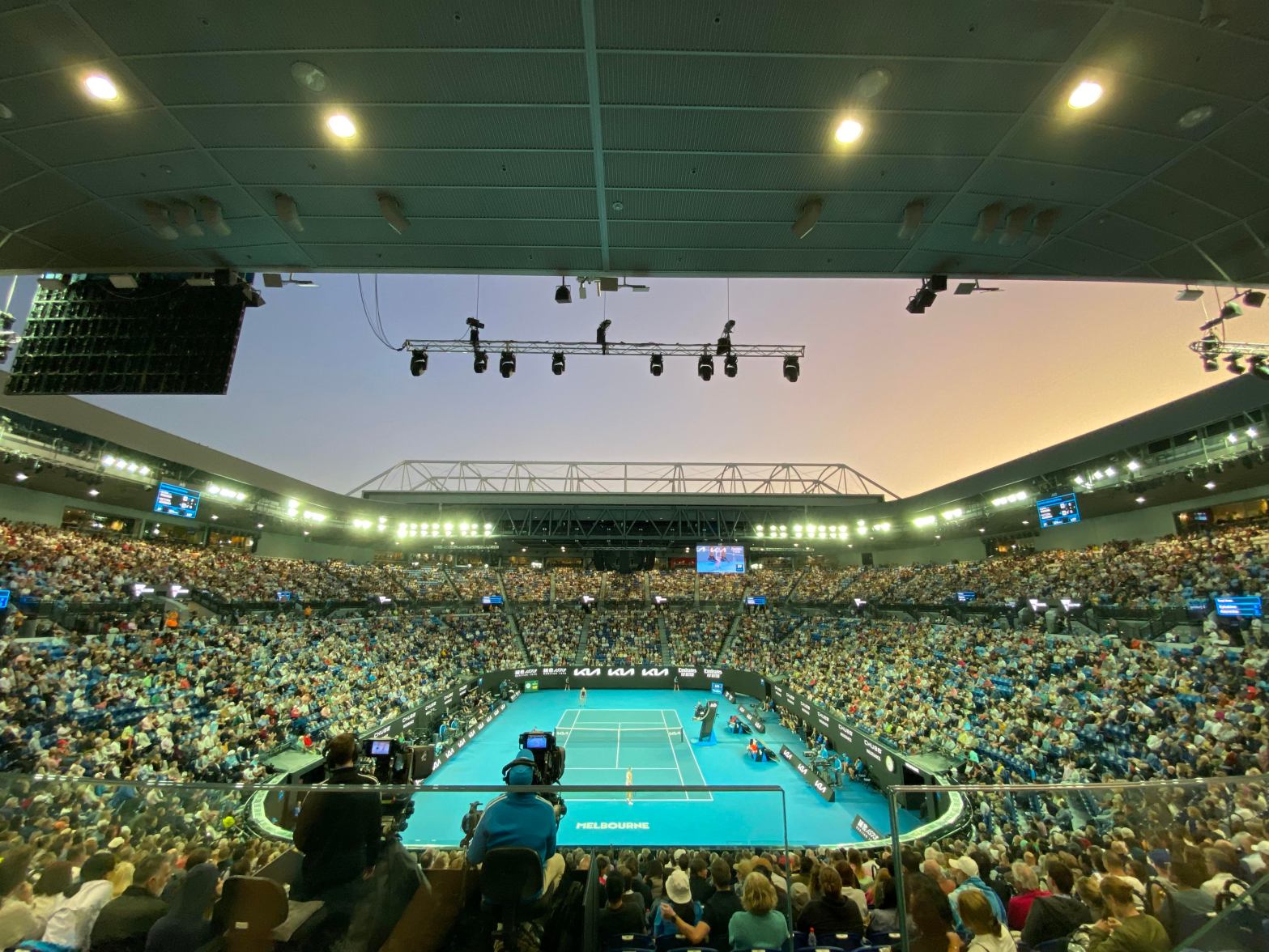
So when I sat down ahead of the women’s semifinals yesterday, I was pretending to be cautious in my optimism, but really, my expectations couldn’t have been higher. The sun was slowly setting outside Rod Laver Arena, sending this ethereal golden glow creeping across the sky as seagulls begun to settle on the structure (as they do when night falls at the Australian Open). Before the match, there was a fantastically over-the-top light show on the court. The seats were full, all four players were riding distinctly interesting runs through the tournament…it was an incredible atmosphere. I even found the courage to chat a bit with my neighbors.
Rod Laver Arena through the night.
I don’t think I took a breath for the entire first semifinal. Elena Rybakina and Victoria Azarenka played a first set entirely befitting of two major champions. It was glorious back-and-forth, push-and-pull, all the way until Rybakina claimed the opener 7-6 (4). Azarenka scored the first meaningful blow — at 2-all, 30-all, Rybakina unloaded a 184 km/h serve that landed inches away from the T, but Azarenka read it seamlessly, getting a clean swing on a backhand return. Rybakina was pushed back by its depth and weight, allowing Azarenka to run in and belt a forehand winner. Another great first serve return later, the Belarusian had the first break.
But Rybakina came back instantly, her superpowered groundstrokes vaporizing any anything that dropped a little short or hung up for a split-second. Azarenka is more historically lauded for her return of serve (understandably, given her astonishing returning performance at her 2012-2013 peak and her significantly longer career to this point), but it was Rybakina who did more damage on the return in this match, holding Vika to a mere 6/27 points won on the second serve (I did a double take the first time I saw this stat). Rybakina broke twice in succession, serving for the set at 5-3.
Then she lost her first serve, opening the door for Azarenka to shine again. The two-time Australian Open champion saved a set point with a stunning forehand pass down the line, hit while on the run, and in a blink of deep groundstrokes, found herself up love-40 on Rybakina’s serve at 5-all. Azarenka failed to break, though, despite having looks at second serves on all three break points (one of which she dumped into the net), and in retrospect that was her downfall.
When Rybakina won the tiebreak, despite the respect I had for Azarenka’s fighting spirit and incredible career (this is a woman who once served for a major final against one Serena Williams, after all), I thought the match was over. First sets in big matches are tight a lot of the time, but when one player comes through — especially if they’re the more powerful player — you often see them relax and go for their shots more. With Rybakina having served at a mere 48% in the first set and winning it anyway, I felt that if she went into top gear, she’d be unstoppable. (The second semifinal followed almost the exact same pattern — Aryna Sabalenka snuck out a close first set, then bombed away with her crushing groundstrokes in the second, leaving Magda Linette no chance.)
And sure enough, Rybakina picked up speed in the second set. Azarenka certainly didn’t give up, saving an early break point with another stunning forehand passing shot, but Rybakina was all over her: Azarenka faced break point in every single one of her service games in the second set. Though Rybakina was broken when serving for the match at 5-2, her tennis was alarmingly sharp. By the end of the match, she had more winners than Azarenka (expected) but she also had fewer unforced errors. This is as good a metric to explain the result of the match as any — if the more powerful player also manages to be more accurate, their opponent doesn’t have a chance. There’s just no way to counter pinpoint aggression.
I was exhausted after the first semifinal. It wasn’t that I was unexcited for Sabalenka-Linette, Rybakina-Azarenka was just all-consuming. I felt simultaneously happy for Rybakina and how well she had responded to the lack of recognition for her Wimbledon title and sad for Azarenka, who is experienced enough to know exactly how close to the title she was. I wished I had a couple hours to digest all the emotions before the second semifinal. That said, the match was a great watch anyway — the stylistic contrast between Sabalenka’s raw power and Linette’s never-say-die defense even reminded me a bit of Nadal-Verdasco. (Though the match had the opposite result, with Sabalenka eventually crashing through Linette’s defensive wall.) Verdasco would have nodded knowingly at Sabalenka’s flawless performance in the first-set tiebreak.
*****
The semifinals might have followed a similar pattern, and they did both end in straight sets, but the skill on display from all four players was mindblowing. There were untouchable aces, screaming return winners, eye-wateringly sharp forehand angles hit on the run. I don’t want to exaggerate the quality of the matches, they aren’t ones people will talk about in ten years, but the standard required to make headway was lofty.
Watching major tournaments is a bit like binge-watching an incredibly dramatic TV show. It’s emotional and gratifying, but it’s also hard to fully process all the storylines in real time. You might miss an important detail, then only catch it when you rewatch highlights a month later. The semifinal slate yesterday had four magnetic storylines — Rybakina seeking a second major and the proper recognition that she was denied after winning Wimbledon, Sabalenka striving to win her first major (and make her first major final), Azarenka trying to tap into her Melbourne magic from a decade ago, and Linette aiming to prolong her dream run of giant-killing. Then two of those storylines were cut short within two hours while the two others became more layered and thrilling. I feel like the losing semifinalists’ runs deserve some mourning, but with the Rybakina-Sabalenka final (which very much has the energy of unstoppable force vs. immovable object) looming, dwelling in the past comes at the expense of enjoying the present and future.
Of course, tennis tournaments share that quality with almost everything in life.
Regrets! We all carry them. They’re instructive in avoiding a repeat performance of past mistakes, but we dwell on them for other reasons, too. Maybe a hypothetical universe in which we didn’t make a certain mistake is more desirable to us than the present we live in. Though such a line of thinking is self-defeating, a way of blinding yourself to both the present and future, we’re all mosaics of our past memories. How are we supposed to ignore them, even the unsavory ones?
I wonder constantly how tennis players manage regrets. I’ll regrettably turn to the poorly-researched and recently racist John McEnroe as an example: In the Strokes of Genius documentary, he said, “I’ve spent the last 25 years of my life trying to figure out a way to remember the wins instead of dwelling on my losses.” McEnroe won seven majors, more than but a handful of the best to ever pick up a racket, so if he wrestles with this, virtually everyone else probably does too. So many matches get played in so many different ways against so many opponents that inevitably, no matter who you are, you’ll suffer a heartbreaking loss or a horrendous choke. You will regret something. It’s unavoidable. How do you deal with that, the retrospective what-if?
Andrey Rublev squeaked past Holger Rune in the fourth round of the Australian Open today, 6-3, 3-6, 6-3, 4-6, 7-6 (9). The match really couldn’t have been closer — five sets, two match points saved, net cord return winner on the last point (AGAIN!). Rublev was wracked with relief at the win, falling on his back in victory as one might do after winning a final, not a mere fourth-rounder. His celebration carried elation, yes, but I think Rublev was also relieved that he wasn’t picking up any more emotional baggage (of which he has quite a bit) for the moment.
The match as a whole was more epically dramatic than high-quality. It had its sleepy periods (I almost dozed off in my seat early in the second set after finishing a pack of gummy snakes). Rune, in particular, seemed way off his game. He hit 12 double faults and significantly more unforced errors than winners. I thought something was missing from his rally shot; he usually hammers every groundstroke, but in this match, he looped quite a few, almost to the point of moonballing at times. Whether it was an ankle issue he picked up in the previous round or something else is irrelevant now, but even in loss I wonder if Rune demonstrated himself as the better player. While Rublev led practically all of the stats, Rune was the one who went up a break in the fifth set and was the first to match point. I’d back Rune to win a rematch in a second.
Not that any of that will be of solace to Rune himself. He lost despite a bunch of opportunities to win. I just got back from Federation Square, where I watched Novak Djokovic dispatch Alex de Minaur like Ron Swanson dispatches cuts of meat — I mean it, this match was as one-sided as a match between two high-ranked professionals can get — and I think de Minaur is going to sleep better than Rune tonight. He had an impossible task, really. Djokovic isn’t only a nine-time Australian Open champion, he was in one of his moods, hitting return winners off first serves and shutting down de Minaur’s offense entirely with his spidery baseline coverage. Even if de Minaur had played the best tennis of his life, Djokovic would have beaten him in straight sets, the match would have just been marginally closer. Rune actually had a beatable opponent in Rublev — and was on the precipice of beating him multiple times! He served for the match at 5-3 in the fifth, got a chance to return for the match at 5-4 (he didn’t win a point in either game), had the two match points at 6-5, then led the super-tiebreak 5-0 and 7-2. Even in a sport as cruel and fickle as tennis, that’s a lot of demons to create in one match.
In contrast, you can watch de Minaur’s presser here (which is fascinating), and while he expresses regret that he couldn’t make the match more competitive, he sounds more dazed and confused than anything. He mentions going in with a gameplan, but when pressed on what it was, it’s obvious from his demeanor that he never had much faith in his tactics. He gets that Djokovic was near-faultless. He knows that it didn’t matter what his gameplan was, Djokovic hit the ball so relentlessly and consistently deep that de Minaur didn’t have time to execute anything properly. While he wishes he could have put up a stronger front, he knows there was nothing he could have done to win. If he can avoid getting existential about how much better Djokovic is than him, this match doesn’t change much. No reason to be deeply regretful.
This may be more important than it sounds. I think that most tennis players (and maybe athletes in general) fear regret more than they do loss. Matteo Berrettini said in Netflix’s tennis documentary (ever heard of it?) Break Point that his greatest fear was “feeling that I could have done more and I didn’t try, like I didn’t give everything that I had.” In the following episode, we learn that Taylor Fritz played the Indian Wells final despite a badly injured ankle because he didn’t think he could forgive himself if he didn’t take to the court. You’ll notice neither player mentions being afraid of losing here, it’s the lack of effort that’s abhorrent to them. Tennis will find various hells to put players through even when they try their hardest, but finding that inner peace — cheesy as it sounds — is a priority. Even the best players ever lose at more tournaments than they win. Tennis is about dominating, yes, but if you can’t cope with the losses, you’ll be a mess for god knows how long.
And regardless of any objective evaluation — objectively, Fritz shouldn’t have played that final because of the likelihood of it making his ankle worse — what matters most to the player are their own feelings about their play. Tennis players are insanely hard on themselves, often tearing their self-esteem down when they should give themselves grace. Fritz playing through injury was potentially self-destructive, but he saw it as self-preserving. Did it set a good example? No. Would I have done the same? Definitely not. But maybe it was the best thing for him in the moment, eventual result of the final (which he won) aside.
Having too many regrets is like walking around with a sack of cannonballs around your shoulder. You ask yourself, “what if I had done this instead of that?” and the logical answer is that it doesn’t matter because the past is past and dwelling on it impedes your ability to succeed in present and future, but the mind is a stubborn thing. You could be so much happier now, it tells you, if – you – had – just – avoided – making – that – one – mistake. I’ve had days when I linger in the past too much, and it doesn’t matter what my agenda is that day, I’m not getting anything done. The sun is down before I know it. Rublev played a terrible point to lose the fourth set against Rune, not doing enough with a few midcourt forehands and then blowing a swing volley. The thing to do after that is to take a full-blooded cut at the next sitter, because hesitating mid-swing will only make it easier for your opponent to stay in the point. But at match point, 9-8 up in the fifth-set tiebreak, Rublev hit a tentative swing volley to the wrong side of the court and got passed easily. He won despite the hiccup, but it was damn close. He snapped back into the present just in time.
Rublev was clearly still recovering from the stress during his post-match interview. Players tend to spout the same dull platitudes in post-match interviews, often regardless of how important or tense the clash was, but Rublev was glaringly honest. The interviewer asked him if the match was like a rollercoaster. Rublev said it was more like a gun to the head. It was an uncommonly transparent look into a player’s psyche.
Poignant as it was, though, the premise of Rublev’s analogy struck me as flawed. He seems as susceptible as anyone to that little inner voice of regret. It badgers him during matches, constantly asking why he didn’t play each and every point perfectly, which may be why he berates himself so much after seemingly understandable errors. It’s all in pursuit of satisfying that little voice which always demands more from him. Had Rublev lost today after having a two-sets-to-one lead, the little voice probably would have raised in volume, screaming at him as he hit the practice courts, yelling as he tried to sleep. If what tennis players fear above all else truly is regret, then their greatest threat is not the metaphorical gun going off, it’s the possibility of that little voice droning on forever.
Iga Świątek, world number one and three-time major champion, is out of the Australian Open. And the way she went down, to a storm of brilliance from Wimbledon champion Elena Rybakina, was of little fault of her own. Sure, you can point to her first serve not doing enough damage (which I’ll get into), but this was Rybakina’s day. She was always going to be a thorny obstacle for a top seed this tournament — if Wimbledon had granted points last year, she’d have been a top seed herself — it was just Świątek’s misfortune that Rybakina ended up in her path.
The game plan against Świątek might not be easy, but it is clear. You can’t match her defense or high-margin aggression, so you have to take chances and try to blast through her with risky winners, starting with the return of serve. Naturally, this puts a lot of pressure on your power shots: Knowing how incredibly precise you have to be makes it that much more difficult to hit those tiny targets. Rybakina, though, seemed impervious to the pressure. She clubbed a pair of return winners in the very first game, breaking after Świątek had grabbed a 40-love lead. Though the world number one eventually broke back, that set the tone — Rybakina’s power would be the decisive factor in the match.
Świątek certainly had her chances, most notably a 3-0 lead in the second set, but she was never exactly in control of the match. At 3-1, she made four first serves — and lost four points. Świątek’s first serve is her primary (and really only) weakness at this point. She’s capable of good spot serving but, maybe buoyed by the knowledge that her ground game is enough to beat most players without the help of a great serve, seems to just want to get the point started much of the time. It’s understandable. Why take unnecessary risk when you can win safely? Against a firing Rybakina, though, it wasn’t possible for Świątek to win with so much margin for error in her game. Świątek won 57% of her first serve points; Rybakina won 80%. The world number one netted a short forehand, the kind of shot she hits for a winner in her sleep, to drop serve at 4-all in the second set. Rybakina served the match out to love moments later.
Though Świątek is the world number one, and a dominant tour-leader at that, this result…doesn’t change things at the Australian Open all that much. She was the tournament favorite, yes. But when she lost to Maria Sakkari in the quarterfinals at Roland-Garros in 2021, the draw was thrown into chaos. Literally anyone could win after that, we said. Here, the vibe is different. Jessica Pegula is the world number three, crushed Świątek pre-Australian Open, and is yet to drop a set. Aryna Sabalenka, power player extraordinaire, has been scarily accurate so far. Fourth-seeded Caroline Garcia is in-form and has survived a couple fierce tests. Rybakina is certainly a contender after this performance. You have Victoria Azarenka, a two-time champion of the event, who just survived a tight match against Zhu Lin to reach the last eight. Jelena Ostapenko and her titanic bullwhip groundstrokes (from which no one is safe) are into the quarterfinals as well. In a tournament that hasn’t featured too many magical matches just yet, I can’t wait for everyone to start scything each other down in the later rounds.
*****
Much of the talk heading into this young season was whether or not anyone could be a meaningful rival to Świątek after her dominant 2022. Maybe that was the wrong question. It is incredibly hard gatekeep a spot at the pinnacle of the tennis tour. Take Novak Djokovic’s 2011 season, one of the very most dominant in the Open Era. He won 41 straight matches that season as well as three of the four majors. He demolished all his rivals. But in 2012, he started losing to the other members of the Big Four, seemingly all at once — it wasn’t any individual one of them that did the damage.
Świątek has been directly in the spotlight for almost a year now, and during that time, her peers have been studying her for weaknesses. It’s just the nature of tennis. Players get sick of losing to the same player over and over, so they figure out tactical angles to prevent it from happening again. Świątek’s potentially vulnerable first serve is no secret; gone are the days of the 37-match winning streak when the query of how to beat her was greeted with a giant question mark. During most of that stretch, each part of Świątek’s game was operating on such an outrageously high level that her serve became too small a weakness to be relevant. But now, whether it’s because the rest of her game has inevitably regressed to the (still extremely impressive) mean or because players are being more proactive in attacking her serve, Świątek is a little more vulnerable.
I’m not trying to write a eulogy for Świątek’s time at number one (there is sure to be more of it) here, but it’s worth mentioning how unstable the ground at the mountaintop is. Whether the pressure or the chase pack or injuries end up getting to you, you’re coming down eventually. Daniil Medvedev lasted all of three weeks as world number one on the ATP before getting displaced.
My point is this: Świątek’s (first?) phase of utter dominance is probably over. And it’s not that the loss to Rybakina marked the ending, but heading into a new season, using it as the lens through which to view Świątek’s future reign could be instructive. The way Rybakina beat the world number one — huge returns, crushing groundstrokes — will be difficult to reproduce. But even before Rybakina’s win, other players put forth the blueprint. There was the Sabalenka win over Świątek at the WTA Finals, the Pegula win over the world number one at the United Cup. More players will blast away at Świątek’s serve, and by the law of averages alone, some are going to execute successfully enough to succeed.
The next step for Świątek is to climb yet another peak that no one else can reach. Improving her first serve will both set up her forehand for easier putaways and make her more difficult to attack, and if that happens the road to beating her will become shrouded in fog again. It’s unfair, really, that the best player in the world should be forced to improve, but that’s where Świątek has found herself. Tennis never stops, even for those who rule it.
Świątek is hardly in trouble. Sure, she’s defending the points from her six big titles, but it was never a question that other players would pick up at least a couple of those titles in 2023. Clay isn’t too far away, where Świątek is more dominant than she is on hard court; her biting forehand and stifling movement are further enhanced on the dirt. And I’m confident she will win the Australian Open in the future — it’s not like this loss carries a sense of foreboding for her future in Melbourne. Świątek is still only 21! But if we were wondering which players could even pose a challenge to the world number one in 2023, we already have some answers.
Andy Murray’s Australian Open might be over for another year, but the resilient Scot proved beyond all reasonable doubt this week in Melbourne that he is most certainly not down and out.
Showing grit and stamina beyond his years, Murray defied all the odds stacked against him during his first two matches. He was written off by many before he had even taken to the court against 13th seed Matteo Berrettini and then again when he trailed by two sets and 5-2 in what became his longest ever match, an incredible comeback against home favourite Thanasi Kokkinakis in a five set thriller (the 11th time he has won from two sets to love down).
It wasn’t to be against Roberto Bautista Agut last night in a packed Margaret Court Arena – but Murray can leave with his head held high after more than 14 hours on court.
My reflections on that match, having been there in person:
1: I can’t believe the audacity of Murray hitting some of the shots he – quite frankly – had no business hitting being a one-hipped man of 35 with 7,000 blisters on his feet.
2: It took Bautista Agut three and a half hours to beat Murray when at times the man could barely even move.
My second point is, of course, not a criticism of Murray but a nod to his sheer determination and dogged fighting spirit to never lie down, never give up. To never say it’s over until the last ball has been played. He fought until the very last point and I’m certain this week in Melbourne has earned him a legion of new fans who have been absolutely astounded by his resilience and passion for the game.
Whatever Murray has been doing with coach Ivan Lendl is working – his serve has improved (albeit he struggled with it against RBA due to the pain in his back and feet) and his forehand has strengthened. Dare I say he was giving off the vibes of 2016 Andy Murray more often than not over the course of those three matches? At the very least, he played better tennis than he did for the whole of last season. In a recent Murray Musings podcast I described 35 as being the perfect vintage. In his post-match interview on Saturday night, another 35 year old – Novak Djokovic – said 35 is the new 25. Maybe this old man is getting a new lease of life.
Four years ago I cried when I thought it was all over for him. I sobbed watching his pre-AO press conference and I bawled watching him fight back, but subsequently lose to (yet again) Bautista Agut in the first round. I was almost inconsolable when the AO organisers played his “retirement” tribute video.
I pride myself on being a words person but I do genuinely struggle to eloquently describe the impact Andy Murray has had on me over the years. It was my mum, a real tennis lover, who first introduced me to him way back in 2003 when he won a Futures tournament in Glasgow. It was definitely harder to follow players outside of the slams back then, and even more so for Andy since he was still a junior, but after he won the US Open juniors in 2004 the coverage on him increased. We would scour tournament results to see if he had played and how he had gotten on, and we followed his progress as a wild card at Queens Club in 2005 where he got his first ever ATP Tour win and made it to the third round. From then on we were hooked.
For years we watched him, hoping he could make that leap from phenomenal challenger to bona fide champion. We cried with him in 2008 when he lost the U.S. Open final to Roger Federer. We cried again in 2010, 2011 and 2012 when he lost the Australian Open and Wimbledon finals. There were tears of joy in August 2012 when he won his first of two Olympic gold singles medals. We cried even more when he won his first major at the U.S. Open in September that same year.
Finally – 2013 came around. Ten years ago now. We cried, cheered, cried some more when Andy, ever the underdog, came out fighting and unstoppable against Novak Djokovic in the Wimbledon final, getting his hands on the trophy he coveted most.
My mum had terminal cancer at the time. When Andy won Wimbledon she said: “I’m so glad I got to see that. I always wanted to see that.”
She never got to see him lift the Davis Cup, win his second Wimbledon or become World Number 1 – but she always knew he had it in him.
People often ask me why I love Andy Murray so much. What is it about him? I’m not lying when I say it’s his grit and determination, and his ability to make tennis look difficult while proving to anyone that if they work hard enough, and want something enough, they can achieve it too…
But it’s also because Andy Murray got me through some of my darkest days – and he still does. I would rewatch matches that my mum and I watched together and remember the chats we would have while they were on, remember our armchair analysis of his play and the rallies and points that made us grasp hands and gasp out loud. My mum introduced me to the joy of Andy Murray and for as long as he plays I’ll always imagine her sitting next to me, watching his matches with me, hiding behind her hands or throwing her arms in the air. He brought her joy even in her sickest moments – and for that I will never be able to thank him enough.
The impact he has on his fans is profound – Andy Murray is superhuman and we are so, so lucky to have him. I can’t wait to see what this year brings.
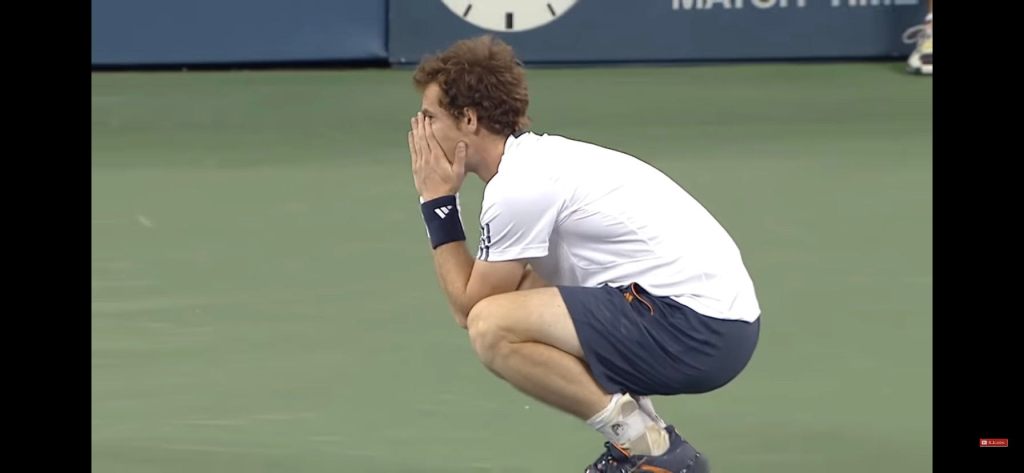
Proving the doubters wrong: Murray reacts to winning his first major title. Screenshot: U.S. Open
When 18-year-old Diana Shnaider from Russia stepped on court at Margaret Court Arena in the second round of the Australian Open to open action against sixth seed Maria Sakkari, much of the audience was unaware of the incredible talent they were about to witness over the course of the next two and a half hours. Even though I had already seen some impressive performances from Shnaider in the past months – not least thanks to her inspiring success in the WTA 125 Challenger Series at the end of the previous season – I, too, was surprised by the depth of my reverence by the time the match was over.
Although Diana Shnaider’s current success was far from unpredictable early (we are talking about a former world No. 2 on the ITF juniors list), there are more obstacles in the way of her career than you could probably find at Stonehenge.
Shnaider is far from an isolated case in terms of facing obstacles and a lack of support. Since there is a little tennis nerd in all of us, I would like to refer to the legendary Algerian tennis player Lamine Ouahab — the only player to defeat Rafael Nadal in a juniors Grand Slam event. Wondering about a common thread between these two special athletes? I can assure you: There are not too many. At least for now, I do not know about any triumph of Diana Shnaider over Rafael Nadal in a recorded match.
Here’s what I am getting at: All the talent in the world is of no use to a player if their financial situation does not allow for proper training. That is what unites the fate of Diana Shnaider and Lamine Ouahab. At least for now, and hopefully only for a while.
Ouahab, who later switched nationalities to Morocco on the tennis circuit, is now 38 years old and, barring future miracles, is a long way from realizing his full potential – he hit a career high of 114 in the rankings. Ouahab wasn’t the most dedicated to fully exploring the limits of his body, mentality and overall ceiling, but mostly the lack of support and unfairness within the vast tennis cosmos was what cost him – which, like in so many other sports and aspects of life, is driven and fully controlled by the sole aspect of profit.
(Small side note: When we talk about “cosmos” in a more-or-less relevant tennis context, Kosmos with a “k” is rarely the means to success – as the ITF with its “Davis Cup” recently experienced. In an appropriate way: happy retirement to Gerard Piqué.)
To put things in perspective again: Shnaider’s chances of being successful in her career are and have been higher since birth than for Ouahab from Algeria. Those are simply linked to some privileges and lack of furtherance. The place of birth and one’s residence have a huge impact on the chances of a successful career.
But even in Shnaider’s case, it is far from a given for a Russian-born athlete that the necessary support to be a successful professional tennis player will be provided. In recent years, many Russian top athletes in tennis decided to switch nationalities and compete under the Kazakh flag, since the Kazakh Tennis Federation offered more opportunities for financial aid and sponsorship.
It was only last year that 23-year-old Elena Rybakina, a Moscow-born player who decided to play for Kazakhstan in 2018 after five years of competing for Russia, won the prestigious Wimbledon tournament. As Rybakina confirmed in several interviews, her decision to play for Kazakhstan was mainly influenced by the support the country could give her when she was an up-and-coming young player. The current world No. 25 was struggling with financial difficulties after high school and stated:
“It was not an easy decision because, of course, financially it’s difficult. It’s a very expensive sport. Like all the parents, my parents, they were worried if something happens, if you get injured, of course you want your kid to study and not to risk.”
When Shnaider walked into the gigantic Margaret Court Arena in Melbourne early Wednesday afternoon (local time), and many people – myself included – realized that she was not even carrying a bag with a sponsor on it to carry her racquets, I knew immediately that I had to write a detailed text on this topic.
While in modern football teenagers are sometimes traded within clubs for absurd amounts of millions, the three-time major champion in junior doubles could not even land a kit bag sponsorship. An absurdity that is hard to imagine.
If I were a brand ambassador, the Moscow-native would totally fascinate me for various reasons. Her look embodies uniqueness, in the form of a stylish head scarf and a more vintage Fila look reminiscent of – for some generations – the so-called “golden days” of tennis that lie a few decades back.
Not only her look is reminiscent of better times, but her incredible forehand bomb, which is enhanced by her lefty angles and versatility, also brought world number six Maria Sakkari to despair. Contextually, “despair” might even be a slight understatement. The forehand whip – paired with the unbelievable will to win in the form of numerous cheers and fist pumps – eventually drove Maria Sakkari to fury.
“If she screams one more time in my face. No, no, no, no, one more time… she’s coming toward me. One more time and I’m going to speak to the referee,” Sakkari said of the 18-year-old Russian.
At the end of the day, Maria Sakkari narrowly won the match. Although Shnaider ended up leaving the court as the defeated player, she was not really a loser that day. Theoretically, It may also have been the starting point and the help needed for a successful pro career.
Maria Sakkari dodges big danger &comes back to win 3-6, 7-5, 6-3 to reach third round of Australian Open. But 18-year-old Russian qualifier Diana Shnaider is a promising, dynamic talent. Bold and powerful & now into the top 100. Could go a lot higher than that pic.twitter.com/UuzGc6fJRQ
— Christopher Clarey 🇺🇸 🇫🇷 🇪🇸 (@christophclarey) January 18, 2023
Reaching the second round in Melbourne potentially reaped her almost $110,000.
Why “potentially”? A few months back, Shnaider, due to lack of financial aid, announced that she would not be immediately turning pro and instead would be playing college tennis at N.C. State.
“One of my mother’s friends told us about N.C. State,” she explained in a video announcing her commitment to play during the 2022-2023 season. “Right now, the situation is really bad for me, and for Russians to travel, so we made the decision that it would be the right time to come here.”
Here comes the twist: Should Diana Shnaider decide to pursue a college tennis career, she would not be entitled to any prize money she won at the Australian Open due to the applicable college rules. It’s a decision that will certainly keep Shnaider busy for the days and nights to come. With her outstanding performances Down Under dating back to qualifying, Shnaider has already secured a place inside the top 100 of the rankings, currently sitting at #94 in the live-rankings.
One thing is certain: Shnaider’s talent would not get in her way should she decide to turn pro. Later in her press conference, Sakkari spoke of her opponent’s professional prospects:
“It was a very high level from both of us. She played an amazing match,” (via Tennis 365). “She’s very young, she’s very promising. Maybe she should consider not going to college and turning pro.”
I think I’m ready to admit that at times last year, my emotional investment in the career of Andy Murray left me feeling somewhat tired. Not because of his form but because I knew that he wasn’t going to give up even with the whole world telling him that it was time. Never let it be said that it’s not OK to be frustrated with athletes’ attitudes. Especially those that we love. Especially those that steadfastly refuse to accept endings. Because until they accept that it’s over, we can’t either. I couldn’t either. I just couldn’t.
But I came close. Oh, boy, I think I came close.
I knew that I and so many of my friends that I’ve been lucky enough to meet through being a fan of this irritatingly resilient man would end up being there long after many more casual supporters had turned out the lights and closed up shop on having faith in seeing something more from him. More than that though, I found that an ugly sense of familiarity greeted me with every Murray tournament entry. Indeed, I found myself getting used to first and second round losses, meeting them with a handshake of acceptance of where he now found himself, a low whisper of “he did alright, he tried, there’s always next week…” exchanged with my fellow diehard supporters.
“But is next week really worth it?” I would find myself wondering later on when on my own. “Like, is this really what he wants, is this really what’s making him happy?” The fact of the matter is that Murray has never been alright just making up the numbers in draws. He’ll have been sick and tired of handing players weekly opportunities to speak about how much of an honour it was to play him in their winner’s post-match on-court interviews. That’s what he became, a big name that holds weight with his career achievements but could be scalped with a heavy and consistent baseline performance by good players and claimed as a demonstration of their own personal talent.
If this sounds like the talk of a bitter fan, that’s because it’s exactly what it is. That’s exactly what I was. Murray owes us nothing but his impact on my life has at times delusioned me, made me feel like maybe he does a bit, like maybe after all these goddamn years of screaming ourselves into nothingness for him, that maybe, just maybe, he owed us just one final something. And I think I came to a point where I realised that something was perhaps a step too far for him, that this guy of such career fight was now on his back and breathing heavy with the weight of metal and pain and one final career ride.
To count out miracle-makers before their final breath is a mistake often made and I think last year, I came very close to making it. I came close to accepting the running down of the clock, the dying of the light, the setting of the sun. Murray, built different as he is and wired with a surgeon’s knife to be sent back into battle, was cramping up, his muscles seizing in early rounds of best-of-three-set tournaments. As his season ended, it was the first time that I ever recall taking a step back and taking in what I thought was writing written large up on the wall that loomed dark behind each and every Murray loss.
Roaring into the Melbourne morning at 4am, Andy Murray looked like a dead man walking, so fucking ALIVE in spite of obvious exhaustion, a winner in spite of his bodily restraints that should have rendered him gone. An impossibility of a man, he stood there only briefly, barking on the crowd that were wired in within the lateness. But what I feel Murray does better than most is that his attitude can at times take hold of the cameras that watch him and speak one-to-one through the screens to those at home and in that moment, I felt it for me.
“You thought I was done, didn’t you, Scott? You of all people, with your cardboard cutout and podcast and silly little tweets about me. You thought me finished…”
And I am not ashamed to say that I found myself emotional because after following this man to the ends of the Earth, yes, I think I maybe did a little. I think I did. I thought I’d seen it all. And so if Murray has taught me anything over the first two rounds of the Australian Open 2023, it’s that it’s fun to be just a little bit mad with your expectations in spite of the disappointment that often follows. Because every now and then, that craziness will creep on through into reality to give us something. Whatever happens now, whatever Murray goes on to do at this tournament, whatever I go on to do in life, whatever you – yes, you reading this right now! – go on to do with the rest of your day, remember that something is always possible. Always.
What he proved last night is that even if he’s nailed in a casket and buried in the ashes of fire hot, Andy Murray will rise from the aftersmoke of it all with a limp in his walk and a glint in his eyes to ask us all with the most serious of dour Scottish wearisomeness “now is that really all you’ve got?”







 Popcorn Tennis