Andy Murray Does it Again

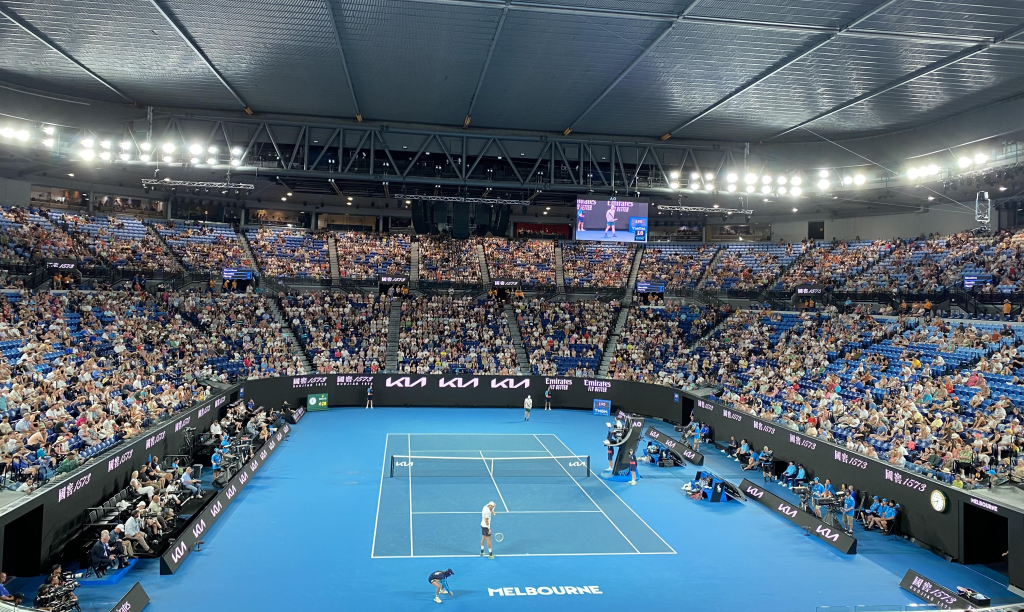
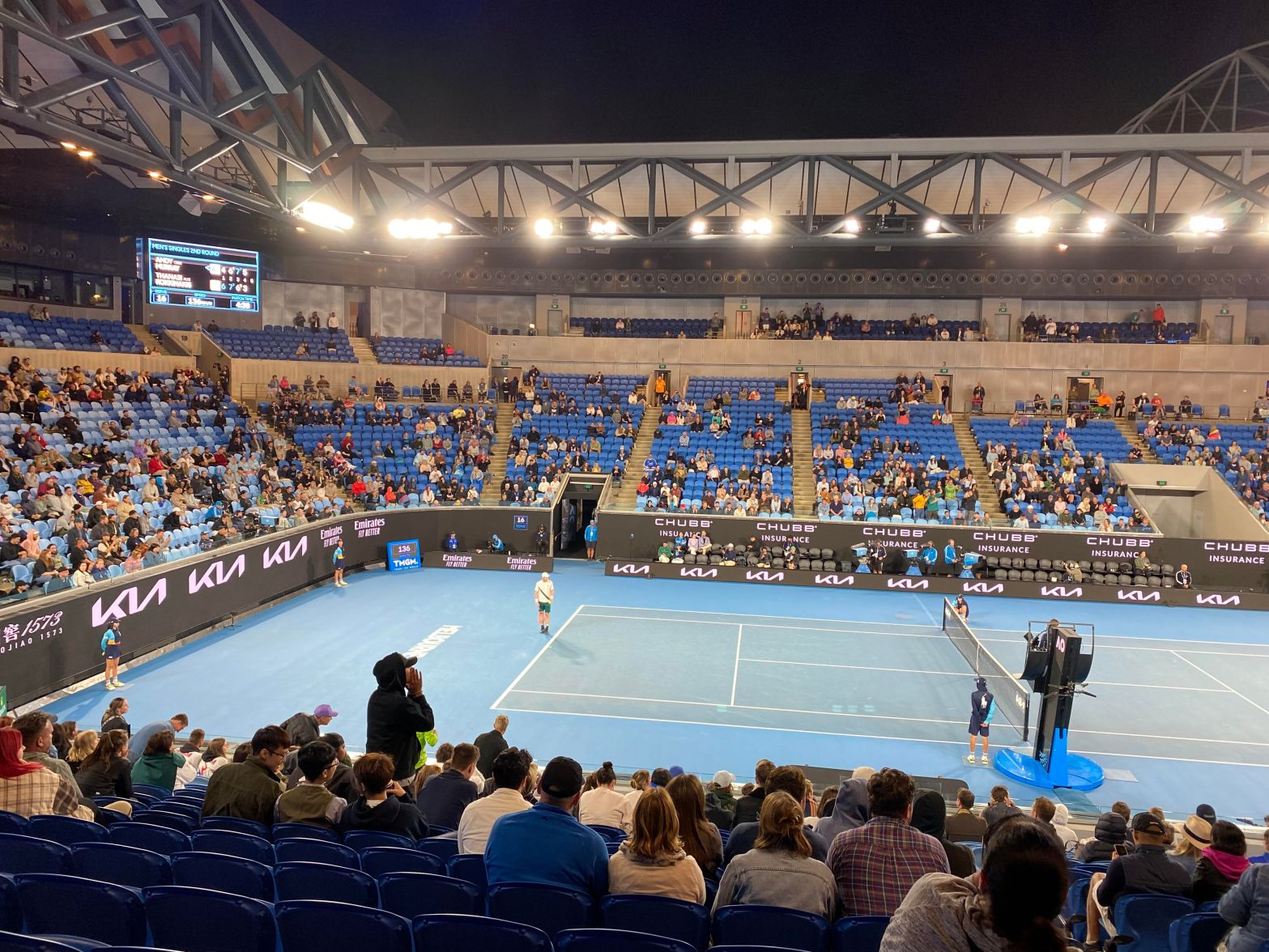
Let’s get the bad stuff out of the way first. Everything people are saying about how this match should never have gone so late, how it was unfair on everyone from the players to the unpaid ballkids who raced back and forth for six hours, is true. I doubt I can add to the issues that have already been pointed out and the potential solutions that have been put forth, but I can tell you what I saw inside Margaret Court Arena — there was the usher who had been on his feet since 6:00 p.m. and told me he had never stayed later than 2:30 a.m. (we all filed out of the stadium at around 4:15). A huge clump of fans left after the third set. Some of the fans who stayed asked if concessions were still open and looked blankly at the ushers when they were told places were closed. People ran out to the lone booth that remained open and came back with trays of hot chocolate and coffee and tea. Phones died, meaning people couldn’t call Ubers. Claire Stanley, one of the three biggest Murray fans on this Earth, had to leave because her phone ran out of juice and she needed to catch the last tram, which she barely made.

That was in the middle of the third set. The match wouldn’t end for another three hours.

When I was watching on one of the TV screens inside the arena — I think it was early in the fourth set — I heard a fan talking to an usher. The fan was being kicked out for saying something, I’m not sure what, to Thanasi Kokkinakis during the instant-classic second-round match with Andy Murray. The conversation was shockingly reasonable for the hour and the nature of the situation. The fan said that Kokkinakis had called him a cocksucker and that a different usher had come to talk to him for what he’d said beforehand, and thereafter the fan had done nothing but cheer appropriately for Murray. “It’s hilarious to me that he, one of the athletes, can call someone a cocksucker and nothing happens, and I do nothing but cheer for Andy Murray since your coworker came to talk to me and I get removed,” he said. The usher seemed not to blame the fan personally, and the fan repeatedly told the usher he understood their plight.

“I’m just the messenger,” the usher said helplessly after a while. It had the effect of an ace on match point.

“I get it,” the fan replied, shaking the usher’s hand and politely asking for his name (not as in so I can talk to your manager, as in I’m sorry, I missed it the first time). He walked away, then spun around after a few steps. “Where is the exit again?”

Anyway, Murray and Kokkinakis played a pretty good tennis match this morning.

I have so many details flitting through my head that I really don’t know where to start. I remember finishing a piece about Novak Djokovic and then going over to watch the screen in Margaret Court Arena; soon thereafter, Andy Murray returned approximately 477593 overheads from Thanasi Kokkinakis and won the point in such an incredible way he immediately seemed relevant in the match again despite being down two sets and 1-2.

Some will say that the overhead retrievals were the turning point of the match, but Kokkinakis answered the bell after Murray’s defensive heroics, toughing out a hold at 2-all, breaking Murray at 3-2, then saving break point to hold again at 4-2. I don’t care who you are or who you’re playing, if you’re on the pro tour, I don’t expect you to win from two sets and 2-5 down. It looked, for all intents and purposes, that Kokkinakis had taken Murray’s best punch on the chin and was no worse off for it. He was having a career day. He kept blasting aces down the T that bit right into the centerline and left Murray ranting at his box. His forehand was a cannon shot, his backhand a helping hand rather than a liability.

But Murray never quit. He kept matters close enough to force Kokkinakis’s nerves into the equation. I was already wondering by the end of the third set if the Australian had ever been in such an intense match. The rallies required three or four finishing shots to kill properly; there were, seemingly, stretch lobs that forced a smash error on every other point. Kokkinakis was regularly pounding his heart as if to show how much will the match was requiring, even with him so close to a straight-set win. I feel for him, because I don’t think he ever outright choked (okay, the volley to lose the third set was a considerable choke). It was more that he made some errors on the pretty big points and Murray won the biggest on his own terms. You had Kokkinakis’s unforced error at 5-3, 30-all in the third set when he served for the match, then Murray’s error-forcing forehand on break point. Kokkinakis saved three break points at 5-all in the fifth, two with gigantic serves, only for Murray to blast an inside-out forehand winner on his fourth chance. You can only do so much.

This wasn’t one of the matches where Murray found himself sucked into a grind fest with an underpowered opponent by being unwilling to pull the trigger himself, which has happened countless times in the past few years. Murray actually did what I’ve been imploring him to do since his comeback and what others have been begging for his whole career: He hit his backhand down the line. He attacked Kokkinakis’s slices with curling forehand winners. Was this 2012 Murray? No. But the resemblance was stronger than it has been in a very long time. And Kokkinakis deserves the credit for pushing him to those heights; nothing less than what Murray produced would have been enough to win.

There were enough bits of magic sprinkled onto the five hours and 45 minutes that this match won’t just be remembered for Murray’s comeback. At 3-2 in the fourth set, Murray, as he is wont to do sometimes, stirred up the crowd with gestures and applause. We started yelling and didn’t stop. Kokkinakis took his time walking over to his side of the court, and I could see him smile from my seat. It was already past two in the morning at this point, we were just a bunch of people screaming for two people hitting a ball back and forth on a little blue rectangle early in a tournament. But the two people made it feel very special.

Murray’s career is inextricably intertwined with the Big Three’s, but he’s the easiest to differentiate. When you’ve won three majors out of the 66 the Big Four have won in total, you’re amazing, but you’re the fourth wheel. Murray’s comeback from injury and attempt to retool his game has not led to more major titles but to a string of gritty mini-epics, reminders that while Murray is no longer immortally tireless, he can still be tireless for a night.

Murray has played and won enough matches in his career that it’s probably exaggeratory to say that any individual one of them was unlike all the others. This was his 11th comeback from two sets to love down, an Open Era record. But to me it did feel different than the other insane matches he’s played during his career, and I think it did to Murray too. It was the second-longest match in Australian Open history! In his first-round press conference after beating Matteo Berrettini, Murray was pretty dour, despite the epic nature of the win he’d just scored. I’d have been joking around if it were me, fishing for as many compliments as I could, but Murray just nonchalantly expressed his pleasure. I expected the same out of him after this. He’s just a grumpy guy, I figured. It’d be nice if he wasn’t, but it’s okay that he is — this is just Andy. The idea of truly taking someone as they are, flaws and all, gets tossed around quite a bit, but I think a lot of the time, if you think about it hard enough, we would use the power to change people if we had it. Murray’s fans must surely wish his second serve were better. But when thinking about Andy, the idea resonated with me more than it had in a while. If he weren’t grumpy, he wouldn’t be Andy, and Andy strikes a chord with people as he is. 

Here’s why I think this match felt different to the Scot: The first question he was asked after the match was how he managed to pull off the comeback. I expected a slow, thought-out answer, and Murray did indeed eventually give a typically intelligent response. But the first thing to escape his lips was a high-pitched giggle. 
Imperial Novak

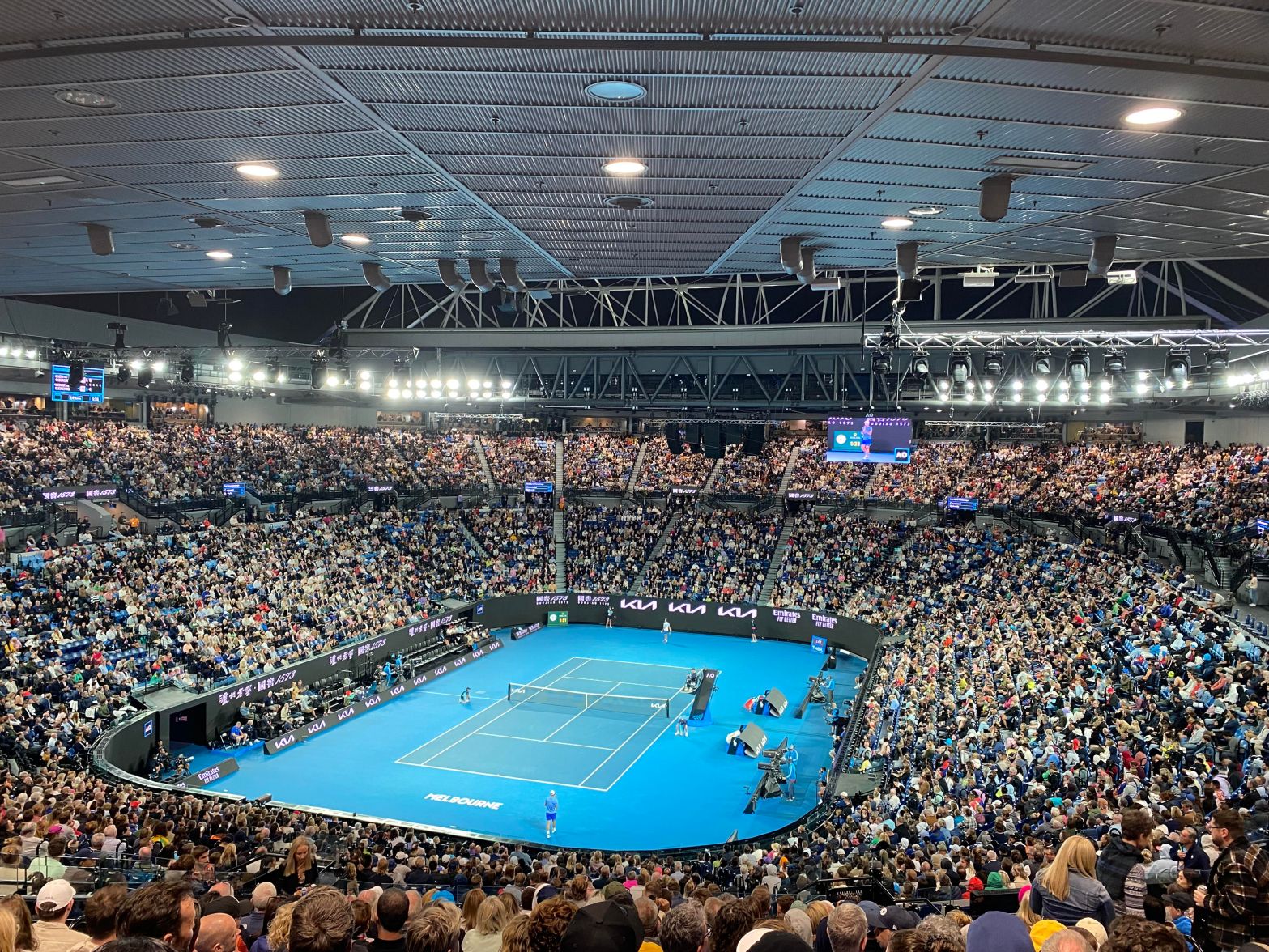
My first impression of the crowd was that there were plenty of Djokovic fans. And there were, but Djokovic’s detractors — and maybe this plays into the narrative that he isn’t popular — are very loud. I sat in front of a row of them way back in the second-highest row on Rod Laver Arena. The people next to me were just fine, one of whom I turned to at the beginning of the match to ask who he was rooting for.

“Djokovic,” he said. That was the end of the conversation. The first set went by in a blur; Djokovic’s opponent, Enzo Couacaud, rolled his ankle badly and lost three straight games after his MTO at 3-1 down. It left me feeling a bit icky — Couacaud had reportedly told the physio he heard something crack in his ankle, and he’d limped badly over to his chair, but he elected to play on nonetheless.

Couacaud actually played quite well for the final three sets of the match, as did Djokovic, despite the Serb’s increasingly obvious discomfort from his hamstring injury. Though physical impairment certainly affects performance in tennis, it always seems to be less impactful than we expect. Rafa Nadal picked up an injury late in the second set of his loss to Mackenzie McDonald that’s expected to keep him out for eight weeks, but Nadal slapped enough forehand winners in the third set to actually make it closer than the first two. And tonight, Djokovic blasted through the final two sets after losing a tight tiebreak, for the loss of just two games. Whatever parts of his game were hampered by the hamstring he made up for by blasting neon missiles with his forehand.

It’s kind of a stomach-turning dynamic, this. Djokovic is so much better than Couacaud, and many others, that he’ll knowingly play through injury because he’s fully aware he can beat them anyway. For all of his struggles tonight, he didn’t lose his serve and he faced just one break point. I have no idea how much worse he made his hamstring injury, but I imagine he’s prepared to sit in a body cast for a month if that’s what it takes to win this tournament. We all remember how Djokovic played through a growing ab tear at this tournament two years ago and waxed Medvedev in the final anyway. He wrecked his body to win, his play being so good that things actually worked out the way he wanted them to. It’s certainly amazing, but I find it hard to watch, imagining what kind of pain he’s putting himself through.

On Djokovic’s dominance at this tournament, I’m genuinely curious what would happen if the same scientists who built the invincible chess and Go bots built a tennis bot and sicced it on Djokovic on Rod Laver Arena. How do you play Djokovic on a hard court? His serve has become near-untouchable. It’s not quite an Isner serve, but I’d almost rather try to break Isner at this point — send a return at the big man’s feet and he’ll snap in two trying to reach down for it, hit the ball onto Djokovic’s baseline and he’ll simply half-volley the ball back before commencing an onslaught of deep groundstrokes. Good returns are no guarantee you’ll win a point against that serve. Then he has the return, the drop shot, the increasingly soft feel at net. In the first round, Djokovic dropped all of three points in the third set against Roberto Carballés Baena. Let me know how they program that tennis bot, because I’d love to see what gameplan it uses. My guess is it’d just play like Djokovic, only its machine-like precision would be literal rather than figurative. They’d probably play a five-setter that lasted ten hours.

Seriously, how do you beat a motivated Djokovic here? If you didn’t watch the match against Couacaud and only saw the scoreline, you’d have no idea whatsoever that he was physically compromised. (The scoreline 6-1, 6-7 (5), 6-2, 6-0 is so very Djokovic.) At the World Tour Finals last year, the 21-time major champion emptied the tank against Daniil Medvedev in the round-robin stage, then was shaking with exhaustion by the fourth game against Casper Ruud in the final. He won anyway, never facing a break point. Some will say he was foxing to set up a rug-pull, but my theory is that he’s just good enough that he doesn’t even need to be fit to beat anyone outside the top two or three in the world.

The row of increasingly disgruntled Couacaud aficionados behind me grew antsier as Djokovic stretched his lead. “Bang!” they’d yell after every shot. “Yes!” they’d cry when a Couacaud lob landed in. Someone a couple rows in front of them told them to shut up. They clapped back at her, asking why she’d come out to the stadium instead of watching on TV.

“It’s just that the players can hear you when you shout during the point,” I tried.

“The people behind us are being loud too!” one of them responded, gesturing to the fans behind a glass partition. “You gonna tell them off?”

“Behind the glass?” I asked. I couldn’t believe they were equating themselves with fans in a sealed-off room. (In retrospect, I half-wish I’d slowly explained that the glass muffled the sound, thereby making those fans less offensive. Though maybe that would have ended badly.)

They repeated that the fans behind the glass were being loud. I gave up after that; any fully grown human being who uses the others are doing it, so it’s okay if I do defense is probably too sloshed to successfully reason with. Interestingly, though, while the row of fans clearly wanted Djokovic to lose, they also clearly understood how great he was. I heard, “how the fuck did he get that back?” more than once. Djokovic’s rifled return winners drew involuntary gasps. One of the hecklers laughed when someone suggested that they settle down early in the second set.

“Why? He’s gonna win anyway.”

With that last statement, at least, I had no argument.

A drunk fan got on Djokovic’s nerves early in the fourth set. Though the crowd was too loud for me to hear his conversation with Fergus Murphy, he was clearly peeved. Injured and irked by drunk fans, a lesser player might have buckled. Djokovic stepped back to the baseline, flung a first serve out wide, then fired a forehand winner into the right corner. If there’s anything I know about Djokovic, it’s that the heat from fans makes him stronger even as it hurts him personally.

*****

After Djokovic ripped a stunning two-hander through the court on match point, I turned back to the guy next to me who had said he was rooting for Djokovic. “Were you ever worried?” I asked him. Sure, Djokovic had won easily in the end, but his physical impairment had been clear in that lengthy second set. I was a little grateful I wasn’t deeply invested in either player’s eventual success; the stress on top of the roiling crowd would have been brutal.

But he laughed and shook his head. “No, no,” he said. “Not until the second week.”

Andy Murray. That’s it. That’s the headline.

By Claire Stanley

Now that I’ve had the chance to calm down, somewhat, sleep and reflect on what happened in Melbourne last night, I’m ready to put my feelings into words.

Andy Murray v Matteo Berrettini may go down as one of my favourite, most exhilarating, most stressful matches in history. There really is no comparison to watching this kind of match live – you feel every raw emotion from the players and everyone around you, the air almost pulsates with energy and the sound is at times deafening.

I lived a thousand lives and died a thousand deaths last night. I couldn’t quite believe what I was witnessing in those first two sets. As ever I went into the match with my usual unwavering belief in Andy’s abilities – I said to multiple people beforehand that he could do it, he absolutely could beat Matteo. He was, after all, due a win after two tough losses in 2022. I figured by now he would have a better grasp on Matteo’s game, know his weaknesses, know what to expose… I wasn’t wrong and in those first two sets Murray did everything right, his tactics were flawless, his first serve had improved and his forehand looked strong and powerful – whatever he was doing with his coach Ivan Lendl was working and Matteo simply couldn’t get a grip on Murray’s game.

By the end of the second set I was almost convinced I would be on my way out of Rod Laver within the hour. I say almost because at the end of the day, I still know this is Andy Murray and anything can happen. And happen it did – Matteo took a short break between the second and third sets and came back out a different player. His aces were, put simply, stunning – the sheer force and power in the way he hit the ball was really something to see. I started to get “a feeling” – not a good one, but a sinking feeling that this wasn’t going to be quite so clear cut as I had hoped mere minutes before.

Throughout those third and fourth sets my emotions mirrored Andy’s – my shoulders slumped every time Matteo hit a blistering ace, usually when Andy had a break point or a chance to put the Italian under pressure. I screamed, roared and fist pumped when he did – he wasn’t done. He wasn’t letting the pressure get to him, he wasn’t losing that belief he could do it. Neither was I.

I could barely watch the fourth set tiebreak and by the time we entered the fifth and deciding set I was a woman on edge, watching through the sheer veil of my Scotland flag, almost using it as a protective shield against what was playing out before me. I had Owen (@tennisnation and Popcorn Tennis editor) checking in on me regularly: are you OK? How do you feel? He can still do this.

The fifth set is still a bit of a blur, I went through it on autopilot, willing Andy to hold his serve like his life depended on it – and hold it he did. There were some huge holds of serve that were crucial but if you ask me to pinpoint exactly which ones there were, I’ll laugh in your face – by the time we were at that point I could barely tell you my own name.

The championship tiebreak: as soon as Andy got the early mini break and consolidated by holding his own, I knew – I knew in my heart – he was going to do this. It didn’t come easy, at 6-2 I thought we were home and dry, and in the blink of an eye it was 8-6. But he refused to lie down, he refused to give up, and the crowd was getting louder and louder. My throat was raw and my voice was hoarse with emotion but I kept cheering him on, convinced he could hear my voice among the thousands. You can do this Andy, you’ve got him, you’re almost there.

And it was match point, Matteo to serve – I knew this was it. I had my phone out, ready to film the moment Murray captured his 50th Australian Open win. The joy – and relief – I felt when I saw that ball bounce off the net cord and fall onto Matteo’s side was also mixed with a moment of sheer disbelief. Is that how it happened? Is that how the match ended? There was a split second of silence – so minute if you weren’t there you probably missed it – before we realised what had happened and the crowd erupted. He had done it.

It still isn’t over. Better never stops.

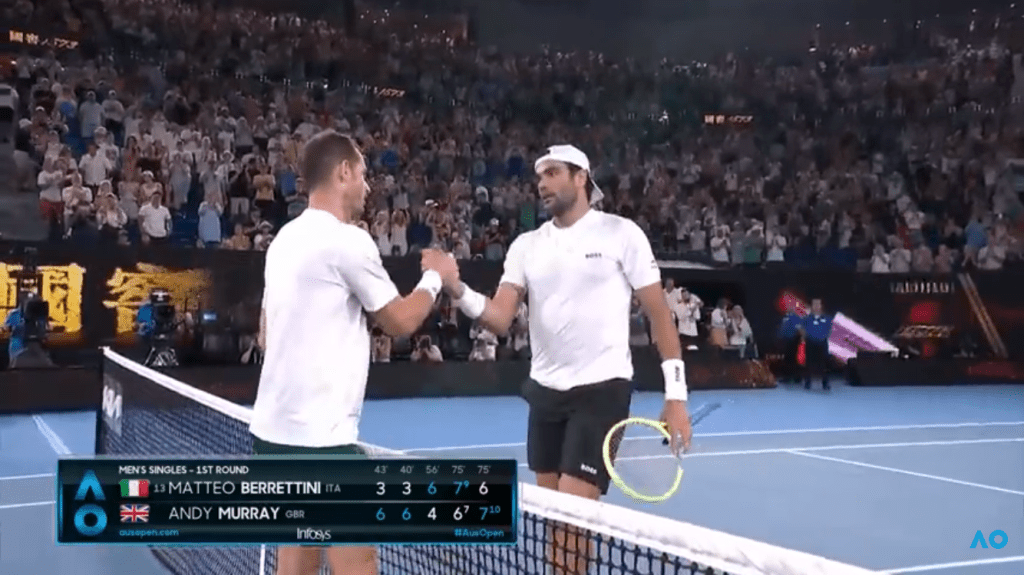
Andy Murray shakes hands with Matteo Berrettini after their epic 5 set encounter in the first round of the Australian Open.. Image: Australian Open Youtube Channel

The Ecstasy of Fandom

Photo courtesy of the author

When Matteo Berrettini chased down a dismal Andy Murray drop shot on match point only to dump an even-more-dismal backhand into the middle of the net, the anticipated Australian Open first-rounder became one of those matches that was certain to devastate one player, regardless of who won. Berrettini had put in the hard yards to come back from two sets down and claw all the way to match point in the fifth, Murray had been two points away from the win in the fourth set. But when Berrettini missed that backhand, he put his heart on the line — after a biffed putaway like that, if you don’t win, the miss may haunt you forever.

I cheered for both players at various points during the match. Murray fan extraordinaire (and Popcorn Tennis contributor) Claire Stanley was also at the match, in a different section, and I wanted a Murray win for her and the other cohosts of the Murray Musings podcast, Scott Barclay and Peter Childs. I’ve never been a Murray fan — his on-court demeanor used to annoy me, and though I admired what he achieved in the thick of the Big Three era, my awe never quite morphed into affection. As I’ve gotten to know Peter, Scott, and Claire, though, I’ve found myself rooting for Murray at times. Their unadulterated love for him is just infectious. Claire and Scott attended Murray’s third-round loss to John Isner at Wimbledon last year (Scott wrote a beautiful piece about it), and with that knowledge I cheered for Murray through the TV screen. I felt hollow when he lost.

But when Murray surpassed all reasonable expectations in this match and won the first two sets quite comfortably, I wanted Berrettini — newfound Netflix star, former Australian Open semifinalist — to at least get his teeth into the contest. While Berrettini eventually did, Murray made it a hell of a challenge. The three-time major champion was razor-sharp tactically, constantly peppering his opponent’s suspect backhand and yanking him wide on the forehand, denying him rhythm on his stronger wing. Time and again, Berrettini went for the improbable running forehand winner and missed. When he turned to the slice defense, Murray was almost always able to retain control of the rally.

Berrettini’s typically awesome forehand was often woeful in the first two sets. I initially thought it was odd how many neutral forehands he was blowing, but then I realized Murray had just forced Berrettini to hit so many forehands on the run that he had lost his rhythm on the rally shot. Early in the third set, Murray had a break point, and it genuinely looked like he might win 6-3, 6-3, 6-3, an astonishing scoreline given the caliber of his opponent.

Then Berrettini pushed back, launching a sustained assault of big serves that lasted deep into the fifth set. It felt borderline unfair how well he was serving at times; Murray was openly frustrated after several of his aces, not because he felt he should have done a better job reading the serve, but because Berrettini was producing the aces so damn readily. I’d say the comeback was awe-inspiring, especially the face-melting fourth-set tiebreak, but I wasn’t really surprised. Berrettini is, after all, the man who beat Carlos Alcaraz in a five-setter at the Australian Open last year. (How long it takes before someone else can beat Alcaraz in five sets, truly, is anyone’s guess.) His serve and forehand are imperious. His topspin backhand sucks, but his slice is good enough to mostly paper over that weakness — he hit some slices down the line today that were positively devilish. He’s a hell of an opponent.

In Break Point, though, the new Netflix docuseries on tennis, Berrettini says his biggest asset is not his serve or his forehand but his mentality. He might be right. He is a special kind of fighter. If you go back and watch the match points of arguably the two biggest matches of his life — the loss to Novak Djokovic in the 2021 Wimbledon final and the loss to Rafael Nadal in the 2022 Australian Open semis — you can actually see his body sag after he nets his backhand (yep, that happened on both match points). It’s not in fatigue, it’s in dismay that he lost. Here’s the thing, though: He wasn’t close to winning either match. In each, he was down two sets to one and down 5-3 in the fourth set to a legendary rival. Especially against Djokovic and Nadal, I’d expect a player to already be processing a loss at that point — the odds of a comeback are essentially nil. But Berrettini reacted like the match points had been his own, not his opponents’. He maintained belief that he could win until literally the last second.

After losing match point to Murray in almost comically tragic fashion — a sliced forehand return from the Scot caught the net tape and fell over to Berrettini’s side — Berrettini simply stood stock-still for a moment, like he couldn’t believe what the universe had just done to him. I couldn’t either, and though I started cheering maniacally for Murray on instinct alone in the fifth set and didn’t stop until after the match, I was gutted for Berrettini.

The camera only shows you Berrettini’s reaction for a second, but it tells you all you need to know.

*****

Rooting for a tennis player, any of them, is an inevitably painful road. Such is the nature of the sport that, sooner or later, they will suffer an excruciating loss. Your favorite player will probably get their day in the sun too, but there’s a lot of agony on the road to glory. Even fans of Novak Djokovic — probably the player with the fewest heartbreaking losses out there — have their demons. There were the missed overheads in the 2008 Olympic semifinal and the 2013 Roland-Garros semifinal, the close losses to Stan Wawrinka at majors. When you live and die with your player, you’ll end up dying a few times, no matter who they are. Claire even wrote, wonderfully, about one such death at the start of 2022.

What impresses me the most about tennis fandom is that most aficionados seem to be incredibly loyal despite the pain. They stick with their favorite players through and through. Jethro Broughton, another friend (and another Popcorn Tennis contributor) also roots for players in a way that’s so affectionate it rubs off on me. His favorite players are Nadal, Dominic Thiem, Diego Schwartzman, and Sebastian Baez, which means Jethro has had a miserable time as of late — Nadal hasn’t won consecutive matches since Wimbledon, Thiem is still miles away from his 2020 form, Schwartzman is in a rut, and Baez is on a horrendous losing streak.

But none of that stopped Jethro from putting his heart in the hands of his favorites in the first round of the Australian Open. I asked him to message me throughout Schwartzman’s match today so I could get a sense of how he processed the Argentine’s successes and failures. Here are some of his texts, printed with his permission:

“God I actually feel sick with nerves for Dominic [Thiem] and Diego”

“Omg [Schwartzman] just hit an absolutely insane backhand winner at the smallest of angles”

“I’m fucking stressing”

“Fucking EMBARRASSING…5-0 and 6-3 [ahead] in the tiebreak and [Schwartzman] loses [the set]”

“Had an easy put away forehand on set point and missed it”

“Shambolic”

At the end of the second set

“I’ve calmed down”

“He’s done it [five crying emojis]”

“I’m so fucking relieved”

“I could CRY”

Post-Schwartzman’s win

This was over the course of a few hours. And remember, this was a first-round match. Being a tennis fan is a fucking rollercoaster of emotions. Unlike other sports, your favorite player can suffer a devastating loss every week, and Roger Federer fans who experienced the 2019 Wimbledon final can tell you that there’s really no limit to how shattering a loss can be. And yet, fans solider on, because the highs are euphoric. The manic experience mirrors that of the players’ in some ways; during episode three of Break Point, Paula Badosa discusses both her tennis-induced depression and the drug-like addictive nature of the sport. After Schwartzman sealed his win in four sets, Jethro told me that he wasn’t going to celebrate in our group chat until after Murray-Berrettini ended, because he knew people were losing their minds over the match. Tennis fans get each other.

It’s tennis’s duality that makes it unlike any other sport I’ve seen. The scoring system can be an angelic hand to one player at the same moment it squeezes the life out of the other player’s heart. Murray’s elation was Berrettini’s misery today; the Venn diagram is a circle. There were moments when Murray looked the likely tragic hero, Berrettini the gritty victor, but while tennis keeps you in suspense (does it ever keep you in suspense), it also makes absolute judgments. By winning the match, Murray now has a wonderful night to look back on for the rest of his life. For Berrettini, though? He fought extremely well and played three excellent sets after losing the first two. But the structure of the tour renders that irrelevant. The cold facts: Berrettini was the 13th seed and a 2022 semifinalist at the Australian Open. Losing in the first round this year is a massive underperformance that will see him lose a bunch of ranking points. The fact that he almost pulled off a miracle comeback doesn’t change the fact that he’s about to fall out of the top 20. Though Berrettini can and should be proud of his effort tonight, let’s be honest, he isn’t going to find solace in how hard he tried. This kind of resilience, impressive as it was, is nothing he didn’t already know he was capable of.

*****

Despite Murray’s eventual win, my most viscerally emotional stretch during the match — and I think what will be my strongest enduring memory from the evening — was early in the fifth set when I came to grips with the possibility that Murray could actually lose. I didn’t want to imagine how sad it would make my friends after all their hopes and belief in Murray, and especially after he had built a two-set lead. I was messaging Claire throughout the match, and in the fifth set I had no idea what to say to make the match less stressful. There was a good chance Berrettini would complete the comeback, and if he did, it would be devastating to Murray and his fans.

I spent the deciding set in full Murraynator mode, yelling for the Scot after virtually every point he won. It’s as vocally as I’ve ever cheered for a player, and again, I have no deep personal wells of affection for Murray. I just noticed I had a desperate desire for him to win early in the fifth set. I don’t think you choose these things. A few games into the fateful stanza, I recognized Claire sitting a few sections over, having not known where she was sitting previously.

“Claire I see where you are now,” I texted in a group chat.

“Oh you can see the crying girl with the Scotland flag,” she responded. “That’s good.”

Blink and You’ll Miss It

I fell down the stairs on my first day in Melbourne, on my very first trip out of the hostel. I had dropped off my bag a few hours before my check-in, then, brimming with a glorious sense of possibility, went down the stairs to explore the city a bit and my feet immediately went out from under me. I was sliding down the stairs on my butt before I could even process that I had lost my footing. Though the most severe injury was to my ego, hardly a good omen for my time in Australia.

Jessica Pegula doesn’t have room to slip, at least not in her first few matches at the Australian Open. She has found herself in a place where she’s so good that it shouldn’t be difficult for her to win opening-round matches, but she’s also so good that she has to win opening-round matches to live up to expectations. Forget about the first round, actually — given her great 2022 and her recent destruction of world number one and title favorite Iga Świątek 6-2, 6-2 at the United Cup, is anything less than a title at the Australian Open is going to sit well with Pegula? Just imagine the pressure she must feel early, say, before the quarterfinals. (She’s yet to make a major semi.) If she plays well and beats a few lower-ranked players comfortably, great, fine, it’s what she’s supposed to do, now let’s see if she can replicate that electric defeat of Świątek. If not? She’s wasted a fantastic vein of form by not performing her best at one of the biggest tournaments in the world.

I wrote about this dynamic when Świątek was powering her way to the Roland-Garros title last year. She had it even tougher — after becoming a runaway world number one and winning five big tournaments in succession, all the expectations were that she would win a sixth. If she didn’t, despite a winning streak of over 30 matches, all those titles would go out the window in the eyes of many, since she didn’t win the major. Really, all a favorite has to gain in an early round is entrée to the next round, where the stakes are slightly higher. A top player usually doesn’t need the prize money, nor do they need the ranking points. The late rounds are the only place they can add to their legacy with a single match. It’s all about getting there.

The pressure of this must be immense. The best way I can relate (and I doubt this is anywhere close to as hard as what tennis players do) is through taking a class in which the final exam counts for something like 70% of the grade. You do your best on participation and small quizzes, but with every good grade you’re reminded that none of it matters unless you ace the big one. All the early success is necessary but not sufficient. You’re constantly on edge.

The plight of the underdog is even worse. Pegula’s opponent in the first round of the Australian Open, Jaqueline Cristian, was likely playing primarily for the prize money and ranking points that are of little consequence to Pegula herself. (Not only does Pegula have millions in prize money, but her parents happen to own multiple professional sports teams and are very rich.) At 161st in the world, Cristian was looking to reclaim the heights she achieved in late 2021 by taking another scalp of a top player. The trip to Australia is long; a win, even in the first round, could make it worth the all the air fare and nerves and days spent training in the hot sun and nerves and frustrations and nerves (did I mention the nerves)?

Tennis matches don’t last very long, in the grand scheme of things, and the stretches that decide the winner and loser are even shorter. Hopes and dreams are either fulfilled or quashed by a couple forehands and backhands. The challenge of a match is twofold: You have to develop your game to the point that it’s better than your opponent’s, and then you have to manage your emotions well enough to give your game the chance to prove decisive. If your backhand is off early on, or if your arms are trembling, even in the first few minutes, you might already be screwed. For all the mental training tennis players put themselves through, I think a lot of professional tennis is about playing on instinct and hoping the adrenaline and endorphins wash away the anxiety.

Unfortunately for Cristian, it was clear within two or three games that Pegula had so many technical advantages that everything else seemed almost irrelevant. Sitting up in the stands, the greater weight of Pegula’s groundstrokes was evident even in the warm-up. She hit the ball harder and deeper, while one of every three or four of Cristian’s groundstrokes would drop short. (Not a massive difference, but fatal against a top player.) Cristian did what she could with the tools she had — she won a few points with what seemed like her best shot, the backhand down the line — but it was an uphill battle from the opening point.

Though the match was over in 59 minutes, it must have felt like longer to Cristian, adrift as she was on the ocean-blue court. She never seemed to throw in the towel, it was just that she didn’t have the firepower to make a meaningful impact on the match. Twice she hit aces on her second serve — but Pegula went on to break her both times. Cristian picked up on the fact that Pegula hit virtually all her putaway shots to the forehand side, reading several of them successfully — but she went on to lose most of the points anyway.

It can be a desolate place, the first round. Losing is obviously the worst-case scenario, but even winning doesn’t guarantee much. In 2016, Fernando Verdasco beat Rafael Nadal in a four-hour, 42-minute first-round epic at this very tournament. Not only did he exact revenge from their incredible 2009 semifinal, but he really played fantastic tennis — he hit so many blistering forehands in the fifth set that even Nadal was helpless by the end, losing six straight games. In revisiting the highlights, Verdasco’s level feels meaningful, like he had a real shot to go deep in the tournament. His businesslike celebrations after the match suggested he felt the same way. But he lost meekly to Dudi Sela in the second round. Story over.

*****

Though winning this match is a necessary piece in Pegula’s path to the title, it’s nothing more than the first of seven stepping-stones. Pegula was already talking about getting ready for her next match during her on-court interview. Cristian left the court quickly. The crowd appeared to sympathize with her, at least to my ears. I caught myself rooting for her early. Sometimes the pain of a loss comes not from surprise but from mourning what could have been gained with a win, and here she was leaving the tournament with very few positive takeaways. (I doubt Cristian will find solace in this, but when she held serve in the middle of the second set to seal what would be her only game of the match, the crowd — and this is to say nothing of Pegula’s popularity — cheered louder than it did after match point.)

It was all over very quickly. I’m staying in a six-person room in a hostel, and got along with my roommates better than I expected on the first day — I’m one of those introverts who needs to be adopted by an extrovert to truly have social success, otherwise I can’t initiate conversation. I was fortunate to be in the room at the same time as a couple friendly chatterboxes late in the evening, then went to a bar with one of them and one of their friends (who asked me, upon hearing I lived in the U.S., if I had ever experienced a school shooting). When I went back to the room early to sleep off the jetlag, someone else came in and told me people were fucking in the bathroom. We chatted for a few minutes. I asked who he was rooting for at the Australian Open; when he mentioned Ash Barty, I didn’t have the heart to tell him she had retired early last year. When I went to sleep, I felt good about the connections I’d made.

I went out at nine in the morning on my second day, before anyone else had woken up. I knew, somewhere in the back of my mind, that check-out at the hostel was always at 10 a.m. and that one of the people I’d gone to the bar with was checking out that morning. But when I got back around noon, I still jolted when I saw four of the six beds had been stripped and the room was empty.

Six Players to Watch Down Under

By Brandon DeMuro

As we take a look at the landscape of the world of professional tennis, one thing is certainly clear: There is a definite changing of the guard when it comes to the top of the men’s and women’s game. No more are the days of Federer, Nadal and Djokovic being the front runners in every major — while Nadal and Djokovic still battle on, there are now more contenders vying than ever before. In regards to the women’s tour, even though Iga Świątek is the number one player in every sense, there is still a wonder as to who is going to win these majors. Sure, Świątek is the favorite – and she deserves to be – but several of her peers possess the dazzling peak level to beat anyone on their day. 

But aren’t Novak Djokovic and Iga Świątek the overwhelming favorites? Yes, but that doesn’t necessarily mean we will see them lifting their respective trophies in two weeks’ time. There is a deep cast of players you can look at and say yes, I can see that player winning or that player seems primed to win their first major. We have gotten used to seeing players like Stefanos Tsitsipas, Daniil Medvedev, and Dominic Thiem (once upon a time) making major finals and establishing them as fixtures at the top. In the women’s game, several players frequently make deep runs, like Coco Gauff, Aryna Sabalenka and Maria Sakkari (though it seems when the finals of a major roll around, you tend to see someone there for their first time).

With any major you always have players that come out of nowhere, making a deep run, changing the course of not only their season but possibly their careers. Here are three men and three women that I think can make a deep run down under and cause some noise in Melbourne. Of course, these are predictions and predictions usually go wrong but in sports, anything can happen.

Frances Tiafoe battled his heart out at the 2022 U.S. Open in a five-set marathon with the current world number one, Carlos Alcaraz, who will miss the year’s first Grand Slam due to injury.  It was a heart-breaking defeat for Tiafoe, whose charisma and easygoing nature had won him the support of the New York crowd. How can you bounce back from something like that? Frances just has to be Frances. Tiafoe is a high-energy player whose joy is palpable every time he takes the court – if he can maintain that liveliness, he’ll be just fine. Tiafoe is projected to play Nadal in the Round of 16, which, given Tiafoe’s win over Nadal at the U.S. Open, seems like a prime opportunity for Frances to take out the Spaniard. Nadal has not had the best start to his season, looking like a shell of himself early on, and for him to make another magical run down under seems unlikely (but then again, so did last year’s run).  Definitely keep your eyes glued to your televisions, phones, computers, however you consume tennis and watch out for Tiafoe in this tournament. We could definitely be seeing him in the final four again.

Qinwen Zheng was the WTA Newcomer of the year in 2022. Her most notable match had to be in Paris, Zheng took a set off all-conquering force Iga Świątek. If Zheng hadn’t had the misfortune of struggling with menstrual cramps later in the match, the contest could have been even closer. Zheng suffered an injury in Adelaide against Kvitová but as long the injury doesn’t linger or nothing too serious, Zheng is definitely someone who could make a deep run at this tournament. She could potentially draw one of the favorites, Coco Gauff, in the third round and then if Zheng reaches the quarters a rematch with Świątek awaits. She is definitely one of the players I’ll be watching out for in Melbourne.

Zheng after beating Anett Kontaveit in the first round of Adelaide. Screenshot: WTA

Sebastian Korda just recently gave Novak Djokovic all he could handle in Adelaide last week, even having a match point against the all-time-great. Korda doesn’t have the easiest draw, potentially drawing 2022 finalist Medvedev in the third round. As the Adelaide battle with Djokovic and Korda’s win over Carlos Alcaraz in Monte-Carlo last year show, Korda doesn’t shy away from going against the world’s best. Medvedev has only played Korda once, back in 2021 at the Paris Masters, which was a three-set victory for the Russian. I’m not saying I think Korda will beat Medvedev if they play, but it’s far from out of the question. Korda has proved that he can hang with the world’s best and he is definitely someone to watch out for down in Australia.  Heck, Sebastian’s Dad, Petr Korda, won the Australian Open back in 1998, it’s the 25th anniversary. Maybe it’s time for another Korda to make some noise.

Maria Sakkari is the sixth seed in this year’s tournament. You’re probably asking, “hey, didn’t you mention Sakkari as one of the more consistent players earlier in this article?” (Yes, and I’m glad you’re paying attention!) But I do think it’s worth mentioning that I am looking at Maria Sakkari to possibly go on another deep run in a major. She has made the fourth round twice in Australia and back in 2021, she made the semifinals at both Roland-Garros and the U.S. Open, so she is definitely a contender for the Australian Open. Sakkari does potentially draw one of the favorites, Jessica Pegula, in the quarter-finals. I personally think Pegula would win that match up based on how she has looked early on in the year but Sakkari definitely has the game to win. Sakkari definitely has more experience getting to the tail end of majors over Pegula. Even though Pegula has made the quarters at all the Grand Slams except Paris, Sakkari has gone one step beyond that. Look out for Sakkari to be around towards the end of the tournament yet again.

Jack Draper is an interesting player at this year’s tournament. I say that because he draws the defending champion, the number one seed, Rafael Nadal.  Now, why would I say Draper is a player to keep your eye on? Well, Draper has been playing some really good tennis to start the year, defeating Karen Khachanov in Adelaide last week and although he lost to Soon-Woo Kwon in a three-set battle, Draper has been making noise for the last couple of months. He beat Felix Auger-Aliassime en route to making the third round at the U.S. Open last year. I think a lot of experts are looking at that Nadal match as a potential early upset for Rafa. It will definitely show how much (if at all) Nadal has improved since his poor start to the season.  If Draper can catch Nadal on a bad night in Melbourne, we could be seeing the young Brit go far in this tournament.

Veronika Kudermetova made the third round of the Australian Open last year and reached the quarter-finals in Paris. Now, even though she had to withdraw from her semi-final clash in Adelaide against Belinda Bencic due to a left hip injury, the hope is that she will be ready to go come match time in Melbourne. She played well in the fourth round of the U.S. Open against eventual finalist Ons Jabeur so she knows how to take it to the top stars of the game. She posted an impressive state line serving against Victoria Azarenka in Adelaide, with 20 aces to only 3 double faults.  If Kudermetova puts serving numbers like that up in Melbourne you could be looking at her making a deep run at the year’s first major. The only issue is the hip injury and the severity of it.

***

There are so many variables when it comes to who eventually lifts the trophy at the end of a major tournament. Between Injuries, weather delays, and everything else, anything can disrupt someone’s rhythm and completely change the trajectory of any match.  That’s what makes this sport such a joy to watch. Of course you have the top of the field and their elevated likelihood of being there at the end of the tournament, but upsets happen in every single tournament. I can guarantee there will be moments at this year’s championships we will be talking about for years and years. Get ready for one heck of a ride, buckle up, and let’s enjoy these two weeks Down Under.

Roundtable: Feelings Ahead of the Release of Break Point

Screenshot: Netflix

Tennis fans may be optimistic or pessimistic regarding the impending release of the first five episodes of Break Point, a tennis-based docuseries on Netflix, but practically all of us are certainly aware of it. While the series is aiming at potential tennis fans rather than existing ones, those who already follow the sport inevitably have hopes and expectations. A few of our writers recorded their thoughts below.

Peter Childs: I for one am incredibly excited to see the Break Point series document several tennis players’ movements on tour. I got to see a few of the Netflix crew trail Taylor Fritz and Morgan Riddle among others at Indian Wells. This doc will help grow the game and make more people who don’t usually watch tennis get excited for new personalities, much like I got into F1 after watching Netflix’s series, Drive to Survive. Any coverage is good coverage. Let’s go!

Hanya El Ghetany: I’m excited to see that tennis is getting the glam it deserves. It will really be interesting to know if the series ends up increasing the size of the tennis fanbase or having a counter effect. I’m not sure if it will add anything to current fans’ experience besides maybe some behind-the-scenes action and getting to know the players more off the court.

Vansh Vermani: I’m excited for the docuseries as a fan of tennis. There’s no doubt that narratives will be exaggerated and hyperboles will be made, but ultimately this series isn’t made for diehard tennis fans who follow the tour week in and week out. It’s about introducing new fans to the sport and showcasing the future of tennis, not to mention to allow fans more insight into players’ raw emotions, and behind-the-scenes access to routines, feelings, and expectations. It’ll be interesting to see how the sport is showcased from a unique and different angle.

Owen Lewis: I’m a little concerned. Though it wasn’t a surprise, I was disappointed to hear that the series sensationalizes certain parts of the tour (like Nick Kyrgios winning a major in doubles) and diminishes others (Iga Świątek’s 37-match winning streak isn’t mentioned in the first five episodes). As someone who thinks simply watching a tennis match is enough to become interested, I’m selfishly hoping that the sport I know and love isn’t distorted too much in an effort to appeal to casuals. If you run into me at some point in the next couple weeks, you may find me feverishly repeating, “I am not the target audience.”

Ashlee Woods: As someone who has been campaigning for the evolution of tennis coverage, this is a good start. I’m upset that it’s not offering much outside of what I normally know, but it’s not geared towards tennis diehards. Eventually, tennis will need documentaries that dive deeper into the world of tennis. But, as an introduction, I’m okay with this and I hope it’s a success.

Myles David: I truly do love the initiative the producers have taken to show off the sport to a broader audience and introduce athletes to players who may not be house hold names yet. The major stakeholders in tennis seem to have rallied around the series (getting this much player access is quite the feat) and want to see it do well. I just hope it breathes some sort of new life into the sport because I’ve seen so many people just causally blurt out something to the effect of, “I really don’t care anymore now that Serena and Roger are done.”

Jethro Broughton: I’m honestly not too bothered about watching Break Point, though I’m sure I will at some point when I feel like it. From what I’ve heard from journalists who’ve watched it already, it won’t offer much to me that I don’t already get out of tennis. And the big Kyrgios focus is off-putting to say the least.

Archit Suresh: I’m curious to see what kind of impact Break Point has in terms of making tennis more of a mainstream sport and what kind of changes to both coverage and inside access it brings to the table. I always love getting any kind of inside look at players given how little tennis is promoted compared to most major sports, but from what I’ve gathered I also know that I’m not the target audience for this as someone who’s invested in daily results of Challenger events and hopes to work in the sport. I’m a bit concerned with directions they’ve chosen not to go in (or not been allowed to go in) but I’m relatively optimistic that this is something tennis desperately needs and is ultimately good for the long term growth of the sport in a post Serena/Big Three world.

Five Takeaways from the First Week of the Australia Swing

By James Steel

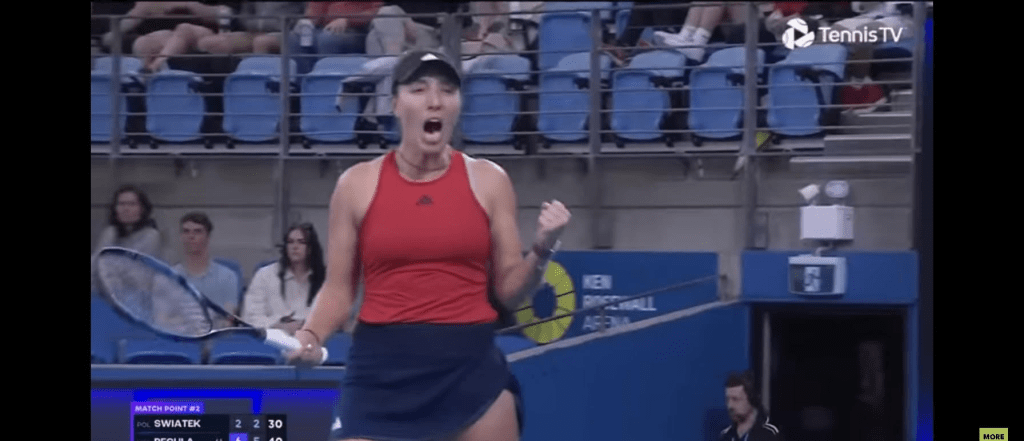
Jessica Pegula celebrates after scoring an improbable win over Iga Świątek with a flawless performance. Screenshot: Tennis TV

1. Challengers to Iga Świątek are emerging

Aryna Sabalenka cruised through her WTA 500 final in Adelaide to pick up the title. It’s been a very good week for the world number 5 with victories against Samsonova, Vondroušová, Begu and finally Noskova (more on her later). Sabalenka didn’t drop a set on the way to the title and showed that on the fast Aussie hard courts she is flying high and has her sights firmly set on the AO title. With a strong 500 win of this magnitude, Sabalenka is off to a good start in 2023. Between this title and her win over Świątek at the WTA finals (6-1 in the third set, no less), the world number one may have a rival in Sabalenka this year. 

Jessica Pegula also looks set to challenge Świątek for some big titles this year. Though Iga wasn’t at her best in their United Cup match, the way Pegula dismissed her was something to behold. Pegula’s performance had everything: return winners, shots on the run that clipped the baseline, massive forehands to equal Świątek’s own. Pegula will have to adapt her gameplan to fit different conditions, but on the quick court, she played near-perfect tennis. If she can reproduce that level, even an in-form Świątek could struggle. 

2. A dangerous dark horse emerges

A new dark horse has emerged in Adelaide that many players will want to avoid in the Australian Open draw: Linda Noskova, a young Czech player (where have we heard that before) whose big ball striking and emerging net game managed to take out Daria Kasatkina, Claire Liu, Victoria Azarenka and Ons Jabeur from the Adelaide draw. All these victories came in impressive fashion and showed a level well above Noskova’s world ranking of 102. The only glimmer of light for the tour is that Linda has to go through Australian Open qualifying next week to get to the main draw. 

3. Consistent Coco

Over in the city which never stops raining, Auckland saw Cori Gauff pick up her third career title in a very rain affected week. The draw wasn’t nearly as strong as Adelaide (due to it being a 250 rather than a 500 and being much further away from Melbourne) but Coco showed that she can see off the players that she should beat in fairly convincing fashion. Given that Gauff was one of the first major shocks of the last AO and she’s made her first major final in the past twelve months, the chances of another early upset seem minimal. 

4. Djokovic feels the love

A lot was written and talked about how the Aussie crowd would react to Novak Djokovic’s return down under. Well, if the response in Adelaide was anything to go by, the reaction will be overwhelmingly positive. Crowds of well wishers squashed themselves into any area of the tournament to watch the 21-time grand slam champion, even for his doubles match. Novak managed to use this energy to help him get some good victories over Quentin Halys, Denis Shapovalov and Daniil Medvedev before probably the most gripping 250 final we will see this year against Sebastian Korda. The Serb saved a championship point in the second set, the 16th time he has saved a match point en route to victory, and the eighth time he’s done so in a final. With his 92nd (yes, 92nd) title under his belt, the nine-time Australian Open champion looks primed to make it ten in a couple weeks. 

5. Fritz and Norrie hit the ground running

Taylor Fritz and Cameron Norrie were a regular of the worldwide exhibition circuit during December and the matches they played there have seemed to have allowed the two players a running start in Oz. Both players put on their national jerseys in the United Cup and showed consistent lights-out tennis. Fritz managed to win all but one of his matches, getting wins over the likes of Matteo Berrettini, Hubert Hurkacz and Alexander Zverev. Norrie, quality of opponent-wise, went one better, getting two back to back top 10 victories over Nadal and Fritz and seeing off his good mate De Minaur in Alex’s back garden. Both players are well-positioned for a strong run in Melbourne.

Next week more stories can be told. AO qualifying, another round of WTA and ATP events in Adelaide, ATP Auckland and WTA Hobart come to the Aussie summer swing. Let’s see who else can write themselves into the minds of tennis fans and journalists alike for the Australian Open. 

Two Ways to Look At Denis Shapovalov’s Loss to Novak Djokovic

Denis Shapovalov just lost to Novak Djokovic for the eighth time in eight matches. The match’s scoreline, 6-3, 6-4, was not close, but the contest itself felt tight. Shapovalov, as in some previous matches against Djokovic, had opportunities to build leads and was largely unable to capitalize. He made some bad errors, including a big handful of double faults, but he pushed Djokovic — not an easy task on an Australian hard court. The match took almost two hours, a rarity for a straight-set match without a tiebreak. Shapovalov broke Djokovic’s serve after trailing 40-love in the second set. The loss is not without positive takeaways.

After a match like this, in which Shapovalov showed plenty of reminders of his skill and potential but fell ultimately (and significantly) short, both the angel and devil sitting on his shoulders would have a lot to say. You played pretty well! Yeah, but are you ever going to beat this guy? Neither approach is necessarily better than the other, in my opinion, but I think you can be optimistic about Shapovalov’s performance or come down on him pretty hard for it, and you could make some strong points either way.

The good

Look, Djokovic is a terrible matchup for Shapovalov. The 21-time major champion’s peerless defense is anathema to Shapovalov’s risky (if explosive) aggression. Shapovalov would not have double faulted nine times against any other opponent, nor would he have biffed an easy backhand volley on a vital point at 4-all in the second set. Not that this result should be asterisked, but Shapovalov would have had an easier time against any other opponent in the world. It’d be harsh to fault him for losing to his principal tormentor.

Despite the lopsided head-to-head, Djokovic clearly took the match seriously from the outset, which is a compliment to Shapovalov. The Serb is prone to bouts of lackadaisical play in many of his matches — but, crucially, he only indulges in them when he can afford the dips. In this match, he was sharp immediately, dodging a pair of break points in the opening game, then another at 2-all in the first set. Though Shapovalov scored a body blow in the second set by going up 4-3 after being down a break, Djokovic duly responded with a quick hold and a break at 4-all. The fact that Djokovic didn’t let go of the set speaks to the idea that he didn’t think he could afford to give Shapovalov an inch.

Shapovalov’s highlight reel from this match is nothing to sneeze at, either. He played some incredible defense, which I think is an underrated part of his game — he’s a great mover, and he’s rangy, so he covers the corners really well. He slides confidently, helping him explode back out of the court’s nether regions when his opponent drives him there. And I’ve never really seen him gas out, at least not in the past couple years — he can defend like this for hours if he needs to. He hit a half volley on break point at 4-all in the second set that made me gasp. He blistered a few massive forehands. Even against the smooth wall that is Djokovic’s tennis, Shapovalov’s game found a few footholds.

This match had more than enough reminders that Shapovalov is a damn tough opponent at his best. There’s the huge serve, the athleticism, the heavy groundstrokes. He’s a great fighter: With Djokovic serving at 3-2, 30-love, Shapovalov erred to end a rally and started berating himself. I thought he was wasting his energy, Djokovic never drops serve from 40-love up. But Shapovalov dug in, banged a couple winners, and got the break. The return of serve is often a mess, but everything else is often great enough to make up for that hole in his game. And when he does have a good returning day? No one is safe.

Tellingly, this video came out more than two years ago, and Shapovalov has hit a lot of amazing shots since.

Shapovalov is a former quarterfinalist at the Australian Open, where he pushed eventual champion Nadal to a fifth set in 2022. He has experience against Djokovic on the big stage. He’s taken part in 20 main draws at the slam events; his body of work is extensive enough that he knows everything he needs to win a big title. And if he needs more time to figure it out, that’s fine — he’s only 23. He’s not going to beat Djokovic at the Australian Open, but if he plays his best, I could see him taking out virtually anyone else. With two victories under his belt prior to the loss to Djokovic, his 2023 is off to a solid start.

The bad

Shapovalov’s rivalry with Djokovic, though it showcases some impressive moments for the Canadian, also highlights his struggles to improve. In their very first meeting (at Djokovic’s backyard in the Australian Open), Shapovalov managed to win a set. He’s yet to do better in a rematch, and he’s had seven bites at the apple since that initial meeting. His return of serve falls to pieces sometimes, but even when it holds up, he can’t convert enough of his break points — he’s 7/29 against Djokovic in total, and 4/22 in his last three matches with the Serb. Shapovalov was the better player for the first six games of today’s match, worming his way into two Djokovic service games without facing a break point himself. Then his serve went haywire at 3-4 and he coughed up a break via three double faults. If Shapovalov hasn’t managed to iron those wrinkles out of his game against Djokovic by now, will he ever?

There’s a temptation to say Shapovalov will figure things out eventually, purely because he’s so clearly skilled, but I’m not convinced. He hasn’t done the best job of learning from his mistakes in the past. In the quarterfinals of the 2020 U.S. Open, he beat Pablo Carreño Busta 6-0 in the fourth set to force a fifth. Carreño Busta had been struggling physically, and Shapovalov seemed surprised and unprepared for a fifth-set resurgence. He lost the decider 6-3. Then, prepared with a nearly identical scenario at the 2022 Australian Open — Shapovalov had forced a fifth set against a diminished Rafael Nadal — he again folded in the decider. This was worse than the U.S. Open loss; Shapovalov didn’t have the excuse of it being his first major quarterfinal, or his first big match against a legendary opponent. He had even beaten Nadal before. But despite Nadal playing fairly tamely (his five winners and three unforced errors suggest he wasn’t trying to force the issue) in the fifth set, Shapovalov made 13 unforced errors and lost it 6-3. He may have logged a lot of time on the ATP Tour, but his notes are a little all over the place.

It’s not difficult to argue that the defining trait of Shapovalov’s career so far is inconsistency. He’ll have a great win or a great run, then he’ll crash for a while. He made the semifinals of Wimbledon in 2021, lost a high-quality, tight match against Djokovic in which he played like a top-five player, then lost four of his next six matches. He beat Nadal in Rome last year, then, inexplicably, suffered six defeats in a row at a time when he should have been buoyed by momentum. It’s not ideal for anyone to follow up a big win with a losing streak, but for a top-20 player, it’s especially hard to find an excuse. And I can’t give him a pass for being young — he’s just 23, yes, but he had his breakout when he beat Nadal in Montreal in 2017, over five full years ago. His ranking steadily rose from just outside the top 50 to #10 in late 2021; it’s since regressed to #18. He’s had ample time to get used to the grind and demands of the tour, and he just doesn’t seem to be improving much.

Consistency is at the core of most great tennis players. Shapovalov doesn’t have it, and until he gets it (if he gets it), he’ll continue to amaze occasionally while underachieving the rest of the time. At this point, Shapovalov doesn’t need to beat Djokovic to show improvement, he just needs to keep his game from imploding for more than a few weeks at a time. Had he won today’s match? I’d have no way of immediately proving it was more than a flash in the pan.

Change is Coming

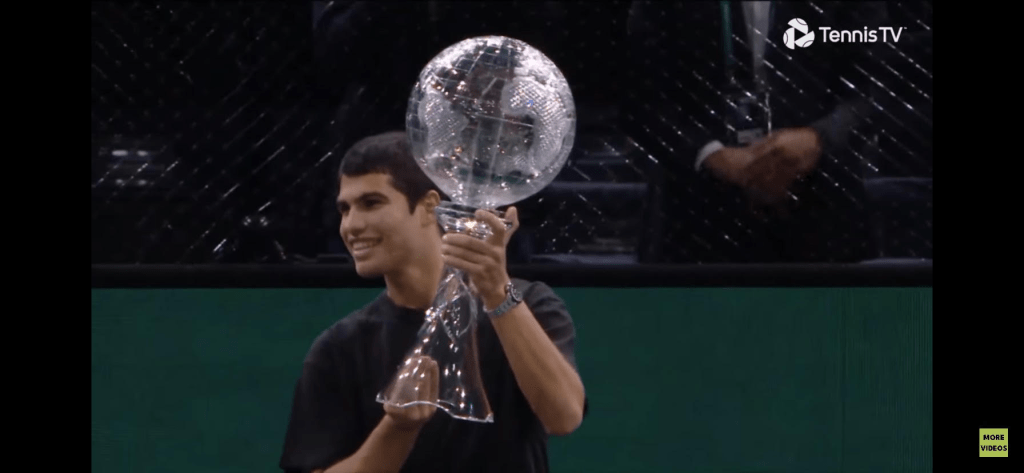
Carlos Alcaraz lifts the world #1 trophy. He is the youngest-ever ATP player to claim the honor. Screenshot: Tennis TV

In February, I wrote about Andrey Rublev. Specifically, I wrote that I was concerned for his future on tour — he hadn’t shown much improvement over the past few years. He had made his first major quarterfinal in late 2017, and though he took part in more major quarterfinals over the next four-plus years, he was yet to win a set in one. (He has now, having taken two sets off Marin Čilić at Roland-Garros this year, but still hasn’t broken through to the semifinals of a big one.) The Big Three have pioneered an ongoing era that makes improving constantly uber-important — if you don’t do it, someone else will, then they’ll start beating you and pass you in the rankings. Even if you’re on top of a rivalry, unless you look for ways to tighten your execution, players will figure you out. Just ask Daniil Medvedev, someone who Rublev used to have fits against, but has managed to win his last two meetings with. Sometimes the fun times slip away before you know how good you had it.

The problem’s not just that you have to improve to get to the top, it’s that you have to improve a lot. Rarely is it enough to turn a glaring weakness into a slight one. Take Casper Ruud, one of the tour’s most improved players in 2022. Not too long ago, his backhand was a big hole in his game. He would over-spin the shot and hit it high over the net, meaning he couldn’t hit the dangerously flat backhands you see frequently from Novak Djokovic. Spin and net clearance aren’t bad things, but Ruud’s backhands also tended to lack depth — his backhand wing produced a lot of innocent mid-court shots that served as cannon fodder for an opponent’s forehand. Ruud’s backhand is way better now. He hits those flat winners down the line much more often. But in two of the biggest matches he played this year — the Roland-Garros final against Rafael Nadal and the ATP Finals title match against Djokovic — his backhand still wasn’t good enough. His legendary opponents peppered that side of the court over and over until Ruud dropped the ball short or missed altogether. And though Djokovic and Nadal are as difficult as opponents get, and Ruud’s backhand might not seem like a liability at all against virtually anyone else, it’s those who ruthlessly expose weaknesses who stand in the way of big titles more often than not.

Much was made at the time of Ruud idolizing Nadal too much, to the extent that it hurt his chances to win the final, but the biggest reason why this match went the way it did is that Ruud’s backhand never forced him to do anything more than hit decent crosscourt forehands.

Like I said, Ruud has actually done a great job of improving this year. He made a Masters 1000 final, two major finals, and ascended all the way to #2 in the rankings, all things he was nowhere close to doing in 2021. It’s the players who have stagnated — or worse, regressed — that might be worrying about their 2023 seasons. (And there are several.)

It gets worse. At least for the purposes of reaching number one in the world, a player needs the nature of their game to be incredibly high-level. There are many out there who are great at improving, or maximizing the tools they have, but have games with limited potential. Cam Norrie, for instance, is a well-balanced player. (And he just beat Nadal from a set down at the United Cup.) He’s smart on court. He works hard, he has great endurance, and he rarely beats himself. But he’s just never going to develop a nuclear forehand. His ceiling, his best level, is lower than Frances Tiafoe’s, despite Norrie’s ranking being five spots higher. While Norrie is a very solid top-20 player, it’s hard to imagine him becoming a solid top-5 player. I’d say Hubert Hurkacz is in the same boat — his shaky forehand just proves too damning at the very top level, no matter how good everything else is.

It’s easy to look at Carlos Alcaraz’s comet-like path to number one in the world and wonder if other players could follow a similar route. Alcaraz got to the top so quickly! He was barely seeded at the Australian Open under 12 months ago, then was ranked sixth by the end of the clay season and had finished scaling the mountaintop by the end of the year. But while other players might be able to imitate Alcaraz’s intent to improve and tireless spirit, his game is much harder to mimic. Alcaraz is so fast that he must have been born with at least some of the speed he has now. (Or he went to a great track camp.) His game isn’t just well-balanced, it’s sharp: He can do damage with powerful forehands and backhands, soft drop shots, and at net. Though the serve is the most important shot in tennis, Alcaraz has so many weapons at his disposal that even though his serve isn’t that great, it doesn’t hurt him too much.

I hesitate to call Alcaraz’s array of weapons “talent” — I don’t know how much of his style he sought out through formative years of practice and how much he had naturally. Whatever the case, though, it’s clear most other players can’t compete with his game. Blunt as it sounds, Denis Shapovalov is never going to become as good a returner of serve as Alcaraz is now. Medvedev will never have the same kind of forehand as Alcaraz, Taylor Fritz will never be as fast. As much as I stressed the need to improve earlier, players also have to learn to work within their limits.

All this is only part of the reason why the ATP has only had six different world number ones since early 2004. Throw in the (simultaneous, until Roger Federer retired at the Laver Cup this year) existence of Federer, Nadal, and Djokovic, and reaching #1 proved impossible for virtually everyone else. Andy Murray managed to do it in 2016, but he had to surpass 12,000 ranking points to get there (no one on the ATP has more than 7,000 right now). And Medvedev, the last player to hold the honor before Alcaraz, was pushed off the mountaintop after just three weeks. Getting to number one in the world is damn hard.

The first reason I’m writing this is to break a long creative drought. The second is because the era I just described is ending soon, and I think writing this could be a good way to center my expectations for the future of the ATP, especially going into 2023. I’m guilty of saying repeatedly that I’m prepared for the new, more inconsistent, era of the ATP. The truth? I’m used to what we have now. It’s one thing for me to say I’m ready for the new era and another for me not to tweet, “this is the first time a player who isn’t a generational great has won a major since…” as soon as someone besides Djokovic, Nadal, or Alcaraz wins a big one. We’re not quite in the new phase yet; Djokovic and Nadal won three of the four majors this year and Alcaraz, who I’d bet my copy of Open (this is a more serious wager than it sounds) on becoming an all-time great, won the fourth. He might be a new star, but he’s going to spend a very long time at the top of the game. He’s already acting as the bridge between the past era of men’s tennis and the next one.

But what does the rest of that era look like? Maybe Felix Auger-Aliassime, Holger Rune, and Jannik Sinner will form something of a new Big Four with Alcaraz. More likely? Those four, headlined by Alcaraz, will win a bunch of titles, but there will be significant gaps for other players to grab majors. All of them will spend some time at number one. Ruud will be the next number one; he’s just 1000 points behind Alcaraz right now, many of which he can make up at the Australian Open — he didn’t play due to injury this year. Fritz might win a major and/or get to world number one. He’s improved a lot, to the point that he can win rallies like the one below with Djokovic. I think that being able to win such rallies will no longer be a must for world number ones, because Djokovic will no longer be the gold standard. Not all of the obstacles someone like Rublev faces are going to fall. There will still be difficult matches and improving will still be crucial, but the challenge won’t be what it is today.

Not all of these changes will happen next year. Maybe none of them will. There’s a probable 2023 where Djokovic wins the Australian Open and Wimbledon, Nadal wins Roland-Garros, and Alcaraz or another youngster wins the U.S. Open. Despite Djokovic and Nadal being in their mid-thirties, they still hit astonishing peaks in the 2022 season. But age’s effects are sneaky. Federer was 37 when he beat Nadal at Wimbledon in 2019 and came within a point of beating Djokovic directly afterwards. He looked ten years younger than he was. Then he picked up a knee injury and only won 30 more matches (he won 53 in 2019 alone) before he retired.

After watching Djokovic and Nadal find new ways to stay on top in the past five years, I won’t pretend to know exactly when the next era is coming. But it is. Nadal has lost five of his last six matches; if he goes deep at the Australian Open, none of that will matter, but if he loses early, it might be time to start talking about a decline. Just last year, way past his physical prime, Nadal took part in a series of epic matches — Medvedev in Australia, Alcaraz at Indian Wells, Djokovic at Roland-Garros, Fritz at Wimbledon. He makes the tour more competitive and thrilling, as does Djokovic, as did Federer. I don’t want to imagine the game without the remaining members of the Big Three, and soon, I won’t have to imagine it, I’ll be watching it.

***

In 2017, after the euphoria of the Federer-Nadal Australian Open final had faded into mild confusion that they were still winning everything later that year, I remember reading a piece that declared the changing of the guard would happen in two years. Two years went by, then two more years after that, then another one, and still the transition isn’t complete. The tennis gods are trying to ease us out of the Big Three era as slowly as they possibly can. I have had ample time to get used to the idea of a tour without the all-time-greats who have dominated the tour for almost half their lives. And I think I’ll still be at least a little bit taken aback when that idea finally, inevitably, hardens into reality.