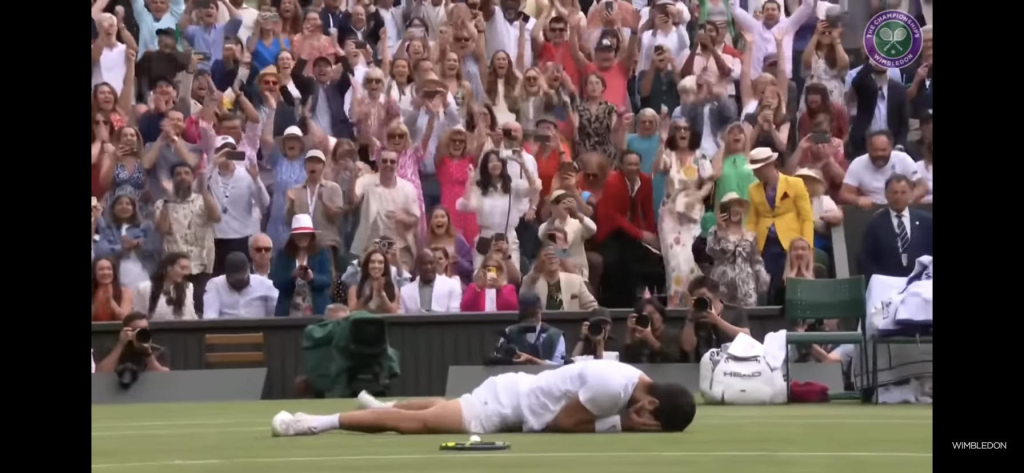
In the 2015 Australian Open final, after winning the first set, Novak Djokovic dropped a tiebreak to Andy Murray in the second. When Murray went up a break in the third, he looked capable of running away with the match. Djokovic reeled him in and won the last 10 games in succession so decisively that some wondered if the earlier vulnerability was a sham.
Five years later, in the Australian final against Dominic Thiem, Djokovic slipped further, losing the third set as well as the second. He looked bizarrely low on energy, and when Thiem produced a break point early in the fourth set, the end seemed nigh. Djokovic saved it with a serve-and-volley play and waltzed through the final two sets to win yet another crown in Melbourne.
And here’s another (you might not know this one): up a set on Roger Federer and leading 5-4 in the second set tiebreak in the 2015 Indian Wells final, just two points from victory, Djokovic somehow managed to double fault twice in a row. Federer promptly won the second set, leaving what should have been a mentally fried husk on the other side of the court. But Djokovic, at the very peak of his powers, won the third set 6-2 as if nothing had happened.
Djokovic always has his dips, and sometimes mini-chokes, in long matches. But he always comes back from them. What was different in his 6-1, 6-7 (6), 1-6, 6-3, 4-6 loss to the sensational Carlos Alcaraz in the Wimbledon final was that Alcaraz matched Djokovic when Novak was coming back from his dips. Yes, it was jarring that Djokovic’s streak of perfection during tiebreaks came to a grisly end (more on that in a bit), and yes, it was unsettling to see Djokovic looking gassed in the middle of the 26-minute marathon game in the third set. But he would have gotten away with those lapses against anyone else in the draw. Alcaraz’s punishing tennis is the story.
The most jarring aspect of the final to me was the ways in which Alcaraz won decisive points — namely, by excelling at the very shots Djokovic has become known for during his all-time-great career. Alcaraz out-defended Djokovic, tennis’s greatest-ever defender, and on a surface that he had barely played on before this year. (Djokovic is a seven-time Wimbledon champion and had won the last four in a row.) Alcaraz broke serve in the fifth set with a backhand-down-the-line passing shot, another Djokovic trademark. He won the second set with a crackling return winner, again off the backhand side. Sliding on grass is Djokovic’s calling card, but Alcaraz did it more frequently in this match than I’ve ever him do it before, to the point that his movement jumped out at me more than Novak’s.
And when you mix in Alcaraz’s nuclear forehand and soft touch, it was all just too much for Djokovic to handle. The first set was a bloodbath; Djokovic reeled off three games without nearing his best and then released his handcuffing deep returns to befuddle Alcaraz. But from early in the second set, the match was played on Alcaraz’s terms. While he had rushed to attack in the first set, he grew more patient, letting his own defense do some work as he searched for openings rather than forcing them. He voluntarily stretched out rallies against the endurance king. In the third set, throughout that agonizing 26-minute game on Djokovic’s serve, Alcaraz stifled Djokovic with his defense. He slid into backhands. He ripped passing shots that Novak sprawled for but couldn’t touch.
A fun way to measure how hard someone is pushing Djokovic is to pay attention to how many elements of his game he’s forced to make use of. We know Djokovic’s versatility is off the charts, but he only has to use a couple of his layers to crush most of his opponents. Increasingly, he just serves his opponents off the court. Even seeing him have to defend (often en route to a highlight-reel worthy winner) seems a rare occurrence against many challengers. So keeping watch for how many tools Djokovic feels the need to use is instructive to how hard he’s working. Is he having to run a lot? Is he having to hit difficult shots after the serve? Is he using the drop shot as a deadly weapon or a bail-out because he seems uncomfortable in long rallies? In this match, Djokovic had to scrape the very bottom of his bag of tricks early in the fourth set. When Alcaraz had him pinned with two break points up 1-0, up two sets to one already, Djokovic missed his first serve. He answered with a beauty of a second serve, a slider that painted the line at 105 mph. It was a serve that no one could have expected him to hit given the moment. But Alcaraz got it back, and forced Djokovic to hit a stunning backhand down the line to win the point. I’d never say this was the moment I knew Alcaraz would win, but Djokovic was having to produce so much quality to win individual points that I wondered if the work rate was sustainable, even for the best tennis player ever.
I’d be remiss if I didn’t mention Djokovic’s lapses. In fact, this is the first match in ages that he had a death grip on and lost. After winning the first set 6-1, he let Alcaraz back in with a dip early in the second. He led the second-set tiebreak 6-5 and — shockingly — authored the death of his own outstanding winning streak in breakers by blowing consecutive rally backhands. (You read that right, Djokovic’s famously solid two-handed backhand actually atrophied in a huge moment of a major final. First time for everything.) Up break point early in the fifth set, Djokovic forced Alcaraz into a backhand exchange, then outmaneuvered him with a massive inside-out forehand. Many probably thought the point was over. But Alcaraz got it back. Faced with a high putaway shot, Djokovic elected to try a swing volley and it limped into the net. He would never have another break point.
The key takeaway from the match, though, is that Alcaraz took advantage of those lapses. He is the only one, sans Djokovic’s legendary aged rivals, who could take advantage of those lapses. You could even argue that the might of Alcaraz’s game provoked some of those lapses. What it comes down to is this: Alcaraz served the match out, and did so with the kind of brilliant, low-margin aggression that always seems to collapse in big moments against Djokovic’s defense. Alcaraz missed a drop shot for love-15, then responded with a lob winner, a glorious volley winner off a classic dipping crosscourt backhand from Djokovic (the one that everybody, I mean EVERYBODY, dumps into the net), a massive serve, and an unreturnable forehand. He closed the deal against Djokovic in a fifth set of a Wimbledon final, which Roger Federer, the king of Wimbledon, famously fell whiskers short of doing in 2019. There can be no more ignoring the hype, or denying it. Alcaraz is a pressure-proof hyperathlete who has the game to win majors on all three surfaces. Say hello to your next GOAT-level player.
*****
Besides 2017, Djokovic has won at least one major tournament every year since 2011, often two or three. The first inkling that a new guard might be incoming was in 2014, when he and Federer looked set to meet in the U.S. Open final only to lose to youngsters Kei Nishikori and Marin Čilić, respectively. But Djokovic then responded by having the singular greatest season in the Open Era by an ATP player in 2015. Each time a bright-eyed challenger has emerged, Djokovic has held them off, often with superior movement and stamina despite his advancing age. He is 11-2 against Stefanos Tsitsipas, who was once touted as the next big thing.
It has become increasingly clear over the years, as Djokovic continued to not just win but dominate late into his 30s, that a special player would be required to displace him. After the Australian Open — which Djokovic won easily despite a hamstring tear — Sports Illustrated published an article headlined, “Novak Djokovic is going to win 30 majors.” So sure were they of his superiority over the opposition.
How do you beat the perfect tennis player? Raw aggression results in frequent misfires when Djokovic’s peerless defense sends your best shots trampolining back at you. Passivity gets you killed by Djokovic’s own aggression. Trying to make the match a track meet might tire him for a little, but you’ll end up losing your legs for good before he does without fail. The answer, if you are not Rafael Nadal playing on a clay court, is to play his game, only even better. To somehow out-defend him. Outgun him for power, even against his now all-time-great forehand. Have weapons so devastating that Djokovic has to take a deep defensive position but also have a drop shot so delicate that he has to shadow the baseline.
You have to be every bit as perfect as Djokovic is. And it’s an impossible task, which is why excellent-but-limited players like — well, all of the NextGen — can’t beat him when it matters with any regularity.
Carlos Alcaraz is that guy. It was so clear he was that guy early on that the hype around him grew to fever pitch even before he won anything of note. I wrote a piece called “The Golden Boy” after he won his first Masters 1000, a tournament casual fans probably didn’t even take note of. Before winning Wimbledon, all before the age of 21, Alcaraz had already bagged a major, a few more Masters 1000s, and the world #1 ranking, a resume that easily surpassed those of his mid-twenties rivals. The hype had already been validated.
But after what Alcaraz did yesterday, you simply cannot say a negative word about his tennis. He has scaled the pinnacle sooner than anyone thought he possibly could — remember, after Roland-Garros, we were wondering if Alcaraz was going to be yet another of Djokovic’s pigeons. He has mastered the one surface it didn’t seem like he was going to take to immediately. Now, there’s no tournament that Alcaraz doesn’t have a fantastic chance of winning. We’re going to get to watch him build a legend in real time.
“Alcaraz is what the ATP have been craving since the Big Three got old, and there’s not much more to say than just sit back and enjoy the show as the next Golden Boy tears up the world,” I wrote after Alcaraz won Miami, 15 long months ago. The world has already been cut to ribbons, and I can’t wait to see what Alcaraz does with the shreds.
 Popcorn Tennis
Wonderful summary, Owen. If I recall correctly, we have had previous conversations before on how Alcaraz can be more dangerous against Djokovic on grass except if his forehand is rushed. And also on baton getting passed to Alcaraz if and when he takes out Djokovic in a grand slam match, let alone in the final.
I think the final yesterday gave us all the answers.
LikeLike
Really glad you liked it, Sanjeet! I remember that, and you floating the idea that Alcaraz could take it to Djokovic on grass. Great call, and couldn’t agree more — Alcaraz played a perfect tactical match after the first set. Not just with the bullet forehands, but with the slower, spinny loopers to Djokovic’s backhand that often wrong-footed him.
LikeLiked by 1 person
Does Djokovic have a good chance of winning any more GS?
LikeLike
Sure! He’s the 10-time AO champion and is always going to have a shot at Wimbledon. I think the other two majors will be tougher for him.
LikeLike