By Elena Tsourdi
For someone who idolizes Roger Federer and Andy Murray, citing clay as one’s favorite surface might appear to be an oxymoron. And yet this mixture of crushed stone and brick has always appealed to me immensely.
My preference for the clay is probably linked to the style of my own amateur game: slicing and dicing, oftentimes running around my one-handed backhand (which I instantly took up at the chagrin of my coach after setting eyes on Roger Federer for the first time and have stubbornly refused to change ever since) to hit inside-out forehands, and also because of the forgiving nature of the surface to my admittedly weak serve.
With regards to elite clay court tennis, I relish the deployment of long winding groundstrokes, the high bounces and heavy topspins galore, the scintillating long rallies, the strategic building up of points only to be finished off with a well-disguised drop-shot leaving the opponent stranded far behind the baseline to the immense elation of the crowd. And how symbolic that after each set the footprints and the sliding marks are swept away and the war of attrition can start afresh!
Clay court tournaments are certainly not underrepresented during the long tennis season and the ones taking place after Wimbledon and before the beginning of the U.S. hard court swing have been criticized. Oftentimes arguments like “but they are just stranded tournaments, not leading up to a Grand Slam crescendo” or even just plain sneer and jeer like “the …Stad tour; you know Bastad, Gstaad and the like” are uttered by casual fans and tennis aficionados alike. Based on my recent experience visiting the Hamburg European Open these past few days, I would like to make the case for the contrary.
The Hamburg European Open am Rothenbaum is one of the most prestigious German tournaments and the oldest tournaments worldwide. It celebrated its 117th edition for male players this year, while female players have joined for the last 21 years. Though the tournament has been home to some memorable moments, taking immense pride in Steffi Graf’s unforgettable six titles in a row and certainly seeking to forget the abominable stabbing incident of Monica Seles in 1993, my personal most vivid memory of the Hamburg Open up to now had been beyond doubt the 2007 final between Roger Federer and Rafael Nadal which put an emphatic stop to the Spaniard’s outrageous series of 81 wins on the surface to my immense joy at the time (I have grown to deeply appreciate and respect Rafa in later years).
Upon arrival, I was very impressed by the venue. The newly renovated Center Court with its retractable membrane mushroom-like roof and sitting capacity of 10,000 is a sight to behold, while the additional four outside courts are easily accessible and their attendance is included in Center Court tickets. Nevertheless, given that I attended at the latter stage of the tournament, I was mostly focused on the Center Court and it is from there that my two stand-out stories derive. There is a common overarching theme to both: the fearlessness of youth. I am sure that fans having their eyes on their tournament during the week can pretty easily guess who I am referring to: they are both 19 years old and have lit up Hamburg.
I must admit that I had never heard of Noma Noha Akugue until this past weekend, but I consider her to be the story of the tournament. Having won the 2020 German National Championships and having mostly played lower-level ITF events since then, she was eliminated in qualifying at both Roland-Garros and Wimbledon. Nevertheless, she was given a wild card by the Tournament Director Sandra Reichel, possibly also because she lives and trains in Hamburg, and what an astute decision this has proven to be! I had watched the highlights of her two-hour, 42-minute quarter-final battle of attrition against Martina Trevisan and was impressed by her poise and easy power blasting left-handed winners, and seeing her live in the semi-final against Diana Schneider consolidated my original thoughts. Schneider certainly did not have one of her best days, her game being impaired by numerous double faults and slow reactions to the drop shots Noha Akugue was throwing at her, but the German teenager showed impressive defensive skills (open-stance reminiscent of Serena Williams, whom she cites as one of her idols) as well as some ferocious baseline play intertwined with courageous serving (ace on second serve included!). As the match closed at 6-3, 6-3, Noha Akugue clearly overcome by emotions, she received a standing ovation from the crowd and pledged to return the next day to claim the title.
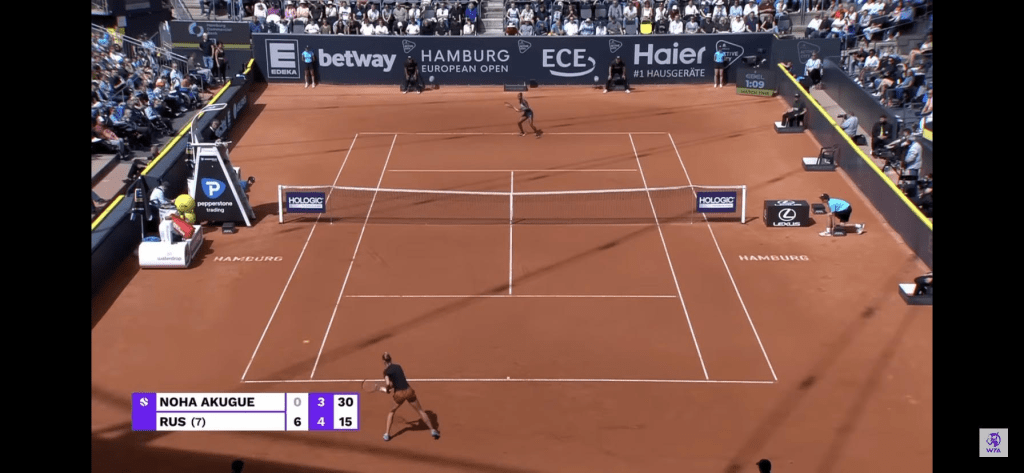
The next day was a completely different affair against the experienced 32-year-old veteran Arantxa Rus. As symmetry would want it, Rus had been a prodigious young talent herself having won the 2008 Junior Australian Open title and been a former Junior World No. 1, but failing to make major strides on the main tour, most of her titles deriving from the ITF circuit. Right from the start of the match, it was evident that Noha Akugue was extremely nervous. Her shoulders sunk and face was distraught; 20 minutes into the first set she was already 0-5 down and could not find her rhythm, overhitting her forehand that had served her so well on the previous days (she finished the match with 46 unforced errors). Rus on the other hand was clinical, especially on the forehand side (with both players being lefties, there were some pleasantly uncommon baseline patterns) and very quick to react to the tentative drop-shots of Noha Akugue and put them away for winners. After what must have been a harrowing experience for her, she went shortly away from the court after the first set to re-compose herself.
I have often thought that it takes an immense amount of mental fortitude and self-belief to recover from a 0-6 set and start afresh, but then again, elite tennis players are to my mind not mere mortals. As if on cue, she played a much closer second set, breaking Rus at the beginning of the set, having to concede the break back and even fending off a couple of match points at 5:4 to retain serve and push the match into the tiebreak with the crowd urging her on. In the tie-break, Noha Akugue saved a couple more match points before Rus capitalized on the fifth opportunity to become one of the oldest first-time winners of a WTA main tour title. Conclusion? Not the final one would have predicted, but an amazing one to have witnessed for the breakthrough of a precocious young talent and the redemption story of a veteran player-both unknown to me before this week.
The second stand-out match of the tournament for me was the last men’s quarterfinal: Ruud vs. Fils. I have to start with a disclaimer: I am a Casper Ruud fan. I enjoy his brand of tennis – him being somewhat of a clay court specialist and encapsulating many of the attributes I have listed above – but I also appreciate him a lot as a person, his quiet ambition, his easy-going yet diligent manner, the way he lets his tennis talk for itself, his sportsmanship and camaraderie. Thus, I went into this match having a clear favorite in my head, also consolidated by the erroneous belief that Arthur Fils is mostly a hard-court player (seems that I had wiped the Lyon title out of my mind!).
Little did I know that Arthur Fils would set the Hamburg night alight! Being in danger of committing a gross offense with this comparison, I believe that Fils played Alcaraz-esque tennis on Friday night. Yes, Casper Ruud was not fully mentally and physically there, especially in the first set, yes, his movement was not point-accurate and he was not able to run around his backhand and bring his world-class forehand into play, and yes, he mostly deployed loopy, paceless shots. But Arthur Fils was a true revelation, playing fearless and inspired tennis, with tremendous depth and placement of his shots (as if aiming for the back of the lines). I lost count of the running forehands and jumping backhand winners and marveled at him never backing out of smashes and swing volleys even when facing the blinding receding sun. The last game of the second set, won by breaking Casper Ruud to love was a microcosm of it all, and being fortunate enough to have a sit courtside I saw the sheer determination in his eyes and instantly knew the experience and sang-froid of Ruud did not stand a chance at that instance. I am well aware of what transpired in the next match against Alexander Zverev, and I am always fascinated by how tennis is all about the match-ups. But something about Arthurs Fils saving multiple match points in the last game with scintillating rallies gives us a glimpse of his precocious talent, his fighting psyche and what a player he is about to become once he learns to adjust to different kinds of opponents.
My overall take of the past few days and experience at the Hamburg European Open? There are true gems hidden in the obscure clay season between the grass and the hard courts. One just has to look close enough to find them.


Thanks – I will try to embrace the clay between the grass and hard courts after reading your piece. Clay is also my favorite surface to watch, but I’ve never been attuned to any clay post-Roland Garros. I see that I need to change my opinion.
LikeLike