Juan Martín del Potro: the evening of retirement, as imagined by a fan

By André Rolemberg

This is a narrative piece telling how I imagine Del Potro’s moments after he got home from his last match. In a sense, you could call this “fan fiction.”

It was just another day in the office. Getting up and ready to practice, match taking place at night — a first round. Wild card. He’s been dealing with injuries for some time, but now he’s ready to go back and play again. He wanted to believe that. So badly.

But the knee pain was hard to forget, and an unwelcome companion at this stage in Juan Martín del Potro’s career — no, in his life.

The match went on. “Maybe I’ll get a chance. My forehand can still do damage,” he thought. But a chance he did not get. Alas, the world does not stop for anyone. 

Federico Delbonis was not ready to succumb to his own emotions to let such a dangerous player, the 2009 U.S, Open champion over 5-time defending champion and all-time great Roger Federer, take control of the match. An idol, a legend in his own country, Delbonis knew all too well who del Potro was. Well enough, at least, to finish that match as soon as he could. The booing was inevitable unless he lost. A quick match is the only way now. 6–1, 6–3. 

No one will know if being the executioner was greater pain for Delbonis than the knee problems were for del Potro. Surely no pain was greater than saying good-bye in that manner, though.

*****

It was night. 

The moment was not yet fully comprehensible in del Potro’s mind. The facts are easy, but the body can’t quite grasp it. It still feels to the Argentine as if he should call his coach. Discuss the match today. Assess the tactics, strategy. Talk about the pain. Schedule time for tomorrow’s practice. All a shadow of the days past. A ghost of his career, hidden in the past, in the many pictures of fist pumps, forehands, trophies. 

It was quiet.

Quite a contrast from the lively crowds just a couple hours ago. Trading the roars of thousands of fans for a rhythmic ticking of the clock was not yet something he was used too, probably because the crowds were never coming back for him — or was he the one never coming back to the crowds?

It was funny, he thought. The people chanting his name, the noise in the stadiums was the epitome of the moment. It was right here, right now. Do or die. Now, the clock ruthlessly announced the time passing, unfazed by his achievements, unmoved by his tears, no signs of fear from Delpo’s forehand. Never once has it changed its pace. Momentum was not to be stolen from it.

That man lived in the past, capable of running for hours, bearing the pain of his aching body, playing a sport that only counts time for the sake of a mere curiosity. Tennis is not interested in how long it takes for anyone to end a match. Tennis only presents you with a goal — it is up to you how long it will take to get there.

Anyone now will be able to see the man del Potro once was. His focused eyes, his energy, all wonderfully recorded in thousands upon thousands of pictures, endless hours of videos of his wins and losses. A man he struggles to remember, if he is being honest with himself, lost in the thought process of a life away from the courts. 

However, they are all there.

His memories.

His trophies, sitting in the silent room dedicated for these important moments of his past life. Up from the couch, Del Potro makes his way, half aware of his own motions and motives, to the trophy room. His steps echo in the hallway, the light bulbs seem to barely give away any light, as if in shame: who are they to shine a light upon this man, who has been under the powerful and iconic lights of Arthur Ashe stadium, the biggest tennis arena in the world?

Once there, a look towards them. One ATP Masters 1000 trophy, earned under the scorching Californian sun at Indian Wells. Another, under the weight of a nation, Argentines’ deafening screams during a Davis Cup final. And the smooth-sliver cup, taken away by brute force during that night session at the US Open, a night that, without this memento, he could very well trick himself into believing it was just a fever dream.

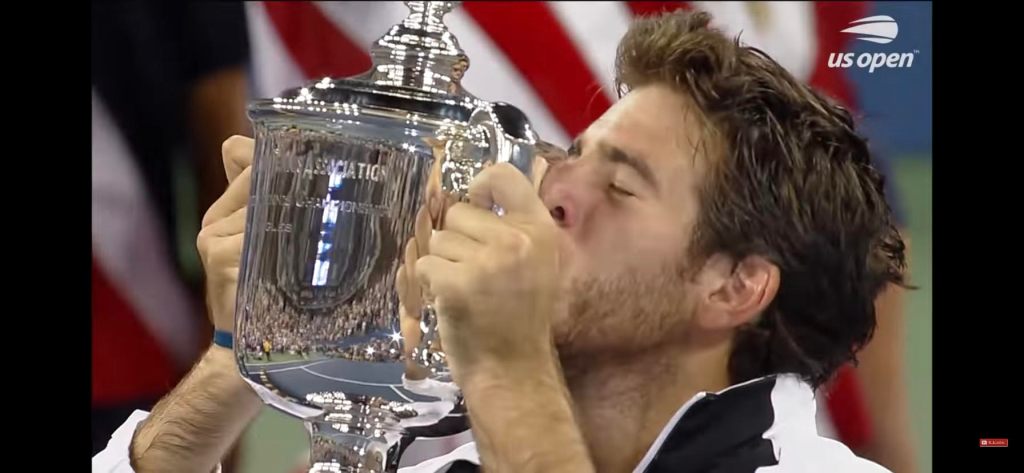
He shook the dust off the U.S. Open trophy. Taking the life-size replica of the original, del Potro, by instinct, lifted it up to the skies, as he did for the first time in 2009. 

Suddenly, it was not a trophy room anymore. It was not a dim, yellowish light bulb. It was not a tick-tock of the clock. It was Arthur Ashe Stadium, it was the powerful spotlights, it was the wonderful and unique sound of crowds saying his name louder and louder. It was a tennis court somewhere in the world, everywhere he has ever set foot. It was an indoor court with its lighting disposition unique to the arenas where he played, it was an outdoor court, the most powerful light source on planet Earth, the sun, shining its burning light onto his head as he lifted that trophy, all the titles in his career, all in that one moment.

The iconic moment from 2009. Screenshot: U.S. Open YouTube Channel

It was the end of his career indeed. But no man knew his memories like he did. No one could relive those moments like he could. He alone was Juan Martín del Potro.

He closed the door to the trophy room as he exited. His characteristic shy smile was on his gentle face, now not gloomy with his last-ever defeat but shining as if all the lights were still on him, was one of his most significant ones. No one was there to take a picture this time. No journalists awaited outside that room. But Delpo would remember this moment for his whole life, now a life he was ready to face outside the tennis courts, but, he was sure, not too far away from them.

Juan Martín del Potro: The People’s Champ

By Owais Majid

I begin this piece with somewhat of a confession. I wasn’t actually lucky enough to witness del Potro in his absolute pomp. While he was on his way to what we now know to be his only grand slam in 2009, the seven-year-old me had not a care in the world for tennis. The start of my love for tennis very much coincided with the peak, (if that’s the appropriate word here) of del Potro’s injury woes. I don’t think I actually watched a del Potro match until the Rio Olympics in 2016, in which he so memorably reached the final. 

Yet, I feel as much a del Potro fan as those who’ve watched his every move since the inception of his career. Because del Potro is a being who transcends the simple fact of chasing a ball and hitting it back to his opponent. He made you care about him the way you would for one of your own children. He made you feel as if he was putting himself through everything just for you.  

In this piece, I want to explore why del Potro is so loved by the tennis watching community, specifically the juxtaposing nature of his tennis and his general demeanour.

On the one hand, there’s this towering, terrifying warrior who would dismiss tennis balls with that famous forehand of his as if he was personally offended by their very existence. Although I can’t visualise the true brutality of said forehand, the sound alone is enough to jerk you out of a daydream, if, for some reason, you fell into a stupor during a del Potro match. In the split second between a del Potro winner and the crowd inevitably reacting with a collective gasp, the lingering sound of that ball leaving his racket strings and ending up on the other side of the court quicker than should be humanly possible is truly mesmeric.

A case in point, that iconic 107 miles per hour forehand during one of his many epics, this time against Rafael Nadal at Wimbledon in 2018. Delpo ended a five-shot rally with a brute of a shot, accompanied with a dismissive “ugh” as if he was simply swatting away an irritating fly rather than hitting a shot which left one of the best defenders in the history of the sport stranded. The crowd gasped as if they had just seen a bullet fired down the other end of the court with an accompanying echo of a gunshot, which in a way I suppose they had done. Andy Murray on commentary simply laughed, such was the absurdity of what he had just seen. This was just one of the many occasions on which Del Potro has left us open-mouthed at this incredible weapon that he possessed, the incredible weapon that he was allowed to deploy far less frequently than we’d all have liked.

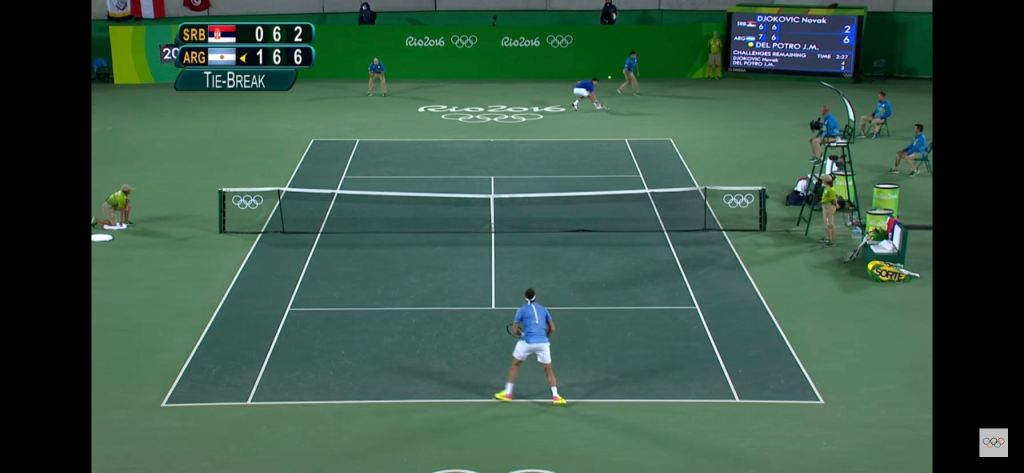
Delpo sends Djokovic scrambling with a blistering forehand down the line on match point of their first-round match at the Rio Olympics. Screenshot: Olympic YouTube Channel

It’s difficult, therefore, for me to get my head around the concept that this beast who induces gasps of something between terror and awe when he’s on the court, can be so gentle, so softly spoken away from the heat of battle. At the conclusion of the aforementioned tussle with Nadal, in which it seemed both men were willing to battle it out to the death, he embraced his opponent in a manner that was reminiscent of how you’d embrace a loved one. Delpo had been trying to punch holes into Nadal. He’d thrown everything at him for four-plus hours and yet, after all of that, his first thought was to give the man who had just thwarted him in spite of his best efforts a congratulatory embrace full of genuine warmth. 

I can’t be the only one who, from time to time, has wished to deliver that type of a hug to del Potro, to tell him “it’s gonna be all right. Keep your head up, you’re a champion”. It is simultaneously beautiful and heart-wrenching that Del Potro was so often the one who gave those embraces rather than being the recipient of them.   

The other off court del Potro moment which I found particularly moving was his tweet almost immediately after *that* Andy Murray press conference in which he announced he was probably retiring. Del Potro tweeted: “Andy, just watched your conference. Please don’t stop trying, keep fighting. I can imagine your pain and sadness. I hope you can overcome this. You deserve to retire on your own terms, whenever that happens.” 

This message would have been quite nice delivered by anyone, But coming from del Potro, it struck a different chord. This man had experienced for countless years the agony, (both physical and mental) that Murray was displaying to that packed press conference in 2019. If there’s one person that could have truly imagined what Murray was going through at that point, it’s the guy who’d lived that for so long. Delpo would have probably known the impact that his tweet would have on Murray. I don’t think it’s too far-fetched to suggest that it ignited some hope in Murray during a time of despair. Here was a man who was proof that despite the misery, there is always a way back. 

This message is particularly apt with the benefit of hindsight as del Potro made one last effort to step onto a tennis court just so he could retire on his own terms, because he deserved to retire on his own terms.  

What I’m getting at here is that Delpo wears his heart on his sleeve to a degree that almost nobody else can. Moreover, when it’s the heart of a lion, it just gets your own heart involved, doesn’t it? 

After his defeat to Federico Delbonis in what is likely to be his last appearance on court, Del Potro delivered one of those tear-jerking quotes that he has become such an expert in throughout his rollercoaster of a career. “The toughest thing to achieve is not a trophy or a ranking position, but people’s love and support. I think I achieved it.” 

I don’t think there’s a single person who could say he hasn’t achieved that, possibly more so than anybody before him, possibly more so than anybody after him ever will. So thank you, Delpo, for taking us on your emotional ride. May your retirement bring an end to your suffering.

Patience is Key

Carlos Alcaraz is the most exciting young ATP player on tour right now. The eighteen-year-old’s game is strikingly mature, from his all-world forehand and return game to his soft touch. He’s mastered areas that players his senior by a decade haven’t come close to. He hadn’t played since the Australian Open, where he came close to a spectacular comeback against Berrettini, so I had to watch his first-round match in Rio against Jaume Munar.

Watching Alcaraz is obviously exhilarating, because of his power-packed groundstrokes and his energy and his willingness to run for everything, but it can be frustrating at times. He has a weird habit of standing in his backhand corner to blast forehands — not forehands that do a whole lot, though, like he hasn’t realized there should be a point to sacrificing court position. He’s also got a great backhand, one more than capable of delivering the shot quality achieved by his more passive inside-out forehands. Sometimes it seems that he forgets about the variety in his game. He has the tools to be a ballbasher and defaulted into that mode for part of the match against Munar. When he found his accuracy and turned to his drop shots and volleys more, he barely lost a game.

Such errors are to be expected of an eighteen-year-old, of course. The fact that Alcaraz’s game is virtually ready to go at the highest level already, and his distance from the top can be closed by him growing into it, is remarkable. I felt similarly about Medvedev for a while — his tennis had so few blind spots that I got frustrated when he spiraled tactically, like his shots wanted to carry him to glory, he just wasn’t letting them.

Alcaraz is ranked 29th, but it feels like a matter of months until he passes half the people ahead of him. Despite Cristian Garín being ten spots higher, I don’t think anyone in their right mind would call him a better player than Alcaraz. The eighteen-year-old losing to any player outside the top ten, to me, would be an upset.

Alcaraz is so intensely talented that I feel impatient when I watch him play. To me, it’s nearly inevitable that he’ll win majors someday, and while following him in his developmental years is fun, part of me wants to fast-forward to the climax of the movie to see how he does at his best. His potential is nearly limitless, so when he lost the first set to Munar, 6-2, I felt almost personally inconvenienced. If he loses this match, it’ll take him longer to get to the top. Sometimes, it seems like Alcaraz suffers from this same kind of impatience. He tries to do too much with his forehand, as if every winner he hits will move him up a spot in the rankings. He rushes, trying to finish points too quickly when he could win them by pacing himself a bit more. It’s understandable — Alcaraz must know, on some level, that he has immense potential. Practically all players aspire to be world number one, but most of them have tangible hurdles separating them from their goal: a suspect backhand, or a mental block, or a lack of surface versatility. Alcaraz doesn’t really have any of these issues. If he can stay out of his own way, it’s hard to imagine that he won’t end up where he wants to go.

*****

Munar didn’t make things easy for Alcaraz. Clothed in the unfortunate Adidas kit that makes its wearers appear to have shit themselves, he is your quintessential clay-courter. He made great use of the surface; though he didn’t try to attack, he hit with safety and spin. Playing against this style can mess with a player’s head. If the opponent is making few errors, all the pressure is on the player with greater firepower (Alcaraz in this case) to finish points. Even if they have the requisite heft on their shots to hit winners, good enough execution of the wall-mode strategy can make them think they don’t, or that they have to go for the lines. Extreme patience is required to beat such an opponent. It was as if Alcaraz was taking an exam that wasn’t particularly challenging, but there were hundreds of questions and each of them took ten minutes to finish. Beating a good clay-court player is manageable, if you can avoid losing your mind in the process. It was a microcosm of the challenges Alcaraz faces as he tries to climb the ladder on tour.

And for a set, Alcaraz seemed to have lost his mind. Despite having the tools to engage in long rallies, he tried to end points quickly. His bad form even bled into the second set — serving to open the frame, he began with a double fault and two forehand errors. The mistakes were so poor I expected him to get broken at love.

Then, suddenly and inexplicably, Alcaraz found his game. Not only did he hold from love-40 down, he sprinted through the final two sets: 6-2, 6-1. He looked brilliant at times: there was one point, a point where Alcaraz shanked a return that sat up for Munar to hit a bouncing smash. Alcaraz got it back, defended his way back into the point, then took a Munar forehand on the rise and belted a sizzling backhand winner back into the deuce corner. “Bravo,” Munar called as the backhand flew into the back wall.

Alcaraz holds up the #1 finger after chasing down a Munar drop shot by sprinting the entire width of the court. Screenshot: Tennis TV

Alcaraz demonstrated his coolheadedness as well. At one stage, he set up for a baseline smash and hammered it into the ground, the ball not even reaching the net. He bent into a crouch and gently tapped the clay a couple times with his racket. The crowd oohed and jeered a bit. Alcaraz got up, walked to the line, and won the next point with a service winner. 

*****

There’s something entrancing about watching a clay court stretched out over my laptop screen, perhaps because I know the players are going to use every inch of it, painting it with their slides and footwork. The court in Rio is tan and smooth. Ball marks left by serves were visible in the service boxes, but just barely. Streaks and footprints rode the baseline like bold brushstrokes, a painting in progress. 

Time is of the Essence

A person wearing glasses

Description automatically generated with low confidence
Screenshot: Australian Open YouTube Channel

By Alex Thorpe

Time. 

WHAT TIME!?

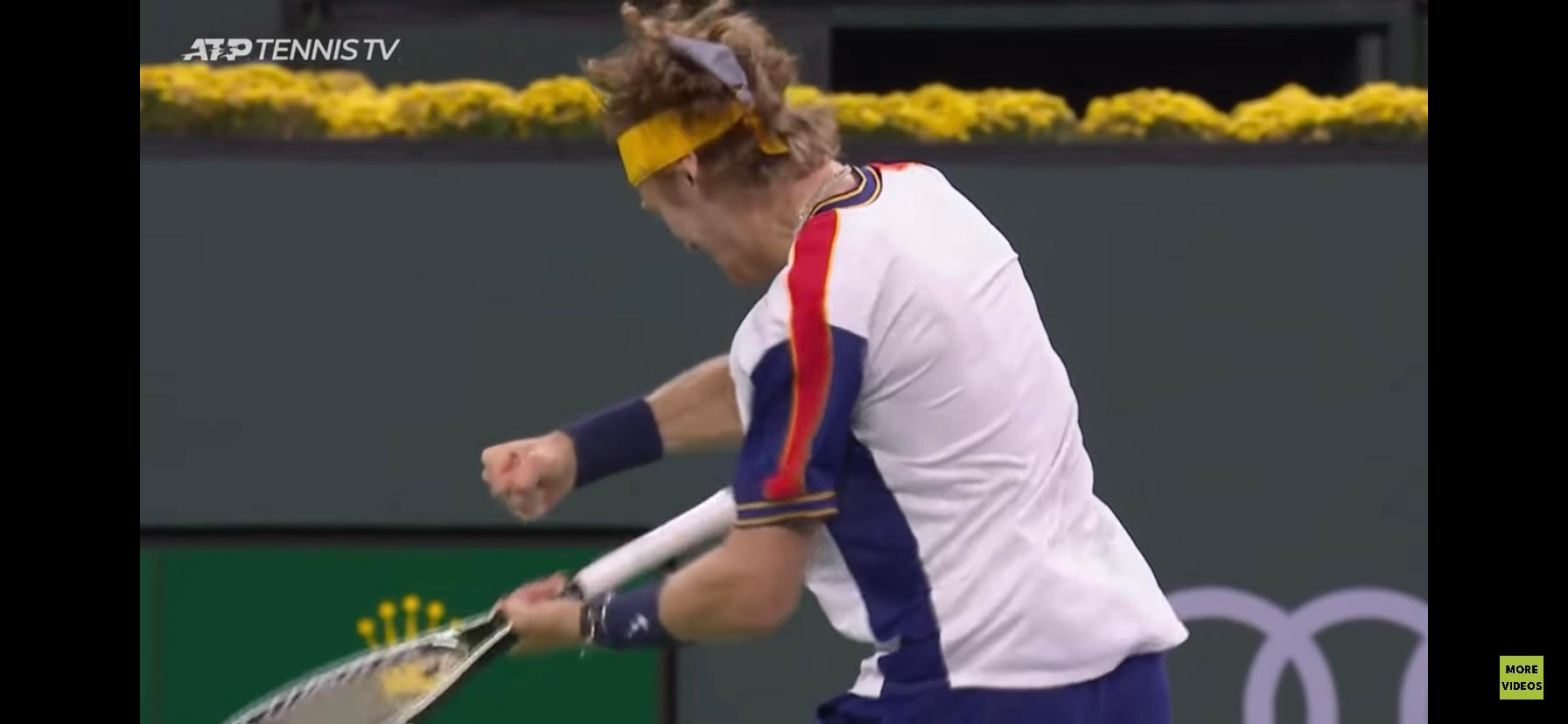
Tennis has a strange relationship with time. It has time limits and it doesn’t. I once told my non-tennis friend I was busy because I was going to watch a tennis match and he asked, “when’s it gonna finish?”, I told him “I don’t know.” Unlike a football match which will generally last 90-95 minutes, tennis matches can last 50 minutes or 5 hours, individual games or tiebreaks can last a couple minutes or 28 minutes, looking at you Nadal-Mannarino! The points themselves can last one second or one minute. So tennis doesn’t have a time limit. But it does. Denis Shapovalov is pretty insistent that it does. “You guys are all corrupt!” he lashed out at umpire Carlos Bernardes, feeling those limits between points were not being enforced as his time at the 2022 Australian Open drew to a close against eventual winner Rafael Nadal. 

Nadal himself had seemingly run out of time to claim his second Australian Open, at what has been a ‘cursed’ slam for him, given his unfortunate near-misses in 2012, 2014 and 2017. The Spaniard was aware of this, both on court and in his post-match interview. The now 21-time major winner was an improbably unstoppable force in his comeback against Daniil Medvedev from 2-6 6-7 2-3 0-40 down right up until he came to serve for the match. From 30-0 up, a double fault and a tame backhand into the net contributed to four straight points for the Russian and a break of serve. Nadal, of course, got a ‘boomerang break’ in the next game and served out for ’21,’ but he was far from certain it would pan out that way after spurning the chance to close out the match at 5-4. “Well, after that I said ‘fuck, one more time a break up in the fifth and I’m gonna lose the advantage again, no?'” he said to Eurosport following his most unexpected triumph. 

Whilst attempting to serve out for the championship first time around, Nadal was surely feeling ‘time pressure.’ He had gone from feelings of joy and gratefulness at the beginning of the tournament at simply being able to compete again on the biggest of stages, to, for the first time, fear of letting a golden and likely final opportunity of a second Australian Open slip away. Breaking Medvedev’s serve for 3-2 with that forehand down-the-line winner in the fifth set was the first time he’d been the favourite to win the title in the whole tournament. 

Human beings, even really cool ones like Nadal and Roger Federer, like to think rationally and work out their problems with a clear head. Being weighed down by the feeling of a door slamming shut, with your only reprieve thrust upon you in a now-or-never situation, can cloud this judgment and cause you to make mistakes, to play below your otherwise stellar standard. Federer felt it trying to serve out a 9th Wimbledon in 2019, his forehand misfired on the first match point, and a combination of a safe first serve and an overly eager approach allowed Novak Djokovic an escape route. When would he again get a chance at a 21st slam, aged 38 years old? (Never, it looks like.) Nadal felt it in both his Australian and US Open finals against Medvedev, needing two attempts to serve out both victories. When would he again get a chance at a hard-court slam without facing Djokovic, who he’s failed to take a set against on the surface since 2013? These slams meant more. Maybe too much. 

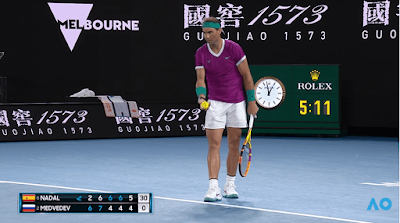
“I should probably do this now in case Novak gets vaxxed.” Screenshot: Australian Open YouTube channel

The same was true for Djokovic at last year’s US Open. The Serb, never one to play down his pursuit of the totality of tennis records, was “hugely inspired and motivated” by the opportunity to complete the calendar-year slam. Yet the pressure seemed to weigh on him as he lost the first set for four consecutive rounds, and these slow starts appeared to catch up with him as he was dismissed in straight sets by Medvedev in the final. Djokovic looked gassed, something we’d never seen so blatantly in a slam final despite him having overcome tougher on-court time and physical issues pre-final before. Something else was at play. A feeling of immense pressure to complete an historic achievement, one that would likely never arise again. As cliché as it sounds, Emma Raducanu had a point during her cruise towards the title at the same event when she said “as soon as you get ahead of yourself and start thinking ahead, that’s when you get distracted and side-tracked.”

If even the ‘GOATs’ are prone to getting tight as their careers wind down, it’s no surprise that we see so few new slam winners post 25 years old. Since and including Federer’s first slam at Wimbledon 2003, of the 11 players to have broken their slam duck, only Dominic Thiem and Stan Wawrinka did so having been older than 25. Of those two finals, Wawrinka was playing against an injured Nadal at his ‘cursed’ Australian Open and Thiem had to battle through a terrible bout of nerves to win from two sets down in a final-set tiebreak against an equally nervous at times Alexander Zverev. The average age for a first major win in this period is 23 and that isn’t a number deflated by the Big Three’s presence, with the previous 11 first-time winners before Federer also being 23 years old on average. Only three of those players were older than 25 when they made the breakthrough. 

It’s why we should be more demanding of those guys approaching their mid 20’s with the abundance of talent required to win a slam who let themselves down performance-wise. I’m talking about Zverev who, under expectations to make the final following his dominant showing at the season-ending ATP Finals, crumbled against his first serious obstacle in Shapovalov. ‘Night Train’ himself was more preoccupied with Nadal’s time between serves than making it his time against a physically compromised opponent. Stefanos Tsitsipas had a strong Australian Open in many aspects, but the way he faded in the fourth set against nemesis Medvedev was disappointing having competed so well for the first three. 

LOOK AT ME! I’M TALKING TO YOU! Screenshot: Wide World of Sports YouTube Channel

These guys have often been filed under the ‘their time will come’ section after similar defeats. But will it? Is it just a case of waiting for the ‘Big Three’ to step aside?

If we look to the women’s game, one of the best examples of ‘time pressure’ was at last year’s US Open. Two teenagers, Raducanu and Leylah Fernandez, met in the final having overcome older competitors for whom the time pressure on the opportunity was suffocating. Maria Sakkari, following her semi-final defeat to the Brit, said of her “she plays fearless, she absolutely goes for it, she does the right thing actually, she has nothing to lose, she’s enjoying herself but you know we (her opponents) were all absent from the court.”

Aryna Sabalenka’s serve was certainly absent when serving to stay in her semi-final against Canadian Fernandez. Four unforced errors including two straight double faults gifted the match away, a stunning collapse from the world number two. Following the culmination of Serena Williams’s era as the major force in slams in early 2017, it has been relative youngsters rather than her established rivals who have been picking up the trophies. Ostapenko, Osaka, Andreescu, Kenin, Swiatek and Raducanu have all won slams aged 21 or under. Ostapenko was unseeded, Raducanu was a qualifier. 

Without the baggage of crushing defeats by the barest of margins, the feeling of ‘fuck…I’m gonna lose the advantage again, no?’, these youngsters play with that extra bit of confidence in the key moments, pushed on by a chance to achieve something, rather than a fear of missing out again. The match is approached in isolation, rather than being seen as career-defining, the referendum on whether all those years of hard work will pay off. 

That’s why there’s no better time than the present for guys like Zverev, Shapovalov and Tsitsipas to be demanding everything from themselves in slams. The level never drops significantly. For example, it’s hard to see someone with the lack of variety of Rublev going 7/7 at a major, post-Djokovic/Nadal or not. New talent is always emerging, and it’s easy to miss your moment. Look at Grigor Dimitrov, Jo-Wilfried Tsonga, Tomas Berdych, who all looked likely slam winners at one point or another. This last week, with Juan Martín Del Potro’s likely retirement, has shown that time in sport is not devolved equally either. 

They should be demanding of themselves not to win, but to show the fight that Félix Auger-Aliassime did against Medvedev, that Carlos Alcaraz has against Tsitsipas and Matteo Berrettini. The older they get, the harder it will be to play with that fearlessness. Then before you know it, you’ve run out of- 

Time violation warning, Mr. Thorpe.

Andy Murray and Ivan Lendl: Chapter 3?

Chapter 1: The Nearly-There and the Veteran

Way back at the end of 2011, back when Andy Murray was but a perennial Grand Slam runner-up forever playing second fiddle to three players seemingly destined to dominate the ATP for years, he asked Ivan Lendl to be his coach.

Way back at the end of 2011, back when Ivan Lendl was but a retired former world number one tennis professional busying himself often out on the golf course and indulging himself frequently in the pleasures that come with no-longer grinding it out on the not-always-grand stage of professional sport, he said yes to Andy Murray’s request.

It seemed like an oddly poetic pairing. Murray had lost his first three major finals at that point, leading to speculation that he just didn’t have the bottle, the mindset to handle the moment. Lendl, similarly, has went through his own difficulties with getting the job done throughout his early career stages, making four major finals and falling short each time before finally hitting bullseye and catapulting himself to legend status. And so these two teaming up grabbed attentions immediately, curiosity captured as many wondered whether or not the notoriously hot-headed Murray could be cooled by the presence of Lendl, a man who outwardly seemed to exude an aura of the no-nonsense.

The results of this setup were born from a far more behind-the-scenes one-to-one conversational variety of coaching. Lendl was never about to teach Murray a new technique to hit a backhand better, rather offer an understanding of the heartbreak that seemed obsessed with the Scot at the time. Under Lendl, Murray’s temper was still very much there and present. But rather than let it tip over and run through his game, damaging the internal circuitboard of his match plans, Murray was far better able to let himself feel the rage before the refocus.

A semifinal loss for his charge in a five hour, five set war of attrition to the world number 1 Novak Djokovic at the 2012 Australian Open gave Lendl a stable base from which to push his methods from. Murray could win matches like that, he could do it but only if he was told that he could by someone who knew how it felt to not do it, someone who knew how it felt to fail at doing it and come back from that venomous demoralisation that threatened confidence free-fall whenever it occurred. Lendl slotted himself into that area of Murray’s coaching team and went to work.

The highlights of this first chapter were painted in the colours of the rainbow, curving across Murray’s career from all angles. A first Wimbledon final was reached and cried over in a close four set defeat but revenge was best served with a hint of a metallic sparkle as an Olympic gold medal was hung around Scot’s neck mere weeks later on the same court following a straight sets win over the same opponent in the form of Switzerland’s Roger Federer. And then – FINALLY! – a U.S. Open trophy tumbled his way and he caught it with a relief stricken face and a missing toenail tumbling about his shoe.

But this wasn’t yet enough, not for the Mendl duopoly as they rode their wave of good vibes into the following season, snowballing through the opening few months of 2013. The Brisbane International title. Another Australian Open final. A Miami Masters trophy. Even a skipped clay season couldn’t derail the feeling that was beginning to storm as the grass season and Wimbledon loomed, recollections of that tearstained ceremony the year before drifting across minds of the British public. Yet another Queen’s Club win set the good omens aflutter and they were quite right to fly high as two weeks later and at long long loooooooooooooooooooong last, Andy Murray beat out the men’s field at SW19, reaching the Holy Grail and setting the headlines alight above photos of a boy from the small town of Dunblane in Scotland lifting the most historic gold cup in all of world tennis.

This was the peak of that first run and what it will always be remembered for. What followed was a tumultuous few months that climaxed with Murray cutting his season short due to the need to undergo surgery on his lower back. From this, it felt like a combination of a steady and slow downturn in immediate results alongside what had felt like reaching the ultimate-culmination-that-could-not-be-improved-on of that dreamy Sunday afternoon on Centre Court the summer before. that resulted in the Murray and Lendl team fraying. Indeed, by the time March of 2014 rolled around, Murray was without a title since Wimbledon, was out of the top five in the rankings, and was without a coach.

Lendl was heading back home.

Chapter 2: The World-Beater and the Veteran

Before we open the pages of chapter two, I think it’s worth mentioning that as an unfortunate side-effect of the success of the Murray and Lendl unit, other coaches that guided Murray when Lendl was not in the picture were often overshadowed. Most notably was Amélie Mauresmo, who Murray relied on through a period of up-and-down results. These two won titles together, a good many in fact, but because she wasn’t with him when he won the very top prizes the sport has to offer, her impact is unfairly footnoted by many. Murray himself has spoken in length about the benefits that Mauresmo brought with her, the skills and knowledge she added. She – and Murray’s other not-Lendl coaches – should absolutely be credited for everything they gave.

And so with that all said…

Way back in the middle of 2016, when Andy Murray was but the second best tennis player on the planet, he asked Ivan Lendl to be his coach… again.

Way back in the middle of 2016, when Ivan Lendl was but a retired former-world-number 1 tennis professional and ex-coach of Andy Murray, busying himself often out on the golf course and indulging himself frequently in the pleasures that come with no-longer grinding it out on the not-always-grand stage of professional sport, he said yes to Andy Murray’s request… again.

Lendl’s return was, if anything, more widely publicised than his initial debut. Everyone knew what he brought to the Murray camp two years prior, everyone knew what he was capable of injecting into Murray’s game through his combination of stoney-faced expectancy and slight nods of vague approval. Could they really deliver together for a second time? Lightning strike twice? Too good to be true, surely?

Needless to say, all of the eyes were watching as Lendl entered the Murray camp on the grass courts of Queen’s Club with the look of a man who’d never left, smirking slightly with the wicked humour he’s famed for. He was here once more, standing behind Murray at the back of the court with his arms folded and with a face that looked like it would remain the same even if a nuclear explosion were to suddenly erupt from the ground in front of him.

A lot of people would describe Lendl’s impact here as instantaneous, so quickly did Murray reunite with him and win Queen’s, a second Wimbledon title, a second Olympic gold medal and more. But Murray had won a title earlier that season as well, it was just the instinct in the biggest of big matches where he found himself still lacking, those times where he’d take his nervous angst and verbalise it through heavy-handed words towards his team. Lendl returned and gave Murray nothing from the box exactly the same as before, nothing at all in response to his meltdowns. It were as though Lendl were a parent and Murray his disappointment that he knew could do better, knew could work it out, knew could perform if he just allowed himself to do so and took responsibility for his errors.

And he was right because of course he was. With Lendl steering the ship, Murray drove forwards through limits that many once thought his career would be unable to surpass. One title, two title, three title, four, five title, six title, seven title, more… In all, Murray won nine tournaments in 2016, eight of those coming with Lendl. He reached world number one for the first time and held on to it through the final event of the year by defeating Novak Djokovic in the last match of the season in front of a home crowd at a sold-out O2 Arena in London. This was as close to the stars as he could get as a tennis player, walking on non-existent air amongst them from win to win with a feeling that if he just kept working and going and moving, he may never need come down, this so clearly and obviously the absolute pinnacle of every childhood daydream that a young Andy Murray would have burned his spare-time envisaging.

But as with every gasp of exhilaration at life’s pleasant offerings, so quickly does it go from you, smoking through your grasp. So it was with Murray and Lendl. From that 2016 aura came 2017 and with it only one title in a year that really struggled to get started. His Wimbledon defence ended with injury and his ranking fell with it, tumbling to outside the top 10. Things looked bleak and it stood out when placed in stark contrast with what had come just before.

Tennis, as ever, kept moving forwards, forgiving none that needed a breather.

Indeed, by the time Murray called time on his 2017 efforts, announcing that he planned to skip the US Open and all further tournaments in order to really try to tackle a hip issue that was scarily refusing to shift, Lendl was once again taking his leave.

Chapter 3 (?): The Veteran and the Veteran

And so that’s the story of Andy Murray and Ivan Lendl as it stands and likely how it will remain. I am not at all naive enough to believe that a third chapter of the Murray/Lendl story will go on to be written. These are two men stubborn in their ways and, while there exists only vague chitchat on why exactly they parted ways last time, it’s somewhat reasonable to assume that it probably wasn’t the easiest of mutual break-ups. When injuries come calling, you need a team close by and Lendl’s commitments elsewhere would have undoubtedly brought about a lot of difficult questions.

A massive amount of compromise on both sides would be required if this were to ever work again, a clearer image of exactly what Murray wants from this final few years of his journey and a blatantly obvious outline of exactly how Lendl would take him there. This isn’t the beginning or middle anymore, it’s the end of the road and it’s been bumpy for Murray so far. Lendl would need to adapt, something he may well find himself unable to do. Murray is no longer primed and ready for the big time with a body willing to sustain the heat. If it is the case that Lendl knows only one way to coach by way of thoroughly rigorous repetitive training cycles, this trilogy completion could never feasibly happen.

Murray needs to be clever and he needs someone on that same wavelength, able to chart out what he can still do to better where he finds himself now. This is less of an appeal for a Lendl return and more of an appeal for a big time hiring that indicates intent from Murray, something his most recent signings haven’t really offered as he struggles to find his footing in the top-flight again. This was fine while he was simply trying to work his way back from injury but it feels like now, he’s looking for a breakthrough performance to properly establish himself as someone to be feared on court once more. He needs to be able to lay out what he wants to achieve and have someone with him perfectly confident in being able to say “yes, I can get you there” and “no, you’re doing this wrong, let’s try this.”

And you know what? That person might not exist for Andy Murray anymore.

Or maybe, just maybe, they do, hidden away behind the vail of his past. This is absolutely the stuff of fanboy fantasy thinking from me here but at this point, what does Murray have to lose from taking a shot in the dark and firing off a text to the old Czech iceman? Ask him what he’s been up to! Ask him how the weather is wherever he’s at! Ask him what he’s having for dinner! Ask him how the family is! Ask him how the golf’s going!

And then ask him if he’s willing to give a bit of that up for one last try.

A Partnership To Remember: Ivan Lendl and Andy Murray won 3 major titles together.

Auger-Aliassime Reaches New Heights With Maiden Singles Title

By Brenda Parry

“Every season starts with the same objective. Become a better player than I was the season prior. Looking back, I’m proud to see that I’ve accomplished that objective by reaching new milestones in my career.”

Félix Auger-Aliassime after breaking into the Top 10 in November 2021

The 2022 season couldn’t have got off to a better start for the 21-year-old Canadian, Félix Auger-Aliassime. Having led Team Canada to victory in the ATP Cup at the start of the year, Auger-Aliassime came within a point of beating Daniil Medvedev, the eventual runner-up, in the Australian Open quarterfinals. Despite going on to lose that match in five tight sets, he proved that he is able to compete on the big stage against the very best. With a dominant 6-4 6-2 victory over Stefanos Tsitsipas in the ABN AMRO World Tennis Tournament in Rotterdam, Auger-Aliassime is now at a 12-3 win-loss record for 2022.

Image
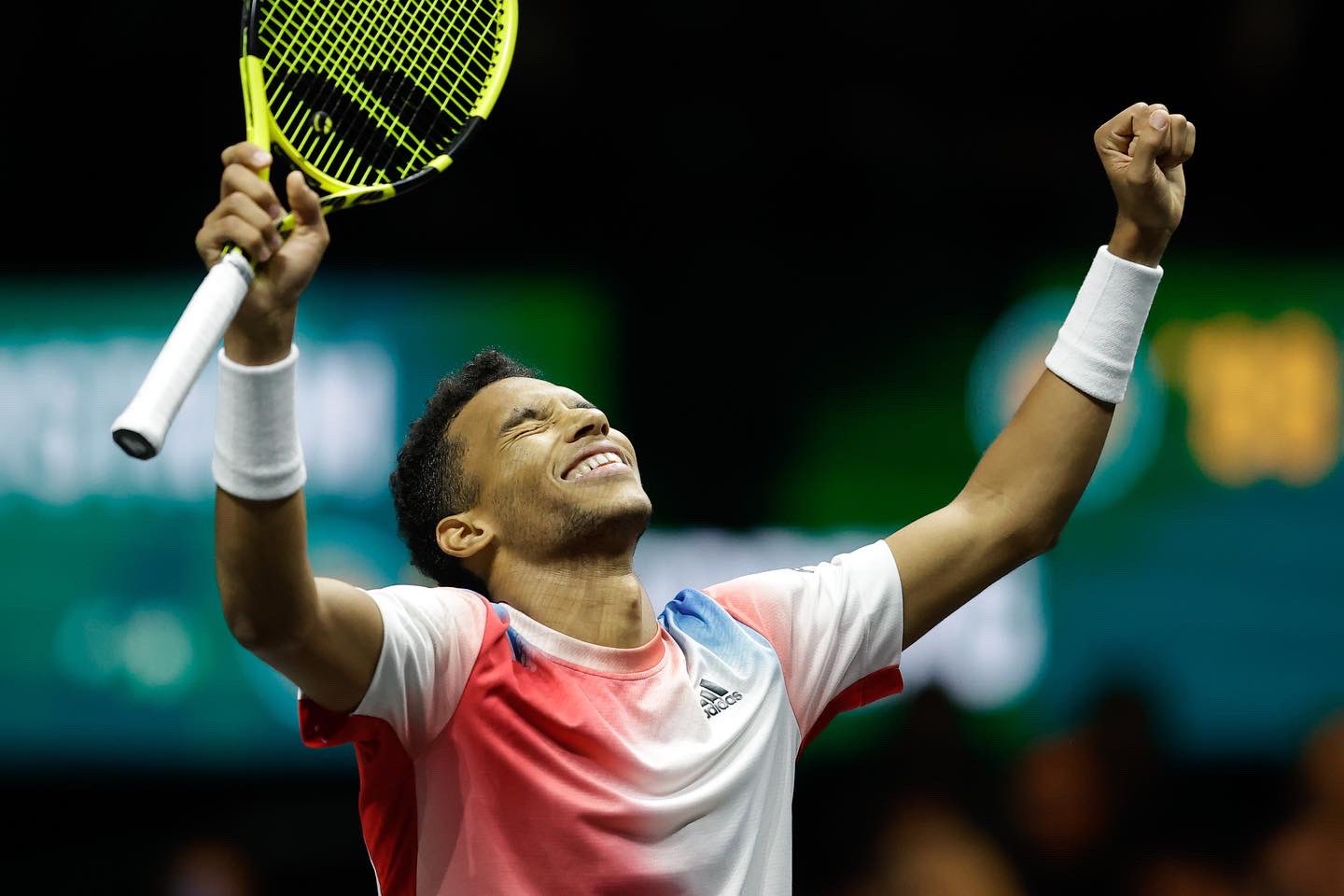
Auger-Aliassime celebrates his first singles title. Photo: Henk Coster / Pam Waslander / ABN AMRO World Tennis Tournament

More importantly, though, Auger-Aliassime has finally claimed his maiden ATP singles title, which has been a long time coming. Auger-Aliassime was the in-form player all week in Rotterdam. He beat Egor Gerasimov, Andy Murray, Cameron Norrie and defending champion Andrey Rublev on his way to the final, but there was even more at stake in the final against Stefanos Tsitsipas, the world no. 4 who, prior to the Rotterdam final, enjoyed a 5-2 head-to-head record against Auger-Aliassime. Tsitsipas already has seven ATP tour titles but surprisingly he has not yet won one at the ATP 500 level despite having previously played seven finals at this level. Auger-Aliassime, on the other hand, has previously reached an ATP final on eight occasions – his first in Rio in February 2019 – but has never even taken a set off the winner. Somewhat fittingly, Auger-Aliassime has come full circle by winning his first title in Rotterdam, the same tournament in which he made his debut on the ATP tour as a wild card in 2018. He lost on that occasion to Filip Krajinović in the first round.

From the promise Auger-Aliassime showed as a junior, the journey has been long and arduous, but he is now starting to see the benefits of his hard work and perseverance. He has steadily improved under his long-term coach, Frédéric Fontang. His decision to hire Toni Nadal as his coach for the clay-court season in 2021 might be a contributing factor in the steady progress he has made over recent months. While he didn’t immediately reap the awards of working with Nadal (he had a disappointing clay-court season in 2021 and lost in the first round of the French Open to Andreas Seppi), Auger-Aliassime’s game has improved on every level since then. His serve has become more powerful, his movement better, he is more aggressive and he handles the big points more effectively. He has grown in consistency and maturity over the second half of 2021 — he stunned his childhood idol Roger Federer (with whom he shares an August 8th birthday) in the second round of the Halle Open, he beat Alexander Zverev in five sets to reach his first major quarterfinal at Wimbledon, then he backed this up with a first Grand Slam semifinal appearance at the U.S. Open in September.

Having finally got the monkey off his back by winning his first ATP singles title after eight attempts, Auger-Aliassime can now play with a newfound freedom and looks set to reach further milestones this year. I’m definitely looking forward to the road ahead!

Great Stagnation

Andrey Rublev is ranked seventh in the world. He’s been a fixture on tour for a little while now, frequently winning ATP 500s and making runs to the quarterfinals of majors. He beat Nadal on clay last year, then Medvedev on hard court. He’s made the World Tour Finals twice, and has been as high as fifth in the rankings.

Try as I might, I just can’t be impressed with him.

Here’s why. First off, there’s the fact that aside from isolated wins like the ones over Medvedev and Nadal, Rublev hasn’t improved much in the last few years. He was actually one of the first young guys from this generation to make a deep run at a major — way back in 2017, he made the quarterfinals of the U.S. Open. (He lost to Nadal in straight sets, winning a total of five games.) That was over four years ago. Since then, Rublev has made three more major quarterfinals, but he’s yet to win one. He’s yet to even win a set in one. I watched part of that quarterfinal with Nadal as a newbie tennis fan. I didn’t know who Rublev was. I probably didn’t even know how many majors Nadal had won. Still, I think if you had told me that Rublev wouldn’t be able to piece together a better run at a major in his next 13 tries, I’d have said something like “oh, that’s not good, is it?”

Then there’s his game. It’s not that he does anything badly, really, but he’s not the best in the world at anything. Per the ATP website, Rublev had the 22nd best serve rating, 14th best return rating, and 55th best Under Pressure rating in the past year. He hits his forehand very well — it’s a compact, power-packed shot that’s often the biggest groundstroke on the court — but it’s not as consistent as Nadal’s, or as versatile as Tsitsipas’s, or as defensively sound as Djokovic’s. His backhand is solid, but not anything to write home about. He defends reasonably well. His touch is near-absent.

His temperament on court is interesting — he holds himself to a very high standard, admonishing himself for his misses. There’s some Rafa-like intensity in him, though it’s more negatively focused. It’s like he doesn’t yet understand that perfection isn’t a realistic expectation. The bigger issue is that he’s not tactically mobile at all, likely partly due to stubbornness and partly due to the lack of depth in his game. Nadal’s fighting spirit is accompanied by his constant willingness to change things up if a match isn’t going his way. Screams and frustration alone don’t magically turn a match on its head. Rublev knows how he likes to play. It works most of the time; he wouldn’t be seventh in the world if it didn’t. Yet when he’s overmatched, there’s very little he can do to hit back. The last time he won a match from a set down was at the Laver Cup four and a half months ago (it was against Schwartzman, and they played a ten-point tiebreak instead of a third set).

A commonly trotted-out line regarding Rublev’s game is that he is one-dimensional, but really excels at his strengths. I tend to agree, but would add that even his strengths aren’t quite decisive enough against the best players in the world. His forehand is great, his desire to dictate play intense, but he can’t hit through human walls like Medvedev and Djokovic.

Yesterday, Tennis.com published an article called “STAT OF THE DAY: ANDREY RUBLEV HAS NOW REACHED THE QFS OR BETTER AT HIS LAST 11 ATP 500S IN A ROW.” Maybe I’m being overly harsh here, but for a top-eight player, that stat has to mean nothing. At that point, winning a 500 represents little more than superiority over the lesser competition in the field. Maybe the points help you climb a spot or two ahead of the next major. It’s certainly not intimidating to your rivals, those just ahead of you, who are racking up deep runs at Masters 1000s (Rublev has made two finals at this level and got crushed in both of them) or majors.

The thing is, this stat sort of defines where Rublev is right now, and has been for the past couple years. He tends to beat the players below him, though this trend hasn’t been apparent at the last four majors — he lost to Marin Čilić at the Australian Open, Frances Tiafoe at the U.S. Open, Márton Fucsovics at Wimbledon, and Jan-Lennard Struff at Roland-Garros. None of these losses are that worrying in isolation, but it’s now been over a year since Rublev made the last eight at a major. He’s beaten Tsitsipas a couple times, and Nadal and Medvedev once each, but it tends to be shocking when he beats a player ranked higher than he is.

Rublev’s consistency has been impressive at times. He has broken into the top ten by going deep in many tournaments rather than winning a big one, which speaks well of his prospects for staying there. In a way, though, it’s less encouraging than a breakthrough like Tsitsipas’s, who beat four top-ten players at the Rogers Cup in 2018 and then made the Australian Open semifinals shortly afterwards. He’s been blighted with inconsistency on hard courts for much of his career, but at least he’s shown that at his best, he can do some serious damage. I’m not sure the same can be said for Rublev, creating the impression that despite having been around for a while and being in the top eight, he’s still waiting on a breakout win.

Not only is he without an epic victory, but I also think he’s yet to have a really courageous loss, like the one Alcaraz endured at the hands of Berrettini in Melbourne. He’s yet to stare down a huge deficit or a terrible matchup, walk the tightrope with a risky strategy to get out of it, and have a near miss. When I watch him play, I think of Andre Agassi’s declaration in Open that losses feel more intensely bad than wins feel good. Rublev never particularly seems like he’s having fun when he plays, besides the odd smile or two, and he almost always looks devastated when he loses. I fear for him a little bit, for when that inevitable shattering loss arrives. No one avoids it, and I think his mindset is going to amplify the pain.

*****

The name of the game in this era is that if you are not constantly improving, you will be overwhelmed. After Djokovic’s supreme 2011 in which he won three majors, he stagnated — only a bit — and won just one major each of the next three years. Last year, Djokovic understood that he couldn’t beat Nadal at Roland-Garros with the previous strategies he had used, so he changed: he lashed wickedly angled crosscourt forehands into Nadal’s backhand corner, made the Spaniard’s life hell for a couple hours, and came away with a historic victory. At the Australian Open this year, Nadal knew that he couldn’t win playing safely, so he started going for 100+ mph second serves, hit his backhand down the line into the corner, and he won. Even the best players in this era have to be prepared for humbling losses, for changing the way they play, because at some point or another, their best tennis has not been enough to dominate the tour.

I don’t expect Rublev, or anyone, to display the tactical mobility of Djokovic or Nadal (they are GOATs for a reason), but the Russian’s persona seems so at odds with any change whatsoever. His perfectionist mindset is admirable on the one hand, but he can be so tough on himself after his misses that it appears he thinks that if he plays well, he will beat anyone.

To be brutally honest, this is a terrible mindset at this time, against these players. There are a handful who are simply better than he is, so much so that no matter how well he executes his standard game, he will usually lose. He needs to adapt, because he is not good enough to beat Djokovic or Medvedev or Zverev or Nadal with any regularity. Is that an immensely humbling, difficult realization to come to? Yes. Is it an imperative realization if a player is to win a major against this field? You better believe it.

*****

Rublev is only 24. Things aren’t hopeless by any means. He will have many more years on the tour to try claiming a spot at the very top. Things can change quickly. Federer and Djokovic each spent a few years in the wilderness between intriguing prospect and dominant force before reaching the pinnacle of the sport. Not only that, but Rublev has struggled with depression amidst the COVID-19 pandemic and lost his grandmother in 2020, which couldn’t have had a positive impact on his tennis. Still, with his whole career in mind, even Rublev’s peak level doesn’t seem to be capable of winning the biggest trophies in the game, to the extent that even when he’s near his best, the best players in the world seem relatively unimpacted. His best tennis is surely ahead of him, I’m just not sure how much better it will be than the tennis he’s playing now.

Maybe Rublev will prove me wrong. Maybe there is a major winner somewhere inside him, and maybe his potential will become more evident over the next couple years. His improvement over the past couple has been incremental at best, though, and I’ve seen little that makes me think this is going to change significantly in the future.

Anyway, today Rublev lost to Felix Auger-Aliassime, who is currently ranked below him, though he won’t be for much longer. Rublev won a tight first set, then had three break points to take a decisive lead in the second. He lost them all, lost the second set, then lost the third going away. I tried to be sorry for him. Had he won, I would have tried to be happy for him. I didn’t learn anything new about him, and I don’t think I would have if he’d won, either.

Venus Williams Reacting to Herself on YouTube May Be the Coolest Thing Ever

Venus Williams, seven-time major winner, equal pay champion, and all-around legend, posted a video of herself reacting to her run to the U.S. Open final as a 17-year-old. Here is the video, which I suggest you watch in its entirety, because it is incredible.

Before getting into analysis, here are some of my favorite quotes:

“Oh, good god, that attitude! No wonder they hated me.” (This after Venus watches her 17-year-old self go right at her opponent with a forehand on top of the net, then puts away a smash.)

“First serve, a hundred and what, 17 miles an hour? At 17? [laughs] Oh, 119!” (After Venus hits a punishing ace down the middle to close out her first round match.)

“I was fast!”

“Wow, I was so serious. I gotta get this attitude again. All business! Just business. Like, I shoulda had a briefcase.”

“Forehand’s a little old school, with the straight take-back, thank god I’ve changed it.”

“Playing smart, just attacking, relentless. Those hands! I don’t have those hands now.” (After a slick drop shot winner at net.)

“I wonder how Anke [Anke Huber, Venus’ third-round opponent] felt. Just playing this seventeen-year-old, who’s like, out of nowhere, and she’s top-ten in the world! She must have felt so much pressure. I’m sorry, Anke. She’s a nice lady.”

“Ooh, bad second serve. She shoulda made me eat that. I woulda made me eat that.”

“She’s playing to my backhand too much. She really shoulda made me hit forehand after forehand after forehand, ’cause it was gonna break down. That’s why you gotta have strategy.”

“Oh, that’s not a drop shot, that’s a Christmas gift!”

“It looks like I have a game plan out here, is the weird part. And I know I didn’t!”

“Oh, come on, keep running, Venus!”

“Nobody gets that except the ballboy!” (After watching herself hit a huge crosscourt forehand winner.)

“Go straight at her…oh, Venus, why did you do that? I was being nice!”

“Oh, man, I still have a big forehead.”

“I just remember, like, choosing myself that day. I chose me, and I chose that I could do it.”

“I mean, that is real maturity for a 17-year-old. 17-year-old me is more mature than…you know, whatever age I am.”

“This is so cool to watch! No one’s more excited than Serena, that’s so sweet! Actually makes me a little teary.” (Watching her celebrate after winning an incredibly tight semifinal.)

“I was never upset with myself about this match, because these are things you can’t prepare for, but these are moments that you build on. And I knew what I lacked, and I knew what I had to work on.” (On losing the final to Martina Hingis.)

“I had a mouthful of braces, and the weird part is I liked my braces. I was a major nerd.”

“Do you know what it’s like to just lose when you get to the end? Like, you’re there, you can see the trophy, but you can’t hold it. But it made me better.”

*****

It was fascinating to see how Venus was impressed with her younger self’s raw talent, but is also way more tactically knowledgeable and experienced than she was then. Experience, she seemed to feel, is invaluable. She mentioned learning how to play opponents over the course of her career, but being next-to-clueless on her first opportunities. Success in tennis is learned, not faked.

Another intriguing aspect of the video was how much importance Venus placed on having belief that she could win. It seemed that belief was a barrier between the certainty of losing and giving herself a chance to win with her tennis — that if she didn’t think she could win, the forehands and backhands were practically irrelevant. She cited not believing in herself enough as the reason she lost the final, and I don’t think a single stat came up in the video. It was an enlightening view into the intense self-belief of a legend of the game — she could do anything, she just had to trust herself to fulfill her own potential.

Venus mentioned that she didn’t and doesn’t dive into the past often; it’s all about the future. She was wistful, she said, at watching her younger self. She seemed happy. I thought of something @PusherT7 once said on Twitter: the past is a nice place to visit, but it’s dangerous to stay for too long. I don’t think Venus will ever have that problem. When watching herself celebrate wins, she said that she feels the same pure, childlike joy even now. This is over 24 years later, practically a quarter-century, more time than I have been alive. Her passion for the game pulses through the screen.

Screenshot: Venus Williams YouTube Channel

*****

It’s hard to fathom what Venus did at her very first U.S. Open. Despite having a near-total lack of experience, she marched all the way to the final, toppling the eighth and eleventh seeds along the way. Three years later, the trophy would be in her arms. Her first and last major final appearances are 20 years apart. Many professional players have cut their careers short after less than half that amount of time, and not always for injury reasons. It is athletic longevity at its most impressive — recall that Venus was diagnosed with Sjögren’s syndrome in 2011, and the feat begins to feel downright superhuman.

“What would you tell your 17-year-old self?” Venus asked before and after her analysis of her 1997 U.S. Open run. I’d tell mine to watch more of her highlights. Thank goodness for the permanence of YouTube, and for the permanence of Venus Williams.

No Place Like Home

By Miguel Guerra

Every grand slam is a fantastic grand slam. Usually, it ends with Nole, Nadal or Roger (RIP) winning the men’s draw and a teenager sensation winning the women’s draw, but what really matter is the pathing, it’s the R2 matches, the epic semifinals or the weird upsets that make a slam tournament simply the best sight in sports history tied with the football world cup (Very biased opinion). 

In 2022, it felt like we lived seven tournaments in one: the Australian Open.

I should begin by saying that, as we know, the Aussie swing is terrible for most of us. The time zone is insane. At the Australian Open, early round matches began at 9 PM (great!) but blockbuster action on Rod Laver Arena started at 5 AM. If you spent the evening watching tennis, you don’t really have a reliable brain at 5 AM. I napped constantly through matches. I remember in 2021, I saw Djokovic going two sets up against Fritz. I napped and woke up to both playing a fifth set. It’s mental.

On the court (not in court), it was grand slam tennis. Superb.

It wasn’t quite like the U.S. Open, with a qualifier winning the women’s draw, but it had some big upsets. 

From Raducanu winning a top-ten worst match I’ve ever seen against Stephens then losing in the second round to Kovinić using 90% forehand slices because of a nasty blister to Osaka and Auger-Aliassime losing after match points up, a Mannarino resurgence, #21 and a famous deportation, the two weeks felt like six months…

But nothing, in my honest opinion, trumps the men’s doubles.

Ok, the men’s singles final was pretty awesome. Glad my sleeping brain allowed me to watch full three sets and a half, buuuut, in the back of your mind, you could see Nadal winning #21. Why not? He’s that good.

You could see the Osaka upset. You could see Collins in a major final. You could see Medvedev choking a two set lead. I don’t think anyone saw Nick Kyrgios and Thanasi Kokkinakis as grand slam champions.

You could also see Ash Barty winning without dropping a set, but that goes into the same category as the men’s doubles, with a little less disbelief. 

A very deserving #1 with 113 weeks on the top spot of her sport, she was and is amazing. But better with the crowd. 

Pressure is no privilege. Ask Djokovic as he attempted the calendar grand slam last year. But Barty didn’t feel it. Neither did Kyrgios/Kokkinakis, which are the focus of this commentary.

Let’s call them KokKyrgios for short. This isn’t much shorter is it? KyrNakis? ThaNick?

Firstly, I have no idea how they defeated the #1 team, Mektic/Pavic, gold medalists and the best team by far, in the 2nd round. Mainly because I didn’t watch it. 

It was, like, in straight sets. They hit SEVENTEEN aces. I slept through it, because I never thought they would win it and you have to store energy in grand slams. Woke up to this amazing surprise.

If you watch the highlights, which don’t tell the whole story, the key of that match and for the whole tournament was: serving + Thanasi’s forehand + Kyrgios’ backhand.

If Kyrgios’ backhand has an awkward look to it, with a very short swing and flat strokes, it’s absolutely golden, especially on the return. The Croatian team was lost, constantly serving to that wing, with Kyrgios nailing spectacular returns. Since Mathew Willis tweeted how much better Kyrgios is returning on his backhand than on his forehand, I couldn’t unsee it. Spot on. 

Kokkinakis’ forehand was absolutely popping. He had just won a title the previous week, in singles, but couldn’t handle the physique of his round one match, losing in straight sets. Nick had a good first round win in singles, but faced the world number two, Medvedev, in the second round. He even got a set! It’s safe to say that it was in this match that the pandemonium started, along with a grand slam dream. Nick played Daniil on Rod Laver Arena, the biggest of the Australian complex, to a rowdy crowd. Excited by Nick constantly, as he urged them to roar and yell every time he did something crazy, this atmosphere, despite not being able to distract Medvedev for long, would be a key to KokKyrgios’ doubles run. 

As the commentator said before their third round match against Behar/Escobar: ‘’Welcome to the jungle, aka Kia Arena’’. The brand new stadium sponsored by Kia was the showroom for some comedic, and eventually awesome, tennis. 

Kokkinakis the Serious, Kyrgios the Jester. With every single point followed by the ANNOYING and UNBEARABLE ‘’Siiiuuu’’ (I always thought it was “SIII,” I have no idea where this U came from), they defeated four seeded teams from the 2nd round to the semifinals. With NINETY FIVE aces in the campaign, they found an absolutely delightful groove. They played tennis, good tennis.

Hate the player, don’t hate the game. What Kyrgios is of a skillful player, he’s a prick. Pardon my Australian. He’s got quite an unflattering history, from randomly and audibly bringing up Donna Vekic in an R-rated context while playing Stan Wawrinka to throwing a chair on court. And he was not immune to annoying antics this tournament. He complained to umpires, threw rackets and, the cherry on the pie, exposed locker room heat with another team coach and went after one of his opponents in the final, all on social media. 

Petty, small, egocentric. If his focus on his ego would go to his tennis…

Regarding his tennis, I’ve never seen him serve so well. He managed to hit 38 aces in two singles matches, being in the top 20 of ace leaders this Australian Open. In doubles, if he wasn’t acing, he was making sure Thanasi had a sitter on the net, exactly how it happened on their championship point.

Thanasi, on the other hand, was not behind on the quality of his serving and hit some of the best forehands I’ve ever seen him hit, while smiling seemingly uncomfortably as Kyrgios did his bits. They took their chances and played break points and other decisive points super well. You didn’t see this coming, did you?

I knew that Tennis Twitter wouldn’t be ready for Nick Kyrgios as a grand slam champion. I totally get it. Especially since we talk so little about doubles. (We should change that.) But for me it was like a car crash I couldn’t look away from. One of those scenes you have to see to believe and when you’re actually seeing it you still can’t believe it, especially since Nick’s on court reaction was like ‘’What, like it’s hard?’’ Well, it was supposed to be!

The title didn’t seem to change Nick that much. He still posted some controversial things on Instagram, but that won’t change if he’s slam champion, or #300 in the world. Thanasi had his story crowned with this amazing comeback story, since struggling so much with injuries. A three year period of struggles reminding us of Juan Martín del Potro, who just this week announced a very likely retirement, which left us all in tears. Thanasi, though, is younger and seems to be on the right path of a safe return. A singles and a doubles title in three weeks is not bad at all!

Neither won alone. A perfect storm to crown a crazy grand slam.

Nadal, Barty, Krejcikova/Siniakova…. Kyrgios/Kokkinakis… Aussie Open champions. There’s no place like home. 

SIIIIIIIIIIIIIIIII (U?)

This Could Be Rotterdam, or Anywhere…

By Claire Stanley

It was the best of times, was the worst of times, it was the age of wisdom, it was the age of foolishness, it was the epoch of belief, it was the epoch of incredulity, it was the season of light, it was the season of darkness, it was the spring of hope, it was the winter of despair.

I wish I could say I wrote that quote, but of course that would be plagiarism. I’ve got Charles Dickens to thank for this paragraph of literary wonder that pretty much sums up every feeling I have when I watch Andy Murray play tennis.

Just yesterday we experienced some of the best of times watching Andy devour an in-form and recent Montpellier champion, Alexander Bublik, in straight sets. Like our Dickensian counterparts, this little morsel of goodness left us begging “please, Sir, I want some more…”

Alas, it wasn’t to be. Felix Auger-Aliassime embraced his role as the villainous Fagin and sent our hero packing with a one way ticket out of Rotterdam Central back to London. The spring of hope quickly became the winter of despair as Murray simply couldn’t keep up with the young Canadian in the first set – one break of serve from the steely Scot simply wasn’t enough to counter FAA’s early double break and the Montreal native wrapped the set up efficiently with Murray managing only one winner. The 6-3 scoreline flattered Andy, who had to grind from 4-0 down to avoid a bagel or breadstick.

The age of foolish, the epoch of belief, returned – as we entered the second set Murray seemed to be getting into his stride. The fire in his belly was back and he was ready to fight. We started to believe he could do it in three. Felix had other ideas. A break of serve from FAA, an immediate break back from Andy – this set had tiebreak written all over it… until Felix broke again and the season of darkness descended. All hope was lost and we were clinging on for dear life.

Running till the end: Murray throws himself beyond the tramlines in an effort to make Auger-Aliassime play a tough volley on match point. Screenshot: Tennis TV YouTube Channel

Yes, reader, I know I’m being dramatic, but let me wallow in my own self-pity for a moment.

I’m disappointed Andy couldn’t go further in Rotterdam. I’m disappointed he doesn’t get a rematch with Tsitsipas. I’m disappointed that my bracket – in which I so confidently (stupidly?) predicted Andy would win the entire tournament – is in tatters. But mostly I’m disappointed that I won’t see another one of Scott Barclay’s “Happy Andy Murray plays a tennis match today day” tweet for the rest of the week.

But what I can take away from the start of this year is that with every passing tournament we see more grit, more determination, more will to succeed. We don’t always get the results we hope for, but those flickers of Murray magic we saw so infrequently last year are starting to come at us harder and faster – soon those flickers will turn into flames, and when they do we’ll still be here, watching, cheering, ready to fight.

Doha, here we come. Rotterdam? I don’t know her.